Flow training challenges movement capacity and ownership and are a great addition to any workout.
Organizing 2-5 different movements into a sequence gives you a chance to focus on smooth transitions, soft ground contacts and stability throughout the effort.
Flow sequences can be up-tempo, or slow and controlled.
Slow and controlled flow training can be humbling for any fitness level, beginner to advanced.
Today’s movement flow includes Cossack Squats, Kick Throughs and Static Beast. Each exercise is great in it’s own right.
The Cossack Squat is a unique squat variation. It’s a strength and hip mobility builder.
How to Perform this Flow
Lower your butt to the floor using a Cossack Squat.
What’s a Cossack Squat?
Bottoming out on the Cossack Squat (whatever depth that may be) find the floor with the same side hand.
Raise the extended leg, pulling it underneath your body as you turn into static beast.
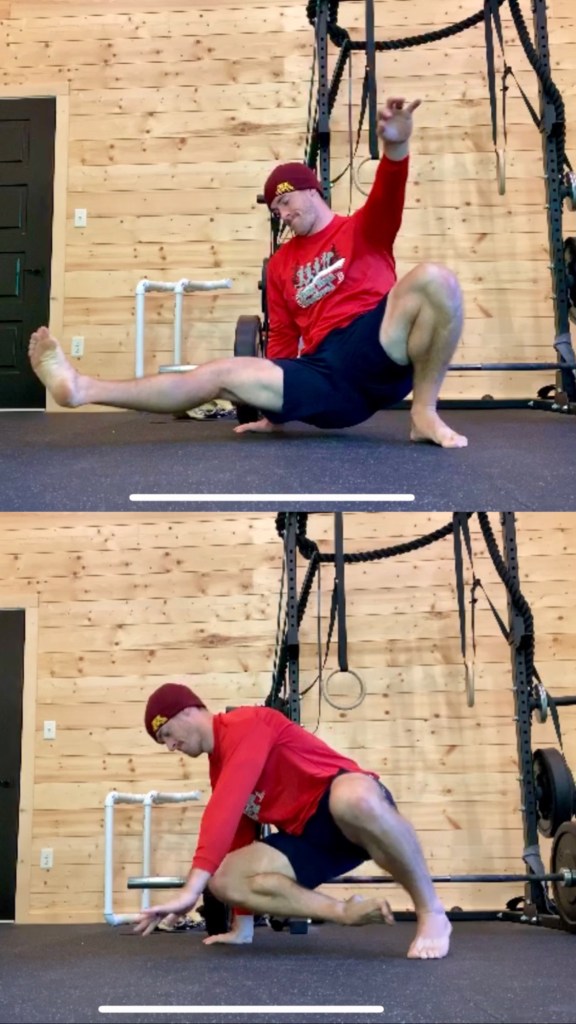
Hold Static Beast for 5 seconds. Stay tight.

Release out of Static Beast, reversing the flow.
Slide the hovering leg through and out the other side where you’ll REACH and point the toes.
Extend the foot out as far as possible re the free arm pulls back in the opposite direction.
This picture should give context to the technique.
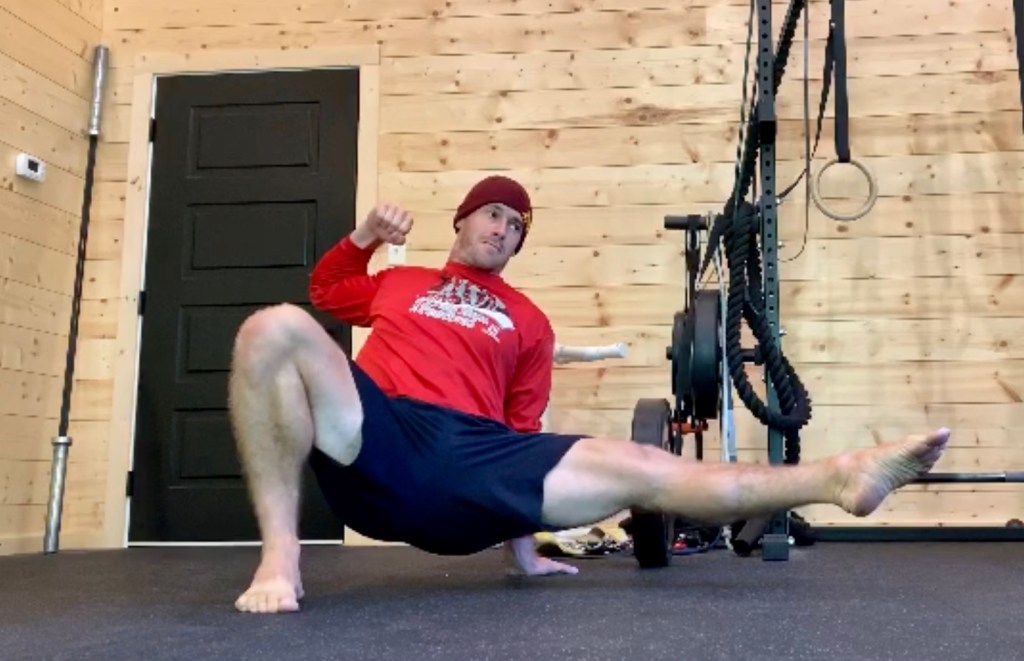
The Kick Through will be felt in the quads, hip flexors, core, up and out the opposite side shoulder.
Pulling back with the arm should resemble the draw of a bow, where the hand stops behind the ear.
Freeze the Kick Through posture and hold. This will be tough.
Re-initiate the Cossack Squat, sliding through the middle and repeating the sequence.
Quiet and Smooth Transitions
In a flow sequence, working toward quiet ground contacts and smooth transitions between exercises is the name of the game.
Quiet interactions with the floor is a good indicator of control over the movements.
With practice, ground contacts become softer as your body adapts to the demands of the movements.
Transitions are present in every day life.
We’re constantly moving from one posture, position or activity to the next.
One minute you’re lifting a heavy, awkward shaped object. The next minute you’re crawling underneath a table to play with your kids.
Static and dynamic movements show up every single day, and the in-between transitions are often overlooked.
Flow workouts are great for improving movement capacity.
conditioning the body to navigate various transitional moments, and move with greater confidence.
Where does Flow Training Fit in a Workout?
Using movement flows in pre-workout warm-ups is a great way to prime the body (and mind) before more aggressive training.
You can practice a flow for 4-5 minutes before lifting weights or performing cardio.
Flow + Resistance Training
Combining tried and true resistance training with movement flow is an effective way to maximize productivity in the gym.
1a) Chin-Up
1b) Squat
1c) Flow Sequence (give this one a try)
Perform the exercises from top to bottom for a target number of sets.
This structure leverages non-competing exercises. Using non-competing exercises, you can move from one exercise to the next relatively quickly because different muscle groups are used for each movement. Chin-ups are an upper body effort, while squats are a lower body effort. The flow might challenge the upper and lower body, but not at an intensity that would take away from the chin-up or squat.
Non-competing exercises organized into a tri-set allows for shorter rest periods, keeping the workout moving along.
People get fixated on lifting weights, adding weight to the bar, numbers, etc.
Put these people on the floor and ask them to execute the flow sequence shared today, and they look like stiff robots.
Flow work is a perfect addition to a resistance training program.
It gives you a chance to put those gains into practice with free flowing bodyweight movements.
Flow Sequences in Circuits
Mixing and matching flow sequences with resistance exercises, ballistic movements like kettlebell swings and a little core work is a great way to create a total body movement session.
1a) Kettlebell Swings x10
2a) Kettlebell Overhead Press x5 each arm
3a) Kettlebell Bent Over Row x8 each arm
4a) Hollow Body Rocks (core)
5a) Flow Sequence
Work through 1a-5a, rest for 45-60 seconds after the flow sequence. Perform 3-5 rounds.
Total body workout in less than 20 minutes.
Circuit training like this is are great for fat loss and performance.
Integration = Best Fitness and Health Results
It’s not any ONE thing that catapults health, performance and aesthetics.
You’ve got to pay a attention to all of the moving parts that contribute equally to a pain-free, athletic, lean and muscular body.
What are those moving parts?
- Mobility Training
- Resistance Exercise
- Cardio
- Ground-Based Movement (flow, etc)
- NEAT (non-exercise activity, like walking)
Most people would be extremely happy with their results by organizing a workout regimen to include a steady mix of:
By including each element, you’re improving joint function and tissue health, performance, building strength and useful lean muscle, movement capacity in unique positions, and overall health.
Your body will have the look you want, free of ache and pains, and the movement performance.
If you’re ready to take your workouts to the next level with quality movement training, this is the program

 M(eaux)tion Fitness