Basic Movements Can Be Leveraged to Produce a Massive Training Effect

Quick Tips

Sometimes the best choice of exercise is the basic one.

Basic movements that are executed with proper resistance and shortened rest periods can produce a massive training effect that can re-shape a person’s body.

Most of my training sessions are as uncomplicated I can possibly make them.

I have talked about perfecting the kettlebell complex for fat loss in the past, but the “complex” is nothing more than a series of simple exercises crammed together without rest.

The reward is an extremely large metabolic training effect.

You cannot deny that complexes will strip fat and build a resistance to fatigue.  If you do have an argument that simple movements don’t produce effective results, I’ll have you know that my performance outside of the gym with activities like trail running, cycling, obstacle course races and hockey has not slipped a bit since I began my self-experimentation with kettlebell complexes.

And I have been working the complex for about a year now.

Moving on…

One of my favorite training methods are tri-sets using basic exercises and incomplete rest periods.  

A tri-set means that you’ll group three different exercises together, moving from one to the next until you complete the number of sets of each exercise for that day.

It would look something like this:

A1)  Dumbbell Bench Press 3×8

A2)  Deadlift 3×8

A3)  Anti-Extension Roll Outs 3×10

All of the movements within this cluster are basic exercises.  It’s the resistance used and the shortened rest periods that is going to produce such a large training effect.

As you can see, once you finish a set of bench press (A1), you rest for a set amount of time, usually somewhere between 30-60 seconds (depending on your fitness level) before moving on to the deadlift (A2).

When I use a workout that is structured like this, I always incorporate at least two different tri-sets.  I prefer my training efforts to be total body versus a split type approach.

The second would look something similar to the following…

B1)  Chin Up 3×8

B2)  Front Squat 3×8

B3)  Anti-Rotation Press 3×8

Organizing a workout with tri-sets using basic movements is a fantastic method for getting in and out of the gym.  The rest periods will keep the workout moving along.  No time will be wasted.

Also, because of the shorter rest periods, your fatigue level won’t overpower your ability to give effort.  By the time you hit the 3rd round of the tri-set, you’ll experience manageable fatigue.

Managing fatigue during a workout is important.  If you drain yourself too early in the session, you won’t have anything left to give later in the workout, leaving a lot of benefit from exercises scheduled in the second tri-set on the table.

This style of training is really popular with athletes.  Strength coaches use tri-sets to make sure that a program is time efficient and balanced for the athlete’s body and development.  You’ll notice that most athletes tend to be quite lean (notice I said most, not all).  Transitioning your training to reflect that of an athlete’s can do wonders for fat loss, strength and power increases and overall performance.

The movements, as you can see from my example tri-sets above, work best if they are non-competing movements.  This means that you’ll be exhausting different muscles for the exercises grouped within a tri-set.  A perfect example of this is pairing a squat (lower body pushing) with a chin up (upper body pulling)

This is an important feature of this particular workout structure.

Tri-sets also represent a total body training session.  I would recommend using a workout like this 3-4 times a week max.  You’ve got to give your body a chance to recover and regenerate in between training days.

The decrease in training frequency during the week is great for a person that is pressed for time, whether with family or career.

Lastly, notice that all of the movements listed a basic exercises.  There is no real reason to complicate your training with complex exercises in my opinion.  Adding complexity to a training session can actually take away from effort aspect and add an element of risk that just isn’t necessary.  The reward is rarely worth the risk.

Pick movements that take very little set up and thought during the set.  Place your focus on exercise technique, breathing and moving more weight than the workout before rather than squatting on a physio-ball while attempting to juggle three tennis balls.

The video makes my point…

Cheers to basic movements organized to produce large training effects…

KG

How to Build Bodyweight Strength: 1-Arm Push Ups and Pistols

Quick Tips

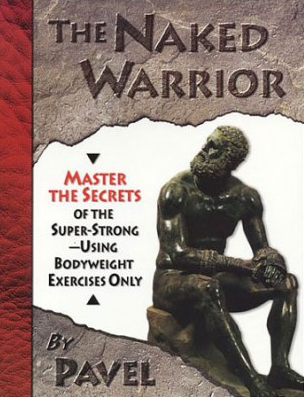
Almost 8 years ago now, I stumbled onto Pavel Psatsouline’s bodyweight strength based book, “The Naked Warrior”.

The Naked Warrior

It was the Summer between my freshman and Sophomore year of college, and I knew that I wanted to pursue a career in strength and conditioning.

I became fascinated with bodyweight training.  One quick Google search led me to Pavel’s book, and I think I read it cover to cover in two days time.

The sad part, I didn’t act on any of his strategies.  It took me a couple of years to finally pick the book back up and re-absorb his methods.  I regret that big time.

Now that I think about it, reading through Pavel’s book was the first time that I was introduced to kettlebells.  They are featured throughout the book as effective loading progressions to make the exercises more difficult.  I didn’t actively pursue kettlebell training for another two years.

Damn.

Hindsight is always 20/20, right?

The Naked Warrior, provides a much needed look at how to develop raw strength through two simple (but not easy) movements:

  • 1-Arm Push Up
  • Pistol

I can remember reading reviews on the “The Naked Warrior, where customers were angry because the entire Naked Warrior book is based off of only two exercises.  I felt the opposite.  I thought it was extremely refreshing to read a book that was so focused.  One upper body movement and one lower body movement.  Both have tremendous carry-over into the real world and athletics.

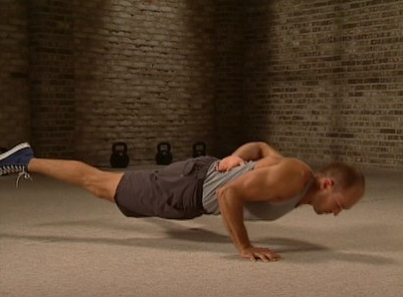
Here is a great snapshot of Pavel executing the mother of all upper body pressing exercises, the 1-Arm Push Up…

1-Arm Push Up

1-Arm Push Up

Here is a still shot of the what I believe is one of the greatest lower body movements known to man…

The Naked Warrior Pistol

The Pistol (aka: Single Leg Unsupported Squat)

Both movements require a large muscular contraction, body tension and zen-like focus for completion with great technique.

Pavel’s teachings provide an extremely valuable lesson on methods to build high level strength.

The road to executing these two movements require large amounts of body tension and muscular contraction.  It’s simple and brilliant.

Here I am executing 1-arm pushups and pistols…


Training with 1 leg or arm at a time is a great way to uncover imbalance in strength, stability and mobility.  You might be able to notice, but my left arm is the weaker of the two.

I used to think that drills like the 1-Arm Push Ups and Pistols should be reserved for like circus performers and stuntmen.  Or, maybe they were just something you show off to your friends after a few beers.  But that’s because I didn’t fully understand their value.

Now I understand their value and incorporate these movements into my own training regularly while advocating their use in the training programs of others. Pistols and 1-Arm Push Ups building tremendous strength while teaching the trainee methods that can be used squeeze more out of their training.

Progression is the key here, as it is always the key to success in building a body that is strong, lean and able to move freely.

Not many people can drop down and perform a full bodyweight single limb movement on a whim.  There’s usually a fair amount of ramping up that needs to take place prior.  I understand this completely.  Both of these moves provide amazing bang for you buck, but they are advanced movements.  ADVANCED.

How do you move yourself into the advanced category?  Keep training, that’s how.  Keep working at it daily, weekly, monthly, yearly.

In a future post, I will give you a road map to executing your first 1-Arm Push Up or Pistol.  It’s a lot more simple than you might think.  Successful completion of both requires dedication and consistency.  You just have to keep working at it.

—>  No mention of fitness?  Not even once?

Strong is the New Skinny

You probably noticed that this post never mentioned fitness until right now.  In my opinion, fitness is nothing without the presence of strength.  Strong is the new skinny.  Spend time working hard building up your strength and your body shape will follow suit.

Cheers to harnessing your body to build crazy strength…

KG

The 5 minute Kettlebell Swing + Burpee Challenge

Quick Tips

I love metabolic challenges, especially ones that incorporate kettlebells and burpees.

If you didn’t get a chance to check out the burpee challenge from a few days ago, I suggest that you do.  It’s a tough workout that will definitely get your heart rate up.

—>  Metabolic Challenges/Finishers Over Boring Cardio

I favor metabolic challenge workouts, sometimes referred to as “finishers”, because they test your mind and body in a controlled setting.  The movements and reps/sets (aka: volume) should always be structured to YOUR own physical abilities, not someone else’s.  Nothing during a metabolic workout should be forced.

It is crucial that a high tempo work capacity style training session have progressions and regressions.  One size does not fit all.  The workout should be scaled to fit each of us on an individual level.  This will decrease the likelihood of injury while promoting physical transformation and improvements in performance.

Once you have proven that you can move efficiently without pain and have acquired adequate strength, stability and mobility to execute basic exercise like squats, push-ups, chin-ups, lunges and planks, it may be time to consider mixing in some metabolic work.

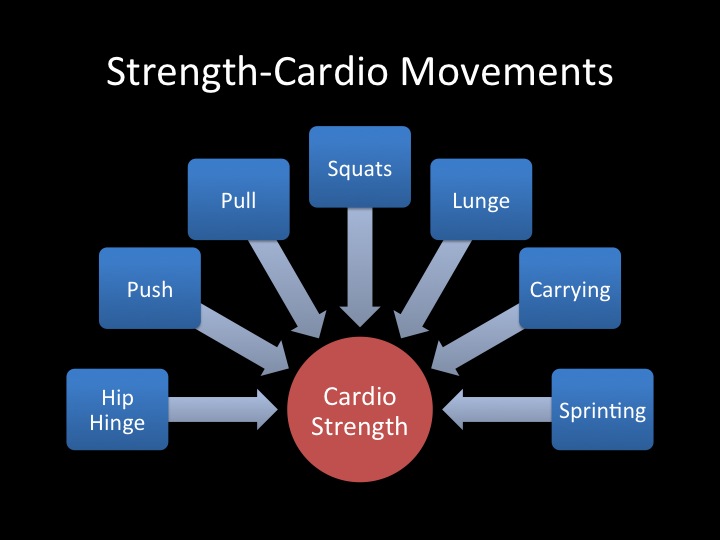
Remember this picture from a recent post?…

Strength Cardio Movements

I use “cardio-strength” and “metabolic” interchangeably…

At the very least, you can mix in some short burst finishers toward the end of your strength training session.  Adding finishers to the end of a workout will shift the way that you think about conditioning.  I know that it did for me.  It was a game changer.

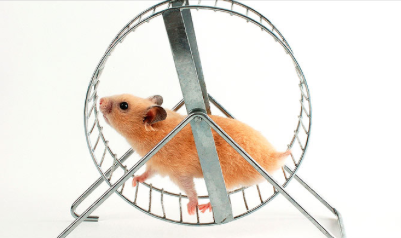
There is nothing wrong with traditional activities like bike and hill sprinting, but to be honest, I find it painfully boring.  I know for a fact that I do not sit alone with these feelings.  Boring cardiovascular training can actually do more harm than good.  If you dread boring cardio to the point that you choose not to workout at all, that’s bad.  It shouldn’t have to be this way.

Boring Cardio Hamster Wheel

Do you ever feel like this while working out?

You don’t have to be a fanatic about your training habits, but long-term adherence to a life full of movement requires that at the very least you find some amount of enjoyment from your workouts.

The main point is that you have great alternatives to the long, slow, boring treadmill trot.  Finishers will keep your training fresh and challenging.  The return on investing in finishers is large.

I will always encourage beginners, novice and even advanced trainees to continue to make conscious efforts to improve strength and power.  This will never change.  So much good comes from building basic strength.

In a normal training session, after working through a complete warm up, strength and power work should be next on the day’s agenda.  Most workouts will require anywhere from 15-20 minutes to work through 2-3 tri-sets of strength/power enhancing movements.

—>  Kettlebells and burpees collide

Lifeline Kettlebells

Lifeline Kettlebells…

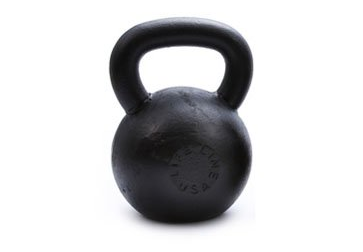
I am a huge kettlebell fan.

Kettlebells changed my perception of working out.  Kettlebells brought  the importance of strong, stable, free-flowing movement back into the fitness equation.  You have to be 3-dimensionally strong to lift, swing and carry a kettlebell.  My gym sessions transformed from a of time devoted to the typical big lifts- squats, pressing and pulling- to ground based movement sessions that built strength and stability using in greater ranges of motion.

I now have a level of stability, mobility, and functional strength that I didn’t know was possible for me to have.  Kettlebells aren’t a miracle, but the shift that they caused in my views on what an effective workout could be certainly make them one of the most influential pieces of training equipment I have ever used.

Kettlebell training is represents true movement.

The Turkish Get Up

Segue…

Next, the reason that we’re gathered here in the first place.

—>  The kettlebell swing + burpee metabolic challenge

I cannot remember where I first saw a version of this challenge posted, so please forgive me.

Credit belongs to someone out there, so take it if you’re deserving of it.

I’ve adapted it to fit my needs over the years, as I do with most everything related to training.


Tools needed:  To complete this challenge, you’ll need a kettlebell that you can swing for about 15-18 reps continuously for multiple sets.  I use a 24kg or a 28kg kettlebell for a finisher like the one described below.  Have some kind of timing device on hand.  I always go with my trusty GymBoss.

You’ll also need an open space of about 8ft x 8ft.  This should work just fine.  You can get by with less- and I have- but the more the merrier.  The ceiling of the space you are training in should be high enough to avoid hitting the top of your head when jumping.  If you’ve got clearance, you’re in business.

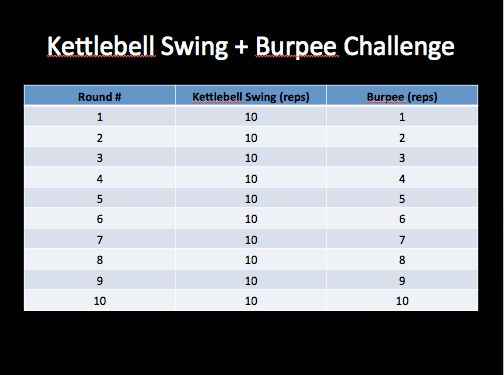
Here is how the challenge is formatted…

kettlebell + burpee workout

Make sense?

Take note of how each round accumulates burpee reps while the kettlebell swings remain the same.  It’s a very simple format to remember.  Two exercise finishers work great because they take very little thought.

The weight of kettlebell used will vary from person to person, but in general I would go with the following:

Females:  12-16kg

Males:  24-28kg

Of course there are going to be those of you who can use heavier kettlebells than what I suggested, but these are common weights for each gender.

The ultimate goal is to finish in 5 minutes.

I won’t p that I “think” a beginner, novice or advanced trainee should be able to finish a challenge like this in.  That’s not the point.  The goal is to finish in 5 minutes, end of story.  Anything longer than that indicates that you have a goal to work toward.  Sound good?

Stop Sign Warning

—->  Mandatory warnings to this workout

If you have never swung a kettlebell before or you aren’t proficient in swinging kettlebells for higher volumes or while under fatigue, this is not the time to test yourself.  Work up then work in.

Lastly, technique breakdown automatically initiates rest until technique can be maintained.  Fatigue kills exercise technique.  Leave your ego at the door when you train, it will save your body from injury.

Work smart and hard, not smart and reckless.

Give it a shot, have some fun and post how you finish up…

Cheers to the conditioning without boredom!

KG

Relieve Stress from Sore and Aching Feet In 60 Seconds Using a Lacrosse Ball

Quick Tips

relieving foot stress


Do your feet ache?  Yeah?  Mine too.  

I’m going to share a simple home remedy I’ve used for years to relieve pressure and stress from sore/aching feet.

It might seem too good to be true, but I can assure you it isn’t.  This is a fluff-free zone, so I encourage you to take 5 minutes and read the rest of this post.  Your feet will appreciate it.

Sore and achy feet is a very predictable, fairly tolerable issue I deal with everyday.  My day time profession often requires standing for 8-14 hour stretches.  

While my feet have acclimated to these standing for these durations, they still throb at the end of the day.  I often describe it as a “pressure build up”.

I know I’m not alone here.  For as many professions sit for long periods of time, there’s another sector of the work force that spends most of the work day walking or standing.  

No offense to the sitters, but the tips in this article are for the standers.  

Standing for hours on end can reek serious havoc on your feet, especially if they are trapped inside of shoes.  It seems the style of footwear can make the situation worse.  

Dress footwear for men and women are horrible for feet for a variety of reasons.  

Mens dress shoes often have narrow toe boxes, smashing the toes together.  Many dress shoes also have an elevated heel, though it is more subtle compared to women’s high heels.    

Women’s dress shoes have single-handedly messed up women feet and ankles.  In high heels, the ankle is locked into an unnatural plantar flexed position since the heel is elevated.  Women’s dress shoes also tend to have very narrow toe boxes.  

Standing for hours on end creates a nagging pressure that doesn’t go away quickly.

standing foot stress

After a full day of standing, my feet feel like an over inflated bike tire.  

Initially, my fix to this was to get off my feet, sitting down or laying down until the pressure dissipates.  While both definitely help, the amount of time it took to get my feet to relax seemed quite long.  

One problem is that sitting is not always an option, much less laying down.  Most employers frown about laying down at work.  

The second problem is both sitting and laying down only provided temporary relief to an ongoing problem.

The first few days of standing all day were a nightmare.  I was hobbling by the end of the day.  It literally effected my ability to think on-the-go, which might seem like an over-exaggeration but it’s not.  

To date, I have been on my feet daily for nearly 10 years.  I can’t even imagine what some people’s feet feel like after 15-20+ years without doing something to get relief.  

However, there is a solution.  The best part is it’s inexpensive and effective.

Ready?

Buy a lacrosse ball.  They cost $3-$5 and you can take everywhere you go.  

Don’t have any money to spare?  Walk out into your garage and find a tennis ball or even a golf ball.  A tennis ball can be a bit soft for most people, though some may find works well.  A golf ball’s surface area is quite small which makes the method I will describe somewhat uncomfortable for people.

I prefer the lacrosse ball because of density and surface area, but these other options will work also. 

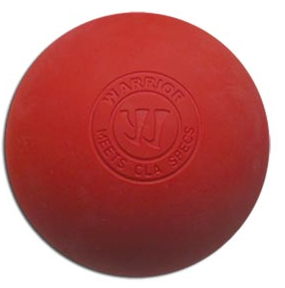
A lacrosse ball looks like this:

Warrior lacrosse ball

Simple instructions for foot relief…

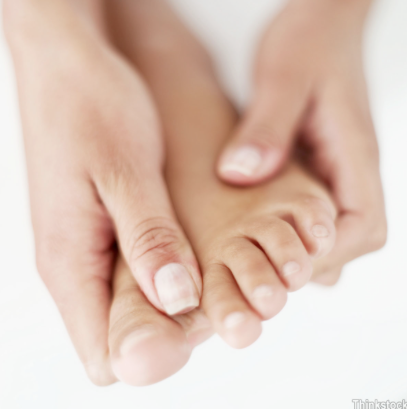
Give yourself a foot massage.

Once you buy the lacrosse ball, do this…

Roll the lacrosse ball deep into the muscles of your feet for 60 seconds on each foot.  Move the ball from the heel, to mid-foot, to your forefoot.  Move it forward, backward, side-to-side, and circular.  Any way you choose to roll is the right way.

Look for sore or tender areas.  Give those spots some extra love.  Consider holding the lacrosse on those spots, wiggling your toes and wrapping your foot further around the ball.  

You cannot mess up this up. 

After you finish with both feet, stand up straight and see how you feel.  

If you’re like me, there should be a big release of pressure.  The release may run up the back of your legs to your back, stopping just short of the back of your head.  

My experience

The first time I rolled my feet out on a lacrosse ball I couldn’t believe it.  It was instant relief.  Remember that over-inflated bike tire analogy?  

Rolling my feet is like letting air out of the tire.

These days, I don’t leave the house for a work day or a weekend trip without a lacrosse ball in my bag.  Sometimes I use it, and other times I don’t.  But I always have it I need it.  That’s the point.  

When my feet start throbbing, I roll.  Rolling buys me more time on my feet, which makes me less irritable at work and more productive.  

Beyond that, the feet need attention just like the rest of our bodies.  Foot health is vital.  Some basic soft tissue maintenance daily can provide a lot of relief.  

Bonus tip:  Spend more time barefoot.  Get out of those shoes, spread the toes out and go skin on surface as much as possible.  

Shoes are soft and comfy, but your feet are designed to be extremely resilient.  Footwear is hurting your foot health more than it’s helping it.  It desensitizes and alters your gait (natural walking motion).  

Your podiatrist loves it, but your bank account and body won’t.

Obviously, most people won’t be able to go barefoot on the job, but any other time, free those babies. 

What is fascia and why does it matter?

Fascia is a giant webbing (laymen’s description) wrapping around our muscles, skeleton and internal organs.  It basically holds us together, gives us some structure internally.

Fascia health can impact our ability to move and overall daily comfort.

Here is a nice article from the Telegraph on fascia.

To fascial researcher Tom Myers, “The ‘illusion’ of separate muscles is created by the anatomist’s scalpel, dividing tissues along the planes of fascia.  Fascia is the missing element in the movement/stability equation.”

Fascia is important.  Taking care of it is important.  Not that you know, you cannot un-know.  🙂

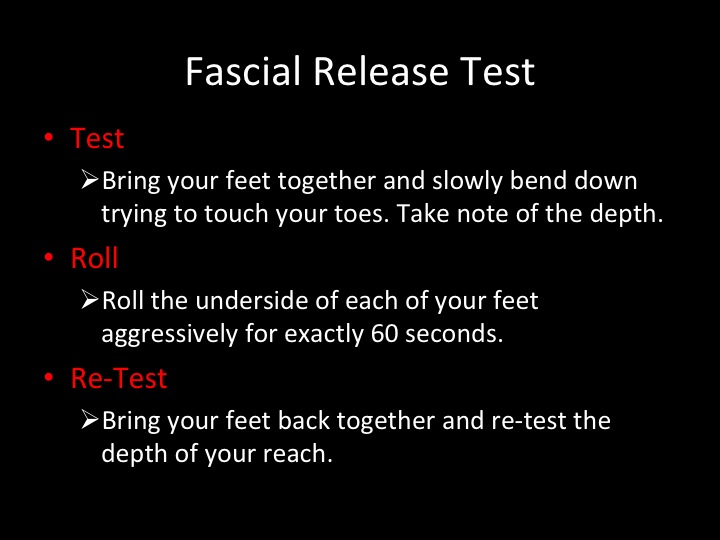
Here’s a simple test/re-test to try…

Foot relief fascia test

Notice a difference?

Chances are you gained few inches.  

I’ve personally seen people who couldn’t reach within 6 inches of their feet on the first test, roll out for 45-60 seconds, re-test and be able to scratch the top of their feet.  

“What the…?”

The expressions crack me up every single time.  

This very basic fascia release allows for an increase in range of motion, though it may be temporary. 

It’s important to understand that basic self-maintenance strategies like this exist and you have the power to work on yourself daily.  

Nothing will replace the experienced hands of a manual therapist, but for ongoing relief of aches and pains, tools lying around the house can gives us relief.  

Advice:  Perform simple maintenance on a daily basis, and over time you’ll start to feel some changes take place.  Don’t be surprised if you feel like your movement improves from this great home remedy, that’s quite common also.


Cheers to giving your feet some love…

Kyle

How Fast Can You Complete the 100 Burpee Challenge?

Quick Tips

ImageThe Burpee.

I’ve been obsessed with work capacity style workouts for quite sometime now, and I have a love/hate relationship with burpees.  Burpees have been a main ingredient in many of these workouts, and for damn good reason.

Burpees are one of the greatest work total body conditioning exercises known to man.  

Transitioning from a standing position down into a pushup then immediately back into a full squat jump is fatiguing as all heck.  Incredibly fatiguing.

If someone gave me the choice between burpees, kettlebell swings, Schwinn Airdyne sprints or hill sprints as a work capacity conditioning session, I am going to choose all three of the latter before I choose burpees.  Sorry burpees.  Sometimes the best exercises are the ones that we dread the most.  This is one of those cases for me and many others out there.  

However, since this is a love/hate relationship, I have to admit that the burpee can drastically improve a person’s cardiovascular conditioning while accelerating body composition changes.  

In other words, if you keep working at burpees and get really good at them, you’re going to put yourself into a state of great physical shape and see some serious changes in the mirror.

I wouldn’t never build an entire program around burpees alone- or any exercise- but I would build an entire workout or a solid “finisher” around the burpees.  “Finishers” are sequences of exercises grouped together at the end of a workout to elicit a large metabolic training effect.  They are designed to test your mind and your body, and well, finish you.

If you enjoy leaving the gym feeling highly fatigued- and lets face it most of us do- the 100 burpee for time finisher is a fantastic challenge.  

Here is how it works:

—> The Rules for the 100 Burpee AFAP (as fast as possible) <—

  • Full burpees only (push up and squat jump included).
  • Take breaks as needed but remember you’re racing the clock.
  • Stop if you experience nausea or dizziness.

That’s it.  Set the clock and get to work.  

Now, I know that not everyone is at a fitness level to perform burpees for the full 100 reps.  You may not be able to finish 20 reps.  If this is the case, adjust the challenge to fit you.

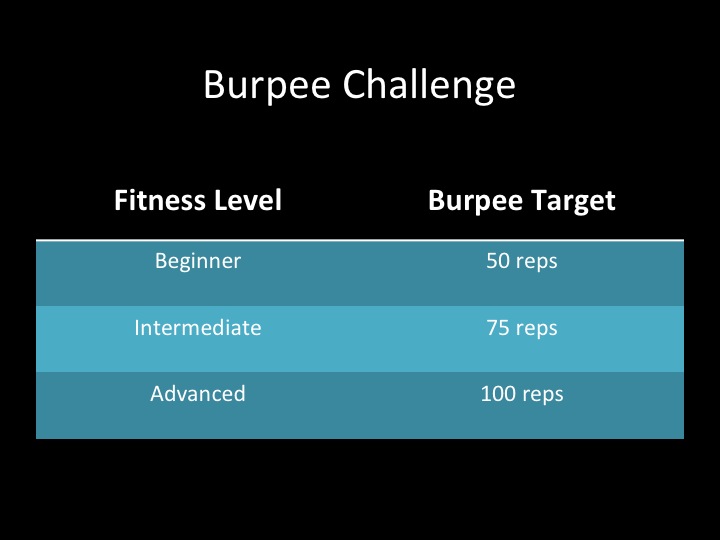
Here are some general guidelines for different fitness levels:

 Image

If you’ve never performed a single rep of burpees, you’re a beginner in my book.  Sorry, but you are.  You might be physically fit but you’ve never experienced a single burpee.  Nothing wrong with that.  Never a better time to start implementing the burpee.

What I really like about this challenge is that it requires zero equipment, can be performed anywhere and can serve as a conditioning test that you can continue to re-test to see improvements in fitness.  It’s no different than testing how fast you can run 2-miles.  

One of the keys to work capacity style workouts and finishers is to avoid letting your mind cash checks that your body can’t cash.  

The best work capacity workouts keep the trainee in complete control of their body and the weight being used.  Of course, it’s every person’s responsibility to pull the plug at his or her own discretion.  You’ve got a brain, don’t be afraid to use it, even if it means swallowing your pride and falling short of your goals for the training session.  

If reps get sloppy, stop the set and regroup.  Grab a drink, take a breather, gather yourself.  If you still cannot finish the set after a break in the action, stop.  Done.  Finished.  

Image

Don’t be afraid to pull the plug.

Grinding out one more rep with horrific form isn’t worth the torn rotator cuff, slipped disc in the lower back or tweaked ankle.  There’s no glory in it.  None.

I’d like to think that much of what I advocate on this blog is high tempo, yet safe.  There will be no circus tricks done for high reps just to burn you out and get you fatigued.  Safety is a real concern here.  

Push it hard and to the limit, but in a safe manner.  If you keep that balance, you’ll be able to sustain a life full of physical activity, not just a few years of glory until ligaments and tendons start giving out.  

Building your fitness and preserve your body.  It’s a balance.

Give this challenge a real shot, either as workout in and of itself or as a finisher after a strength training session.  

Submit your time in the comments section!


Cheers to 100 beautiful burpees in a row…


KG

Hybrid Suspension Training: Body Row + Anti-Extension Ab Roll Out

Quick Tips

Suspension training is probably the best training option for the home, travel or outdoors.

I used to feel a little guilty about promoting suspension training because I felt like I was turning into a guru.  Then I just came to the conclusion that I value the tool so much that it’s completely worth the time taken to talk about it.

As I have mention, I am an avid Lifeline Fitness product user.  I love the innovation coming from this company.  It’s innovation within reason, meaning that they are bringing products to consumers that solve problems and serve a purpose.  Best of all, they are made with quality and are affordable for just about anyone.  The portability of all of the products is a major benefit to people who love to workout at home without sacrifice.

Quality workouts in the comfort of your own home will change you life, literally.  

I will commonly work hybrid style suspension training exercises into my warm ups and the meat of my workouts.  The versatility of products like the Lifeline Jungle Gym suspension trainer make these hybrid movements safe and natural.  Nothing feels forced or out of control.

Jungle Gym Suspension Trainer

A strap with two handles and foot loops

In the video below, you’ll see me performing a sub maximal body row that flows into a standing anti-extension abdominal rollout.  The body row is best performed on a suspension trainer.  The hands are free to rotate, which adds a rotational component to the rotator cuff and shoulder muscles.  The standing anti-extension ab rollout (besides being a mouthful) is a tremendous movement for reinforce core stability and preventing extension in the mid-section.

Both exercises provide tremendous functional carry over to the demands of a physical lifestyle and sport.

I like the explosiveness of the body row.  You’ve got to put some force into the full in order to get yourself to the standing position, transitioning into the forward fall of the ab rollout.

With this movement, the upper body does the bulk of the work.  The feet should not move and the rest of the body should remain rigid.  After the aggressive pull on the body row, you’ll transition from the heel of your foot, to the mid-foot, then on the balls of your feet.  Pulling out of the ab rollout you will go in reverse order (ball, mid-foot, heel).

heel, midfoot, forefoot

Heel (hindfoot)— Midfoot— Ball (Forefoot)

***Wear non-skid soled shoes or perform on a non-slip surface to avoid any unnecessary slippage on the ground surface.  One slip and you’ll understand what I am talking about.  I am wearing my trusty Vibram Five Fingers in the video demo.


Cheers to pulling and resisting extension…

KG

How to Warm Up Before a Home Workout (Video)

Quick Tips

Below is a sample of what a warm up looks like for me prior to a training session.

The only awkward moment comes when I attempt to stay on the rubber matting while performing forward, backward and side to side gorilla hops.  Hey, I’m human, shit happens.  This isn’t Hollywood produced, it’s real world home training.  Film it like it happens, right?

The important thing to remember is that you should always maximize the equipment, time and space that you have available to you.  You can always get way more accomplished with what you have than you originally thought.

I have really come to enjoy integrating animal style movements in the warm up, as it demands rhythm, stability and mobility to accomplish the moves.  Plus it isn’t boring, which is important for keeping your movement endeavors interesting and sustainable.


After you watched some of the video, it’s important to understand a couple of things:

1)  I only foam roll problem areas (trigger points, stiff muscles, overactive muscles)

2)  I only address mobility in areas that I lack it.

3)  The dynamic movement prep is mostly total body.

4)  Jumping rope serves to increase blood flow, core temperature and gets me sweating.

The point is that there is no time wasted and everything has a purpose.  My body is prepped for the transition into the physical demands of the workout.

My workout for this day was highly metabolic, which is how I have been training for quite some time now.  All workouts are designed mindfully and not intended to destroy my body, but rather build and condition it intelligently.  I completed all of the exercises below without rest between movements in a 15 minute timeframe (I was tight on time):

Metabolic Strength Training


I have used workouts like this successfully for over 5 years now.  The loads and exercises are appropriate for my skill and fitness level.  To be completely honest, the less complicated you make a session like this, the more fun you will have.  I rarely stray from the basic movement patterns: push ups, vertical pulling, squats, kb swings, etc.

I am after the training effect, not a circus-like performance.  The risk doesn’t always match the reward with complex movements.  It usually looks great on paper and sucks in practice.

For the time invested, I haven’t found any other style of training that keeps me lean and functional for the time invested.  The trade-off for time reduction is an increase in intensity.  This isn’t for beginner or the weak of heart.  You’ll be tired at the end.

It’s a great blend of work capacity and strength movements that demand full range of motion and attention to technique.  Of course, you can increase the difficulty of a workout like this or make it slightly easier if need be.  Progression is always the answer.


Cheers to making less excuses and  taking more action…


KG


Good Calories, Bad Calories: Weight Gain or Fat Loss

Quick Tips

I recently read an article where a blogger that posts about his journey to overcoming struggles with food addiction, moving into a life of health and movement, had his wrist slapped for promoting nutritional advice without being a licensed professional.  So, to CMA (cover my ass) I will go ahead and let it be known that this article or any article on this blog that discusses nutritional interventions should not be implemented without consulting a professional.  This is for reading entertainment only, the choice to take action is yours. 🙂

The hard part about saying that is that a lot of nutritionists use outdated methods and refuse to move past the calories in verses calories out recommendations to treat overweight or obese patients.  This is sad, because there is obvious more going on with weight gain and fat retention than just calories.

Overweight belly

I am going to tell you right now that there are good calories and bad calories.  No doubt about it.

What about the quality of food?  The type of food we consume?  This has to count for something, doesn’t it?

Scientists are starting to blow the whistle in agreement.

Gary Taubes is an author that is leading the charge, not a scientist but worth listening to.

I have long thought that it is an ingredient issue, and since I dove into the underground nutrition world some years back, it is obvious that our health epidemic is heavily related to the quality of our food more than the quantity of our food.  Again, calories do count for something, but the source of those calories seem to be impacting bodily fat loss more than anything.

I like analogies to understand topics so let me ask you this…

—>  If you drink 300 calories of soda versus eating 300 calories of lean meat/veggies/eggs, which will have a bigger negative impact on body composition, particularly with regard fat gain?

The soda, right?

Fat gain and diet soda

It’s clearly the soda, and so many people know that it is the soda that it boggles my mind why we as consumers continue to buy products like soda, candy and pastries when we know that regaining control of our body would require choosing natural whole foods like lean meat, veggies and eggs.

Here is a decent article from Men’s Health about diet soda and fat gain.

It’s crazy to think about.  There is an incredible amount of psychology behind why we choose to eat what we do.  I know for a fact that kids are exposed to crap food through their parents and schools.

Kids will eat whatever their parents prepare, and when they are at school, they have to eat whatever the school has prepared (unless they pack a lunch that their parents have made).  I haven’t seen a healthy school lunch yet, even though I know there are pockets around the country that are promoting the transition to healthier lunches for schools.

Unhealthy school lunch

This is what my school lunch looked like as a kid, how about yours?

I was reading this morning, and I came across a link to an article discussing calories and the food industry.  The article goes on to say that the food industry is tricking us.  They have mastered the art of influencing people’s buying habit based on calories.  The promotion of low calories in processed foods leads people to believe they are making a healthy choice, when in reality they are buying highly processed food that increases the body’s likelihood of translating that food into fat.

Here is a nice snippet of the article:

calories in versus calories out

You can find the entire article here:  Debate over calories starting to erode “food pyramid’

Take a few minutes to read it, it’s worth your time.

I do agree that calories still count for something, but I also think that in order to get the pendulum to swing back away from the calories in versus calories out approach, we have to preach quality versus quantity.  Once this thought process starts to stick, we can then re-introduce mindful calorie consumption in combination with quality food consumption.

I know that I am an extremely active person and that has helped me maintain a lean body, but I haven’t given a crap about my calories consumed in a given day for well over 7 years.

Why?

Because when you diet consists of mostly plants combined with adequate protein, water, coffee and green tea, what is to be concerned about?  Eating well is the best stress reliever because you can feel confident that what you put into your mouth is giving you the best possible chance at a long and healthful life.  Aesthetic-wise, you’re giving your body the best opportunity to stay lean, which does wonders for your self-confidence.

I intended for this post to give a bird’s eye view of some of what is currently being discussed regarding what we perceive as good calories and bad calories.

One thing is certain… we’ve got an epidemic on our hands and the solution to it is simple, but how we get there seems to remain complicated.

Subtle positive changes in diet will have provide massive returns on investment, I guarantee this whole-heartedly.  It’s a decision we all have to make from individual to individual.  The food that you consume will either put you closer to your body transformation goals or lead you further from them.  Exercise alone is not enough.

What will you choose?

Cheers to sticking it to the food industry and regaining health…

KG

3 Time Efficient Methods To Squeezing in a Workout While Building a Career

Quick Tips

One thing that I have learned about writing and consulting on topics related to fitness is this:  Not everyone thinks about training, eating and health as much as I do.

Not everyone cares about how great a kettlebell swing is, how bear crawling can restore function or jumping rope is 10x better for conditioning than a recumbent bike.

I think sometimes as professionals we forget that we care about fitness far more than any other people on the planet.  Hell, we made a career out of it.

One issue with training that comes up time and time again is time, or lack their off.

As I mentioned in a recent post, I completely understand the time issue.  I currently have a full-time career, write, train and am currently building an internet based fitness company/culture to help transition out of my existing career.  Time is short, just as it is for so many other career professionals.  I am in your shoes, which is why I feel so at home writing on this blog.  You and I are in the same boat.

We’ve got to find solutions to working out when time is really tight.

Here are a few ideas that can put you back on track for working out around a career…

1)  Strength-Cardio Circuits

Interval training using strength based movements are amazing for building adequate levels of strength and power while stripping fat.  These workouts leverage our body’s natural ability to continue to burn fat for hours after the training session has ended.  Strength cardio circuits, sometimes referred to as metabolic training, involve short burst efforts and minimal rest periods between movements.  You’ll want the training session to be a total body experience, alternating exercises between upper body and lower body to increase performance by avoiding fatigue. By alternating movements, you’ll be able to hit more muscles in less time without sacrificing exercise technique.

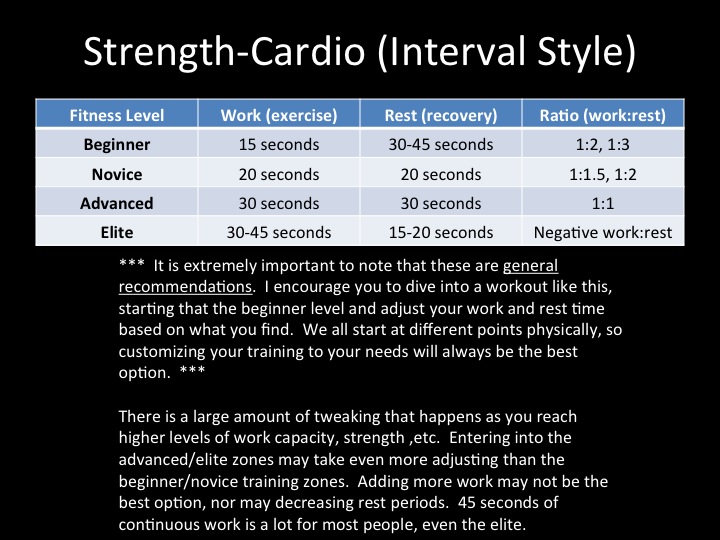
Although the amount of time designated for work and rest during a strength-cardio workout will vary depending on your fitness and skill level, you should be able to find a sweet spot for yourself.

Here is a simple table to reference:

Strength Cardio Interval Training

Choose from these simple movements…

Strength Cardio Movements

2)  Train on the weekends.

Nothing ground breaking here, but I just want you to start thinking about where you can fit in a training session.  The weekend usually provides some relief from the time commitments of the workweek, so look toward Saturday and Sunday for squeezing in a couple solid training sessions.  This will work wonders for your attitude as you enter into Monday and Tuesday.  You’ll have the confidence knowing that you put forth a solid physical effort that you can leverage for 24-48 hours.

I train on the weekends all of the time.  During this time, I feel no need to rush through the workout like I do during the week.  The training session becomes enjoyable.  Often times, I will spend a significant amount of time working on my mobility and addressing any muscles that feel overactive with knots.  It’s a time for training aggressively and regenerating my body.

Weekend Training Solutions

3)  Two Sessions Per Day

This might sound crazy, but incorporating two smaller training sessions into your day might provide some relief to your training efforts.  Rather than spend 60-90 minutes exercising once a day, try splitting the day into two smaller training sessions that last anywhere from 15-20 minutes.  The smaller window of time will keep you focused on moving forward throughout the workout and also motivate you to do more in less time.  Stoking your metabolism twice a day will work wonders.

Check out this recent post about that would help you coordinate a couple short training sessions:

—> Time Based Training

Having a career and committing to a life of physical fitness should be able to coexist with each other.  They have to.  Wealth without health is completely pointless, just as health without any wealth is stressful.  Find the balance that fits your situation, integrate the suggestions above and make an effort to not only maintain your body, but improve it.  Succeeding in career and physical performance will elevate your attitude and take your confidence to new heights.


Cheers to earning the $$$ and engineering a high functioning body in the process…

KG

Crawling to Improve Core Stability and Performance

Quick Tips

Animal movement is getting a lot of attention from forward thinking fitness professionals these days.

I predict that Men’s Health will jump on this bandwagon soon enough.  You’ll probably see a headline that screams:

“Burn Fat and Build An Athletic Body Like True Animal!”

Men’s Health has mastered the art of the headline and how to attract to attention.  That’s cool.  I am slightly jealous, but then again, I would rather have the freedom to write with my own authentic voice and tone, not what they think people want to read.  That would get old real quick.  You lose your identity as a person, what makes you uniquely you, when you start working for the man.

My blog articles wouldn’t be authentic if I didn’t get a bit lost here and there, so let’s get back to the business of discussing animal-like exercises, and where they might fit in a workout program.

—>Bear crawling is an awesome therapeutic movement…

First, let me say that I understand movement, however, I am not an “animal movement”, I simply see it as a methodology that can provide some great benefit while keeping your training session fresh.

Crawling for a better body…

I have used crawling off and on for quite some time now, both in my own training and in the training of my general and athlete clients.

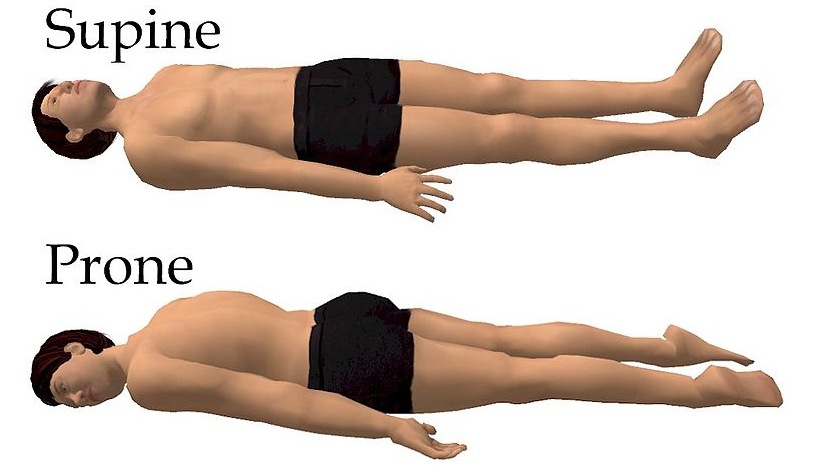
Actually, I have used the supine and prone versions of crawling for about 7 years.  Here is what I mean when I use the anatomical terms supine and prone:

supine and prone

Crawling was valuable part of our warm up when I worked with my younger athletes.  I have to admit however that I really only used crawling movements with the younger population, mostly between the ages 9-12 yrs.  Reflecting back, I wish I would have programmed more crawling with my elite athletes and corporate personal training clients.

Babies crab and bear crawl all of the time.  It is essential for their movement and development into the early walking stages of life… Check out these videos for proof….

The Crab Crawl and Variations

The crab crawl is the supine version of crawling.  The front of the body faces the ceiling and back faces the floor.

Here is a simple variation of a supine crab crawl called the Table Top Pull Through.  You’ll understand why it’s named this way once you click on the video.  Great warm up movement…

With the younger athletes, I mostly used the crab crawl (supine).  I saw (and still do see) tremendous value in the upper body and lower body connection that a supine (crab crawl) provides.  When working with younger athletes, it’s important to keep the balance of entertaining them (keeping them engaged in what you’re coaching) and teaching them how to use their bodies.  It’s quite an interesting process working with younger kids, I deeply respect any coach or trainer that is successful at it.

Here is what a full crab crawl looks like:

I would ask my athletes and clients to crawl forward like you see in the video above until I verbally cued “hips up!”, at which time they would stop, raise their hips and form that human table top that you viewed in the first video.  The backside muscles of the body light up during this static hold, as does the torso.  While the backside activates you’re simultaneously lengthening the anterior (front side) aspect of the shoulders/pecs.

This is such a fantastic movement for people who sit all day long.  It really helps to unwind some of the structural changes that as a result of sitting for extended periods of time.  Unwinding and reversing these changes is really important to avoid unnecessary injury and malfunction.

It was great, but most of all, it was fun for the kids and adults alike.  It’s one of those movements that doesn’t feel like a “workout”, yet has tremendous bang for your buck.

Shortly after incorporating the crab crawl, I started playing around with the bear crawl.  This is essentially the flipped over version of the crab crawl, with the participants face and belly facing the floor.

You’ll notice  that it is quite easy to “butcher” crawling movements and cheat.  However, if you take your time, align your body and move as if you were trying to stay as soft and quiet as possible, there is an incredible amount of motor control, timing and recruitment that takes place to make it all happen.

Sidenote:  I have found the “soft and quiet” idea to be quite effective for working to perfect movements related to crawling and Turkish Get Ups.  Staying soft and quiet asks the person to stabilize and activate muscular in a timely manner in order to be graceful.  In a fitness world that seems to drool over “harder, faster, aggressive, yeah!!!!”… moving with grace is a nice breath of fresh air.  Think yoga-like grace.

Now, the bear crawl, just like any other movement, can be performed at different speeds.  My recommendation is to prove that you can perform the slow motion bear crawl before you start racing around with horrible technique.  I’ve seen some videos of bear crawl racing on YouTube.

Not where you should be starting…

If you can’t go slow with expert like technique, why should you go fast?

It’s almost hard to say “technique” when talking about bear crawls, because I don’t know if anyone has actually established what ideal technique should look like.  It’s open for interpretation and varies depending on who you are talking to.

Keeping the mid-section still and some sort of rhythm is key however. Picture a glass of water balancing on your back as you crawl, avoid spilling any of the water during the movement.

—> Keep the bear crawls training effect in perspective…

1)  The bear crawl is a demanding exercise that has progressions, just like any other exercise.  If you can’t hold a satisfactory plank or properly activate your abdominal musculature, bear crawling might be a little further down on the needs list for you.  You may have to fix some other things first, than work into the full bear crawl.

2)  Start slow and perfect the movement. Move with control over speed.  It’s not a race.

3)  Don’t expect anything extreme to come from the bear crawl.  You’re not going to develop a six pack (abs are made in the kitchen), burn crazy fat, or become super human by incorporating the bear crawl into your workouts.  It’s a tool, treat it as a small but important piece of the whole picture.

4)  Integrate the bear crawl into your warm-up.  It’s a fantastic upper/lower body activating exercise that will prepare your joints for the demands of the workout.

I have to admit, I am fascinated with animal movements and how they can and should fit into a training program.  It’s an old idea that is creeping back into workout programming for forward thinking coaches.  I value animal movements, but I wouldn’t be the first to base an entire program off of them.  As I mentioned earlier, they are tools and puzzle pieces that help create a complete program.

Definitely worth messing around with in your own training however.  I can say that for sure.

—>  People will think you are a weird for sure…

You’ll get some weird looks if you’re doing bear crawls in a public place or at your local gym, but remember, who cares?  People don’t think much about anything, so just do it.  You’ll have a blast and create some positive training effects from it.  If you’re at the gym and people roll their eyes, let them.  You’re ahead of the game by incorporating crawling movements into your training regimen. Keep yourself away from stale training programs.

Cheers to humans crawling around like bears and crabs…

KG