Interval Workout| Lizard Crawl + 500m Row

20 minute Workouts, Ido Portal, Workouts

Mixtaping different disciplines of fitness to create unique workouts is a hobby of mine lately.  

Yesterday, I found myself short on time.  I had roughly 20 minutes to make some workout magic happen.  Assessing the previous day’s workout, I decided on two modes of exercise:

  • The Lizard Crawl
  • Rowing

The goal:  total body training effect (in under 20 minutes)

Short burst workouts are a perfect solution to time-restricted days.  Days where I’m tight on time, but high on motivation.  “Short”… not be confused with “easy”.    

Generally, shortening a workout means the intensity gets cranked up to offset the decreased volume and duration.

Lizard Crawling is a locomotion pattern popularized by Ido Portal’s movement catalog.  


It involves crawling forward (or backward) in a low prone position, much lower than a traditional bear crawl.  The Lizard Crawl is a total-body exercise, well worth learning and working through the progressions.  

Most people will feel limited by their upper body strength when Lizard Crawling.  The strength needed in this particular range of motion may need some acclimation. 

That being said, there are plenty of Lizard Crawl variations to accommodate any skill level.

Here’s an example:


The Lizard Crawl, though graceful and rhythmic when performed by great movers, sucks the life out of you across even moderate distances.  It’s a very complex and demanding pattern.

Rowing, on the other hand, is, well, rowing.  

The rowing erg is beautiful in its simplicity,  yet brutal in its ability to break a person’s soul at higher intensities.  Though machine-based, rowing is one of those near total body activities that I cannot recommend enough. Rowing is primarily a posterior chain, upper body pull/lower body push action.

A quality rowing erg will cost you some cash, but across the long-term, it is well worth the investment.  

Turns out, the Lizard Crawl and rowing compliment each other perfectly.  

I’ve created workouts in the past using short distance Lizard Crawls and 250-meter row intervals, but never beyond that distance.  The 250-meter is a fantastic distance for an all out sprint.

Today I increased the challenge a bit, bumping the row up to 500-meters.

Here’s how the workout was structured…

Lizard Crawl for 20 yards

+

500 meter Row

  • Repeat for 6 rounds.  
  • Rest for 60-90 seconds in between each round.  

That’s it.  Two movements and roughly 18 minutes of time to work with.

Warm-up with something, anything.  A jump rope or some simple dynamic movements will work fine.  I do not advocate skipping warm-ups all of the time, this situation is unique, an outlier.

A cheetah doesn’t ask a Gazelle for a chance to warm-up before pursuing it for nearly a mile, it’s worth considering a human may not always have adequate time to warm-up.  

Many times, doing less things, but doing those things better makes for the best workouts.

Aesthetics and performance are built incrementally, piece by piece, workout by workout.   

Thoughts and Suggestions…

Find a pace on the rower a few levels below your personal best.  I aimed for a 1:35 min/sec pace for the 500-meter intervals, knowing that my best 500 meter was roughly 1:27 min/sec.

Why do this?  Because you will not be able to maintain a personal best pace for 500-meters across 6 rounds, with incomplete rest periods and lizard crawling before hopping on the rower.  Setting a challenging pace just below your best will get the training effect you’re after and allow room for progression in the future.

After standing up out of the rower, expect your heart rate to be sky-high.  60 seconds of rest will not feel long enough, and it shouldn’t.  It’s incomplete rest by design.  Use every second to collect yourself before the next round.  Walk around slowly, stay upright and slow your breathing.  

Keep in mind, a 500-meter row is not an easy distance to row on its own.  Adding pre-fatigue in the form of a Lizard Crawl will zap you.

When rest comes to an end, force yourself into the Lizard Crawl.  You’ll want to rest longer in later rounds but don’t.  Stay strict.  When rest is over, settle your breath and start crawling immediately.  

Anticipate the first few rounds of Lizard Crawling to feel great, followed by a steep drop off.  

If the full Lizard Crawl is too aggressive, scale it back.  Head over to my YouTube page and search “Lizard Crawl”.  You’ll find a bunch of different Lizard Crawl options I’ve played around with. 

Or, simply go with a crawling pattern in higher, more manageable body position, such as Beast (Animal Flow).  

If you found this post while surfing the inter-webs, thank you for stopping by.  

Do me a big favor and try this workout today, tomorrow or the next time you’re in a pinch for time.  


For more about Ido Portal and some his training methods, check out this post:


Cheers to you, 

Kyle 

Metabolic Conditioning: The Bear Barbell Complex Workout

20 minute Workouts, Quick Tips

“The Bear” Barbell Complex is as close to flowing barbell training with a barbell that you’ll ever get, or at least I have ever gotten.

I’ll assume that “The Bear” is referred to as “The Bear” because of how difficult the workout is.

This complex workout leverages barbells.  Barbells are mostly thought to develop pure strength and power.

The barbell was manufactured to work well for moving heavy weight.  Moving heavy weight creates the ideal training stimulus for building strength.  If a person moves the barbell fast enough across a set distance (Point A to Point B), the barbell becomes a tool that enhances an individuals power.  Think cleans, snatches, jerks, etc.

  • Slower moving + heavy weight = Strength Development
  • Fast moving + medium/heavy weight = Force Production = Power Development

Although barbell training might not be an appetizing fitness solution for a lot of people, taking some time to learn and practice the basics of barbell training can pay a person back ten-fold over time.

My guess is a lot of people avoid barbell training because of the intimidation and unfamiliarity factor, or for some, the uncomfortable sensation of iron grinding against the skin.  Barbell work will develop tough hands over time.

The callouses I cannot help you with… but if you want to know more about barbell training, buy Starting Strength by Mark Rippletoe.  Read a few pages, practice, read a few more pages and practice some more.  There is a wealth of knowledge in Starting Strength that can help you establish the emotional confidence and the technique to play around with the barbell a bit more.

It’s important not to be afraid or intimidated by the barbell.  When people think of barbell training they usually picture a 300lb tank-of-a-man squatting 500lbs, yelling like a maniac during every rep while his friends stand around yelling like maniacs during every rep.

You’re partially right if this is your initial mental picture.  But barbells, and how we use them to develop physical qualities has evolved a lot over the years.

Like any other fitness tool, barbells can be leveraged for other purposes also.

In particular, I enjoy using the barbell during work capacity directed training sessions (aka: metabolic conditioning) or at the end of a workout for a short burst finisher.  Think high reps with lower loads, or a highly concentrated amount of work done in a short time frame, or unique mixture of both.

When I re-stumbled onto the The Bear Barbell Complex a few weeks ago, I reintroduced myself to a style of barbell training that I used to use quite a bit, especially when available workout time was limited.

“What is The Bear Complex?, you ask.

Come a bit closer and let’s take a look…

Barrier to Entry

Tools: Barbell and plates (bumper or standard metal work fine), clock timer such as the GymBoss.
Skill:  Working knowledge of the barbell based exercises listed below.

The Exercises

#1: Power Clean

#2: Front Squat

#3:  Push Press

#4: Back Squat

#5:  Behind-the-neck Push Press

Workout Structure

–  Each movement is performed for 1 repetition before immediately moving into the next exercise.

–  1 Cycle =  1 repetition from #1-#5 in alternating/descending order.  After exercise #5’s rep, return back to exercise #1.

–  1 Round = 7 Cycles

–  Perform 5 Rounds

–  Rest 90 seconds after finishing each round.

–  Barbell weight is dependent on:

  • Weakest lift (the weakest lift determines the appropriate load, which should be sub-maximal)
  • Exercise technique and know-how.
  • Reaction to fatigue (which correlates closely with the deterioration of exercise technique)
  • Advanced Women – 95lbs
  • Advanced Men – 135lbs

The Extended Break-Down…

There are 35 reps of every movement being performed throughout all 5 rounds.  Just 35 reps.  If you consider the volume of a more traditional work-rest training session, where a squat is performed for 8 reps x 3-4sets, the volume is not much higher.

The weight used is also much lighter than a more traditional work-rest set and should be determined by your weakest lift in the complex.  For a lot of people that is going to be the push press, possibly the power clean (grip). I’m asking you to perform 5 reps for each round.  The barbell load should be a sub-maximal, which means that you should be able to push press that barbell for 8-10 reps comfortably.

My suggestions on weight for men and women are not the law.  Adjust the weight to what is appropriate for your current fitness level and know-how.

Every exercise is performed for a single rep before moving into the next exercise.  From rep to rep, you’re alternating between different movement pattern throughout each cycle.  It’s important to understand this aspect of The Bear Complex, because it’s one of it’s features that makes it so physically taxing.

Elevation Change

The barbell begins on the floor and travels to chest height after the clean and during the front squat.  After the front squat the barbell moves overhead after the push press.  The barbell then transitions from the front of the body to the back of the body on the descent down from the push press.

At this point, the barbell rests on the shoulders while you perform a back squat.  At the top of the back squat, the barbell is forcefully pressed overhead once more, and caught back into the front rack position at chest height.  The barbell is guided back to waist height and eventually back down to the floor to prepare for the next cycle, starting with a power clean.

The training stimulus elicited by moving the barbell up and down, front to back, movement to movement creates a large metabolic training effect.

Performing single rep of a movement pattern, followed by single rep of a completely different movement pattern, while bundling a bunch of different movement patterns together in a row (creating a “cycle”) is extremely fatiguing.  It’s provides a unique training stimulus for the body to cope with and also laser-like focus for the mind to keep up with since every rep involves a different movement pattern.

‘Single-rep-alternating-movement-pattern-workouts’ have proven to be an effective variation of traditional complex training, where exercises are performed for multiple repetitions before moving on to the next movement pattern.

If you’re accustomed to sectioning off your complexes, doing 6 reps of one exercise here and 6 reps of another there before moving on, alternating movement patterns with every rep will be a shock to your system.

It’s reiterating once again that alternating the movement pattern on every rep requires great skill.  The barbell is constantly changes levels, stopping and starting in different positions.  The transitions can be brutal.  There’s a high level of focus needed here.

The Fatigue is Coming…

During The Bear Complex, the first few reps/cycles usually don’t feel too rough, but the wave of fatigue that bites you in the ass somewhere around cycle 5, 6 or 7 can be overwhelming.  Possibly so much so that executing all 7 cycles for any 1 round is just plain unreasonable if you’re new it.  Don’t be afraid to remove your hands from the barbell to take a break and to gather yourself.

Loaded conditioning is a fantastic method to burn fat and develop high level work capacity which has great transfer into sport and becoming more resilient toward real life labor, but fatigue can break down your exercise technique.  Don’t be a hero here, be smart.  If 5 rounds is too much, do 4 rounds.  Be reasonable.

Movement technique first and foremost, forever and always.

Pay Attention to your grip integrity

Alternating movement patterns and transitioning the bar to different resting positions can fry your grip.  Consider that the bar is moving from the floor, to chest to over head, to shoulders, back to overhead and finally back down to the floor position.  That’s a lot of bar movement.  Don’t be afraid to walk away from the barbell if your grip starts to slip.  A quality grip is needed for the cleans.  Attempting to pull a barbell with a poor grip can be dangerous, and the fatigue that’s been created with slow your reaction/recovery time.  Again, rest for a few seconds, gather yourself, then complete the work with a solid grip.

If you’re a tenacious sweater like I am, also be aware of any sweat rolling down your forearm and into the hand/barbell interface.  Don’t push through this situation either.  Dry all surfaces with a towel and continue on.  Maybe consider using a no mess chalk solution such as HumanX Chalk Balls to help maintain grip.  Chalking your hands has come a long way.
.

This workout is advanced 

Complex training in general is an advanced form of training.

Any exercise scheduled in a complex must be an exercise that you have a familiarity with BEFORE you enter the workout.  You must have experience and proficiency in executing each of the included exercises on an individual level before you attempt a workout like The Bear Complex.  If you don’t know how to perform any one of the exercises, The Bear Complex is not the place to learn.

Explore…

If you’re looking to add in some variety to your training, give The Bear Complex a legitimate shot.  Be honest with your rest periods, your exercise technique and the structure of the reps, cycles, rounds.  Also be honest with weight that you choose to use.  There’s no shame in lessening the load if you need to.

Cheers to The Bear…

Kyle

(Video Coming Soon)

A Tough 20 Minute Kettlebell Workout: Clean+Squat+Press

20 minute Workouts, Kettlebell Training

Simple training delivers results.

And what’s more simple than taking a clean, squat and press and forming it into a great workout?

Today I’m sharing a 20 minute kettlebell workout that incorporates three tried and true exercises.

The training effect is awesome, and the time investment is minimal.

I’m a connoisseur of exercises and using basic equipment to create great workout, but I always keep focus on movement patterns. Compound exercises that train the entire body. Keep

Keeping it simple, for me, is keeping it effective. Simplicity eliminates decision fatigue and increases my focus and productivity.

Do less, but do it better.

Here are the 3 exercises we’ll be using for the workout:

Double Kettlebell Cleans

Double Kettlebell Squat

Double Overhead Kettlebell Press

Just three exercises, and good ones at that.

The clean, squat and press are time-tested exercises for building power, strength and muscle.

Kettlebell cleans are an hip hinging ballistic/explosive total body movement.

Kettlebell squats are a lower-body pushing exercise.

Kettlebell overhead press trains the vertical push pattern, which has great carryover to the daily living.

Combining all 3 exercises into a circuit makes it a total body effort. Plus, keeping the rest periods short and completing multiple rounds, the training effect is potent.

If calorie are in check, workouts like this are great for keeping muscle and accelerating fat loss.

Warm-up

Always work through a warm-up to prepare your body for more intense work ahead.

10-15 minutes is all you need to get a warm-up, work through mobility drills, lightly loaded movement patterns and raise core temperature.  

Here are some GREAT movements for warm-ups:

14 Exercise Full Body Warm Up

The pre-workout period will also give you an opportunity to assess how your body is feeling on that particular day.

Not feeling it? Run down? Poor night’s sleep, stress, etc? Don’t be afraid to work through a warm up, but bypass the workout for the day. Come back tomorrow fresh and focused.

Much of my pre-workout warm-ups are infused with ground-based movements and active joint mobility training.

On the tail end of the warm-up, I’ll jump rope, flow with a macebell or practice some lighter kettlebell drills.

The Workout:

Image

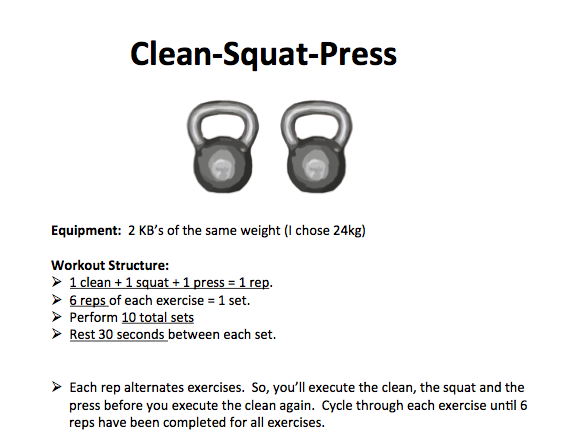
Transitioning to a different exercise on every rep makes this circuit more challenging.

Again, you’re not doing the same exercise for X amount of reps before moving onto the next exercise, you’re performing 1 rep of clean, then 1 rep of squat and then 1 rep of overhead press before circling back to the clean.

1 time through the clean + squat + press = 1 rep.

Each set consists of 6 reps per exercise. The workout is recommended for 10 total sets. That’s a grand total of 60 reps per exercise.

The kettlebell is constantly moving throughout the workout, changing levels and positions.

Rest periods. If a 30 second rest period is completely unmanageable for 8 rounds, TAKE LONGER REST. Try 45-60 seconds. When workouts are shared, whether on this blog or any other website, you must consider your own fitness level and make adjustments as needed. NOTHING is set in stone. Tweak the session to suit your needs.

Weight. Use moderate to heavy weight for this workout. I like 24kg for males and 12-18kg for females.

Because this little circuit is using 3 different exercises, the weight you choose will correspond to both the weakest exercise of the three AND the recommended reps.

The weakest exercise with either be the clean or the overhead press for most people, and the weight of the kettlebell should be something you can squeeze 2-3 additional reps out of.

So, if the overhead press is the weakest exercise, select the weight based on that and make sure you can press it 8-10 times (even though suggested reps are 6 each)

Related Articles

Home Gym Workouts! Total Body Sandbag Circuit for Fat Loss and Muscle

Locomotion| The Weighted Lizard Crawl

One Kettlebell, 3 Fat Loss Workouts

Concept: Training When You’re Pressed for Time

20 minute Workouts

You’ll never have more focused, productive workout than you will when you are pressed for time.

I’m serious.

Sure, 45-60min is probably the best case scenario for a complete workout, but hot damn if some of my best workouts have come when I look at the clock and realize I have no time to waste.

Yesterday I had 20 minutes to get a workout in.  I adapted my regularly schedule training session into a complex format.  I used two kettlebells, both 53lb (24kg) and I got to work.

Warming up with authority, especially when pressed for time, should provide some aerobic benefit as a by-product.  Yes, a warm up should be more than arm circles, head rolls and leg swings.  Prepare your body for 3-dimensional movement and the demands of the training session ahead.

When there is no time to waste, you’ll find that you will only execute the activities that matter.  There is nothing to contemplate, no over-thinking, no procrastination.

In my case yesterday, this is what I worked through in this exact order:


  • Foam Roll:  Glutes, back, lats.
  • Band assisted Mobility/Stretch:  Tall Kneeling Hip Flexor (I have tight hip flexors)
  • Activation:  Glute bridging, band walks and wall slides.
  • Movement Prep:  Elbow to instep, sumo squat, lunge matrix, eccentric focused bodyweight push ups, hand walks.
  • Movement Warm Up Circuit:  Bodyweight squats, pushups, jumping jacks, reverse lunges.
  • Workout:  Kettlebell Complex (5 rounds, 60sec rest, 6 reps per movement)

Shower and out the door.


If you were to stand on the sideline and watch a training session like the one I describe above, you would notice that there is no separation between each of the different components.  Everything flows.  It is non-stop movement from the beginning to the end.  There is no time to waste.

Is this ideal?  No, probably not.  I would have like to focus more time on correcting my problem areas and had the workout be less of a work capacity style event and more of a strength based session.

Is this better than sitting on my ass for 20 minutes?   Absolutely.  Movement matters in any way you can get it.

Don’t make the excuse of lack of time.  Things are rarely “ideal” in life, so find a way to get the work done.  Work through a fast paced session when you are pressed for time.  You’ll probably never have a better training session.  You’ll feel better that you did it, that is for sure…


Cheers,


-KG-

20 Minute Workout: “Country Jam” Training

20 minute Workouts, Bodyweight Workouts

In honor of our local Country Music festival here in Eau Claire, WI, I decided that I would throw together a workout.

The template for designing a crazy effective workout is simple.

My rule has always been… Keep it simple.

Simple means big bang movements using minimal equipment while closely considering loading (weight), rest period(s) and total time of workout.

Avoid complexity at all costs.   Complicating a workout with fancy technical lifts only moves the risk versus reward pendulum deep into the RISK category.

I equate HIGH RISK with HIGH INJURY.

Enough babbling, start training.


Give this a go…


Country Jam Training

The Details…

—> Time:  14-20 minutes

—> Work-set:  2 minutes

—>  Rest:  Remaining time after work is completed

—>Rounds:  7-10

—>Equipment:  Bodyweight + Suspension Trainer, Gymboss interval timer or equivalent


Procedure:

15 Push Ups

30 Mountain Climbers

15 Squats

30 Jumping Jacks

15 Full Burpees or 15 Inverted Rows (if you have a suspension trainer)


*  Complete full reps of each movement for the set amount of reps.  Pay attention to full range of motion and technical perfection.  Your rest period is determined by the speed with which you complete the final rep of burpee.  Rest begins then.  Each round starts at the top of EVERY 2nd minute.

An example of what I am desc is seen below:

Minute 20… Start set

Minute 18… Start 2nd set

Minute 16… Start 3rd set

Minute 14… Start 4th set

… and so on.


Customize the workout to your training level…

  • Beginners/Intermediate:  Start with 5-7 rounds of this (10min-14min total work)

—–>  If it is easy, add more rounds of work.

  • Advanced:  Go for the full 10 rounds (20min) and don’t look back.

—–>  If it is easy, add load to the movements or add rounds (12-14rounds… 24-28 minutes)


Did you get your heart rate monitor yet?

Don’t underestimate the power of a bodyweight workout.  No excuses, just get the work done and get on with your day.

Remember the equation:

 Intense physical exertion + clean eating = Ramped up fat loss

See you soon… let me know how it goes…


*****  Did you see this girl?  She knows how to put a kink in the obesity hose*****

Turkish Get-Up and Kettlebell Swing ONLY Workout

20 minute Workouts, Kettlebell Training

This workout includes two foundational kettlebell exercises (Turkish Get-Ups and Kettlebell Swings) and is perfect for a home gym workout.

Who doesn’t love a home gym workout these days?  Time-efficient and minimalistic workouts are PERFECT proving the superiority of the home gym workout experience.

Clearly, I’m an outspoken advocate for creating a home gym space.

In the kettlebell training world, turkish get-ups and swings are two of the best exercises a person could learn, practice, and improve on.

I stand firm on this statement.  Call it “my truth” or whatever.  I’ve spent years working these two movements and the benefits of my efforts include sustained power, strength, and a consistently lean and muscular physique.

Aesthetics might seem superficial, but no one trains hard to stay fat.

There are HUNDREDS of other great exercises, I support them all, but going full-on minimalistic mode, I know that attacking turkish get-ups and swings would make a lot of people happy with the time investment.

It’s a powerful combo.

Kettlebell swings are a ballistic hip hinging exercise that’ll improve power, train fast-twitch muscle fibers and if organized accordingly, build conditioning in a really unique way.

Turkish Get-Ups are a pure loaded movement-rich exercise.  Few other exercises are as humbling, addicting, total body, and rewarding as practicing turkish get-ups on a regular basis.

You feel less like a Lego exercising while doing turkish get-ups, and more human.  

Equipment needed:  Timer and kettlebell

15 minutes Alternating Turkish Get-Ups

+

2-Hand Kettlebell Swings (24 rounds of 15sec on/15 sec off)

The TGU’s

15 minutes of continuous turkish get-ups is a lot of work, so if the duration needs to be decreased a bit, please do it.

Start with 5 minutes, see how you feel.

If 5 minutes is a breeze, add 2 more minutes and see how that feels.

There are very few secrets to fitness.  Actually, there are none.  Only what you know, and what do you don’t know… and how consistently and effectively you are at practicing what you know.

The key to building fitness safely, is auditing and be honest with your fitness level, and adjusting any pre-formatted workouts (like this one) to match your abilities.

Turkish get-ups, like any other exercise, are not supposed to be sloppy.

A full turkish get-up is a marathon of an exercise, multi-segmented, with many steps/moves/transitions on the way up and down.

The technique, timing, hand and foot placements, breathing and coordination are just a few key things to pay attention to while performing Turkish get-ups.

Poor technique… can result in tweaks, strains and injuries, which is not the point of exercising in the first place.

We exercise to improve our lives, not make it worse.

Regressions may be necessary, and the person who acknowledges they need to scale back a workout is a person I RESPECT!

The Swings

24 rounds of 15 seconds on (swinging) and 15 seconds off (rest) equates to 12 total minutes.

6 out of 12 minutes are spent performing kettlebell swings.

Pausing to think about how potent kettlebell swings are for fat loss (among other benefits), it’s pretty amazing a measly six minutes can have such a dramatic impact on body composition over time.

When I first started shaping this workout years ago, I used a 24kg kettlebell.

Today, I like to use a 32kg or my 40kg for the swings.

Exercise Variations for the Workout

Establish familiarity with both turkish get-ups and kettlebell swings BEFORE diving into a workout like this one.

Here are the recommended variations of each exercise:

Turkish Get-Ups

Kettlebell Swings

Give this workout a shot and leave a comment.

A Simple Bodyweight Based Workout

10 minute Workouts, 15 minute Workouts, 20 minute Workouts

Bodyweight training is effective as hell for fat loss.

Honestly, don’t underestimate it.

You can accomplish so much work in a very short amount of time using a simple bodyweight training only template.

The same rules apply for a bodyweight based training session:

  • NO crunches (micro-trauma to your spine!)
  • Multi-Joint Movements (Squats, hip hinge, upper press, upper pull, etc)
  • Limited or no rest periods (we want a training effect)
  • Keep the main thing, the main thing with bodyweight training.

Also, get away from fancy/complicated exercises.  I promise you that you won’t get any greater training effect out of fancy circus-like movements as opposed to basics.

Keep it simple and get it done.  I will show my cards early here in this post.

Here is a perfect workout for you in a pinch…

10 bodyweight squats

+

10 push ups

20 Jumping Jacks

10 Reverse Lunges

  • Rinse and repeat.
  • Complete as many rounds as possible in 10 minutes, 15 minutes or a 20 minute time limit.
  • Transition from movement to movement WITHOUT REST for the duration of the time limit that you choose (10min, 15min, 20min)
  • This is an timed based AMAP (as many as possible) workout
  • Start slow, this may crush you harder than you think.

I spent a number of months using strictly bodyweight training for fat loss when I lived in my apartment.

I got an incredible training effect from the workouts that I designed.  Some were more “flowing” than others.

These days, I use the exact workout listed above for 2-3 rounds before my kettlebell/suspension trainer fusion workouts.  I can activate a large amount of musculature rather quickly and safely, increase core temperature and blood flow to joints, grease the groove on fundamental movement patterns all while preparing myself mentally for the work about to be done.

The downside is that bodyweight training has it’s limits with regard to progression.  Like anything you cannot perform the same workout over and over and expect to see results.  Adaptation will occur and something about the workout/program will have to be tweaked.

Did you notice anything else about the workout above?

No pulling movements.  If you don’t have a bar of some kind or some straps, awesomely big bang movements such as chin ups/pull ups and inverted rows are a no go.  Some people say, “Use chairs for inverted rows”.  That advice is a stretch and quite frankly chairs for inverted rows were unstable as hell when I last tried it.

What I have found is that for the biggest return on your time investment, any tweaking that is done is most commonly got to be an increase in loading.

What do I mean by loading?

Meaning you have to add weight of som kind, either in the form of a weight vest or external loading with any number of training tools (dumbbells, kettlebells, barbells, etc) to continue to see accelerated fat loss, strength gains, etc.

The body adapts quickly to physical exertion.  Be aware of this if you are frustrated with your current regimen…

Have you changed anything lately?  Chances are you probably have not.

Bodyweight training isn’t the end all be all, but it is a refreshing change from the gym, it’s free, can be performed anywhere and can be progressed or dialed back very easily based on your training level.

Give it a go.

Tell me what you think in the comments section…

More to come… Just warming up here… 🙂