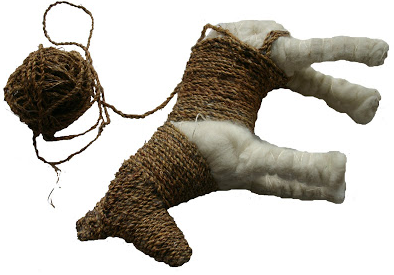
Stop Dragging that Horse Around, Bury It.

Brain Training

burying the horse

No horses were harmed in the creation of this post…

The mind controls the body.

The more that I read strength and conditioning, physiology, physical therapy related books like Diagnosis and Treatment of Movement Impairment Syndromes (who the hell reads stuff like that for fun?), anatomy, blah blah blah…

The more I realize that this material is all pretty similar.  It hasn’t changed much, and most of the information is just a new angle on an old topic.  Not that taking that approach is bad thing, because anything that gets you to think differently about your habits is definitely worth a read, whether you choose to adopt that new way of thinking or not.  It’s important to explore all angles before deciding on what you believe personally (at least that’s my opinion).

However, reading all of these fitness/movement related books has made me realize that I might be missing something, which is the mind’s powerful control over the body.

I have come to realize that fit people or those people who have decided to commit to a life of health think differently than those folks who don’t care so much.  It’s a mindset.

Personal development is another major interest of mine.  I’ve spent much of the last few years trying to figure out what drives my own thought processes and habits in an effort to break through to higher levels of my own success.  I am not talking about money here.  I am taking about developing every aspect of my life.

  • Relationships
  • Interests and passions (achievement drive)
  • Stress
  • Financial
  • Physical development

I had been thinking about my need to improve upon the  bulleted points (above) for quite some time, so I started to seek out coaches and methods to help me in my quest.  I stumbled upon a hierarchy that absolutely hit the nail on the head…
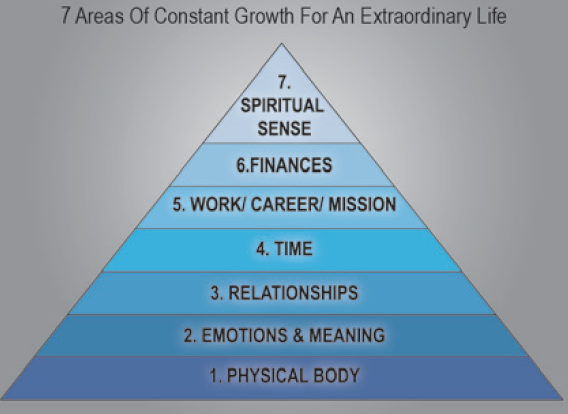
Personal development

Photo credit:  Tony Robbins

I used to think that personal development gurus like Tony Robbins were real clowns… then I grew up and realized that they know their shit.  They live what they speak on, and their results transform people’s lives.  Live and learn Kyle.

Personally, I discovered that I had hit barriers in my effort to move to the next level in all seven categories (above), and it largely because I was dragging numerous “horses” around.  The barriers were all mental restrictions.
mental thoughts control us

My aspirations of what I wanted be in the future were being clouded by the thoughts circling inside of my own head in the present.  Like dead weight, I was limiting my ability to think creatively, see opportunity and therefore achieve.  It’s frustrating to think that we can hold ourselves back from achieving greatness simply by generating poor thoughts about ourselves.  It’s crazy actually.  So many naturally talented people fall victim to this kind of thinking for an entire lifetime.

The mind is more powerful than you can ever imagine, and it most likely the main reason that your body isn’t where you want it to be.

With that being said, this blog is heavily centered around building a physical lifestyle that can complement all other areas of your life.  If you look at Tony Robbins theories on achieving mastery, developing the physical body is #1 on the depth chart.

Think about that.  How you perceive yourself physically speaking, and how you think about others perceiving you physically can impact all six of the other areas of personal growth.  Much of this perception is either a drain or a boost to your self-confidence and posture that you carry around daily.

Screen Shot 2013-04-20 at 12.47.05 PM

Hair not included.

You don’t need six-pack abs to have confidence in your appearance.  In fact, six-pack abs are overrated.  Let the Jerry’s down at the Jersey Shore  enjoy their baby-oiled bodies and six packs.

Start your journey by burying the horses that you continue to drag around.  Whatever those horses are.  Bury them.  Put them behind you and head for greener pastures.

In the past, I thought that talk like this was dumb.  “I didn’t need it”, I told myself.  Boy was I wrong.

Thankfully I snapped out of that cocky attitude and realized that burying the past is the first action step to achieving anything you can dream up for the future.

For example, if you’ve been struggling with sticking to a healthful recipe of exercise and eating nutritious food, you should take a look at your social circle.  What are they doing?  Are they exercising and eating well?

You become like the people who you hang with the most.  Behavior is contagious.  It’s been a concept that has been written about extensively, so this is not made up B.S.

—>  Read an article from the New York Times here:  Are Your Friends Making You Fat? 

If your social circle eats like crap and is proud of it, you’re likely to follow suit.

If your social circle spends most waking hours in the recliner watching reality shows, you’re like to do the same.

If your social hates like and constantly plays the “victim card”, you’ll throw that card out at the first road bump you come across.

the human domino

Get out of this line.

Don’t become the human domino… have the courage to break the cycle and step out of line.  You’ll find that it is extremely uncomfortable and you may want to quit at times, but I am constantly reminded that nothing amazing in life (that is worth doing) is ever easy or free of growing pains.

It’s the beautiful struggle.

Go for it.  Less talk, more walk.  All of the tools are right there in front of you, pick them up and use them.

I will do the same and let’s see where it gets us, I bet we will all be thrilled with our end result.

Cheers to  breaking the bad and breathing in the good…

KG

Maybe I Should Post a Workout?

Brain Training, Dumbbell/Barbell Workouts

I got to thinking about what purpose this blog is going to serve.  As I build my information publishing business from the ground up, the blog will serve as an outlet for updates, current thoughts on news and media, ideas to get you thinking about your own training and also a splash of what my training and eating habits look like.

Kind of sounds like the average blog uh?

Hmmm…

Anyways, I thought that I should probably fire up a post sharing a sample workout.  I’m typically not a person that promotes individual workouts.  I am more of a program type guy.  The program is the road map.  It’s complete and will keep a person progressing for months, years, etc.  Programs build bodies resistant to fatigue and injury.  Programs build strength, stability, power and work capacity.

A workout is really just the “sweat of the day”.  However, hot damn if I don’t love an improvised workout!

{I’ve literally got hundreds of improvised workouts in a notebook at home here.  I record everything.  I tested throwing together workouts based on movement patterns and exertion versus the traditional approach to physical fitness.  I got some interesting results.}

But never mind that…

After all, the gym is a busy ass place.  Not all of the equipment that an author or coach draws up for a program is going to be open all of the time.  I think that authors forget about this when they write.  You’ve got a free weight area in each gym which gets more and more popular every single year, and the author wants you to stake claim to a bench, 4 pairs of dumbbells and barbell?  Get real.

I despise those people who pull this kind of shit in the gym.  Especially since the effort put forth by the individual doesn’t even come close to the amount of equipment that they have hoarded.  (Sorry for the rant)

Sometimes you have to adapt, right on the fly.

If you recall, last Sunday I got my head jarred and suffered a concussion.  I am sure I have beat that into the ground already.  Any how, I gave myself a solid week of doing nothing but sleep and minimal movement around the house.  I have been through the concussion scenario before and it helped big time to lay low.

This past weekend my lovely girlfriend (Amanda) and I spent the weekend away from my Eau Claire training compound, in Minneapolis, MN.  I debated whether or not to try to do something physical while in Minnesota but ultimately decided that I wanted to see how it felt to exert myself a little bit.

Turns out I was good to go.

Anytime I am in a commercial gym I always prepare for the worst…

… the worst equipment.

… the worst crowds.

… the worst amount of space.

… etc.

Seriously, if you plan for the worst possible situation and you know that you have a Plan B no matter what… that is comforting.  You’ll never miss a workout and you’ll always be pushing closer to your objective or at the very least maintain what effort you have put forth already.

I could get a quality workout in a phone booth.  I am convinced of that.  I don’t need any equipment and I can get by just fine for an extended period of time.  But not all of you have that knowledge which is partly why I am writing my ass off (book-wise) lately.  It isn’t always peaches and cream when it comes to the resources available for the ever important workout.

Luckily, I play with the free weights almost exclusively.  It’s the most underused section of the gym, especially after New Year’s, which is weird because it is also the most effective place in the gym to change your body, build strength, lean mass, etc.

Develop an athletic looking body if you will.

Seriously, you’ll strip fat twice as fast using nothing but free weights as opposed to running on that hamster wheel we call a treadmill.  This is no joke.  Those who have been at it for while will back me up on this (feel free to do so in the comment section so I know that someone out there has a pulse:)

After I knew that I could train at a decent intensity (which wasn’t much since I was so out of it all week), I went for the free weights and had at it.  The gym had one squat rack which is all I needed to know to make the session respectable.

Here is what my on-the-go adapted  training session looked like:

A1)  Rear foot elevated split squats x8 R/L

+

A2)  Push-ups x15

–  No rest between exercises for 5 total rounds.

–  Rest for set up of the next movements (roughly 2-3 minutes)…

B1)  Deadlift x5

+

B2)  Chin-Up (slow eccentric) x8

–  Very minimal rest between movements for 5 total rounds.

– Rest for the clean up of the equipment used and transition to cardiovascular dusting…

Aerobic:  2.5mi run on treadmill (aka: hamster wheel) keeping the heart rate around 153-156bpm.

The workout time was about 45 minutes.

As you can see, I measure everything.  I knew that I needed to keep my heart rate down post-concussion just to be safe.

I warmed up for a ridiculous amount of time just to be safe.  They had a really shitty jump rope which I tried to twirl for about 3-4 minutes before finally giving up on it.  Having decent functioning equipment really makes things more enjoyable, trust me there.

I will say that the work capacity portion was tough for me.  It felt like I hadn’t trained in months which is common when you just lay around for days at a time.  The aerobic session was strictly just to re-acclimate my body to that kind of oxygen exchange and continuous movement.  The treadmill, in reflection, was a good choice since I really just had to move enough to keep up with the belt.  My body isn’t ready for anaerobic type conditioning just yet, and that is me telling myself “no, not yet”.  I don’t want to risk anything shitty happening with my brain.

My conditioning was great prior to the concussion, so it shouldn’t be too much work getting back to that point.  That is the beauty of strength training.  Build it once and your body will remember what it needs to do.  The first couple sessions are discouraging but you have to keep it in perspective.  The body operates on an incredibly predictable set of rules.

Do this, then this happens.  Do this, then this happens.

It’s really nothing more than that quite honestly.  Don’t hype it up anymore than is necessary.  Avoid the over-hype.

Most people really don’t need to be concerned with every little detail of fat loss or lean mass building.  Do this, then this will happen.  Let guys like me worry about that kind of stuff.  Stay low information with your training.  You’ll be much happier.

938 words into this post and I am finally wrapping it up…

Oh, but before I go, check out some new tunes that I have been training to…  I dig this guy and his music a lot…

  • Macklemore- “The Heist”

[Hip-hop, not rap.  Incredible lyricist.]


Cheers for two-a-day posting from this guy…

KG

Is a Rep Just a Rep?

Brain Training

The small details in life are often what seem to separate poor from average, average from good, and good from great.

So when I get the question of whether it is ok to miss/skip a rep in a work set, I have changed my tune quite a bit over the years.  On the surface, one might say, “Who gives a shit, it just a workout and it is just one rep”.

Is it?

I think that it is more than that.  I think that physical activity, and a person’s ability to finish a training session according to plan, is a clear indicator of someone’s behavior and habits.  The brain is so heavily connected to whether or not you get off the couch for a training session, run that extra 100 yards or finish that last set or rep.

So, if you consciously skip that last rep when you could have finished it, it would be interesting to see if you are doing the same thing in other areas of your life.

–      Are you missing opportunities to make that sale in your career?

–       Are you avoiding continuing to pursue your goals?

–       Are you eating processed foods because it takes work to cook a meal?

I am not an expert on behavior, but I observe everything.  I enjoy observing and trying to understand why humans do what they do.  I often think about why I do the things that I do in my own life.  Habits are hard to break, there is no doubt about that, but they can be broken.  It is never too late to create new and improved habits, it’s just a decision.  It’s uncomfortable to call yourself out, but sometimes that type of irritation can create a world of change.

I know this is a deeper way to think about exercise, but I also think that thoughts like this can stick and help to create change.  I believe that habits carry over into everything that we do.

So yea, I think that finishing that last rep can make you a better person. I think that having the conviction to complete your workout exactly as it is drawn up for that day can push you over barriers that may be holding you down in other areas of you life.  Absolutely.

It’s not just a rep.

Training Tunes Episode #1

Brain Training, Music Motivation, Quick Tips

Music motivates.

Quite frankly, training without music sucks in my opinion.  The research is clear that music can make our brains tell our bodies to keep going.  It’s not really that simple, but essentially music is a major part of our physical culture…

So what are you listening to?

Here is what I am listening to…


Post up!  I want to know what you are listening to!!!

Brain Training for Fat Loss

Brain Training, Pure Fat Loss

Thanks for hopping over from my “What’s Slowing You Down:  Brain or Body” post…

I apologize for the organization of the end of this post.  I had to bullet each paragraph to separate it from the the previous paragraph.  A glitch in WordPress I believe.  I don’t know… Sorry about that…

Ok, where I left off…

Well, maybe nothing.  Most of you will never push yourself to the point where your brain or body begins to tell you to, “fuck off”.  It’s not a knock against you, it’s just a reality.

Two years ago I dove head first into the SSST (Secret Service Snatch Test), which is a kettlebell challenge not for the weak of heart.  The SSST is comprised of:

  • 24 kg (53lb) kettlebell
  • Perform as many snatches as possible in a 10 minute timeframe.
Simple and insane.
  • If you are a competitive minded person, this is something to shoot for.  I got about 190 snatches into the SSST and my brain flooded with “just quit this shit” thoughts.  I fought them off for another 1:30min or so, then tapped out.  I destroyed my old snatch record, but still, the thoughts came and engulfed me.
  • It’s easy to succumb to your thoughts during physical activity.
  • Next time you are on a run or bike, pay attention to how many times you start thinking about how nice it would be to be finished already, or how you could just walk for a bit, or no one is looking so you can dog it for a minute or two, blah blah blah.  I am human, I have these thoughts, so I know that you do too.
  • I think what the average person struggles with the most with is their thoughts.  Just one negative thought that slips passed your “will-power filter” in your brain and will infect your entire body during a workout, or ever before you ever strap on your shoes pre-workout.  Negative thoughts are infectious.  Once you start thinking about quitting on a task, for most people, it’s ALL OVER.

Think about it.  I know that everyone has had those thoughts during a long run, during a personal training session or even back in high school or college as an athlete.

When your brain quits, you quit.

Controlling your thoughts will build you a body, I firmly believe this.

Crazy.

***Go do something great today that your body will thank you for in the future.***

What’s Slowing You Down: Brain or Body?

Brain Training, Human Performance Discussion

Let me ask you this…

1)  Is it the physiology of a champion?

or

2)  Is it the brain of a champion?

***  Keep reading if you don’t understand what I am asking.


Olympics Miracles!

With the Summer Olympics quickly approaching, I think that this topic is incredibly interesting.

Anyone who has ever watched a sport on TV has no doubt heard the announcer cry out, “Look at that finish!  It was all heart on the last 50 meters!  A new world record!”

Even if that isn’t word for word, it is pretty damn close.  I am a sucker for these kinds of stories.  I love seeing, reading, listening to stories about humans pushing themselves to new heights.

What about the average joe?

Yes, you probably understand that you are never going to be an Olympian.  That’s ok.  Neither will I.

Looking at what causes humans, Olympians or otherwise, to be able to accomplish or fail at physical tasks as they relate to our daily performance during body transformation, I often ask myself, “Is it physiology or all brain?”


Enter: The Central Governor

It wasn’t too long ago that I read an article about Dr. Tim Noakes and his ideas that human performance is controlled by something called the Central Governor.  Essentially, he is saying that human performance may be controlled less by physiological limits and more by the brain.  The brain will shut down physical output if it detects that the body is nearing a fatigued state that will damage the heart or homeostasis.  If physical exertion exceeds what the brain deems as acceptable, it will turn down the dial on the whole program (fatigue).

Here is a more official description of the Central Govnernor Theory (as described by Wikipedia):

The central governor is a proposed process in the brain that regulates exercise in regard to a neurally calculated safe exertion by the body. In particular, physical activity is controlled so that its intensity cannot threaten the body’s homeostasis by causing anoxia damage to the heart. The central governor limits exercise by reducing the neural recruitment of muscle fibres. This reduced recruitment is experienced as fatigue. The existence of a central governor was suggested to explain fatigue after prolonged strenuous exercise in marathons and other endurance sports, but its ideas could also apply to other causes of exertion fatigue. 

Begin rant…

—>  You might be saying, “Come on Kyle, don’t cite Wikipedia!”

Let me remind you that I am writing posts with the goal of providing practical and simple information.  If you read the studies behind the Central Governor Theory, most of you would experience early symptoms of head explosion.  The research can get heavy, and I am not here to impress anyone with scientific jargon.

We can either take a complicated theory and apply it to give real-world results, or we cannot.  Results-based information is what I am interest in sharing and results are probably what you are interested in experiencing.

End rant. 🙂


Criticisms to the Central Governor Theory:

Now, the Central Governor Theory is not flawless.  Dr. Noakes has pissed off a lot of researchers around the world with his theories.


Here are is one of the major criticisms (also sniped from Wikipedia):

The existence of a central governor over physiology has been questioned since ‘physiological catastrophes’ can and do occur in athletes (important examples in marathons have been Dorando PietriJim Peters and Gabriela Andersen-Schiess). This suggests that humans can over-ride ‘the central governor’.[16] Moreover, a variety of peripheral factors in addition to those such as lactic acid build up can impair muscle power and might act to protect against “catastrophe”.[17] Another objection is that models incorporating conscious control also provide an alternative explanation,[18] but also see Noakes’ reply.[19]

Exercise fatigue has also been attributed to the direct effects of exercise upon the brain such as increased cerebral levels of serotonin, reduced level ofglutamate secondary to uptake of ammonia in the brain, brain hyperthermia, and glycogen depletion in brain cells.[20][21]

The idea of exercise causing hypoxia at the heart, in the absence of arterial disease, moreover can be questioned due to the heart with every beat is delivering through coronary arteries that arise from first branches from the aorta freshly oxygenated blood to its own cells. Other factors exist that could in a self-limiting way limit oxygen uptake. For example, as more accessory muscles of respiration are recruited, (as occurs at near maximal values of VO2), the energy cost of increasing rib cage expansion is nearly equal to that gained by the oxygen obtained from doing so. Indeed, the Fick equation (see VO2 max) itself includes terms of limitation: Q (cardiac output) is determined by stroke volume and heart rate. Stroke volume has a natural, physically limited upper bound (the heart obviously has a maximal volume, and is restricted by surrounding structures such as the pericardium), while heart rate is limited by the ability rate at which cardiac cells can maintain rhythmicity. There are also natural limits to the rate at which oxygen can diffuse from the blood to the tissues, i.e. gas exchange is itself a limiting factor.

These criticisms suggest the potential exists for known physiological processes to adequately carry out what Noakes and others attribute to a complex, pre-calculated central mechanism of homeostasis. (Though they may be relevant for accounting for some types of observations such as the effects of altitude on cardiac and other muscular capabilities.)

Another criticism is that Hill’s original suggestion of a central governor uses a study in which a VO2 max test was conducted in which some of the subjects did not achieve a plateau in oxygen uptake. This failure led to his suggestion that VO2 max itself is a failure to account for their fatigue requiring the existence of another mechanism that could limit aerobic performance. However, this plateau requires that subjects are highly motivated, as the protocol of the test requires work at near maximal levels for protracted periods, and this might not have been the case.


I apologize for the long description, but there are some good points and I want anyone reading to be able to develop an opinion on it.

Here is an excellent article from The Walrus…  “The Race Against Time”.

Honestly, I am a physiology kind of guy as it relates to this matter.  I believe that exertion is mostly limited by our body’s natural processes as we experience fatigue.

To really confuse your decision-making on the matter even more, how do YOU explain this?…

Commonly know as “Bonking”

However, I have to say that I am extremely fascinated by what could come of Dr. Noake’s research.  The brain is an incredible switchboard that controls so many daily processes, and the thought that it can be one of the limiting factors of performance is not out of the question by any means.

We just haven’t figured out where all of the pieces fit.  It is going to be interesting to watch the research in the coming months/years as continue on our quest to figure out what makes us tick as humans.

What does this have to do with fat loss?