Cossack Squats are single leg loaded exercise (mostly) that require a fair amount of mobility and strength.
Cossack Squats can be used as a warm up or a strength exercise depending on your preference. I use them both ways. Bodyweight-only reps during the warm-up is a nice way to grease up the hips before lifting. Adding weight increases the difficulty and will build strength.
The internets love to bicker about exercise technique, and Cossack Squat technique is no exception.
Here’s my two cents on body position of a Cossack Squat:
Outside shoulder-width stance (get the feet wide!)
Glute drops down INSIDE the working knee and foot
Chest tall, head up!
Foot stays flat on the floor for as long as possible (before going onto the heel)
Tar and feather me.
The front view of the working leg is in a similar position as a bilateral squat.
Adding Weight to Cossack Squats
Weight can be added to Cossack Squats exactly as you would any other exercise.
The opening video was to showed how to go about doing this.
After the bodyweight repetition, the weighted Cossack Squat incorporated using 12kg kettlebell.
From there, the load increased by roughly 4kg in each video clip. I finish the video using a front racked double 24kg kettlebell repetition.
If I were to go beyond 106lbs of added load, I’d take the following approach:
60lb weight vest + 24kg kettlebell
Loaded barbell (back squat or front racked position)
My loading options are based on the equipment I have available in my home gym. Use what you have!
The good news? Weight is weight. The body doesn’t care what you’re using for added weight.
To give you an idea on how to hold the barbell, check out this lower body mobility flow.
Swipe left for the full flow (and subscribe to my Instagram while you’re at it 😉)
The barbell rests on the shoulders while the lower body performs the work.
Bailing Out of a Rep
If you’re adding external load to any exercise, it’s important to know the “outs” should you need to bail on a difficult rep.
You can easily “ditch” a kettlebell being held in the goblet position. Just give it a little push forward and drop it on the floor. Make sure the floor you’re training on can handle the impact!
Using a barbell supported on the shoulders or in the front racked position, you’ll perform a similar maneuver. If the barbell is on the shoulders, allow the barbell to roll off of the shoulders while you move forward away from it. Using a front racked position, have the barbell roll forward and give it a little shove in the same direction as you move away from it backward.
You never know.
Alternatives to load the Cossack Squat
A heavier sandbag being held bear hug style increases the difficulty 10x. Bear hug sandbag exercises increase the difficulty of most exercises.
In general, heavy sandbag training is a brutally effective strength builder because you’re fighting to hold onto the sandbag as much as you are grinding through the lift.
Dumbbells can be used in the goblet style position. Palms together, one of the dumbbell resting on the hands. It’s a very comfortable position and a great way to add weight to the exercise.
Why practice Cossack Squats?
Expanding your arsenal of squatting variations will only help to make you a more skilled mover in daily life. The more control you have over movements and body positions, the more you’ll tap into those movements whenever you need them.
The more important Cossack Squat rep I’ll ever do. 👶
When you own a movement, you’ll use it. If you don’t, you’ll avoid it.
I use a bottom-up Cossack Squat variation almost daily with my kids. I’ll be playing with them on the floor and when it’s time to stand up, I grab them and WHAMMO! Cossack squat. It’s become an efficient and effective maneuver.
The more movements you own, the more freedom of movement you have.
This is hard for some folks to grasp, but trust me, it’s a really liberating pursuit and well worth your time. Especially as you get older. Preserving movement capacity as you age will keep you doing the things you love for longer.
Few things are more powerful.
Consistent practice will improve your Cossack Squat technique. Don’t expect to drop your ass to the floor on the first rep. Lowering to parallel might be difficult.
Start with a modified range of motion, or possibly assistance lowering down using a door, chair, couch, etc. Take note of where you feel tight, where body position begins to degrade, etc.
On each rep, move yourself through the largest range of motion that allows for sound technique.
Gotta start somewhere.
Mobility Training Accelerates the Process
In addition to practicing the Cossack Squat exercise, adding mobility exercises will strengthen and improve control in your hips and other joints that contribute to the exercise.
Hip articulation drills like CARs and internal and external work from the 90/90 position will further building strength and control that accelerates the achievement of exercises.
Mobility training is not promoted nearly enough. And when it is, it’s by trainers spitting jargon that most people cannot translate into “What’s in it for me?”
You don’t have to commit the entire workout to mobility drills, just a portion.
Adding 10-15 minutes of mobility focused exercises most days of the week will do wonders over time. I’m living proof of what micro-dosing mobility work will do. I rarely ever train mobility longer than 15 minutes in a workout.
At risk of sounding like a broken record, taking steps to improve active range of motion, strength and control improves EVERYTHING movement-wise. Including learning how to do new movements.
For me, mobility training makes new movement patterns feel like I’ve been there before. It decreases the learning curve. When you’re grooving new exercises, that’s a great thing.
MyDailyMobility is a follow-along mobility program I highly recommend for quality coaching in an easy-to-follow format.
Muscle Soreness to be Expected
Any new exercise has the potential to make you sore afterward.
It’s neither good nor bad, but a sign you did something you haven’t done before.
If this is your first time trying Cossack Squats, you can expect to be sore.
The muscles used might be getting stimulus they haven’t experienced before.
The simplicity of a two exercise workout finisher might lead you to believe it’ll be easy.
Wrong.
Bouncing between these two exercises non-stop for 5 minutes is exhausting. By the 3rd round, you’ll understand. The training effect is massive.
Push-Ups
Push-ups on an upper body horizontal pushing exercise. Push-ups build strength and condition the chest, arms and core. Bodyweight push-ups can be performed virtually anywhere. Long before I started this blog, people were leveraging push-ups to build strong bodies. Long after I’m gone people will still be using push-ups to build muscle and improve performance. Do not underestimate push-ups.
Push-ups (and the progressions) are one of the most under-progressed movement patterns. People stop at 2-arm push-ups and opt for high reps using a sub-maximal exercise variation. Explore the progressions that exist beyond 2-arm bodyweight push-ups. Carpet slide push-ups, archer, typewriter and single arm push-ups are worth your time.
Kettlebell Swings
Kettlebell swings are an explosive hip hinging exercise. On every repetition, the kettlebell travels through a arc of motion, hiking between the leg, pulling through out and up to the sternum height. Kettlebell swings have a pendulum-like look to them. Kettlebells are incredibly resourceful tools for building fitness. Swings are a great exercise to train the “go” muscles of the body, the posterior chain. For people that want to train power but don’t want to mess around with Olympic lifts (snatches, cleans, etc), swings are the exercise.
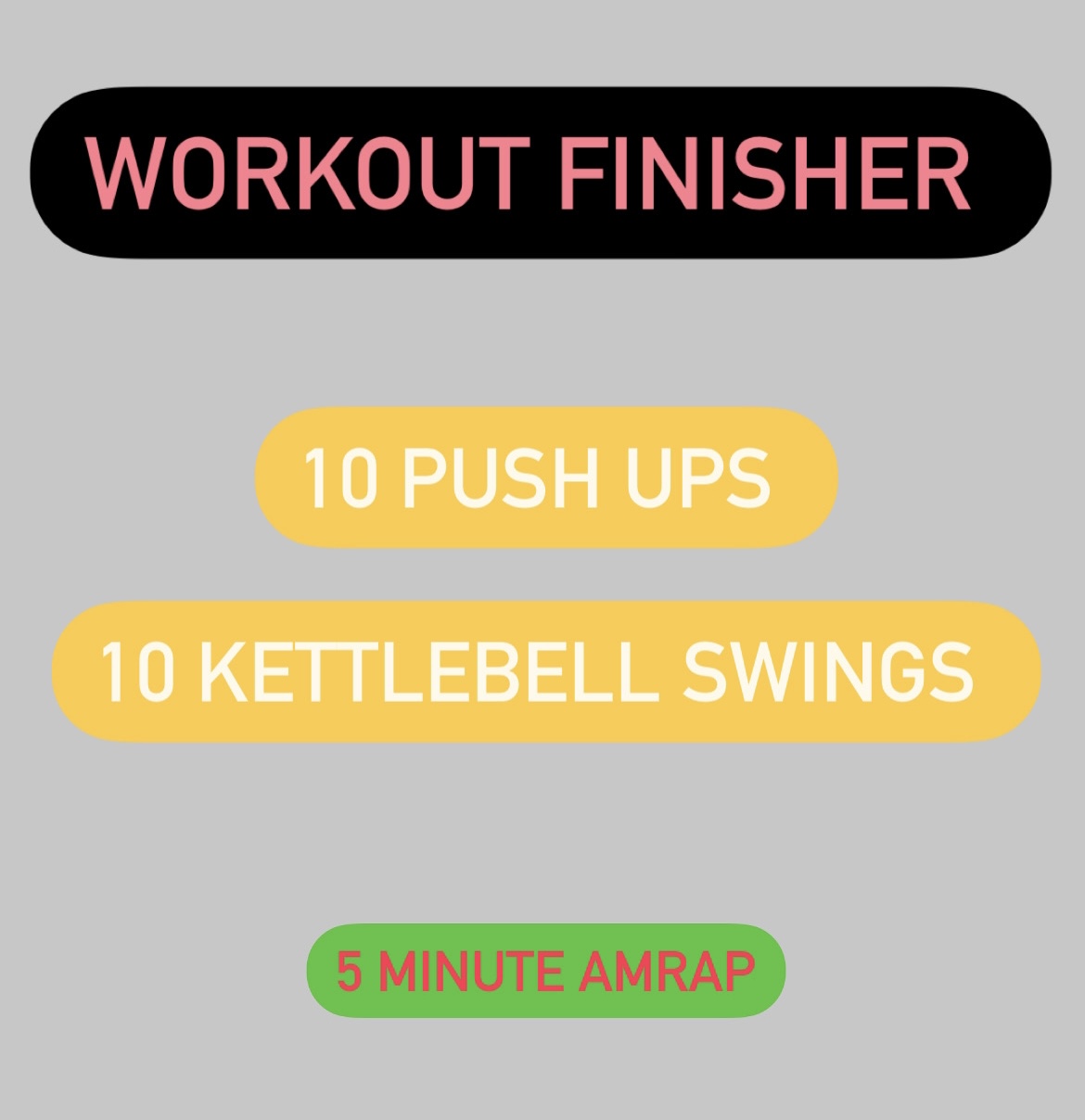
Workout Finisher: Push-Ups and Kettlebell Swings
Perform as many rounds as possible (AMRAP) in 5 minutes.
Take rest if you need it. There’s zero reason to injure yourself because you were chasing a personal record with horse-sh*t technique brought on by fatigue. Stay disciplined with technique.
Conditioning yourself to move well when tired takes time. Lots of personal trainers act like fatigue does not exist out in the real world, or high intensity (machine free) conditioning is “dangerous”. I’ve developed an opinion that it’s dangerous not to do it.
If you’re living a physical life, conditioning your body to move with integrity when you’re exhausted will serve you well.
Fatigue is a technique killer, yes, but the gym is a controlled environment where we can practice demonstrating technique when fatigue creeps in.
Like I mentioned above, take rest if you need it. There’s no shame.
A workout finisher is a short burst bout of high(er) intensity positioned at the end of a workout. It usually consists of 2-4 exercises, using minimal equipment (or no equipment).
There are thousands ways to design a workout finisher, and I intend to share them all!
Kettlebell swings, push-ups and rowing are timeless exercises. They also happen to make a perfect workout finisher.
Push Ups
Push-ups are an upper body horizontal pushing exercise. They work the chest, arms and core. Push-ups are easy to modify for any level of fitness. Beginner? Elevate the hands, reduce the weight and limit the challenge to the core. Advanced? Add weight to move on to single arm variations. A set of push-ups is seamless to start and end, making them a great option for a workout finisher.
Kettlebell Swings
Kettlebell swings are an explosive hip hinging exercise. I’ve been swinging kettlebells for 13 years and it’s still one of my favorite movements. Swings are a great choice for workout finishers because they are easy to set up, start/stop and train the entire body. Walk up to the kettlebell, grab the handle, swing. Plus when you’re using weights for cardio, I prefer swings because they are more forgiving with technique (compared to barbell cleans, etc).
Rowing
Rowing is one of the best cardio activities a person can do. Rowing is taxing for the entire body. Rowing isn’t as quick to get set up (compared to push-ups and swings). Put your butt on the seat, strap the feet, grab the handle and row.
Push-ups and kettlebell swings make a fantastic pairing. Upper body push with a hip hinge. Grip is preserved for the swings, pushing muscular is preserved for the push-ups, lots of muscle being taxed with two basic exercises.
Aim for completing 5 rounds using an 8 minute time limit.
In other words, you get 8 minutes to complete 5 rounds, and if you fall short, the workout finisher ends.
Is this workout finisher too aggressive?
Cut the push-up and kettlebell swing reps down to 5. Lower the rowing distance to 150-200m.
Do not be afraid to tweak workouts to suit your fitness level.
You don’t need permission to do this.
Flow and Non-Competing Exercises
The best workout finishers have a good flow/transition between exercises.
Remove as much set up fiddle factor as possible.
The goal of a workout finisher is constant movement. Transition from one exercise to the next until it’s over.
Don’t waste time with exercises that have a long set up time.
Choosing non-competing exercises allows you to give more energy to each exercise and take a total body approach to the finisher.
3-4 exercises is perfect for a workout finisher. Remember, workout finishers are supposed to be the icing on the cake, not the meal.
Non-competing exercises can help with safety. You’ll be tired, but not overly tired in any one movement pattern or muscle group.
Here are a two simple non-competing exercise strategies:
Upper and lower body exercises
Push and pull exercises
Non-competing exercises:
Squats + pull-up
Lunges + overhead press
Push-Up + kettlebell swings 😉
Crawling + loaded carries
⚠️ CAUTION ⚠️
A workout finisher should be brief. By definition, a workout finisher is the ending to a workout, meaning you completed other activities leading up to it.
If a workout finisher drags on for 15-20 minutes… it tells me it’s over-engineered, didn’t do enough quality during the middle of the workout, and set yourself up for unrecoverable fatigue in the coming days.
People make the mistake of biting off more than they can chew. They step up to workouts that don’t account for the days ahead or their current fitness level.
Fitness is a long-term play.
Hundreds of workouts (and diet) will create the body and performance you desire. This is the #truth, depressing for some, but realistic and honest.
Like this workout finisher??? It’s just the tip of the iceberg for options.
Here’s the rep scheme I went with for the Macebell exercises:
360 Swings x 10 per side
Gravediggers x 5 per side
I didn’t want to have type out the reps for each round, it’d be redundant.
Reps can and probably should vary from person to person. This will depend on your familiarity with the exercise, macebells and current fitness level.
Also, I do use specific equipment in this workout. Suspension trainer, barbell and landmine trainer. You don’t need this exact equipmetn to participate. Leave a comment below and I can help with substitutions.
Round 1 – Macebell 360 Swings + Push Ups
Round 1 of this workout kicks things off with a bang: 360 swings and push-ups.
10 reps of push-ups.
Keep each burst of exercise brief, constantly alternating between exercises.
Push-ups, are undefeated for building upper body pushing strength and muscle mass.
Many people stop exploring push-ups at the basic 2-arm variations. Progressing into single arm push-ups builds pushing strength, core stability and total body tension.
Gravediggers are the gym version of exaggerated shoveling. You’re “scooping” the macebell from low to high, up and overhead. While shoveling dirt, you’d never do this, but the gym isn’t the back yard.
Inverted rows are one of my favorite horizontal upper body pulling exercises. They’re resourceful, demand total body tension and can effectively balance out the pushing in one’s workouts.
Gravity creates the resistance. I stuck with bodyweight loading for this workout, but feel free to add or decrease weight to tailor the difficulty to you.
Round 4 – Gravedigger + Landmine Grapplers
Round 4… time to toss the barbell.
8 reps of landmine grapplers per side.
Landmine grapplers are a side to side, midline crossing exercise, and one of my favorite landmine exercises ever.
The landmine apparatus creates a whole new dimension of exercises and training options. I highly recommend looking into getting one if you’re curious. Great piece of equipment.
Round 5 – Macebell Swings + Deadlift
Round 5… deadlifts?
6 reps of traditional barbell deadlifts.
Yes, pre-fatigued, sub-maximal barbell deadlifts in round 5.
I’ll take the walk of shame. Shame…. shame… shame…
Know thyself, worry about thyself, not your neighbor. I know that I can handle 225lb barbell deadlifts x 6 reps handedly while under fatigue. Can you? If the answer is no, dial it back, use a kettlebell or consider an exercise like hip thrusts for this round.
8 reps of modified dragon flags and 6 reps of Pallof Press.
Modified dragon flag:
I used my sexy new Ancore Trainer to add resistance to the Pallof Press. The Ancore Trainer is an amazingly versatile and genius piece of home gym equipment. It’s a functional trainer shrunk down into a portable unit weighing about 5lbs. Attach it to almost anything and start training. Game-changer.
Assuming you don’t have an Ancore Trainer, use resistance bands or a cable machine.
Pallof Press is an anti-rotation core exercise, and a good one. Press the hands out, avoid any rotational deviation. Bring the hands back in.
You thought I was going to skip core exercises? Not a chance.
Summary
30 minutes of movement using the macebell and a variety of other exercises.
Very little rest and lots of work being performed in a relatively short amount of time.
I did this workout on a Saturday, where I knew Sunday was a non-exercise rest day. The volume of macebell 360 swings and gravediggers fried my grip and arms. I actually felt this workout for a few days after.
Any of the exercises can be adjust/modified to suit your space, equipment and know-how.
Leave a question in the comments section and I’ll help you with ANY questions.
The difference between a kettlebell swing and a macebell swing is profound, and damn it, I intend to show you the difference!
Kettlebell swings and macebell swings look nothing alike, although they are both called “swings”.
Both are amazing exercises to include in a workout regimen.
The information below will shed light on the differences between these two great movements.
Kettlebell Swings
Characteristics: Mobile hips, stabile shoulders, front-to-back pendulum/arcing motion, hip hinge (flexion/extension)
Grip for a kettlebell swing involves hands hooked around the handle, side by side. The handle of a kettlebell with be parallel with the floor.
Kettlebell grip
Kettlebell floats nearing the apex of the arc. “Float” meaning the hip snap/drive/extension powers the kettlebell out from between the legs and up the arc, where it has a split second of float (perceived weightlessness) before traveling back down the arc. During the float, you could literally let go of the kettlebell briefly, or at the very least, relax the grip.
Swings have been a staple exercise since they were first introduced to the Western culture back in the early 2000’s.
I use kettlebell swings A LOT. For going on nearly 14 years, kettlebell swings have shown up in my workouts 2-3 days per week, sometimes more or less. I swing using different variations (1-hand and 2-hand), weights, reps and sets.
There are an infinite number of ways to design a workout with kettlebell swings contributing to the session.
Macebell Swings
Characteristics: Stable hips, mobile shoulders, side-to-side circular motion, very little deviation from the standing position (subtle rotation and lateral lean)
Grip for a macebell swing involves stacking the hands near the bottom with fingers wrapped shaft of the macebell.
Macebell Grip
The macebell swing does experience a similar “floating”, but in a different way, and it’s a little harder to describe.
Macebell 360 swings complete a full circle with every repetition. As the head of the mace descends down, your job is to ready the body for what comes next. The head of the mace gets a taste of gravity’s pull as it travels down and across the midline (posterior). The hands grip tight and resist letting go. The mace “floats” after passing through the middle, traveling up the opposite side of the body. It’s brief, but there is a moment where you can ever so relax the body during the float.
Macebell training is still relatively undiscovered by Western culture, and many who do know about it consider it taboo training.
Using my crystal ball, I predict macebell training will experience a very similar rise to popularity. The circular exercises make for an amazing addition to workouts.
The shape and design is what makes the difference with both exercises and the grip.
The risk of losing your grip during kettlebell swings and macebell swings is about the same. Maintaining grip on the shaft of the macebell to be more difficult. As the head of the macebell whips around, the shaft wants to slide out your hands.
I relate it to hanging from a horizontal bar versus hanging from a rope. The vertical position of the rope can wear out the grip and make the hands feel really weak.
Use Both Kettlebell and Macebell Swings for Fitness
Combining both kettlebell swings and macebell swings into the same workout regimen will expand the ballistic movement experience, and build athleticism using different tools and completely different motions.
Here’s a sample workout:
This is one workout example (of thousands) that mix kettlebell and macebell swings with a few other key exercises (squats, push-ups, etc). It’s a density circuit, so you’re setting the timer and getting a ton of work done within a short time frame.
Fitness is about making gradual gains, exploring and expanding outward.
There are a lot of really useful tools to help make gains. Adding equipment like kettlebells and macebells adds variety to your workouts, options, while building new skills and overall health.
By including kettlebell swings and macebell swings in your daily workouts, you’d getting different benefits from both tools.
Be a skilled generalist, you’ll be happier overall.
And for heaven’s sake, explore and stay curious about different modes of exercise!
Traveling can make sticking into an exercise routine difficult.
For those that travel frequently for career, your ability to stay fit is hinged on staying active once you arrive at your destination, and managing calories (and quality of those calories).
While traveling, never forget the POWER of bodyweight based exercises.
Yoga, bodyweight strength training or an exertion focused workout, bodyweight fitness requires no equipment, minimal time investment, while delivering a potent dose of physical activity when you need it the most.
Spend time getting familiar with “minimalist” fitness techniques. You never know when you’ll need to put those resourceful methods into action.
If you know how to design a workout for a small space, with little to no equipment, in a varying time frames, you can stay fit for life.
And I’m telling you, getting a daily dose of exercise, no matter how small and insignificant it might feel, is worth the effort.
Here are 5 exercises for busy travelers:
1. Crawling
Crawling is the one of the most underutilized bodyweight-based exercise. Basic forward and backward crawling provides a ton of benefits that you’d just don’t get with other exercises. There are hundreds of crawling variations and combinations I can deliver a great workout and keep things fresh and interesting.
Sideways, Lizard🦎 , Bear🐻 , Amoeba🦠 crawling patterns are all kick ass crawling variations.
Crawling can serve as a a reminder that fitness shouldn’t be all about up and down repetitions.
Movement is life, and it comes in many different forms.
Kick-throughs are a ground based movement pattern that challenge your core, upper body strength, timing, balance and coordination. These exercise variations, for many people, will be a much needed departure from traditional exercise.
Kick-throughs can be performed to the side or front.
Workouts can really benefit from incorporating MORE dynamic, free flowing movements like this.
Tip: Perform reps at slow tempo. Control every inch. Breathe.
Multi-planar, “quirky” movements like kick-throughs are an exceptional exercise to push movement training outward from the cookie cutter stuff.
If you find kick-throughs interesting, here’s an online program that specializes in coaching clients through multi-planar movement training techniques.
3) Flow Combinations
Flow combinations are a great option for minimalist travel workouts. Flows can include common bodyweight exercises into a 2-3 exercise mini circuit, or multi-planar (less definable, yet movement rich) drills into movement sequence. Either way, a flow adds a whole new dynamic to a travel workout.
Here are some examples:
Cossack Warm Up Flow
Push Up+ Cross Body Knee + Scorpion + Side Kick Through Flow
Dodging the furniture in a small space hotel room adds another level difficulty to the flow.
4) Push-Ups, Squats, Lunges
No article related to staying fit while traveling would be complete without mentioning 3 of the most effective exercises: push-ups, squats and lunges.
Over the years, one of my biggest regrets is not documenting the hundreds of the workouts I’ve done inside of sh*tty hotel rooms and Airbnbs. The best workouts almost always include variations of push-ups, squats and lunges. I’m not talking about a fancy pants variations either, just grinding HARD using the basic push-up, air squat and lunge.
Fitness trends remind me a lot of fashion trends. They come, they go. People get hooked onto “new” exercises, methods, etc… and in time forget about the pillar exercises and the principles that should be applied to those exercises (progressive loading, tempo, etc) that deliver predictable results.
Here’s a classic workout for you to try.
Perform the following, in cyclical order, for 10-15 minutes without stopping:
10 push-ups
10 squats
10 jumping jacks
10 lunges
Too easy? We can make it harder by ramping up the exercise complexity:
“You son of a bitch! Burpees are the worst exercise ever created! Rot in hell, bastard!”
Few other topics get people upset like burpees.
Burpees have a bad reputation because many (not all) personal trainers mindlessly plug them into client workouts using super high rep ranges, without giving thought to the clients readiness to perform a burpee with reasonable technique.
A decent base of strength and mobilityis required before diving into a full burpee workout.
If you can’t squat, don’t burpee. If you can’t push-up, don’t burpee.
Personal trainers have a tough gig because clients knock on sign up for training sessions often expecting to get beaten into a pulp.
It doesn’t have to be like that. Especially if you’re chasing body transformation (weight loss, fat loss, etc). Put less calories in your mouth if you’re wanting to lose weight. Versus injuring yourself doing an exercise your body isn’t suited to tolerate. As if the 100 calories burned during the beat down will offset the 500 calories the client ate on the way home. You dirty clients!
The benefits of having a blog is I get to write about whatever… Z-Fack… I want. And on that note, I love burpees. Actually, I don’t love them, but do I use them and see value in using them from time to time.
Burpees can elicit one hell of a training effect.
I don’t use burpees every day, or every week for that matter. I do frequently use them while traveling because they create a total body training effect with a minimal time investment. And, most hotel gyms suck, so if there’s no equipment available, burpees kick ass.
The key to having a healthy relationship with burpees is remaining mindful of the following:
Burpee variations and modifications (select a variations to suit your abilities)
Volume: reps/sets
Rest periods for recovery
Frequency throughout the week
Current fitness Level
It’s all about expectations. Burpees aren’t the end all be all of fitness. They are difficult, but difficult doesn’t mean they are good for you.
Fact is, burpees deliver a WHOPPING punch when it comes to cardio. A shit ton of total body work can be performed in a really short amount of time.
Like any other exercise, be mindful of HOW burpees are being used in a workout. Don’t bite off more than you can chew with regard to volume and the ability to handle fatigue.
Burpees are a tool, use them sparingly, pay attention to your movement quality while doing them, keep a reasonable perspective about their purpose.
If you’re not ready to engaged in a burpee workout, don’t! Skip it. Use other exercises and mobility techniques to build a solid base first.
Two exercises, 1 workout. Rowing and Turkish Get Ups.
Today’s workout incorporates my favorite cardio machine, the rower, and an exercise which has become one of my all-time favorite total body strengtheners, Turkish Get Ups.
The rowing machine is a cardio machine that I have a true love-hate relationship with. Rowing provides a tremendous low-impact, high reward workout, regardless of the distance or intensity, therefore I love the training stimulus. I also hate rowing because it sucks my soul out of my body each and every time I use it.
Rowing is hell wonderful.
Turkish Get Ups show up on the Meauxtion blog in a lot of other posts. I love Turkish Get Ups. You should learn to love Turkish Get Ups.
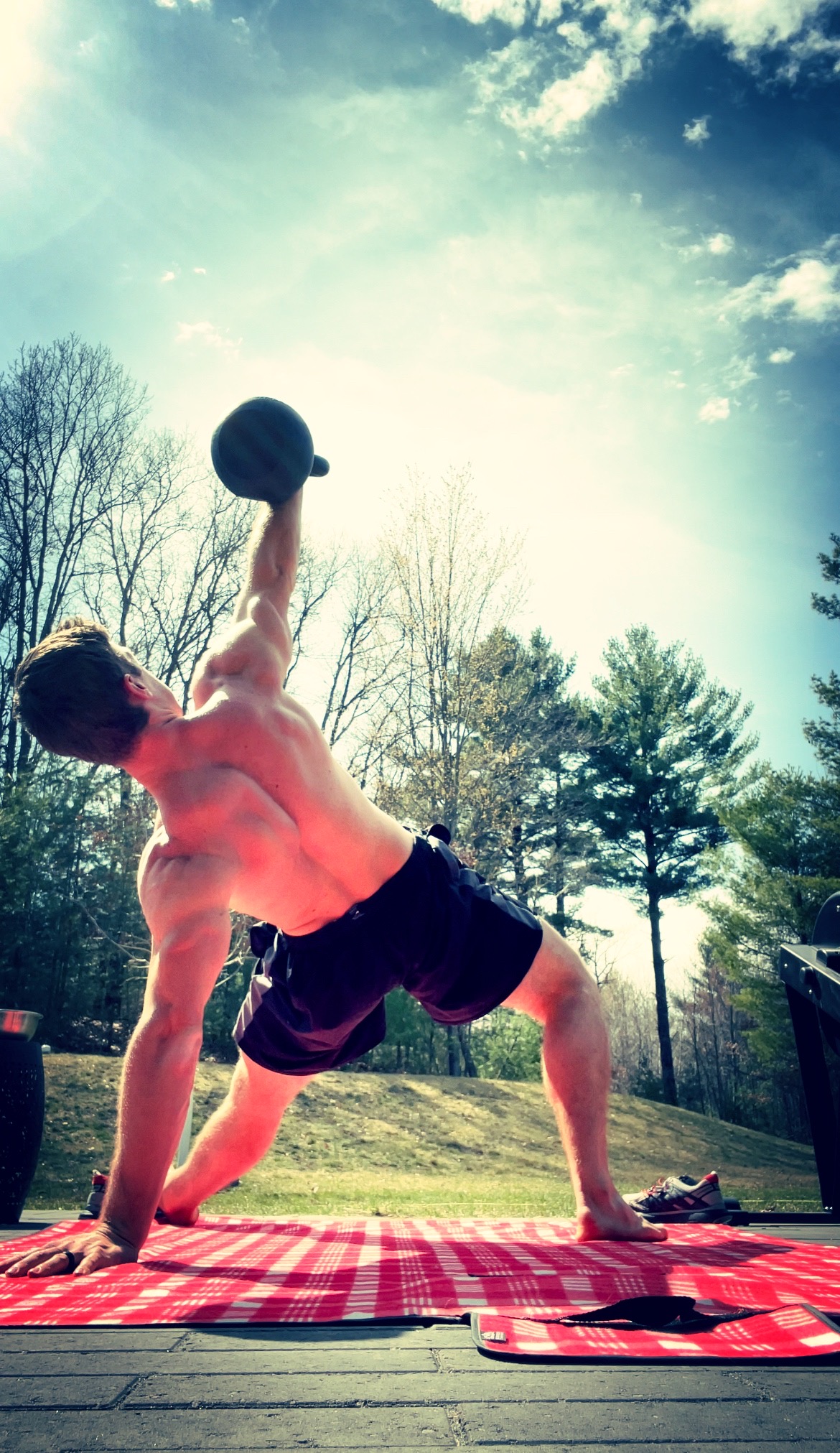
The gist of Turkish Get Ups is to move from a laying position to a standing position, returning to back to the original laying position. While you’re moving, a shoe or weight (kettlebell, dumbbell, etc) is being supported using one arm. The weight starts out over the chest, but eventually ends up vertically overhead.
Turkish Get Ups build tremendous total body movement strength, and are great for reinforcing shoulder stability.
(At the bottom of this post I’ll share a link to other challenging Turkish Get Up variations worth exploring.)
Combining Turkish Get Ups and rowing into the same workout creates a total body training stimulus that is time efficient (30 minutes and you’re toast).
Note: The great part about mixing rowing with Turkish Get Ups is that it fills in a gap. Upper body pulling. Pulling is one motion not included in a traditional Turkish Get Up. One of the main features of rowing is the pulling. Match made in heaven.
Turkish Get Ups tax the legs to some extent, but not horribly. The lunge to stand up and down is the primary lower body movement in a Turkish Get Up (along with lifting the hip lift), and the overall volume of lunges performed is really low. If you’re performing 10 Turkish Get Ups on each side for a workout, that’s 10 reps of lunges per side.
For most people the lunge is not going to be the weakest link in the chain when selecting weight for Turkish Get Ups. The lunge is going to be challenging, especially stabilizing the weight overhead, but a sub-maximal effort. You can likely lunge quite a bit more weight compared to what you’ll use for TGUs (slang for the in-crowd).
Rowing is lower body intense, yet low impact. It’s low impact in comparison to activities like running or jumping rope. Low impact does not means it’s easy. Each stroke requires a big effort from the legs as you unhinge at the waist, extending the knees and hips (along with upper body pull). You’re driving hard with the legs to push away from the flywheel, creating powerful strokes.
Rowing experts might cringe at this statement, but I like to think about rowing strokes as being similar to a repetitive horizontal barbell clean, if such an exercise existed.
Anyways…
The main message is: Turkish Get Ups and rowing make a great pairing for a total body workout, without needing much time.
Cardio and strength in 30 minutes.
The Workout
Set a timer for 15 minutes, start performing Turkish Get Ups, alternating each side. Do not stop until the timer sounds. Of course, grab a drink and towel off the sweat, but keep moving.
Next, hop on the rower. You have a few options with the rowing portion of this workout:
10 sets of 250m distance
6 sets of 500m distance
No matter what distance you choose (or a mix of both) follow a 1:1 work to rest ratio for rest periods. If it takes 1:45min/sec to row 500m, you’re resting the same amount of time before starting the next round. If it takes you 55sec to row 250m, you’re resting 55sec before starting the next round.
Make no mistake, a 1:1 work to rest ratio is intense. Round 1 might easy, but rounds 4-5 definitely will.
Fatigue breaks people in half.
Note: If you need to take more rest in between rounds, you make that call and you take the rest that you need. I am only making the suggestion of 1:1, this is not the law.
Bonus Points: Vitamin D 🌞
Doing this workout outside, under the sun, will earn you bonus points.
Much has been written about the importance of maintaining adequate Vitamin D levels.
I live in Wisconsin. We are a translucent, see-through, pale skinned people coming out of Winter. The first 50+ degree day, we flock outside like it’s Summer. Brats, beer and completely underdressed, yet feeling comfortable and happy.
Warmer temperatures and the sun lifts moods in the Spring.
Moving the workout outside, limiting the clothing you’re wearing to allow the sun exposure to as much skin as possible is a nice little bonus.
Attempting to kill too many birds with one stone can create headaches, but this is a seamless tweak to the workout. Just get outside.
In general, if you can transition a portion or all of your workouts from inside to outside, you have an opportunity to reap the benefits of sunlight and the benefits of exercise.
That’s powerful stuff.
Equipment-wise, Concept2 is my rower of choice. It’s bulletproof and used by Olympians, so it’ll be good enough for the average Joe/Jane.
What I’m about to say regarding kettlebells isn’t completely true, but to some extent, weight is weight. Especially now, with the pandemic decimating most of the fitness equipment inventory, find what you can and buy it. I also have a responsibility to be sensitive to everybody’s financial situation. These kettlebells bridge the gap between cost and quality.
Remember, companies will charge you for shipping weights. So now your $1.50 per pound kettlebell is suddenly $2.75 per pound after shipping. Even heavier kettlebells (up to 70lbs) from Amazon bypass shipping costs with Amazon Prime.
Explore: Turkish Get Up Variations
Earlier in the post, I promised you Turkish Get Up Variations.
Push-ups are one of the best all around upper body exercises.
You can do push-ups anywhere, anytime, using hundreds of different variations branching out from the standard push-up that you see me performing above.
Push-ups are an effective muscle, strength and endurance builder for the anterior (front side) muscles of the upper body.
In absolutely no order whatsoever, here are a 5 quick benefits and ideas about push-ups…
Moving Planks
Push-ups are essentially dynamic (moving) planks that require whole body tension. Maintaining body tension provides benefits far beyond defining the chest and arms. From the armpits down to the heels, nothing is changing position while the arms/chest push up and lower down. The muscles of the core have to participate or technique will slip.
The practice of creating whole body tension will spill over into other movements that also benefit from body tension.
In fitness, everything seems to help everything else. Some thing more than others, but still.
Regarding the reference to push-ups being “moving planks”, try holding the bottom/middle/upper position of a push-up during each for 5 or 10 or 15 seconds, each position. See what you think. 🔥
Free the Scapulas
Push-ups are a great exercise choice for shoulder health, because the scapula are free to move. For this reason, push-ups can and should be mixed in with traditional bench press type exercises. It’ll help balance out the pressing exercise variations and add more flavor to your workout.
I’m not a push-up junkie, nor am I a bench press hater. I value all exercises. That being said, it’s important to be informed about the benefits of push-ups and how effective they are. Push-ups take a backseat to bench pressing, and they should’t. Don’t get fixated on it.
Add Weight for Strength and Muscle
If you’re able to perform 40 to 50+ continuous reps of push-ups without feeling much fatigue, it’s time to consider increasing the load progression somehow, someway. To increase the challenge, add weight to your back using a weight plate, weight vest, sandbag and or rubber variable resistance band is effective to attack load progression. Don’t get fancy here… just add weight and start pushing.
People forget push-ups can be progressed (just like any other exercise by adding weight), and how far the load progression can go. You can execute 3-5 reps of grinding push ups or even 1-rep max type efforts. Doing so will build strength and muscle using a different type of pressing exercise.
No weight?
Slow down bodyweight push-up tempo going down and up. Perform one repetition that last 60 seconds. 30 seconds down, 30 seconds back up. Even if a push-up only requires around 70% of bodyweight, 60 seconds for a single rep is brutal.
Push-ups don’t seem to create an insane amount of body fatigue. Beginners tread lightly here. A lot of people perform a fairly high number of push-ups almost daily without issues. I’ve gone in spurts where I’ll perform quick 20 rep sets throughout the day, around 5-6 times per day. 5 sets of 20 rep = 100 push-ups. Done daily for a year, that’s 36,500 reps of push-ups in a year. If you’re into aesthetic make-overs, doing 36,500 reps of push-ups per year would impact looks dramatically.
The simplicity of push-ups make them a brilliant exercise. A hidden gem. The 100 push-ups per day idea reminds me of the 10,000 steps per day target.
How would you feel (and look) if you stayed disciplined to walking 10,000 steps and performing 100 push-ups every day?
Don’t underestimate the power of doing the little things regularly.
People might think you’re wasting your time until they see what consistency looks like across 365 days. 💪
Push… AND PULL
Like anything, too much of a good thing could become a bad thing. A balanced workout regimen will include a fair amount of pulling exercises to balance out the pushing. Including an adequate amount of pulling exercises will help avoid creating cranky shoulders and imbalances. I’d suggest at least a 1:1 pull-to-push ratio in a workout regimen, if not a 2:1 pull-to-push ratio.
The basic message here is do not become infatuated with pushing, engage in pulling also. Backside muscles of the body, both upper and lower body, are extremely important.
For more push-up variations, head over to my YouTube channel and search “push-ups”. I do a pretty good job organizing and cataloging exercise videos for convenience.
Just as push-ups are similar to moving planks, the lizard crawl is a leveling up dynamic variation of push-ups.
There are many unique fitness benefits of macebell training for people who are looking for a different training stimulus that only the macebell can provide.
Macebell training, in the modern age, is primarily performed using a macebell, or steel mace. Historically, Gadas were used by Indian wrestlers and strongmen to develop strength for sport.
Steel mace, macebell, steel macebell or mace are interchangeable terms describing the same piece of fitness equipment. It can be confusing seeing different terminology when you’re first learning. The exercise catalog is exactly the same.
Macebells have a distinctive design which is what makes the exercises unique, interesting, fun, challenging and beneficial for building physical attributes that other fitness equipment cannot.
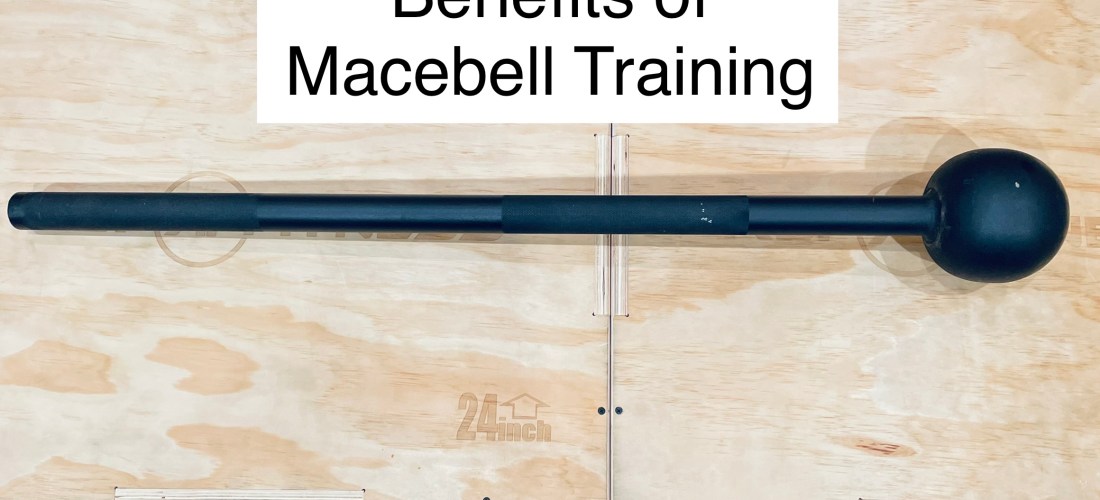
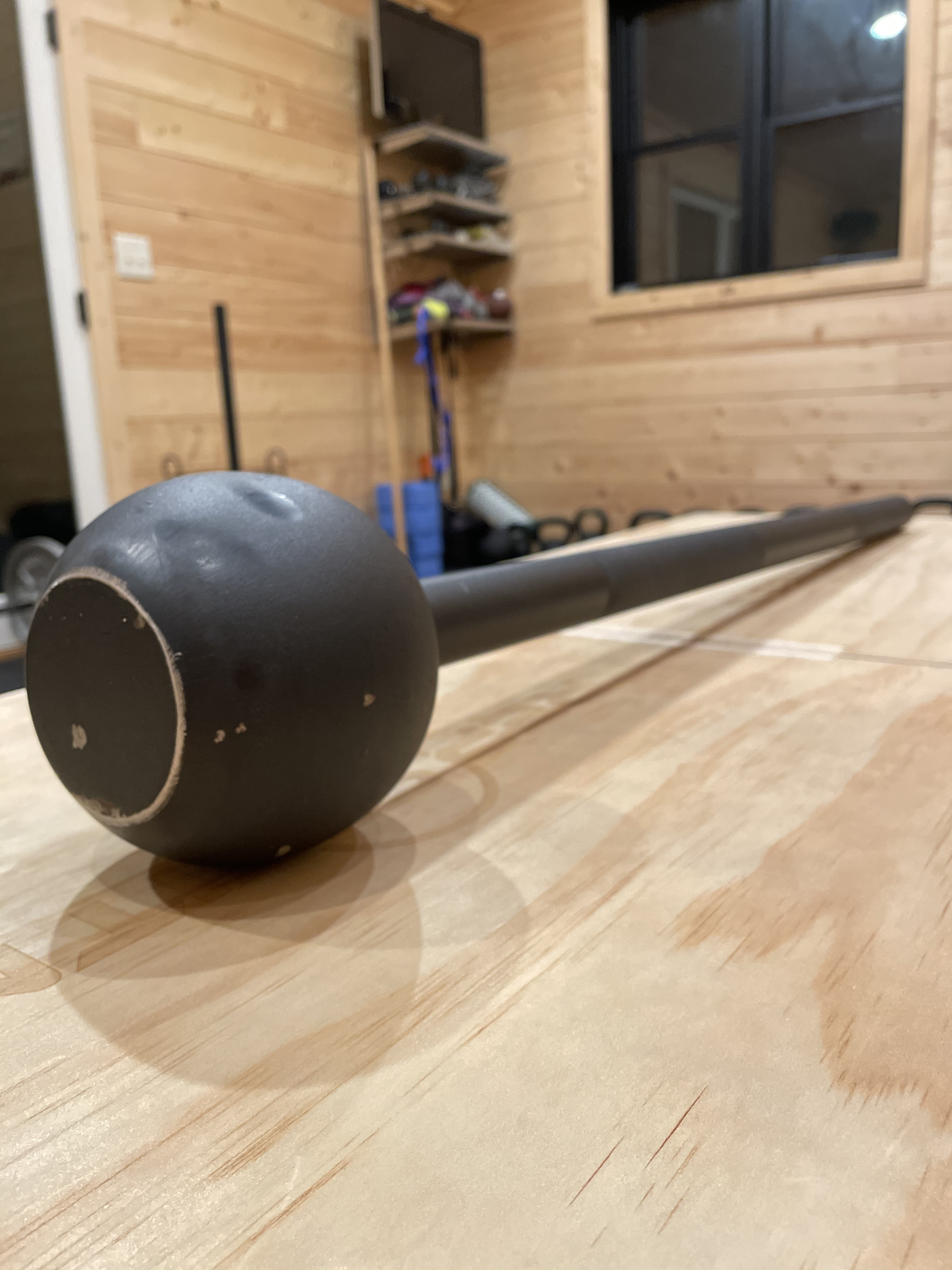
A macebell is ball with a long handle attached to it.
Macebell
Most of the weight of a mace is located at the end of the handle, or the head of the mace. This extreme offset center of gravity is unlike dumbbells or even kettlebells.
The shape and design of the macebell create opportunities to train high torque, asymmetric and circular strength exercises.
The magic of mace training is in design of the tool.
Benefits of Mace Training
Grip strength and endurance
Shoulder strength and mobility
Force producing/Force resisting
Rotational, total body strength
Reactive core stability
Cardio-strength training
Hand-eye coordination, motor control, balance, proprioception
Less linear (breaks out of the sagittal plane)
High torque, asymmetric loading,
Exercise variations
Portable piece of equipment
Learning new physical skills
Fun and challenging
All of the benefits of mace training, listed below, can be experience with consistent mace practice.
Benefits of any style of training are maximized when you’re committed to consistent practice, versus dabbling here and there or training mace every other month.
Use it, or lose it.
Here are mace training benefits, explained…
Grip Strength and Endurance
Grip strength is one of the most underrecognized athletic qualities, and mace training does an incredible job not only improving grip strength but building grip endurance.
Too many articles overcomplicate this.
You’re swinging a weighted ball attached to a handle, at high speed, with hands fighting to maintain grip in a relatively disadvantaged position (compared to gripping a kettlebell, barbell, etc).
Macebells train the grip dynamically.
Just don’t let lose your grip, or it’s destroying whatever surface is nearest.
Shoulder Strength and Mobility
Recently, I came across a macebell article promising the readers, “You’ll have the shoulder mobility that you thought you’d never have”.
Meh, be careful with that.
People who specialize in teaching a certain method, discipline, or fitness tool tend to over-exaggerate the benefits of that tool. That person discovered macebells before others, experienced improvements in shoulder health, kept training and now asserted themselves as an expert touting big benefits.
To be honest, I’m not a huge fan chasing basic mobility using weighted steel ball whipping at high speeds.
If your shoulders are locked up and cannot move freely, performing basic motions (overhead reach, cross body, slow and controlled shoulder circles, aka CARs), swinging a weighted steel mace seems risky.
“Hold up, you’re saying macebells aren’t good for improving shoulder mobility???
No, that’s not what I’m saying.
I’m saying twirling a mace without first establishing basic shoulder control and strength could be a bad idea.
Do this… lift your arm overhead, flex at the elbow, reach and touch as low on your spine as possible.
How’d it go?
If you can’t scratch the back of your head, it’s questionable if you should be swinging a heavy medieval looking weapon.
Instead, adopt a shoulder mobility strategy that’ll lay a good foundation of shoulder strength, control, and the ability to articulate through a sexy range of motion.
No weight necessary, just use bodyweight against gravity to begin with.
Exercises like CARs, prone swimmers, lift-off, external rotation work, Y-T-W-L, will do wonders for your shoulders.
4-5 days per week, for months.
After building up your shoulder range of motion and control throughout that range of motion, bring macebell training into the mix and get after it.
Mace training has the ability to improve shoulder mobility and performance (even mitigate injury).
The macebell will do an excellent job of building resilient shoulders, but I prefer to add in dedicated mobility training that will establish range of motion, articulations and strength.
Force Producing/Force Resisting with a Unique Motion
Most exercises involve force production and resisting forces, but I think the key wording is: with a unique motion.
The mace 360 swing and 10-and-2 exercises cross the midline on every repetition, and that is extremely unique in the exercise rolodex.
You’re producing force to swing the mace from the bottom position (behind the tailbone) and resisting force as the macebell begins it’s descent into the next rep.
Circular macebell movements like this are a brilliant addition to any workout regimen.
Rotational, Total Body Strength
Macebell swing exercises such as 360 swings and 10-and-2 cross the midline of the body on each repetition, and effectively train the torso.
Rotation and macebell are synonyms.
The first time you swing a macebell, you will realize how different of a training stimulus it really is.
It’s a total body workout.
The legs are spared, to some extent, but you’ve got to stay active and tight to twirl that sucker.
If you’re serious about building well rounded fitness, make sure you’re including rotation exercises in your workouts.
Reactive Core Stability
The goal is to control every millimeter of the swing with regard to technique, but with that being said, not every rep is exactly the same.
You’re constantly adjusting to the torque of the mace traveling, offsetting the mace’s tendency to pull you out of position, which is great for reactive core stability.
My first few attempts at swinging my 25lb macebell threw me off-balance immediately. I’m lucky I didn’t lose my grip or head into the wall.
It’s amazing how quickly the body acclimates to demands. Shortly after, my body acclimated to the moves.
Cardio Strength Training
Do enough repetitions and you’ll get a great cardio strength training effect from exercise like swings and gravediggers.
Gravediggers are pure work. It’s like digging up dirt, except you’re not shoveling anything and the range of motion is larger.
Much like kettlebell swings, rhythmic macebell exercises can be an excellent choice for loaded conditioning.
Here are a few simple ideas:
Combine gravediggers and/or swings to bodyweight exercise like push-ups, squats, lunges, pulling, and core work
Do 10 sets x 10 reps on each side of macebell 360 swings. Rest for 20-30 seconds in between each work set
Perform as many 360 swings as possible in 5 minutes (alternate sides every 5-10 reps, your choice)
I find value in pairing up my Concept2 SkiErg with various mace exercises. All conditioning is performed in the standing position.
Exercising with the SkiErg is a flexion/extension heavy movement pattern and exercises such as macebell 360 swings compliment SkiErg using a cross-body circular motion.
Bouncing between the SkiErg and the macebell repetitions is quick and painless.
Hand-Eye Coordination, Motor Control, Balance and Proprioception
Macebell exercises require focus.
You cannot check out while the mace is in motion, or you’re breaking bones, impacting your body, throwing the mace through a window or wall, or tweaking something.
These movement requires ongoing ironing out of timing, body position and mechanics.
Adding new movements to your repertoire only serves to boost your coordination and motor control.
Don’t be slug, expand your movement IQ.
Less Linear (breaks out of the sagittal plane)
There are 3 planes of movement: saggittal, traverse and frontal.
A really high number of exercises take place in the sagittal plane (squats, deadlifts, etc).
One clear benefit of macebell training is the rotational element.
Incorporating rotational-rich exercises can really make a big difference in performance and everyday life, since rotation is part of daily movement.
High Torque, Asymmetric Loading
Look no further than the macebell swing for a high torque movement.
The further the hands are positioned from the head of the mace, the longer the lever arm, the more torque will be created.
For beginners, it’s beneficial to start with a lighter weight macebell and/or position the hands closer to the head of the mace for any swinging exercises.
The closer your hands are to the head of the mace, the shorter the range of motion and overall torque during swinging exercises. You’ll be able to control the movement with this modified hand position.
With asymmetric loading, most of the weight of the macebell is located at one end of the handle. This makes the macebell asymmetrically loaded at all times, much different than a dumbbell.
Because of this, your body is constantly working overdrive to maintain body position during exercises.
Exercise Variations
Macebell 360 swings, 10-and-2 and gravediggers are a few of the more popular and recognizable exercises.
Other exercises ideas that work well with the mace:
Squat
Lunge
Rotational drills
Push-ups
Bicep curls
Slams
Carry
There are macebell movements that are extremely hard to name and define.
Exhibit A:
Several exercises can be combine together to create a pre-planned flow sequence, or an improvised flow.
Improvised flows require exercise and mechanics know-how, but they are really fun and challenging.
Portable Piece of Equipment
Some might disagree, but macebells pack away in the car nicely if you’re traveling.
I’ve brought my macebell to hotels and it adds a pretty cool element to hotel workouts that are otherwise pretty shitty places to workout.
The average hotel gym is crap.
Remember, a 15lb or 30lb macebell will feel like 2x that weight.
So it’s not as if you’re hauling around hundreds of pounds of bulky fitness equipment.
Learning New Physical Skills
Countless studies have demonstrated the brain benefits of exercise and learning new physical skills.
Shiny six-pack abs are desirable (for some), but the benefits of macebell training on a regular basis go far beyond a nice midsection.
Learning new physical skills connects the body and brain in incredible ways.
Fun and Challenging
I’ve been training with barbells, kettlebells, dumbbells and suspension trainers for over 15 years.
The day I pulled my macebell out of the shipping box and started playing around with simple exercises, it felt like new life had been injected into my workout regimen.
I love getting new fitness equipment. Who doesn’t?
To me, this is a huge benefit of macebell training… the simple idea macebell training is DOING SOMETHING DIFFERENT.
For those of you who are all work and no play (ahem… barbell peeps), get a macebell and start swinging.
Do not be afraid to try new things out of curiosity.
Fitness pro’s tend to be WAY too strict and stuffy with fitness advice.
Train outside of your current comfort zones.
The rotational aspect of macebell training is what initially lured me in, but I was pleasantly surprised with how versatile the macebell became over time.
Move your body, work hard, refine technique and have fun.
Adex created an adjustable mace that uses one handle and modular weights allow the mace to be loaded with 11 different weight settings (2.5lb increments) from 6lbs-30lbs.
Game changer.
Actually, I’d buy the big deal package from Adex, which gets you short, medium, and long handles which are all compatible with modular weights.
Now you’re in the game with an even wider spectrum of exercises.
If you train in a home gym, space is one of the most important considerations, and an adjustable mace will have a much smaller footprint.
Preserve space.
In Closing
The benefits of mace training are pretty extensive, but remember, it’s all about taking action.
Consistency is key to getting benefits from any approach to fitness.
Rear foot elevated split squats (often called “Bulgarian Split Squats”) are a time-tested and resourceful exercise that are pure gold for building strong legs.
If you’ve got a stable surface roughly 18” high to prop your rear foot onto for support, you’re good to go.
Rear foot elevated split squats are more difficult (compared to bilateral squats) for two simple reasons:
The front leg is pushing against more weight.
Stability is decreased.
Back leg (rear foot) helps to stabilize, front leg pushes.
Rear foot elevated split squats are a supported squat, whereas pistol squats are an unsupported squat.
Rear foot elevated split squats (RFE-SS) are effective for improving single leg squat strength without requiring access to a bunch of weights or a gym, and while sparing the back.
Rear Foot Elevated Split Squat Technique
The Set-Up
Here’s how to get into a good start position for the rear foot elevated split squat.
TOP of the foot rests on the rear surface, not the ball of the foot.
Hot tips on technique:
Front leg does the work (not the back leg)
Back leg provides as little assistance as possible.
Lower down until the front leg (femur bone) is parallel to the floor.
“Kiss” the rear leg knee cap to the floor.
Drive through the heel/midfoot and EXPLODE back to the top
Head up, gaze 6-8 feet out in front of the working leg.
Inhale and pressurize before descending, exhale driving back to the top.
How many reps/sets/days per week?
3-5 sets of 3-6 repetitions using a challenging weight will provide a great stimulus.
Train this exercise 2 days per week to start, with 1-2 days of rest between each training day.
Put in the work, rest, recover, come back in a few days and attack it again.
Progressive Loading for Rear Foot Elevated Split Squats
Beginners can start with assisted or bodyweight only RFE-SS to acclimate to the demands of loading, balancing and stabilization required to train using a single leg.
Progressing forward from assisted and full bodyweight variations, just add weight.
Whether you’re a beginner, intermediate or advanced, adding weight progressively is the path to making gains.
Adding weight to rear foot elevated split squats using tiny increments is my preferred way to get the most out of the exercise.
It’s hard to argue with the effectiveness and simplicity of progressive loading.
Select a weight that you can control.
A lot of people make the mistake of going too heavy, and technique suffers. Reps should be quality, smooth and free of any compensations.
Start with light weight, perform a few reps. If you need to increase the weight, do it. If not, stay there and execute the reps and sets for the workout.
If you have access to weight equipment, here are a couple of ways to vary the exercise.
Adjust the position of the weight. Weight can be held in the suitcase position, front rack, bearhug, overhead, etc. The suitcase position is straightforward and best for beginners. The higher the weight goes (chest level, over head, etc) the more difficult it becomes to hold position.
A front racked barbell is also a brutal variation. Start light here.
Asymmetrical Loading. Only have 1 dumbbell or kettlebell? Perfect, use it. Hold it on the inside of your foot, outside, front racked position or overhead.
Get creative. Life is one big asymmetric party. Balance is for the birds.
No Equipment to Add Weight?
Beyond adding weight, there are other ways to modify the exercise to increase the challenge.
For people who are training at home or don’t have access to weight equipment, the following tweaks can be made to boost the difficulty.
Vary the tempo (slow down, fast up). Spend 5 seconds lowering to the bottom, pause for 1-2 seconds, explode back up.
Increase the range of motion by elevating the front foot. Even elevating a few inches will increase the range of motion on each repetition. Be careful to avoid elevating the front foot beyond the rear leg/hip flexors capacity to stretch on the way down.
Instability. Place front foot on an unstable surface. A pillow folded in half, BOSU ball, uneven surfaces, etc. Unstable training is not the end all be all, but our bodies should be conditioned to handle uneven terrain in the real world.
Add volume. Adding extra reps and sets is always an option. At some point, additional load will be necessary to keep making strength progress. Keep that in mind.
If you have resistance bands, you can loop the band underneath the front foot and around the shoulders to add resistance to the exercise.
Single Leg Training is Suffering
Single leg work sets are LONG.
Both legs must complete the designated number of reps in each set, the amount of time spent working is TWICE as long.
Finish 6 reps on the right side, switch legs and do 6 more reps on the left side. The work sets are extended.
You’re holding the weights for a lengthy amount of time, grip training is a nice byproduct.
Pure suffering.
The ability to get comfortable suffering is an added benefit to this style of training.
I’m careful not to come across with too aggressive of a hard ass tone on this blog, but holy cow, conditioning your body and mind to embrace discomfort during a workout is a CHARACTER BUILDER that will spill over to other areas of life.
By the numbers, you can get the same training stimulus with RFE-SS using half the weight as a bilateral squat.
If a person can barbell back squat with 300lbs, a RFE-SS can be loaded with a pair of 75lb dumbbells and achieve nearly the exact same training effect.
For those with cranky lower backs, RFE-SS is lower back friendly, assuming you hold weight at the side of the body and avoid going into excessive lumbar extension at the bottom.
I’m not suggesting you avoid stressing the lower back forever, but for those who have previously dealt with cranky back issues, this variation is a nice alternative to build lower body strength while minimizing the chance of re-injury.
“I don’t have access to a bench.”
You don’t need a bench.
What do you have laying around that can be used to set the top of your foot on?
The only reason so many videos exist of people performing rear foot elevated split squats using benches as the support surface, is because most of these videos are being shot inside of gyms.
Benches are a common piece of equipment in gyms and the top surface of a bench is rather soft so it won’t dig into the foot with or without shoes.
I’m big on training without shoes when it makes sense, foot directly in contact with the floor.
For people who exercise at home, the following items can be substituted if a bench isn’t an option:
Chair
Staircase
Sofa
Coffee Table
Suspension Trainer/gymnastics rings
Low plyo box
Toilet
Bar racked at a knee height
Tree stump or log
Literally anything that’s roughly 18 inches high and reasonably stable will work just fine.
The rear foot will, at times, need to apply pressure into surface it’s resting on to help maintain balance throughout the work set.









 M(eaux)tion Fitness