Bodyweight Leg Conditioning Using Dragon Squats, Lunge Variations and Horse Stance

Motion

Dragon squats, lunges and horse stance are great exercises to help improve lower body strength and efficiency.

I went on a pretty solid run of posting lower body drills (dragon squats, curtsy airborne lunge, horse stance, etc) on my Instagram page, so I thought I’d repurpose those posts into a blog.

You can find and follow me at instagram here.

All of these posts depicted bodyweight leg exercises.

I find myself posting more and more bodyweight-based lower body exercises, using no equipment, just progressively challenging body positions/mechanics/timing.

2 years ago, I couldn’t fathom performing a full dragon squat.

I couldn’t even comprehend how my body was going to allow me to drop down to the floor with the hovering leg positioned behind my working leg.

Making progressive gains in mobility and literally feeling your body adapt to positions, stress and range of motion is a crazy experience, but it takes consistency, discipline and reflection.

One day you might feel a million miles from being able to perform an exercise. Fast forward 2 weeks, and you own it.

Quoting Mat Fraser, “Hard work pays off”.

4x Speed Lunge Variations

Lunge training, using ONLY bodyweight and added weight, has become a staple in my workouts over the last 6 months.

Almost daily, I noticed myself using some variation of a lunge pattern to perform basic tasks or play with my kids, and decided to commit to training lunges more regularly.

People sound off about how great the squat is for daily activity, and I’m not saying it isn’t, but the lunge is a workhorse for me.

After becoming a Dad, my reasons for training shifted a bit. Preserving my ability to get up and down from the floor with EASE became a priority.

I started thinking about when I have grandchildren. My life would be fullest if I’m able to maneuver up and down from the floor (where kids dwell in there younger years) without any issues.

The lunge pattern is an excellent way to make a transition from standing to the floor (and vice versa).

I used to dodge like the plague.

In reflection, this avoidance was two-fold:

  1. Discomfort, not being as good at lunges as other exercises.
  2. Perception that single leg squat practice was enough.

The number of times we avoid exercises because we either suck at them or the discomfort is overwhelming is humbling.

Notice in the video above, the number of variations I’m playing around with.

Extended stance, feet close together, knees way out over the toes, lateral lunge, reverse lunge, static hold/pause, rotational lunge, etc.

Lunges don’t have to be a dull experience.

Practice and acclimate to all lunge variations using simple variations first and progressive loading.

Expand.

Curtsy Airborne Lunge

I had no clue that this exercise was called the “Curtsy Airborne Lunge”, until I started performing it and felt the need to assign it a name.

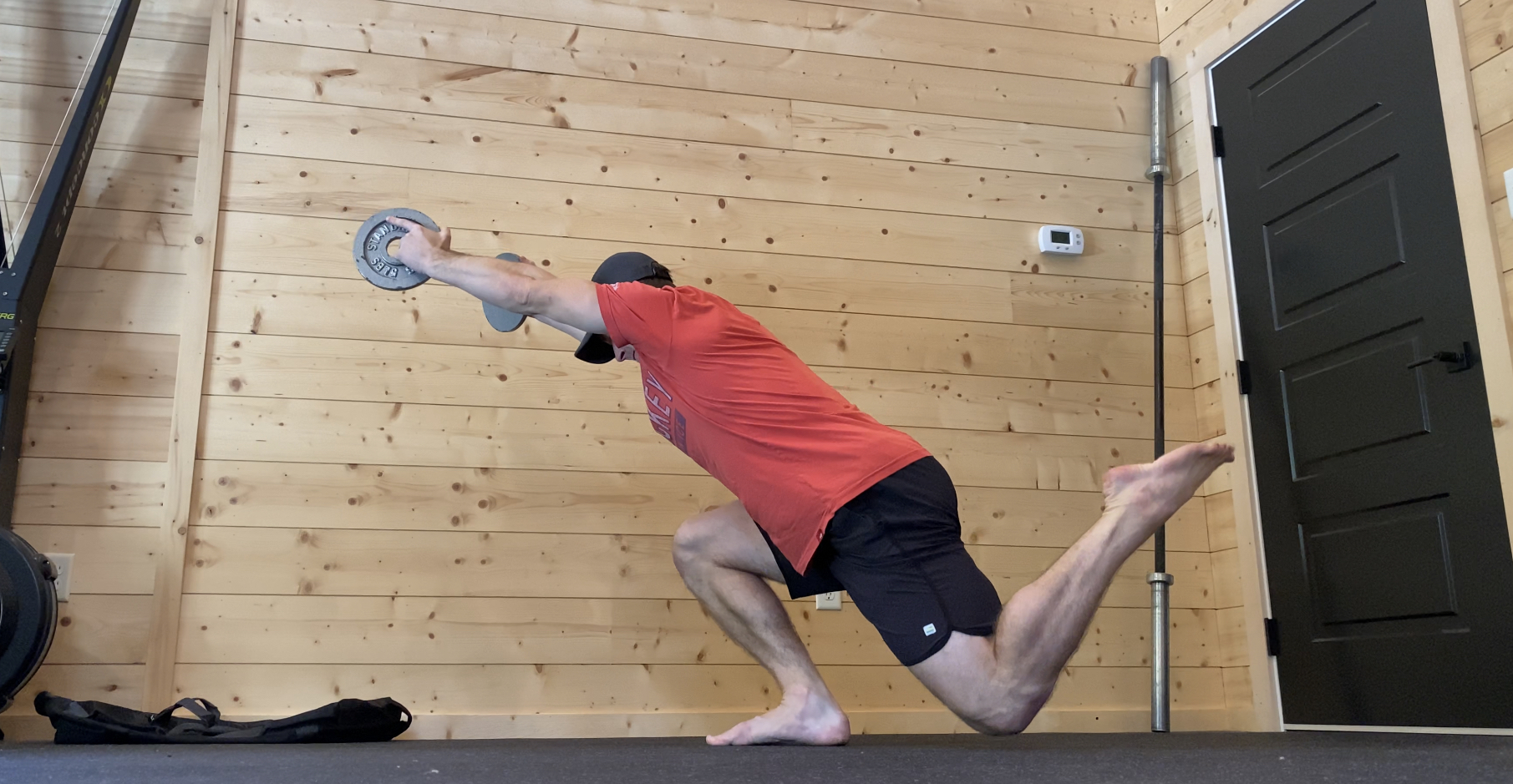
The curtsy airborne lunge is a phenomenal exercise regression that can help lead a person into a dragon squat.

Why?

Curtsy Airborne Lunges use similar mechanics. Lowering down, touching the knee cap to the floor on the outside of the working foot looks a lot like the initial lower phase of a dragon squat.

What makes this exercise a regression, is not having to deal with hovering the trailing.

Keeping the trailing leg off the floor during a full Dragon Squat is hard.

You’ll see what I’m referring to in the next video.

Dragon Squats, Ice Cold in Street Clothes

In my opinion, cold performance is the only thing that matters beyond competitive athletics.

Pretty bold statement, but whatever athletic qualities I can express at the snap of a finger, ice cold (no fancy 15 minute warm up, activation, core temp elevation, mobility, etc) with whatever clothes and footwear I’m wearing is my performance capacity.

Right?

I like to test cold performance periodically.

Cold performance efforts are, of course, at my own risk.

I accept this risk.

Horse Stance and Cossack Squats

Horse stance and Cossack Squats are two exercises show up in my daily workouts.

Sometimes I use them during the warm up, other times I’ll add weight to build strength, or I’ll slip them into a flow sequence.

It’s amazing how often I use a dead stop Cossack Squat to stand up from the floor with my kids in my arms.

Quick Deadstop Cossack Squat

From any seated position, bring either leg in, foot close to the butt cheek, slight transfer of weight forward to steady myself and load the foot, push and stand.

Simple as that.

I added a 53lb kettlebell to the video above as a defense mechanism for the hecklers out there.

If you have ownership over a movement or range of motion, you’ll use it.

If you don’t, you’ll avoid it.

In the case of performing a Cossack Squat from the bottom position, I own it, so I use it A LOT.

The value of pursuing efficiency with a robust number of movement patterns and ranges is that it gets hardwired in your system. Practice these movements until you can hardly stomach another repetition, then transfer it to real life. The gym is a controlled environment where we can build our bodies to perform out in the real world.

It’s difficult to explain to people how liberating being able to move confidently however, whenever, wherever really is.

Zero aches. Zero pains. Zero restrictions. No second thoughts of “Can I do this?”.

When you own it, you just do it without hesitation.

Being able to access a wide array of movements and having control over a robust range of motion will seriously change your life. Lowering your susceptibility to injury is an often overlooked MAJOR benefit of building a body that can move well.

Regarding long holds in the horse stance, allow me to set the expectation for you. It’s a slow death. No way around that.

Turn gaze out into space with a blank stare and feel your soul drip out of your body, through your hips. Bonus points if you don’t moan softly or wince.

You develop a tolerance for the discomfort, and quite frankly, plowing through the discomfort is something you’ll have to acquire a taste for if you desire fitness.

This reality is left out of many fitness books.

The carryover from horse stance conditioning into Cossack Squat work has been profound.

Vahva Fitness – Movement 20XX Review

Motion

In recent years, functional strength, mobility and movement training, and Animal Flow are all modes of exercise that have grown in popularity and taken the fitness industry by storm.

The quality over quantity approach to fitness has gained traction as people realize how good it feels to improve mobility and movement capacity, while still achieving aesthetic goals.  

Improving mobility can improve lean muscle gains because joints are able to move through a larger range of motion, while staying safe and mitigating injury.

A big key to getting fit and staying fit regardless of circumstances (space, equipment, time, etc) is learning how to exercise without equipment.  

Moving your body through space, without equipment… changing shape, exploring and building strength and efficiency at all angles while working varying tempos.  

For imperfect workout spaces, which most home gyms are, knowing how to exercise purposefully with minimal or no equipment is a game changer. 

Across the last year, lockdowns and closing of gyms has given people a new perspective on what life might look like without access to gyms and athletic facilities.  

Gyms closures have created a huge demand for workout alternatives as people try to figure how to keep moving, stay healthy and pursue athletic performance (and physique). 

All without having access to weights and cardio equipment.   

People who were once hesitant to embrace online fitness coaching were forced into considering the online fitness format to stay fit during the Pandemic.  

Not having access to gyms was the nudge people needed to check out online training options.  

For the record, online training is NOT what it used to be. It’s significantly better.

Fitness has evolved and transitioned from being solely an in-person experience, to giving customers damn good results through high quality coaching/instruction, tools and memberships. A number of companies have bailed on doing in-person sessions because they help more people using the online format.

Online fitness products are cost-efficient, convenient (train anywhere, anytime) interactive and the coaching is top notch.  

Fitness can now be streamed to directly to your location (home, hotel, outside, etc) and has become a really effective way to train and make significant progress.  

Technology has improved (mobile phones, tablets, better wifi, etc). Exercise instruction is captured and uploaded in HD, clear as day.

The modern day trainer has also adapted to the online marketplace, providing clear and concise communication for members to get the most benefit out of the product.

Vahva Fitness

Vahva Fitness Movement 20XX

Years ago, Vahva Fitness launched several successful programs to satisfy the rising demand for quality online fitness programming. 

  •  Movement 20XX 
  •  Athlete 20XX
  •  Warrior 20XX

(Athlete 20XX and Warrior 20XX are programs that’ll have to be reviewed later.) 

Vahva Fitness’s flagship movement program, Movement 20XX, offers up an under-addressed catalog of movements, exercises and flows.

Natural movement training, ground based conditioning and other multi-planar bodyweight exercises are incredible for building a capable body, yet often absent from workout regimens.

This review may serve as an introduction to such training styles.  

People who’ve added dynamic ground based movement exercises/drills to their workouts quickly realize how effective it is at tying everything together.  

Lifting weights and cardio training is great.  

But weight lifting is very linear, while the human body is very dynamic and capable of moving in a million different ways.

Bridging the gaps that are sure to exist between repping out squats/deadlifts and cardio training by using multi-planar movement drills (and flow work) will catapult a person’s movement know-how.

Cherry picking the best elements from various sectors of fitness, Movement 20XX will get you strong, mobile and limber in one shot. 

Prior to the pandemic, Movement 20XX was already starting to emerge as one of the best online fitness programs.

Eero Westerberg and the Vahva Fitness team took a risk on creating a program that veered away from the, “We’ll make you dead tired with insanely high intensity workouts to get the body of your dreams” approach that so many other mindless fitness programs have suckered customers with.   

One of the biggest misconceptions in fitness is that results are based on fatigue.

Redlining the body every workout is a horrible idea, which becomes even worse of an idea without adequate rest and recovery between each workout.

Any fool can make another fool tired.

Movement 20XX is designed to teach people how to move well, restore form and function and build bodies with the holistic approach. 

Don’t get it confused however, you’re sure to be humbled by the difficulty and intensity of the movement curriculum.   

The customer is NOT always right when it comes to making decisions on fitness.  

Sustainable fitness integrates different disciplines, creating a hybrid approach to exercise and bodybuilding using ALL of the tools, methods, ideas and concepts.  

Movement 20XX is a breath of fresh air and a step in the right direction to offering customers coaching on how to build strength, movement capacity and mobility.   

It’s a whole body approach to movement that’ll build athleticism, improve health and keep you moving at a high level for years to come.  

Let’s take a closer look at why the program has been so successful for so many members and why it’s become the preferred program for my readers.

What is Movement 20XX?

Vahva Fitness Movement 20XX

Movement 20XX  is an exercise program that integrates movement, mobility and strength into an easy-to-follow online system.

Few programs offer customers a hybrid approach to fitness.

It’s an uncommon style with huge benefits.  

The user is exposed to a wide variety of training styles. Plucking the best elements from Yoga, martial arts, gymnastics, calisthenics, locomotion and flow training.

The course curriculum emphasizes learning each exercise in isolation, which is important to lay the foundation for the next phase of the journey, flow sequences and fully flow training. 

Flow based training is phenomenal for mixing different training philosophies into sequences or improvised movement sessions.  

The “isolation+ integration + improvisation” approach is a gold standard methodology for optimizing physical fitness.  

First build strength.  Establish know-how, familiarity, mechanics and efficiency by practicing exercises is an isolated fashion.  

Second, fuse these isolated movements into movement sequences (several exercises performed in a row) where smooth transitions exist between exercises.  Timing, balance and coordination are key during this phase.   

Third, move into improvised flow work.  A flow session can last 60 seconds or carry on for 10+ minutes continuously.  There are no rules here.  You’re moving any way you want using exercises, positions, combinations that you’ve built up during the isolation and integration phases.    

Flow training is a blast and it’s really effective for building a strong and lean body. 

Navigating a movement flow is both physically and mentally demanding.

It’s also the junction where people feel themselves waking up from the monotony of the average body part focused gym routine. 

Movement 20XX – Cost

The best fitness products in the world deliver value above and beyond the price.

Vahva Fitness is known for delivering high-value fitness content, along with membership features and benefits inside of their online programming.

Vahva Fitness Movement 20XX

$997 gets members lifetime access to over 6+ months of insanely good movement training, coaching, exercise demonstrations, regressions/progressions, ideas, and concepts. 

What’s included in Movement 20XX:

  • 53 flow elements and 11 flow routines
  • 30 strength exercises and 30 mobility drills
  • 6 active flexibility drills and 4 static strength skills
  • 6 months of workout routines with a weekly schedule
  • Bonus muscle-up guide
  • Customer support

A 30-day money-back guarantee is honored should the member not satisfied with the product.

The 30-day money back guarantee gives customers buying confidence.  

Vahva Fitness Movement 20XX

By offering a no questions asked money back guarantee, Vahva Fitness is saying “We stand behind the quality of this product”. 

If you don’t like something about Movement 20XX or it’s not what you thought, get your money back. Simple as that.

Pro tip:  Once you finish first 6 months of training, cycle back through the program using more difficult progressions as your starting point.  You’ve got life-time access to the content, why not level up and get even more fit?

Comparatively, the hourly rate for similar instruction from a good personal trainer might range from $60-$100 for a single 60 minute session, and that’s assuming the trainer understands movement training, which many don’t.  

Online fitness programs have a real cost-to-value advantage compared to in-person training.   In-person training certainly has it’s place, but it’s expensive.  

Note:  If you bundle several programs together, you’ll save even more. The Trinity Bundle is a crazy good value, giving the customer the ability to mix it up and explore each program. Buy more, save more. 

A really cool aspect to Movement 20XX is the number of training methods used to create the product. I’ll talk about this A LOT throughout this review, and for good reason.

You’re coached on techniques to improve mobility/flexibility effectively while building strength.

The value of including all of this on one platform using simple to follow coaching and an easy to access website is what truly sets Movement 20XX apart.

It’s important to note that ALL skill levels can participate in this program.

Beginners will focus on performing the movement drills slowly and properly while still seeing the benefits of their effort.

Advanced athletes can scale up the curriculum to increase the intensity, correcting exercise form issues through proper technique coaching and challenging themselves. 

Across the 6-month duration of the course, you’ll begin to notice significant transformations in your physical appearance and performance, and most importantly, your overall health.

Stick to the plan Movement 20XX has created, and you’ll see the benefits.  

What to expect with Movement 20XX

Vahva Fitness Movement 20XX

After becoming a member, you’ll gain access to the member-only resources:

  •  HD video tutorials
  •  Weekly schedules
  •  Daily workout routines.

Movement 20XX is broken down into two main categories of training:

  • Movement Training
  • Strength and mobility training

You can choose to attack movement training or the strength/mobility section (or a little of both) during daily workouts, accessing the content from anywhere (computer, tablet, smartphones, etc) and anytime.  

Movement training

Here’s where it gets fun

The movement training focuses on uncommon whole body movements, blending higher intensity efforts, poses rooted in Yoga and other locomotion intense training and yoga-like poses. 

You’ll be tired, not broken.  

Over time, members gain coordination, strength, improve range of motion.  

As the flows become progressively more difficult, you’ll experience improvements in your agility, strength and mind-body connection.

The movement portion is broken down into 3 different categories:

  • High Flow (performed standing)
  • Low Flow (performed low to the ground)
  • Ground Flow (performed on the ground)

Having this variation is sure to target the body parts that may be neglected in our day-to-day routines. 

The increasing amount of time that the average person spends standing or sitting can have a detrimental effect on our bodies, and movement training is a great way to counteract this. 

These flows will assist in developing functional strength in areas that are necessary for correct posture and stability.

Strength and mobility training

During this phase, members are coached through 30 different bodweight strength exercises and 30 mobility drills using only bodyweight. 

Bodyweight strength training is grossly under-utilized and underrated.  

Again, these exercises are broken down into 3 categories:

  • Pushing strength and mobility
  • Pulling strength and mobility
  • Leg strength and mobility

Time-tested exercises like pull-ups, push-ups and squat variations are essential components of building useable strength, and will add to the potency of the movement and mobility work.  

Strength is crucial for mitigating injury and building a well-functioning body.  

The strength portion of Movement 20XX was designed tastefully, so as not to exclude people with pre-existing injuries or limitations.  

For those with existing injuries or nagging pain, the advice is straight forward:  If it hurts, don’t do it.  

Exercising around aches/pain and injuries can be done successfully, but it requires careful attention to identify the movements that cause discomfort (avoiding them temporarily) while implementing protocols that can restore function and help get rid of that pain.  

Get sh*t working nice.  

Mobility training ends up being a real eye opener for a lot of people. When joints are able to move freely, with strength and control, people often experience relief from nagging aches and pains.

The triad of movement, strength, and mobility training is the recipe that gives Movement 20XX it’s balanced, comprehensive approach.  

Summary of Movement 20XX

Movement 20XX is perfect for any fitness enthusiast who’s looking improve how they move, look and feel.  

You get it all here. 

Most people find this style of physical activity to be a fun yet challenging, new and refreshing approach to exercise. 

Members get to indulge into true movement capacity training that leverages hybrid programming to build a strong foundation of coordination, strength and mobility.  

The amount of research and testing are apparent, as the system works equally well for beginners looking to develop foundational strength and technique, or the athlete who’s in search of exploring alternative modes of building fitness.  

This global approach to fitness gives customers the results they want, without breaking down bodies in the process.  

Joint health, strength, mobility/flexibility and movement coordination all coexist inside of a really well thought out program. 

Combining ground-based movements, flow, mobility training and other movement methods with resistance training (pushing, pulling, squats, etc) creates a well-balanced fitness regimen. 

The exercises, combinations and flow work is gradual, scaled and appropriate. 

Movement 20XX content is 6-months long, but customers have lifetime access to the program, giving them the option to circle back and work through the programming again and again, building on their progress.   

It’s rare to find a program that executes on blending such a diverse number of training methods into a single program, but Movement 20XX got it done.  

The training concepts inside of Movement 20XX are relatively low-impact and designed to help improve joint health and restore function.

Movement is truly medicine.

Great program from a great company.  

Are Burpees a Bad Exercise?

Motion

Burpees have to be the most controversial exercise on the planet.

I haven’t seen another exercise cause so many fights in the comments section of social media.

That being said, the hooting and hollering over burpees being “dumb, dangerous and mindless” is worn out.

I don’t think burpees are the greatest exercise on the planet.

But, when you’re stuck in a hotel room or simply looking for a short burst dose of exercise, burpees deliver.

A burpee is a squat/hinge, sprawl, push up, return to stand, jump.

It’s not rocket science.

Deconstructed, these are all basic movements.

But… but… buuuut………. the abuse of burpee to elicit a “hardcore” workout is where things went wrong. More on that further down.

I’m curious to know how many trainers/coaches who playing around with burpees behind close doors, but bashing them on their social media pages?

Probably the same amount who rip on CrossFit and and then go test out Fran in their basement. Or the same amount of people barking about diet who secretly smash donuts in private.

I bet the number is higher than you’d think.

We all have our guilty pleasures.

Again, that being said, I do not think burpees are the greatest exercise on the planet.

Here’s a reality, people go too far with a lot of things in life.

Alcohol, food, video games, sex, drugs, social media, political views, religious views, TV, etc.

It’s not your flatscreen’s fault we can’t press the power button and find something better to do. Alcohol is not a fault for a person’s inability to stay sober. Goddamn Republicans. Goddamn Democrats. Social media is the devil!

Burpees are just an exercise, a really small tool in a gigantic tool box.

Deconstructed, burpees are nothing more than a series of smaller exercises woven into one giant exercise.

People don’t seem to have a problem with the smaller exercises that comprise a burpee.

Push up, squat/hip hinge, jump, sprawl, moving from a prone lying position to a standing position with some tempo (or vice versa).

But they have a problem with the burpee itself.

Fatigue is a major concern and factor with the burpee haters.

I get it.

But fatigue creates problems with ANY exercise after a certain point.

From a resource standpoint, burpees can be a pretty damn good conditioning builder, all without any equipment, a super small space and minimal time commitment.

Holy shit can burpees elevate heart rate in a hurry.

Like this burpee variation… whew!

Should you engage in a decent warm up before hand? Absolutely. Get some quality mobility training, dynamic movements and activation going before you engage in a burpee massacre.

You can leverage burpees to create a cardio-strength (some are calling it “strength aerobics” these days) type training effect without going overboard.

Imagine this… you could do quality 5 burpees, rest for 45 to 60 seconds, then do another 5 burpees, then rest for 45-60 seconds.

You work hard and smart for 5 good reps, then pace around and breathe deep to recover before starting the next set.

Part of the reason people hate on burpees so bad is because of the obnoxious work sets and prescription.

Doing 100 burpees AFAP creates horseshit body position after rep 15, yet the person flails around for the next 85 reps to set a “PR”.

By rep 40, the technique is so bad you can’t tell what’s happening. At rep 75 it looks like a panic attack.

Instead, you could try slow down the entire cycle of a burpee and control the hell out of it.

Table Push Aways for Body Transformation

For those using burpees to burn calories… it’s not that it’s wrong. It’s just that you could push away from the table a little sooner each day and spare yourself the physical torture.

Crushing your soul with a massive set of burpees, creating unnecessary aches and pains isn’t really a great strategy to reveal your six-pack or fit in that wedding dress.

Physical exertion does burn calories and can help to achieve body transformation goals, but it’s a really small piece of a larger pie.

You could increase the focus and discipline with quantity and quality of calorie intake. Sleep more. Improve hydration. Walk a lot.

Easier said than done yes, yet, completely reasonable.

People are traveling to the moon riding rockets, so it’s definitely humanly possible to place the fork down softly on the table a few bites early during lunch and dinner.

From the lens I look through, it’s a lot more efficient to eat a little less each at each meal, compared to wrecking my body and redlining my heart rate with 200 burpee workouts.

Very few average Joes (which an overwhelming majority of the people on this planet are) can out train their diet.

And yes, you are likely average. Sorry. I’m average too.

But hey, every person over the age of 18 years old is considered to be an adult, and can therefore make independent adult decisions on how they want to organize their life.

Extreme rep schemes of burpees look terrible. Atrocious. It doesn’t make you move better. It makes you tired and more susceptible to a stupid injury.

That being said, extreme work sets of squats, push-ups, pull-ups, sprints, jumping jacks, planks, deadlifts, inverted rows, lunges, box jumps also look disgusting.

It’s not burpees fault. Stop hating.

Mobility and strength is also a factor with burpees. People lack mobility, big time. They also lack strength.

Shit, some people might watch my movement and think I lack mobility.

It’s probably not a good idea to “crush” burpees if you’re lacking in any one of the smaller exercises that make up a full burpee.

For example, take a basic hip hinge.

A kettlebell swing is a GREAT example of a hip hinging exercise.

You don’t need a Kinesiology degree or a CSCS certificate to know how to push your hips back.

Literally, just push your hips back and lower your belly button closer to your thighs. You might feel a little pull in your hamstrings, squeeze your butt cheeks a little bit..

Boom. That’s a hinge. Some folks can’t make that happen on command.

Others cannot perform a quality rep of isolated push up or bodyweight squat.

You don’t need burpees.

People fear spine movement, particular flexion. I’m no longer afraid of spinal flexion. We flex our spines in everyday life, so why not condition for it?

Can you jump? No? Scrap burpees. Work on jumping.

Practice the isolated exercise that make up a burpee, before combining them into a gut busting cardio torture session.

Hammering these exercises in isolation will build strength, endurance, efficiency, lean muscle and fitness.

Any one of these programs can help you tremendously.

You’ll prep your body gradually for cranking out those burpees.

The number of people who don’t have a regular exercise routine is staggering.

I’m not talking about ramping your deadlift and squat up to 2x bodyweight either. I’m talking about the basics, maintenance, the bare minimum. Accumulating adequate steps most days of the week.

Modern humans exercise because we aren’t moving like once did.

The average person is sitting more than ever, and moving less than ever.

Deadly combination.

But again, that is not the burpees fault. You can’t point fingers at burpees and label them as a trash exercise.

It’s just an exercise.

Burpees are not the worst exercise on the planet, and they are also not the greatest.

They’re just an exercise.

Use them, or don’t.

I’m still going to use them here and there, responsibly, WHENEVER I FEEL LIKE IT. 👊

A Guide to Performing Your First Dragon Pistol Squat

Motion

This article is for a beginner/intermediate trainee who’s looking for simple tips on how to build up to a dragon squat using exercise regressions and mobility drills.

To clear up something right out of the gates, Dragon Squats are frequently referred to as “Dragon Pistol Squats”.

Same difference. Exercise names have some purpose, but can be confusing and annoying at the same time.

Lastly, I’m not a calisthenics athlete. I’m a dad of two, husband, career driven, normal guy from Eau Claire, Wisconsin. I don’t spend hours in the gym everyday. The work is focused and meaningful.

Before anyone tries to share unwanted tips with me in the comment section, be prepared for me to request you share your dragon squat technique.

Too many peanut gallery commenters in this world. 😉

Google: “How to Achieve a Bodyweight Dragon Squat”

I came up empty handed searching for a reasonable article demonstrating good lead up exercises to a full dragon squat, which is why I’m writing one.

One article offered up decent exercise regressions, but only offered black and white photos.

Just photos? Come on! Give people video demonstrations for crying out loud.  

What happens between the beginning, middle and end of a single repetition of an exercise is best portrayed in video format, ideally from several different angles.

Other info I found was trapped inside of a $29.99 e-book (again with black and white shitty photos), or a monthly subscription to a trainer’s “revolutionary” at-home fitness program. 

I also have a hunch the pure difficulty of dragon squats has bottlenecked the number of trainers who can successfully complete the maneuver.

The crowd of people demonstrating movements that require a profound amount of mobility, strength, and practice is rather small.

12 months ago I had no business writing an article about how to achieve a bodyweight Dragon Squat, because I didn’t own one.  

Today?

I’m there baby.

Dragon squats are AGGRESSIVE with regards to strange body position, joint angles and mobility pre-requisites.  

It’s an unnatural, unexplored and unfamiliar exercise, which is why people struggle with it.

There a few basic ways a person can apply pressure to a squat pattern:

  •  Increase weight or volume with bilateral squat variations
  •  Transition to single leg squats (pistol, skater, rear foot elevated, etc)
  •  Add complexity single leg squat 

While I do see value in adding weight to the barbell with bilateral squats, I also value exploring single squat variations that pose a greater challenge with mobility, coordination, stability, balance, body position.  

You don’t have to be a one-trick pony in the gym.

Pro Tip: Add Active Mobility Training to Your Workouts

I don’t know if it’s right or wrong to start an article by telling you how much mobility training can change how your body feels and moves, but F it, I’m diving in.

Consistent mobility training will change your life.

The most significant daily fitness strategy I’ve integrated in the last 10 years was committing myself to active mobility training.

It improved how I move and how my body feels throughout the day.

I wake up each morning free of aches, stiffness and any dull pains.  My body feels like it’s ready to move, strong, stable and capable of control ranges of motion.

And to be transparent, it was NOT always like this. I’ve always had an appetite for training hard, but it was predictable to feel pretty cranked in the days afterward.

No longer.

As Andreo Spina is famous for saying… just get shit working nice.

Active mobility training doesn’t mean you have to stop training exercises and patterns.

Mobility work and movement pattern training can coexist in a training regimen.

Dragon Squat require mobility, stability and strength throughout an unfamiliar range of motion.  

MyDailyMobility is my mobility program of choice.

Regression #1:  Train other single leg squat variations

Develop strength, coordination and efficiency with other single leg squat variations: 

Each of these exercises are worthy exercises in their own right. Yes, they are a bit more linear, but still valuable.

(While this article is focused on giving you a roadmap to achieving a dragon squat, it’s also crucial to take a 360 approach to squatting and training in general.  

In other words, DO IT ALL.  PRACTICE all of the squats.  Explore, try and build all the variations.  Add weight, slow down the eccentric, integrate them into a flow sequence, etc.)

The squat variations listed above are GREAT starting points to begin pursuing the dragon squat.  

A lot of people will inevitability ask, “how many reps and sets for each?”

The answer is the same most of the time: 2-3 days per week of 3-5 sets of 5-6 reps per exercise.

Commit yourself to that and see where things go.

Basic guidance on how to decrease the demands of the exercise (regression):

  • Decrease the load and use assistance 
  • Move to full bodyweight with light assistance
  • Consider practicing SLOW eccentric reps if needed
  • Full bodyweight, low reps, quality work
  • Build volume with reps and sets

The amount of assistance each person needs will vary, we’re all unique.

A chair, couch, door, suspension trainer or wood dowel works EXTREMELY well for assistance.

I‘ve uploaded a number of single leg squat ideas on my YouTube channel.

Regression #2:  Use lighter loads and eccentrics

Give your body a chance to understand the pattern and range of motion using by practicing reps with less than bodyweight and slow/controlled eccentric. 

SLOW the descent, fight gravity to the bitter end (the bottom of the squat).

Eccentrics are well known create soreness, but they also very helpful for building strength.

Hold onto a chair, wood dowel, plyo box or a suspension trainer for support and assistance.  

These common household items and cheap gym tools can make a HUGE difference when getting acclimated to the demands of these exercises.  

For a lot of single leg squat variations, high-cost equipment is unnecessary. 

Use what you have, where you are, right now.   

Also, allow me to remind gently that you can’t train eccentrics forever and expect a full range of motion repetition to suddenly appear.  

The rules of progressive loading and SAID Principle (specific adapations to imposed demands) are always at play.  

If you do what you always did, you’ll get what you always got.  Simple as that.  

At some point, you’ll have to progress beyond the eccentric focused dragon squat training, and start in on driving hard out of the bottom of the squat, back to standing.  

Regression #3:  Hammer hip flexor/adductor mobility

One of the biggest hang-ups with the dragon squat is lack of strength and mobility in the hip flexors/quads/adductors to successfully hover the nonworking leg above the ground.

You’d think strength with the working leg would be the main issue, and it’s certainly a barrier to overcome, but the vast majority of people who attempt a dragon squat will see their non-working leg drag across the floor like it doesn’t have a working muscle in it.  

Why is this a problem?

The angles and body positions of the dragon squat are very aggressive, compounded with weak hip flexors and adductors.  

If you’re reading this and having trouble understanding, stand up and try an assisted dragon squat, and hold the hovering leg 4-5 inches above the floor at the bottom.  

Here are a few drills to help build strength for the hovering leg:

It’s humbling.  

Regression #4:  Elevated Dragon Squats and Curtsy Airborne Squat

Standing on a box or chair allows the non-working leg to go lower than the surface you’re standing on.  

I’m telling you, the keeping the hovering leg off the floor is one of the most difficult components of the dragon squat.  

Training in an elevated position really helps with this.  

In conjunction with elevated dragon squat work, practice the Curtsy airborne squat.  This simple modification gives you a small dose of the demands of a real dragon squat without struggling with the hovering leg.  

The working leg/hip gets gradual exposure to the what it will have to overcome on each rep.  

Curtsy airborne lunges were BIG for me during my journey towards a full dragon squat.  

Regression #5:  Rest

Say what?  

Yes, give your legs a break from the loading and stress.  

3-5 days.  

I took a break from any gym work for roughly 3 days during whitetail deer bow hunting season. Literally sat motionless in a tree stand for 6-7 hours per day and when I returned, I dropped right down into a wobbly, yet full dragon squat. 

Prior to achieving those reps, I was close but always missing (losing balance, lacking strength at various points, etc).  

I stepped away, did other things, came back and got it.  🤔

The Real Deal:  Dragon Squat

Expect to feel weak, wobbly, uncoordinated on the first full attempts. 

This is normal, stick with it.  

Most people never share their shitty reps on social media, only the finished product.  

The lead up to a full dragon squat is NOT SEXY.  

But stick with it.  

Keep attacking the regressions intelligiently, moving to the next challenge in the ladder when it’s time.  

How many sets and reps for each exercise!?

It depends!

(What a shitty answer)

It really does depend.  

When I started pursuing dragon squats, I was aiming for 2-3 decent reps with the regressions.  

Some days my left leg would only give me 1.5 good reps and my right would give me 2.  

After a few weeks of practicing for 2-3 days per week, I’d add 1-2 reps to each work set when I felt good. 

My body was acclimated and adapted to the stress and demands, so adding a rep here and there was necessary for ongoing gains. 

Once I hit 6 good reps on each side, I jumped to the next exercise progression.  

Eventually I arrived a the full dragon squat.

There’s no secret sauce. You have to commit yourself to the work and the time.

Did you get value from this blog post???

If so, please spread the word and give it share with others.

I appreciate you all, cheers.

Kyle

Low Repetition Kettlebell Swings

Motion

Low repetition kettlebell swings are great for training fast twitch muscle fibers, explosiveness, power.

Keeping the reps low also help to focus on swing technque.

It’s common to see kettlebell swings prescribed for high repetition, high fatigue, fat loss, “metabolic conditioning”. etc.

After all, kettlebell swings are a powerful and unique conditioning tool, and can serve as a potent contributor to body transformation.  

Quick Blurb About Swings and Fat Loss

👉 If you’re aiming for fat loss, be sure you’re in a caloric deficit somehow/someway and protein intake is adequate.👈   

If you’re not in a caloric deficit and trying to lose body fat, you’re wasting your time.

I’m not going to sit here and pretend like kettlebell swings are the single greatest exercise man has ever known, but they are pretty f*cking awesome.

Kettlebell swings are a bullish*t free exercise that ✅ a lot of boxes.

That being said, you still have to stay discipline with the basics.

Walking, diet, adequate sleep and hydration can create MASSIVE changes with regard to fat loss and lean muscle gain.

Avoid the fancy sh*t being marketed. Stick to the basics.

A topic for another blog post I suppose.

As much as I enjoy attacking high volume kettlebell swing workouts, they’re NOT the end all, be all.

Low repetition kettlebell swings prevent form decay while mitigating the chance of unnecessary injury do to that decay.

It doesn’t matter if you’re talking swings, squats, crawling, handstands, chopping wood, raking the yard or target shooting with a bow. 

Fatigue kills technique and when taken too far (how far? not sure) can make us more susceptible to intra-workout tweaks, strains and injuries.

Reps

Depends who you’re talking to, but in my humble opinion, 5-7 repetitions of quality swings with plenty of rest in between efforts is a good target.  

When the mind body connection begins to slip, muscles get tired, movement gets sloppy, you’re playing with fire.

Explosive low repetition kettlebell swing training using a heavier weight kettlebell are great for training fast twitch muscle fibers, developing explosiveness and power.

For the aging population, or anyone really, preserving (or improving) the ability to express power is essential. Kettlebell swings can be used as a tool to preserve power and limit the loss of muscle mass with age (in combination with resistance training).

Swings are a very rhythmic form of training, even when using heavier kettlebells, so completing 6 repetitions of kettlebell swings takes inside of a 5-6 second window.

It’s starts quick and ends quick.

Low rep swings will keep the exertion time to a minimum and the focus on technique maximized.

Rest Periods

Rest periods in between each set can vary, but I often opt for 45-60 seconds of rest.

45-60 seconds of rest might seem excessive, but it’s important to be fresh for every set.

Set a timer and stay strict to the rest periods. The stopwatch on your iPhone works great, or find a free website or app.

You shouldn’t feel exhausted after each effort.

Rest periods should be complete, not incomplete.

Utilizing incomplete or non-existent rest periods is a whole other style of training with a different structure and intentions.

The goal with low rep kettlebell swing training is to bang out quality/powerful swings, rest fully, and stay hyper focused on technique.

Sets

After the last rep of the set, place the kettlebell down, breathe deep, pace around little bit if you want to, get ready for the next effort.

8-12 work sets in a workout where reps are kept low should just fine.

For the well conditioned folks, work sets can go higher than 12.

Personally, I get what I’m looking for from 8-12 good sets using a 32kg-40kg kettlebell. 

In summary:

  • 5-7 reps/per set
  • 45-60 seconds of rest
  • 8-12 sets

You could get after explosive/power focused swing sessions 2-3 days per week. 2 days might be enough to see significant changes over time.

For a lot of people, the hardest part about using low rep/high rest kettlebell swings is going to be the “feeling” that little work is being done.

Resist the temptation to skip rest and chase fatigue.

Save the high repetition, metabolic resistance training for another day.  

🤔 Keep in mind, a blog gives generalized advice, so, use your big boy and big girl brain to make you-focused choices on kettlebell weight, reps and sets for YOU.

Not your neighbor, someone boasting on a Reddit thread, or me.

Get after it, have fun, leave me a comment and let’s chat.

👉 Be sure to check out my YouTube channel and Instagram for more fitness content.

Kyle

Strength Training with Bodyweight ONLY Squats

Motion

First of all, I am not a bodyweight fitness guru.

I post A LOT about bodyweight fitness, mostly because it’s been incredibly eye opening to see how far a person can go using nothing but body against the earth’s gravitational pull.

The purpose of this article is to share information about how to go about using bodyweight ONLY squats to build strength and movement capacity.

Progressive bodyweight training is one of the most overlooked methods in fitness.

Exercises like squats, lunges and step-up variations are all INCREDIBLE for improving leg strength.

This article is focused on strengthening the legs using bodyweight ONLY squats.

The problem with a large majority of the information being shared about bodyweight fitness, is that the exercise variations do not contribute to gaining strength. 

It’s hard to know if the authors don’t own advanced bodyweight exercises (therefore avoid sharing tips) or if they simply don’t know the progressions.

Either way.

Here’s a classic example of a difficult bodyweight squat challenge that is MEDIOCRE (at best) for improving leg strength… 

300 reps bodyweight air squats

Performing 300 continuous bodyweight air squats (a basic 2 legged bodyweight squat) is definitely challenging, but it does little to improve strength.

100 reps in, you’ll wonder why you’re doing it.

By definition, “strength” is the extent to which muscles can exert force by contracting against resistance.  

The more you resistance your muscles can contract and overcome, the stronger you are.  

To gain strength and expand movement capacity, it’s important to consider leverage progressive strategies:  

  • Increase the load being applied to an exercise.
  • Decrease the base of support (bilateral to unilateral).
  • Increase the range of motion of an exercise.
  • Drill mobility: train active range of motion, articulate joints, expand control over end range, etc.
  • Increase the complexity of an exercise (example below: pistol squat to dragon squat)

Fixation on Strength

It’s nauseating for me to read hyper-focused blogs or websites dedicated to sharing content on building strength, with zero mention of anything else.  

A lot of these articles are written by gym rats who can lift big weight, but often neglect other important qualities such as active mobility and endurance.  

It’s less than appealing to deadlift 700lbs, yet blow out your back while putting on your socks.

That being said, the average person needs to know how to go about improving strength.   

Gain in strength make a huge difference with movement capacity, carrying over into real world tasks, boosting aesthetics (assuming diet is decent) and contribute to overall health.  

Strength is a good thing to pursue.  

Bodyweight Only Exercise Progressions

Paying attention to exercise progression while training is similar to following a road map to a destination.  

An exercise progression increases the demand of any give exercise, somehow, someway.

Refer to the list in the opening paragraphs that describes ways to increase the demand of an exercise. 

By progressively challenging an exercise with incremental load, body positions and range of motion, we can make quality progress while staying safe.  

Move from bilateral to unilateral exercises

Without question, single leg exercises are super important when it comes to strengthening the legs using only the body as weight.  

If you’re subscribed to a exercise professional, program, book, blog or website that’s center around bodyweight training, and they aren’t talking about the value of unilateral exercises, run away.  

By transitioning from two legs to a one leg, you are decreasing the base of support, which increases the stability, balance, and coordination demands of the exercise.

The game changes when you start moving on one leg.

The ability perform well on a single leg is crucial for life and athletics.  

Assisted Single Leg Squats

When you do make the transition from bilateral to unilateral exercises, do not be surprised if you need assistance to complete the exercise. 

There’s zero shame here.  Embrace it.  

Assistance can be provided in many forms, but a simple approach is to place your hands on a steady object to help guide yourself up and down.

Suspension trainers work well here. 

Limited Range of Motion

Limiting the range of motion makes a big difference when you’re attempting to learn these exercises.

The skater squat video above is a great example of what progressive range of motion looks like.

The yoga blocks are roughly 3 inches thick, so every time I remove a yoga block the range of motion increases by 3 inches.

You can feel this change in depth immediately.

I’m always amazed by what a few inches can do when it comes to a successful repetition versus a failed repetition.

Ok, unilateral squats are great for building strength.  Which exercise is best?

It doesn’t work like that, ALL of the single leg squat variations are good.  

Don’t make the mistake of ranking exercises.  

Select a variation that is appropriate to your current fitness level, and work at it.

Practice them all for best results.  

Developing efficiency, strength and control over a bunch of different movements is a good thing.

Expanding movement capacity.

Here’s a list of single leg squat exercises organized in descending order of difficulty:

Rear Foot Elevated Split Squats

👇

Skater Squats with limited ROM Squats with limited ROM

👇

Full ROM Skater Squat

👇

Pistol Squat with limited ROM

👇

Full ROM Pistol Squat

👇

Shrimp Squat with limited ROM

👇

Full ROM Shrimp Squat

👇

Assisted Dragon Squats (partial ROM, less load)

👇

Full ROM Dragon Squat

This is not the LAW, simply a suggestion of how to attack single leg squats.

I tweaked the order by including limited range of motion and full range of motion options, leading up to the mother of all single leg squats, the Dragon Squat.

Dragon squats require an insane amount of hip mobility and control over a really foreign pattern and body position.  

As you descend, the non-working leg moves behind and out the front of the workin leg. There is timing involved in making this happen. This is not a simple maneuver.

Shrimp Squats are HEAVILY quad dominant, requiring plenty of ankle and hip mobility.  

The final few inches right before, during and after touching the knee cap to the floor is intense.

Don’t be surprised if you can’t stand up after lowering down.      

Where do we go from here?  

Add weight. 

Look, I know this is a bodyweight focused article, but the legs need progressive loading. 

You need to add additional weight to these exercises to continue making progress.

The good news is you don’t have to have own an entire set of dumbbells, kettlebells or the nicest kevlar sandbag to add a loading challenge to any of these exercises.

You can add weight with common household items, children, pets, etc.

Weight is weight.  

Your body does not know, nor does it care, if you’re progressively loading using a fancy piece of gym equipment, or a gallon of milk. Use whatever you have available.

Adding weight to an exercise/movement is simple and effective.  

I’ve played around with ultra slow eccentrics for each of these movements. 

Eccentric training has its place, but in my opinion adding weight to the exercises listed is the most effective path to building strength.

Rear foot elevated split squats are PRIMED for adding weight. You get the stability of the back leg on a bench, box or chair, while loading the front leg aggressively and safely. The rear foot elevated split squat is back friendly.

It’s an incredible exercise.

Reps, Sets and Tempo

3-5 sets of 5 challenging reps provides a great training stimulus.

Certainly, you have the option to lower the reps further and perform either singles or 2-3 reps with more weight.

Bang out one grinding rep, rest for a while, then attack another rep.  

These exercises can also be adjusted for an endurance-like training effect.  12-15 reps or so. In this scenario, the load must decrease (compared to strength-focused training) and you might be using assisted pistol squats or bodyweight ONLY loaded pistol squats.  

For a strength focused, lower to 3 reps and train strength. 

If you’re training for strength, each rep should be a grind.

In order to make the reps difficult, consider slowing down the tempo of the movement or adding load.  

My preference is to add load. 

A weight vest, kettlebell, weight plate or sandbag.  Anything that adds weight to the exercise and can be handled without risk of dropping on your toes is perfect.  

The final few reps should be CHALLENGING.  

I like to walk the line between technically great form and using the most load possible. When technique takes a sh*t and I start making odd shapes to complete a rep, I pull the plug on the work set.

Finishing a set of pistol squats, you should feel like doing another 1-2 reps was probably not going to happen, regardless if you’re training higher rep endurance or lower rep strength.  

Some might disagree with this oversimplification, but I believe a GREAT training stimulus is achieved when you’re busting your ass in the work set (versus going through the motions).  

The thing is, this approach to a work set applies to all methods of improving fitness.  Strength, endurance, mobility, etc.  

When you’re working, WORK!  

The effort should be hard.  

Tempo-wise, I really like the 30X0 approach.

3 seconds of eccentric

0 pause at end range

X explode up

0 pause at the top before starting the next rep

Anywhere Workouts

I love writing about bodyweight fitness because bodyweight training is incredibly resourceful.

If you understand how to make an exercise more difficult/challenging using nothing more than gravity, body positions, tempo, varying rep ranges and the weight of your body, you’re literally never without the opportunity for a workout.

Eliminating the need for a gym membership crushes a few of the common excuses people use for not exercising.

Money, equipment and time.

If I remove those barriers, what reasons are left?

Again, I am not asserting myself as a bodyweight fitness guru, I simply want to share how simple getting strong can be, if you’re willing to stay consistent and explore.

If you’d like to learn more about effective bodyweight training, I highly suggest checking the bodyweight based training program from Global Bodyweight Training.

How To Perform Skater Squats| Tutorial and Variations

Motion

In this article you’ll find: 

  • Technique for Skater Squats
  • Common technique flaws and how to correct them
  • Benefits of skater squatsBeginner skater squat variations
  • Skater squat progression ideas
  • How to organize skater squats in workouts 

Skater squats are a less frequently explored single leg squat variation, yet very challenging and worth anyone’s time.

Pavel Psatsouline ruined it when he popularized Pistol Squats back in the mid-2000s.

I’m here to re-popularize Skater Squats.

Unilateral squat training is a resourceful way to increase the demands of traditional bilateral squats, build strong legs, improve balance, stability and coordination.

Single leg squats are no joke.

Skater squats fall under the single leg squat category, and to the extent that you don’t add external loading, also can be categorized as a bodyweight based exercise.

Skater Squat Technique

Skater Squat coaching cues are:

1)  Lowering into the squat with control, raise arms as you descend

2)  Keep the chest up, spine straight and avoid hunching 

3)  Allow the working leg knee to track over the toes 

4)  Lightly “kiss” the airborne kneecap to the floor

5) Stand up

Counterbalance. Raising the arms with weight during skater squat creates a counterbalance to help distribute wait, remain stable and balanced. 

Be mindful to avoid excessive hunching or rounding of your back.

The upper body will lean forward slightly for balance.

Most Common Technical Difficulty

By far, the most common technique mistake with skater squats is overly rounding (hunching) the back.

The fix is simple.

Decrease the demands of the exercise and try again. If you’re struggling to maintain ideal shape during a movement, the movement is too aggressive (somewhere) for you.

Options to decrease the demands:   

  • Increase the height of the surface behind you to decrease the range of motion of the knee touch.
  • Use a door, couch, suspension trainer or resistance bands to help stabilize, keep balance and reduce the load.
  • Or, both.  

When the demands of an exercise exceed a person’s current ability to meet those demands, exercise technique suffers.

Practicing a regression of an exercise is helpful, but including dedicated mobility training in addition to the attacking the exercise can speed up the process significantly.

I’m said it before, but mobility training is a game changer.

Learn more about effective joint mobility training here if you want.

Benefits of Skater Squats

Skater squats are a unilateral lower body exercise. 

Unilateral exercises, or in this instance single leg squats, have many benefits, including (but not limited to): 

  • Effective strength builder for the legs
  • Improving balance 
  • Avoiding overuse of a dominant side
  • Injury mitigation
  • Improving movement capacity
  • Cross-education training effect
  • Resourceful strategy to add load and demand to the squat pattern

Cross Education Effect

The cross-education benefits of unilateral training are fascinating.    

Simplified, the cross education effect is when you train one side of the body, but the other side is also stimulated.  

A person with a lower leg injury might still be able to practice skater squats (and other unilateral strength exercises) with the healthy leg, indirectly receiving strength benefits via cross-education.  

Assisted Skater Squat Variations for Beginners

Beginners to unilateral training need to consider the increased balance, stability and load demands of such exercises.  

To help ease into single leg squats, it can be helpful to hold onto something.

A chair, door or a suspension trainer can be used to assist with each repetition, allowing the body a chance to familiarize and adapt to the demands.  

Here are few ideas on how beginners can dive into skater squats using assistance.

Couch assisted:

Door assisted:

Baseline Skater Squat

This a run of the mill, baseline skater squat.

I’m using 5lb weight plates as counterbalance, lowering my trailing knee to the floor, kissing the knee cap, standing back up.

Again, the weight plates keep me steady from front to back while I perform the movement.

Advanced Skater Squats

Progressing the skater squat into the “advanced” realm can be achieved by adding more weight or increasing the range of motion.  

There’s no secret sauce here, either add weight or lower down further (increase range of motion).

I recommend exploring both options to see how you do.

If you don’t have access to a weight vest, heavier dumbbells or kettlebells, play around with skater squats from a deficit like you see in this video.  

The only real change here is the range of motion.  I’m standing on a 45lb bumper plate, which elevates my position 4-5 inches above the floor, yet, makes a HUGE difference with difficulty.  

Adding a few inches of motion to an exercise can change A LOT.

Worst case, if you’re struggling to stand back up from an elevated position, use a SLOW eccentric ONLY skater squat variation.

For a painful 8-10 second count, resist gravity down to the floor.

Place a focus on the last 4-5 inches of the exercise and really fight off gravity’s pull.

If you do have access to heavier weights or a weight vest, check out these loaded variations.

Minutiae: Other Names for Skater Squats

“Skater squats” have been referred to as airborne lunges or shrimp squats.  

Shrimp squats, in my opinion, are quite different compared to skater squats, but I’ve seen the terminology used interchangeably.  

Shrimp Squats:

I’m sharing this with you to avoid confusion.  

At the end of the day, single leg squats are single leg squats.  

It’s just a matter of body position, where the arms/legs are positioned and the path of motion.  

Both Skater Squats and Shrimp Squats will put your ankle mobility to the test. You’ll find out pretty quickly if the ankle is the weak link.

Don’t get hung up on exercise name semantics. 

20 Minute Movement Flow Warm Up

Motion

Here is a 20 minute movement flow that I used as a warm up, before more aggressive resistance training.

Movement flow training has become a big part of my workout regimen. I enjoy moving from one exercise to the next without a plan. I find that it challenges my mind and body to communicate at a level that isolated resistance training simply doesn’t.

Movement Flow Breakdown

I begin the movement flow in the 90/90 position working forward leans on each side.

The 90/90 position is a staple base position for a lot of my mobility work. The angles are difficult, and the exercises can be easily scaled based on my progress.

Forward leans, heel clicks and other movements out of this position have proven to be brutally effective for hip flexibility.

Half way through my 90/90 sequence, I spend a few minutes working in the bear position. I’m squeezing essentially squeezing my legs inward against the resistance of my arms, followed reverse the motion outward.

Just after this, comes the most torturous exercise known to man: straddle hip circles. 🤮

Few other exercises make me cringe like straddle hip circles. Great drill, lots of pain.

After a quick change of the music, assisted sissy squats (using a dowel) make their appearance, followed by prone swimmers, an awesome drill for shoulder conditioning. I’ve filmed prone swimmers as part of a larger movement flow, but never in isolation. I’ll have to do that soon.

Sissy squats make a lot of people nervous, but holding onto the dowel makes this exercise much more palatable.

Using the dowel as a guide, lowering your knees down to the floor becomes more manageable due to the added stability and slight decrease in load.

Next in the flow came Cossack squats.

Cossack squats have been a staple movement for me for a number of years.

I’ve experienced consistent progress with this movement, and seen my mobility increase pretty significantly from practicing Cossack squats on a regular basis.

Animal Flow’s Crab Reach has played in both my warm ups and as a filler exercise during strength training for quite some time. It’s one of those exercises that delivers a ton of value and can help to unwind a body that sits for prolonged periods of time.

Hip extension + spinal rotation/extension + active stretch through the quads/hip flexors/anterior body = AWESOME.

Crab Reach is fantastic to incorporate into flow sequences.

This 2 exercise flow sequence is a prime example:

Of course, I’m crawling. Always crawling. Forward, backward, lateral, and with plenty of transition work in between each variation.

Around the 1:45min/sec mark, I inject a little bit of creativity with a few ground based patterns.

I don’t have names for these movements, but I really value the slow tempo, focus on range of motion, control and overall difficulty.

In the last few seconds of this 20 minute flow, I shift my focus to a few natural movement exercises.

Inline lunges are best performed using a 2×4 piece of wood, but you can mimic the inline challenge using your imagination.

Wide stance, stable base of support movements might be preferred, but as we all know, are not always realistic in real world scenarios.

Sometimes you’ve got to demonstrate strength and balance all in one shot.

3 Best Crawling Exercises for Every Fitness Level

Motion

Crawling exercises can be rehabilitative, restorative or performance-enhancing, which is pretty cool.  

I say again, crawling on the floor, without any equipment, like a baby, can serve to heal and make you stronger.  

Wild.  

Crawling exercises deliver a plethora of benefits, including:

  • Improving reflexive strength
  • Brain stimulation (activate and stimulate)
  • Integrating: 
    • Vestibular system (balance system)
    • Proprioceptive system (self awareness in space system)
    • Visual system 
  • Connects shoulders and hips using contra-lateral movement (opposite limb movement)
  • Central nervous system reset (lower stress, recovery, etc)
  • Great carry over to real world tasks
  • Interesting, fun, challenging, a breath of fresh air

Obviously, I’m a fan of crawling during workouts and I think you’ll find a ton of value in it too.  

Plus, it’s interesting, fun, challenging.  

Bear Walk, Forward/Backward Crawl, Lizard Crawl

re

This article was created to share 3 of the best crawling exercises for any fitness level:

1) Bear Walk

2) Forward/Backward Crawl

3) Lizard Crawl 

As you scroll through each of these exercises, take notice of the change in body position during each exercise.   

In particular, the shoulders/chest/hips in relation to the floor.

Body position changes a lot with these exercises. 

Bear Walk

The Bear Walk is a sem-inverted position that will challenge hand and foot coordination, hip flexibility, and shoulder strength. 

During the Bear Walk, your body is working to control twisting and bending forces from your arms and legs.  

Practiced regularly, bear walks can improve rotator cuff, scapular and spinal strength, along with positively impacting hamstring and calf flexibility.

Notice, this variation of the Bear Walk involves keeping the hips high and the arm/knees straight.  

Wait, why is this referred to as a “walk” and not a “crawl”.  

No clue.  

Exercise names can be confusing.  

If I were to name it, I’d call it “Downward Walking Dog”.  

From a difficulty standpoint, Bear Walks are the most forgiving exercise to learn on this list.

Forward/Backward Crawl

Forward and backward crawling is awesome for challenging the arms/shoulders, core and hips.  

This crawling variation is excellent for improving reflexive strength.

My self-coaching cues for this exercise are simple… keep the spine parallel to the floor, avoid excessive movement through the torso while moving, quiet hand/foot contacts.

Another great cue is to “Imagine balancing a glass of water on your back. Don’t spill a drop”.

Better yet, place a shoe or a yoga block on your backside and balance that sucker for the duration of the crawl. That’ll keep you honest.

Or a wood dowel if you’re looking for insane honesty with this crawl.

As with any crawling pattern, move slow for greater benefit. 

Slow movement requires more fine motor skill and the time under tension will creep up on you.  

Animal Flow 2.0 refers to this pattern as “Beast”, and is where I first learned my technique cues.

Lizard Crawl

The lizard crawl is a low-to-ground locomotion pattern that seriously challenge scapular mobility and stabilization, core control and hip mobility.  

Lizard Crawl is a SUPER challenging patterns for the muscles. It takes your breath away when you’re first adapting to the demands.

Notice the how low my shoulders, torso and hips stay in relation to the ground.  

I’m hovering 1-2 inches above the floor as I move forward.  

Staying low makes this exercise extremely demanding for the muscles since you’re in a disadvantaged position. 

First timers to lizard crawling will feel this in the days after.  You’ll be sore. 

This pattern is more similar to true resistance training compared to the Bear Walk and Forward/Backward Crawl described above.  

Over the years I’ve substituted the lizard crawl in place of push-ups and other pressing exercises in workouts.

12 to 15 feet is all you will need to get a great stimulus.  Practice each work set with focus, soft hand and foot contacts, moving the limbs with control.  

Be sure to rest plenty in between effort, as this crawling pattern is more like resistance training.

Movement20XX (Vahva Fitness) does an excellent job describing lead-in exercises to the Bear Walk and the Lizard Crawl, leading up to mastery.  The progressive design of Movement20XX program was a real draw for me.  

“How to organize crawling in workouts?”

You cannot screw this up. Seriously. There is no right or wrong way to practice crawling in a workout.

If you’re a beginner, I would suggest practicing each of these crawling patterns while you are fresh.

Either as part of the warm-up or just after the warm-up, but get your crawling in before any resistance training or higher intensity exercise.

Practicing new exercises is best done FRESH, not fatigued.  You can test yourself while under fatigue down the road.  

Once you’re at the intermediate or advanced stage, you can get a little bit more creative with where you place crawling exercises in the workout.  

Personally, I like to use crawling as an element of movement sequences, long duration movement flow, or as part of a conditioning circuit. 

Try this simple combination:

Because crawling is bodyweight-based, it pairs up extremely well with equipment such as kettlebells and barbell work.

Crawling for Time or Distance

Each of these crawls can be performed for a set distance or time. 

I’ve tried both options, and they both work really well.

For distance, 15-20 feet of slow tempo, technique focused crawling is plenty for a beginner.  

I’m talking about a single set of 15-20 feet, then taking rest.  Usually, rest periods should last 1.5-2x the time spent crawling.  

Personally, I like to set a timer and crawl until it sounds.  This way I can stay focused on my movement, instead of speculating how far I’ve crawled.  

For a beginner, 3-5 sets of 30-40 seconds of continuous crawling is enough time to elicit a great training effect.

Intermediate/advanced trainees will likely need to increase the time and play around with slowing down the tempo, toying with other variations, etc.

Crawl for 5 minutes straight. 🤷‍♂️

New to ground based movement exercises?

Start adding ground based movements to your workouts, immediately.  

Don’t wait.  

Most folks simply aren’t used to doing movements like these on a regular basis. 

In fact, crawling and other ground-based movements are a rarity in most workout routines.

To improve your coordination, mechanics and skill with anyone of these crawling patterns, it’s often a matter of practice and consistency.

20 Minute Home Gym Workout

20 Minute Workout| Skierg, Kettlebell Swings and Landmine Grapplers

Motion

20 minutes is all you need to get a hell of a workout.

This 20 minute workout combines the SkiErg, kettlebell swings and landmine grapplers to create one hell of a training stimulus using just 3 exercises.

The SkiErg and kettlebell swing combination is one of my favorite gym combinations of all time.

Yes, they are both somewhat linear, but the opposite actions is what I love.

Kettlebell swings are mostly hip extension focused. (Yes, I know the eccentric loading is great with kettlebell swings).

SkiErg is a flexion heavy exercise. The pull downward requires a lot of lat and core contribution. The hips hinge as you finish the stroke, followed by moving back up into extension to reload for the next pull. One of the great features of the SkiErg machine is being able to walk up to it and walk away from it quickly. It’s awesome.

Landmine grapplers, well, read below about why I think landmine grapplers are badass.

Both are completed in the standing position, feet firmly fixed to the floor. In a world where machines are taking over, standing up like human during a beat down is refreshing.

The Workout

Set a timer for 20 minutes.

Complete the following exercises in cyclical fashion:

Kettlebell Swings x8

Landmine Grapplers x8

SkiErg x150meters

Choose your kettlebell weight and throw a plate on the barbell for the landmine grapplers, and you’re ready to move.

I used a 32kg kettlebell and a 25lb plate on the landmine apparatus.

The beauty of this circuit is how little space you need. I’m clearly training in a larger home gym space, but I could be getting after it inside a bedroom closet and still get the same training effect.

Maybe I’ll shoot another video doing the same workout inside of super tight space to make my point.

The best training spaces are IMPERFECT.

The rest periods are designed to be INCOMPLETE. You won’t want to start into the next exercise, but do it anyways.

The idea is to start the next exercise BEFORE you’re completely ready to do so, yet be mindful of when it’s inappropriate to start the next bout of work to avoid injury (technical failure, etc).

You have to be an adult in the gym, make adult decisions, and know thyself.

If the next round is going to involve crappy reps, stop. Rest. When you’re ready, get back to it.

It’s a fine line… and only you know when you’re toeing that line.

Landmine Training is Sexy

There’s no other way to say it.

Landmine training is sexy and I love my landmine set up. It was a small investment for the vast amount of training options I gained.

For anyone who owns a barbell and plates, but doesn’t own a landmine, SHAME ON YOU.

Kidding.

Adding landmine trainer to your home gym can change a lot about how you workout, including more pressing, pulling, squatting options. As it relates to this workout, more rotational training.

My favorite landmine exercises involve rotation.

Grapplers are a classic rotational exercise that can be tweaked for rotational power work, grinding strength or cardio conditioning.

Every swipe through the middle feels like this movement has application beyond the gym setting. And no, not all exercises give me that same warm and fuzzy feeling.

Landmine Grapplers bring joy to my soul.

They aren’t a cheesy isolated core twist. Grapplers are full body exercise that begin on the floor, traveling up the body, through the hips/torso and out the hands.

Biggest Problem with this Workout

Access to the SkiErg will be the biggest issue for people to give this exact workout a go.

If you have a few dollar laying around, the SkiErg is an incredible piece of equipment to own.

I have to admit I purchased my rowing machine first, but the SkiErg was a much more anticipated addition. It hasn’t disappointed one bit. Mine is well fixed to a wall.

Here are a few more ways the skierg can be used in workouts.

If you don’t have a SkiErg to play on, here are a few exercises that can get you close:

  • Medicine ball slams
  • Battling rope waves or slams
  • Explosive resistance band flexion moves
  • Macebell or sledgehammer slams into a tire.
  • Towel Snaps (say what?)

Give this workout a shot and let me know how it went.

Cheers.