Crawling patterns and kettlebell swings are two great exercises that work really well together inside of circuits.
Quick and saucy training stimulus.
Combining two exercises might sound limiting, but if you select the right exercises it can be a really effective way to train.
Workouts don’t need to be complicated to be effective. There doesn’t need to be a long list of exercises to work through.
Alternating between two non-competing movements allows for max energy to be plugged into each movement, improves time efficiency while keeping the work focused.
Let’s talk about crawling and kettlebell swings, shall we?
Crawling
Crawling exercises can be performed in almost any training space. Tiny hotel rooms, outside, or at home in the make-shift home gym.
6-8 feet of straightaway space can accommodate any crawling variation.
There are a hundred different ways to modify the crawl to fit your environment and training space.
However, as you gain strength and coordination with the patterns, consider increasing the challenge by introducing obstacles, crawling over, under and around different terrain creates a whole new challenge.
Crawling looks easy. Baby’s crawl without a problem, so adults shouldn’t have an issue, right?
The shoulders, chest, core, and hips tire quickly, which is not necessarily an indicator of an effective workout, but more so a point to make for folks who think crawling looks “too easy”.
Here are some notable benefits of crawling:
Spatial awareness
Total body strength and conditioning
Coordination
Confidence (movement skill education)
Minimalist (can be performed anywhere, anytime)
Scalable for beginners to elite movers
Easily adjusted to elicit different training effects
Pair well with other exercises (lower body, pulling, swings)
Natural movement other than lifting weights and linear cardio
Kettlebell Swings
Kettlebells are one of the most versatile pieces of gym equipment on the planet.
A single kettlebell is all that’s required to crush a workout featuring kettlebell swings.
Similar to crawling, kettlebell swings can be performed in extremely small spaces, outside, hotel rooms, etc.
Higher rep kettlebell swing workouts are fantastic for burning calories and accelerating fat loss. It’s essentially loaded conditioning, similar to metabolic conditioning.
Kettlebell swings will burn fat while doing a surprisingly great job at maintaining muscle mass.
Some bloggers would feel guilt writing something like that, but there are too many testimonials to argue otherwise.
Thousands people who’ve leveraged kettlebell swings for body transformation. With good nutrition and a caloric deficit, using higher volume kettlebell swings will blast fat.
You can see how the lizard crawl and bear walk differ with regard to hip position.
Hips stay high, arms straight with the Bear Walk.
The lizard crawl is a whole other situation. Lizard crawling drops the hips close to the floor, making this crawling variation a serious challenge.
Kettlebell Swing Variations
The video above demonstrates 3 basic kettlebell swing variations:
2-hand kettlebell swing
1-hand kettlebell swing
Hand-to-hand swing
There are a lot more variations to explore, but I would consider these to be the fundamentals.
We will pair these variations up with a crawling pattern for each of the nano-circuits shared below.
Nano-Circuit Training
Nano-Circuits incorporate 3 exercises or less.
They are simple, saucy, and focused.
Reducing the number of exercises in the circuit removes unnecessary thinking.
There’s no stopping to check what exercises come next, how many reps, etc.
You just go.
Here are a few ideas for you to try:
Forward/Backward Crawl + 2-Arm Kettlebell Swings
Accumulate 20 yards of forward and backward crawling.
After finishing the crawl, step up to the kettlebell and perform 10 swings.
Side-to-Side Crawl + Single Arm Kettlebell Swings
Accumulate 20 yards of side to side crawl.
Upon finishing the crawl, step up to the kettlebell and perform 10 reps of 1-hand swings.
FW/BW/Side-to-Side + Bear Walk + 2 -Arm Swings
Perform forward, backward, side-to-side crawl, bear walk for 10 yards each…
… step up to the kettlebell and bang out 10 reps of 2-arm swings.
Lizard Crawl + Hand to Hand Kettlebell Swings
Obliques are going to take a beating with this combo. The lizard crawl is one of the toughest crawling patterns. Lizard crawling might require shortening the crawl distance because of how aggressive it is. Play around with it. Perform 5 reps per arm with the hand to hand swings. Use a lighter kettlebell if needed.
Move with focus.
Not every exercise needs to be picture-perfect from the get-go, but DO NOT RUSH THE MOVEMENTS.
Slow down, focus, move with stability
Beginners will feel and look wobbly, which is why selecting an exercise variation of the appropriate difficulty level is so important.
Even with simple exercises, movement mechanics are rarely sexy in the early days.
No matter which exercise variations you choose, establish the discipline DO IT RIGHT, versus opting to do it fast, intensely or while versus blasting through it chasing burn.
Generally, moving slow to learn exercises and develop strength, mechanics, and coordination.
I think people chase fatigue by rushing through exercises far too early in the process.
Learn slow, create a solid foundation, then add in the sexy stuff.
Bodyweight training can (and probably should) be the foundation of any home workout.
No matter where you go, what equipment is or isn’t available, bodyweight based exercise is a card that can be ALWAYS be played.
There many ways to design and organize a bodyweight workout.
Varying the tempo, joint range of motion, training on one leg, changing levels, balancing, transitions between exercises are all ways to keep bodyweight training fresh and effective.
Today’s workout is non-traditional, imagine that.
If Yoga, locomotion, and calisthenics got together, partied and made a baby, this flow would be the result.
Flow training is like a more dynamic form of Yoga.
I find myself sharing a lot of slow-tempo movements and flow sequences on YouTube and Instagram.
Subconsciously, it might be a knee-jerk reaction to counterbalance all of the high-intensity training videos out there.
Removing momentum from movements can reveal strengths and weaknesses with regard to what positions and motions you own versus what you don’t.
Here’s the bodyweight flow:
This flow is designed to be mirrored on the right and left side and can be performed as a warm-up or as the workout itself. Changing legs on the single-leg squat will keep you alternating sides.
If you choose to use it as a workout, set a timer and keep working for the duration non-stop.
Aim for 20 minutes. If you get 20 minutes, go to 25 minutes, 30 minutes, etc.
You’ll be exhausted (in a positive way) moving like this for long periods, and it might be an eye-opening shift away from high-intensity training.
Muscles will fatigue and heart rate will elevate, even though you’re moving slow and steady.
This flow is low-impact on the joints but does require a decent amount of joint mobility.
Focus on momentum free movement.
Especially with the modified hip CARs (controlled articular rotations). Do your best to ONLY articulate the hip joint without changing posture to do so. Obviously, in the video, I’m moving elsewhere but the goal is to keep the movement at the hip.
CARs are incredible for joint health, especially the hips which are supposed super mobile, but oftentimes aren’t.
Most people lack mobility at key joints like the hip, which forces other joints to try and pick up the slack, but so commonly ends up creating greater issues (aches, pains, injury).
MyDailyMobility.com is a really good follow along resource to keep up with daily mobility work. The guys upload new workouts all the time. Last time I checked they had 5 months’ worth of workouts for customers.
Similar to resistance training (muscle) and cardio (endurance), mobility must be practiced consistently for maintenance and improvement.
Use it or lose it.
[You can see me lose balance returning to the single-leg stance. I could have reshot the video and uploaded a perfect rep, but I decided to keep the original because this flow will test your balance.]
After the single-leg deadlift (Warrior 3 to the Yoga peeps) descending to the floor gracefully is the next order of business. While this flow is controlled, learning how to fall is a skill people could really benefit from, especially older folks.
Lowering down to the floor stress your pushing muscles and core. You’re basically hitting the brakes on the way down, and stepping on the gas to stand back up.
Lastly, expect the final move to make you cramp at the hips. It’s aggressive. Squat down, lift the hovering leg as high as possible and REACH.
Find the floor, transition through the middle and get deep into the Cossack squat.
Flow completed.
Stand up and start over.
Movement sequences like this are perfect for a home workout.
No equipment is needed, it’s just bodyweight, balance, expressing strength and mobility while flowing into and out of various body positions.
🤔 Want to make this flow harder? Add a weight vest,slow down the tempo ever more or speed up the tempo and move quicker.
👉 Make sure to check out more M(EAUX)TION fitness content on Instagram and YouTube.
⏰ This workout will take 18-22 minutes to complete.
22 minutes of time invested to train the entire body is not bad. The sheer amount of work and incomplete rest periods will test your cardio as well.
Workouts DO NOT need to be super long, or packed with the lastest and greatest fancy exercises to be effective.
Short burst, higher intensity efforts using time tested exercises will deliver a potent training effect.
The intensity of this resistance training workout will put you on track to losing fat and gaining muscle.
Post-workout, the key is to pay attention to nutrition and hydration to leverage the effort of the workout.
Don’t waste the effort!
Get a good night’s sleep and get ready to attack tomorrow’s session.
Sandbag Training at Home
Sandbags are perfect for the home gym and have a lot of uses.
Common exercises such as push-ups, squats, lunges and body rows can be enhanced dramatically via loading up with a sandbag.
Progressive loading is vital to building strength.
Heavier sandbags can be used as an anchor point for quality core training. Grip the handles and get to work.
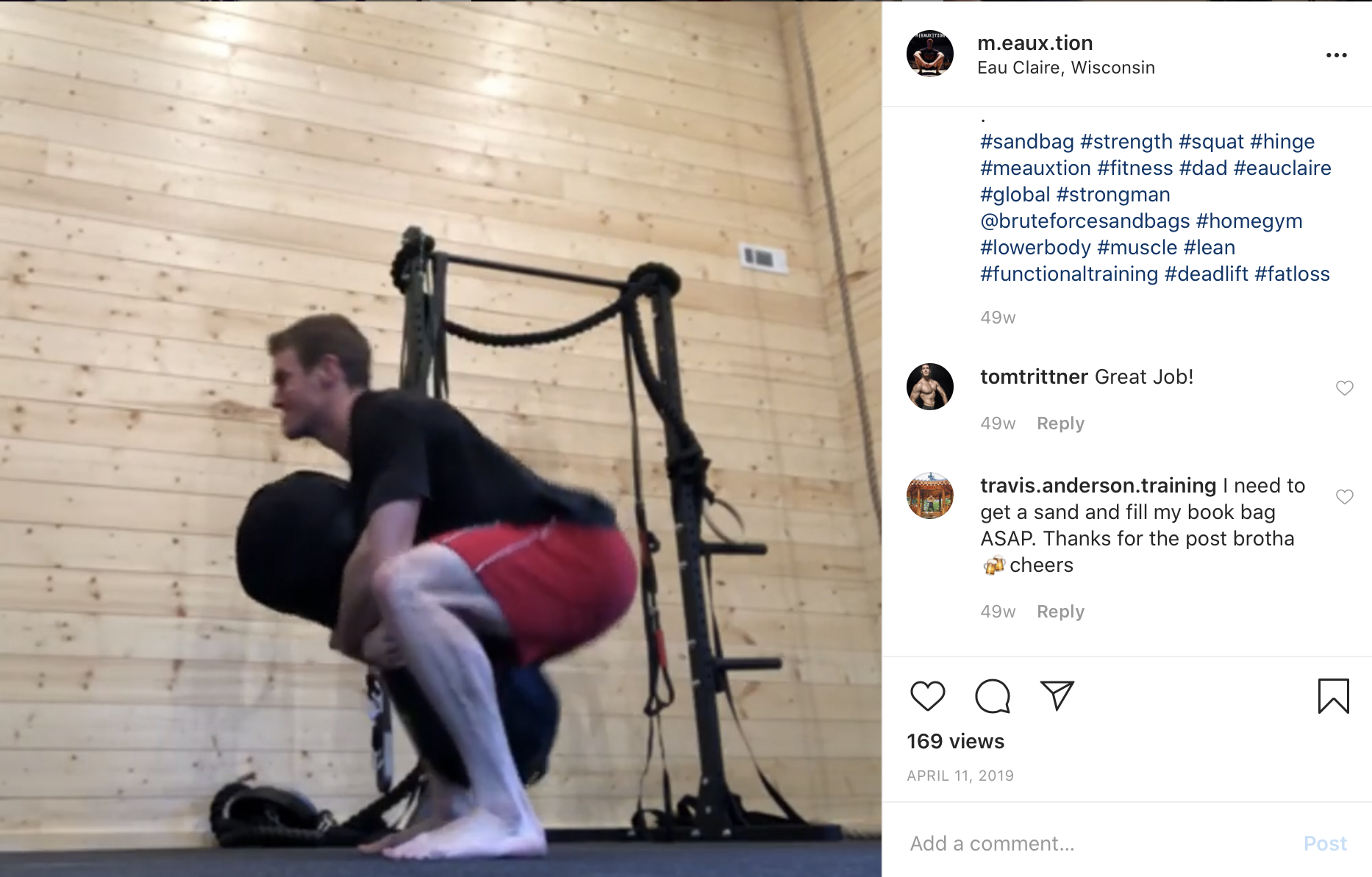
Click👆 image to see Instagram post
On that note, I prefer loading push-ups with a sandbag versus weight plates. Sandbags mold themselves to your back and do not slide off like weight plates.
Shimmying the sandbag up, over and onto your back requires some effort. It’s good to be a DIY’er.
When it comes to loading a push up with barbell weight plates, I wish you the best of luck flipping them onto your back. One is doable, two is tough. Balancing a weight stack on your back can be annoying and take away from the exercise.
Power training with a sandbag. While awkward at times, power training with a sandbag is pretty realistic if you think about it. Sandbags move a lot differently than a barbell, and the effort translates really well into the real world.
Although sandbags generally have several different handle options, the fabric of sandbags is tough to grip.
Sandbags are odd-shaped to begin with and they tend to change shape during exercise. You’re constantly adjusting to the shift in shape.
✅ Pro Tip: Overstuffing a sandbag diminishes the shape-shifting benefits of sandbag training. Leave adequate space inside the outer shell for the inner bags to move around.
Carrying a heavy sandbag with a bear hug grip cannot be performed with iron, nor can shouldering exercises. Both of which are total body efforts and will drain energy from your soul.
Click 👆image above to view Instagram post
I use and value barbell lifts, but I’ve never had to lift any object outside of the controlled gym environment ergonomically shaped with perfect weight distribution like a barbell.
It just doesn’t happen.
On the other hand, sandbags are a bear fight every single time. Each repetition is a wrestling match, similar to the giant cardboard box Fed Ex dropped at my door.
Drag, flip, toss, throw, slam. Several fitness companies sell super durable outer sandbag shells that allow for throwing, tossing, slamming, dragging and flipping.
🖐 Pushing or dragging a sandbag will reduce the lifespan of the bag, especially on rougher surfaces. Regardless, sandbags can be pushed and dragged.
Save your floors. Sandbags will not destroy surfaces the way iron will when dropped. Sandbag training is also “neighbor-friendly” from a noise perspective since it’s a “soft” training tool.
M(EAUX)TION specializes in teaching people how to transition exercise habits away from public gyms into the home setting.
I’m not trying to put any gyms out of business, because there’s enough pie to go around.
Statistically, we are as unhealthy as we’ve ever been, which is confusing because we’ve had access to better technology, effective transportation, and information indicating the importance of engaging in daily activity.
Richard Simmons did a better job at getting people moving in the 80’s.
Not moving enough is destroying us, slowly.
Anyways, I cancelled my gym membership 12+ years ago and haven’t looked back.
Many others have done the same thing, taking back their time, saving money and building superior fitness.
Today, I provide strategies on how to go about select gym equipment, identify space and engage in quality home fitness (for the long-term) is my expertise and passion.
The exercise video below was created a while back with zero anticipation it would be shared as a home workout solution during a worldwide pandemic.
For as long as the Coronavirus keeps us quarantined and socially distanced from each other, I’ll be pumping out effective exercises, workouts, and links to other resources.
(There are some incredible online fitness programs out there, created by relatively unknown brilliant people.)
Strength, mobility, cardio, movement flow, etc. All of it matters and contributes to a well-rounded fitness regimen.
Some of these ideas and methods you may recognize, others you won’t.
For instance, are you familiar with lizard crawling?
Most people aren’t yet it’s crazy good exercise.
The lizard crawl is an incredible locomotion pattern that blends strength, mobility and fluid movement.
Some days, I feel a solid dose of lizard crawling is superior to push-ups.
Totally unfair to push-ups to play favorites, but the lizard crawl will blast your chest, arms, and core in one shot. Lots of boxes checked ✔️ .
How about ground-based conditioning?
My friends over at Vahva Fitness created an entire movement program called Movement 20XX focused on ground-based movement techniques.
It’s great program designed for bodyweight only ground-based movement. Perfect for home.
Anyways… guess what?
You and I have nowhere to go for the next couple of weeks and my fingers are antsy to publish more home fitness content.
Now is the time to explore how incredibly effective and efficient home workouts can be. Whether you’re training barebones minimalist or you’ve got some equipment to enhance the workouts, it doesn’t matter.
We can work around any limitations and space constraints.
You might be canceling your gym membership 😃
Let’s turn 🍋 into lemonade folks.
My Two Cents on Coronavirus
Don’t be an idiot. Is someone in your social circle or family noticeably acting like an idiot? Tell them to get it together.
What classifies being an “idiot”? Not following the basic directions of local and national government.
We need to take care of each other right now.
How do we do that?
First, take a deep breath, curb the panic, stop hoarding toilet paper, follow directions, limit contact with others, enjoy your family, do your part and let’s get back to normal living as quickly as possible.
Bodyweight-based exercises can (and should be) progressed similar to traditional resistance-based exercises.
The SAID Principle (specific adaptations to imposed demands) applies to everything done in the gym.
Cardio, weight training, Yoga, stretching and mobility work.
If you do what you always did, you’ll get what you alway got.
In other words, gains will come to a screaching halt when your body becomes efficient at handling the stress being placed upon it.
And to be clear, developing efficiency is not a bad thing. You don’t want every physical experience in life to redline your system.
We attack goals in the gym so the sub-maximal events of real life seem easy.
Anyways, with bodyweight trainig, more specifically push ups and squats, one simple, effective and resourceful way to make impressive gains in strength and coordination and progress is to pursue unilateral variations.
One arm push ups and single leg squats.
More pressure must be applied o achieve the next set of goals.
Switch things up, bust out of the comfort zone and embrace the next challenge. It’s the only way to move forward
A simple and effective way bust progression bodyweight exercises is by transitioning the exertion from 2 limbs to 1 limb.
Bilateral to unilateral.
The squat pattern goes from a traditional bilateral air squat to a single leg squat, sometimes referred to as “pistol squats”.
2-arm push ups transition to 1-arm push ups.
Single arm push ups are one of my favorite upper body strength builders. I avoided them for a really long time because they seemed like a circus exercise.
When I committed to more palatable progressions leading to the single-arm push-up, my opinion changed completely.
Single limb training makes SO MUCH SENSE.
A lot of life and sport require single limb performance. Yes, ideally we execute tasks using two arms and two legs, but it’s not always the situation.
Walking, running and climbing stairs are great examples of where single leg performance shines.
Plus, training one side at a time can reveal some major asymmetries that you otherwise wouldn’t notice.
One-arm push-ups are also secretly one of the great core training exercises.
It’s amazing how incredibly sore the torso musculature can be in the days following one arm push up training. The obliques in particular. Tender to the touch.
Side-note: Mobility training with change your life…
If you desire ongoing progress from your workout time, increasing the challenge steadily is a necessity.
The human body is a brilliant adaptation machine. It will reshape, re-organize, re-calibrate in order to adapt to stress.
Activities that once seemed impossible become possible through the process.
Fitness is amazing when you think about it from that perspective.
If you’re willing to put in the time and work, you can have ANY result you want.
We, adults, need these reminders.
You were born to move, move well and move A LOT.
Anyways, nothing creates enormous self-inflicted frustration like performing the same exercise for the same reps/sets/tempo day in and day out and expecting a different outcome.
It’s like smashing your hand with a hammer over and over, expecting the next impact to feel good versus elicit extreme pain.
The body becomes so efficient that it’s no longer work.
And it’s not your body’s fault for having this built-in efficiency mechanism. Building efficiency is a good thing. We don’t always want to feel like we are redlining the system while doing basic tasks.
Push-ups and squats are two essential exercises that can add value to anyone’s workout regimen.
One effective way to progress the basic bodyweight exercises like the push-up or squat is by migrating toward single limb variations, also referred to as unilateral training.
Unilateral exercise = one arm or leg does all the work Bilateral exercise = two arms/legs do all the work
Bilateral exercises distribute the weight evenly between both limbs. Each leg is moving 50% of the load.
Unilateral training requires one limb to move the entire load through the range of motion.
In addition, decreasing the base of support creates a significant balance challenge that amplifies as the muscles tire during the work set.
Indirectly, one arm push-ups rank extremely high on the effective core training exercise list.
I would put one arm push-ups up against almost any other isolated core exercise.
Maintaining rigidity from head to heel will blow apart your mid-section. Expect soreness in the days following.
People often get confused with how to make bodyweight-based exercises harder, often opting to add reps versus increase the load. High repetition work sets can provide benefit, but transitions the effort toward work capacity and endurance gains, versus strength.
Endurance training = higher repetitions, low load, and extended work sets.
The lower the load, the more reps can be achieved because the muscles are challenged as aggressively.
I’m not bashing endurance-oriented training. It certainly has it’s benefits. I actually engage in aerobic-based training 2-3 days per week, which is night and day different from what I used to employ for cardio training. It used to be high-intensity intervals all day every day.
But that isn’t sustainable, and I think for a lot of people it’s doing more harm than good, despite the same EPOC after-burn studies authors keep twisting and referencing in their books.
In the time it takes to burn an extra 100 calories via blowing my body apart in a HIIT session, I’ll instead choose to take 3 fewer bites of calorie-dense food.
Talk about time savings.
Anyways…
… a lot of people use the wrong rep and loading schemes to achieve goals.
You can dig a 20-yard trench with a screwdriver.
However, we can both agree there are probably better tools for the job.
High repetition/low load work sets will do very little to increase strength.
You might feel tired with burning muscles, but increased strength is not the end-product of these efforts.
For now, ditch the high rep/low load schemes. Increase the loading, lower the reps, take more rest, get aggressive.
If building lean muscle and optimize movement is of interest to you, is strength is a critical physical characteristic to improve.
This is a blind and generalized statement, but I do honestly believe most people would be happier with results (both from a time investment and effort perspective) from gym work if steps were taken to increase the intensity/loading of the exercise, versus piling on more volume.
Unilateral training is a great way to do this.
A large chunk of life’s daily tasks requires single limb performance.
Why not load unilateral movements during workouts?
It’s resourceful, both from an equipment and time standpoint.
The return on investment is significant.
One-arm push-ups and one leg squats effectively increase the load of the working limb while simultaneously decreasing the base of support.
Transitioning from bilateral to unilateral squat requires navigating instability through the range of motion.
The stabilizing muscles of the hips have to get involved, the intrinsic muscles of the feet contribute as well. Yes,your feet have musclesand they are vitally important.
Staying balanced on the way down and up is difficult.
In time with practice and exposure to the balance requirements of single leg squats, your body will develop an understanding of how remain stable on each repetition.
Adaptation is a beautiful thing, but it takes time, patience and plenty of practice. A lot of people give up before known benefits have time to take shape.
In the beginning, bodyweight alone will be sufficient to receive a training effect for single limb exercises.
But in time, the body will become efficient and adding weight, adjusting the tempo or increasing reps will become necessary for further gains.
Don’t underestimate the impact of adding 3-5 seconds to the eccentric descent of an exercise. It will humble the hard asses of the world, and it takes discipline to slow down the tempo of a movement to savor the pain.
The nice part about adding load to unilateral exercises is you shouldn’t need much weight to challenge yourself. Adding 10-15lbs in the form of a kettlebell, dumbbell, sandbag, small child or a spare weight plate will be enough to shock the system.
Add enough weight to challenge the movement, but not so much that it degrades technical form and posture.
In a real-world chaotic situation, anything goes to survive. In the controlled environment of the gym, form matters.
The end goal of exercising is betterment, not injury and regression.
Compared to the sheer amount of equipment needed to strength training using bilateral squats, single-leg training can be very resourceful. Very little goes a long way.
3-5 sets of 5-8 throws per side (ideally early in the workout the body is fresh).
32.Chops and Lifts
Chops and Lifts are two simple (not easy) exercises that most people will find they:
a) struggle to execute on either side (even with lightweight).
b) can only successfully do on one side, not the other (even with lightweight)
There are many different positions to perform Chops and Lifts in, but the inline position is one of the most humbling.
Assume a half-kneeling position (one knee down, one knee up).
Place the down knee directly behind the heel of the up leg.So, make a straight line with your up and down legs.
Chopping or Lifting once in this position is dramatically more difficult.
33.Anti-Rotation Press Outs
Training rotation is often forgotten yet a HUGE part of everyday movement.One of the core’s important functions is to brace against forces acting upon it.
Stretching a resistance band under tension, pressing the hands out away from the body, you’re calibrating the core to resist rotational forces.
3-5 sets of 8-12 repetitions.
Hold each rep (elbows extended) for 2-3 seconds. Add time as needed.
34.Single-Arm Push-Ups
Everyone is fanatical about something, and I am fanatical about the value of single-arm push-ups.
To get started here, allow me to say that single-arm push-ups are not a circus exercise only for the flashy calisthenics athlete.They are for EVERYONE.Follow the progressions and you can make great gains with upper body pressing strength, stability, and range of motion.
Single-arm push-ups are a fully scalable movement for a beginner.A beginner can make single arm push ups more approachable by executing from a kneeling position, hands elevated on stairs/bench/plyo box or by wrapping a resistance band around the chest to reduce the loading.
All of these regressions will build strength while moving you closer to a full single arm push up.
I have found single arm push-ups to be one of the best upper body pressing exercises available.
35.Atomic Push-Ups
There is a time and place for isolated core work, and at some point, you realize that all exercises are “core work” on some level.So if you can add a push up to a knee tuck, do it.
The key to the knee tuck in this exercise is lifting the butt/hips to the ceiling, as high as possible, to make room for the knees tucking in toward the elbows.
3-5 sets of 6-15 reps
36.Core Smash
Core smash = intense core flexion contraction.
Lay face-up on the floor.
Place hands on the side of the head (fingertips just behind the ears), slowly bring your knees to meet your elbows, pressing elbow into the knees as hard as you can.
Hold it there, think of something other than the cramp brewing in your mid-section.
The set ends when the elbows lose contact with the knees.
Aim for brief holds at first, extending the duration as you gain strength.
37.Arch Body
The core is not only on the front of the body, easily seen in the mirror.It wraps around your body like a weight belt.Hard to see in the mirror, the glutes and spinal erectors are crucial for human performance, body health, and injury mitigation.
Arch body exercise is the opposite of the Hollow Body exercise.Chest down on the floor, you’re going to create a pronounced U-Shape by lifting the arms/back/hamstrings and heels.
Many will feel weak during the arch body, cramping, etc.It’s ok.Hold as long as you can, rest and repeat.
Hammer the front side, hammer the backside.
38.Hollow Body High Plank or Push Ups
Assume a high plank position (aka the top of a push up), roll your pelvis under, arch your spine and protect your shoulder blades to make as pronounced of a “U-Shape” as possible.
Hold there and embrace the suck, because it’s a highly rewarding position but a sucky position at first.The hollow body position is fundamental for many more difficult gymnastics based movements.
Stability balls are naturally unstable.So, putting the elbows on the stability ball to perform a plank creates a wobbly situation.Now, add a circular motion with the elbows as if you were stirring a giant pot of soup.
Why do this exercise?Because adding more time to a marathon length standard plank is not what most people need.More time doesn’t mean greater gains.At some point, especially with planks, make them harder.
One way to make them harder is to add a dynamic movement to a fundamental stability exercise.
40.Suspension Trainer Pendulums
Slip your feet into the loops of a suspension train or gymnastics rings, turn over and assume a high plank position (top of a push up).The feet are now suspended while the upper body is supporting.
Initiate a side to side motion pendulum motion from the waist on down by activating the hands/arms/torso.Grip the ground hard and swing the legs without breaking at the low back, hips, knees.
This is a very non-traditional exercise that will blow up your mid-section.Expect oblique soreness in the days that follow.
3-5 sets of higher repetitions, maybe 10-20 per side.
41.Core Compression Pulses
Core compression pulses are a beginner level gymnastics exercise, which in itself is humbling to think about.
To do them, sit on the floor, upper body erect and legs straight out in front of you.
Place hands on the outsides of the thighs, pressing into the ground for assistance as you lift each leg entirely off of the ground, pulsing up and down.
Lift the legs as high as possible without rocking, bending the knees or compensating to do so.
Core compression pulses are a high repetition exercise, but beginners don’t be surprised if you’re only able to get 3, 4 or maybe 5 before form breaks or cramping commences.
I like to work these early in the workout, before any other lifting or cardio because they are so demanding and isolating the motion is important.3-5 sets of 4-20+ reps.
42.Loaded Carrying Variations
Loaded carries are incredible for core development and total body tension.
For the functional fanatic in all of us who want every minute of strength work and cardio exercise to translate to real-world scenarios, is there any other mode of exercise more functional than carrying objects of varying weights, texture, shapes and sizes (not to mention carrying in various positions) from Point A to Point B?
Personally, I do not think so.
43.Lizard Crawl + Push or Pull
Perform a lizard crawl while pushing or pulling an object of weight.Simple as that.
I hesitated to include this hybrid exercise but ultimately felt that people who can Lizard Crawl proficiently would enjoy adding a brutal push or pull to the exercise.
A sandbag on carpet or a hard floor surface, a kettlebell, dumbbell or weight plate can all be used as the equipment for the push and pull.
I’ve used all of these tools with success, but I prefer using a sandbag on carpet or hardwood.
44.Spinal Waves
It’s been said, “we are as old as our spines”.
The spine is our life force and if we cannot move it when we need to, it is likely to become a problem down the road.
Exercise tips: Soft pump the wall for 100-200 reps most days of the week.
Sounds like too much?200 reps of spinal wave take less than 5 minutes and your body will thank you for the movement.
45.Standing Spine CAR’s
Lock in the hips, hug yourself and articulate in a circular fashion as if you were trying to dodge pushes from a boxer.Say hello to controlled articulations and their ability to wake up the obliques.Brace and breathe.
46.Hip CAR’s
Assume a quadruped position with hands, knees, and feet in contact with the floor.Raise your leg out to the side of your body as high as possible, pretend like you’re a dog about to pee on a fire hydrant.Be mindful to keep your shin bone parallel with the floor, which means your foot doesn’t move higher or lower than your knee.
[The guys at MyDailyMobility.comteach controlled articulations and a lot of other effective mobility drills in their daily mobility program. Give it a look. Your body will thank you]
Draw a large circle with your knee (articulate) as you slowly move the knee behind the body.This will look like the finishing position of a donkey kick.Lower the knee back underneath the body, but don’t set it down.Reverse the pattern.
Many of the best “core” movements are not isolated movements, and they shouldn’t be because isolating the “core” is not how humans operate.
47. Movement 20XX Kick Throughs
Side Kick Through’s are a basic movement element in Movement 20XX, resembling a break dancing type move.
Movement 20XX is a bodyweight focused, ground-based movement system packed with performance and restorative movement patterns.
Begin in a quadruped position, hands and feet supporting the body (knees hover 1-2 inches off the floor).
Rotate to one side by pivoting on the ball of the foot, opening up your chest to the side you’re turning toward.
Slide the trailing leg through and “kick” it through until fully extended.
While the leg kicks through, pull the opposite arm/hand back as if you were drawing back a bow and arrow.
The number of exercise variations and hybrid circuits that can be performed using a SkiErg is relatively unknown.
Simple adjustments in body position, adding exercises or implementing other equipment to alter and amplify the training effect of the SkiErg are many. You’re only limited by your creativity.
Most SkiErg videos and articles are centered around “SkiErg how-to” stroke technique and mechanics. We need these videos, and there are some really informative instructional videos on YouTube.
But for people wondering how they can expand there use of SkiErg, there are very few videos. Not a lot of discussion on stroke variations, adding movement to strokes, combining exercises with SkiErg to create work circuits, or other creative applications for the cardio machine.
This article is an introduction to a few of the variations I’ve played with and implemented successfully into my own workouts.
Per usual, everything shared has been tested by me first.
Try Something Different, Avoid Boredom at All Costs
There are ZERO reasons to allow boredom to creep in and dissolve your workout regimen.
Fitness pro’s are willing to argue over nutrient transport and motor units recruitment during deadlifts, but few acknowledge how boredom is a very effective killer of exercise motivation.
Changing it up from time to time is important.
Adjustments and tweaks can always be made to create a new challenge and keep daily workouts fresh.
I’m a big believer in gym discipline. Show up and leverage basic fitness principles because they are powerful. The fundamentals get results.
But…
… if you’re one bland workout away from throwing in the towel with your fitness, it’s time to switch it up.
❤️ SkiErg
SkiErg workouts have never made me cringe the way other cardio machines do.
Rowing? Brutal. Someone utters “2000m row for time” and I melt into the floor. Gross.
Airbike? Meh. Not as bad, but bad enough. Higher intensity air bike training can be awful, especially when gunning for personal records on the 5-mile ride for time.
For whatever reason, I’ve developed an affinity for tough workouts on the SkiErg.
I’m always game for a quality SkiErg session. Even the longer distances don’t give me the heebie-jeebies like the rower.
Save the Legs!
SkiErg training is a leg sparing cardio activity.
The training stress is much different compared to rowing, biking or running.
SkiErg is upper body dominant.
While the arms pull on the handles, the trunk begins to flex slightly as the hips hinge and knees bend ever so slightly.
This loosely describes traditional SkiErg stroke technique.
Reach and contract, pull and flex/hinge…. relax and return to the start.
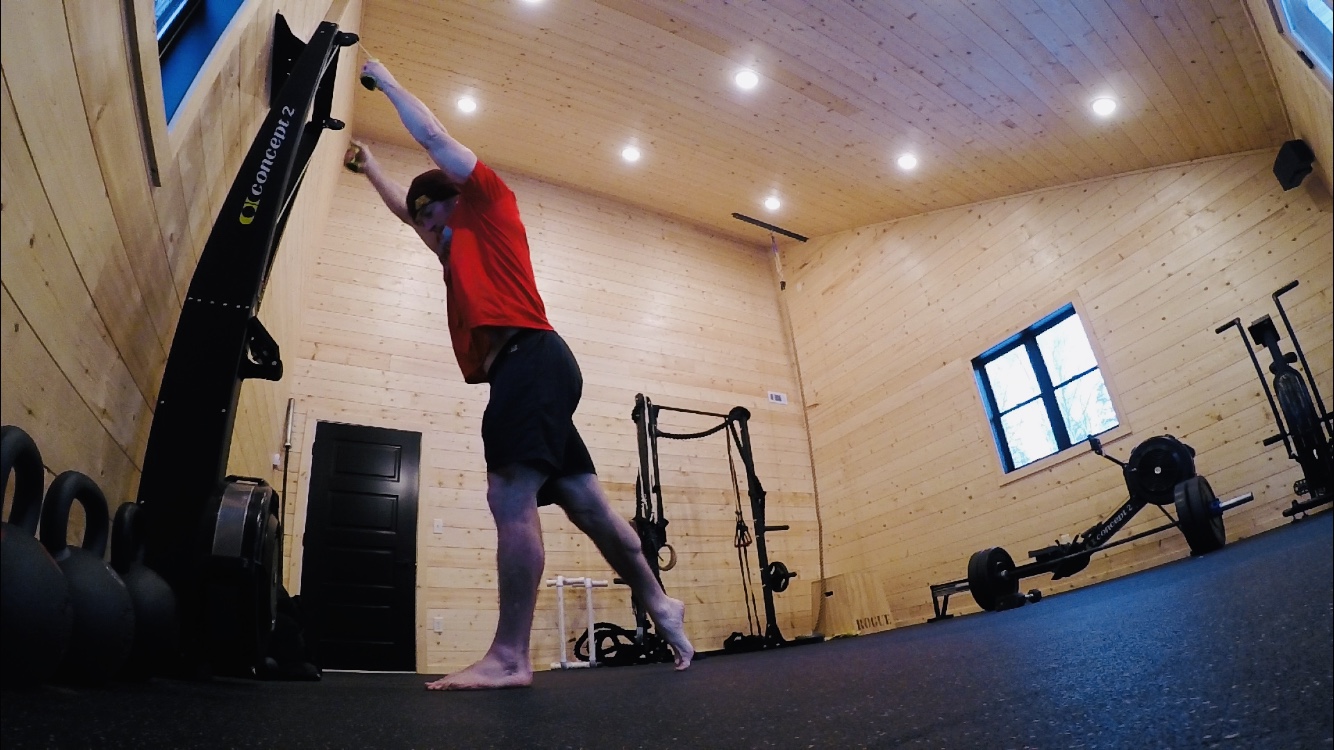
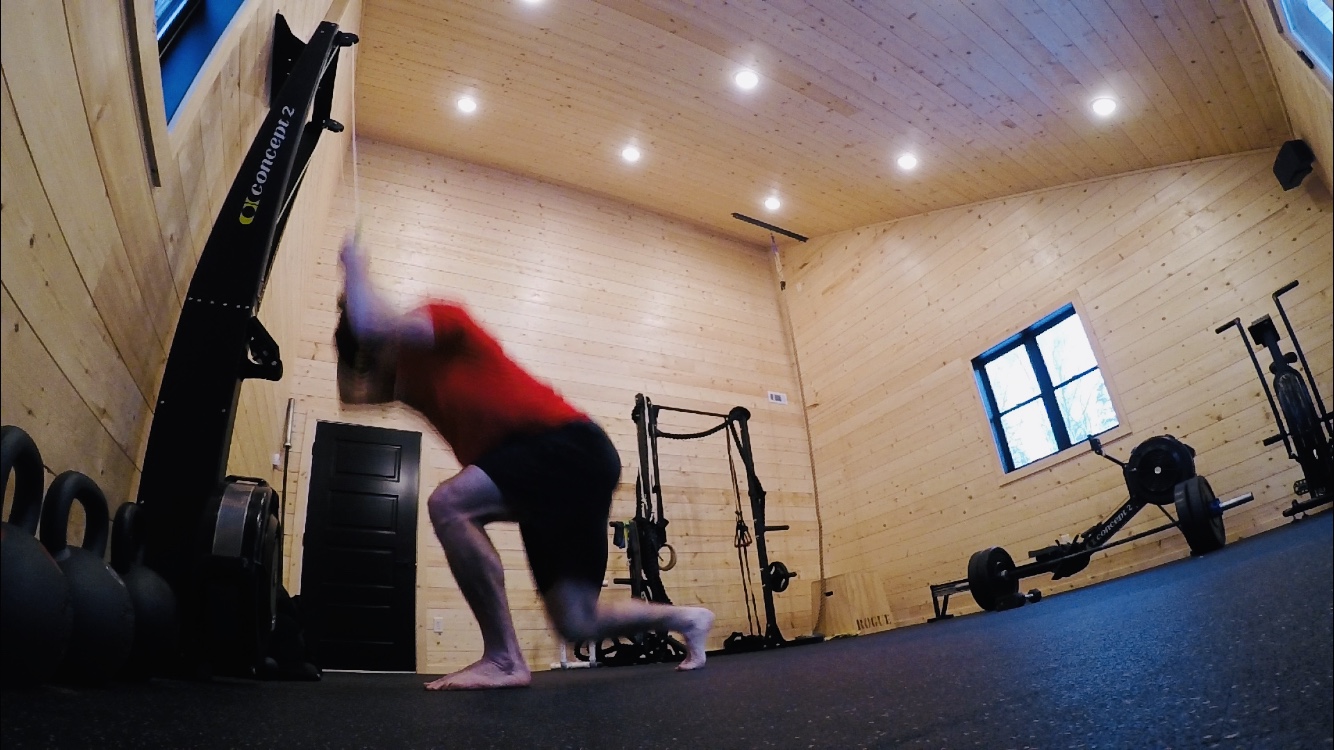
Photos of a split squat variation…
Strokes become rhythmic while the meters accumulate.
SkiErg training is mostly (not always) performed in a vertical standing position. Training in a standing position with feet on the floor is a nice feature of SkiErg.
I say “not always” because the SkiErg can be used in the seated or kneeling positions.
These modified positio are great for adapted athletes or people with lower-body injuries.
SkiErg Variations
Over the course of the last year, I’ve tested a wide scope of applications for SkiErg training.
Short burst efforts integrated into hybrid circuits
Long distances (2000m, 5000m, etc)
Power training for shorter distances (100-200 meters)
Multi-modal aerobic cardio training (bike, row, SkiErg)
What did I find?
It all works quite well.
SkiErg is seamless to integrate into circuits because there’s zero set up to initiate the exertion.
You don’t have to climb onto it or need to strap any body parts in, or mess around with seat heights, etc.
As you can see… pairing SkiErg with other exercises (bodyweight, kettlebells, barbell, etc) is a piece of cake, and challenging as hell. This integration adds a whole new dynamic to basic gym equipment.
Simply walk up to the machine, grab the handles and start pulling. Make it purrrrrrr.
Tiny adjustments to the traditional SkiErg stroke technique can change a lot about the training stimulus.
Staggering the stance, turning the body to a 45-degree angle, jumping on each stroke all create a new training experience.
Below are several different ways to shake up your next SkiErg session.
Future articles will branch off to share more SkiErg variations I’ve found to be challenging and “fun”.
The idea here is simple…
TRY SOMETHING DIFFERENT.
Foot Placement/Base of Support Variations
Shifting foot position can alter the base of support, which changes the training effect ever so slightly as the body makes on-the-go adjustments to remain in control and balanced during efforts. The feet remain in a fixed position on the floor in all of these variations.
Split Squat Double Arm Pull
Technique cue: “kiss” the knee cap of the rear to the floor at the bottom of the split squat.
Leverage your body weight’s descent to the floor and pull HARD on the handles. Generate power!
45 Degree Angle Stance + Double Arm Pull
Rotate the lower body to a 45-degree angle to the SkiErg. Turn the upper body to face the chest at the SkiErg.
Training from this position will challenge the upper body/lower body separation and hammer the obliques. Again, the obliques will take a serious beating here.
Dynamic Variations
Now, we get the lower body moving.
What was once upper body focused training, goes headfirst into the total body cardio realm.
Everchanging positions, twisting/turning, jumping and lateral bounding. The lower body movement will vary, the upper body pulling action remains the same.
Alternating Split Squat Jumps + Double Arm Pull
Adding split squat jumps to the double arm pull creates a total body training effect. The split squat jump increases the fatigue factor 3x, versus normal technique. Traditional SkiErg training is primarily upper-body focused, the split squat jump changes that.
At the bottom of the split squat jump, “kiss” the knee cap to the floor. Soft and quiet landings. Try and time the pull of the handles with the landing of the split squat, which will give you the best opportunity to create as much power on each stroke as possible.
Rotational Squat Jumps + Double Arm Pull
Squat, jump and rotate. Find the floor, pull.
Got it?
This SkiErg variation adds complexity to the effort.
The key to having success with this exercise is planting the front foot on the floor in line (or as close to) with the tower of the SkiErg. Doing so will create space for the handles to straddle the front leg and avoid any interference on the pull.
Adding Equipment
Sometimes, other gym tools can be used to add a new dynamic or challenge to a cardio experience. With SkiErg, the hands are fixed to the handles, so the external loading will likely be hands-free. Weight vests and resistance bands work really well here.
Here is a badass resistance band variation worth trying out...
Stretch Band Resisted + Double Arm Pull
The resistance band pulls the hips backward, making driving hips forward into extension a more difficult.
The pull of the band will set your glutes on fire.
Of all of the variations listed in this post, this is my favorite.
Getting a little more action for the glutes and reinforcing aggressive hip extension is a fantastic addition to an already great cardio activity.
SkiErg Hybrid Circuits
Whenever I feel my workouts getting a bit stale, I’ll mix 1-2 exercises with the SkiErg to create a hybrid circuit. “Nano-Circuit” may be a more accurate description.
Kettlebell swings, clean and press, loaded lunges, goblet squats and lizard crawling all pair extremely well with the SkiErg and the transition between activities is painless.
Generally, I keep the SkiErg distance consistent. Each of the videos below shows a 100m effort on the SkiErg, short enough to really power up each stroke, but not so far to create fatigue too early in the workout.
I recommend keeping the resistance exercise, locomotion pattern and SkiErg effort brief and intense. Choose fewer reps for the non-SkiErg exercise… anywhere from 6-10 reps.
Rest after achieving your target distance. Execute for however many rounds you prefer.
Steady, accumulated fatigue is the goal. As the clock ticks, you’re going to get tired training using this format. Don’t start out too aggressively and burn out in the first round.
I value these workouts because almost all of the work is performed standing.
Here are some examples:
Kettlebell Swings + SkiErg
Macebell 360’s + SkiErg
Lizard Crawl Flow + SkiErg
Ah, yeah, that’s enough for this post.
Get into some of these variations and let me know how it went.
Music artist Lizzo recently shared a powerful snapshot of the adversity she overcame on her path to success.
I cannot stress this enough…
… do not make the mistake of looking at someone’s finished product (body, money, business, and etc) and think they didn’t fight through hell to achieve their goals.
Stop wallowing around, dig in prepare yourself for war.
War against weakness.
War against lack of discipline.
War against instant gratification.
War against temptation.
You can have whatever you want if you HOLD THE LINE.
Holding the line, means digging in when sh*t gets difficult. ‘
And it’s going to be difficult.
It seems like the things worth pursuing the most are often the most difficult.
If it was easy, sights were set too low?
Improving fitness takes time and consistent effort, and there are a lot of times when you’ll want to cut corners and give up.
Hold the line.
A lot of fitness programs and books promise X results in Y amount of time.
If X ever equates to 30 days or less to get Y results, you run away from that gym, personal trainer or online training program as fast as possible.
There are a lot of fitness programs worth your money, time and effort, but if it seems too good to be true, it probably is.
Beginners… enjoy the massive gains early on. Seriously, the early days are pure magic.
A beginner can exert, exercise or lift using just about any method or program they want, and see signficant changes. A little shift in calories in vs. calories out, swapping out junk food and drink for more nutritious options, and you won’t recognize yourself.
Remember, everything works, for a little while.
Eventually, the stress must increase to continue seeing improvements. And while adding more stress might seem insane right now where you’re at physically, trust me, once you start making progress, you’ll be like a shark with blood will be in the water.
You’ll crave more progress, and more, and more.
The real discipline of fitness, is both mental and physical. Establishing a mental state capable of handling adversity and temptation and being able to clearly identify right from wrong.
Physically, you’ve got to be able to “suffer”. Not pain or injury inducing suffering, but the discomfort that comes with physical stress.
Blend the mental and physical together and repeat that daily for a lifetime.
Piece of cake. 😦
Once you’re over the initial beginner’s hump you’d better start sharpening your sword and get ready for the warpath because staying fit is harder then getting fit.
What? No way!?
Way.
Waking up at 4:30am to workout because leaving a training session for later in the day means it might not happen.
Choosing salad over pizza at a restaurant with friends.
Drinking ice water instead of soda.
Passing on desert.
Maintaining what the fitness you’ve built requires ongoing flexibility, adapting, planning and thinking about it EVERY SINGLE DAY.
I cringe when TV health experts refer to it as a “lifestyle”… but it’s a goddamn lifestyle.
A style of living, different than the old style of living which likely put you smack dab where you are right now.
And once you’ve adopted the lifestyle, or think you have, any slack, laziness or complacency can compound over time, and it all goes away.
The fitness that took 3 months of breaking old habits, grinding in the gym, making changes to sleep and nutrition regimens all in an effort to make noticeable gains, can vanish in about 2 weeks.
2 weeks to piss all of it away.
2 weeks of behavior relapsing can become 3 weeks, then 4, then 5, then…
So, I’m in awe of people who flip the switch when they’ve had enough, and attack fitness goals. It’s incredible to see someone draw a line in the sand and say “No more”.
I’m more intrigued by people who maintain or improve on fitness goals year after year.
Like many other endeavors, fitness has a way separating out people who cannot hold the line versus those who can. The disciplined from undisciplined. The ones who want it from those who don’t.
And while saying that “some people want it and others do not” sounds a bit harsh, can we find common ground to agree that this is a reality?
Whatever you want in this life, can be had.
The path to what you want will be brutal, drive you want consider quitting, folding, packing up in favor of taking the easy road.
But, if you stay the course long enough, adjust your technique, keep working, grinding, shape your mind to digest and handle the crazy thoughts you’re going to have, taking repeated action…
… you can have it. And probably will someday.
You don’t have to be an elite athlete, Mr. Olympia or Matt Fraser to reap the benefits of sensible exercise and nutrition.
Start with the basics, build up as you go.
Keep doing it, over and over and over.
Next Steps…
For more info on basic, intermediate and advanced exercises, fitness and techniques, please subscribe to this blog and YouTube follow me on social media.
Contact me, I love talking shop with people. We can figure it out together and get you going in the right direction.
Years ago when I was low on cash and training in my studio apartment, my lone pair of 24kg kettlebells provided workout after challenging workout. Making the most of a tiny home gym also gave me PHD in resourcefulness.
Kettlebell training is unique, unlike any other mode of training.
Bursting onto the fitness scene in the early 2000s, kettlebells gradually became a mainstay piece of equipment in gyms all over the world.
Kettlebells disrupted fitness. The spotlight was shifted really functional loaded exercises. Drills like swings, cleans, snatches, Turkish Get Ups and other combinations became the new standard. Most of which performed in standing position.
Though the effectiveness of kettlebell training has never changed, the novelty of the tool has since dissipated, which is common in the fitness industry.
Exercises, equipment, and methods lose their popularity in the mainstream… here today, gone tomorrow.
“Bring in the next shiny toy of the year, please!”.
Despite the sex appeal fading a bit, basic kettlebell exercises remain brutally effective for building strength, conditioning, and fat loss.
I’m one of those people who don’t forget.
Outside of nutrition, sleep, hydration and adequate non-exercise activity on a daily basis… short burst kettlebell training (high intensity, low rest, etc) is amazing for burning body fat.
And yes, if you want to maximize workouts, you’d better be auditing habits outside of the gym. Don’t sabotage your efforts.
Kettlebell Clean, Press and Squat Combo
The clean, press and squat combination is a prime example of how a simple 3 exercise circuit can be leveraged to produce a significant training effect.
And it doesn’t require much time at all. 15-20 minutes at most.
For your eyes only…
This kettlebell combination features 3 staple exercises: clean, press and squat.
Each exercise is performed with very little or no rest in between each exercise.
Smooth transitions between each exercise is the goal.
Changing levels with the kettlebell… cleaning the bell from under the legs up to the front rack position, pressing overhead, back down to the front rack for the squat for repetitions…
… is pure work.
This work creates a total body training stimulus.
It’s the “magic sauce” of this combination.
Before moving on, here are some key thoughts:
You must have a working familiarity with each exercise before engaging in this circuit.
Respect fatigue and what it does to the body while under load (increase rest if needed)
Work reps, rounds and rest periods appropriate to your
Choose a sub-maximal kettlebell weight that allows for 10-12 reps per exercise (even though you’re going to do 6 reps).
Not sure what weight to start with? Go light, work up as needed.
Keep the workout short (15-20 minutes at most)
Alternatives/Substitutions
Not everyone is going to have access to a pair of kettlebells that are the same weight, or maybe they are the same weight, but too light or too heavy for your current fitness level.
One of the most important ideas in staying fit is becoming resourceful. When space is limited, equipment is scarce or time is tight, DO NOT FOLD.
How many times do we read a workout blog or fitness article and realize we don’t have the same set up the author did? I’ve had this experience hundreds of times.
What do you do? Make adjustments, move forward, get the work done.
No kettlebells? It’s ok! Here are some equipment alternatives:
Barbell (same exercises and reps)
Dumbbells (same exercises and reps)
*Bodyweight (change exercises and reps)
Barbells and dumbbells are the most common pieces of weight training equipment in the world. Most hotel gyms, YMCAs, 24Hour Fitness or Big Box Gym is going to have one or the other.
Both allow for the clean+press+squat exercise combination to be performed. The main difference between barbells/dumbbells and kettlebells is the design and how you can maneuver them.
Barbell training fixes both hands to the shaft of the barbell. For some people, this is great because you’re not having to control each hand independently.
Dumbbells allow for independent arm work, but the shape of dumbells means you’ll have to tweak hand position/technique for each exercise. These are subtle adjustments are mainly to avoid bumping the dumbells into your body on each movement.
Bodyweight. Now, if you’ve got no equipment available whatsoever, you’re still in the game, don’t worry! You’ve got plenty of options. Tons.
When resources are scarce, you make adjustments, adapt and push forward. Don’t get hung up on imperfections.
Try this bodyweight combination…
Wouldn’t it be great if life was perfect all day, everyday? Yes, it would be.
(👋 slap across the face)
Life’s not perfect and never will be, so the best practice is to be ready to embrace the situation presented and make do with what you’ve got.
If bodyweight is the only option for the workout, consider digging into this circuit:
Alternating Split Squat Jumps
Dive Bomber Push-Ups
Air squat (or variations: pistols, rear foot elevated, etc)
Burpees
– 6-8 reps per exercise
– 6-10 rounds
– Limited/no rest between exercises
– 45-90 seconds rest after each round.
Perform in descending order (top to bottom) without rest between exercises. Alternating split squat jumps first, then dive bomber push ups, etc…
Factoring in no weight is being used to load these exercises, consider increasing reps per exercise, increasing the number of rounds performed or reducing the rest periods.
Be mindful not to adjust all of these variables in one shot, it may create more fatigue than what your body can handle. It’s like fine-tuning the dial on a boombox to get the signal of a radio station.
Tweak here, tweak there.
Burpees?!?! What?!?! I h*te you!?
I don’t believe burpees are the greatest exercise on the planet.
Some people do, I do not.
Burpees are often blindly prescribed to the wrong people and abused by many, but burpees are an incredible exercise to increase heart rate quickly and condition the entire body… in a pinch.
Personally, I rarely perform burpees. But if I have few other options, hell yeah, I’m going to rip out some burpees.








 M(eaux)tion Fitness