14 Exercise Total Body Warm-Up Routine

Motion

Before the workout, there is a warm-up.  

Warm-ups are an INCREDIBLE 15-20 minutes to make mobility gains, nourish joints, rep out isolated movements/activation drills, playfully engage in movement sequence or explore other movements that peak one’s curiosity.  

I used to dread warming up before workouts, as most people probably do.  

Warming up seemed like a barrier to the productive section of the workout.  

A period of time where I’d swing my arms around a little bit, bounce on your toes, a few neck rolls, get my hype playlist dialed in and throw a few shadow punches.

This used to be me.  

I’d drudge through a smattering of hand-selected, mindless dynamic stretches, mini band walks to “wake up” the glutes, and finish strong by mobilizing the ankles and T-Spine.  

I elevated my heart rate, initiated a sweat and feel focused, so the warm-up boxes must all have checkmarks ✅, right?  

In my mind, the answer to that question was, “Boxes check, good to go.  Moving on to the sexy part of the workout.  Exertion.”

Re-Establish the Purpose of the Warm-Up

People generally think of warm-ups as a stimulus to awaken and prime the body for more aggressive exercise, be it resistance training or cardio conditioning.  

This isn’t the wrong way to view things by any means.  Elevating the heart rate and increased body temperature is still important.

But the warm-up can serve as a vehicle to make incremental (valuable) gains in other areas.  Mobility, movement transitions, balance, coordination, etc.  

The problem, rather a common perception, is that investing time in a progressive warm-up seems like a waste of time.  

No muscle pump?  It must be a waste of time.

Lungs not burning?  Surely time is being wasted.

“Let’s get this over boring-ass sh*t over with so I can start making my gaaaiiinnnzzzz”.

For clarification, “Gainz” generally describes the usuals for most people:

  •  Fat loss 
  •  Muscle or strength gain
  •  Losing weight 
  •  General fitness improvement
  •  Big bouncing pecs, softball-sized biceps, and curvy butts, etc. 

I think we can do better with our pre-workout warm-up routines. 

We can do this by integrating joint mobility training, moving limbs through disadvantaged or strict patterns of motion, movement exploration/play, flow sequencing, transitions, etc.  

Today, it’s really hard to see where my warm-up stops and the workout begins.

The days of twirling arm and leg swings are long gone.  I’ve traded them for slow and controlled mobility drills, where I attempt to express the true joint range of motion I have ownership over, and fighting to earn and expand that gradually.

Rather than flailing my arms around in circles for 10 reps and calling it good, I’ll crush a tennis ball and draw the largest possible circle with my fist (from front to back) doing my best to stay avoid moving body parts to draw that circle.   

These mobility drills involve articulating joints through a maximum controlled range motion.  It’s simple, but not easy.  Each repetition is painfully slow.  You can find a lot of these drills on my YouTube page.  

Functional Range Conditioning refers to these joint nourishing exercises as CARs (controlled articular rotations).  

I also like to get on the floor and move.  

Twisting, turning, reaching, flexing/extending, squatting, lunging, blending pushing movements and rotation movements, crawling, changing levels, tossing, throwing, etc.

5-10 minutes are allocated to getting lost in bodyweight-based groundwork.

Some workouts, I’ll include a wood plyo box or other pieces of equipment, but moving with bodyweight through an open space remains the foundation.

Here are a few other things I like to practice during the warm-up:

  • Mobility techniques
    • Kinstretch
    • Gymnastics drills
    • Spinal Waves
    • Wood dowel training 
  • Improvised ground-based movement
  • Exploring new exercises, methods, and techniques
    • Macebell training
    • Weck Method drills (Coiling, RMT rope drills, etc)
    • Hybrid kettelbell exercises
      • Turkish Get Up variations
      • Swing variations
      • Hand-to-hand exercises 
    • New Bodyweight Movements
      • Sissy Squats
      • Dragon Squats
      • Task-Based Challenges
      • Legless Rope Climbs
      • Parallette Bar drills 

Total Body Pre-Workout Preparation

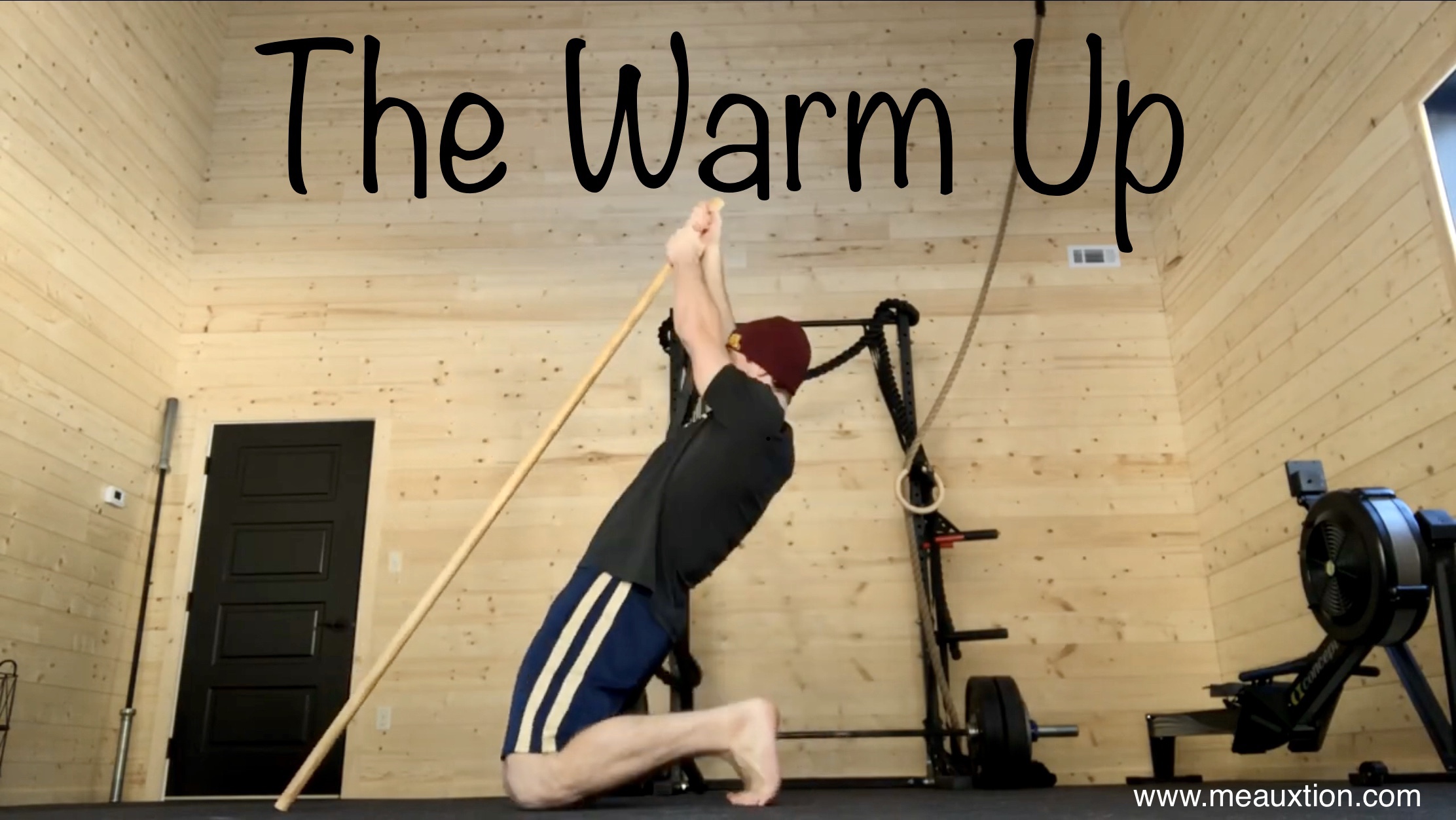
A while back, I uploaded a YouTube video demonstrating 14 different warm-up exercises to prepare the entire body for a workout. 

Here is the video…

Exercise order:

1.  Shoulder CARs

2.  Spine CARs

3.  Hip CARs

4.  Dowel Assisted Sissy Squats

5.  90/90 Series (transfers, lift offs, hovers, etc)

6.  Prone Swimmers Hovers

7.  Bodyweight Squats

8.  Bodyweight Lunges

9.  Bodyweight Push-Ups

10.  Side Kick Throughs

11.  Crab Reach

12.  Back Bridge

13.  Scorpion Reach

14.  Cossack Squat w/ Horse Stance Pause

Take notice of all of the joint articulations, slow tempo movement of arms and legs through challenging patterns, bodyweight exercises and movement combinations. 

It’s all there. 

Basic joint mobility work, ground-based conditioning, and exploratory movement training can really have a significant impact on your movement capacity, joint health, and performance.  

In time, movements that once plagued you or simply felt impossible, begin to feel very achievable.  Joints feel buttery.  Your body is changing.  Adapting to the stimulus. 

If you’re training 4-5 days per week, sectioning off 15-20 minutes to warm up with a few of the exercises featured in the video can add 60+ minutes of unique training to your regularly scheduled workout regimen. 

This adds up.  

Daily, the full-body approach to warming up is my personal preference.  Even if the day’s workout is mostly upper body, I still deliver a stimulus to the hips, knees and ankle joints.  

Conducting total body maintenance has made my body feel better at 35 years old then I did when I was supposedly at my “peak physical condition” in college.  

Nothing against people who opt for upper and lower body splits, but I prefer a daily micro-dose of joint articulations and full range movement.  

Find what works best for you.

It might not be what works best for me… and that is ok.  

How long should a warm-up be?

Working through 14 exercises generally takes 15-20 minutes, depending on reps and tempo per exercise.    

Should it always take 15-20 minutes?  

No.  Starting out, expect it to take longer because you won’t know what the hell you’re doing.  

Time will decrease as you become more familiar and waste less time setting up.      

All this being said, the more volume with most of these exercises, the merrier.  

How many reps per exercise?

In the video, I demonstrate 2-3 reps per exercise.  

I reduced the reps to keep the video moving along and lower the boredom factor.  Plus, uploading a 20+ minute video to YouTube can be full of problems.

Increase the reps to 8-10 per side for each exercise. 

Progress through all 14 exercises, one after the other, non-stop until the end. 

Of course, pause and rest as needed, but don’t waste too much time.  

Keep the show moving. 

Reminder… 

This warm-up shows 14 different exercises.  

Only 14.  There’s a mountain of other effective warm-up exercises not shown in this video.  

I simply wanted to share an example of a total body warm-up routine. 

There are many other incredible mobility drills, activations, locomotion exercises and ground-based movements not included in the video.

A total body warm-up can be organized a thousand different ways.  

Should all warm-ups look like this?

They don’t have to.  

Some days my pre-workout build-up consists of jumping rope for a few minutes paired up with crawling.  Other days I’m in the mood for ground flow, swinging kettlebells, rolling around on the floor, wall assisted handstands, etc.  

I like to mix it up.  

It doesn’t always follow this 14 exercise recipe.

On days where I am engaging in a long slow cardio session, I’ll climb on my air bike and ride.  No warm-up at all.  

The message of this post is to audit your current warm-up routine and observe if you’re breezing through a below-average pre-workout warm routine.  

Are you undervaluing warm-up time?  Is there room for improvement?

I’d bet there is.  

I used to overlook my warm-ups, and I’d guess a lot are doing the same.  

Time is a valuable commodity and goal achievement is important.  

Warming up with greater purpose can help to accelerate the time it takes to reach physical goals, keep your body feeling good and leverage your time in the gym.     


Cheers to getting after the warm-up, 

Kyle 


Locomotion| The Weighted Lizard Crawl

Motion

The lizard crawl is a total body locomotion pattern, made popular by Ido Portal.  

As great as lizard crawl exercise (bodyweight only) is, there are simple ways to make it harder if you’re interested, and that’s what this post is about.

Crawling exercises can be progressed similarly to a squat, deadlift, bench press or any other traditional resistance exercise. 

The key is increasing the challenge somewhere, somehow.  Make it harder.  

Progressive overload (adding weight) is a key strategy to continue building fitness, especially strength.  It keeps you in progress mode. 

Exposing the body to progressively greater demands (movement complexity, load, etc) is a pathway to build strength and mitigate injury.

Weak bodies seem to be at a higher risk for injury.

If a given stress overloads tissues beyond their capacity, injury often results.

This is an over-detailed article about my experience adding weight to the infamous lizard crawl, the “king” of locomotion training. 

Progressive Overload

Know your options.

Conventional methods of progression include:  

  •  Add resistance
  •  Add repetitions
  •  Increase training frequency
  •  Increase volume (sets x reps x resistance)
  •  Decrease rest periods 

Halts in progress require a quick audit and a few simple decisions. 

Training the same movements with the same weight, time under tension, reps/sets, etc… will yield the exact same results.

And if this seems like common sense, please considered common sense is not always so common.  

Adding more weight to a lift, movement or locomotion pattern is not ALWAYS the answer, but more often than not, it is a solid solution to many of the problems people encounter in their training.

Don’t be afraid to increase the load, incrementally and intelligently.  

As highlighted in the title of this blog post, I chose to add weight to the lizard crawl as the mechanism of progressive overload.

From sloppy to strong…

When I finally decided to attack the lizard crawl pattern, adding weight was the last thing on my mind. 

Early on, even simple crawling patterns exposed my sloppy technique, lack of endurance and heavy-handed/footedness.

Crawling short distances (15-20 yards) wore me out quick.  It was humbling.  I felt weak. My story is similar to others I’ve heard and read about across the internet. A strong guy in traditional lifts who could not move well on the ground without weight.

Strict crawling drills crushed me.  Moving naturally with detailed precision is HARD. 

I experienced a pretty dramatic change in movement quality by practicing basic crawling patterns like Beast Crawls (forward, back, and lateral) and Bear Walks.  

I’d section off 10-15 minutes of EACH workout for crawling practice, and I still do to this day.

Gains with the basic locomotion patterns evolved into disadvantaged crawling in low positions. 

With near daily practice, I became extremely efficient with lizard crawling.  My body acclimated and now understands the demands.  Adaptation is a beautiful thing.   If you want something in the gym, attack the shit out of it.  Be relentless.  

Crawling distances increased, tempo and pattern variations were added along with introducing crawling backward.  

I reached a point where adding more volume became a time suck and borderline ineffective.

Lizard crawling requires a low-to-the-floor body position, aggressive joint angles and a constant on/off body tension from head to toe.  The upper body and core demands are intense.  Plus, it’s easy to get twisted up with hand and foot placement.  

The lizard crawl pattern connects traditional strength work with movements that exist in between.  The transitions, gracefulness, soft interactions with the floor, twisting, turning, propelling the body from point A to point B.  

The Weighted Lizard Crawl


I have to believe people have added weight this pattern before the writing of this blog post.  If not, I am a visionary

Regardless, I was humbled by this movement progression.  

I added a 40lb weight vest and a pair of 10lb ankle weights around each leg. A simple weight vest is a very natural tactic to add weight to movements while keeping the hands free.

The weight vest loaded the upper body/torso, while the ankle weights challenged the lower body.  Adding the ankle weights is a simple way to load the articulating motion of the hips.  

This articulating motion is similar to hip CARs, but a bit less isolated and strict.

When weight increased with any exercise, generally reps/sets, duration, time under tension need some relief.  Usually, it’s just for a short time to give the body an opportunity to execute quality work, avoid unnecessary training injuries and adapt to the stress.

Keeping all training variables the same would be too aggressive and unmanageable. 

Factoring this in, once I added the weight, I immediately decreased the distance of the crawl and increased rest periods.  

Previously, my average bodyweight lizard crawl distance was around 40 yards, broken up into a 10-yard crawl forward/10 yard crawl backward (twice down and back).  

For the weighted lizard crawl, I more than cut that distance in half, crawling roughly 10 yards (5 yards forward and backward).  On this day, I worked a total of 6 sets.  It was enough to leave soreness in the days afterward.

I’d recommend anywhere from 5-8 sets of 10-15 yards of a technique-driven lizard crawling. 

As I mentioned before, adding load commonly means taking longer rest periods in between efforts.  I wasn’t super detailed on the rest periods, but they were long enough to feel damn fresh.  

There is absolutely no need to rush this.  Do it right, or don’t do it at all. 

Equipment Used

 10 lb Valeo Ankle Weights 

 MIR Short Weight Vest

There are plenty of weight vest brands to choose from, but MIR is a trusted name and I couldn’t be happier with my MIR weight vest.  It’s durable and the short version is awesome.

Arguably, ankle weights are, well, ankle weights.  

Although I did get a nice product referral for the Valeo ankle weights from a great trainer in Philadelphia.  My only advice here is to size up and buy heavier than you’d think. Also, buy a set that has adjustability (ability to remove the weights).  You can always lighten them up if needed, but it’s nice to have heavy ankle weights if needed.  

So, I added weight, should you?

The crappy (but honest) answer is, maybe or maybe not.  It depends on your experience and goals.

Have you played around with increasing distance and tempo using bodyweight only?  

If not, start there.

Initially, leverage basic lizard crawl variations.  Gradually add distance and play around with tempo.

Practice lizard crawl press ups, modified range of motion crawls.  Place emphasis on body position, technique, timing, and mechanics.   

Aim for efficiency.  

People like to knock efficiency in training, but the fact is being inefficient at everything wastes precious energy.  At some point, you want the work being performed to feel natural. 

When it’s natural and fully integrated into your body, it’s useable in the real world.

Adding load to the lizard crawl, in my opinion, increases the challenge exponentially.  Far beyond anything I’d experienced before.

Once you’ve added weight, expect the silky smooth crawling technique disappear.  

You’re fully engaged in a hybrid variation of resistance training now.  Ha.  

Muscles and joints will need some time to fully understand the stimulus and adapt to it. 

Just getting started with crawling?

If you’ve not yet added crawling exercises (even the basics) to your workouts, you must.  Just try it.  There’s nothing to lose and everything to gain.  Don’t make the mistake of marrying any particular tool or method.  Explore everything and integrate what’s useful.   

I talk about crawling patterns often.  Progressive crawling is excellent for building natural movement strength, endurance, and skill.  If you’re an avid lifter, add 5-10 minutes of crawling to your warm up.

Unsure where to start with crawling?  

Vahva Fitness and my YouTube channel are great resources to get exposure to crawling.  Anyone interested in ground-based movement training of any kind is referred to Movement20XX.  

My YouTube channel is LOADED with videos.  There’s plenty to watch, not a ton of boring commentary and I am always available for questions and conversation.  Simply enter the “crawling” into the search bar. 

Closing Thoughts…

The purpose of this article is to introduce people to one simple strategy of increasing the difficulty of the lizard crawl. 

Start with bodyweight based lizard crawl variations.

Don’t be a dumbass.   

Earn tougher movement progressions by practicing the basics.  

I referenced several good resources above, make sure you check those out.    

Lastly, leave a note on your experience, I love hearing from people.  


Cheers, 

Kyle 

FLOW| 4 Exercise Bodyweight Flow to Build the Hips, Shoulders and Spine

Motion

Give your hips, shoulders, and spine some love with this bodyweight only combination.

This flow features 4 bodyweight exercises and is for EVERYONE.  

Each of these exercises can help to “unwind” folks who sit for long durations throughout the day. You know, that shoulders and head forward, spine rounded, hamstrings and butt smashed against the chair posture.  

The same posture that sucks the life out of many of us. 

Our bodies adapt to positions we spend time in the most, but I am telling you, spend some time working through basic flows like this one and you will be surprised at the difference it makes over time.

Here’s the flow…

Exercises featured:

  Table Top

  Table Top with Thoracic Rotation

  Crab Reach (from Animal Flow)

  High Bridge Rotation

*** Links to exercise demonstrations.


Reps/Sets Suggestions…

Start with 4-5 reps on each side.  Find a way to accumulate 3-5 sets per session, most days of the week.  It might sound like a lot, but we are talking about 5-7 minutes of movement.  

In a perfect world, you’d be able to work through this combination during designated workout time. 

However, despite what social media projects, nobody lives in a perfect world, so get it in when you can.  

This is a bodyweight-only flow combination, not incredibly demanding, but it does require some attention.  Practice quality to get quality.  Take pride in being detailed.  

Constant practice is key to learning new movements and refining the technique of those movements.

Personally, I prefer higher rep ranges. 

Go north of 10 reps on each side.  

I’m not afraid to turn on a good song and work combinations like this for the duration of the song, getting lost in the flow, turning attention inward to my breathing, relaxing the jaw, steadying the hands on the floor and shoulders as well.

Even after this combination becomes “easy”, I recommend revisiting it periodically to check in on each exercise and shape.


Exercise tips and commonalities…

  Drive the hips up toward the ceiling, squeezing your butt and rolling your pelvis toward your belly button.

  Maintain weight distribution on the midfoot/heel, pull the heels actively toward the hands, squeeze the thighs together (roughly 6-8 inch gap between)

  Keep the rib cage tucked.  

  Stay active with the shoulders vs. slumping, search for shoulder extension.  

  Allow the head and neck to relax and fall back in line with the spine.

–  Breathe.

  Return to the same starting position (butt swinging between the hands) before re-elevating the hips back into extension to complete the next exercise. 

*** If you’re able to flow through all 4 exercises, change sides after completing the high bridge thoracic rotation.  Or, change sides after the most difficult exercise for your current fitness capacity.  


Benefits of this flow… aka: “What’s in it for me?”

  Hip extension reinforces glute engagement. 

  Stretching the hip flexors 

  Shoulder extension and stability

  Pelvic control

  Thoracic extension and rotation (spine mobility)

  Movement transition practice

  A different view of the world in Crab Reach and High Bridge Thoracic Rotation

  Exposure to new body positions and movements


Closing… 

“Exposure to new body positions and movements” might be the most important benefit of practicing this simple movement combination.  

Exposure, exploration, and problem solving is the gift of trying anything new.  

I was reminded of this while reading Erwan Le Corre’s new book, “The Practice of Natural Movement”.  Erwan founded MovNat and has been promoting natural movement tactics well before it was popular to do so.  

Children get TONS of exposure to new movements while navigating the playground or in Physical Education class or while learning any new motor skill.  It’s not “working out” to them, it’s fun and playful.  Moving into adulthood, people lose this playfulness and curiosity.

Anyways, the simple message is continually introducing the body to new and challenging positions/movements is fantastic for growing mind-body connection. 

Expanding your range of movement skills is a worthy investment.   

You’re never too sophisticated to move.

It’s not necessary to obsessively think about movement at all times of the day.  Leave this to the gurus.  But, movement of some kind must be a part of your day, most days of the week.  Rack up the mileage walking, lifting, carrying, maneuvering, navigating, crawling, rowing, running, pressing, flowing… whatever.  

I’ve never met a person who adopted a progressive movement regimen who regretted it.

People who stick a movement regimen feel better, move better, have more energy and look better.  No sugar coating here.  

Success leaves clues.

Moving is both the benefit and the medicine.

Wolff’s Law:  Either use it or expect to lose it.  

Let me know what you think in the comments below…


Cheers,

Kyle 

Beginner Flow Training: 5 Challenging Bodyweight Exercise Combinations

Motion

Natural movement flow is a key training element missing from most people’s fitness regimens.

Including movement combinations, ground-based exercises and sequences bridge the gap between linear resistance training and natural movement.

Practicing exercises in isolation essential for developing performance.  

What is isolation?  

Deadlifts, front squats, push-ups and pulling without the addition of any add-on exercises, using a work-then-rest format, is isolation.  

You’re isolating an exercise and performing it for a set number of sets, reps and rest.

In a separate blog post, I dove deeper into Ido Portal’s general training template, which included an overview of his methods following this approach:

Isolation 👉 Integration 👉 Improvisation

Walk into any gym, and you’re likely going to see people exercising in isolation.  

Perform a set of deadlifts, rest, check Instagram, a sip of water, then back to the next set of deadlifts.

This is the isolation phase of movement training.

Movement Flow

If you’re looking to add a fresh challenge to your workouts, combining exercises together to create movement flow sequences is a great way to do that. 

Several years ago, I started mixing and matching traditional movement patterns and non-traditional exercises together to create 2 or 3 exercise flow sequences.

Here’s an example:


Gym workouts and real-world movement can be very different experiences.  

While I value pursuing a mechanically perfect squat, do I ever stop to align my feet before squatting in a real-world scenario?

NEVER.

The modified squat I’m using in a real-world situation is often combined with 1 or 2 other movements.  

Squat down, lunge up, twist and carry.  

It’s rarely every just a perfect bodyweight squat in the real-world.

One goal of controlled environment training (aka gym workouts) is maximum transferability.

We lift and conditioning with the idea that it will enhance the physical moments (daily tasks, sports, and recreation, health, etc) help us improve the functionality of our body.

Yet, natural bodyweight movement is completely absent from most workout templates.

Crawling, climbing, rolling, navigating changing levels (laying to standing, fall training, etc), rotation or fusing exercises together in a pre-planned movement sequence or improvised movement work where you don’t know what’s coming next.

Practicing how to transition efficiently and effectively between two different body positions or patterns just makes sense to me.

Benefits of Movement Flow Training

👉  Improve movement IQ (confidence, dissipating fear of unexplored positions and tasks).

👉  Coordination and skill-building.

👉  Improving spatial awareness and how to transition between movements.

👉 Strength at more angles and positions.

👉  Injury mitigation via conditioning tissues to handle stress.

👉 Improve mind-body connection 

👉  Control over one’s bodyweight. 

👉  Fun, refreshing, never boring. 

Movement flow is very challenging for the mind, which to me, is one of the greatest benefits of flow work.

While you’re learning a flow, you really have to think it through to execute it properly and avoid getting twisted up, trips and falls.

“Ok, so my hand goes here, foot over the top, create tension, then relax, drop down, etc…”

The elevated thinking involved with a lot of ground-based movements is a major benefit.

Plus, introducing flow training is refreshing and fun. 

Hours in the gym working the same exercises, chasing the numbers (weight increases, more reps, more sets, faster finishing times) can get quite bland. 

Remaining excited every to move every single day is best for the long-term.   

5 Bodyweight Movement Combinations

#1  Parallette Bar Pass Through to L-Sit

Parallette Bars are inexpensive to buy and easy to build from PVC pipes.

Start in a push-up position, passing the legs through the middle of the parallettes right into an L-Sit.  

If an L-Sit is too aggressive, transition into a tuck position instead.

Hold the L-Sit for a 2-3 second count, then reverse the motion back to the start position. 

Perform 2-3 sets of 8-10 reps.

No parallettes?  

Chairs, stools or yoga blocks a good equipment substitutes.      

#2  High Bridge Rotation to Lizard Crawl

A reasonable looking back bridge used to be impossible for me.  My body was stiff as a board and incapable of arching through the spine. My shoulders lacked mobility, etc.  

Using dedicated joint mobility drills really accelerated the process, expanding the positions I was able to get into and out of, but bulletproofing my joints as well. 

MyDailyMobility is my recommendation for mobility conditioning. 

Today, I practice some variation of back bridging in nearly every workout, either as maintenance or to make progress.  

High Bridge Rotations require an adequate amount of spinal extension, shoulder mobility, stability and strength, which is why I recommend adopting a mobility program to accelerate the process.  

From an exercise progress perspective, practicing basic back bridges is the starting point.  

Adding in the rotation will come after.  

Transitioning out of the high bridge rotation can be a dizzying experience.  Refocus your vision, lower down and crawl lizard-style. 

The lizard crawl is an amazing strength and conditioning exercise.  

Here is a variation better suited for beginners: 

  Alligator Crawl

  Hand Slide Lizard Crawl 

  Elbow Crawl

#3 Burpee Sprawl – Push Up – Squat – L Sit

Perform a push-up, hop forward into a deep squat position, place the hands on the floor slightly behind the butt cheeks as the legs extend and LIGHTLY tap the floor with the heels. 

Reverse the flow.  

Keep the sprawl motion soft and graceful. 

#4  Lunge to Pistol Squat Flow

Lower body training is essential for health and performance. 

Our legs need to be strong and well-conditioned, but also mobile and capable of expressing strength and stability throughout a large range of motion.

Especially the hips.  Hip mobility training has been a game-changer for me.

This combination connects two movement patterns:  lunges and squats.  

During the transition from front to back, do your best to avoid making contact with the floor.

This is one combination probably best executed for reps. 

3-5 sets of 6-10 reps per side will work. 

#5  Lizard Crawl + Low Scorpion 

This lizard crawl + low scorpion combination is a unique, high-value movement combination. 

There’s no beginning or end with this sequence, which makes it a great bodyweight-based cardio alternative.

This flow is relatively compact, making it perfect for a small home gym or other imperfect training spaces.  

Practice this sequence for repetitions or time. 

I like to set a timer and go.  Not having to keep track of reps allows me to focus on what my body is doing.  

Time-wise, I’ve used this flow for 5+ minutes continuous and it’s a challenge every time.

MOVEMENT20XX 

Fusing movements together to create flows is a great addition to traditional lifting and cardio, and is sure to bring a refreshing challenge into workouts. 

If you want to learn more about movement flow training, I highly recommend checking out the MOVEMENT20XX program from Vahva Fitness.

MOVEMENT20XX is one of the best movement-based products I’ve come across.  

Eero Westerberg did a brilliant job organizing and communicating the techniques of each exercise, how to create flows and leverage this method of training to build a high functioning body.


Related Blog Posts

✅ Basics of Movement 20XX| The A-B-C’s of Crawling Exercises

✅ 14 Exercise Total Body Warm-Up Routine

✅ A Giant List of Effective Core Exercises| Part 1

Benefits of the Crab Reach Exercise

Motion

The Crab Reach is a great bodyweight exercise with a whole bunch of options of use before, during and after a workout.  

For a simple bodyweight move, this exercise offers a lot of benefits. 

Benefits of the Crab Reach

  • Posterior chain activation and hip extension
  • Active Thoracic Mobility
  • Anterior body stretch (hip flexors, quads, torso)
  • Shoulder stability/endurance emphasis in loaded shoulder
  • Trunk rotation
  • Right and Left Side 
  • Low-impact

Combat Sitting 

The Crab Reach is a great exercise to battle/off-set the negative effect of long duration sitting. 

It’s not “the cure”, the only tool or the “best” tool, but it’s a good one to implement on a regular basis.   

Reversing aches and pains caused by primarily long duration sitting requires dedication, discipline, and volume.  There is no quick fix.  

A quick hip flexor stretch, thoracic mobilization, and glute bridge are not going to cancel out 8+ hours of sitting in the same turtle-like, wound up position.  

Body restoration takes time, effort, consistency and volume.  Lots of repetitions, likely lots of time and an aggressive mindset.  Assuming you’re doing everything right, expect improvements over time.

Most people slump like a turtle while sitting.  Sitting like a slouchy turtle for 8-10 hours per day, 5 days per week isn’t good for our bodies.

We become the positions we use most.  

Fill in Gaps with Movement Training

Strength and conditioning built from traditional resistance training can benefit greatly from practicing multi-planar movements like the crab reach.   

Deadlifts are great.  Chin-ups are great.  Rows, push-ups and rotational core training are all great.

These are fundamental movements to build a strong body.  

But there are movement gaps leftover from each of these exercises.  

Once you’re on the floor crawling, transitioning between locomotion exercises, you find out pretty quick there’s a difference between squatting up and down with lots of weight on the bar and moving gracefully through space.  

It’s humbling. 

Exploring bodyweight oriented movement is a key piece of the fitness puzzle that will improve your movement IQ and create a well-functioning body.  

What’s a well-functioning body?

Strong (proportionate to what a person needs to thrive in daily life), mobile, confident in many different postures/positions/patterns, conditioned, free of aches and pains. 

Ground-based conditioning is a great way to backfill any gaps resistance training is not designed to address.  

Free-flowing, multi-planar fitness. 

Practicing postures and movement patterns less common to daily life. 

Improving strength, mobility and stability in uncommon movements make everyday exercises feel easy. 

Rotation

Looking at the average person’s exercise favorites, it’s usually a shortlist made up of linear resistance training and a sprinkling of cardio. 

Break out of the linear matrix. 

Every repetition of Crab Reach moves the body through a multi-planar, active range of motion.  

Through the range of motion, the body will extend and rotate.  

The twist is visible from the hip flexor, moving diagonally through the mid-section to the loaded shoulder.  

How to Use Crab Reach in Workouts

Ground-based bodyweight movement is extremely versatile.   

Keeping it simple, here are a few different options to integrate the crab reach into daily fitness:

  •  In the warm-up
  •  Filler exercise during a lifting session
  •  As part of a flow sequence

Crab Reach can be practiced in isolation or as a combination. 

I recommend practicing new movements in isolation to increase focus on technique. 

Practicing an exercise in isolation is better to understand the mechanics and demands is best. 

Isolating the exercise will give you the opportunity to focus on the mechanics of the movement and spatial awareness.

Warming Up with the Crab Reach

Movement flow exercises are perfect for pre-workout warm-ups. 

These movements are generally dynamic, full range of motion exercises that require movement into and out unique body positions, angles and tempo.  

Crab reach can serve as a valuable movement prep before exercises like deadlifts or kettlebell swings.

Crab Reach as Part of the Workout


Positioning the Crab Reach as part of a Tri-Set is a great way to isolate and practice the exercise while staying active/productive during a strength training session. 

Here’s an example a simple Tri-Set:

Exercise A) Front Squats

Exercise B) Chin-Ups

Exercise C)  Crab Reach

Crab Reach acts as a non-competing exercise with the front squats and chin-ups. 

Flow Training

Crab Reach can be used to create a simple bodyweight flow.

Start with two exercises separated by a switch to keep it simple.  Here’s an example:

The video above is an example of a simple movement sequence.

For an added challenge, increase the number of exercises in the sequence to 4, 5, 6 and beyond. 

Adding more exercises to create longer flows is great for the mind-body connection. 

The ultimate goal of movement training is improvisation, which is essentially moving without a plan.

Improvisational movement is an idea I plucked from Ido Portal’s movement hierarchy, which looks like this:

Isolation —> Integration —>  Improvisation

Read more about Ido Portal Method here.

Reps/Sets/Time 

In the beginning, keep the reps low.  

6-8 reps per side is a good place to start.

Focus on a slow and controlled tempo through the fullest range of motion you can make happen.

After you are feeling good about the mechanics, increase the volume. 

Don’t be shy about bumping up the reps to 15-20 reps per side.  Setting a timer can be a nice option.  

Not interested in counting reps?  

Set a timer and go.  Alternating right and lefts for 2-5 minute timed sets can free’s you up from having to count reps. 

Summary…

  • Bodyweight ground-based movements are effective for building strength, mobility, endurance, and movement IQ
  • Crab Reach is a versatile exercise that can be performed anywhere and anytime.  
  • Benefits of the Crab Reach include posterior chain activation, anterior body lengthening, thoracic mobility, body awareness in space.
  • The Crab Reach is great to include in warm-ups, during the workout or as flow training.  
  • The Crab Reach is an effective exercise to help mitigate aches/pains from sitting, restore function.

Want to Go Deeper? Check This Out…  

Vahva Fitness has created a fully streamable bodyweight-based movement program called Movement20XX.

The movement curriculum in Movement20XX is progressive, challenging, and scalable for beginners, intermediates and all the way up to people seeking movement mastery.   

Movement training is easily scaled to suit each person’s skill level.

Movement20XX is one of a small number of hand-picked online fitness programs I support. 


Build a Home Gym? Yes, You Should.

home gym, Motion

Before you read this, please know I am a HUGE advocate for moving workouts into the home setting.  

Cutting the cord on a big box gym membership is a little like cutting the cord on cable television.  I’ve done both so I’ve got some experience here.  Change is hard.  Sounds dumb but when I cut cable television for good, I had a few weeks of not knowing what the hell to do with myself at night.  

It was purely conditioning and habit driving these feelings.  

But eventually, I adapted and transitioned my time to more productive activities.  Of course economical streaming subscriptions also helped fill the void (Netflix, Hulu, Prime Video, etc). 

Anyways, there’s some initial hesitation, weighing, back and forth, and although it sounds kind of funny… anxiety involved with cancelling a gym membership (or cable television).

“What will I do without my gym membership?”

Step one is to ask yourself if you’re actually using your gym membership.  If you are, how many days a week are you going?  Are you getting results from that money and time investment?  

These are simple questions.  Are you going to the gym enough to make the cost of keeping the membership worth while?

A lot of people go to the gym with intentions of losing weight, building strength, getting healthy, yet have very little if anything to show for it.  

No offense to these folks, but there’s a lot of people that fall into this category.  Gyms love them because not achieving results (aka:  spinning tires in the mud) is great for ensuring a steady revenue stream.  The anxiety is too high to cancel the membership.  So, you pay every month.  

If you do go to the gym and you enjoy it, KEEP YOUR MEMBERSHIP.

The goal of this article isn’t to project a rigid stance on big box gyms and paint them as being a bad place.  

My goal is to shed light on the effectiveness of working out at home and let you know it’s more than doable, it’s becoming the new standard.  Lots of people aren’t aware of this.  #themoreyouknow

A lot of folks use gyms as a social hang out just as people get memberships at the local country club to hang out with their buddies.  

Well built gyms often offer amenities to families (pools, child care, classes, etc).  So for these folks, spending the money might be well worth it.  

Mom and Dad can get some exercise in while the kids play in the pool with licensed gym staff.  

But…

… cancelling your gym membership will free up funds, time and hopefully bring some excitement back to your workouts.  

The biggest benefit (in my opinion) of moving workouts to a home gym set up is the freeing up of TIME.  

When I was younger I had a much harder time understanding the value of my time on this earth.  My perception was that I had all the time in the world.  Wrong.  

Fast forward several birthdays later, I feel much differently.  I have a desire to own as much of my time as possible.  Life’s too short.

Google “Memento Mori Chart” and fill one of those out if you really want the realities on the shortness of life.  

Balancing family, career and finding time for recreation can eat up most of the time in a day.  

Working out at a membership based brick and mortar gym certainly has it’s advantages, but it also has limitations which often go overlooked.


#1  Paying for something you don’t use.

A gym membership going unused or not being used on a regular basis is a waste of money.  

#2  Time.  

How much is your time worth?  

Time is our most precious commodity, and we can never get time back.  Drive time to and from, changing clothes time, waiting for equipment time, workout time, shower time, etc.  Big box gyms are a TIME SUCK. 

#3  Safe equipment.  

Most gyms still refuse to offer fitness equipment considered to be “taboo” or “dangerous” because it’s a liability for injury.  

So, the average big box gym is littered with fixed range of motion (aka:  artificial and unnatural range of motion cardio and resistance machines)

There’s a reason most people despise exercise…  because spending hours on these machines is uneventful and completely against human nature.  We were force fed the concept of exercising on fixed machines back in the 1960’s and 1970’s and somehow the concept survived to 2018.  

Those feelings of boredom while “ellipticalling” are real… and more importantly they are NOT WRONG.  Your body craves robust movement, exploration, change of direction, challenge.  

It took 8+ years for most gyms to offer kettlebells to clients for fear of throwing them through mirrors, dropping them on toes, or blowing out backs from poor technique.  All reasonable concerns.

To be blunt, if your gym isn’t offering and promoting alternative modalities of building fitness such as kettlebells, you’re missing out.

#4  Personal training is expensive

God bless personal trainers and their ongoing commitment to educating the public on the benefits of exercise.  

But personal training is expensive.

Personal training is expensive regardless if you’re training 1-on-1, semi private or in a group setting.  At $5, $10 or in some areas $70-$80 per session you could pivot and transition those dollars into one of many online training programs (probably starting with bodyweight based training like yoga or calisthenics) and gradually purchase some home equipment.

Start with a simple pair of dumbbells or kettlebells, maybe a suspension trainer.  These are three of the most versatile pieces of gym equipment on the market.  

Yes, I know barbell training is amazing.  But even in the year 2018, barbells freak a lot of people out.  I don’t know if their is data on this, but it’s anecdotal fact for me in conversations with people.  

So, do your homework on dumbbells, kettlebells or a suspension trainer.  

For the cost of one month of gym membership, you can buy one or possibly two pieces of equipment.  A kettlebell is a one-time purchase.  That kettlebell will outlast your life. 

The gym membership model succeeds and relies on signing up customers who don’t set foot in the door.  

I didn’t make this up.  

Listen, if I owned a gym I wouldn’t want all of my members to workout daily and tear up my expensive equipment.  

It would be a hassle and lost dollars for me to constantly fix broken down cardio machines, reface beat up barbells and weight plates, patch holes in benches, etc.  

No, no… if I owned a gym, give me your money and stay at home.  

Here are some great articles regarding gym memberships:

A snippet from the last NPR article:

“Joining a gym is an interesting form of what behavioral economists call pre-commitment,” says Kevin Volpp, director of the Center for Health Incentives and Behavioral Economics at the Wharton School. Volpp says we actually like the idea of being locked into a gym contract … at first, anyway. “They’re picturing the ‘new me’ who’s actually going to go to the gym three times a week and become a physical fitness machine.” We convince ourselves that since we have committed to putting down money for a year, we will make ourselves go to the gym. And then, of course, we don’t.

Working out at home is not for everyone. 

“Wait, I thought you just told me that…”

I did.

Before you cancel your gym membership, it’s important to understand your habits and personality.  

Cancelling a gym membership with intentions of working out at home, but never actually getting the home workout habit to stick is not good.  It’s a step in the wrong direction.

If you were exercising twice a week at a gym, but now exercising ZERO times per week after making the transition, this is not a good scenario.

While taking workouts into the home setting is loaded with advantages, a lot of people may find it difficult to stick to a workout regimen at home.

I’ve found that inability to make the home workout habit stick are pretty similar to the reasons a lot of people shouldn’t have a home-based career.  

The comfortable environment of the home setting can kill off motivation for physical exertion and breed complacency.  

The temptation to do anything but be productive and get work done is too great.

Before cancelling a gym membership, test the waters by bringing 1 or 2 workouts into the home.  Keep it simple.  Work some bodyweight sessions, play around with the space you’ve got and get acclimated.   

No equipment means no workout!

Survey says:  Wrong.  

A common perception is that quality exercise cannot happen without the presence of fancy fitness machines.  

Heavenly Father… what are you supposed to do without any fitness equipment?!

I can see how a person would have this opinion, I really can. But the reality is you DON’T KNOW WHAT YOU DON’T KNOW.  

If you have these feelings, you’ve got to explore your options.   

Here are some ideas for you… 

Yoga, Animal Flow, KinStretch, gymnastics and calisthenics and resistance training are all INCREDIBLE forms of movement that can provide far more benefit for your body (looks, feel and performance) than any machine ever will.  

Listen, exercise machines have their place, but moving your body in a natural environment should be a primary goal.  Your body and the ground.  Start there.

What about walking?  

Walking, time and time again has proven to be potent form of daily activity.  Start with 10 minutes per day, every single day.  See what happens.  

The Economics of Building a Home Gym

Before buying home gym equipment there are two important points to consider:

  1. Quality gym equipment often isn’t cheap at time of purchase.  The upfront cost of purchasing the equipment will likely exceed what you were paying per month at your gym.  However, shift your attention to the long-term value instead of the short-term.  Most quality gym equipment should last you lifetime versus paying for monthly gym memberships.
  2. What’s the cost of not exercising across the long-term?  This question can be hard to wrap one’s head around, but seriously, in 10, 20, 30 years, what will be the cost you pay for not taking care of yourself physically when you had the chance.  

A badass home gym could be built by shifting spending habits for 6-8 months.  

Many people won’t buy gym equipment for the home because they don’t know how to use it.  In 1996, this was a valid concern, but not in 2017.  This little thing called the internet has created massive opportunities to learn basic technique of physical conditioning, all the way to movement mastery.  

Fitness is now digital.  The information is distributed through video, audio and the written word, there is education that appeals to all forms of learning.  A lot of it is given away for free.

Everything a person could want to know about fitness is on the internet.  

If you’re one of those anti-internet people… please stop.  Yes, the internet has some crap floating around but so does society.  

Take ownership, research, experiment, explore, refine, get curious, learn.  

I want this article to open your eyes to a different perspective on working out, where you do it, how you do it and a alternative view to transitioning your health regimen back to home base.  

Even if you don’t make the switch, it’s important to have the information.

Please let me comments or questions.

Check out some of these other topics of I’ve explored on the blog…  

All center around workout programs, workouts, exercises or equipment fully compatible with the home gym setting.


For now… cheers to you and building a home gym.


Kyle 


Workout Finisher: Kettlebell Swings and Burpees

Motion

Workout finishers (also known as metabolic finishers or conditioning finishers) are a short burst series of exercises at the end of a workout designed to complement strength based training.  

A workout finisher can be a single exercise, like a burpee, or a series of exercises strung together (squat, push up, pull up, etc).  Finishers typically take 1-10 minutes to complete, and can be organized into intervals or metabolic resistance training (think thrusters).  

A tough finisher will burn extra calories, boost cardio and work capacity while increasing the fat burning potential of the days workout.  

These days, I mainly string together several different exercises, using a variety of movement patterns and equipment.  From time to time, I’ll schedule a single exercise finisher, but it’s rare.  Burpees are a great exercise to use if you’re only going to do choose one.

Mixing Kettlebell Swings and Burpees

This post is all about one of the toughest workout finishers…

The word “burpee” makes me cringe. Burpees are a brutally effective exercise and I rarely program burpees into my own training simply because they are hard.

I shouldn’t admit that.

Burpees jack up your heart rate fast.  Few other bodyweight exercises compare to burpees for total body conditioning.  Burpees, though simplistic, are extremely functional.  Transitioning up from a low ground position to a standing position happens in sports all of time.  Maybe not for high reps like we program in a workout, but it happens.  

How do you make the burpee experience harder? Add in some kettlebell swings. 

This kettlebell swing and burpee workout finisher is brutal.  Back when my equipment arsenal consisted of 3 kettlebells, I gave the kettlebell swing/burpee finisher a go.

The combination fit the equipment and space I had available perfectly.   

I stopped twice on my first attempt. Not for extended periods, but long enough to consider throwing in the towel.  It’s hard to remember my finishing time, but I think it was less than 8 minutes.

I do remember the fatigue however, it was hard to gather myself.  I ate a pile of food that night and the following morning and the afterburn effect was potent.  

So I share this workout finisher with you. Keep it in your back pocket on the days where you’ve completed your skill work and strength training and still high on motivation.

Equipment needed… 

You’ll need one kettlebell and some space to for burpees. Ideally the burpees will include a squat jump each time (aka: full burpees), so take into account overhead clearance. Choose a kettlebell you can swing for 15-20 repetitions comfortably. It will be sub-maximal weight for the swings.

I recommend most males to swing a 24kg or a 28kg kettlebell and females to swing a 20kg or a 24 kg kettlebell.

Of course, you can swing whatever size kettlebell you want, the recommendations are just generalized suggestions.  A heavier or lighter kettlebell may be chosen based on your fitness level and experience with swings under extreme fatigue.

By design, this workout finisher has 100 kettlebell swings and 55 burpees.

Structure:

10 KB Swings + 1 Burpee
10 KB Swings + 2 Burpees
10 KB Swings + 3 Burpees
10 KB Swings + 4 Burpees
10 KB Swings + 5 Burpees
10 KB Swings + 6 Burpees
10 KB Swings + 7 Burpees
10 KB Swings + 8 Burpees
10 KB Swings + 9 Burpees
10 KB Swings + 10 Burpees

The kettlebell swing reps remain fixed at 10, while the burpees increase by 1 rep each round. When you finish the 10th burpee on the last round, you’re done.

When you’re doing this workout finisher, it’s easy to lose track of what round you’re on.  I’ve performed several rounds twice by mistake.

Modification and Variations

Decrease Difficulty

There are a ton of options to reduce the stress of this workout finisher, here some examples:

Decrease kettlebell swings to 5 reps each round
Swing lighter kettlebell (keep reps at 10)
Burpee with no jump (removing the jump makes burpees easier)
Burpee with no push up and no jump (again, much easier)

Don’t forget… take rest if you need it.  Resting is a simple way to decrease the difficulty of this workout finisher.  The goal should be to push through each round without rest, but if you need it and technique depends on it, take it.

Increase Difficulty

Careful here.  Having completed this workout finisher periodically over the years, I know how brutal it can be.

Before trying to make this harder, set a target finish time finish of 6 minutes or less. Anything over 6 minutes and there is no reason to make it harder.  You’ve got progress to make before increasing the difficulty.

If you finish in less than 6 minutes, consider sizing up the weight of the kettlebell or adding an extra round where you’ll complete 11 burpees in the final effort.

I don’t foresee a lot of people needing more intensity, but there are always options to do so.

Variations to the original…

Smaller Cycles w/ rest periods

Keep kettlebell swings at 10 reps but stop at 5 reps of burpees.

Round 1:  10 Kettlebell Swings + 1 Burpee

Round 2:  10 Kettlebell Swings + 2 Burpees

Round 3:  10 Kettlebell Swings + 3 Burpees

Round 4:  10 Kettlebell Swings + 4 Burpees

Round 5:  10 Kettlebell Swings + 5 Burpees

Above is an example of one round.  

Rest for 90sec-120sec after this round before starting the next round.  Complete anywhere from 2-5 rounds total.  This decrease the working time in half and give you a chance to rest before going again.  

Break up the Burpees into separate movements

Instead of performing a full burpee with a push up and squat jump, break it up.  Now you’ll be performing like so:

Round 1:  10 Kettlebell Swings + 1 Push Ups + 1 Squats
Round 2:  10 Kettlebell Swings + 2 Push Ups + 2 Squats
Round 3:  10 Kettlebell Swings + 3 Push Ups + 3 Squats

And so on…

Flip-Flop Swing and Burpee Reps

Switch around the kettlebell swing and burpee reps.  

Round 1:  1 Kettlebell Swing + 10 Burpees
Round 2:  2 Kettlebell Swings + 10 Burpees
Round 3:  3 Kettlebell Swings + 10 Burpees

And so on…


The afterburn effect of this workout finisher is HUGE.  If you’re pushing your boundaries, you’ll feel it for hours post-workout.  Personally, I like to position something like this after a strength training session where I know the next day is a rest day.  

Workout finishers are great for adding in a little work capacity and increasing the fat loss potential of a workout.  

Give this a try and let me know how you did. 


Cheers, 

Kyle 

The Many Ways to Use Animal Flow in Workouts

Animal Flow, bodyweight training, Motion

Scorpion

“Hmmm… Animal Flow looks a bit moving yoga. Then again, it also looks a bit like Capoeira. Well, maybe not. Maybe it looks like gymnastics. Yes, definitely gymnastics. Wait… there’s another yoga exercise, now it looks like yoga again.”

These are exact thoughts I had watching Mike Fitch demonstrating a movement flow several years ago.


Watching Mike flow seamlessly around the empty room captivated me. Even to the untrained eye, it’s unmistakable when you see someone who has complete dominance (aka control) over their body. When you see it, you know it.

I crashed head first into Ido Portal Method and Animal Flow at about the same time. Which makes sense now since they are both rooted deeply in bodyweight based movement. 

At the time, Ido Portal was growing at breakneck speed, but he had not (and still hasn’t) packaged his movement system into a product. Animal Flow did have a product, which it has now updated into Animal Flow 2.0.

Crawling patterns and primal movement were gaining traction as validated tactics to reset one’s body, improve strength, stability, core integration, body controls, yadda yadda yadda. In reflection, it makes sense Animal Flow caught my eye because Traveling Forms (Ape, Beast, Crab) are crawling locomotion patterns. For branding purposes, Animal Flow refers to these three basic forms as “animal-like” exercises which they are, but they are also crawling patterns.

Piggybacking the opening paragraph of this blog post, the most important point I could make about integrating Animal Flow into your workouts is this: Shape, mold and make it function any way that suits you.

Animal Flow is a hybrid training system constructed from many other movement disciplines, therefore it can serve you any way you need it to.

Cardio conditioning? Move fast, aggressive, lots of transitions, soft but quick floor contacts.

Recovery? Full range of motion, move slow, controlled, breathe deep, hold positions, find the stretch.

Pre-Workout Warm Up? Move through a full range of motion, activate hard at end range looking for expanded range, build the tempo up from slow to fast.

Animal Flow as the workout? Leverage lots of different tempos, explore many positions, make shapes, breathe, bring the heart rate up, lower it back down, improvise, etc.

Ground-based movement can serve an infinite number of purposes. How do you want it to serve your needs? That’s what I’d like you to keep in mind as you read through the rest of this article.

The purpose of this article is two-fold:

1) Share Animal Flow movement tactics with people who aren’t currently familiar.

2) Expand the application of Animal Flow exercises.

In we go…

I won’t pretend like it was love at first sight.

It took me a while to jump into Animal Flow. I was already working yoga steadily on non-workout days. Days when my body needed a rest but craved a sweat, range of motion, slow tempo and breath work. You know, the calming effect yoga is famous for.

Once I finally committed to mixing in Traveling Forms more seriously, I could immediately feel the difference. I felt more connected from my top half through my core to my bottom half. Shoulders opened up and felt more stable. General body awareness in space and control improved also. 

Stepping away from lifting is a major reason my body “opened up” and felt more fluid and connected. Pressing pause on lifting for several days if not several weeks (even months) is something that changed my entire perspective on daily physical activity. I recommend anyone who’s been a die-hard lifter to remove yourself from weight training for an extended period of time. Don’t stop exercising during this time, rather, seek out alternatives.

Animal Flow is a perfect place to start and explore.

Using Animal Flow exercises for Pre-Workout Warm-Up

Initially, I started by using Traveling Forms during my warm-up. Here is how I structured everything…

Pre-Workout Warm-Up (15-20 minutes)
Foam Roll + Thoracic Mobility Peanut Drills
Dynamic Stretching
Activation (using mini bands, wall slides, etc)
Animal Flow Traveling Forms (and maybe some jump rope)
The Workout

Yes, I still foam roll.  

After working through more traditional strength and conditioning stretches, activation and mobility, I’d start crawling for 3-8 minutes, sometimes followed by jumping rope, sometimes not.

In the beginning, 3 minutes of crawling patterns seemed daunting. After a month or so, I was crawling without rest for 8-10 minutes. Challenging? Hell yes, but the body acclimates quickly with consistent practice.

This pre-workout routine provided enough time to explore each of the three Traveling Forms in isolation. Isolating new exercises has always been my strategy. Isolating an exercise allows me to focus on the mechanics of the movement. 

Beast

Favoritism and familiarity lead me to practice Beast and Crab first. Beast is a prone crawling pattern (chest to the floor) and Crab is a supine crawling pattern (chest to the ceiling). Beast and Crab are essentially opposites, and therefore complement each other very well. The difference in body position changes the stress on the core and arms, front, back, and side of the body. Each movement also challenges active mobility differently.

Currently, my home gym allows for 12 feet of crawling in any one direction. Working with my training space, I would crawl 12 feet forward, reverse it and crawl 12 feet back. The first couple of workouts I programmed low volume and a much slower tempo crawl.

Beast – Crawl down and back 5 times (120 ft of crawling)
Crab – Crawl down and back 5 times (120 ft of crawling)

Start Workout.

From here, I ramped it up pretty quickly. I get antsy.

Combine Beast and Crab together, crawling down and back 6 times each without rest. This will take about 5-6 minutes to complete with a steady tempo.

Once I started to explore and understand Animal Flow Switches, I integrated them into my little Beast/Crab crawling medley…

Forward Beast + Under-Switch + Reverse Crab

Forward Crab + Under-Switch + Reverse Beast

Start Workout.

Rinse and repeat for time. This combination is simple and effective. Crawl down forward, switch, come back in reverse.

Next, I played around with longer duration for each Traveling Form, ramping it up to 1-minute per exercise before switching to the next…

Cycle 1-Minute per exercise of:
1-minute Beast
1-minute Crab
1-minute Beast
1-minute Crab

Start Workout.

… And so on.

I recommend working these patterns for as long as you like. Don’t overthink it. The risk of overdoing crawling is almost non-existent. Of course, if your plan is resistance training afterward, leave something in the tank for the training session.

Eventually, I introduced Lateral Traveling Ape to the pre-workout routine. Lateral Traveling Ape was my first real exposure to side-to-side locomotion. I struggled. What my mind’s eye thought I was doing was not what the playback on my iPhone camera showed. My technique was brutal. But the pattern was completely foreign.

I practiced Lateral Traveling Ape more incrementally than Beast or Crab, starting with two reps in one direction, two reps back to where I started. Rest and repeat. A smooth flowing Lateral Traveling Ape did not come easily for me.

Fast forward to current day, I’ll rip out pre-workout Traveling Forms almost in any structure I like. Lately, a medley I’ve been enjoying has been:

Cycle 8 minutes of:
Lateral Traveling Ape 16 ft
Switch
Beast Crawl 16 ft
Switch
Crab Crawl 16 ft

Start Workout.

Cycle through each of the 3 Traveling Forms for 8 minutes without rest. You’ll never feel more ready for a workout as you will after this effective little medley.

The badass thing about Animal Flow exercises is that your body will learn the mechanics quickly with diligent practice. Lateral Traveling Ape went from being an exercise I avoided to one of my favorites.

Personally, I think there are a lot of people dabbling with crawling patterns, which is great, but not including enough volume to see desired results. I’m not implying you’ve got crawl for a .5 mile every workout, but if you really want to get benefit from crawling patterns, play around with increasing the volume (without bending on technique).

A Tool for Recovery…

I love many aspects of yoga and typically feel great afterward, but I don’t always enjoy how stationary yoga is. Yoga sessions can feel rather restricting. Stay on the mat, you must never part with your mat.

Animal Flow takes features of yoga and transforms it into a dynamic practice. Essentially, you can move around the room until you’re ready to hold a pose or position.

Transitioning into an animal-like crawl to relocate or continue switching body positions to find the next hold.

Combining movement with elements of yoga creates a comprehensive training session pack with benefits from each.  Here is a simple recovery workout…

Lateral Traveling Ape x10 yards
Beast Crawl x10 yards
Downward Dog x 5 long breaths
Reverse Beast x10 yards
Downward Dog x 5 long breaths
Crab Crawl x 10 yards
Table-Top x 5 long breaths
Reverse Crab Crawl x10 yards
Crab with Reach x3 each side
*** Repeat the cycle for time or rounds***

This simple recovery workout seamlessly fuses yoga with Animal Flow. I’ve worked sequences like this for 20-30 minutes and felt absolutely fantastic afterward.

Or, give this more comprehensive recovery session a try, which includes drills from Kinstretch and Animal Flow.

Start with some basic Kinstretch drills to nourish the joints, finishing with some dynamic Animal Flow exercises to further open up and re-educate the body to cross-crawling patterns, reaching and positional switches.

Kinstretch:
Hip CAR’s x5 each leg
Spinal CAR’s x3
Shoulder CAR’s x5 each arm

… Followed by…

Animal Flow:
Beast Crawl x 10 yards
Reverse Beast Crawl x 10 yards
Crab Crawl x 10 yards
Reverse Crab Crawl x 10 yards
Lateral Traveling Ape x 10 yards
Crab with Reach x 5 each side
Slow Under-Switch x 5 each side
Scorpion Switch x 3 each
Slow Side Kick-Throughs x 3 each side
*** Repeat for 3-4 rounds ***

*** Sidenote: If you aren’t familiar with Kinstretch, check it out. It will change your life.

This will take 30 minutes of your time (or less). Move slowly through each of these exercises in descending order (top to bottom). Breathe deep with control, owning each movement.

This workout has a boatload of natural joint mobility and muscle activation work in it. Crab with Reach alone is a million dollar movement. If you’re activating extending the hips and reaching hard in the high position of each Scorpion Switch, there is likely to be some soreness the next day.

A gentle recovery workout like this helps to open up the joints, turn on important muscles, challenge multi-planar core stability and while getting a sweat without the beaten down feeling.

It might seem off-topic to list sweating as a benefit of a recovery workout, but considering the skin is the largest organ of the human body and sweating helps eliminate toxins from the body, support proper immune function and fight out toxin-related diseases.

Animal Flow and Kettlebells for Cardio

Virtually any exercise or series of exercises can be adjusted to create a cardio training effect.

Limiting rest, increasing the tempo and exercise complexity are all fantastic ways to further tax the cardiovascular system.

The recipe is simple: global bodyweight movements recruit more muscles plus higher intensity tempo with little or no rest in between elevates heart rate and respiration. Across time and with enough intensity, the body will head straight into oxygen debt. Huffing and puffing begin.

Ground-based movements are a total body experience. Combining various Traveling Forms (ape, beast, crab, lizard crawl variations, etc) and Switches creates a potent multi-planar training effect. 

Kick-Throughs…
Kick-Throughs are an excellent ground-based cardio exercise. Kick-Throughs, similar to any other Animal Flow exercise, can be scaled to suit any skill or fitness level. The explosive nature of faster tempo Kick-Through’s makes them ideal for cardio.

There are two primary variations: Forward and Side Kick-Throughs.

Many people will find Side Kick-Throughs to be a great entry into higher tempo ground-based movement.

Side Kick-Throughs how-to:
• Start in the quadruped position (static Beast), hands and feet on the floor, knees hovering an inch above the floor.
• Lift and slide one leg underneath your body as you pivot on the supporting foot.
• Reach with the sliding leg and open up the chest.
• Return to the quadruped position and perform the same action on the opposite side.

Gradually increase the speed of the kick-through to the point where technique remains intact but on the verge of “out of control”. 15-20 repetitions per side of Side Kick-Throughs will get the heart rate going. Another measurement of work is time. Anywhere from 30-45 seconds of exertion is a great place to start.

Kick-Throughs pair very well with kettlebells, as you’ll see below.

Select two kettlebell exercises and one variation of kick-throughs. Here are two great examples.

Workout A
Kettlebell Swings x8-10
Side Kick-Throughs x8 each side
Kettlebell Overhead Press x8 each arm
*Repeat for 6-8 rounds, rest for 45-70 seconds between each round.

Or…

Workout B
Kettlebell Gorilla Row x8 each arm
Forward Kick-Throughs x5 each side
Kettlebell Deadlift x10
*Repeat for 6-8 rounds, rest for 45-70 seconds between each round.

Or…

Mix and Match: Alternate Workout A and Workout B
Round 1: Workout A
Rest 60 seconds
Round 2: Workout B
Rest 60 seconds
Round 3: Workout A
Rest 60 seconds
Round 4: Workout B
*** Repeat for 8 rounds ***

Each round you’re performing 3 completely different exercises, using the same tool (kettlebells). If you’re tight on space, limited on equipment or looking to keep training simple and effective, this is a fantastic option.

Improvised Workouts Ground Based Conditioning Plus Animal Flow…

This is my favorite part of this article.

Animal Flow is a flexible movement discipline that can serve as little or big of a role in your training as you need to. In this section, I’ll talk about using Animal Flow as the workout, not just part of the workout.

Practicing many of the Animal Flow elements in isolation leads to stringing together longer pre-planned sequences, which eventually leads to the total improvisation of a workout or freestyle. This is the “flow” part of Animal Flow.

Flowing between various exercises for several minutes changed the game for me. It’s liberating to move around an open space without having a plan, just an understanding of knowing you can move in and out of many different positions, making shapes, increasing tempo, slowing tempo, etc. You’re in control of the session, your mind-body connection is communicating the way it was designed.

Very poetic.

Improvised flow is the highest form of training. It’s essentially movement play and exploration. I touched on this in my popular Ido Portal Method post.

I have no recommendations for improvised workouts, as they are improvised.  You make it up as you go.  Take what you know about Animal Flow: locomotion patterns, switches, transitions, etc… and build a sequence.  

There is no wrong way to flow, just start moving.  

Workouts like this can last as long as you’d like. I’ve improvised for 20-30 minutes, increasing the speed of movement sporadically throughout the session but constantly moving and changing positions.

Closing Personal Commentary…

Equipment free, ground-based conditioning has expanded my conditioning in incredible ways. I am a huge advocate of rowing ergs, airbikes, skiergs and the like, but conditioning on an open floor is entirely different than machine-based conditioning.

I’m not anti-machine.

I still use my Assault Bike and Concept2 Rowing Erg 2-3 times per week. Not for extended periods, but long enough to matter.

Taking a break from machine-based cardio will make you realize how mindless it is. I’m not saying it’s easy. It’s difficult but mindless. The gears and levers of a cardio machine move through a fixed pattern/range of motion. How hard you push yourself on the machine is entirely up to you. It’s a mind game. It’s willpower.

The amount of energy required to crawl, bend, twist, lunge, reach, roll, sprawl, rotate, squat, press around an open floor intensely for an extended period of time is mind-blowing.  Especially if you are new to it.

—>  More details about Animal Flow 2.0


Cheers, 

Kyle

Benefits of Movement 20XX| Ground-Based Locomotion Training

Animal Flow, Motion

Screen Shot 2017-11-13 at 8.30.36 AM

Movement 20XX is an innovative, gap bridging movement system built around fundamental bodyweight exercise, organized in a readymade package.  

The movement system is comprised of a wide range of exercise progressions to get a beginner flowing in their first workout, leading up to advanced movement mastery.

Movement 20XX exercises and workouts are designed to help people improve strength, flexibility, body control and coordination.

The most impressive aspect of Movement 20XX is how well the movements and transitions fit together to create an artistic, fluid practice. 

Ground-based conditioning is a missing element in a lot of workout regimens and can help reboot the body’s natural ability to move well.

It’s just you and some empty space on the floor, which is both daunting and liberating.  

The brilliance of Movement 20XX is it’s a collection of many different movement disciplines.  

Instead of being pigeon-holed to training with one movement methodology, Movement 20XX  teaches key elements from yoga, martial arts, parkour, break dancing and gymnastics to name a few.

The emphasis on teaching locomotion patterns like the lizard crawl is awesome.

Expanding movement capacity and improving movement I.Q. through natural ground-based movements is as functional as it gets. 

Locomotion patterns make up 1 of 6 components in the Animal Flow training system. 

What is Locomotion?

Locomotion exercises often mimic the movements of animals. Basic crawling variations are an example.  Crawling is a full-body conditioning pattern. 

Each moving form has an emphasis on contralateral movement, which means the movement occurs across the body’s midline.

The opposite hand and foot are going to move together. Contralateral movements are great for building body awareness and coordination.

Locomotion, in laymen’s terms, means moving from one place to another. Walking, skipping, running, pushing a heavy sled, farmer walks are all variations of locomotion.

A large majority of locomotion patterns are performed in a quadrupedal position, with hands pressed against the floor supporting body weight under the shoulder, knees flexed near 90 degrees and only the balls of the feet supporting the lower body. 

Benefits of Movement 20XX locomotion exercises?

Humans are bipedal creatures.

We move most efficiently in an upright position using our legs to propel us through space.

Practicing locomotion patterns with the body and head in unique positions other than upright walking position (head on shoulders, eyes forward, arms hanging at the sides, etc) challenges the body to re-orient itself to those uncommon positions.

Quadrupedal, animal-like movement patterns expand our movement capacities, making our body a more complete piece of machinery.

Sure, one could argue that life happens on two-feet and that’s partially true.

However, there are many moments in life where we must be able to move into (and out of) positions outside of normal vertical standing

Supplementing a training regimen with ground-based conditioning trains a person to be more capable of handling known and unknown tasks.  

It’s hard to predict when you’ll need to be strong in a quadruped position, right?

When you need it, you need it.

A great goal of any fitness program should be to create a higher level of movement efficiency across a broader range of positions.  

Screen Shot 2017-11-13 at 7.41.50 PM

Locomotion movements provide a gentle loading for the upper extremities and demand the core musculature sort out new stimuli (cross-crawling).  

Yes, locomotion work is going to light up your core.

Other benefits of locomotion training:

  • Establish neuromuscular links throughout the kinetic exercise chain.
  • Movements are multi-planar, preparing the body for different planes of motion.
    • Up and down
    • Side to Side
    • Transverse (rotational)
  • Flexibility through movement and the opening of fascial lines and slings.
  • Full articulation of joints to reinforce mobility.
  • Reconnecting the brain-body activity with contra-lateral movements.
  • Exposure of asymmetries and energy leaks as you move closer to the ground (versus standing).

Ground flow drills are not boring, which is a really unscientific yet powerful reason to start exploring the practice.

If your current workout regimen has you bored out of your mind, you better switch it up quickly.  People who get bored often stop exercising all together.  It’s very predictable.   

Let’s take look at each of the three basic forms taught in Animal Flow…

Side-to-Side Locomotion

Side-to-side (lateral) locomotion is a challenge technique-wise.


Timing, force absorption, core compression, and flexibility are all equally important 

This same pattern can be executed forward and backward.

Quadrupedal Crawling

Screen Shot 2017-11-13 at 6.50.24 PM

Crawling is a fantastic activity for the pre-workout warm-up, or as a main component of the workout.

This dynamic quadrupedal activity reinforces and builds reflexive strength along with connecting the left side of the brain with the right side.

Small space? No worries.

Crawling is an adaptable exercise that can fit whatever size space you are training in.

In my old basement gym, I had less than 10 feet in any one direction.  Adapt to small spaces by making more trips down and back.  For folks who are stuck in hotel rooms while traveling, crawling is PERFECT.

8-10 feet of space is all you need to crawl.

Crawling can be modified to suit a wide variety of training stimuli and goals. Ramp up the tempo to elicit a cardio training effect or slow it down for movement control.

Beginners should practice crawling slow and controlled to establish a familiarization with technique. 

Crawling can be performed in high and low positions, forward and backward, side to side.

Supine Crab Crawl

Screen Shot 2017-11-13 at 6.41.04 PM
Supine crawling, sometimes referred to as the “Crab Crawl” positions the front of the body toward the ceiling with arms supporting behind the back and inches in front of the glutes.

This crawling variation engages the backside muscles of the legs to a higher degree while challenging shoulder extension.

The Crab Crawl is a unique exercise because of the way it engages the lats, traps and external shoulder rotators, opens up the anterior chain while simultaneously activating.  

How to Add Locomotion Drills to Your Workout

Locomotion exercises can be used as warm-up drills, recovery from the previous day’s training stress, included in a circuit or practiced as part of a long duration flow.

Natural bodyweight movement can be practiced anytime, in virtually any environment. 

Personally, I prefer a “less but better” training philosophy.

Starting out, I practiced basic locomotion patterns for 10-15 minutes before any resistance training or cardio work, using brutally slow tempos to gain an understanding of mechanics and build motor control and timing.


Slow movement training reveals movement deficits.

As mentioned earlier in this post, crawling can be used for cardio conditioning.  Increase the tempo and intensity.  Move faster.  Or, crawl for a longer duration.  Maintain quality of movement, however.  

Change of direction, body position, loading the upper extremities, tension, crawling, sprawling will jack up your heart rate as fast as any other form of cardio. All without any equipment.

Movement 20XX

Movement 20XX

Movement 20XX is the program I recommend for those who want to begin exploring ground-based training.

Eero Westerberg has done a fantastic job creating a comprehensive movement platform that really delivers significant benefits to customers.

Movement 20XX is packed with basic (similar to what I shared today) and advanced exercises and technique tutorials for those exercises, leading to flow training.

Flow training is highly challenging and fun.

Subscribe

Make sure to subscribe to this blog to receive updates on future posts.  I will never spam you, it’s not my style.

Screen Shot 2019-12-07 at 5.56.13 AM

YouTube and Instagram are also great resources for constantly updated exercise progressions and variations, flow training and how I’m integrating techniques to create hybrid workouts.  


Cheers, 

Kyle