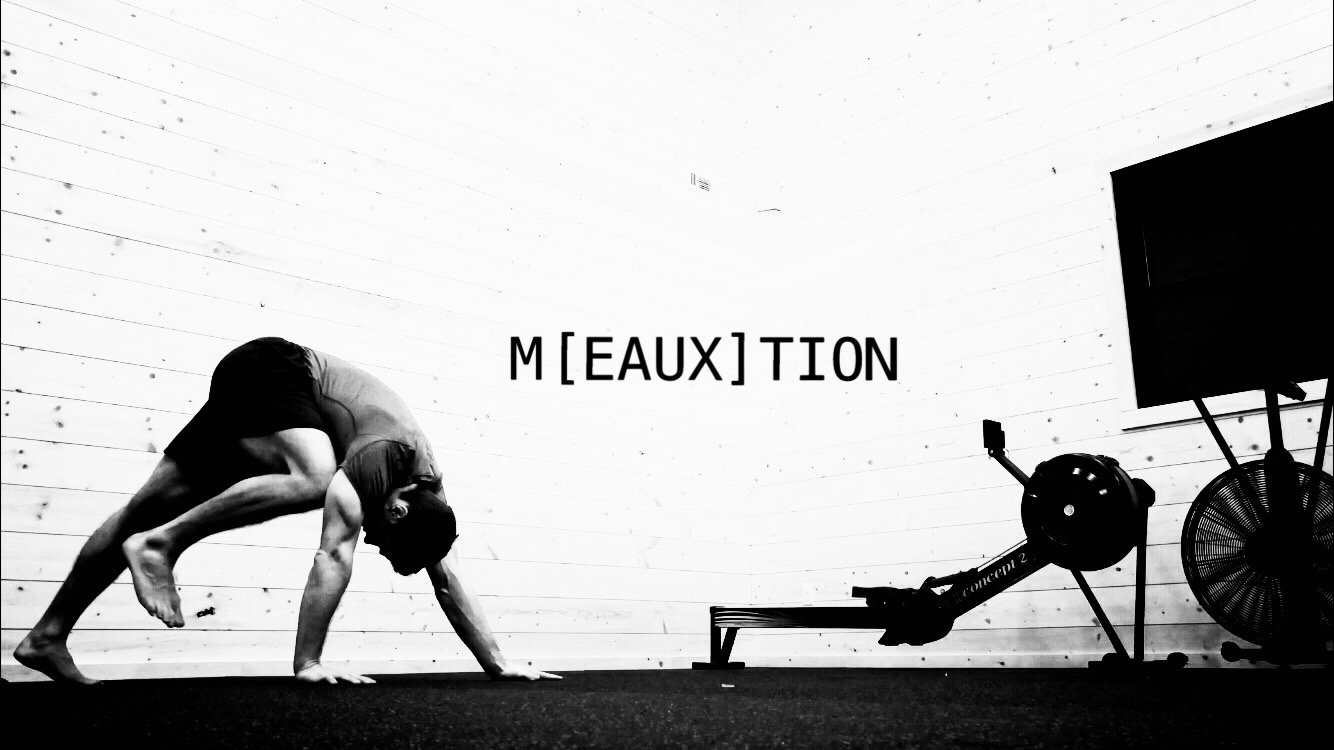
The Swinging Plank is a brilliant hybrid exercise designed by Scott Sonnon, founder of TacFit training systems.
The movement will put your upper body strength, endurance and multi-planar core strength and stability to the test.
If you’re looking for a non-traditional movement challenge, this is it!
Swing Planks will burn out your core and arms even at lower rep ranges.
For the last several months, I have beaten on this exercise (and it’s variations) aggressively.
Bodyweight movements like this will get you functionally strong in a hurry without adding bulk, which is great for someone who want’s to function the way they look.
Bodyweight control…
Those of you who’ve been loyal to traditional forms of resistance training will find ground-based bodyweight exercise to be an incredible supplement workouts.
The swinging plank embodies current fitness trends: the shift away from structured exercise and into exploring integrated movement training.
And its not that traditional exercise is bad, it’s not, it has its place and will always have it’s place. The idea is that at some point, the body and mind crave freedom of movement, beyond what adding more weight, reps, sets can offer us.
Patterns like high and low crawling, narrow surface balancing and hanging exist.
Ground-based exercises that require full bodyweight support (hands and feet in contact on the ground) are fantastic for building functional strength, or in some cases where injury is present, a gentle re-introduction to loading.
By movement design, the swinging plank elicits a minimal amount of stress to the lower body, making it ideal for non-competing circuits or training days where the lower body needs a break from exertion.
However, execution of the exercise will require adequate mobility in the hips, knees and ankles, so if you’re extremely restricted, free up those joints first. One look at this drill and you can see that lower body joint mobility is a pre-requisite for proper technique.
A fusion of exercises…
Swing planks are a hybrid exercise.
The static plank, chaturanga, push-up, dive-bomber and crawling all merge to form the swinging plank exercise.
At the midway point of the drill, you’ll find yourself in chaturanga (Four-Limb Staff Pose), one of yoga’s asanas (“postures”). In chaturanga, the body is gracefully lowered toward to the floor, stopping where the elbows reach 90 degrees and tucked into the ribs, core fully activated.
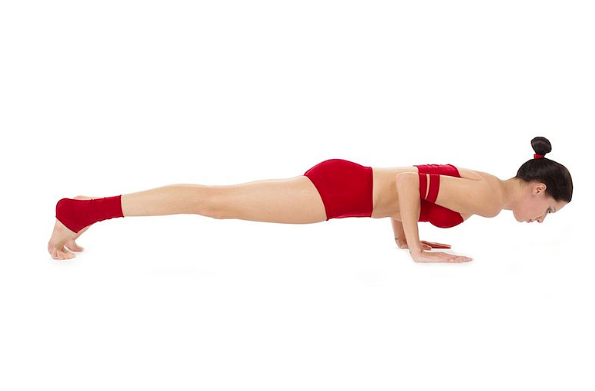
Chaturanga
Pressing back and out of chaturanga feels a lot like a push-up or a dive-bomber. Dive-bombers are a real shoulder burner when performed strict. Because the movement is backward and not straight up, it’s hard to relate the stress as being identical to a push-up.
Now, what you came here for…
How to do The Swinging Plank

1. Start with weight on the balls of your feet (knees and hips flexed into a squat position) hands extended out in front of the shoulders with palms placed firmly on the ground, eyes gazing between the hands or slightly in front of the hands.
2. In a front to back motion, lunge your body forward out in between the hands, keeping the elbows against the rib cage, body rigid and low to the ground.

3. Rotate the chest and torso over the hands and onto to the opposite side, pressing with the arms and pulling slightly with the legs back into the starting position (#1), now facing the other side.
Here is TacFit Commando creator Scott Sonnon demonstrating the swing plank…
The starting position of the swing plank looks a lot the start position of a bear crawl, except in the swing plank, the shoulders are situated just behind the hands verses over the top of the hands.
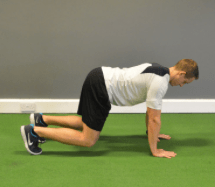
Start position of a bear crawl.
I’ve found that using this prone table top position (picture above) is a great way to get hand/foot spacing correct.
Technique tips continued…
Technique-wise, it’s important to force the hips into full extension. Create a straight line from heels to the crown of the head.
Core should stay “soft” yet active to control body position. Avoid over-tensioning or you’ll be too stiff to flow through the movement.
*** To avoid hand slippage, place the hands on a surface that gives you a good grip. On the way out and back in, you’re not going to be over the top of your hands like you would be during a push-up. Rubber gym matting, grass, a quality yoga mat with some stickiness or a a grittier surface like concrete all work well.
Swing Plank exercise progression…
If you’re quite not ready for the swing plank or maybe you’re looking for a soft progression to get there, here are some drills to work through (in order from top to bottom):
- 1. Static Prone Plank (Hold for 40 seconds or longer)
- 2. Static Lateral Plank (Hold for 30 seconds or longer each side)
- 3. Rotational Dynamic Plank Variations (see here)
- 4. Bodyweight Push-Ups (15-20 reps)
- 5. Dive-Bombers (eccentric and concentric phases, 8-10 reps)
- 6. Piston Planks
- 7. SWINGING PLANKS
Not everyone is going to need every exercise progression listed.
You might be ready to attack swing planks today.
The exercise regressions allow your body to acclimate to stress progressively.
There’s no need to rush. Aim to do it right, or quite honestly, don’t do it at all.
Creating and building out from a foundation is critical.
Mobility
Making sure you have adequate active range of motion is essential to moving well.
During the swing plank, the hip, knee and ankle joints should move freely without restriction, aches or pains.
Controlled throughout the entire range of motion.
The starting position of the swing plank places the ankle, knee and hip joints into a very demanding range of motion.
If you find yourself locked up and struggling to get into position without rounding the lower back, I recommend addressing mobility restrictions first.
MyDailyMobility is a great program to use.
Where do swing planks fit into a workout/program?
Anywhere you want.
I like to mix swing planks into work capacity training sessions as a transition/filler exercise.
Swing planks fit well in between upper (vertical pressing, push-ups, dive-bombers) and lower body exercises (lunges, squats, deadlifts, kettlebell swings).
A sample sequence:
8-10 minutes continuous of:
1a) Bodyweight Lunge x 6 right/left
2a) TacFit Swing Plank x6 right/left
3a) Bodyweight Chin-Up x6
Using a non-competing exercise format provides an opportunity to focus on movement technique while limiting the fatigue much as possible.
Discussion…
Deconstruct and go slow.
I suggest you break the swing plank down into segments in order to appreciate the movement. Practice the swing plank in slow motion for fewer reps. Do it right. Pause when you reach extension (chaturanga-like posture). Connect your mind to each muscle and transition.
Be conscious of your hand, foot, torso and head position. Pay attention to your breathing throughout the range of motion. Are you breathing or are you holding your breath? Make sure that your tongue stays relaxed and you’re breathing.
Stay low! You should have a little dirt on your t-shirt when you’re done.
Maintaining a rigid posture while turning over from side to side will blow up your mid-section. The rotational core stability challenge is potent as you flow through each rep.
When performed as a part of a circuit or for higher reps, the swinging plank elicits a potent cardio training effect, making it a great exercise for metabolic workouts.
Hybrid bodyweight training is highly effective and yet so often overlooked. It’s easy to become infatuated with adding weight to the barbell and racing the clock for reps.
Having full control over your body in many different positions is the ultimate safeguard against injury (injury mitigation) and a gateway to performance.
Bodyweight training can humble people quickly.
If you’re interested finding out about more unique bodyweight workouts that incorporate movements like the swinging plank, check out TacFit Commando.
Cheers,
Kyle





 M(eaux)tion Fitness