3 Time Efficient Methods To Squeezing in a Workout While Building a Career

Quick Tips

One thing that I have learned about writing and consulting on topics related to fitness is this:  Not everyone thinks about training, eating and health as much as I do.

Not everyone cares about how great a kettlebell swing is, how bear crawling can restore function or jumping rope is 10x better for conditioning than a recumbent bike.

I think sometimes as professionals we forget that we care about fitness far more than any other people on the planet.  Hell, we made a career out of it.

One issue with training that comes up time and time again is time, or lack their off.

As I mentioned in a recent post, I completely understand the time issue.  I currently have a full-time career, write, train and am currently building an internet based fitness company/culture to help transition out of my existing career.  Time is short, just as it is for so many other career professionals.  I am in your shoes, which is why I feel so at home writing on this blog.  You and I are in the same boat.

We’ve got to find solutions to working out when time is really tight.

Here are a few ideas that can put you back on track for working out around a career…

1)  Strength-Cardio Circuits

Interval training using strength based movements are amazing for building adequate levels of strength and power while stripping fat.  These workouts leverage our body’s natural ability to continue to burn fat for hours after the training session has ended.  Strength cardio circuits, sometimes referred to as metabolic training, involve short burst efforts and minimal rest periods between movements.  You’ll want the training session to be a total body experience, alternating exercises between upper body and lower body to increase performance by avoiding fatigue. By alternating movements, you’ll be able to hit more muscles in less time without sacrificing exercise technique.

Although the amount of time designated for work and rest during a strength-cardio workout will vary depending on your fitness and skill level, you should be able to find a sweet spot for yourself.

Here is a simple table to reference:
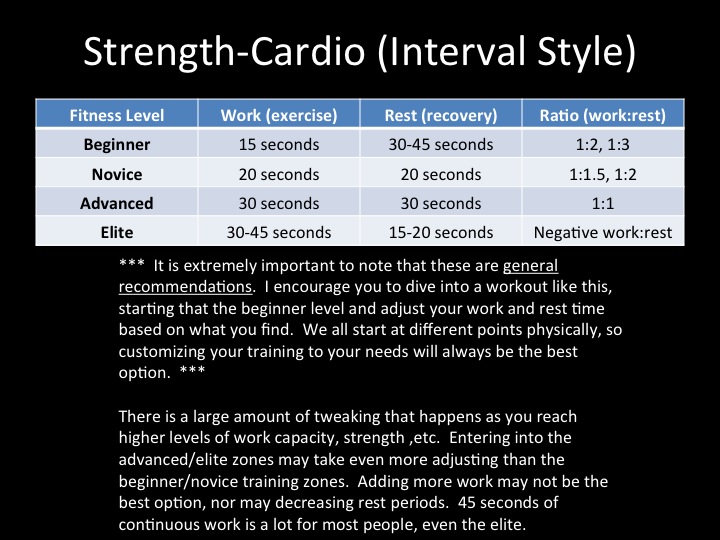
Strength Cardio Interval Training

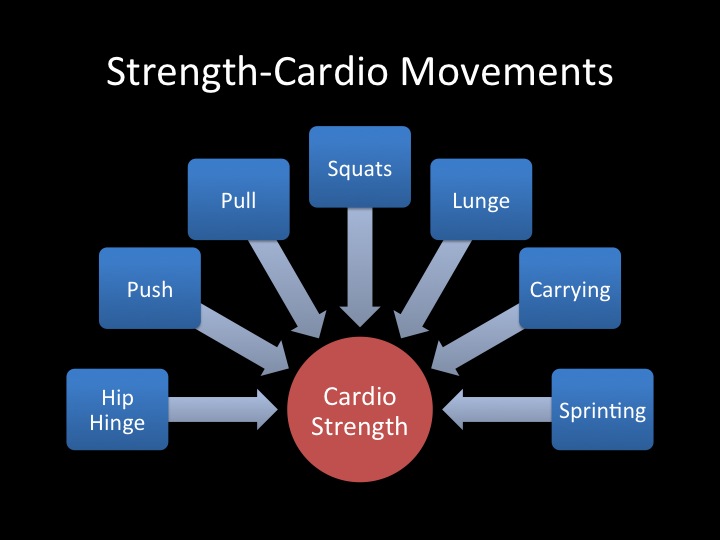
Choose from these simple movements…

Strength Cardio Movements

2)  Train on the weekends.

Nothing ground breaking here, but I just want you to start thinking about where you can fit in a training session.  The weekend usually provides some relief from the time commitments of the workweek, so look toward Saturday and Sunday for squeezing in a couple solid training sessions.  This will work wonders for your attitude as you enter into Monday and Tuesday.  You’ll have the confidence knowing that you put forth a solid physical effort that you can leverage for 24-48 hours.

I train on the weekends all of the time.  During this time, I feel no need to rush through the workout like I do during the week.  The training session becomes enjoyable.  Often times, I will spend a significant amount of time working on my mobility and addressing any muscles that feel overactive with knots.  It’s a time for training aggressively and regenerating my body.

Weekend Training Solutions

3)  Two Sessions Per Day

This might sound crazy, but incorporating two smaller training sessions into your day might provide some relief to your training efforts.  Rather than spend 60-90 minutes exercising once a day, try splitting the day into two smaller training sessions that last anywhere from 15-20 minutes.  The smaller window of time will keep you focused on moving forward throughout the workout and also motivate you to do more in less time.  Stoking your metabolism twice a day will work wonders.

Check out this recent post about that would help you coordinate a couple short training sessions:

—> Time Based Training

Having a career and committing to a life of physical fitness should be able to coexist with each other.  They have to.  Wealth without health is completely pointless, just as health without any wealth is stressful.  Find the balance that fits your situation, integrate the suggestions above and make an effort to not only maintain your body, but improve it.  Succeeding in career and physical performance will elevate your attitude and take your confidence to new heights.


Cheers to earning the $$$ and engineering a high functioning body in the process…

KG

Crawling to Improve Core Stability and Performance

Quick Tips

Animal movement is getting a lot of attention from forward thinking fitness professionals these days.

I predict that Men’s Health will jump on this bandwagon soon enough.  You’ll probably see a headline that screams:

“Burn Fat and Build An Athletic Body Like True Animal!”

Men’s Health has mastered the art of the headline and how to attract to attention.  That’s cool.  I am slightly jealous, but then again, I would rather have the freedom to write with my own authentic voice and tone, not what they think people want to read.  That would get old real quick.  You lose your identity as a person, what makes you uniquely you, when you start working for the man.

My blog articles wouldn’t be authentic if I didn’t get a bit lost here and there, so let’s get back to the business of discussing animal-like exercises, and where they might fit in a workout program.

—>Bear crawling is an awesome therapeutic movement…

First, let me say that I understand movement, however, I am not an “animal movement”, I simply see it as a methodology that can provide some great benefit while keeping your training session fresh.

Crawling for a better body…

I have used crawling off and on for quite some time now, both in my own training and in the training of my general and athlete clients.

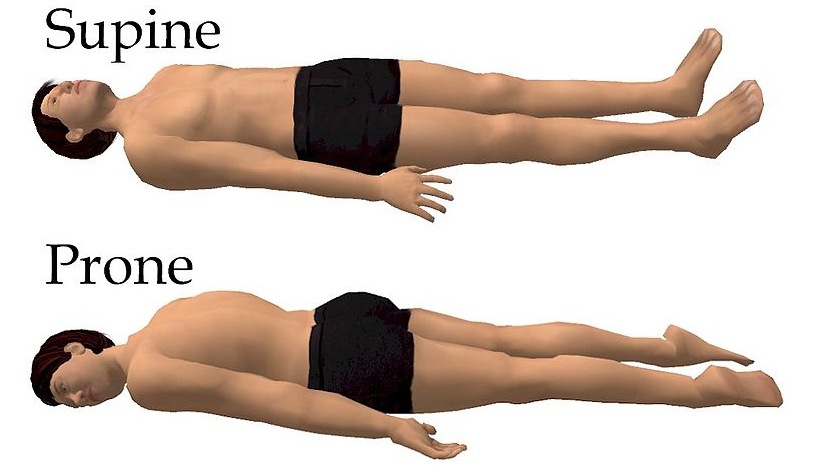
Actually, I have used the supine and prone versions of crawling for about 7 years.  Here is what I mean when I use the anatomical terms supine and prone:

supine and prone

Crawling was valuable part of our warm up when I worked with my younger athletes.  I have to admit however that I really only used crawling movements with the younger population, mostly between the ages 9-12 yrs.  Reflecting back, I wish I would have programmed more crawling with my elite athletes and corporate personal training clients.

Babies crab and bear crawl all of the time.  It is essential for their movement and development into the early walking stages of life… Check out these videos for proof….

The Crab Crawl and Variations

The crab crawl is the supine version of crawling.  The front of the body faces the ceiling and back faces the floor.

Here is a simple variation of a supine crab crawl called the Table Top Pull Through.  You’ll understand why it’s named this way once you click on the video.  Great warm up movement…

With the younger athletes, I mostly used the crab crawl (supine).  I saw (and still do see) tremendous value in the upper body and lower body connection that a supine (crab crawl) provides.  When working with younger athletes, it’s important to keep the balance of entertaining them (keeping them engaged in what you’re coaching) and teaching them how to use their bodies.  It’s quite an interesting process working with younger kids, I deeply respect any coach or trainer that is successful at it.

Here is what a full crab crawl looks like:

I would ask my athletes and clients to crawl forward like you see in the video above until I verbally cued “hips up!”, at which time they would stop, raise their hips and form that human table top that you viewed in the first video.  The backside muscles of the body light up during this static hold, as does the torso.  While the backside activates you’re simultaneously lengthening the anterior (front side) aspect of the shoulders/pecs.

This is such a fantastic movement for people who sit all day long.  It really helps to unwind some of the structural changes that as a result of sitting for extended periods of time.  Unwinding and reversing these changes is really important to avoid unnecessary injury and malfunction.

It was great, but most of all, it was fun for the kids and adults alike.  It’s one of those movements that doesn’t feel like a “workout”, yet has tremendous bang for your buck.

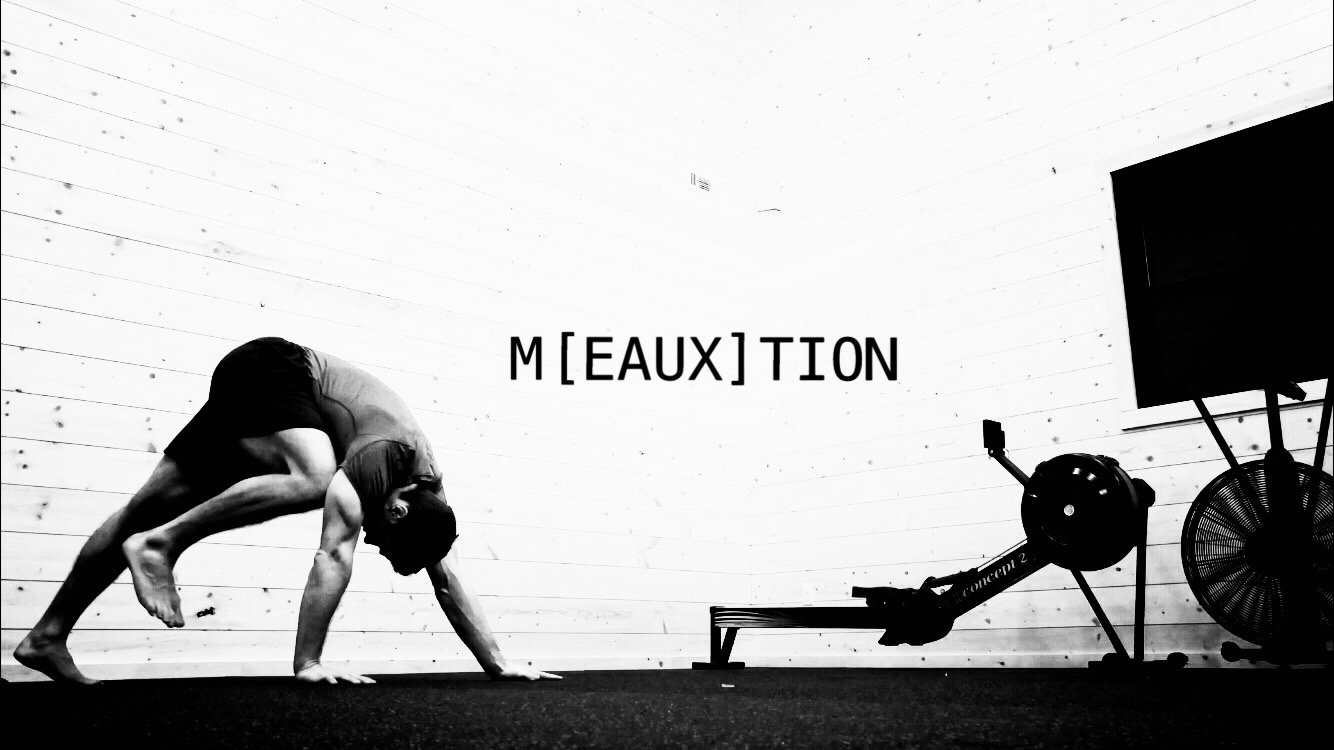
Shortly after incorporating the crab crawl, I started playing around with the bear crawl.  This is essentially the flipped over version of the crab crawl, with the participants face and belly facing the floor.

You’ll notice  that it is quite easy to “butcher” crawling movements and cheat.  However, if you take your time, align your body and move as if you were trying to stay as soft and quiet as possible, there is an incredible amount of motor control, timing and recruitment that takes place to make it all happen.

Sidenote:  I have found the “soft and quiet” idea to be quite effective for working to perfect movements related to crawling and Turkish Get Ups.  Staying soft and quiet asks the person to stabilize and activate muscular in a timely manner in order to be graceful.  In a fitness world that seems to drool over “harder, faster, aggressive, yeah!!!!”… moving with grace is a nice breath of fresh air.  Think yoga-like grace.

Now, the bear crawl, just like any other movement, can be performed at different speeds.  My recommendation is to prove that you can perform the slow motion bear crawl before you start racing around with horrible technique.  I’ve seen some videos of bear crawl racing on YouTube.

Not where you should be starting…

If you can’t go slow with expert like technique, why should you go fast?

It’s almost hard to say “technique” when talking about bear crawls, because I don’t know if anyone has actually established what ideal technique should look like.  It’s open for interpretation and varies depending on who you are talking to.

Keeping the mid-section still and some sort of rhythm is key however. Picture a glass of water balancing on your back as you crawl, avoid spilling any of the water during the movement.

—> Keep the bear crawls training effect in perspective…

1)  The bear crawl is a demanding exercise that has progressions, just like any other exercise.  If you can’t hold a satisfactory plank or properly activate your abdominal musculature, bear crawling might be a little further down on the needs list for you.  You may have to fix some other things first, than work into the full bear crawl.

2)  Start slow and perfect the movement. Move with control over speed.  It’s not a race.

3)  Don’t expect anything extreme to come from the bear crawl.  You’re not going to develop a six pack (abs are made in the kitchen), burn crazy fat, or become super human by incorporating the bear crawl into your workouts.  It’s a tool, treat it as a small but important piece of the whole picture.

4)  Integrate the bear crawl into your warm-up.  It’s a fantastic upper/lower body activating exercise that will prepare your joints for the demands of the workout.

I have to admit, I am fascinated with animal movements and how they can and should fit into a training program.  It’s an old idea that is creeping back into workout programming for forward thinking coaches.  I value animal movements, but I wouldn’t be the first to base an entire program off of them.  As I mentioned earlier, they are tools and puzzle pieces that help create a complete program.

Definitely worth messing around with in your own training however.  I can say that for sure.

—>  People will think you are a weird for sure…

You’ll get some weird looks if you’re doing bear crawls in a public place or at your local gym, but remember, who cares?  People don’t think much about anything, so just do it.  You’ll have a blast and create some positive training effects from it.  If you’re at the gym and people roll their eyes, let them.  You’re ahead of the game by incorporating crawling movements into your training regimen. Keep yourself away from stale training programs.

Cheers to humans crawling around like bears and crabs…

KG

A Time Based Bodyweight Workout for Boosting Fitness and Fat Loss

Quick Tips

Let’s face it, time is a commodity.  It’s our most precious commodity.  The clock will continue to tick no matter what we do.

I used to think that people who claimed that they “have no time to work out” were just dishing out lame excuses.  I might be conditioned though.  I have heard this time and time again from people who ask me for fitness advice.  Once I give them a rough outline of what they need to be doing in the gym or at home workout-wise, they raise their eyebrows and throw out the “I have no time for that” card.

What did you expect?  Hahaha.  It makes me laugh every time.

Enter:  Time based training.  

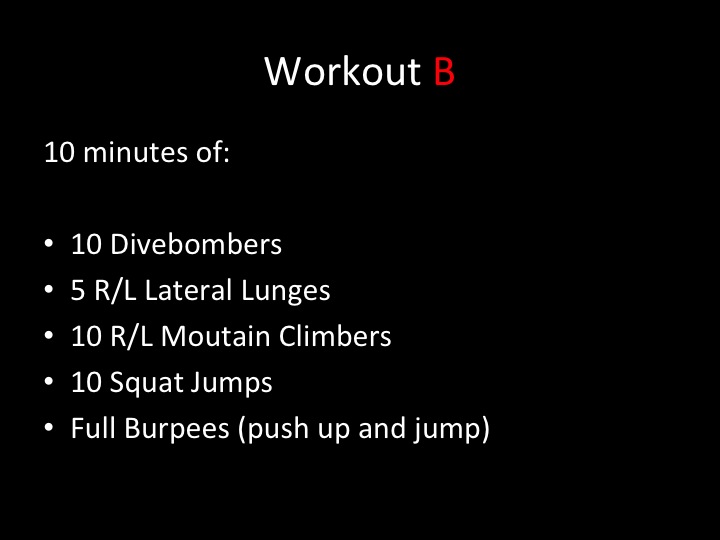
What follows is a simple time based workout program that is an immediate solution for anyone leery of investing decent time in a workout or for people who are legitimately short on time (because I know that you are out there folks).  

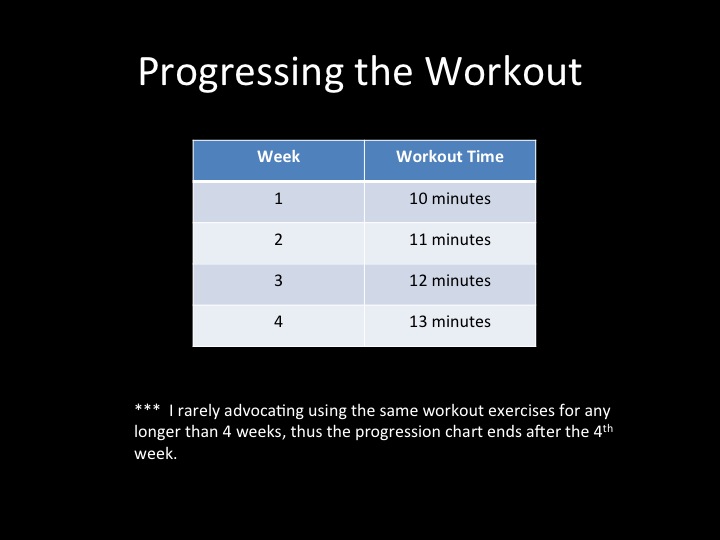
You’ll be able to progress this training plan for about four weeks while avoiding stagnation and adaptation.  The body tends to get really efficient at activities that we repetitively engage in, so don’t be silly and try to ride this program out for a year or something crazy like that.  

Building fitness demands that you constantly keep tweaking the variables.

Here you go… 

ImageImageImageImageImage


Essentially you are increasing the volume of your training sessions by adding one minute per week for four weeks straight.  I like workouts like this for beginners or advanced individuals alike because everyone can move at a pace that is appropriate to them.  Beginners can grab a breather and some water if need be, and advanced trainees can whiz through at break neck pace to get their training effect from the workout.

Best of all?  You can do this type of workout anywhere.  

Worst of all?  No pulling and no hip hinging movements.  Without equipment, it’s really hard to work upper body pulling movements into a workout.  Suspension trainers like the Jungle Gym XT really help this issue.  

Hip hinging is the motion you’d make if you were butt bumping a car door shut.  You’re hinging at your hips.  Without weight, it’s hard to train this movement pattern, which really sucks because hip hinging is one of the most beneficial movement patterns that we humans can train.  

You’ll find that every style of training sacrifices something.  Nothing is perfect.  

The key with short workouts like this is leveraging the training effect of the session.  Short training sessions like this need to be high tempo since you are cramming a lot into short duration. 

If you’re not willing to buckle down on your eating habits, well, prepare to be awfully disappointed by every workout program ever created.  Physical activity is a supplement to eating food worthy of fat loss.  The changes that take place post-workout are just as important if not more important than what takes place during the workout.

Sure, you can reduce body fat and increase performance without any dietary intervention (yes it is possible), but you’ll sell yourself short in the long run.  Sooner or later you’ll reach a plateau.  Eating crap food and training like a crazy person only gives off the perception of health.  Food is the key to the body aesthetic universe and long-term health and wellness. 

Any honest personal trainer or fitness advocate in the world will tell you that nutrition makes up the bulk of the foundation of any athletic or fit-looking body.  We cannot train hard enough or long enough to offset poor eating habits.  Unless you are an Iron Man athlete, in which case you are training for 3-5+ hours per day, almost daily and you have no real world career other than your sport.

Less than 1% of us fit that description, so lets just be big boys and girls and eat nutrient rich foods.  Ok?  Make the food that enters your pie hole primarily veggies and plants mixed with some animal protein and nuts.  Perfect little diet solution that will work wonders.

Plus, it would be so stressful to think about having to workout so ridiculously hard to combat all of the junk food eaten.  

If the food grew from the earth or has a mother, eat it. That’s your checklist to decipher through the food trickery that has saturated our restaurants and supermarkets.  

Rock this workout plan for at least 2 weeks.  Training for any period of time shorter than that isn’t even worth lacing up your shoes for the first training session, and it really shows that you aren’t prioritizing to make some changes.  Stay committed and trust yourself and your program.  

All in good time.


Cheers to leveraging our body’s natural ability to burn fat…


Kyle

Is Planking Worth It?

Quick Tips

Some headlines from a recent Los Angeles Times article caught my eye…

Planks

As I read through the article, some decent points were made.  I have to say that I have learned a lot from Stuart McGill.  He really is a back expert.  It’s an area that a lot of health professionals didn’t understand until rather recently.

Check out the full article here.

In my opinion, hell yes planking is worth the time.

Will I have the same opinion 5 years down the road?  Who knows.  Our industry is constantly reshaping itself.  But right now, planks are a must do exercise.

I believe in progression with exercise.  Planking is a part of my progression to more challenging movements.  Therefore, I can justify it.  Will I be able to justify planking in 10 years?  I don’t know.  But right now, planking is an impactful exercise that gives benefit to the trainee while giving me information about how they handle (or cannot handle) that stress.

For a certain population.  If you can’t hold a technically perfect plank for say… 30-60 sec, we might have some work to do.  I have personally worked with some people who could not hold a rigid plank for 5-10 seconds without collapsing or moving into a body position that made the drill easier.  The body commonly resorts to the path of least resistance.

cartoon plank

Not a bad plank here… I would straighten the legs out a bit.

I love planks for beginners who are learning how to stabilize their body progressively, and also for intermediate and advanced trainees to reinforce body stabilization.  Sitting kills the normal function of the torso musculature.  Core muscles lay dormant all day long.  It is important that we make a conscious effort to wake them up and get them firing appropriately during training sessions.

Doing so will aid in preventing unnecessary injury not just in the gym, but in life.  When the muscles of the core shut down or begin firing out of sequence, other muscles get involved to help get the physical labor done.  This mis-firing can lead to serious injury.  Think lower back injuries here.

We all know someone who has fought or is currently fighting a lower back injury.

Screen Shot 2013-02-06 at 2.17.27 PM

I don’t think that many movements are over-rated.  From my eyes, I see safe and unsafe exercises

Movement selection is dependent on your goals.  

One of the reasons that I am so fond of the functional movement screen is that it allows us to perform routine maintenance checks on our body’s ability to move.  The human body is vulnerable to malfunctions.  Our wiring gets mixed up, muscles fire when they shouldn’t, joints get sticky ,etc.

Nobody is going to move perfectly and pain-free for their entire life.  We must perform these check ups to verify that we are functioning appropriately.

—>  No hail mary please…

Don’t throw a hail mary for any exercise.  Planking does engage the core, yes.  However, how you incorporate planking (if you need it at all) in your program is going to be different than the next person.  It’s all based on your needs you see.

The thought that holding long duration planks to “burn out” the core and get those wash board abdominals is ludicrous.

Abdominals are made in the kitchen.

Vegetables dominate planks in race to the almighty six-pack.

Never forget that.

Cheers to planks and keeping it simple…

KG

Are They Mental or Physical Roadblocks?

Quick Tips

I’ve come to realization that there are very few physical roadblocks in life, while mental roadblocks are plentiful.  

Physically, the human body is capable of enduring stress far beyond what we believe it can.  While it’s not always intelligent to put your body through extreme stress, it’s worth grasping the fact that most of us are capable of handling high levels of physical exertion if need be.

When a person really takes a step back from fitness related endeavor, regaining control of eating habits, career adversity, or whatever it is weighs heavy on their mind, you realize that it is exactly that.  It’s all in your mind.  The mind is so powerful that it can hold us back from becoming the people that we dream to be.  

We become what we think about most.

That’s a scary thought, but it seems to be true far more often than not.  I’ve been a victim of my own thoughts, just as I suspect that many of you have.  It’s a tough thing to admit, especially since the only thing holding you back from greatness is, well, you.  Crazy.

Re-programming the mind to operate in such a way that is in line with your dreams and aspirations seems to be the key to the universe.  

In my own life…

… maybe I have mentioned this prior on this blog, I cannot recall, but I am an extremely emotionally driven person.  I wear my heart on my sleeve.  It’s my belief that the people who know me both love and become annoyed with me because of this.  I cannot help it.  It’s part of who I am.  My poor girlfriend gets the pleasure of dealing with it daily.  Muah!

For a while I thought that I could toughen up, work through my emotions, maybe become slightly more desensitized to handling certain situations with such emotion.  Maybe have a little more brutal honesty toward people, etc.  I can’t (PS:  I HATE the phrase “I can’t”, but it works for this situation).  It seems like honesty- not the kind where you have the choice of telling truth or lying, but the kind where you speak your mind- is practiced less and less in the real world.  We sugar coat everything.  

While I think that I have become a much more direct and effective communicator, I’ll always carry big emotions.  I used to think that it would be my downfall in life, but I have since learned that it doesn’t have to be that way.  I can choose whatever path I desire, I can harness my emotions.  It will be important to continue to do so as I find my ultimate calling in life.  

This blog and business is definitely one of them. I feel that my emotions will act as my source of fuel as I scratch and claw to the top.  

Well, that’s me, how about you?

What’s holding you back?  Is it your head?  Your daily self-talk?  Your self-confidence in your abilities to accomplish something great? 

I figured that some of you could relate well to the contents of this post.  The mental barriers in life hold us all back from greatness, all of the time.  We battle against them constantly.  Daily in fact, whether you know it or not.  Some of us know don’t think big enough, and some of us know what we want to achieve/accomplish in life but are being held back by the thoughts inside of our head.  

Simple as that.

Some of us will submit, transition into autopilot living and fade away.  This is a tragedy.  Others will find the inner strength to continue pushing back against the negative self-talk.  These folks will continue to work to re-program their mind to think massively big.  These are people that I personally want to be around.

If you’re in the market for a newly remodeled body, these are people that you need to be around during your own journey.  Never mind physical abilities, get with someone that is headstrong and driven.  It’s contagious.  

Some of you may think this kind of talk is cheesy.  Maybe so.  Or maybe you’ve just got it all figured out, in which case I will invite you to share your secrets with the rest of us.  

I personally want to be in the second group.  The one that thinks and dreams about the impossible, then works to make it possible.  My time on earth is short in the grand scheme of things.    

I often hear older generations say, “Do __________ (fill in blank) now while you’re young, because you won’t have time or have the physical capacity to do it later”.  

This is a complete tragedy for me to think about.  People giving up that is.  I hope that you feel the same way.  It’s never too late.  It can’t be.  Life was meant to be lived aggressively, surrounded by people who you love and enjoy spending time with.  We should all be working to accomplish something that you genuinely enjoy, whatever that “something” may be, that will create our own legacy.

When I say legacy, I’m not necessarily talking about money here.  Money is commonly the only thing people associate with success, but it doesn’t define success.  Be successful with something that is important to you and you truly love, whatever that may be.

If you landed on this blog and are considering joining me in moving closer to a body that looks and functions the way that you know that it can, wonderful.  I can help you with that, bit by bit we will move forward together.  Think what you want about fitness and nutrition, but everyone deserves to feel comfortable in their own skin.  Your body is your vehicle throughout this life, you should feel confident about how it looks and feels.  

If you landed here by chance, great, maybe I can give you something to spark a thought that you hadn’t considered before.  I really value reading content that makes me think.  There is always another viewpoint to consider, whether I agree with it or not.

If you’re anything like me, whenever you start to feel yourself thinking negatively or “small”, fight back.  Put yourself back into a positive state.  Never submit to yourself.  It’s a horrible feeling knowing that because you lost the battle mentally, you now have to lose the battle physically. 

Keep pushing forward as hard as you possibly can and I will do the same.  

Maybe someday our paths will cross and we can share our stories at the peak of the mountain.  


Cheers to destroying negativity and creating something great…


KG

5 Hot Trends in the Fitness World

Quick Tips

I always enjoy reading “list” style article from other writers, so I am making a conscious effort to put out more list style articles.  I have to be careful on how I word the titles however.  My major beef with article that are constructed in the list format are when they appear like the following:

“3 Best Foods to Eat for Fat Loss”

“10 Best Resistance Band Exercises”

“5 Best Butt Shaping Moves”

What is the common trend that you see there?

The word “best”.

I have trouble with the word “best” these days.  I used to be the kind of guy that would give out information about what I thought was the best, but I have since realized that just about everything works.  That being said, there are definitely exercises that I would select over others for most people.  But I still don’t feel comfortable saying that there is any one “best” of anything.  It’s a human malfunction, not an exercise malfunction.

I am guilty of it myself.

So I am careful on how I am going to word these “list” articles.

Moving on…

Physical culture has evolved tremendously over the last few years.  Products and methods have continuously improved our industry.  Naturally, the information being dispensed to the public has also become much more applicable.

Below are what I feel are 5 red hot trends in the fitness world

1)  Metabolic training.

I can’t really use any more description than that.  We have officially entered the age of Cardio-Strength, Met-Con (metabolic conditioning) and work capacity based training for getting lean and regaining control of our bodies.  It’s a trendy method, and rightfully so.  I myself have trained using incomplete rest periods and high volumes of work in short amounts of time for years.  The results are undeniable.  I don’t like to generalize statements, but the kind of aesthetic look that metabolic style training produces seems to be highly desirable by the public.  People want the lean and athletic look.  As with any trendy method, metabolic conditioning is also heading toward the dangerous realms.  There are always individuals who will take ideas to the extreme, and we are seeing this currently with metabolic conditioning.  Over-training and injuries have never been so prevalent, yet people seem to think it is part of the gig.  It doesn’t have to be.

2)  Suspension Training.

Screen Shot 2013-02-07 at 7.09.40 PM

Yes, TRX first hit the mainstream a long time ago.  Close to 6-7 years actually before finally hitting it big time.  Jon Hinds at LifeLine Fitness has been promoting his Jungle Gym suspension trainer for years prior to that.  What is amazing is the evolution of how we are using the suspension trainer.  It’s become a go to tool for rehab, developing and regaining mobility and stability and also yoga like movements.  It’s arguably the most versatile piece of training equipment in fitness right now.  Every home should have one.

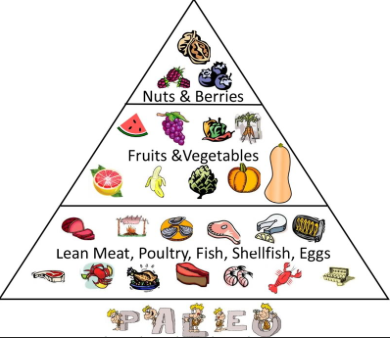
3)  Paleo.

Screen Shot 2013-02-08 at 6.24.55 AM

Paleo is the hottest trend in eating, and I have to say that I have been eating ridiculously close to Paleo for quite some time.  Paleo is clean eating.  Whole food, lean meats and plenty of plants.  Although I feel that some professionals have really enjoyed the marketing appeal of a term like “Paleo”, I cannot argue with the eating recommendations.  If you want to strip fat and get yourself out of the “sick, overweight and heading for preventable disease category”, Paleo is a fantastic option.

Here is a link to Robb Wolf, a trusted name in the Paleo world: Robb Wolf

4)  Animal Movements.

This is something that I am HIGHLY interested in at that the present time.  I will be reporting back on this in future posts.  I would like to call it ground based mobility training, but that doesn’t even do it justice.  After watching a few video clips from the folks over at Primal Move, I was hooked.  I see so much value in it.  Strength and Conditioning coaches have been gravitating to Gray Cook and his Functional Movement Screen for assessing athletes and general population clients alike.  I can see this building on the findings of Gray’s FMS.  Moving joints in a range of motion like the video below would be a tremendous addition for so many people…

5)  Self-massage.

It’s never been more simple to perform self-maintenance on your body.  Tools like foam rollers and lacrosse balls have around for ages, but the information on how to use them was really lacking.  Sure, guys like Mike Boyle and others were promoting foam rolling sessions as a pre-workout method for eliminating trigger points and changing the density of muscle before changing length.  Some will argue against the effectiveness of stretching statically, and I am not even sure where I stand on static stretching at the present time, but no one should argue against the effectiveness of relieving oneself of restrictions (aka: knots and sticky tissue).  Trigger Point Performance, a company out of Texas, has really taken the concept of self-massage to the next level.  There educational seminars and products are fantastic.

Where is physical culture heading next?  Who knows, and that is the beauty of it.  We read, learn and apply daily.  The landscape of the fitness industry is constantly changing, and I really like that.


Cheers to being trendy (in a good way)…

KG

Time Based Fat Loss Circuits: Some Thoughts…

Quick Tips

Once you have established that you can move without pain and 3-dimensionally in a strong, mobile and stable manner, it’s time to start thinking about your training goals.

Assuming that you don’t want to be a body builder or a power lifter, work capacity based fat loss circuits are a great option.

Basing the amount of work you perform during a work-set off of time versus reps can breathe new life into your training program.  Battling the clock can really ramp up a training session as you attempt to complete as many reps as possible before the beeper goes off, signaling the next rest period.

As much as I like the idea of time based training and how effective it can be, I also have some hesitations.  I feel like it’s natural of me to feel this way, and I wanted to get you thinking also.

–>  What amount of time is appropriate for work?

Yes, work capacity style training sessions are going to be highly metabolic.  Often times they are going to use incomplete rest periods (because they are fixed) and the work-sets are going to be a bit too long.

Just as the most common rep scheme in the fitness industry seems to be 10 reps, the most common duration of work in a fat loss circuit seems to be 30 seconds.  If I dig hard enough, I can probably find some research paper that the entire industry has interpreted to establish this 30 second work-set, but that will have to wait for another time.  Just my own thoughts for now.

First, let me say that 30 seconds is a long time to be performing work.  For the lower body, this might be more appropriate.  Movements like squats, lunges, step ups, etc could be managed by most trainees for 30 seconds.  But for the upper body, 30 seconds in my experience is way too long.  We often lose the training effect if we extend the work-set to 30 seconds.  The effort tapers and technique goes to hell.

The work being done becomes aerobic.

If you’re trainer reading this, observe it in your next session with clients.  Even the advanced clients are about 50/50 for solid movement technique and output for the duration of the 30 seconds.

If you’re incorporating upper body pulling movements, particularly vertical pulling movements like chin ups and pull ups, forget about it.  Very few can sustain a high effort beyond the first round of the circuit.  Body rows (aka: inverted rows), maybe.

The time that each person works is dependent on their physical abilities (strength, stability, endurance, etc).  Selecting a time that is appropriate for the later rounds of the session should be considered before you ever start the workout.  The first round of a high tempo fat loss circuit doesn’t provide a glimpse into what is coming once fatigue sets in.

And fatigue will set in, trust me here.  It sneaks up quick.  Plan for it.

So, for me, I would reserve 30 seconds of work for a proven population.  Mostly advanced who can produce the output and handle the fatigue.

15-20 seconds might be more appropriate to get the training effect you’re looking for.

5-10 seconds of work can make all of the difference in the world.

—>  What exercises are best for a time based fat loss circuit?

It has to be sub-maximal (lighter weight) or bodyweight here.  I haven’t necessarily found a sweet spot for gauging the number of reps a person should achieve, but somewhere in the 1 rep for every 2-3 seconds is probably manageable for most.

That would mean a 30second work set would allow for 10-15 reps during that period of time.

Not bad.

How aggressive you are with your loading will also change the reps completed in that time frame, so consider this.

Lower body movements are fantastic for fat loss circuits.  Keep them simple.  I haven’t found a need to go beyond something as simple as say a squat.  Squatting while balancing on a BOSU ball with resisting band rotation just complicates matters.  You’ll end up performing the entire sequence with awful form maybe mediocre at best, versus executing perfect squats with every single rep.  Don’t sacrifice form for entertainment.

This is also largely a judgement call for you.  Can you manage a squat with external forces also being applied?  An of an external force would be incorporating a rotational component to the squat, say a resistance band that wants to pull you left or right.  If you can, go for it.  If you are sacrificing form for it, ditch it.  This is my personal opinion.

Save the anti-rotation training for after the circuit when you can focus on, well, resisting rotation.  The middle of the fat loss circuit is not the time to introduce new exercises to yourself.

Upper body movements are great too, but there is a fine line here.  The upper body, for most people, isn’t suited for handling the high volume that the lower body is.  That doesn’t mean that you shouldn’t work to change that, it just means that you’ve got to choose exercises wisely for your circuits.  Overhead pressing has been identified time and time again to be an issue for a lot of people.  If it hurts to go overhead or form is sketchy, ditch it.  If it hurts, like pain type hurting, you might need to make an appointment with a health professional.  If your form is breaking down, you’ve either got mobility or stability issues.  Usually it’s mobility issues.

Bodyweight movements like body rows, push ups, battling ropes and even dive bombers work quite well when training against the clock.  Technique, technique, technique!

Hybrid moves like the squat-to-press, burpees and sled pulling/pushing are all fantastic moves for a high tempo fat loss circuit.  Sled pushing is a favorite of mine because of how effective it is while being extremely safe.  It’s really hard to push a heavy sped improperly.  The sled determines when your technique fails.  The instant feedback is great.

Experience sparked this article.  Training against the clock is extremely effective, but what works for one person might not be appropriate for the next person.  It’s the beauty of being human, we all have different needs.

I hope that it can help you improve the design and effectiveness of some of your workouts


Cheers to re-thinking how we workout…

KG

What, Where, When, Why, How: The Prone Plank

Quick Tips

I love planking, but probably not for the reason that most people do.

I see tremendous value in a person’s ability to maintain a rigid plank, especially the prone plank.  Screw lateral planks for now, they will get their time in the spotlight in another post.

The prone plank is a drill that gets very little respect in this world, probably because it falls into the “core exercise” category, yet planking alone will do very little for uncovering those hidden abdominals.

I have opened my mind in recent years to new ideas.  I no longer make harsh judgements when I am introduced to a new style of movement, methods, etc.  I take the time to learn about the method or exercise, run it through my checklist of importance/advantages and disadvantages/safety and ultimately where it would fit in an average Joe or Jane’s workout program.

I can’t lie, sometimes I see movements that make very little sense to me, so I discard them to the junk pile immediately.  Use what is useful, right?

With other movements, I see high value and high reward to the trainee should they perform them regularly.

Enter:  The Prone Plank.

—>  What is the Prone Plank?

Well, first off “prone” is an anatomical term that simply means the front side of the body (belly, thighs, chest) facing the ground surface.  Planking is a drill that asks a trainee to hold a rigid and typically long body position where the only contact points are the elbow and the balls of the feet.  Keeping rigid body posture and a straight line from heels to head (no caving, etc) the position is held for a duration of time.  Inhalation and exhalation (aka: breathing) is controlled smoothly against a braced torso.

cartoon plank

—>  Why should I perform the plank?

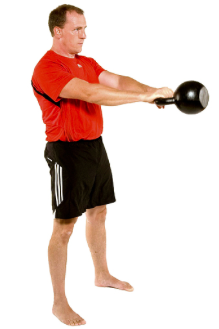
The plank serves many different purposes depending on a person’s physical abilities.  It’s no different then any other exercise, it deserves proper progression for optimal benefit.  For most people however, the plank is a stabilization drill for the torso musculature (“the core”).  Firing important tummy muscles in proper sequence is vital for body health.  (Yes, tummy).  The ability to exhibit adequate stability for a duration of time can give a person many clues as to what they need to be working on.  If an individual struggles to hold a plank position for 5-10 seconds, we can use that information to tweak not only the plank exercise, but also the movements in the rest of the program.  The plank also serves as a reinforcement drill for other movements.  The top of a kettlebell swing where the hips are engaged and extended and the lockout of a deadlift are two positions that closely mirror the principles that we seek to reinforce in the simple prone plank.  Body rigidity with proper breathing.  Tense yet relaxed.

Screen Shot 2013-02-07 at 8.31.38 AM

—>  How should I perform the plank?

I briefly touched on this in the “what” section above, however I suppose it deserves some elaboration.  Here are some coaching cues for the prone plank:

  • Straight line from head to heels.
  • I should be able to set a glass of water on your back and not have it spill.
  • Brace the core 360 degrees around your body as if you were going to take a punch.
  • Squeeze your butt.
  • No peaks (butt high) and valleys (low back caving in)
  • Breathe

Also, think about it this way:  I want you to resemble a rigid standing position (vertically) while you are in your ground position planking (horizontally).  I should be able to stand you up and lay you down and you would hold the same rigid body position

—>  When should I plank?

There are many schools of thought on where core work should fit into a daily program.  Should it go in the beginning of the workout?  The middle?  The end?  On off days?  Who knows what is correct here.  Honestly, the best advice might be to make sure that you get it done.  Execute the plank with attention to detail and respectable technique, and get it done.

For me personally, I tend to enjoy putting any direct core work into a tri-set.  It would look something like this:

1a)  Squat

2a)  Chin Up

3a)  Plank

If my workout is work capacity based, and the plank has no place in the meat of the session, I will simply save it for the end of the training day.

Simple as that.

The number of days per week that you are planking may also vary.  In general, I would say around 3 days per week would be just fine assuming you are training 3 days per week.  The plank won’t drain you like a squat or a kettlebell swing will.  You’d be hard pressed to overtrain yourself by simply planking alone.

Duration? This is heavily dependent on your physical abilities.  30-40sec is a good length of time for someone that can successfully hold that rigid body position.  Base your time of hold on your technique.  When technique breaks, you stop.  Reset yourself, assume the plank position and hold until you feel the slightest break in technique.  Stopping a set for poor technique will help avoid injury and also create good training habits.

—>  Where should I feel it?

I used to roll my eyes to this question, but then I realize that it provided a great opportunity for me leverage the question to my advantage.  The plank, for most people, isn’t going to burn out the stomach muscles.  Some folks have weak shoulders and some have a weak lower extremity.  You very well could feel it both of those places first.  Remember this gives you clues that something might not be firing properly if this is the case.

Screen Shot 2013-02-06 at 2.17.27 PM

I cannot say that you shouldn’t feel this in your lower back.  What I will say, is that if you feel pain in your lower back, body position is not correct or muscles are firing improperly.  Either way, you’ve got some regressing to do.  It’s not a bad thing people, it happens.  Better that you found it now as opposed to when you go to lift that 60lb box in your house and you slip a disc.  Right?

If you’re squeezing your butt and bracing your core in a 360 degree fashion, you should feel most of the stress between your butt and your sternum.  Shaking during a plank is common and breathing may become labored.  Labored breathing is always interesting to me.  Challenging positions create a stress response that usually shows up in a person’s breathing.

—>  Progressing the plank.

This article is a brief introduction, not a comprehensive novel on planking.  There are a tremendous amount of progressions and regression for planking that will have to wait for another article.  But know that it gets fun as this drill progresses.

Here’s a glimpse of where planking leads…

What is important for you to remember is that we can simplify the movement for beginners, or add challenging elements for those who demonstrate mastery of the exercise.

It goes both ways.

Cheers to dominating the plank…

KG

How to Workout in 30 Minutes or Less: The Movie Threat

Quick Tips

Last night “dinner and a movie night” at our place.  After a long weekend, yes, a long weekend… I couldn’t wait to lay on the couch and mindless watch Sherlock Holmes: Game of Shadows.  It was a good flick.  I enjoy the modern-day film that is shot in the old day setting.  Know what I mean?

Prior to the dinner and movie, my girlfriend Amanda gave me the challenge of ripping out a movement training session in 30 minutes or less.  She knows that when I go downstairs to train, I typically procrastinate the workout by writing while I am down there.  There is something about being in our training area that puts me in a frame of mind to write.  I can’t say it’s a bad thing, but when I am on a time crunch, it usually delays whatever we have planned.

Amanda was nearly finished with dinner (fajitas, so good!) when I told her that I was heading down for a workout.  To her credit, that is a bullshit move on my part heading down with dinner so close to being done, but I am always confident that I can get a quality workout done in short time.  Especially if it’s going to be work capacity based.

“I bet you can’t finish a workout before 7:01pm”, she says.

I looked at the clock, it was 6:31pm.

“I will take that challenge”, I said.

“But there is one more thing I would like to add to this.  If you don’t finish the workout by 7:01pm, we are going to watch my movie, What to Expect When You’re Expecting”, she adds with a grin on her face.

Screen Shot 2013-02-04 at 5.15.20 PM

I took the challenge and without thinking twice (still in my scrubs from the work day), I grabbed my computer and sprinted downstairs.  The computer is very necessary for an enjoyable workout I will have you know.  It’s provide me the advantage of being able to listen to whatever music I want, and with my premium subscription to Spotify, my playlists are rock solid.  No music, or worse yet slow music or bland tunes during a training session are brutally painful.

Here is an example of one of my Spotify playlists…

Macklemore- The Heist Spotify

Fueled by a deep burning desire to not watch her awful chick flick, I quickly traded by scrubs for a workout shirt and short, filled the water bottle and got my Macklemore playlist going.  Macklemore is a stud.

Here he is in Breckenridge, CO at the Dew Tour… stud:


Once I made it to the basement, I made of list of quick priorities for the workout:

1)  Grease my t-spine and hips

2)  Jump Rope to increase my core temp and basically sweat (some skill practice here).

3)  Unloaded and sub-maximal loaded movements that would act as a primer to the demands of the workout itself.

4)  Kettlebell Complex (my staple metabolic workout)

5)  Any time leftover would be devoted to “anti-core training” of my choosing.


I got it done.

Crisis avoided.

It was a great reminder of what a person can accomplish in a ridiculously short amount of time.  I enjoyed competing against the clock.  I weeded out any unnecessary exercises and created priorities for the training session by asking myself, “With the time that I have, what are the most impactful activities that I should incorporate into this workout”.  It created a focus to what was most important.

Strategy with training is important, but people tend to over think their training sessions I find.

Keep it simple…

—> Choose movements you can manage, ideally:

  • Squats, hip hinging lifts, presses, pulls, drags, carrying, “anti”core work, etc.
  • Go total body to elicit a larger training effect.

—> Choose reps/sets or rounds to perform:

  • 3-5 sets/rounds of 8-10 repetitions per movement.

—> Choose rest periods that make sense to both your goals and your conditioning level:

  • Beginner: 60-90 sec 
  • Novice:  45-60 sec
  • Advanced: 45 sec or less

Basic strength based movements using sub-maximal loads at a rep/set or round type format,  organized with challenging rest periods between movements can do wonders for people.  

Forget complicated workouts.  Keep it simple and safe.  There will be plenty of reward from a well designed simple and safe workout.

Are there some pretty awesome exercises that aren’t basic?  Yes, absolutely.  But my point is that you can get one hell of a training effect, create some serious change and work your way to earning the right to integrate those higher level movements into your program.

—>  Warning:  Here comes an awful attempt at an analogy…

If you sign up for a marathon you start your race at the starting line, the 0 mile mark, and you run 26.2 miles to the finish line.  They don’t drop you off at the 24 mile mark and still call it a Marathon.  That’s my awful analogy for skipping over essential progressions in movement.

Now, not every training session is like this for me.  I spend a great deal of time working on the quality of my movement, making sure that I avoid nagging injuries like low back pain or shoulder issues.  I value my mobility, stability and bodily symmetry.  When things get jacked up and become restricted, unstable or asymmetric, the body starts compensating for those issues and injuries begin to surface.  A small amount of proactive interventions goes a long ways in preserving the integrity of one’s body.

—>  Eating isn’t the only thing but it is everything…

Plain and simple: my eating is on track.  I don’t feel the need to “kill” myself during each and every training session.  In fact, there is zero need for me to bury myself in each and every training session.  Eating the right foods makes training more enjoyable and vice versa because I do not feel the need deprive myself of “vice-like” foods or “fun training”.

If you looked at my diet, you’d notice a couple of things without digging too deep:

1)  I eat a lot of vegetables.

2)  I drink a lot of water.

Veggies keep me full while delivering vital nutrients and water keeps me hydrated.  Pure and simple.  The benefits of staying hydrated go well beyond what I care to touch on in this post… so I will refer out for that:

All About Dehydration

You’ll notice that the link says “dehydration”.  Dr. Berardi and his team at Precision Nutrition are the best (in my opinion), so I jumped on that article.  At the very least you’ll get an idea of why you should avoid entering a dehydration-like state.  There’s a fair bit of science in the article for those of you that enjoy that sort of thing.

So, what did we learn from my movie threat experience?…

—> Anyone can get a workout done in about 30 minutes or less and feel damn good about what they accomplished<—

… and What to Expect When You’re Expecting is worth avoiding. 🙂


Cheers to less being more!


KG


I Have a Stranglehold on Mondays

Quick Tips

Ted Nugent’s “Stranglehold” is one of my favorite songs of all time, and it has absolutely nothing to do with this article.  Just saying.

I wanted to take a quick second and talk about Monday, the well known and well hated first day of the week.  Monday is probably the most dreaded day on the weekly calendar.  It means that we all get to end whatever fun we had from the weekend and prepare ourselves for the workweek.

On Mondays, most work environments reach dangerously high toxic levels when it comes to people’s attitudes and overall outlook on life.  That kind of negativity can be a real drain on someone who is trying to make the best of a Monday, pursue greatness and improve their mind, body or spirit.

I used to despise Mondays.

I was one of those people.  It wasn’t the alarm clock in the morning, it was the ineffective armor that I brought with me into the work environment which was quickly penetrated by those who weren’t so chipper.  Life beats people down, but most times it seems like we are accepting of this beat down.  Almost like we cannot change it.  “It is what it is” kind of thing.

Actually, I really hated Sunday’s because although it is a day off and considered a day of “rest”, it just meant that Monday is right around the corner.  Just hours away.  On Sundays, you can “kinda sorta” have fun and do something cool, but not really.  It’s a bit of a tease.

Back to Mondays.  As I lightly mentioned, my attitude has always been brighter than most on Monday, but I still went to bed on Sunday night anticipating the blare of the alarm clock.  It always seems a bit more shrill on a Monday morning at 5:30am.  Weird.  Waking up early has never been an issue for me.  It’s a time to enjoy some coffee and focus on ideas and creation.  All good things right?

  • Check out my referral article on coffee and how it helps the move things along (or out I should say) and also serves as an appetite suppressant.

A while ago, I made a small commitment to myself.  Despite not minding the early morning Monday awakening, I needed to be a little  more proactive on a Monday.  Aggressive if you will.  I started thinking that maybe I should attempt to dominate Monday’s with the achievement drive that I used to gain momentum and dominate later in the week.  By Thursday and Friday, I am a rockstar when it comes to getting things done.

But that’s too long to wait.  Monday, Tuesday, Wednesday are perfectly good days to get shit done and move forward with life.

Why make a dreary day even more dreary?  Monday is what it is, so why not approach it proactively versus reactively?

Slide7

(Good personal trainers and holistic health coaches understand the proactive versus reactive theory… I applaud you)

As it pertains to fitness, Monday is a tough day for most people to get a training session in.  I don’t know why exactly.  Maybe it is the long, drug out Monday workday that makes people feel like they need to rest up, or maybe it’s the general attitude that most people carry throughout the day, which ends up spilling over to the thought of working out.  I really don’t know.

I do know that if you can get your ass out of bed in good shape early on a Monday morning, you’ll have the run of the gym.  It’s a ghost town in most gyms on a Monday morning, except maybe the Monday immediately after New Year’s.  On that particular Monday it will be  like some sort of circus attraction in the gym.  But as we all know, that fizzles out rather quickly, doesn’t it?

Making an effort to be slightly better than average or working to improve health is the last thing most people think about on Monday morning.  That my friends, can be learned, yet it is definitely an acquired taste.  Those who stay dedicated to a Monday morning or evening routine health and wellness-wise have built character.  Character is what you do when no one is there watching you.

Sidetracked again!!!

So, as I was saying, I decided to ramp up my attitude and willingness to get stuff done on  Mondays.

—>Here are my general guidelines for Mondays<—

1)  Do everything (tasks, chores, etc) that I dread doing, and complete it as early in the day as humanly possible.

2)  Under no circumstances do I dare hit snooze (I typically don’t anyways it’s just a reminder)

3)  Workout no matter what.

4)  Dominate the food I eat no matter what (starts with breaking the fast).

5)  Mandatory two glasses of ice water before eating no matter what.

6)  Write SOMETHING no matter what (building the future).

7)  Smile and say hi to as many people as possible.

8)  Get into as many conversations as possible (without being weird about it)

9)  Establish/finalize what I want to accomplish for the days ahead.


Now those are Monday guidelines.  What I have found to make Monday so much tolerable and productive is to take some of the usual Monday load and put in on Sunday.  That’s right Sunday, you’re involved now.  Sunday you hung around long enough, you just got the call up.

For all the guys out there (since I am a guy) I typically shave, lay out work clothes and set out breakfast related items (that don’t need to be refrigerated) on Sunday night. I also make a short checklist of everything that is going to be happening or I need to get done on Monday and set it on the table that I eat at each morning.

The checklist ritual is BRUTALLY EFFECTIVE.  The “brain dump” as it is commonly referred, has been one of the most simple yet effective integrations into my life.  When you jour down every little worry that has potential to create stress you before or during the night time sleeping hours, you can sleep like a baby knowing that you won’t forget anything.

It sounds ridiculously but try it for a week straight.  You’ll sleep like a small child.

Write it on anything!  I have used post-it notes, notebook paper, the back of a utility bill, receipts, my iPhone Reminders App (with alarm set), etc.  I have even use the back of my hand, but that looks a bit tacky, especially if you cannot get the ink off in the shower the next morning.  If you use your hands and your success in the workplace demands a clean look, you might want to invest the $1.00 in a post-it note pad.  Just saying.

Take a proactive approach to your health, career and overall well-being Mondays.

Mind.  Body.  Spirit.

Why?  Because most people don’t, and you don’t want to be like most people do you?  I sure as hell don’t.  I watched video that got me fired up recently where Ray Lewis makes some great points to some young basketball players.

His message was simple:  Do whatever it takes to put yourself into that 1% in your craft.

(P.S. I don’t believe that Ray works out 5 times a day, because that is overkill, but that was a minor hiccup in his fantastic message)

Now, YOUR craft can be anything in this world.  It is exclusive to you.  If keeping yourself fit is important, then go for it, don’t just go through the motions in hopes of making it happen.  Hoping is like wishing and fitness isn’t something that should be hoped or wished for.  It is something that is accomplished by emotional and achievement drive.  Make it happen for shit-sake.  The only person holding you back is you.  Understand?

Bottomline is this:  Attack Mondays, don’t let them eat you alive.  Heck, take Ray Lewis’s advice and put yourself in the top 1% for Monday domination.  If you approach Monday like you are just looking to survive, you’re going to at best stay the same if not take a step backward.  If put yourself on autopilot to get through Monday, you’re risking getting steam rolled at some point.  It will happen.  You get caught with your hand in the cookie jar sooner or later.

Do you have any tips for me?  Things that you do that have helped you deal with Monday?

Let’s connect as I would love to hear them…


Cheers on MONDAY MONDAY MONDAY (@ 5:45am)…


KG

(P.S.#1  Whoever counts the number of times I said “Monday” in this article gets a fist pump)

(P.S.#2 How to Stranglehold the Monday Workout… coming soon)