A Martin Luther King Quote Could Help Ease Your Fitness Anxiety

Quick Tips

martin luther king jr quotes


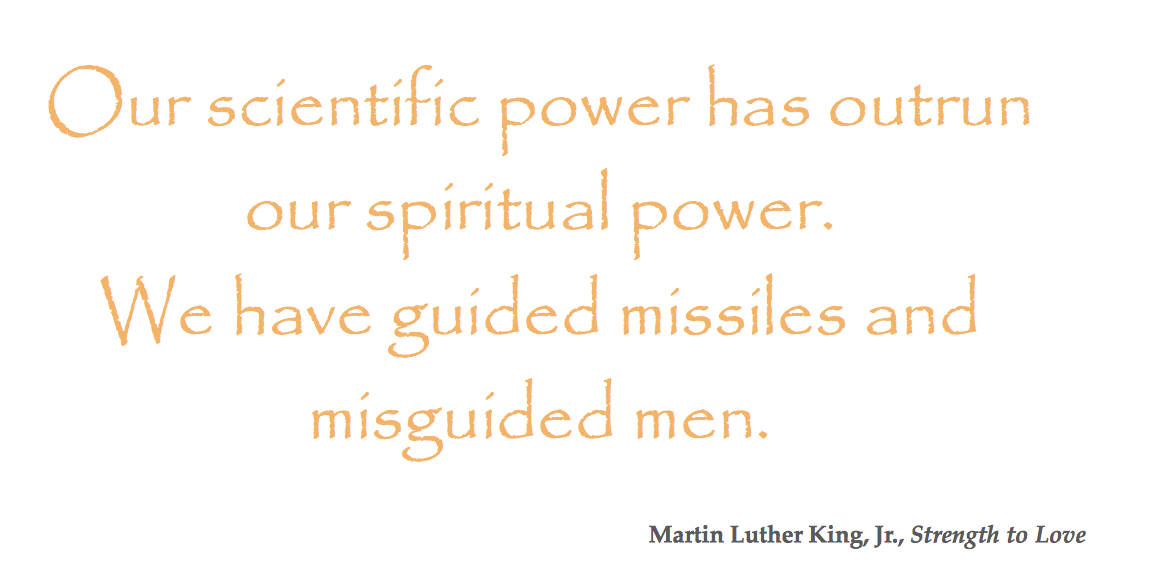
After watching an episode of Madmen that shared some audio and video clips about Martin Luther King Jr. being assassinated, I felt that it was ironic that I stumbled upon this quote this morning.

The quote hit home for me because it represents some feelings that I continue to have toward modern science.

First, let me clarify that I really enjoy reading studies and learning of scientific breakthroughs. I find it fascinating that we continue to understand things that were previously only considered true through speculation or anecdotal evidence. I continue to read articles on Business Insider where scientists claim to have identified formulas for “What Causes Men to Be Attractive” or “Scientists Have Figured Out The Noah’s Arc Would Have Floated with 70,000 Animals If Built By Dimensions In The Bible”.

I would be lying through my teeth if I said that I didn’t click on links like this to see what exactly was the conclusion of the findings. I am lured in like everyone else it seems.

However, I’m usually less than impressed with the findings, just like I am with nutritional and exercise studies at times. There completely meaningless. Whether Noah’s Arc had 7 animals or 70,000 animals on board, it doesn’t matter to me.

It’s pure minutiae, but you know damn well that there are groups of people fighting about those facts and figures as I write this. Someone is always trying to prove someone else wrong.

All of this relates back to what I am realizing is my spiritual connection with exercise and nutrition, kettlebells, short burst workouts, long walks to re-energize, breathing to calm the mind and body, yoga (not often but more so lately) and the exploration of ideas that haven’t been proven by double-blind study or a laboratory somewhere.

I thoroughly enjoy partaking in activities that science cannot find explanations for. Yoga has been around for thousands of years and delivered a healing/calming effect to millions of people. Science decided to investigate all of the hype to investigate matters. Initially, they concluded that the entire concept of Yoga had inconclusive evidence supporting it’s integration into a human beings life.

I wasn’t a yoga supporter at the time so I have to admit that I didn’t care. My body was younger and more pliable than it is now. Once I gave yoga a chance, even just focusing on a few poses that I knew would help to alleviate tonic muscles or calm my nervous system through deep breathing, I knew it worked. Just because I couldn’t explain it or support it with 10 pages data filled charts and tables, I knew that it worked extremely well for my mind, my body and to be somewhat poetic, my soul.

Science is great but we lean on it way to much. It’s a crutch for people to finally take action. It seems like we increasingly disregard activities that our mind and body tells us that it thoroughly enjoys, just because a study says that it burns 5% less calories than an alternative approach.

Who gives a shit? Do you really care that much?

Maybe if your a top 1% athlete (those who we watch on TV) or a professional (paid) bodybuilder who can detect the slightest alternations in their workout and eating habits.  These two populations can gain a competitive edge over such minutiae.  Shaving .0001 sec can be the difference from wearing a gold medal and shedding a tear over the silver.

But when we are talking about Billy Bob who handles accounts at the office versus Sandra who is the company social media direction this 5% becomes less and less important in my mind.  The average Joe needs to focus on establishing and perfecting the basics.

I’ve seen multiple studies showing that running is superior to riding a stationary bike, but from my own experience, I thoroughly enjoy putting my headphones in and riding my $180 (bought from Craigslist) Schwinn Airdyne over pounding the pavement. 5% more calorie burn for the same duration of exercise is irrelevant to me because my nutritional habits are good and I am 100x more likely to consistently hop on that old rickety Airdyne than I am to tie my shoes and beat the streets.

There is a beautiful simplicity in ignoring science jargon, and there is also value in respecting it.

The evidence based approach guys/gals will always claim that the spiritual approached guys/gals are lazy and “just don’t want to work to understand the data”, and the spiritual guys/gals will always claim that the evidence based approach guys/gals are robots guided by incentive based research.

I think both parties are somewhat accurate in their assessment of the other and quite honestly, I prefer to be a hybrid of both approaches.

As I have gotten older, I find that I don’t have that deep seeded need to prove why everything works the way that it does. I enjoy letting my body and mind dictate the intensity of any given day’s workout, staying up late because I feel like it or drinking too many cups of coffee in the morning because I enjoy the aroma and taste.

Modern day research would frown upon these things because the data says that all three won’t make me the best possible functioning human. Science says that I should be monitoring any fluctuations in my resting heart rate upon waking from an adequate 8 hours of sleep, following by a cup of green tea.

Did I mention that I love drinking craft beer also? Science hates beer, but my soul loves it.  I drank two delicious beers last night in fact.

I have found that no matter what approach guides your fitness and nutritional actions, what’s most important for the long-term is that you ENJOY whatever form of physical activity and eating style you adopt.

High tech or low tech, extreme or un-extreme, evidence based or spiritual…  it doesn’t matter as long as it ignites a motivation to take consistent action for the long haul.

If you evidence based, take the time to understand the spiritual approach and if you top-heavy on the spiritual approach, take some time to understand the evidence based approach.

The fusion of spirit and evidence based efforts might provide the truest enjoyment of the journey.  The side of your brain that wants science supported action can get along with the side of your brain that wants to discover your inner connectedness.  They can coexist.

Self-experimentation can be a liberating experience for both parties.


Cheers to thought-provoking quotes from MLK!


KG


Quick Tips

Screen Shot 2014-02-17 at 2.19.56 PM

Decisions, decisions, decisions

This might be the single most important thought I ever post on this blog.  Seriously.

I really should make this my new landing page for anyone stopping by for the first time.

It’s that important in my opinion.

Decision fatigue refers to the idea that people make worse decisions after having made a lot of decisions.

Limiting decision fatigue can catapult your fitness success.  It will streamline your workouts and relieve the anxiety of your workout choices.  It starts from the moment that you decide to rid yourself of all of the minutiae.

If you’re not familiar with the concept of decision fatigue, try this exerciseDrive to your local gym, walk to the middle of the building and stop once you feel like you are dead center in the gym.

Now, do a slow 360 degree spin, making sure to take in all of the equipment, classes, posters, tv’s, etc.  Take note of the vast amount of options that the gym has so graciously offered you in exchange for your monthly membership fee.

Now, take note of how overwhelming the number of options truly are.

Assume for a second that you walked into that gym with a limited knowledge on exercise, with no notes and no workout plan in hand.  Assume that you walked in just to improvise your workout for the day.

My question is this… Assuming that you’re not yet an expert in effective exercise, how in the hell are you supposed to make steady progress toward your goals (which are commonly weight loss, fat loss or lean muscle gain)?

How?

How are you supposed to make any lasting progress what so ever?  One great workout is not going to create change.  A series a great workout spread out across months and years is going to solidify your results, paying dividends on your physical efforts.

There is a niche machine or gadget for everything in that gym, and in my personal opinion, over 80-85% of them are not worth your time.  Yes, if you’re an able bodied person, put the blinders on to over 80-85% of the strength machines, ellipticals, treadmills and the like.

Just to take the heat off of the geriatric resistance machines and the hamster wheels, the equipment that I promote the most doesn’t help the situation much more.

Medicine balls, resistance bands, dumbbells, power wheels, kettlebells, barbells, sandbags, weight vests, suspension trainers, bodyweight specific movements, sleds, jump ropes, battling ropes, climbing ropes, plyo boxes, and on and on and on.  This is all equipment that I highly endorse, but there is an overwhelming number of options.  Where does it all fit?

I know how to design a program using this equipment, but it is insane to think that the average Joe or Jane, who is focusing their attention on building a career outside of fitness, should know how to incorporate all of this equipment.

You can experience this same sense of “decision fatigue” when you walk onto a dealership to shop for a car, peruse a website to compare digital cameras or enter a grocery store to purchase grocery items for the week.

Decision Fatigue

Grocery store decision fatigue.

The grocery store might be the best immediate example of how draining decision fatigue can be. There are tens of thousands of products in a grocery store, and probably less than 200 that are ideal for human consumption, assuming you are mindful of your health.  I recently read a marketing article stating that grocery stores put candy and other junk food next to the checkouts because by that point in the shopping experience, people are weakest.  If they are going to make a impulse buy, it’s going to be in the check out line because they have the perception that once they are done checking out, the opportunity to have that package of delightful candy is no longer.

Decision fatigue.  I don’t know why it took me so long to make the connection between decision fatigue and achieving body transformation/performance.

I have often stressed about paying attention to the details of your workouts, nutrition and recovery tactics, but now I have to admit that I believe that limiting the onset of decision fatigue might be the key to high level fitness results and reduced anxiety.

Off of the cuff, I have a couple of suggestions that can help relieve decision fatigue:

1)  Have Your Workout for the Day in Your Hands!

Unless you’ve had experience designing strength and conditioning programs, don’t wait until you arrive to the gym and “wing it”.  It’s a complete waste of time to sit down and brainstorm a workout once you arrive.  Have your plan in hand so that when you arrive you can immediately get to work, then get out.  Do not, for any reason, head to the gym expecting to make progress if you don’t know exactly what workout entails for that day.  Would you drive to a far off, highly populated unknown destination without a map?  Probably not.  So don’t put yourself at risk by showing up to the gym without some idea of what is about to take place.

Also, have an idea of what you accomplished in the previous workouts and a decent idea of what you hope to accomplish in the future workouts.  Keep measuring where you came from, where you are and where you are going.

Side-note:  I am convinced that the likelihood of a person to buy poor quality food in the grocery store because they didn’t make a shopping list is increased exponentially.  No list + no plan = poor choices. Decision fatigue beats you down until you have little to no willpower.

2)  Choose between 1-3 pieces of equipment.

The best workouts I have ever had usually involve no more than 3 different pieces of fitness equipment.  Weight can only come in so many forms, and to be honest, weight is weight.  The earth’s gravitational pull has established what things are going to weigh, so keeping that in mind, weight is pretty much weight.  The design of the grip points and the location of center of mass might vary between equipment.  Think kettlebells versus dumbbells here.

I choose “iron” when it comes to weight.  “Iron”, meaning dumbbells, barbells and kettlebells (cast iron).  You cannot go wrong with this type of equipment.  Using less equipment is great for acclimating yourself to that style of equipment.  Jumping around from innovation to innovation without working to master the basic (time tested) equipment teaches you nothing over the long-haul.

As I mentioned above, you have to measure your progress.  If you lift the same 100lbs on the barbell squat all year long, you’re not going to get anything out of it.  Your body will adapt quickly and then progress will flatline.  But, if you add weight in small increments, you’re going to get a hell of a lot stronger and your body will change in the process.  Staying consistent with that barbell squat will allow you to measure your progress over time.

Choose less and you’ll receive more.  Decision fatigue will entice you to touch everything in the gym for that “total body workout”.  Total body workouts are accomplished through movement patterns, not equipment.

3)  Choose less exercises.

Half reps, whole reps, tempo, single leg, double leg, off-center loading, overhead, goblet, racked, alternating grip, neutral grip, blah blah blah.  There are so many options it makes me sick.  “Options”, keeps fitness magazines profitable.

First off… squats, deadlifts, pull ups, chin ups, push ups, row variations, lunges, and a select few core specific exercises should make up the bulk of your training.  Choose an upper body movement and pair it with a lower body movement.  Sprinkle on a core drill after the second exercise in the tri-set, or address flexibility issues during your rest period.  Add a realistic amount weight that challenges your muscles and joints, lift it up and down a few times, set it down, rest, rinse and repeat.

Leverage the basics to the fullest and you’ll end up getting great results on your investment.

An example of a complete resistance training workout might look like this:

Tri-Set #1

A1)  Squat

A2)  Chin Up

Core)  Ab Wheel Roll Outs

Tri-Set #2

B1)  Lunge

B2)  Inverted Row

Core)  Lateral Plank

9 out of 10 people will see dramatic results from a workout designed with the format above.  Executed 2-3 times per week with adequate rest in between each session and a steady progressive loading plan, now you’re getting somewhere.  Drink some water, eat protein and veggies, get adequate sleep and you’re going to enhance the gym work.

It’s almost disheartening reading statements like that isn’t it?  I think our brains desperately want us to believe that there is something complex, some secret, some hidden element missing from our training efforts.  We subconscious crave the complicated and complex versus accepting and leveraging the simple tactics.

I didn’t believe in simplicity much when I went deeper into strength and conditioning rabbit hole some years ago.  I thought we needed more exercises, fatigue, fancy gadgets and variability all of the time.

It’s not true.  Simple is better.  Simple is better for the beginner population and simple can be a much needed element for the advanced population that has gotten sidetracked from information overload.

Our days are chock full of decisions.  Use your mental strength to make decisions about life, career and what is best for yourself and your family, not your workouts.  If you’re forced to workout in the evening, chances are quite high that you’ve been beaten down by the amount of decisions that you’ve had to make throughout that day.  More decisions is not what the doctored ordered.

Find a simplified and streamlined plan and execute like a savage.

Cheers to limiting decision fatigue and leveraging simplicity in your workouts!

KG

Precision nutrition logo

*** The same can be done with nutrition.  Find out how to limit decision fatigue with your eating here***

How Many Eggs Can Be Eaten Everyday?

Food/Eating, Quick Tips

20140216-124123.jpg

As I was perusing through one of my trusted nutrition websites, Authority Nutrition, I noticed there was a posting about egg consumption that was a few days old.

Articles about eggs always catch my eye. I am a huge supporter of egg consumption, and yes that means eating the entire egg, not just the white portion.

Eggs, considering their cost and nutritional impact, are probably one of the best foods that a human can eat. They are a great source of protein. If you’ve adopted resistance training into your exercise regimen, eggs provide a daily protein boost that will aid in your quest to build more lean muscle.

Obviously, there is more to complete nutrition than just eggs. But if you’re in search of a quality source of protein that simultaneously provides other vital vitamins and minerals without breaking the piggy bank, you really need to consider eggs.

If I was really down on my financial luck, and I needed to choose one food to get me through, I would choose eggs. Cheap, easy to cook and nutritionally dense.

For those of you who are still on the fence about making the transition away from breakfast cereals, toast and oatmeal, please give this article a read. I think that the information provided will help to ease your mind about the consumption of eggs. Notice the scientific support from the author, it’s a nice touch.

For those who are already eating eggs steadily, here is an article from Authority Nutrition that was published on February 6th. Give the entire article a focused read. This is the article that further discusses the health benefits from eating eggs, and also what might possibly be the boundaries of how many eggs can be eaten everyday.

The information is solid and entertaining.

I am in no way preaching that everyone needs to be eating eggs, but I am saying that it’s helpful to understand that eggs are a tremendously healthy alternative to sugary breakfast foods. When you consider that more and more research points toward sugar intake as a major contributor to poor body composition and other health issues, eggs begin to look like a superfood. Maybe a savior for some.

Heck you can even have eggs for lunch or dinner, which I do quite often.

Also notice that the article is very upfront that most of the larger population studies that investigate health benefits/negatives of egg consumption involve consuming 3 eggs per day (at the most).

The author does a great job reiterating this throughout article.

I personally eat 3 eggs per day at the minimum. Breakfast is always a 3 egg scrambler with veggies and left over lean meat from the previous night’s dinner.

If it is a training day, which most days are, I also add in some Ezekiel toast with peanut butter. Peanut butter is my vice food.

Lately, I have been buying eggs in bulk (box of 96ct.) to save myself time from having to run to the grocery store and the pain from waking up to no eggs in the refrigerator. I highly suggest any of you reading this look into how you can buy in bulk also. If you have good food conveniently available, you’re more likely to eat it. If you have to go through the trouble of driving to the store, checking out, driving back home, cooking it, you might find that you’re more apt to avoid it altogether.

Whatever is most readily available, you’ll eat.

I have also gotten back into hardboiling a dozen eggs at the beginning of the week. Hardboiled eggs make an amazing protein rich mid-day snack, especially in situations where you don’t have much time to sit down and eat, as I do not most of the time.

1 egg has roughly 6g of protein. Eat 3 eggs and you’ve just taken in 18g of protein without giving the situation much thought.

Sprinkle some salt on top for added flavor or just eat them peeled as they are. Wash it down with some ice cold water and you just had a meal/snack that you can feel great about.

Let me know what you think of the article, as I thought that it would be a great read for all of you…

Cheers to eating more eggs!

KG

*** If you want less trivial information and more of a structured nutritional system, I highly suggest you check out Precision Nutrition.

Full Disclosure on My First Ebook: It Might Not Be for You, I’m Not an Expert, I’ll Avoid Niches and My Tone is My Own

Quick Tips

I decided to relieve myself of the stress of trying to compose a book that is for EVERYONE.

It can’t be done, and I won’t try to swim up that stream any longer.

While I think that anyone should be able to extract at least a couple of pearls from my information and ramblings, including the scattered thoughts published on this free blog, I have also come to the conclusion that one book will never satisfy everyone, nor should it.

I actually read somewhere recently that if an author’s writing causes a decent rush of negative comments, reactions, reviews, etc… than the topic and angle on that topic was probably right where it should be. Of course, my goal is not to piss people off and ruffle everyone’s feathers.

It is first and foremost to put some ideas on paper that anyone can read and apply to improve situation. I also understand that not everyone learns the same way.

Personally, I struggle to read and then apply on the first try. I am the guy that has to read a chapter 3-4 times before most of the information sticks. Visually, I do much better, so videos are my preferred method of learning.

Anyways, there are going to be naysayers and haters always. Every product on the market has a group of Negative Nancy’s putting it down. The internet is a place where anyone can post negative comments, and they often do. Ironically, I wonder how many of these same Negative Nancy’s would comment to a product creator’s face that “they suck”.

Probably less than 1% I bet. This is one small reason I dislike the internet. It’s created an emotional disconnect with human interaction. Everyone is a hero on the internet. Oh well, it is here to stay, adapt and move on I suppose.

So, as much as I believe in the concept of fixing your movement before ramping up your movement volume/intensity/progressions, I felt it necessary to let you know that my first ebook is going full disclosure to keep your money in your pocket if you have any deep movement dysfunction.

As Gray Cook once said, “We should avoid piling fitness on top of dysfunction”.

I couldn’t agree with that more.

Since I am more interested in leveraging the outreach of the internet, I need to be completely realistic about my writing. Fixing poor movement patterns through the written word is tough. It’s hard to feel comfortable expressing (through writing) how important it is to fix the quality of your movement before you go all in on attacking your performance and pile on things like intensity, load and volume.

Upping the intensity, load and volume can be great things for the right population of people while being horrible for another population of people. For the latter population, it’s a lot like throwing gasoline on a fire that you’re trying to extinguish.

I’m never really sure how much of your cautions and warnings are being received and sincerely applied to each readers situation.

This isn’t a post to announce that faulty movement patterns “aren’t my problem” or that I am going to be “blatantly negligent” in my approach to promoting the adoption of new training habits or better yet smarter and more effective training habits…

… it’s the announcement that my lack of action in producing a workout manual has been deeply connected with my inability to realize that I cannot be everything to everyone.

To each, their own.

Another topic worth discussing: the concept of being an “expert”.

I hate it when I read a training manual or blog and the person refers to his or herself as an expert. Shut up. Self proclaiming yourself as an expert is annoying. Anyone that has retained just enough knowledge to teach someone else can call his or herself an expert in that topic, because to the person with a lower level of knowledge, the other person seems like an expert.

I might know more about kettlebell swings than you do, but that doesn’t make me an expert. They say “never say never”, but I refuse to adopt the title of “expert”. I don’t care if it costs me income. I’m always a student.

I don’t want to be an expert, guru, specialist, etc. I know that might limit the amount of traffic to my website and conversion clicks on my product sales, but I will be able to sleep comfortably at night knowing that I am truthful, honest and hardworking to be better everyday, rather than call myself an “expert”.

Another topic of discussion: niche fitness websites.

I’ve read the “niche” fitness sites. The early years of content is usually great! But then there is a drop off. Why? Because they start frantically reaching for ridiculous topics, methods, etc. I don’t want to be like that. I want to write about whatever I want, when I want to write about it, and feel passionate about it always. It must be miserable pigeon-holing yourself to just being “the kettlebell guy/gal”, “the metabolic finisher guy/gal”, “the fat loss guy/gal, “the suspension training guy/gal”.

What a boring and monotonous life to be niche. Might be great for your bank account but boring as all get out.

[I have exclusive allegiance to no piece of equipment, program, style or fitness tactic. Generally, speaking, everything works.]

You’d have to sit and wait for the next applicable study to be published and then find a way to cleverly manipulate the results of the study to create your own “secrets”, “insane results”, blah blah blah. I’ve always said it… I respect science, but I am not going to wait for it. Don’t tell me kettlebells are great, I know they are. I’ve known for years based on my own results and the results from everyone around me.

Another topic of discussion: tell the whole story.

My absolute favorite pieces to read are those from people who have documented their own experiences using a method of exercise or nutritional strategy. I recently read an amazing PDF book from Dr. John Berardi and two of his nutrition colleagues that gives first hand accounts of their experience with Intermittment Fasting.

Intermittment fasting involves shifting your total food intake to a smaller window of time throughout the day, while the time between the last bite of food for the day and the next bite of food for the next day is uncommonly long. For instance, you might finish your last bite of food at 8pm on Monday night, and not eat anything again until 12-noon the next day.

Instead of eating 3-6 meals/3,000 calories across 12-14 hour day, you would eat 2-3 meals/3,000 calories across 6 hour window of time.

You don’t actually restrict your food intake, you consume it all in a smaller “feeding” window and spend more time without eating between the end of a feeding window and the beginning of the next feeding window.

There is more to intermittment fasting than what I outlined above.

Dr. Berardi shared his experience in an honest fashion, and I retained more from that style of writing than any intermittment fasting expert’s jargon bullshit up to that point. He commented on his emotional reaction to fasting, his physical reaction and even his meals (and timing of those meals) eaten throughout his experiment. He even mentioned that his speech felt slow during work meetings and his irritability toward his family was unsettling during his first few days denying himself breakfast.

The writing was real. I could relate to the words on the page. They had meaning to me. I didn’t have to read that book twice, it stuck after the first time through.

I learned a lot about how I want to approach my connection with my current and future audience through that book.

I also recently read something on a self-growth blog, where the author made the point that as long as you’re willing to admit you don’t know everything, won’t know everything, but relentlessly pursue building yourself personally to increase your perspective outlook in your chosen field, you are on the right track to being the best version of yourself.

They also said write in a style that matches who you are in real life. Friends and family should be able read your work and hear you saying it.

People don’t care how much you know until they know how much you care.

My goal is to grow my confidence exponentially, yet stay humble enough to realize that I can and should be learning something everyday, even if what I learned that day is proving to change my opinion about something that I once thought was best in class.

Things evolve, and so should I.

I will believe and sell what I write about until I find something that works better. Than I will make the switch to what is better. Make sense?

I always sign off by saying “cheers to __________________!”

I am sincere in that cheers every single time. While the blog is about me conquering my fear of putting myself out there for all to see, it is mostly about you, and always has been and will be about you.

My leap is coming, join me if you will…

Cheers to your success and self-exploration!

Kyle

Great Alternatives to Abdominal Crunches: Anti-Extension Roll Outs (aka: Ab Wheel Roll Outs)

Quick Tips

Crunches are dead?

It’s been said that traditional abdominal crunches are a dead exercise, and I mostly agree with this position.

Actually, I don’t think crunches are as bad as most people claim they are.

The micro-trauma to the lower back is definitely there and further shortening the abdominal muscles even more than they already are in people who sit a lot can be disastrous.

But the biggest issue that I have with crunches is that I have no idea what they are good for?

There is one of the most non-functional exercises I have ever seen.

Laying flat on your back, performing hundreds of tiny little crunches to make your belly burn is ridiculous to think about.  Flex, extend, flex extend, flex, extend.

My personal belief is if I cannot justify why I am including something in a workout then it should be discarded immediately.

I cannot justify crunching.

I’ve transitioned my stance on crunches to the following statement:  “I don’t hate crunches, but I do think there are much better alternatives to the traditional crunch that deserve exploring”.

Websites and magazines that are bashing crunches rarely provide any alternatives in their articles.  If you’re going to tell the world how shitty an exercise is, tell us what to do instead.  Ranting about how shitty crunches are isn’t doing anything for anyone.  Sure, maybe you’ll raise some awareness to the cause, but help us find a better solution to the problem.  

Building on that point, simply naming an alternative isn’t enough.  You have to not only identify a better alternative but then teach people how to properly execute that alternative.

This is a value that I really want to provide on this blog moving forward.  No secrets or Jedi mind tricks, just good information that you can apply immediately.

Video: Anti-extension rollouts look like this:

What it is: Anti-extension rollouts are a core exercise variation for the anterior (front) of your torso, which as the name implies, are designed to reinforce your body’s ability to resist falling into extension.  If you watch the video above, you can see how gravity wants to pull my body towards the floor as I roll out further into extension.

How to do it: The cues for an exercise like this are rather simple.  Actively pressurize and brace your core prior to initiating any movement.  As you begin to roll out, consciously avoid breaking at the lower back while maintaining a straight line from knees to the top of my head.  Doing this makes this exercise very challenging, especially as you increase the distance that the hands travel away from your knees, which increases the range of motion.

Regressions: How to make ab rollouts easier:  If you’re a beginner or simply lack the strength and the stability to execute a full roll-out, fear not because there are several options to acclimate yourself to this exercise.  The first option would be to roll out on an incline, which would ease you into extension and also give you momentum as your return back to the start position.  The second option would be to roll out toward a wall, having the wall provide a contact stopping point when the wheel hits the wall.  This is a great option because you can be extremely precise with the distance the wheel travels, progressing each week as you gain strength and stability.

Progressions: How to make ab rollouts harder: If you’re strong, there are several progressions to make this exercise killer.  The first option is to roll out on a decline.  The decline will cause the wheel (and your body) to gain momentum and travel faster away from the knees, and also make it more difficult to return to the start position.  In other words, the extension part of the exercise and the contraction back to start part of the exercise both become more challenging.  The second option is to anchor one end of a resistance band to an immovable object- like a bench, squat rack or door- and loop the other end around the handles of the ab wheel.  The band provides forces that act to pull you into extension sooner, and also gives added resistance on the return to the start position.  This is a flat ground variation of the decline roll out.

If you’re really a stud, forget about rolling out on your knees.  Stand up and roll out from there.  Yup, that’s correct, you’re going to start bent over with your hands on the wheel, rolling out slowly until you reach full extension- arms extended above the head and chest facing the floor- and then return without any break of the lower back.  I would say that 1-2% of the population will be able to execute a technically acceptable standing roll out.  But hey, it’s something to work toward.

When and where to do it:  Core training can happen wherever you want it to in a workout.  Beginning, middle or end, it doesn’t matter much in my mind.  If you’re especially weak in the mid-section, you might want to save your ab rollouts for the end of the workout so that it doesn’t adversely effect any of your other lifts.  Adding rollouts to a tri-set is very time effective and keeps the pace of the workout high.  It would look something like this:

1a)  Squat

2a)  Chin Up

3a)  Anti-Extension Rollouts

You’d work from 1a to 2a to 3a, then after finishing 3a, you repeat the process until you finish the sets you’ve got planned for the workout.

As for sets and reps, it’s dependent on your current fitness level.  However, ideally you can get 2-4 sets of 8-10 reps for each set, using a 30X0 tempo on the movement itself.  What does 30X0 mean?

3 – The number of seconds that it takes to go from the start position into full extension (end range of motion).

0- The number of seconds spent at end range of motion.

X- The speed with which you return, which in this case “X” means explode.

0- The seconds spent at the starting position of the exercise

Exercise tempo has great influence on the training effect of an exercise.  Time spent under tension is important to exhibit body control in space and also to develop useful lean muscle.  Increasing the time that your core musculature are aggressively contracted will work wonders in your quest to achieve elusive six-pack abs.

My personal take on six-pack abs:  They should be a reward for smart training, never the sole goal of working out in the first place.  If you are doing the right things- eating smart and training smarter- anyone can have a six-pack without putting much thought into it.

Some professionals have included roll outs into circuits, but I am not a fan.  Core training is extremely detailed training.  You should be nearly fully recovered before starting each set.  Fatigue is an exercise technique killer, so I haven’t found intra-circuit ab roll outs to be very smart.  I’d rather save my core work for the end of the training session, when all of my energy and attention can be directed to executing each rep with perfect, or near perfect form.  This is just a personal preference based on my experiences.

—> Other variations I have played with:

Half/quarter reps:  These are more challenging than you might think because your core gets no relief from contraction by going half-way out.  It is tough to stop the movement short and bring it back in.  Sometimes I will execute a full rep roll out, come back in  half way, then go back out to full extension in an alternating fashion.  Your abdominals will be on fire in short time by doing this.

Right/Left roll outs:  Instead of going dead center, roll slightly left and right of your body, alternating every rep.

Decreased base of support:  Instead of supporting on two knees, remove one from the ground surface.  As you roll out, hover one knee above the ground as the other knee supports.  This is extremely challenging.

Slow reps:  Instead of 3 seconds on the way out, make it last 10+ seconds.  This is tough.  Or, make the roll out last 5 seconds, hold extension for 5 seconds, roll back for 5 seconds.  That’s 15 seconds of TUT (time under tension).  1-3 reps of this will make your muscles tremble.

Equipment Substitutions:  While the anti-extension roll out is most commonly executed using an ab wheel, it doesn’t have to be.  Suspension trainers, carpet slides, physic-balls, barbells, ab dollys, power wheels, etc.  I won’t go into detail here because I could write 4 more posts about awesome exercise variations.  I’ll get this done for you.

Here is a clip of what suspension trainer variation:

Anti-extension roll outs are an effective exercise for building the core aesthetically and reinforcing important functional features of the torso muscles.  It’s important to be able to resist forces (known or unknown) that act on the body.  The core is the conduit that connects the upper and lower halves of the body.  It’s important to be mindful of building the core to preserve body health and also to take your performance to another level.  As we age, it is also important to keep the core functioning as it should to reduce the likelihood of unnecessary injuries.

Cheers to more effective core training!

KG

Saturday always provides adequate time to explore different combinations of work capacity style circuits.

I like to take the governor off and push myself on Saturday mornings.

This past Saturday didn’t disappoint.

The goal was to accumulate 25-30 minutes of a work:rest style circuit.  I didn’t feel like being monotonous with the exercise selection so included 10 different exercises, stringing them together strategically so that I could give an honest effort to each exercise without sacrificing anything (mostly due to fatigue) to the next exercise in the circuit.

It really worked out well and challenged a number of movement patterns.

The equipment that I used:  24kg kettlebells x2, jump rope, Jungle Gym Suspension Trainer

Here is how the workout was structured…

—> 20 seconds of work: 20 seconds of rest of the following:

24kg kettlebell snatch right hand

rest

24kg kettlebell snatch left hand

rest

Bodyweight Chin Up

rest

Double 24kg kettlebell squat-to-press (aka: Thrusters)

rest

Mountain Climbers

rest

Kettlebell Figure-8 (advanced and technical, but great drill)

rest

Bodyweight Push Ups

rest

Double 24kg Lunge (alternating sides)

rest

Hand-to-Hand 24kg Swings (alternating every rep)

rest

Burpees (jump and push up)

rest

Jump Rope (combination of two foot bounce and running)

—-> Repeat 4 complete cycles of the above…

The best part about this workout is that you don’t have to worry about keeping track of reps.  When I am doing work capacity style training, counting reps can be a major pain.  It’s really the last thing I want to be doing while I am huffing and puffing.  Instead, the work starts on the buzzer and ends on the buzzer.  It’s really convenient.

Know thyself… If you’re a beginner, this workout might not be scaled to suit you.  If you’ve been working out for a while, this might work great for you.  If you’re a tough guy or gal, bump up the weight for kettlebell exercises, add a weight vest to chin ups and push ups, use a weighted jump rope, etc.  I can provide exercise progressions to bury anyone if that is what you are seeking, hopefully that isn’t the case though.  Smart training reigns supreme.

You might see a lot of volume in a workout like this, and you’re absolutely right, so nice observation.  However, I preach workouts that can be managed.  I managed this one nicely.  Notice how explosive work is ordered first in the workout.  That is on purpose.  People tend to get hurt when they attempt to move weight quickly under fatigue and will poor form.  I am not foolish enough to place a highly technical lift at a place in the workout when I am most fatigued.

Also notice that all of the exercises are non-competing, and ordered in such a way to respect that.  In fact, look at the kettlebell figure-8 + bodyweight push ups + double 24kg lunge… sequence.  Very different muscles are being taxed there.  Figure-8’s are combination of squats with rotational power where the kettlebell moves from a high front to low back to side and finally diagonally across body to high position (hybrid movement).  Push ups are an upper body push dominant exercise, and lunges are mainly a lower body hip dominant exercise.  This allows for an increase in heart rate and work, without gassing out the body for the next exercise.  You tax one movement pattern, than move on to the next.

Different movement patterns, different muscles, quality technique, short rest, big training effect.

Now I don’t own a calorimeter or a metabolic analyzer, but I would guess that the calorie burn from a workout like this was quite high.  Maybe 650-800kcals total, and that doesn’t include the residual calories that are burned post-workout.  Shortened rest periods combined with resistance based lifts that leverage a sub-maximal muscle contraction are notorious for creating an after-burn effect, it’s been studied quite extensively in the last few years as the concept of fat loss slowly gains momentum versus weight loss.

Metabolism can stay elevated for several days leveraging workouts like this.

If you leverage some quality eating habits during that period of elevated metabolism, you’ll burn some fat no doubt.  Rinse and repeat the process and you’re going to end up burning a bunch of fat.

I should also note that I designed this workout knowing that the coming days were going to be either complete rest (no workouts) or at the very most, a short yoga/static stretch session.  It’s important to rest, recover and let your body heal in between workouts.  Your body can only handle so much stress before adverse events begin to occur.  You really don’t want to play chicken with overtraining or chronic fatigue in general.  The point of recovering in between workouts is to give your body the best possible chance to leverage the work done in the previous workout, while allowing enough time to enter the next training session and make gains.

I think that a lot of people could lose greater amounts of body-fat (faster) while boosting performance if they decreased the amount of cumulative stress from workouts.  You want your body to recover in full.  Always entering a workout in a state of recovery is bad for business.  If you haven’t acquired a full taste for physical activity, this is good news for you, as each dedicated workout can be used to accelerate

Instead, choose fewer weekly workouts that create a larger (but quality) training effect.  Make them count.

Focus on accelerating other areas of life while you recover in between sessions.  Focus on establishing quality eating habits.  Re-think your water intake.  Read more books on success and self-growth.  Calm the mind with yoga, foam rolling and a long static stretch session.  Get more sleep.

Learning how to workout is great, and building fitness is empowering.  But keep your training efforts sustainable.  Win the war, not just the battle.

Give this workout (or a variation of it) a go.

Cheers to kettlebell and bodyweight workouts!

KG

30 Minute Workouts, Bodyweight Workouts, Kettlebell Training, Quick Tips

The Howard Stern Diet

Quick Tips

Howard Stern Radio Logo

Howard Stern, on the radio is an entertainer. He knows how to attract listeners and boost ratings. Howard’s craziness on the radio often overshadows his intelligence, career success, and real world insight.

Lately, most of my driving has been accompanied by Howard Stern streaming through the airwaves.

If you don’t like Stern, I apologize. Keep in mind, he’s an entertainer. What you hear on the radio is not the REAL Howard Stern.

The Stern Show is ridiculously entertaining. His no bullshit unfiltered and uncensored interviews to world-famous people are second to none, mainly because of the Sirius censor-free platform.

For the last 4 years, I’ve renewed my Sirius subscription without batting an eyelash.

Howard is has mastered his craft, radio. Detailing it further, he’s a master of entertainment and communication. It’s got to be difficult to do.

One aspect of the Howard Stern show that’s fascinating is how frequently he talks about his personal life, more specifically his ongoing battle with nutrition and fitness.

It’s comical, but it’s reality.

The other day, I turned on the radio to catch him ripping apart one of his staffers, Benji Bronk. Benji is a long-time writer and content creator for the Stern show who’s famous for his clever public pranks and funny radio bits. Benji is an absolute character.

If you know the Stern Show at all, you know the staff feuding is as entertaining as the celebrity interviews.

In the radio bit, Benji told Howard that he’s depriving himself of eating in order to drop weight. Leveraging the old calories in versus calories out equation.

As is common with a lot of people, Benji lost focus with healthy habits. He had gained an unnecessary large amount of weight and now wants it gone ASAP.

Howard’s conversation with Benji evolved into a hardcore lashing of Benji’s extreme strategy.

Overall, I have to say that Howard didn’t miss the mark by much with his advice, which was…

  1. Find a mentor who understands nutrition and eat what they eat.
  2. Avoid the extreme in favor of simple, work into it, increase the intensity.
  3. Identify a health strategy he enjoys and can stick to over time.

One might read this and think, “duh”.

But common sense is not so common.

Humans overcomplicate and overanalyze EVERYTHING.

What makes perfect sense to you doesn’t make perfect sense to everyone else.

The perfect health plan doesn’t exist, so if you fall into the category of a person who’s constantly searching for the “truth”, call off the search.

We live in the age of computer, tablets and cell phones, all connected to the internet moving at break neck speed. Information is literally everywhere. It’s difficult to find focus on just one thing, especially if you’re desperate to lose weight.

There are so many strategies, it’s overwhelming for a lot of people.

Let’s briefly touch on why I valued Howard’s health advice to Benji…

#1. Role models are important.

Someone, somewhere, has already done what you are attempting to do, so why not learn from them?

Regarding the best approach to health, get around people that are already on the healthy path. Do what they do. Spending time with people who are not making health oriented decisions is going to send you in the same trajectory. YOU BECOME WHO YOU SPEND THE MOST TIME WITH.

Start teaming up with people in the gym who are getting after, and understand how to get after it. If they are a decent human being, they will take you under their wing and stretch your comfort zone. Eat as many meals with people who understand what simple clean eating is.

Learn from what they do. Study their habits, emulate those habits. Are they bringing healthy leftovers from last nights dinner in a Tupperware versus scrambling to the local fast food establishment for a burger and fries? Follow that lead.

One of the first steps to making incredible gains in fitness and nutrition is becoming aware. Once you know, you cannot un-know.

Role models can help guide you along the way.

#2. Begin with the long-term in mind.

If you want to put the pedal to the metal right out of the gates, go for it. It’s your life. But beware that many people fade with this approach.

It’s mentally draining to adopt healthier habits.

Health is a process. It takes time and it requires discipline. You have to trust the plan and stick to the plan.

Fast gains can be made, but there is no overnight success and there shouldn’t be.

Celebrate your efforts in the short-term, but understand that the real victory is in dedication the long-term.

Begin with the end in mind.

#3. Make an effort and enjoy it.

If you hate your workout program and your eating plan, it wil never last.

You will burnout. The resistance crush any will-power you have.

There is a happy-medium between making an effort and finding enjoyment in the efforts being made. Where those two intersect is where results reside.

But here’s another reality. Making a shift from sloppy eating habits and a sedentary lifestyle over to smart nutrition and daily workouts are going to be stressful in the beginning. It’s work, and it’s not always easy.

You can expect many days where the last thing you want to do is eat a salad, especially when everyone else is smashing a greasy burger. You can expect days where getting up an hour earlier to get a workout in before starting the day is the last thing you want to do, especially when other people are sleeping in.

There is great (perceived) pain in building healthy habits. It is a lot easier to ignore the details and be careless. But, doing so has a price.

So, in the beginning, find foods that fall into the realm of being nutritious. Eat them. If you don’t know what foods are nutrient dense, Google it. Seriously. Type in “healthy foods” and you’ll find millions of search results. Find a list, go to the grocery store and familiarize yourself with those foods, regularly.

As you gain confidence, expand. Find other foods that serve your health well.

Same goes for fitness. Don’t jump into a hardcore metabolic conditioning workout on the first day. Opt for yoga, a long walk or some simple body weight drills like Animal Flow.

Animal Flow is an ideal fitness program for beginners since it’s body weight based. Plus, you can learn how to exercise effectively in the privacy of your own home.

Crawling is a low-impact highly effective activity to build strength, motor control, and core stability.  Can you do this?  I bet you can.

Bodyweight training is ideal for everyone, particularly beginners because you can get your training in ANYWHERE. Stop thinking, buy the Animal Flow DVD and get going.

Mike Fitch, the creator of the program will teach you everything you need to know.

If you’re not there yet, at least subscribe to my YouTube channel. Watch me do it, then you do it. Simple.

Less thinking, more doing.

Not into Animal Flow? Fine. No matter what you choose, remember that YOU HAVE TO MAKE AN EFFORT. You have to.

The effort given will be proportionate to the reward, nothing more and nothing less.

So what does Howard Stern’s Diet consist of?

Plain and simple, Howard is a mono-eater, just like many other lean and healthy people I know. No surprise here. A lot of times, people who have a good grasp on healthy habits aren’t preparing extravagant meals like you see on the Food Channel or various social media platforms.

Howard knows the foods he likes and he eats those foods on a regular rotation. A lot of healthy people do this. It removes the decision fatigue from the situation.

Here’s a snapshot of a day in the life of the Howard Stern diet:

  • Breakfast- Egg Whites, half piece of toast and fruit
  • Lunch- Salmon with 1/4 baked potato and veggies
  • Mid-afternoon snack- Apple
  • Dinner- Eat out or at home (protein with veggies/fruit)

He keeps it simple. I can appreciate that.

If I could change one thing about Howard’s daily eating, I would add more protein. I would also encourage him to eat the yokes in the eggs. There is so much nutrition in egg yokes!

I’d also be curious to see if he’s consuming enough calories. Based on the example above, it seems like he’s a contestant on the TV show Survivor.

On the fitness side of things, I would encourage Howard to limit the long, slow distance cardio training. In general, adults need more resistance training to preserve or build lean muscle mass.

Nothing crazy here… just simple and effective exercises like squats, lunges, push-ups, pull-ups and chin-ups, body rows, etc. People underestimate how effective a couple of rounds of simple bodyweight exercises can be.

Ground-based movements like you’d find in Animal Flow are also making giant waves fitness. Crawling, locomotion exercises various dynamic core drills, mobility training, etc… are all incredibly effective for burning fat, building lean muscle and re-establishing movement capacity. Again, this is all stuff you can find in the Animal Flow DVD.

Now, if you’re interested in leveraging the power of nutrition, I am going to direct to Brad Pilon and his intermittent fasting program, EAT STOP EAT.

Screen Shot 2017-06-10 at 5.42.13 AM

Brad is one of the smartest nutrition coaches in the world, and EAT STOP EAT is a perfect example of a massive shift in our understanding and approach to healthy diets. In fact, he refers to it as a “pattern of eating”, rather than a diet.

What we now know about highly effective eating, is that it’s not only about the foods you’re eating (or not eating) but it is also about the timing of eating food.

Intermittent fasting is not nearly as torturous as it sounds, so I encourage you to check it out.

The food you’re eating should give you a metabolic advantage to stay lean and healthy, no matter what your age or body type.

If you’re constantly stressing over counting calories, it’s worth auditing your food choices. Sometimes, I feel that calorie counting is what the modern generation does to manage the negative effects of eating food we know to be bad for our bodies.

Howard turned 60 years old this year. He often comments his body has never looked or felt better since he started focusing on leveraging smarter nutritional strategies.

Nutrition and fitness are never a bad investment, and it’s a lot more simple than you’d think.

The biggest secret is getting started and building steadily on that momentum, day by day.  


Cheers to the Howard Stern Diet…

KG

You Watch! Crawling Is Going to Be All the Rage in Fitness

Quick Tips

20140114-172621.jpg

You wait, just wait, crawling is going to be all of the rage in the fitness industry. It’s going to spread through the websites, blogs and then infect it’s way into print media like Men’s and Women’s Health, etc.

It’s coming, and there is probably little that anyone can do to stop it.

Why? Because it is NEW, and as consumers, we love ideas that are NEW. We are fascinated and engulfed by new ideas, trends and material goods. The editors of big magazines know this quite well. They know that we get weak in the knees for what is perceived as the latest and greatest.

But, does crawling actually hold up? Or is it just another “new” trend that will temporarily satisfy the thirst of the average fitness enthusiast.

My personal opinion…

… crawling is going to hold up for the long-term.

Why? Well, because crawling is a ground based, deconstructed and completely stripped down activity that is fundamental to a young human being’s (infant’s) progression to more advanced activities like walking and running.

As infants, we literally had to crawl before we could walk. We had to learn how to walk before we could run, etc.

Tim Anderson has recently coined a term that he calls “reset”. I love the term, because by calling for a “reset” he is asking for humans to re-establish lost function by going back to our roots, ground based movement. Crawling, rolling and planking are all forms of ground based movement. Tim is asking for us to leverage our body’s natural interaction with gravity and the ground surface.

Ironically, shortly before finding out about Tim and his efforts to endorse low load ground based movement done properly, I got on the same kick.

I started to notice how physically challenging it was to perform what are normally fast paced exercises, slow. Slowing it down and moving through a full range of motion was- and still is- extremely difficult, and it seemed to be very effective at highlighting weak points throughout range of motion of any given exercise. Identifying these weak points gave me some valuable insight about what I was missing in my training by blasting through all of my exercises and workouts.

The world is stuck in an “extreme”, “high tempo”, “explosive power” and “fast paced” vortex of fitness right now. Except for “extreme”, I believe in the three other phrases. They have a valuable place in a workout and a program, at the right place and the right time. Everything has some value it seems, it just a matter of how it (and when) it is applied. If you apply the world’s greatest exercise to a person that isn’t ready for it, you’re putting them at risk. If they are ready for it, you’ll take there performance to the moon.

We trick ourselves into thinking that we are moving properly when we rush through exercises. Even if the exercise is being executed technically sound at a fast pace, that DOES NOT mean that you are going to be able to execute it in a technically sound manner at a slower, more controlled tempo.

Watch a pro football player work through a session of yoga, many of them cannot hold positions longer than a split second. They are all fast twitch with very little stability and grace. Gray Cook proved it when he made a bunch of NFL guys perform a 50lb/50yard slow and controlled overhead carry. Most of the players involved failed to complete the challenge, yet can overhead press 1-1.5x their bodyweight without batting an eyelash.

The mountain climber was the lightbulb moment for me. I’ve done my fair share of mountain climbers. I greatly value the mountain climber in my work capacity training sessions, using it primarily as a “filler exercise” to actively recover in between two more demanding movements. Before, I had hardly paid attention to anything but how fast I could whiz through 30-50 reps of mountain climbers, driving my knees to my elbows without breaking at the lower back junction in the process.

One day, I slowed it all down. I attempted to “pull” my knees through to my elbows as opposed to violently driving them forward.

You know what I found? I was ridiculous weak once I flexed my hips beyond the prone/horizontal 90 degree mark in the range of motion. I was weak, and I could pinpoint the exact point in the movement where I was weak. The only way that I could complete the movement in full was to compensate, and I wasn’t about to stroke my ego by cheating the movement.

After my run in with mountain climbers, I really started to gain interest in dabbling with other low load movements that are primarily ground based. These movements were typically isolated to a lateral, supine or prone position. Sometimes the movements were transitional/segmented, moving from a supine to prone to lateral all in one shot. This, to me, is the progress of things. You start working isolated movements, gaining control of these movements in an isolated fashion and then you slowly begin to integrate the patterns to work more complex movements.

More complex movements require a greater recruitment of muscles, dynamic stability and mobility and thought. Integrated movement takes integrated thought, which is a rarely spoken of benefit of complex movement training. We exercise our mind as much as we are exercising our bodies.

So, the movements slowly evolve from isolated to complex, all the while we must learn to turn our muscles on and off gracefully as we maneuver our bodies through space.

Gymnasts have mastered this type of movement expression, and I am growing to value practicing it more and more every single day. Movement is second nature for a gymnast. They have established high level movement through consistent repetition.

Drills like crawling, dynamic planking, slow frog hops and turkish get ups make me feel more like a human capable of executing 3-dimensional movement and less like a robot lifting weights to no end. I enjoy knowing that my traditional weight lifting is translating to something more valuable than six-packs and bulging biceps. Both of which mean absolutely nothing in the real world. Well, I guess you’ll look cool in those Summer time still shots, but it doesn’t mean you can move.

All of that weight lifting should translate into something greater than, well, lifting more weight.

Translating isolated resistance training into improving your ability to move with grace, strength and unwavering stability is a noble endeavor. It can be hard to stay on this path, especially when our society provides so much temptation to build the perfect body, or what we perceived as the perfect body.

This is obviously my personal opinion, don’t let it stop you from leaning out.

Crawling is a reset movement activity. The first time I really started to employ crawling patterns into my own training and encourage others to do the same, it was about 4 years ago. We used to have our group athlete training sessions crab walk and high crawl as a fun warm up. I saw it as a time to get the core, shoulders, and hips firing all at once. The crab walk would be performed with forward motion until I said “stop! hold!”, at which point the athletes would drive their hips to the ceiling, effectively creating a “human table-top”. Creating a level table top required that the athlete actively contract their glute muscles while actively stretching their pecs and anterior shoulder. There is some core activation hidden in their also, as the torso muscles work to protect the spine.

Quite honestly, I think that the crab-walk+tabletop combination is one of the best warm up drills out there. Crab walking, to me, is a supine variation of a prone crawl. Infants move around frequently on their butts. They push with their arms while pulling with their heels, supporting the weight of their body with both upper and lower as they “scoot” across the floor surface. There is value in training this movement pattern in adults who have lost the ability to do so.

Sometimes we have to take a developmental step backwards to regain control and start to take steps forward in present day.

We’ve discussed- almost at nauseating length- that sitting causes a lot of metabolic and structural issues with humans. The longer and more frequently we sit, the more our body seems to take on the shape of the sitting position, even in the standing position. We start to hunch our shoulders, our hips remain tilted forward and our lower back gets creased like a bi-folded letter home to Mom.

Once in this position, we attempt to walk, run and do other physically demanding activities while being confined to these un-ideal postures.

Is it more complicated than this? Of course it is, but what most people really need to know is that sitting is slowing breaking our bodies down to nothing, sometimes beyond the point of any ability to repair. One day you might even find that surgery is the final intervention to fix years of poor alignment and compensation.

Attempting to express athletic-like qualities such as strength, explosive power through forced ranges of motion with poor posture many times requires compensatory movement be present as a temporary solution to completing such activities. If you remember, compensatory movement compounded with high reps and high load can rip a person to shreds over the long term.

It been said that workout injuries are just “unfortunate”, when in reality, they were staring us in the face from the beginning, looming in the darkness waiting to be identified. Obviously, those who feel the pain of that disc exploding in their back will one day wish they would have taken the time to identify movement flaws. But the damage is done.

The next time you engage in a warm up prior to a workout, try prone crawling for 1 minute straight with ideal crawling posture. Shake it out for 30 seconds and then complete that 3-5 more times. It might scare you how challenging crawling really is. The stress placed on the upper body is tremendous, especially if it is a new stimulus. It’s easy to fatigue quickly from the waist on up while crawling, in my experience.

Not to be gross, but if you’re someone who gets off on working the core muscles to exhaustion and that “deep burn”, crawling is definitely for you. Keep your back flat and your belt line zipped up and tight, and you’re going to feel every synchronized step of the hand and foot ripple right through your torso.

In fact, I would recommend trading that marathon abdominal training session for about 10 minutes of dedicated crawling. If you’re rolling your eyes, stop. Try it and report back to me. Let me know what you think.

I recently watched a video where Tim Anderson crawls an entire mile without breaks, in a low crawl position. That’s incredible, as you’ll soon find out when you give it a shot. If you make it to the end of his video, he remarks that his ipod shut off right from the start but he was too mentally focused to quit and reset it. Nothing like crawling for nearly an hour straight listening to yourself wheezing from fatigue.

My cues for ideal crawling posture are simple:

– Keep back parallel to the ceiling, stomach parallel to the floor.
– Keep eyes looking down or roughly 12 inches forward toward direction being travelled.
– Keep spine in a neutral, braced position, pulling your stomach out of anterior tilt.
– Simulate a full glass of water on your back as you crawl, preventing any spillage.
– Make each hand and foot contact as quiet, soft and graceful as possible.
– Have fun and work at it.

Start crawling. Use it as a tool not an entire workout.

Leverage it’s ability to be a safe alternative to core training, and a important developmental step to restoring your body’s desire to move without compensation and pain.

Start slow, build from there, and remember that it is process.

Cheers to crawling around like an infant!

KG

The World’s “Best Results Guaranteed” Fitness Program

Quick Tips

Some time ago, I jokingly mentioned to my fiancé that when I finished my book, I wanted to make a crystal clear statement that those people who followed the guidance in my book are 100% guaranteed to see short-term results, with long-term results pending. I say “pending” because you have to continue to do the work to maintain what you’ve earned.

I also wanted to make another guarantee in the book:

If you act on not a single word on any of the pages within the cover of this book, you’re 100% guaranteed no results whatsoever.

Too harsh?

Or is that pure honesty? Some of us don’t need more sympathy. As I mentioned in a recent post, we have become too sensitive. We crumble when our feathers get ruffled. I am as sensitive as anyone, so I know what it’s like.

Lets stop and ask ourselves, do we really need more people to rub our backs every time we fail to take any significant action toward something that we say that we want? Is that helping us, or hurting us? Is all of that sympathy love making us delusional?

I personally think that it is making us extremely delusional as a society!

I wanted to take down the Christmas tree for nearly 2 weeks now and all I did was walk by it, get riled up that it was still standing there taking up valuable space in our living room. I stewed about it. Almost like I was going to come bouncing downstairs one morning and it was going to magically be gone and cleaned up.

Then, I snapped one day and took some action. It was time consuming removing all of the ornaments and unstringing the lights, throwing hip checks into my 7th month old golden retriever to prevent him from eating candy canes, but I did it. I got the job done and it felt fricking awesome. I took action, and my negative feelings disappeared.

You see, in life, a lot people wake up 10, 15, 20 years down the road in the same exact spot that they were when they started thinking that they wanted some kind of change, some kind of advancement.

I think this post is very easy for me to compose because I am a person that was having my back rubbed. I was that guy, making up stories about how I really wanted to write a book, create an online community, build a legacy, take my life portable via a laptop. I received a lot of support, and also a lot of back rubbing.

While there is no doubt that failing to make any of this come to fruition is certainly a “me problem” first and foremost, I can also say that I should have been mixing it up with people who were willing to call me out. Yes, I needed a heavy dose of “you’re all talk”. I needed more, “what are you going to to about it?”. “What have you done about it?” “Stop talking and start doing!”

Here is a quick synopsis of how it usually went:

Me, “I am going to write a book, sell it, create a membership site that crushes other membership sites on the web, and enjoy the satisfaction that I am getting what I want by helping others get what they want”.

Person I needed to be hanging around, “Ok, do it. Less talk more work Kyle. What steps have you taken thus far? What are your deadlines? Do you have deadlines? Who is holding you to those deadlines? So far, it seems like you’re full of shit, are you really serious about accomplishing all of this?”

The butterflies and then the sudden stomach drop is your inner self getting a splash of cold water and finally waking up. That’s when you finally realize that you’ve been sabotaging your potential. You’ve been dogging it. You’ve gotten comfortable, complacent and lost desire. You’re effectively going through the motions, treading water and doing just enough to get by.

Those are horrible feelings to have, but that can have the potential to initiate the wake up call in all of us.

You may think I am crazy for creating dialogue between myself and an imaginary friend, but I really think that we could all use a heavier dose of reality. I use myself as an example because you can learn from me. Don’t let constructive criticism break your back. Have a spine, develop a posture and an attitude that wants to compete and win. I don’t care if you’re competing against the inner demons that have held you back for years or against real world competition in the marketplace, just compete.

It doesn’t take talent to hustle.

The hardest part about receiving that much needed kick in the ass, is realizing that the only person that you are fooling (or were fooling) is yourself. Everyone else can see your bluff.

Boiling it all down…

If you’ve been trying to lose fat or lose weight for years without any results… you’re doing something wrong.

If you’ve been trying to gain strength for years and are still pushing the same weight… you’re doing something wrong.

If you’ve been trying to make more money at that sales job with no increase in income… you’re doing something wrong.

If I’ve been trying to write a book for years without anything to show for it… I have been doing something wrong.

Don’t be afraid to be honest with someone if you feel they need it. It might be uncomfortable for you to say and for them to hear, but many times it can provide the spark that is needed to create some forward motion. Getting your feathers ruffled can be a good thing.

As it pertains to restoring health, if you find yourself spinning your tires in the same spot for the last few years, you definitely need to make some adjustments. There is something that you are either doing, or not doing, that is keeping you in the same spot. End of story.

Maybe it’s a nibble of junk food here and there. Maybe it’s skipping that workout just every so often. Maybe you are actually making it to the gym or engaging in a home workout but it isn’t what your body is calling for to see change. Whatever it is, it is adding up and it is costing you results.

Check out The Training Effect Facebook Page for a recent post about how easy it is to gain weight without noticing.

The problem isn’t the workout program that you purchased, it’s you. But the author can’t tell you that because they have a business to run which probably feeds their family and keeps the heat on in the Winter months.

But I will tell you that, because we are on the same level right now, you and I. You’re reading and I am writing, and we are here together for the time being. For every 1 finger that you point to redirect blame on someone or something else, there are 10 more fingers pointing back at you.

Whoa, it got kind of heavy there for a second!

Finally, on to fitness related stuff…

The best part about building fitness and leaning out (at least I think), is that we can keep making tweaks to our approach for life. You don’t need to keep the same regimen for the rest of your life. In fact, you shouldn’t because you’ll burn yourself out.

Crank up the intensity of your training sessions for a few weeks. Then, dial it back after a while and create some separation anxiety between you and your workouts. Once you start seeing results, you’re going to want to keep training. However, removing yourself from the workout program can fuel you even harder when you do finally get back into the gym. It’s hard to take time off, but doing so will give your body some much needed rest while motivating your mind.

Starting crawling and handwalking, planking, squatting and then pressing, rowing instead of biking, engage in some yoga, some long duration stretching, foam rolling, quality sleep, hill sprints, some fat loss complexes, etc. Mix it up. Keep it fresh.

Take a small amount of time and make the $$$ investment in learning about nutrition. I HIGHLY recommend investing in the Lean Eating Program that Precision Nutrition has established because they are at the top of their game. They really are. They cover everything, and push for a perfect blend of evidence based eating while considering the real world. They’ve created a system for eating just as a personal trainer creates a system for burning fat off of someones body.

That is powerful. After you make the smart decision to buy into Precision Nutrition Lean Eating system, follow it! I GUARANTEE that you will get results. You will lean out, see worrisome health markers correct themselves, and most of all you will feel confident. You can’t put a price on self-confidence. Self-confidence sets the stage to make even bigger waves in the future.

So, in the end…

… results are guaranteed, but you have to be willing to do something about it first, and then actually do something about it.

Cheers to guaranteeing your results!

KG

Is This Blog Really Being Run Off Of An iPad and Powered by Coffee?

Quick Tips

20140109-142729.jpg

Every word in that statement is true, except for the fact that my iPAD is being powered by coffee.

I am being powered by coffee. When I write, I drink coffee. A doctor might say that this is a bit of a compulsive need to take every single time I sit down and force myself to write, but for me, it puts me in focus. Plus, in Wisconsin, it’s bitter cold right now and warming up a bit with a cup-o-joe never hurt anyone.

So, yes, the truth is that this blog is now being run from an iPAD. Reason being is I received a Belkin Bluetooth Keyboard for Christmas and yes, it kicks ass. The keys have the same feel as my MacBook Pro, which is great because now I can write anywhere. Lugging a MacBook Pro around can get a little annoying after a while. The iPAD + Belkin combo is much more sleek, and I really don’t mind the WordPress application offered by the App Store.

The truth is that any application works for writing, whether you’re using Word, Scrivener, Pages, or any other writing program, it all works. We’ve become a picky society. It all works just fine. Worst case scenario, you write your thought for the day and then email it to yourself or copy and paste it between programs. Your writing doesn’t improve just because you’re using a fancy program.

Anyways, so back to coffee. Yes, I am powered by coffee because I love coffee. I would say that it is vice of mine, but I can’t. Coffee is full of antioxidants and if you look it up on the “unhealthy list”, it ranks pretty low when compared to just about every item found in the center of the grocery store. Yikes. There are thousands of consumables that are worse than drinking a cup or two of coffee.

Is there caffeine in coffee? Yes, of course there is, and caffeine from time to time has been labeled as the world’s most widely consumed stimulant.

Here is a great article by my friends over at Precision Nutrition: All About Caffeine

As long as you’re not absolutely relying on coffee to roll out of bed and start your day, or it is preventing you from quality sleep, keep on sipping. Beware that no one, and I mean no one, enjoys coffee breath.

If you want a performance boost, drink some coffee before a workout. A cup of coffee pre-workout is one of the only things that I do to help me dial in and get work done when it’s time to train. Coffee doesn’t make me superhuman or anything, but it does give an extra boost of energy, no doubt about that.

If you’re wondering how much coffee is safe for you to drink, start getting in touch with yourself. If you feel fine after a cup or two, well, that means that you’re fine. If you drink a bucket of it and struggle to write a legible personal check, then you may have over-consumed a bit. In that case, dial it back.

It’s easy to let the pendulum swing too far. When this happens, make some simple adjustments. The important part is to recognize that it has happened. Awareness is soooooooo important. If we as a society could just increase our awareness with eating and exercise, we would bring ourselves back to center. Over time, it would happen.

Like our Grandparents are famous for saying: Too much of anything can be a bad thing.

It’s funny how this statement holds up in so many different situations. Too much working out, bad. Too much water, bad. Too much alcohol, bad. Too many calories, bad. Too much coffee, bad. Too much, bad bad bad.

A person could really live a quite healthy life by following old adages. I believe this. Why complicate matters any more than they already are? Some things don’t need to be re-invented, they are fine just the way they are.

Branching out from awareness, self-exploration/experimentation is a lost art.

We read generalized guidelines in newspapers and magazines and automatically think that the suggestions apply to us. Maybe some do, but maybe some don’t. I know that I have personally tried a boat load of health tips found in magazines (who hasn’t?) without any noticeable improvement. It doesn’t mean that the health advice doesn’t work, it means that my mind and body might not be as accepting of it as someone else’s.

Nearly every sleep expert on the planet preaches about 8+ hours of sleep per night, yet why then, do some people function best with less than 6 hours? You can call them outliers, but the point is that not every health tip applies to everyone. We need to stop calling people out, define our goals, find plans to achieve those goals, and keep self-experimenting.

It’s never too late to learn about yourself and refine your techniques.

I listened to Howard Stern comment yesterday (yes I listen to Stern and I am a loyal fan) about how he just got turned on to mind-mapping. He went on to say that it may just be the greatest productivity/organizing tactic he has ever encountered. Of course, this is Howard’s personal opinion, as it might work for crap for someone else. Regardless, mind-mapping has been around for quite some time. I can remember mapping out ideas for a book 5 years ago. The book didn’t happen, but the map that I created really helped bring my ideas into focus. Prior to mapping, I just had a tornado of ideas clogging up my creativity. It crippled me from even starting the project.

Howard is 59 years old, going on 60 this month. Again, it’s never too late to refine your technique. A guy who’s career rivals some of the best that this world has ever known, is busy trying to figure out how to better himself in his free time.

What a lesson that is.

This is the beauty of being unique. There is not one-size-fits-all solution for anything, for anyone. We are all different.

You can read books and get ideas from the trail blazers, but those tactics may not fit your personality. They may not be right for you. One of the toughest lessons that I have had to learn is that I have my own unique personality and delivery that I should feel confident about and harness. I don’t need to write like anyone else, speak like anyone else or act like anyone else. I am me.

Of course, I realize that most things in life have been done before, so there are hacks to many of life’s experiences, and this part I feel I have grasped quite well. I do pick up bits and pieces from people I respect. This happens almost daily. I watch successful people operate and then try to emulate the things that are making them successful.

Sometimes I think that this is the key to success in life. Get around people who make you uncomfortable with their level of success and beg them to allow you to shadow them for a period of time. Doing so would probably open your eyes to a level of work ethic, professionalism, character and class that most people have no idea even exists. Most of the people I know who are very successful in there chosen fields have worked at it relentlessly for some time.

I have learned how to emulate what has made others successful, without losing my identity.

Call it growing up or whatever you want, but it’s been fun the last few years as begin to taste success and hit my stride. Delayed gratification can be frustrating, but it’s important to remember that putting forth ridiculous amounts of work on the front end is often rewarding on the back end. I’m interested in life-long, sustainable solutions. It doesn’t matter what topic… exercise, nutrition or income.

If you’re a flash in the pan, what is the point?

Here is another great tip: If you practice something long enough, it becomes automatic. Your behavior will evolve and your newly acquired habit will become second nature. You adopt it and it becomes a part of the regularly scheduled program. That’s why I encourage people to stay with exercise fight for it if it’s important to them. Hold it sacred. Make time. Find space. Make it a priority and don’t give up on it for anything during the first few weeks and months. Trust me, once you bust through the growing pains, you’ll find that you’ve just successfully acquired a new habit. One that will pay you back a thousand times over, for the duration of your life on earth.

There is no greater thrill than accomplishing something that you once perceived to be out of reach.

The key to that last sentence is “perceived”. We perceive a lot of things in life. We have perceptions of ourselves, our bodies, what we are capable of accomplishing, what kind of colleagues we are, what kind of parents we are, etc. A lot of these perceptions are limited. A limited perception of yourself doesn’t allow for growth. It’s been said, “Dream big, because you’ll never be bigger than your dreams.”

I cherish this quote and protect it daily. It fuels me. You have to protect your dreams because they are yours, no one else’s. It’s ok to have tunnel vision on your dreams because it will allow you to absorb and move passed the 20 foot swells that arise while you are on the path to making your dreams a reality.

So what did we learn from this post?… Drink some coffee, explore yourself, become more aware and consider mapping your mind for increased focus and clarity. Oh, and the Belkin Bluetooth Keyboard kicks ass.

2014 is going to be a great year, I hope that you feel the same way.

Cheers to scratching and clawing and moving closer to a version of your ideal self!

KG

This post brought to you by Racy’s Coffee:)