Jumping Rope is Back! (Thanks Rogue SR-1 for restoring my faith)

Quick Tips

Keep Calm and Jump Rope

I took a break from jumping rope for about 2 months.

After destroying my 4th jump rope and nearly slicing my cat in half on the very next rotation of the broken rope, I decided that the durability of 90% of jump ropes on the market are piss-poor.

[On a side note, I recently came to learn the origins of “piss-poor”… kind of interesting actually]

I gave up on jumping rope for a while.

Replacing ropes was getting expensive and frustrating.

Considering that most jump ropes are nothing more than plastic handles with plastic rope or leather rope, spending $20 on a tool that has a lifespan of 2 months seems ridiculously.  At least it does to me.  I want my equipment to last.  I want to be able to abuse it (not recklessly) without holding my breath, waiting for it to break.  My first jump rope (from a reputable company) severed at the handle/rope junction and smashed the screen on my 47″ Vizio television.  No damage resulted, but it was extremely frustrating.

That’s why I love kettlebells.  They are indestructible and effective.  Pay once, use them forever.  That is a good investment if you ask me.

But, the benefits of jumping rope are tremendous and undeniable, and I could not push forward with my workouts without having the jump rope around.  It’s just too valuable of a tool to not leverage.  Both as a warm up tool, a circuit filler drill or a complete conditioning tactic in and of itself, jump ropes serve a number of purposes and truly work wonderfully.

So after searching the forums high and low, along with discussing jump rope products with colleagues, I made the decision to go with the Rogue SR-1 speed rope.  $20+shipping might seem like a lot, but honestly, it’s a steal if you’re actually going to use the rope.  If you aren’t going to use the fitness equipment you buy, everything is a rip off, right?  Use it and you can justify it.

Choose to eat out one less time per month and the rope becomes affordable! 🙂

Instead of pretending like I wrote an original gear spec on the SR-1 rope, let me share a snapshot taken directly from the Rogue website:

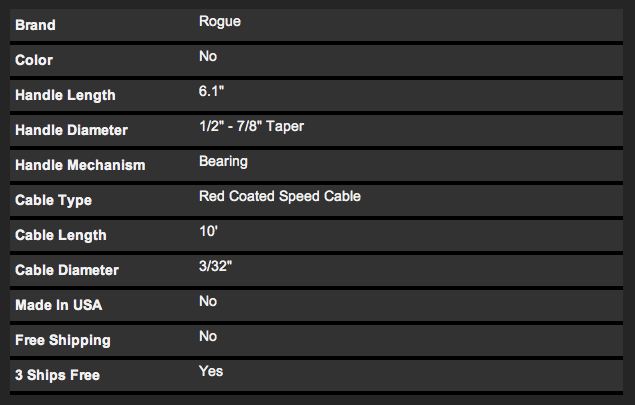
Rogue SR-1 Gear Specs

Rogue Jump Rope SR-1

Although the description touts the rope as the best for “solving your double-unders”, I should tell you that it’s not necessary to be able to execute double-unders in order to get a great workout with a jump rope.  I view at double-unders as the “hill sprinting” of the jump rope world.  Sprinting an incline will definitely create a large training effect (strip fat, building athletic-like conditioning, etc), but you can also arrive to your destination without sprinting that hill, or in this case, using double-unders.

Single revolution jumping can be tweaked to create a serious training effect also.

Are double-unders great?  Yes, absolutely they are, but you can use other variations of jumping rope to accomplish goals also, or at least until you are able to work into double-unders.  I’ve had my heart rate at the upper ranges using aggressive single revolution jump workouts.

I commonly use my jump rope for 5-10 minute of continuous jumping warm-ups or interval style work.  Set the clock in plain sight, adjust your Spotify playlist to something up tempo and go.

If you’re thinking of warming up using a jump rope, work in a bunch of variations of jumps (two foot square, single leg, running, side to side, forward and back, rotational, etc) within that time frame.  It will keep you engaged, work different body/foot positions and make the time move much faster.  The more monotonous you make jumping rope (or training in general), the more likely you won’t jump at all.

Keep it fresh.

For intervals, I would suggest starting by executing one style of jump, twirling the rope as fast as you can while maintaining solid body posture and rope technique.

Usually, the two-foot square stance jump is a great place to start.  As you become skilled at the basic two-foot square stance jump, progress to a stationary running action as you twirl.  Stay soft on your foot ground contacts and bring the knees up to a reasonable height (without hunching), which is probably a few inches below belt level.

30sec work: 30sec rest for 10 rounds (or slow jumping active recovery) is a great place to begin scaling to your conditioning level.  If you are crushing a 30/30 for 10 rounds no problem, add time to the work and decrease the rest or add additional rounds.  Play around with the logical progression that suits your situation.  I prefer to keep the 1 minute block for work:rest.  It’s much easier to calculate if you don’t have a dedicated interval timer like a Gymboss .

I’ve found that single foot jumping is very challenging, but I have to admit that I don’t like it for conditioning specific workouts.  Technique gets sloppy as the loading is overwhelming for your foot/ankle/leg to handle.  Think about it, it’s the entire weight of your body coming down on each impact, and the impact is completely vertical in direction.

Single leg plyometrics are considered advanced methods for training elite athletes, so imagine the effect they have on the average desk worker.  Before of the increases ground contact time with single leg jumping, the rope tempo also slows down.

I’ll work single leg jumps in often while jumping rope, I am just not sold for using single leg jumping exclusively for interval training.  It’s too much for a lot of people and it seems to work against the idea of interval training.

If I do work single leg hopping in for an interval session, it is usually a 3right + 3left alternating variation to avoid exhausting either side, keeping the tempo as high as possible.

But, as always, I recommend that you test it for yourself because your situation is unique to mine.

Peaking back at the construction of the SR-1 jump rope, notice the length of the handles, the ball bearings and the construction of the rope itself (cable coated in plastic).

Rogue Jump Rope quality and material

All of these features make this rope silky smooth when jumping, which in reality, is the key to great jump rope experience.  If you have to fight a jump rope that grinds on every revolution, you’re going to drive yourself nuts.  I’ve been there a bunch so I can attest to this situation.

Here is a more complete view of the rope:
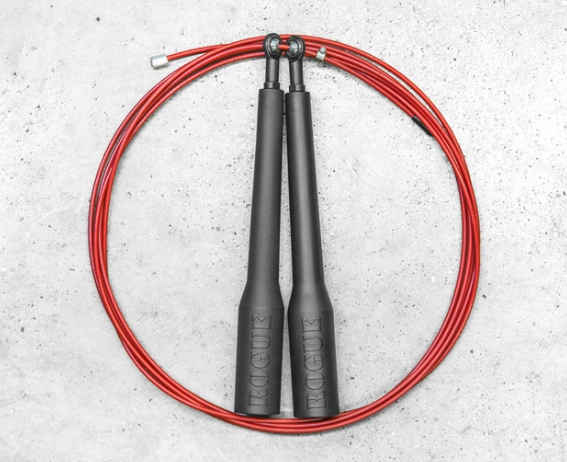
Rogue Jump Rope


Lastly, you can adjust the SR-1.  Don’t buy a rope that you cannot adjust.  A jump rope needs to be fit to your height in order to work properly.  Most come in a 9ft length, and you can trim down from there.  Here is a video on how to adjust the rope from the Rogue guys:

If you’re a small space workout warrior (like I am), jumping rope is the perfect conditioning alternative to running and cycling during the Winter months.  Cycling is out of the question (unless you ride a $2500 fat bike) and running becomes a challenge here in Wisconsin from late November through March/April (or late May as we received 10inches of snow last year).  Yuck.

Jump rope suggestions for workouts

Yup, that should about do it if you want to jump rope inside.

Jumping rope on carpet is a nightmare, so I would avoid it from the beginning if I were you.  You’ll have a much better experience on hard floor with the rope skipping underneath your body without any interference.

Jumping rope is a an acquired taste.  I composed a post a while back that discussed what I personally believe are the pitfalls of jumping rope.  I would call these words of caution, not a protest against jumping rope.  Even though the jumps in between the rope rotations is basically a low intensity plyometric, it is still ballistic and requires high volumes in order to receive any kind of training effect.  These were just words of caution.

If you haven’t conditioned your legs, specifically your calves and ankles to jumping rope, start slow.  You’ll know instantly if you overdid it, as you won’t be able to touch your calves without wincing in the days that follow.

Know thyself you’ll be just fine.

If you’ve lost faith in the quality of jump ropes recently, re-read this post and restore that faith.

There are decent products out there, you just have to do some homework before you make the purchase.


Cheers to jumping rope!


KG

Hand Walking/Crawling Exercises: Demanding More From Your Upper Body

Quick Tips

6 years ago I watched Jon Hinds strap his LifeLine Power Wheel to his feet and proceed to walk on his hands 100 yards down entire length of a football field.

I have to admit I thought the entire sequence was pretty badass.  The feat also seemed like something I could achieve… wrong.  It’s way harder than it looks.

The LifeLine Power Wheel boasts that it’s core activation is top notch, and that is supported with a study composed by CSU-Sacramento students.  The two other training tools that were compared to the Power Wheel were quite weak in my opinion (Ab Revolutionizer, ab straps).  

However, it appears that based on muscle activation (through surface electromyography (EMG), the Power Wheel performed extremely well.

When you watch YouTube videos, especially how-to exercise videos, it can be hard to find value in what the performer is showing you.  You watch it, roll your eyes and move on the the next suggested video.

I did exactly that with Jon’s hand walking video 6 years ago.

It’s a damn shame.

But, fast forward 6 years and I am an advocate spending more time loading the upper body via static/dynamic various of crawling, handstands and hand walking.  I think we need to stress our upper extremities in a similar fashion that we do our lower extremities.

Battling ropes are an example of a tool have added tremendous value to the average trainee’s tool box.  Battling rope drills are primarily executed in a standing position, involving timed (or rep based) work sets that are highly metabolic, recruit a ton of muscle for completion and train the upper body to produce repeated effort force in a way that is extremely unique.

But, battling rope drills don’t require our upper extremities to support the weight of our body.

Sure, the shoulder is not a load bearing like the hip or the knee, but we should be able to support and stabilize a percentage or even our entire body with our hands and arms.  Please don’t ask me to give “functional” examples of how drills such as handstands transfer over into real world activities until you yourself perform a series of 1-minute inverted holds yourself.

Doing so might make you feel like you like a weakling whether you are an avid exerciser or not.  I sure did.

—> What can you attribute to the difficulty of a hand walking/crawling/stands?

New stimulus?  Yes.  Very challenging regardless?  Absolutely, every single time.

The average workout just doesn’t stress the upper body in the same way that it tends to stress the lower body.  It makes sense since humans are bipedals.  Keeping our lower extremities strong, mobile, stable, and capable of sustained and high level repeated physical effort serves us very well.

But we need to be strong, stable and mobile movers in many different positions, not just with walking and running.

Hand walking, crawling, handstands and other upper body support drills stress the upper body much differently than push ups, overhead pressing, Turkish Get-Ups.  In the past, most hand walking drills were exclusive to gymnasts and other tumblers.  It’s amazing that it has taken so long for this type of training to leak out to the general population.

But, it’s here now and we need to leverage it.  It’s a tool (or maybe a strategy is a better description), and like all training tools, it serves a purpose in our physical development.

Handstands.  I have been a huge fan of hand walking and crawling for years, but have more recently begun to see amazing value in practicing handstands.  Simply kicking your feet up to a wall and holding that position with assisted support from your feet is extremely challenging and beneficial for overall physical improvement.

Ido Portal Handstand

Try it for yourself.  Go.  Now.  Try it.

It feels unnatural to support yourself vertically and I believe this is a good thing (unless you are experiencing pain).  You’re acclimating yourself to a new movement skill.  I am all about safety in training because it keeps us moving for life, but exploring uncharted territories of movement will bring you back to your childhood roots, where exploring is encouraged and crucial for overall development.

Fast forward to our adult years.  People who are hesitant to participate in certain physical tasks haven’t exposed themselves to that stimulus before.  They haven’t explored, so the movement seems risky, difficult or in some cases unfathomable.

Much of this handstand talk is probably coming from Ido Portal’s training philosophy, which is fine because I love the tenacity that Ido is bringing to the movement community.  He doesn’t dabble with movement, he is movement.  That’s pretty cool.  Devoting your life’s work to becoming the best mover possible, and then teaching the progressions on how to get to that level to others, is pretty amazing when you think about it.

Kudos to Ido Portal.

In my own training, I have divided my hand walking/crawling into two different categories:

  • Horizontal walking/crawling
  • Vertical walking/crawling

Both of these have two sub-categories that can be broken down even further:

  • Static (not moving)
  • Dynamic (moving)

I haven’t felt the need to progress any further than the bulleted points to be honest.  Hand walking/crawling is a supplement to my current training regimen, not the entire training regimen itself.  It’s a skill that I am looking to develop starting from ground zero.  The decision to keep hand walking/crawling as a supplement to the whole is based on my current goals.

My warm-ups have proven to be prime time for practicing and experimenting with various progressions of hand walking/crawling.  80% of the time I am crawling, which is what I would consider to be a horizontal-dynamic drill.  Something like this…

If you slow down while performing a basic bear crawl and do it properly, you may notice that you aren’t as connected as you thought you were.  Timing and an upper/lower body connectedness are two main keys to crawling properly.  The core serves as the conduit between the upper and lower body.  You’ll also notice that crawling isn’t as easy as it looks, as it can be extremely taxing even at shorter distances.

If you’re looking for a core workout, start crawling.  Start with a basic static hold.  You’ll find that  supporting yourself in this position activates your torso musculature like the 4th of July.  Progress to dynamic crawling slowly, working on the the timing of your opposite hand/foot.  Again, feel the burn in your stomach.

Here is Dewey Nielsen working through the ladder of crawling progressions…

—> Why should you incorporate more crawling and hand walking into your training?

1)  It’s fun.

I never thought that I would tout “it’s fun” as the top reason for crawling and hand-walking, but it really is.  Both provide a unique challenge that we can look forward to.  Pursuing specific goals in your training will keep the fire going in your belly.  Otherwise, it’s easy to begin flaking out on training.

I have recently dropped a few barriers with regard to my viewpoints on training, and what it means to “workout”.  For sometime, I felt unfulfilled in my workouts.  It seemed there was a piece that was missing.  I felt like a robot going through the motions.  Start a set, do the reps at a particular tempo using a particular weight, stop, rest, rinse, repeat.  It was nauseating.

Crawling and hand-walks scratched that itch.  Now intentionally incorporate warm-ups packed with plenty of crawling and hand walks.  It’s open new doors for me as I know it will for you.

2)  Loading the upper extremities uniquely

Moving yourself around using your hands/arms is a new training stimulus for many.  Even holding yourself against a wall for a brief period of time puts a valuable stress on your upper body to support the weight of your body.

3)  Balance

Horizontal or vertical crawling/walking are activities that require constant body correction.  Reflexive stability is a hot topic right now, and crawling/walking works reflexive stability nicely.  Keeping the hands connected to Mother Earth is advantageous, creating a closed-chain training scenario.  Crawling is both simple and more complicated than we think, especially when we realize how dysfunctional we have become from our lack of movement.  Holding a wall supported handstand requires stability, strength and balance.  A free-stranding handstand is the perfect expression of balance.

4)  Connecting the core

Not six-pack abs.  Chasing six pack abs should be furthest down on most people’s list.  The torso musculature’s main job is to protect the spine.  Our core is supposed to activate when it senses that the spine might be in jeopardy.  Our torso lights up (activates) to keep our bodies stabile and in control during these movements.  Lightly palpate (touch) your stomach while in the assumed basic bear crawl position, tell me what you feel.

5)  Primal movement

We had to crawl before we could walk.  Crawling isn’t a fitness progression, it’s a human life progression.  Regressing back to crawling can help to restore lost movement patterns from which we can build a bulletproof body.  The body’s wires can easily become crossed, don’t make the mistake of blowing a fuse by skipping the crawling section of the progression book.

6)  Low impact

Crazy is the craze right now.  Extreme, hardcore, tenacity and intensity!  But not everyone wants crazy workouts, and crawling fits the bill nicely for those who seek a bodyweight challenge without the risk of injury.  Although it’s possible to hurt yourself doing just about anything, crawling/handwalks are extremely low on the injury potential ladder.  Your joints will applaud your choice.

7)  Movement

To take an unofficial idea from Ido Portal’s training philosophy…  Just start f’ing move people.  Stop over thinking it and engage in full fledged movement.  Explore what your body can do in space.  If you’re embarrassed to do it in the public gym, do it behind closed doors in your basement or garage.  As I have said before, movement is the benefit of moving.  So keep moving every which way.  Caution… be prepared to be humbled at first… you might need to lubricate your joints and blow off the cobwebs for a few sessions before it starts flowing and feeling natural.

So there you go, the most un-organized 1600+ word article ever written on crawling/handwalking.

Stay tuned for how to get started with crawling/walking and where to slip it into workouts…


Cheers to exploring the upper body’s ability to move!

KG

The Huffington Post Advocates Exercising With “Kettleballs” to Burn Fat and Lose More Weight

Quick Tips

20131007-113409.jpg

“Kettleballs” are a great tool for exercise enthusiasts looking to building elite level endurance, raw strength and burn fat.

The Huffington Post thinks so at least.

After opening the “news” drop down on my iPAD today, my eyes immediately connected with the bolded heading “Kettleballs”.

Here’s precisely what my eyes saw:

20131007-115742.jpg

I’m fascinated by the suggestion because it seems that I’ve been using the wrong tool all of these years!

You see, I’ve been using kettlebells to build and maintain my boyish figure. But that’s not what the Huffington Post is recommending.  They’re touting “kettleballs” as the go-to workout tool for those who are serious about reshaping their bodies.

I feel cheated.

What might I look like had I been using “kettleballs” all this while? How would my performance improve if I had been using “kettleballs”?  Could I have been spending less time training and more time building other businesses if “kettleballs” were a part of my daily workouts?

I Googled “kettleballs” just to see what I have been missing…

Kettleball Training

I couldn’t believe it!  Photo after photo kept popping up!

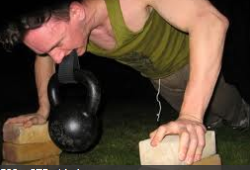
Kettleball Extreme Training

“Kettleball” exercises that incorporate bite strength?!  I was feeling weaker with every passing second…

… and then… the dagger…

Faster results with kettle balls

I had hoped that I wouldn’t see any “kettleball” claims like the picture above, but there it was, staring me in the face.  I did the math on this.  I could have trained for 10min per day (instead of 30 min) and seen 3x the striations in my muscles, increased abdominal visibility and all while shaving minutes off of my trail race time.

Stupid kettlebells. Their worthless it seems!

I’ve been swinging, pressing, pulling, carrying and snatching a cheap knock-off piece of equipment.

Unreal.

Here’s a link to The Huffington Post’s “kettleball” workout review that I am ripping on so hard.

Got Kettleballs?

Got “kettleballs”?


Cheers to the “kettleball”!

KG

Is Sitting is the New Smoking? Is Strong is the New Skinny?

Quick Tips

Spend a few minutes scrolling through your news feed on Facebook, you’ll inevitably come across someone posting spirited words of inspiration.

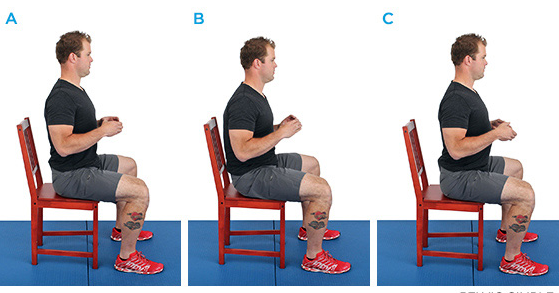
Diagram A:

Image

Diagram B:

Image

Very spirited posts indeed.

Let’s start with “strong is the new skinny”…

I recently read a Huffington Post article that made a great number of points about the concept that “strong is the new skinny”.  I have to say that I agree with many of the points made in the article.  I felt that the author made some really good points that seemed to be deeply tied to her preferences.

I’ve never preached skinny.  I actually think that “thinning out”, “getting skinny”, “slimming down” are all as annoying as “strong is the new skinny”.  Strong definitely is strong.

What’s even cooler than saying that “strong is strong” is building up a person’s confidence to the point that they are about to explode with ambition, drive and the pursuit of their own form of greatness.  Whether “getting skinny” or “getting strong” is the path to jump starting a person’s legacy, it doesn’t matter to me.  Use whatever fuel gets you moving.

I once trained a 12-year old hockey player in Detroit, MI, who will remain nameless.  At 12 years of age, most males are just starting to figure out their bodies, muscles, etc.  They are on the brink of puberty, so this makes sense.

This young man was one of my favorite training sessions of the week, by far. I always looked forward to working this kid because I could tell that he didn’t have much confidence, and his Mom- after a few training sessions- praised my efforts by telling me that her son really looked up to me as a coach.  I praised him every chance I got.  High-five’s, knuckles, shouting and clapping when he succeeded was my formula.    As with any enjoyable client, his strongest trait was that he listened.  He was coachable.  He may have been smaller and weaker than other kids his age, but he was willing to listen to my advice and follow through with my suggestions.

A few months down the road, after never missing a scheduled training session, he walked into our training center smiling from ear to ear.  “I made the Peewee A team (hockey), I am the strongest on the team and a girl at school said I have big muscles”.

Naturally, I laughed, particularly at the end part of his comments.  I was ridiculously proud of this kid.  His entire demeanor had changed over a course of months.  Not necessarily from an introvert to an extrovert, but definitely from a kid that lacked confidence to a kid that realized he could accomplish whatever he wanted if he stuck to the recipe and did the work.

Strong may not be the new skinny, but building strength, both physically and mentally can change a person in a matter of weeks.  You’d be surprised at home many people, kids or grown-ass adults have displayed a new-found confidence from improving that strength, ability to move, performance and most recently… their composition of their body.

So, I really don’t care what you choose to refer to “it” as,  but in this situation, strength is confidence.


Next, “Is sitting the new smoking”?

Kelly Starrett thinks that it is, and while Kelly Starrett isn’t god, he is certainly a massively influential face in the movement world right now.  Right up there with Ido Portal.

The truth is that I don’t think that comparing sitting to smoking is really a good comparison.  I understand the message that people are aiming to convey by saying that over-indulging in sitting is kind of like smoking, but sitting is sitting, and smoking is smoking.

Everyone needs to sit at some point.  Quite honestly, I enjoy sitting.  It usually means that I am reading a book, listening to music, watching the waves roll in on a lake, watching NHL hockey (as I am right now) or writing.  All great activities that I thoroughly enjoy.

I don’t punish myself for sitting and nor should you.  However, I also don’t sit 8+ hours day for my career.  That fact, makes me consciously accepting of times that I sit.  I feel that I earned the right to sit, rest my feet, relax and reboot.

The magnitude of the negative effects that sitting has on a person should be related to each person and their unique situation.

If you’re a person that remains seated and stationary during most of the waking day, you probably need to be more conscious of your sitting.  You probably need to move more.  You probably need to consciously focus on an improved posture for sitting.

Image

Photo credit: bodybuilding.com

You probably need to consider a standing desk (if you can have one where you work or at home), you probably need to take more walking breaks throughout the day.  You also probably need to be more aware of the structural changes taking place with your body as a result of such prolonged periods of sitting.

If you sit too much, you just need to be aware.  Don’t get compulsive about it, just be aware of the events that are taking place as a result of sitting so much.

Also, if you are sitting for prolonged periods, understand that you need to be consistently diligent about off-setting the effects of sitting.  Here are some simple things that you can do:

1)  Open up your thoracic spine using the tennis ball peanut.

2)  Yoga (donate 30-60 minutes of your time, you’ll feel great after)

3)  Rapid circulation (aka:  exercise)

4)  Foam roll aggressively and then hold this stretch…

Although sitting affects us all differently (just like getting punched in the head affects us all differently), the rules of unwinding and off-setting the negative adaptations of sitting can be somewhat generalized and still provide tremendous benefit and relief.  As I have said in the past, our bodies are extremely complicated and yet at the same time, extremely predictable.

So is sitting bad?  For some people, yes, it’s a slow road to a whole host of future issues.  But sitting is not evil and there is no need to pull your hair out if you sit down for a while.  Just be aware of how much you are moving around, and do you best to increase it or sustain that movement for the long haul.

Smoking, on the other hand, is terrible.  I cannot think of one benefit that anyone receives from bucking a dart.  I have an orthopedic surgeon colleague that was telling me a story not too long ago about a patient that he saw in his clinic.  This particular patient was in severe pain from bone on bone knee articulation.  Obviously, the average person is supposed to have nice lubricated cushion of meniscus, but this lady had worn through her cushion.  So, bone on bone grinding was taking its place.

Surgeons do extensive health checks for any patient that is a candidate for total joint replacement.  Upon conducting a health check on this lady, it was identified that she was a heavy smoker.  By heavy, I am talking about a pack of cigarettes per day, if not more.  This is common for orthopedic surgeons to see during consults.

After taking this patient’s knee through range of motion tests, exhaustive questioning about symptoms and an evaluation of her x-rays, the doctor told the patient that she was in fact over-due for a knee replacement.

“I would like to see you again in a week for another series of tests so we can properly schedule your surgery”, the surgeon told her.

“Another visit?!  I can’t afford that!”, the patient responded.

“Why is that?  It’s important to make sure that you’re able to make it through the surgery, it’s in your best interest ma’am”, said the doctor.

“I won’t be able to buy my cigarettes if I have to drive down to the clinic again”, the patient said.

The irony in this story is that the patient had terrible bone quality from smoking, diabetes and no meniscus in her knee from her lack of activity and her weight.

But she just couldn’t give up those cigarettes.

Sitting is not smoking and smoking is not sitting.


Cheers to moving more, sitting less and the pursuit of your greatest self!

KG

5 Simpleton Tactics for Waking Your Ass Up To Workout

Quick Tips

Nothing recommended in this post is rocket science, but hot damn these suggestions work wonders.

Listen, I know what it’s like to come home after a long day and not feel an ounce of motivation to workout.  You don’t have to plead your case.  We are all human, therefore we have all experienced these lethargic feelings at some point.

No one is denying that the workday is draining.  Or, maybe it isn’t just the workday.  Maybe it’s your kids,  significant other, or some other mind draining task or activity.

It’s a struggle to keep our energy levels hovering high enough to keep excited to a purposeful workout at the end of the average day.  Dealing with people all day long, staring into computer screens for data entry or extreme boredom in the workplace is enough to deter an individual from pursuing a workout.

A workout is the last thing someone wants to see on their to-do list at the end of a long day.

But, pushing through the urge to lay on the couch has tremendous rewards.

So, without further delay, let’s get into some great little tactics that will get you back on track for accomplishing the daily dose of physical effort…

Photo Credit:  howstuffworks.com

Photo Credit: howstuffworks.com

1)  Slam a 24oz glass of ice water.

Pounding a glass of ice water pre-workout takes the least amount of time and resources of the five tactics listed here, yet delivers from multiple angles.

First, slamming that tall glass of unsweetened goodness aids in hydrating your body pre-workout.  Hydration is the key to, well, just about everything.  Hydration is one of the most overlooked, yet most impactful aspects of basic performance nutrition known to man.  Entering into a workout in a dehydrated state is like riding a moped in a 65mph zone.  Not good.

If your performance is hindered before you ever lift a weight or head out the door for that run, you’re already selling yourself short.

Second, the sheer chill of the ice water entering your system will wake you up quickly.  For the purposes of this article, this is what we are after.  Slam it, hydrate, wake up.

Third, some say that ice-cold water burns a small of calories.

Screen Shot 2013-10-04 at 7.24.07 AM

Photo credit: lythamcoffee.com

2)  Brew a coffee.

Coffee is the most widely used stimulant in the world.  Don’t believe me?  Take a drive by your local Starbucks or Caribou Coffee between 6:30-7:30am in the morning, and observe the parking lot and the drive-thru.  I’ve save you the trouble… it’s a zoo.  It’s mayhem.

Coffee is a proven performance enhancer.  Many believe in using coffee to help stimulate fat loss and improve endurance like qualities.  But we don’t need to complicate matters here… for our purposes, we are going to use coffee to wake your ass up for the workout ahead.

Personally, this is my go to tactic for my own training endeavors.  A 10oz. cup of coffee from my Keurig roughly 20-30 minutes pre-workout is my sweet spot.  If you can swing it, use tactic #1 (slam ice water) and then brew that delicious coffee.  Be aware that coffee is a well-known diuretic, so use the ice water to jumpstart the hydration process before you down that cup-o-joe.

Go black with the coffee by the way.  I was going to crack a stupid joke right here, but I’ll holster it for later.  If you have never enjoyed your coffee black, try grinding your own beans and brewing it that way.  Fresh ground coffee is the first step to a true coffee experience and new-found appreciation for the beverage.  I’m not a coffee expert, but I know the difference between a stale pre-ground Folgers cup and a nice cup of fresh ground whole bean.  Give it a shot.

Photo credit:  advice unsolicited.tumblr.com

Photo credit: adviceunsolicited.tumblr.com

3)  Take a nap.

Power naps save lives.

I could end my commentary there, but that wouldn’t be right.  In a world where most people (adults and children included equally) are sleep deprived upon waking in the morning, naps might provide the most bang for your buck overall.  Sleep is crucial.  We act like exercise and nutrition are the only two influencers of health and wellness (and six-pack abs), but sleep affects us beyond what most of us care to know.

10-20 minutes is the key to greatness.  That’s all you need to refresh and recharge.  Make sure that you limit your nap to 10-20 minutes.  Laying down for a 2 hour marathon session might leave you feeling more sluggish coming out of the nap than it did going into it.  Remember the goal is to recharge, not catch up on lost sleep.

It’s also the best way to fall into the trap of “I don’t have enough time to workout” syndrome.  Set the alarm loud, lay down, fall asleep, wake up and… show time.

Check out this great article from my friends over at Precision Nutrition to learn more about sleep.

4)  Force the warm-up.

This might sound a little aggressive, but just like all of the other suggestions above, it works.  Don’t fold  on your workout until you lace up your shoes (or take off your shoes preferably) and move through a warm up.

I don’t care how tired you think you are.  Get into your workout attire and start foam rolling, mobilizing, stretching and moving.  Treat it like you are warming up for the gold medal finals of the Olympics.

You’re going to find out one of two things by warming up:

1)   Movement wakes you up and you’re not as tired as you thought you were.

2)   You’re body wasn’t lying to you and today is not the day to train.

The problem with this tactic is that it’s largely a judgment call on your part.  So, you have to know thyself and be aware of your tendencies.  If you have a tendency to be mentally vulnerable when it comes to being consistent with a workout regimen, this may not be the tactic for you.  You might find that you end up talking yourself out of the workout regardless of how great the warm up session is.  If you are more likely to stick to a training regimen on a regular basis, use it at will.

Photo credit:  fourhourbody.net

Photo credit: fourhourbody.net

5)  Take a cool shower.

Much like slamming a tall glass of cold water, taking a shower is the next step of motivational water therapy.

A cool shower has been shown to inspire and motivate 8 out of 10 people (on average) to get ever important workout in for the day.  It’s a home run for establishing a level of mental alertness and physical readiness that prepares a person for a great workout.

On a side note, I completely fibbed the “8 out of 10 people” statistic above.  People love to see stats with regard to fitness advice, so I couldn’t help myself, sorry.  However, the cold shower works wonders.

Be aware that this tactic is also the most time-consuming and requires the most motivation to complete… however it also impacts the most of the five tactics listed in this article.  Your choice here.


There you have it, five solid simpleton tactics for making sure that you can recover you mind and body for the workout.  The workday is draining.  It’s hard being a human.  Mix and match any of the five pre-workout tactics above and lets cheers to your success.


Cheers to waking your ass up to workout!

KG

A Quick (and effective) Kettlebell Swing + Bodyweight Movement Workout

Quick Tips

I’ve started to trend some of my posts toward topics that people are searching for in Google, which I am informed of on my blog.  You cannot see these stats and search terms, but I can, so advantage to me!

I won’t sell out and write what I think will drive more traffic to this blog (a lot of fitness bloggers do), but I am interested in what kind of traffic numbers will arrive if I direct some of my posts toward the needs of the people.  My goal has always been to write authentically and reach as many people as possible.  We will see how it turns out.

Ha, listen to me… “The needs of the people”.

Photo Credit:  tv.com

Photo Credit: tv.com

I sound like I should run for city office, or city treasurer on Boardwalk Empire.

Anyways, I put myself through what I would consider an intermediate workout tonight.

This workout was heavily centered around kettlebell swings, and supplemented with various other bodyweight movements.  I feel like “supplemented” is the proper terminology in this particular situation, as you’ll see from the workout below.

The bodyweight movements that separate the kettlebell swings are nothing more than filler exercises used to keep my heart rate elevated in between bouts of swings.  More muscles worked, more calories burned during and after training.

I tend to choose both upper and lower body bodyweight movements to disperse the training stress to  more of a total body approach.  Splitting the movements to upper and lower allows for a brief period of training stress directed at a specific movement pattern (horizontal push, squat, vertical pull, etc) without exhausting that pattern completely.  This allows for intelligent fatigue management during other bodyweight movements and more importantly during kettlebell swings.

When fatigue sets in, technique gets ugly, people are exposed to bad habits and injury.

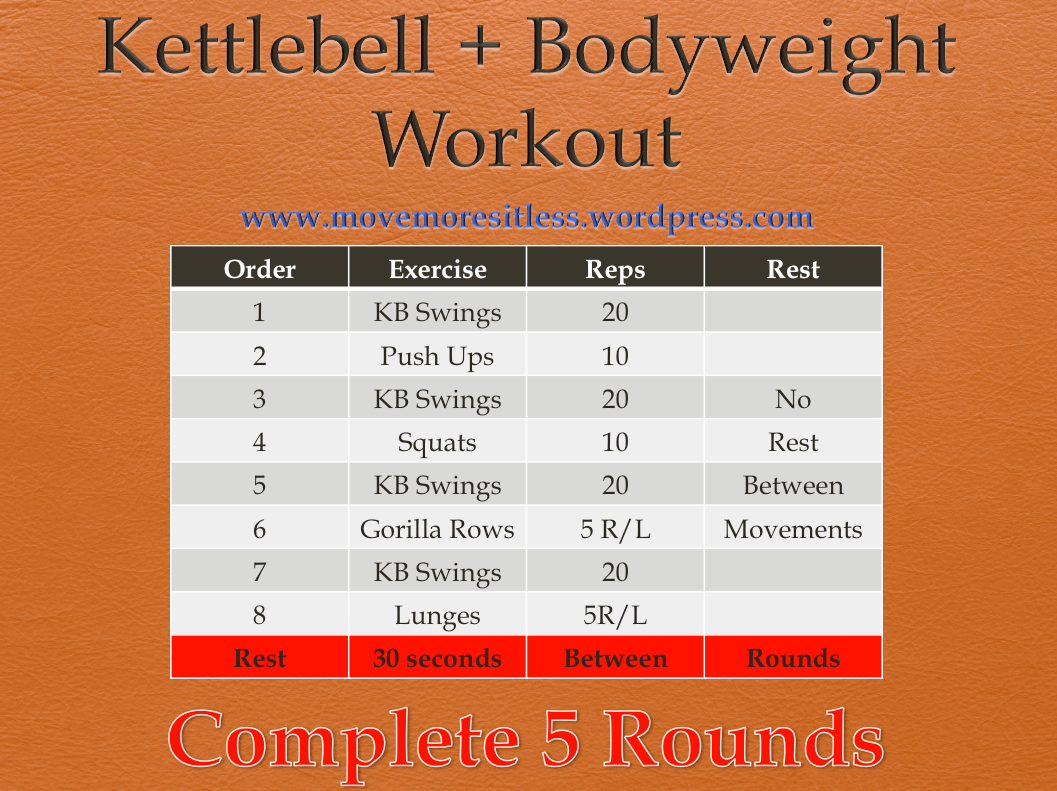
So, without blabbing any further, here is the structure of the workout, please notice that it is very similar to the multi-method cardio approach:

sample kettlebell and bodyweight workout

A couple of points…

First, there is a lot of work being done here, as you can see.  There is a lot of muscle being stressed and the rest is light.  A workout like this could be a complete training session for a beginner or an intermediate, or scaled up for an advanced lifter.  Scaling up for an advanced trainee might involve a bump up in bodyweight exercise progression or adding a weight vest to those movements.  It’s all a matter of tweaking the variables based on your unique situation and needs.

Second, I kept the reps to even numbers, 10’s and 20’s.  Why?  Because it is annoying having to check your notebook after every movement.  I want you to be focused on what you’re doing during the training session not counting reps like people count food calories.  Focus on your movement, your breathing, your recovery.  Forget about complicated rep schemes… I have plenty of those that I will post in good time.

Third, go sub-maximal but not too light on your kettlebell swings.  Grab a bell that you could swing for 30 reps and focus on hip snap during those suggested 20 reps.  Guys you might grab a 24kg or a 28kg, gals you might grab a 16kg or a 20kg.  Both guys and gals, you’re allowed to grab more or less than that, but on average, males and females will use those weights.

Remember, don’t gauge your energy expenditure on the first set of swings because you’ve got 3 more sets of swings and 4 different bodyweight movements lying ahead.  Manage your fatigue appropriately.  If you have a heart rate monitor, I would suggest using it to check you heart rate.  Of course, you’d want to already have an idea of the beats per minute that separate you from exhibiting crappy movement technique.  When you reach that heart rate, you can back off, rest for a few seconds, then get back into the workout once you can control and OWN the movement.

Why 20 reps of swings?  Because I personally feel that anything more than that really doesn’t provide much benefit other than poor technique (lack of finishing in full hip extension, slouching, etc) and a rising risk of losing the bell on the backswing or at the highest point of the arc.  One slip will kill your pet or put a hole in your wall, and the other will destroy your brand new LED TV.

20 reps (or less depending on your conditioning level) seems to allow for a sufficient elevation in heart rate without making the swings pointless from lack of load and endless volume.  There will be plenty of work performed in this training session, it doesn’t all need to be accomplished with kettlebell swings.

If you’re bored with your typical cardio routine, I would highly recommend giving a workout like this a real shot.  You will be pleasantly surprised at how hard your cardiovascular is taxed during a training session like the one described below.  20 minutes seems to be the sweet spot for me.  I have tested up to 30+ minutes of work like this, and it just doesn’t work for a couple of reasons…

1)  I feel like I am just going through the motions with regard to loading (aka weight used).

2)  I feel like I am adding  volume for an unjustified purpose.

These days, workouts like this serve as a great follow-up to my 2-day on/1-day off training schedule.

Day 1 is a heavily focused on strength work with a splash of jump rope or Airdyne cardio work, while day 2 (this workout) is dedicated to sub-maximal movements strung together to work cardio-strength (traditional strength moves with incomplete rest periods).

Ultimately, the goal is to stay physically prepared until I shift my training toward a particular goal.

Also, although the 20-25 minutes of work being completed in a workout are definitely stressful and draining, I feel as though it’s a short enough bout that allows for adequate recovery between training sessions, avoiding over-training.  The full 24+ hours of rest is also a motivating factor to work hard during this type of training session.  The rest day is just that… a rest and recovery day.

Be a perfectly golden marshmallow at the end, not a crusted black scabby marshmallow.

Give it a shot and let me know how you make out!

Cheers to short effective bouts of exercise!

Kyle

Hang In There… The Kettlebell Clean is a Great Exercise and an Acquired Taste

Quick Tips

The kettlebell clean is an acquired taste, for sure.

It reminds me of a craft beer drinkers first sips of an I.P.A. or a Double I.P.A.  Do you remember the bitter beer face commercials?

One quick search on the old Dragon Door article library or the new StrongFirst forum, and people will praise the hell out of this move, but I am here to warn you up front, you might not enjoy this exercise at first.

It’s an acquired taste.

Both from a technique standpoint and a “Why the hell would I choose this exercise over kettlebell swing variations, kettlebell snatches, weighted jump squats or even barbell cleans”?… standpoint.

For quite some time, I wasn’t exactly sure what significant purpose kettlebell cleans served.

At that time, the kettlebell clean seemed more like a sweet little method to move the kettlebell from the floor up to the rack position, and not much more than that.

Photo credit:  FitBomb

Photo credit: FitBomb

In case you’re not familiar, the rack position describes a static posture where the bell rests for a given amount of time (split second or for multiple seconds) against the chest with elbow tucked tightly to the side.

Also, at that time, my timing was way off with the kettlebell clean.  I was mostly pulling the bell up from between my legs using my upper extremities, and flipping it over the top of my knuckles.  Obviously, the upper body does have some involvement in most kettlebell training, but one of the main principles of any ballistic kettlebell movement is hip snap.  I have always viewed “hip snap” as the slang terminology for aggressive/powerful extension of the hips.

Kettlebell drills like swings, snatches and cleans all thrive off of aggressive hip extension, or hip snap to catapult the bell through its trajectory/range of motion.

[Improving your ability to aggressively extend your hips is incredible for sport performance and fat loss.  The research on the influence that kettlebell swings has on body fat elimination has been growing rather consistently in recent months.  Anyone that has spent any time working out with kettlebells in a dedicated manner will no doubt give the nod to kettlebell training (specifically swings, cleans, snatches) and its dramatic effect on fat loss.  Almost to the point of zero dietary intervention.  That’s not to say that you shouldn’t pursue higher standards of eating… because you should.]  

Ok, back to kettlebell cleans.  Originally, I didn’t like them.  I just didn’t see the value.  Swings (moving the bell to about sternum height) provided a noticeably large training stimulus that mimicked an explosive deadlift and kettlebell snatches (moving the kettlebell overhead) worked very similar to dumbbell snatches, which are amazing for building uni-lateral explosive power.

But kettlebell cleans seemed like the red-headed step child (forgive my joke if this offends anyone).  I kept asking myself,  “What are they good for?”

I never felt like I was achieving anything while practicing the kettlebell clean.  The hip snap didn’t feel like it was present, and quite frankly, it didn’t seem like it really needed to be present in order to execute the clean.  So then what?

Again, as I stated early in this post, the clean (to me) felt like an efficient method to transport the kettlebell vertically to the rack position so that I could set up for other exercises like:  squats, overhead pressing or carries.

Eventually, I made the decision to work on my clean technique in a diligent manner.  I also spent some time combing over the forums and articles from trusted resources for to increase my understanding of what the kettlebell clean is and why it was important.

Here’s a messy synopsis of what I found…

From a basic observation, I thought of the kettlebell clean as a variation of the swing, and still do.  Obviously the motion is different, but hiking the kettlebell through the legs, moving forward into an arcing pattern is very similar to that of the kettlebell swing.  However this arching pattern is interrupted as the hand/arm pulls the bell much tighter to the anterior (front) aspect of the body than the arc of the kettlebell swing.  Some people will refer to this as “taming the arc”.

You can read more about “taming the arc” from this excerpt:

Kettlebell Taming the Arc

Once the bell begins its ascent vertically to the chest, this is where most people will get lost, as I did.

Why?  Because in the time that it takes to blink your eyes, the bell needs to transition from a prone (hand over the top) grip to a neutral grip (palm toward the midline of the body) with the kettlebell nestled partially against the forearm and chest, at armpit height.  The entire sequence happens really quickly.

The most common mistake here is “flipping” the bell.  Technically, it’s incorrect yes, but the bigger mistake is that flipping the bell over the hand is essentially beating yourself with the greatest mass of the kettlebell.  Kettlebells are constructed of dense cast iron so… it hurts.  Once the bell flips over the hand, the only object to stop its motion is your body, and this can be painful.  If you’ve played contact sports, the sensation of the bell impacting your body will be eerily similar to the impact of another human hitting you.

So what is supposed to happen?

Around waist height, the bell begins to turn over and rotate.  It’s a combination of both.  The only way to successfully accomplish this, is to relax your grip and allow the kettlebell to turn over/rotate around your forearm.  I said RELAX, NOT LET GO.  Your hand position changes on the bell, without your hand ever leaving the bell.  I use the terminology turn over/rotate because I feel this is the best description of what happens to the kettlebell as it transitions into the rack position hand position changes on the bell, without your hand ever leaving the bell.

This “relaxed” grip was uncomfortable for me at first.  It didn’t feel natural to loosen a grip and relax while dynamically swinging a 53lb piece of cast iron.  I am sure that you might feel the same way when you give this movement a go.  It can be unsettling for the first few reps.  Make sure that your hands are dry and free of any grease.

Chalking your hands is a great technique for improving hand/grip integrity kettlebell training, although chalking can be messy for you house over time.  Check out this Metolius Eco Ball chalk bag that really helps to save yourself the hassle of cleaning up chalk mess.

But, like anything other new stimulus or skill, consistent practice will move your  technique of the clean from completely foreign to second nature.

Filming my kettlebell clean (which I encourage you to do always) revealed that I wasn’t initiating my turn over/rotation of the bell soon enough.  I was attempting to mimic the barbell clean, where the hands and elbows (and body) move under the vertical moving barbell above waist level.

Again, if you attempt to “flip” the kettelbell above waist level you’re going to get some tough love from the bell in the form of a shot to the chest/shoulder.  As long as you don’t hurt yourself, this type of feedback is probably a good thing, as there will be no question that your timing is off.

The kettlebell should park itself into the rack position rather peacefully.

The kettllebell clean is a “steering strength” movement that requires adequate attention for successful completion.

You might start out despising it like I did and end up loving it as I do now.

A series of simple tips that can help you out:

  • In the beginning feel free to learn using a lighter bell.  This is important.
  • Quickly move into a heavier kettlebell that demands some  hip snap to make the bell move.  Otherwise, you may find yourself “muscling” the bell as I was.
  • Work the single arm kettlebell clean until you feel you are proficient with technique at heavier weights.  Forget about “work capacity” training while you are learning, learn it first, don’t get ahead of yourself.
  • Once you’re moving a heavier kettlebell (32kg men/24kg women), consider transitioning into the double kettlebell clean, which will require attention to be paid to both arms and an increase in hip snap to move the bells to the rack position.
  • Practice, practice, practice.

On a positive note, if decide to dedicate some time and practice into learning the kettlebell clean, you’re going to find great carryover to all of your other lifts also (kettlebell swings, presses, etc).  The move requires timing and coordination, but improving both will boost your performance and your results in the race to lose fat.

The clean is nothing that I thought it was and everything that I thought that it wasn’t.  I have been pleasantly surprised and challenged by its technique and it’s purpose inside of a balanced strength and conditioning program.  I highly suggest that you work it for yourself and see how it benefits you.


Cheers to kettlebell cleans babies!

KG

A Self-Limiting Barrier to Fat Loss and Performance: “If I Had ________ Than I Would Definitely _________ ” Syndrome

Quick Tips

Image

This will probably be the easiest post that I ever compose on this blog.

The idea is clear and I think that most of us can relate to it, at least at some point in our lives.  Heck, maybe we feel this on a daily basis.

It’s a common barrier to fat loss and performance.  

As the title of the blog shows, “If I had ____ I would definitely be _____” is a self-inflicted syndrome.  

Some common examples go like this:

  • If I had more time to workout, I would definitely be in better shape.
  • If I had a membership to that new gym on the other side of town, I would definitely be in better shape.
  • If I had more money to go 100% organic with all of my food, I would definitely be able to see my abs.  
  • If I had more equipment at my house, I could perform all of the best exercises and engage in all of the best workouts that the magazines talk about.
  • If I had more fitness apps on my iPhone, I would be able to make much greater gains in much shorter time.
  • If I had better fitness apparel, I would re-dedicate myself to my movement.
  • If I had those supplements, I would be able to drop the weight and exercise more frequently.

If I had _____ I would definitely_____” Syndrome.

It’s a syndrome brings us to our knees, cripples us, leaves us uncertain about whether our goals are worth all of the effort. 

We convince ourselves into thinking that the grass is greener on the other side, and then when we get to the other side, we realize that the grass is the exact same color.

Use exactly what you have right now, where you are at right now.

If something is worth doing, it’s always worth the effort.

Don’t get caught up in the minutiae of building health, wellness and performance.

Because there is a lot of minutiae.  If you’re a beginner, all you need to know is enough to get started.  If you’ve already started, all you need to know is enough to keep going.  

You’d be surprised at how taking a few minutes to re-examine your training options can open doors to new challenges and a refreshing movement experience.  But you have to be willing to open your eyes to all of the things that you do have going for you (time, equipment, space, a roof, mobility, etc) versus dwelling on all of the things that you don’t have.  

If you’re wondering where you can find new ideas for your training, comb over the archives of this blog.  I have been posting for a little over a year.  There are more than 150 posts to read on Range of Motion.  Bookmark it in your browser or better yet, sign up to get an update whenever I post.  

A lot of the posts on this blog contain workouts and effective exercise variations, some performed by yours truly and others I outsourced because I didn’t have the video or someone else was more effective at demonstrating.  Eat your heart out.  

One big culprit of “If I had _______ I would definitely ________” Syndrome are fitness “secrets”.  There are no secrets, there is only what you know and what you don’t know.  And you don’t know what you don’t know.  Ok?

If you’re really in an exercise slump, redirect yourself back into the movements that you avoid and hate the most.  Chances are quite high that those same movements might be the missing link in your training success.  More often than not, this advice will hold up.  That which you dread just might that which you need.  

Just a few simple thoughts on a Monday.

Go do something great today.  Go ahead, you have time.

Less thinking and more doing, and I will do the same.


Cheers to wiping “If I had ____ I would definitely ______” Syndrome off of your shoes at the front door before entering!


KG

It’s Just a Kettlebell Workout: Adjusting a Brutally Effective Kettlebell Complex

Quick Tips

I added a few new elements to what I like to call a staple kettlebell complex that seemed to fit the bill just right.

The original kettlebell complex was structured like this:

Kettlebell Complex Training

First let me say that if you have the physical know-how and ability to train like this, you won’t regret it.  If you’re short on time, its pure gold.  If you’re looking to lose fat, its pure gold.  There is so much happening in a condensed total body work capacity-style training session like this, it’s definitely going to create a large training effect.

And that is what you should be after… A large training effect while keeping safety in the front of your mind.

So, as much as I love the above training session, it was time to re-organize some things.

Boredom in training sucks.  I aim to avoid this without straying too far toward the radical.

Using the above kettlebell complex, my rest periods had decreased to nearly 40 seconds in between complex rounds, and my total number of complex rounds had increased to 6.  I felt as though I was spinning my tires.  Would adding another round or decreasing the rest periods  the 40 second mark really provide any benefit?  I really had to ask myself what there was to gain from adding more, or resting less.

My options seemed to be: increase the loading or change the stimulus.

I chose to change the stimulus and see what happens.

My first experience with the modifications was promising.  Here is how it looked:

kettlebell complex training

Alternating the double kettlebell swing and the double kettlebell cleans added significant work time to the beginning of the complex.  I should clarify that “significant time” is really only 15-20 extra seconds, but when the entire complex round clocks out at 2min11sec total, 15-20 seconds of extra work begins to look a lot more challenging.

Other areas of the complex that seemed to increase the working time were the overhead presses.

Exploding out of the last rep of  squats, I immediately transitioned into a double overhead press.  Upon bringing the kettlebells back to the rack position, I then pressed the right hand bell up and back down, followed by the left hand bell up and back down.  Pressing a single kettlebell while holding the other in the rack position is draining, but this is what I was aiming for.

Lastly, the implementation of the alternating reverse lunges added working time to the entire work set.  In the original kettlebell complex, sumo-style deadlifts were used.  The cadence of a sumo-style deadlift is commonly much quicker than alternating between reverse lunges.  The training stimulus is also altered by changing the movement pattern.  I quickly found out how much I had deprived myself of lunge work.

As far as rest periods go, I suspect that 45-60sec of incomplete rest will remain adequate to receive the training effect that I am after (lean, conditioning, maintenance of strength qualities).

I refer to the rest periods as incomplete anytime my heart rate doesn’t recover to 130 beats per minute.

In the later rounds of the workout, my work periods begin higher and higher heart rates.

My goal is to be a perfectly golden marshmallow.

If you’re proficient with kettlebell training, give this workout a shot.  You may have to adjust some things to suit your abilities, scale up or scale down, but you’ll be pleasantly surprised at the results you’ll get from training like this.

At the very least, it’s a different angle on working out.


Cheers to shifting the complex to create a new training effect!


Kyle


A Great Trick for Stationary Bike Workouts to Boost Conditioning

Quick Tips

Stationary Biking

The stationary bike is not the devil.

Riding the stationary bike might be on the lower end of eventfullness  and brutally repetitive, but it is not the devil.

I’m about to share completely unscientific and unsupported Jedi Mind trick for your next stationary bike workout that will boost your conditioning efforts.

I use it extensively in my home training sessions on my trusty Schwinn Airdyne.  If you’ve read any of my work in the past, you know by now that I believe that the Airdyne (yes the old school Schwinn Airdyne) is one of the best conditioning tools on the market.

Browse on Craigslist and I best you can find one dirt cheap.

Craigslist Schwinn Airdyne

It’s well worth the investment assuming you give it a little TLC to ensure that the nuts and bolts stay tight and the chain is lubed.

But you don’t need the almighty Schwinn Airdyne to reap the benefits of making this simple switch to increase the effectiveness of your biking sessions.

The fact is, although it might not be the BEST option, you can get yourself into excellent cardiovascular shape by riding the stationary bike on a regular basis.  At the very least, you can lay a great foundation of conditioning to build from.  If you’re a runner, you might find that the carryover from the bike to the pavement isn’t the greatest, as it really isn’t.

The demands of running and cycling are different.  Just because you are efficient at one doesn’t mean you’ll be efficient at the other.  Look at Lance Armstrong’s (all doping aside) plunge into the running world.  A lot of people thought based on lab statistics that he could finish quite high in the marathons that he ran, but this just wasn’t the case.  Lance was quoted to say post-marathon, “that was the most challenging thing I’ve ever done”.

Interesting don’t you think.?

But anyways, the stationary bike is a low impact alternative to other higher impact methods of cardio such as running.  Running also isn’t the devil, but high impact all of the time can agitate and overwhelm a person’s body.  The stationary bike becomes a valid alternative in these situations, and with the properly prescribed training session, it delivers.

At some point, despite your personal preferences, you may find yourself forced to ride a stationary bike, and I am here to tell you that it really doesn’t have to be a nightmare.  Embrace it, make the best of the situation.  Put in your headphones and get to it.

As mentioned in past posts, a person doesn’t need special equipment to leverage the benefits of a workout… but you have to be wiling to adapt on the fly and try something new occasionally.

So, here is a subtle trick for you to squeeze even more out of that dreaded pedal session…

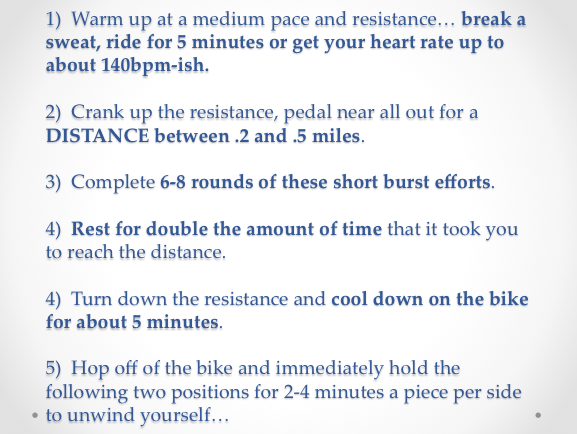
Schwinn Airdyne Ride for Distance Training Protocol

What’s different you ask?

Riding for distance, that’s what.  I want you to ride hard for a distance versus riding for time.

In fact, forget about riding for time, ride for distance for the next 4-weeks.  When you ride for time, people tend to give a much lower effort, just “surviving” against the clock.  A lot of us will quit pedaling well before the clock hits our target work time.  I’m guilty of it.

When you pedal for distance, you want to get the pedaling over with a quickly as possible.  This is a natural tactic that promotes effort beyond what you may have given had you been riding against the hands of the clock.

Although I have a sickening love for the infamous 5-mile Airdyne Trek for time, if I am performing short burst work, I typically keep the distances between .2-.5 miles.  On the big fan, .3 miles typically takes me between 39-45seconds to complete.

That is a long time to be pushing it hard.  Remember to remind yourself not to judge the demands of the workout based on the first set, second set or even the third set either.  As I have said before…

… the fatigue is coming, be patient, it is coming.  

If you are curious about the timing of fatigue in a work capacity style workout, read about the golden marshmallow.  Although that I wasn’t referring to stationary bike conditioning… fatigue is fatigue.  The article still applies.

So as you can see, the concept is beautifully simple.  Switch your target effort markers of hard pedaling from time-based to distance-based.  Spin to that .3 mile mark as hard as possible, then verify the time that it took to get there.

It’s just a simple mind trick and it works.

Give it a shot… reading without implementation will yield the same results.  You have to actually do it to see reward!

Cheers to tricking yourself to boost the reward of your workout investment!

KG