

One paragraph blurbs that are straight to the point. Add these tips up, and you have yourself a pretty solid foundation for fat loss and getting lean.


Non-traditional movement has been the name of the game lately.
Pure ground based locomotion and flow.
It’s not that I don’t have time for more mainstream forms of movement, because I believe in that also, but I am becoming increasingly intrigued with other methods of movement training. I almost used the term “time-tested” instead of mainstream. It might have been a better description, but admittedly, 95% of my personal workout habits and the habits which I recommend to others seeking movement regimens are in fact, mainstream.
A simple blend of squats, lunges, hip dominant hinging, upper body pushing and pulling in a vertical and horizontal fashion will set you up for success. Add in some chops and lifts and you have got yourself a damn good routine. It’s all in how you organize it and tweak the variables to best fit your goals.
A squat is a squat, but with a few tweaks here and there, you can make the squat conducive to building a number of different human physical qualities (strength, endurance, power, etc), all completely different from each other.
Always remember, in the beginning… establish mobility, establish stability in that new-found range of motion, then begin the process of building strength.
It’s a layering effect.
This is a recipe that works every single time for the person that is willing to be diligent in their training efforts.
Are you that person?
Because here is the reality: Movement works every single time. 100% effective. It’s people that fall short.
Movement works. People don’t do the work. Shame on us.
Over the past few weeks, I have progressively integrated more and more Ido-style movements into my pre-work training block. Maybe I shouldn’t refer to these movements as “Ido-invented” (after watching some of his videos he probably would deny they are his but were there from the beginning of time), but he was one of the first (and still the best that I’ve seen) to make sense of less mainstream forms of movement.
He is a mover, in every sense of the word.
From one-arm hand stands and other hand balancing, single arm chin ups, planches and twice bodyweight back squats, Ido can move with flow and move load if necessary.

Planche
I keep referring to Ido’s teachings as “movement”, and that’s because it is. He neither specializes nor generalizes.
I guess I never really stopped and thought about it, but most of what is published and preached today is purely about fitness. Even Yoga, with it’s cult like following, doesn’t necessarily make a person MOVE better. It might help a person increase flexibility and improve range of motion, but it doesn’t guarantee that you will move better.
You have to practice movement to improve your ability to move.
Now, I will say that I don’t necessarily believe that the mere act of practicing movement is going to grant you access to better movement. It may open a few doors to becoming a better mover, but I also think that each person needs to be real with themselves and their own situation. Some folks have got some real compensations, imbalances and dysfunction going on. Who knows where or how these issues manifested themselves (a lot are from sitting too long) but they are there, so it may be completely necessary to address these movement restrictions before you’ll ever be a great mover, or even an average mover.
The Functional Movement Screen is a great system for evaluating yourself, and your ability to move. Why? Because it is systematic. You grade your movement quality, and lesser quality scores in any given movement pattern has a roadmap of corrective drills that you can use to clean up that movement pattern. In essence, you can correct faulty movement rather quickly.
Realistically, you can perform a poor man’s movement screen at home on yourself. It will always be better to have a knowledgeable FMS certified trainer evaluate you, but hey, we can DIY.
Use a big mirror or better yet film yourself performing the tests from the movement screen. Don’t feel dumb filming, you can delete it immediately. The filming of your movement capabilities is extremely valuable. What you “think” you’re doing isn’t always what you actually doing movement-wise.
Take your video and compare it to some perfect screens (which you can easily find on YouTube) and take note of the differences. Most people will notice that their overhead squat is a lacking, rotational stability nearly impossible to complete and the inline lunge makes you feel like you’re balancing on a tight rope.
Cleaning up these patterns will make you a better mover, and probably decrease the likelihood that your dysfunction manifests itself into an injury.
However, cleaning up the screen doesn’t mean that you’ll all of the sudden be a great mover. You have to practice moving to be a great mover. Are you sick of me saying move? Mover? Movement yet? Sit tight I’ll drop those terms a bunch more in the coming paragraphs.
In many cases, I have substituted ground based crawling variations (supine and prone) and walks in place of my go-to dynamic warm up. I haven’t felt like I am sacrificing anything by doing so. My joints still move through a full range of motion and my muscles are activated in a low-impact fashion. I would even argue that my time is being maximized by practicing my movement flow using Ido’s training drills versus my standard cookie cutter warm up.
I’ve actually exited many of these warm-ups in a pool of sweat, even before beginning what I would consider to be the “work” portion of my session. Interesting.
I’ve quickly found that I am ridiculously weak in certain positions, uncoordinated and all around uncomfortable as I work in some of the Ido Portal warm-up drills and ground based training. It’s an ego check for sure, especially since he refers to many of these flow-like drills as being “beginner”. Ha! Soreness has also been a product of the unfamiliar movements, although it’s never a goal. Unfamiliar movements almost always produce soreness because your body hasn’t experienced it yet.
I am reminded – as I continue to force myself to become more vulnerable by the day with Ido’s training idealogy- of how a newbie to the workout scene feels at first. It’s an emotional uppercut showing up to a personal training session or a group class (even training by yourself behind closed doors) knowing that you’re going to struggle to complete what is being asked of you.
But the key is to keep coming back. Keep grinding. Keep learning. Realize that it’s a process, just like everything else. And as a process, you’ve got to work at it, consistently and in a focused manner. Leave your feelings at the door and work.
We’ve become detached from our bodies and desensitized to our physical abilities. In fact, many of us no longer have a relationship with our body, and our physical abilities. Things that we could easily do as kids are now foreign and seemingly impossible. But all of that can be regained.
One major takeaway from the my small bit of reading Ido’s work is this: We’ve got to establish a lifelong relationship with our movement. Every one of us. We will all start at different points and need different adjustments along the way- and this makes sense because we are all individually unique- but you’ve got to make sure that you start and find a way to make it stick.
Enjoy the challenge of learning new physical skills. Embrace the frustrations and work out the solutions on your own. If you find yourself stuck, hop on the computer or tablet and search out a solution. The internet is packed with incredible free information that can get you where you need to go.
I suck at many of Ido’s locomotion drills right now. I’ll admit that. I filmed myself and I look stiff and the opposite of gracefully. But that will change with time and practice. It’s frustrating to know that I am practicing something that I am not good at (yet).
I think many people may find that they actually like dedicated workouts more when you a aiming to develop a certain movement skill. Pursuing skills transforms a person’s daily workouts into a journey instead of a dreaded 60 minutes of robotic physical activity that we feel we need to participate in to chase the idea of “fitness”.
A movement journey may not have an end point. But that is the beauty of it. You achieve a goal and begin planning and preparation for the next goal. One day you look back and realize that over the course of time you hopped over barriers that you never imagined you would hurdle. That’s an incredible feeling to evaluate significant forward progress, especially when looking at where you started.
People often ask me what the benefit of an exercise is, or which exercises will best target a specific area of the body…
For a long time I couldn’t find the exact words to answer this question in a way that felt true to myself… but try this one out because I think this might be where I stand…

Cheers to getting uncomfortable in your movement endeavors…
KG


I’ve been following Ido Portal for nearly 2 months and I’m starting to question how we “practice” fitness, what it means to be “fit”, how we get to the point of being considered fit, what humans should be able to do movement-wise, and on and on and on.
I have to admit, thought process-wise, I am going through a shift.
Ido makes incredibly great points about movement and body control. It’s a raw thought process, completely stripped down to just… movement.
The point that Ido conveys time and time again is that we should be able to move freely. He references movement patterns, but I know from reading through his blog and watching his YouTube videos that he isn’t referring to the “safe” movement patterns that we fitness professionals beat into the ground. He’s expanding far beyond that thought process.
Here are some snapshots of Ido-style movement…
We are slaves to sitting in chairs, cubicles, in front of the television and in cars. If you really stop and think about how much we sit on any given day, it’s nauseating. Even if we have no choice but to sit for our careers, when the weekend comes we still choose to grab a lawn chair and sit, sit at the bar, sit at restaurant. Sit.
I can partially throw myself into this group also because I have to sit down to write on this blog.
I consider myself to be an athletic dude, but watching some of these videos leads me to believe that I have handicapped my own movement performance. I am not even in the same realm as some of the people that have been under the Ido Portal tutelage for as few as a few months.
I can squat (ass to grass) and rest in the squatting position for long periods of time, elevate my arms overhead without breaking at the low back, and exhibit rotational range of motion at my thoracic spine when it’s required… but integrating of all of these elements into a free-flowing long sequence without making it look painfully difficult was humbling for me.
The low lizard crawl is a basic locomotion pattern in the Ido Portal Training Method, and it’s basically used as warm-up! I am here to tell you that it is humbling how difficult it is to crawl 10-15 yards like this (fast forward to 1:56)…
Are the followers of the Ido Portal Method been practicing different techniques than I am?
Yes, of course. They are following strict progressions that allow for a appropriate movement education. A repetitive approach to learning movement in a progression-friendly manner will ensure that no fundamental steps were skipped along the way, all while achieving desired results.
The human body will adapt and increasingly better how we ask to move, or how we don’t it to move. That is why a lot of people have back pain, poor hip mobility and loss of muscle activation from sitting. But humans naturally want to stand up straight, so in order to make this possible, we compensate to achieve.
So I think that over time my movement will begin to flow like some of his videos, but it is going to take some work, some practice, dedication and time.
Many of Ido’s students YouTube videos display what I would consider to be “test-outs” or results from following his teachings, so I think that it’s important (when watching these videos) to keep in mind that there was an incredible amount of dedication and work put in prior to shooting each person’s testimonial of the Ido Portal Method.
It didn’t happen over night, in a week or in a month.
The other night, I was trying to find the words to describe my perception of how we pursue health and wellness, and where I stand on the matter. It’s a difficult topic to discuss because there are so many elements that combine to form, health.
I continue to find myself veering away from “safe” more and more. Now, I don’t mean that I am moving toward “unsafe” and negligent, but I really am questioning why we do what we do in the gym or outside of the gym (wherever we train). It’s cookie cutter and robotic in nature. It’s lacking exploration. Reps, sets and rest cannot be the pot of gold at the end of the movement continuum.
Who established these rules that we follow so closely? Science? Industry leaders?
Do we continue to teach and preach these methods because that is what the masses want? Or are we lacking in our own understanding of more complex movement patterns, integration and improvisation? Are we aiming for the wrong target? What does fitness mean anyways?
We aim for reproducible results- and I don’t think that we should be aiming for anything different- but we have become robots in our pursuit of fitness. The entire idea is skewed. Everything that we preach for people to do is cookie cutter and safe.
There is very little room for anyone to stray from the path, and if you do (as I am exploring currently), you’re branded and thrown out to the wolves.
We preach moving within our means, avoiding compromising body positions and alignment, moving weight safely, employing safe rep and set ranges for maximizing our goals, adequate rest to perform that work safely, etc. Safe, safe, safe.
Before you label me a hippocrate, let me say that I actually also believe in safe.
Ido Portal’s methods of movement might be right for everyone at some point, but maybe not at this moment.
The human race have never moved less or eaten worse.
We sit more, we move less. We are walking time bombs with regard to our ability to move effectively or for any duration (endurance, etc). We eat food created in factories, food that has never seen the earth’s soil, food that contains ingredients that we cannot pronounce much less identify… and because we eat so much of this food, our body’s have become a reflection of these poor choices.
Make no mistake, we are what we eat.
But the problem is that we don’t even know we are heading down a path of self-destruction. Eating crap has become the norm, and we don’t even know it. But food chatter is outside of the scope of this blog post. I’m not a nutritionist nor do I really want to be. I’ll end the nutrition talk here.
We walk around commenting that a person is “in shape” if they don’t cast a bubbly shadow on pavement on a sunny day. Not everyone needs to have a six-pack, but we are desensitized to what health looks like. “Lean” is almost taboo is some areas of America, and the world. One look back in history will show that most of civilization is getting bigger. And by bigger, I am not referring to taller.
In many instances, our body shape is actually limiting our ability to move. Yes, the amount of tissue that we are carrying on our bodies are preventing us from moving the way that we are supposed to move.
Studies like this support my bantering…
I started thinking like this a few years ago, and I thought I was crazy, because my background is strength and conditioning. Strength and conditioning workouts and programs are EXTREMELY structured, and EXTREMELY safe. There is very little room for movement exploration in the eyes of strength coach. Strength based programs, as I mentioned, are extremely structured. You work through phases that place focus on building different athletic qualities (hypertrophy, strength, power, work capacity, etc). The reps and sets are calculated, training days, rest, etc.
I got trapped in that way thinking for everyone, athlete or otherwise. More like handcuffed. To the point that I felt like if I explored anything outside of a 4-phase workout program, a barbell squat or a systematic approach to “core training”, then I was a Looney Tune.
Then I picked up a kettlebell for the first time. Kettlebells had been around for a little while, but they were still considered taboo by some of the leaders in the strength and conditioning industry. After executing some kettlebell swings and some turkish get ups in a hotel room after a performance conference, I realized that movement was different from exercise.
Movement is different from exercise.
This is movement:
This is exercise:
I was strong, but my integrated movement was shit. In fact, I wasn’t graceful at all. My muscles were powerful and my joint were mobile and stable, but I had zero grace in pure movement. I was powerful, strong and stable within the confines of identified movement patterns, but when I challenged myself outside of these confines, I was at beginner level.
Again, I realized that movement is different from exercise. I was certainly moving when I exercise, but I was trapping and limiting my ability to move freely with traditional exercise.
In fact, I don’t even like the word exercise. I use it but I don’t like it. I use the word “movement” on this blog over and over again. I would even prefer to say “train” or “practice” or “drills” over the word exercise. Exercise makes me cringe. “Exercise” makes me think of automated robots on a treadmill. I don’t want to be an automated robot. I want to move. I want to move because I enjoy moving, and seeking out new methods of movement is challenging. I want to move in an unrestricted 3-dimensional manner.
I’m not going to discard structured movement training using such drills as push ups, squats, and lunges, because they have their place. But I am damn well going to explore un-traditional forms of movement from here on out. Climbing, hanging, swinging, etc. Full integration of movement play and practice starts now.
We fitness professionals think that we know movement and that we are teaching people how to be “functional”, shame on us. We stop our teachings at “flat back”, “shoulders down and back” and “pressurize your core”!
I learned a long time ago, after crumpling up and throwing away probably 2-3 books worth of writing material that I should trust my thinking. I feel that I should trust my thinking now. I have grown to appreciate being exposed to new ideas that initiate an evolution in my own thinking.
Why be trapped? Go explore, go move…
Oh and here is that picture that I promised some 910 words ago…

Cheers to stumbling onto ideas that open our minds!
KG

 The KISS method is the most effective path to jumpstarting a consistent training program.
It’s also how you make a active lifestyle stick for the long-term.
If I handed a lot of people a 12-week training plan, most won’t progress passed the first week, if not the first few days.
It’s just too much to process.
Too much information to process. All of the information creates a surplus of anxiety and excitement inside of a person’s head. They have EVERYTHING that they need in that 12-week program, but there are way too many moving parts to concentrate on completing them.
We lose focus and end up doing nothing when we get overwhelmed.
We shut down.
What you can handle (mentally and physically) will determine what you need right now, at this very moment.
And surprisingly, the amount that you need to make significant change is relatively small.
If I write the world’s greatest fat loss program, not everyone is going to hit a home run with it.
Why? Because the world’s greatest fat loss program might be way too much for most people to digest.
My hesitation in talking about kettlebells on this blog has always been that not everyone is ready for kettlebells. Some people don’t even know what they are until they read about it on here. Are they good candidates for kettlebell training? Maybe, maybe not.
Maybe we should consider that there are far better places for these folks to start. Places that will engrain powerful habits of exercise that will one day evolve into kettlebell training and all of the amazing benefits that come along with kettlebell training.
Some folks cannot execute a bodyweight squat, push up or run a 1/2 mile without taking a pitstop. And that’s fine if you can’t, all in good time. You have to start somewhere.
I reference the Bruce Lee quote consistently on this blog:
“Absorb what is useful and discard the rest”.
This blog is a la carte style. You pick the information that you can apply to your situation right now. Act on it. Everything else, discard. You won’t hurt my feelings by doing so.
And truthfully, I write about whatever I feel like writing about for that day. My most popular posts have been centered around sharing detailed workouts, but I don’t want to be the blog that just shares workouts without discussing WHY you’re engaging in them.
Treat this blog like a menu at a restaurant. At a restaurant, not everyone in the group is going to order the same meal, which is why they provide a vast variety of options.
Back to KISS…
The next time that you get the motivation and inspiration to push forward with a movement program, take a second to step back and ask yourself, “How complicated does this process need to be? Can I arrive at my destination (goal achievement) by employing simple strategies?”
KISS is a theory that thinks so.
Many before you have used KISS to absolute perfection, achieving amazing results over time. Be patient and proactive in your approach, and for heaven’s sake… KISS!
Try this KISS workout today:

Cheers to KISS!
KG

There is really nothing like sprinting up and down a long staircase.
If you’re fortunate enough to have a staircase near you that is of decent length, congrats, you’re in luck.
By decent length, I am referring to a staircase that takes about 30 seconds or longer to run up at a brisk pace.
If you’ve never treated yourself to a staircase training session, you’re going to find that running vertically is nothing like running horizontally. Every step/stride requires brute force and attention to detail.
Why attention to detail?
Because the split second that you get lazy or lose focus on what you’re doing, you’re going to miss a step and leave shin skin on the staircase.
Staircase running requires hip extension. You can fake to make it for a little while, but you’ll find that opening up the hips and driving “down and back” with every stride is going to get you to the top faster and with a higher efficiency. The hips are the powerhouse of the body, so you might as well use them if you have them, right?
Besides, your quads are overworked. Let’s build a backside.
If you are finding that you cannot comfortable achieve hip extension, I would suggest regressing and addressing these issues quickly…
Here are some videos that might help…
Thanks KStarr.
Now on to the workout…
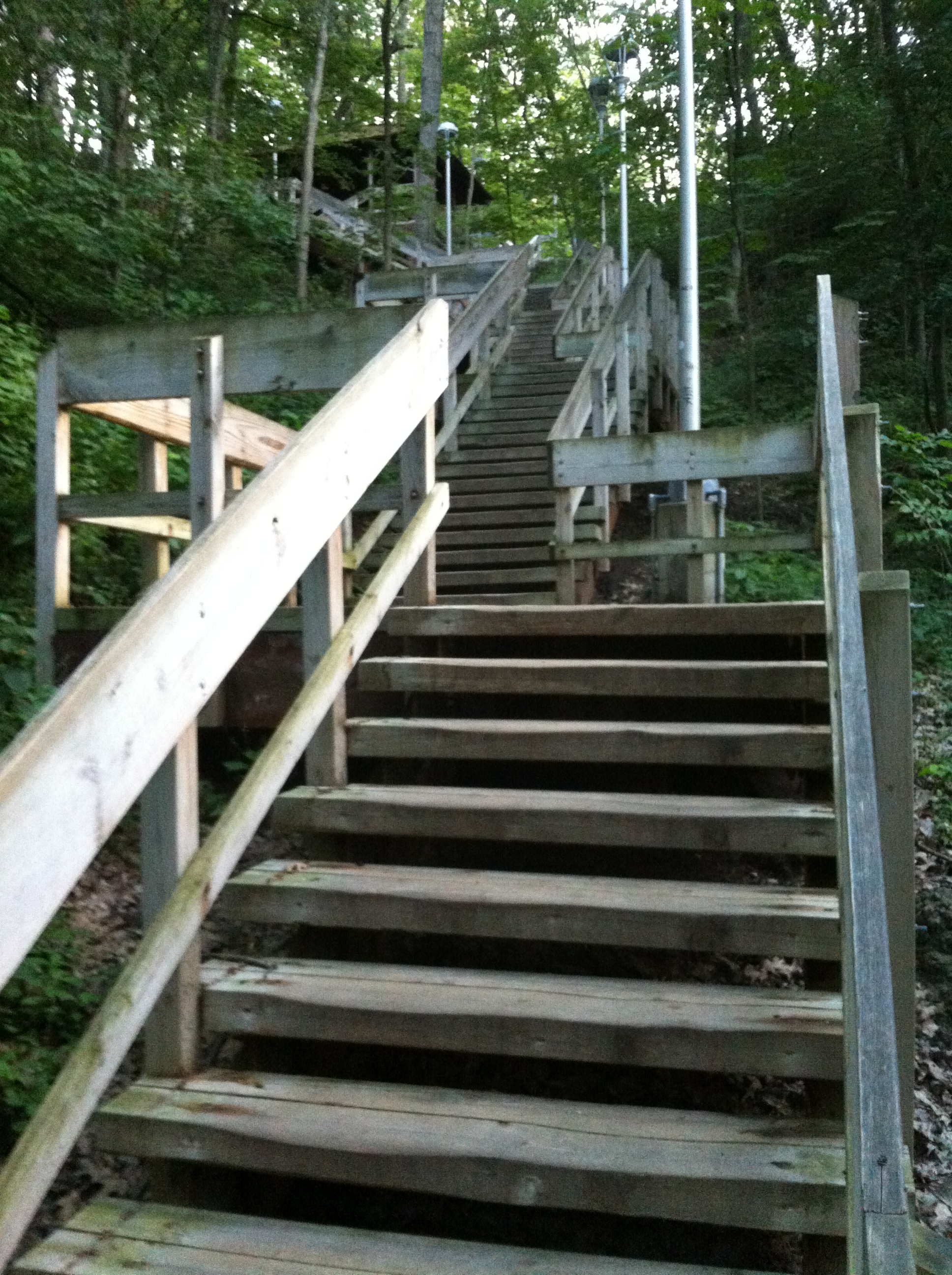 165 glorious stairs

Total time from start to finish for this workout.
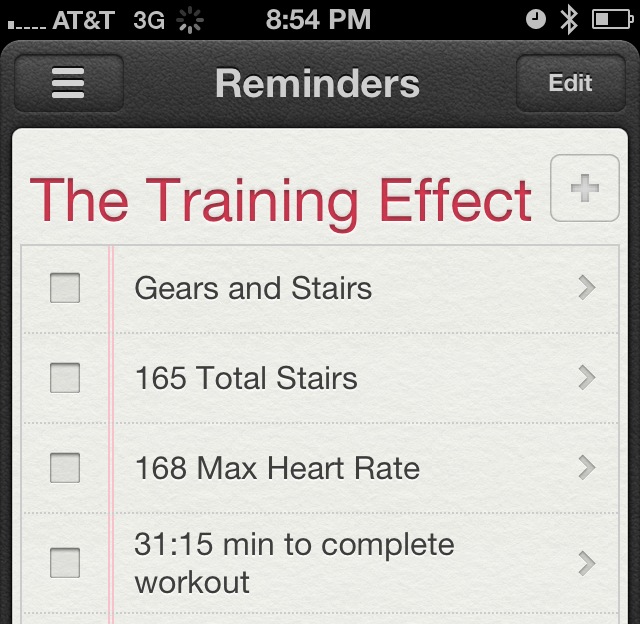
This is the break down of the workout. 30 minutes of work was my initial target. I hit that.
My heart rate peaked at 168bpm, which I thought was surprising. I thought that it would have been much higher. I’ve seen it 175bpm while running trails. Interesting. I suspect that had the staircase taken me longer to run, I may have seen higher heart rates.
I have to disclose that I probably whipped through 12-13 rounds. 2 of these round were loaded up with kettlebells. I brought my trusty 24kg LifeLine kettlebells with me for some fun carrying variations. After looking at the length of the staircase and evaluating what I wanted from the workout, I decided that I would only use one kettlebell for these carrying drill.
I worked overhead, racked position and farmer carries, switching hands using a single arm swing hand transition + KB clean + Press. I can explain this later, but I prefer using this method for switching hands during single kettlebell workouts. Always loaded this way.
The general structure of the workout look like this:
Men’s Health ran an article almost a year and a half ago that I thought I would share because they included a research study out of the British Journal of Sports Medicine which concluded that stair climbing was pretty bad ass, even at relatively low output (just walking up).
One interesting thing to think about here. Keep in mind that the speed with which you run the stairs is not the only quality we are aiming to build here.
We are also aiming to reduce the time it takes for you to recover, and repeat that effort. Faster recovery is a sign of improving conditioning.
If you’re a weekend athlete or a movement enthusiast, increasing your ability to recover quickly from multiple bouts of vigorous activity is beneficial for performance and your body composition.
Runners, I would consider this an amazing supplement to improving your running endeavors. You’re essentially lifting yourself with every stride while running a staircase, and focusing on explosive hip extension is what most of you could benefit from. Get the hips involved people.
Cheers to training where other people aren’t…
KG

[This blog post has ZERO pictures. Straight written word kids]
I’ve read a lot of books on health and wellness.
Nutrition, biomechanics, fat loss, athletic development, psychology of sport, anatomy and physiology, Orthopedic volumes and so many more.
I cruise through blogs that are maintained by some of the brightest and most innovative on the planet.
While I do feel that all of my reading has been for something, I also feel like at the end of the day… you’ve got to continue self-experimenting.
Some of the biggest names in the industry frown about self-experimentation, but I look at the concept as being no different from playing as kids. You live, you experience, you learn.
Obviously, don’t dabble around with something that could potential harm your life permanently, but don’t be afraid to… just… try stuff.
Try it. See if it fits in your program.
The truth is that almost anything that you do exertion-wise is going to move you closer to your goals, especially if those goals are aesthetically based goals.
If you want to trim down, create less of a shadow, decrease your pant size, drop lb.’s on the scale, flatten that stomach, develop some muscular definition…
You’ve got to make an effort to progressively move more and eat with a sense of urgency.
Exercise is simple. Start somewhere that fits your current strength and conditioning level and training know how, and begin climbing the staircase. Stop over thinking it, just put on foot in front of the other and climb. There are free resources all over the internet that can get you moving forward.
Progress yourself as quickly your body can tolerate over time. Keep progressing. The body is no different than the mind. Imagine if you would have stopped learning mathematics at addition and subtraction. Would you have understood Calculus? No, you wouldn’t have. You would have been lost like a puppy and miserable. You’ve got to progress and build up to learning Calculus, at least most of us did.
Trust me on one quick thing here… you’re going to reach a point in your progressions where it feels like you’ve reached the top, but believe me, you can bust through that barrier.
There is another gear that you can drop in to. Always another level of effort.
If you disagree with me, ask yourself if your body is holding you back, or if your MIND is holding you back. You might be surprised at what you find here. The mind is the command center of your universe… get it in check.
With eating, explore everything. I am serious with this suggestion.
Buy something, cook it and eat it. If you like the way it tasted, right down the recipe. If you didn’t, find a new one. Just because something doesn’t taste good the first time you try it, doesn’t mean that it will never taste good. Give food another chance. It’s not all vegetable’s fault that you don’t like eating it, it might be your desensitized palate.
If your diet primarily consists of processed foods, of course most veggies and fruits are going to taste like cardboard at first!
Everyone eats differently. What I like to eat, and can tolerate eating on a daily basis is not the same as what you can tolerate eating on a daily basis. This is just my guess.
If you don’t like boiled broccoli, sauté it. If you don’t like either of those options, throw it on the grill. If you still don’t like it, season it for heaven’s sake! I don’t even think that plain broccoli is that appetizing.
If you hate broccoli, stop complaining about how much you hate broccoli and eat something else. Find a substitute, an alternative. There are thousands of foods on the planet. Choose something else that provides a nutrient load that you body can use.
Seasoning can change a food, and to be quite honest, who cares if you add some salt to your food. Just don’t be a donkey and throw a pile of it on there. Be sensible in your approach, a pinch is more than enough. You season foods to enhance their flavor, not drown it out.
I’ve always wondered why people drown food in condiments. Why eat something if you have to bury it in so much ketchup, BBQ sauce or some other condiment on it to the point that you don’t even taste the meal? Not judging, just wondering why we do it.
Eating for performance is different from eating for aesthetics. This might be getting a bit too detailed, but when I was eating to sustain my athletic performance, I didn’t have the greatest physique. I was lean, but only because of my daily energy expenditure. When I finished my athletic career, I cut out a few foods that I was initially led to believe that I “needed”. Bread was one of them.
Thanks government created food pyramid for that load of B.S.
My abdominals popped through in less than 3 weeks. Ironically, my performance didn’t suffer a bit. I had no idea if this elimination would work, but it seemed logical. Pure trial and error here.
Actually it was more like trial and success.
One thing that gets beaten like a dead horse is the concept of avoiding trying to out train your diet.
I should stop telling you not to try this, and let you try it for yourself. Go ahead, workout like a maniac and eat whatever you please. See what happens. It’s an experiment right? So, go ahead and experiment with it. Challenge the thought. If you’re an Ironman, I don’t want to hear a word from any of you, because you’re about the only category of human that can make this work.
Experiment and experience.
Guys and gals are writing books, shooting DVD’s and maintaining blogs (just like this one) that preach a certain way of doing things in order to get results.
But how about this… learn a little something, enough to get you started, and begin carving out your own path. Nothing about fitness is the law. There are theories that I would prefer to follow, but if you break them, who cares!
The more you do something, despite your knowledge, know-how or skill level, the more you learn.
You develop knowledge that sticks because you experienced it. You didn’t read about it and do nothing, you experienced it first hand. You became an eye-witness to what works well for you and what doesn’t.
It’s important to break out of your shell… practicing and experiencing things. My suggestion, as I have learned in my own life, is to get out and practice as many things as you can. You’ll develop likes and dislikes, and you’ll carve your own path.
I tried not to get too specific with anything here. This is a thought process that applies to everything.
Trial and error, self-experimentation and experience are tremendously powerful methods for catapulting a person forward toward their goals. If you have the conviction and dedication to follow through over the long-term, you’ll find methods that are the best fit for you.
Just remember, the grass isn’t always greener on the other side. Trust yourself…
Cheers to trial and success!
KG

A few months ago, I wrote a post titled:
—> It’s Just a Kettlebell Swing Workout

That has been my most popular post on this blog, by far.
I wrote it because I wanted to convey how simple a workout can be, and probably should be for most people.
Totally stripped down. Nothing but a timer, a towel and water bottle, and a kettlebell of a decent weight. You could make the argument that a “totally stripped down” workout would only involve bodyweight exercises, but that’s beside the point.
A lot of people avoid physical activity because of two things:
Simple workouts are time effective and aim to limit anxiety. You look at the agenda for the workout and say to yourself, “Oh, I just have to focus on kettlebell swings today. I can do that”.
If you have a kettlebell or have the means to acquire a kettlebell for the future, I will ALWAYS encourage you to make the purchase. Don’t wait, don’t peruse, don’t over-analyze.
Just buy and be done with it. You won’t be sorry.
Well, I take that back, you could be sorry… if you buy it and fizzle out and using it. Then it’s just another heavy object holding a door open. What a shame that would be.
Anyways, I wanted to build on that post, because I felt that the workouts displayed were rock solid, and applicable to a large population of readers.
They are simple, yet brutally effective. I would consider them entry-level workouts, however, I have to admit that I continue to use the 15sec work/ 15sec rest (24 rounds) kettlebell swing protocol to this day.
The only difference is that I have climbed the ladder in weight. When I started with the protocol, I used a 20kg kettlebell from LifeLine Fitness. I then climbed to the 24kg kettlebell, then to the 28kg kettlebell and now on to the 32kg kettlebell. All were purchased from LifeLine Fitness also (yes, I promote these guys heavily, they make equipment worth buying).
Don’t be fooled by elaborate training protocols. Keep it simple and be detailed.
A simple workout/program executed to perfection will trump the world’s most complex/perfectly written program done poorly.
Stay in the “simple” zone, do it right.
That being said, I would like to say that kettlebells and suspension trainers are a match made in heavy. For roughly $300, you can outfit your home with a Jungle Gym XT and a nice variety of kettlebells ranging in weight.
The combination of a suspension trainer and kettlebells is magic.
Seriously, they are match made in heaven.
Let’s look at workout that I’ve employed over the years…

A workout like this is complete.
The kettlebell swings alone are enough to initiate a tremendous training stimulus, but when paired with the other movements, the workout is magic. Push, pull and ballistic movements for the upper and lower body are all represented here.
With high volume workouts, I typically choose simple rep schemes. It’s annoying trying to remember how many reps to complete in the middle of round, when you’re real focus should be on controlling your breathing and fatigue. Once you experience this frustration, you’ll wish that you would have picked simple rep schemes.
After completing each round, I would rest anywhere from 45-75 seconds depending on your conditioning level. Don’t be a hero and rest for 45sec in the first round if you can’t handle it. This decision may bite you in the ass in the later rounds when your fatigue levels spike.
Fatigue accumulates throughout the workout, just as it does for every workout. It’s inevitable that it’s coming, but timing it so that you complete quality work while you can is the idea here.
The number of rounds that you complete is depends on your ability to complete quality work (exercise technique, complete reps, etc). If your form breaks, you make the decision to rest before re-engaging, or you pull the plug on the workout altogether.
Safety first, always. Form good habits.
Put this workout in your back pocket for now, load it in the chamber when you need a challenging high tempo training session.
Cheers to ST’s, BW’s and KB’s!
KG
(PS: I turned on “Location Tagging” so that you’ll really believe that I reside in God’s Country… Eau Claire, WI)


There is a concept emerging from the behavioral/psychology scene that I predict is going to make it’s way into the health and wellness arena.
Happiness.
The pursuit of happiness over the pursuit of weight loss, fat loss, muscle, athletic prowess.
Because happiness is at the root of all of these things if you stop and think about it.
We all want to lose weight for different reasons, but when you boil it down, the foundational motivation to lose weight might be so that we can experience emotions of happiness.
Happiness is the fuel is at the root of nearly every action that we take in our lives, and when opportunities slip by, we tend to lose these feelings of happiness. We experience regret, discontent and guilt.
We feel bad, not happy.
Everyone wants to feel happy. Happy feels good.
I’m not a scientist and won’t pretend to be, but what if you shifted your thought process away from “I want to lose weight” to “I want to be happy”?
Would that change anything for you?
Maybe, maybe not. Not every method is effective for every person.
I think humans have a tendency to place focus on the wrong things at times, and I can certainly be lumped into this bunch. We develop tunnel vision toward something we want, like weight loss or money for example. But we don’t stop and think about our deeper reasoning for wanting it.
It seems like the moment that we uncover the real reasons for our pursuits might be the moment that we develop an unshakeable attitude and drive toward accomplishing that pursuit.
Cheers to being happy…
KG

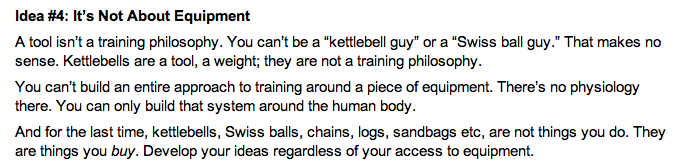
When I initially read Alwyn Cosgroves post (shown above) I immediately felt that it was too good not to share.
Once I established my training philosophy, I was set for life. I was set to teach others and also to execute for my own benefit.
It doesn’t matter what equipment is around, what I have access to or what I don’t have access to.
I can accomplish something even though I don’t have everything.
Sure, my ideas and preferences will evolve, but I think that much of what I believe makes a great program and workout is solidified. I am not sure (at this point) how it can get much better, without sacrificing certain things that I morally cannot consciously sacrifice. One of those being safety of myself, or the you guys.
I write about kettlebells and suspension trainers on this blog A LOT.
But it’s not for any other reason than I believe whole heartedly that the combination of kettlebells and suspension trainers make for insanely effective workouts, especially since they fit into my training philosophy so well.
Kettlebells provide loaded (resistance), ground based movements that are primarily (not all) completed in a vertical standing position. The bold print is a part of my training philosophy. I could substitute “kettlebells” for a whole host of other fitness equipment, and things would be just fine.
Movements like kettlebell swings and turkish get ups are world class for building a variety of qualities, at the same time.
Suspension trainers are an entire gym in a box, weighing in at less than 2lbs tops. Equipment-free bodyweight training is great, but suspension training makes it better. Suspension trainers allow for the leverage of a person’s bodyweight against gravity. My favorite benefit of the suspension trainer is the fact that you can PULL! Inverted rows (aka: body rows) and chin ups (supinated and neutral grip) are all made possible by two straps with handles.
Get rid of that shoddy kitchen chair set up that you’ve been using for so long…
But as stated in Alwyns commentary above, kettlebells and suspension trainers are just tools that I use to to implement my philosophy of what makes a great workout, program, etc. I am not exclusive to any piece of equipment. That’s not my style.
The fact is that most equipment works wonderfully.
It’s the user (aka: you) that has the opportunity to make the magic happen.
I know a lot of people that own a complete set of kettlebells and the best suspension trainer money can buy, but they don’t have a philosophy, or any sort of guidance on how to use it. In turn, they are stalemate in their efforts, or on to the next fashionably trendy workout tool.
For most people who are beyond their days of athletics, the total body approach to training is probably best. I know that there are upper body/lower body splits and a thousand other ways to organize your weekly training, but total body is effective in short windows of time.
Time is probably our most precious commodity. We can never get time back. Once a minute passes, that minute is gone. Same with days, weeks, and months. Time keeps moving forward at the same steady pace regardless if we want it to slow down or stand still.
That being said, leveraging a total body workout, using a smart philosophy to structure the workout is (in my personal opinion) the best approach for accomplishing goals of fat loss, building all around strength and many other athletic qualities using time management.
But, it must also be said that paying attention to your nutrition, specifically what you shove into your mouth and drink, is the most time effective way to stay lean.
My advice to all of you is this: Treat tools are tools, not philosophies.
Gravity decides what an object is going to weigh, humans decide how the object will be shaped, how the weight is distributed and to some degree how the tool should be used best. An example of how a tool should be used best is in fact, the kettlebell. You can swing a dumbbell, sure. But your first time swinging a kettlebell will lead you to believe that dumbbell shouldn’t be swung.
Kettlebells are the standout choice for swings and many other exercises.
But I can in fact swing a dumbbell. I can also perform a turkish get up with a dumbbell, or a sandbag, or a filled milk carton, or a loaded backpack, etc. It might not feel the greatest, but I can do it because it has weight and a handle to grip.
The tool is not the philosophy. It is an augment to the philosophy. A supplement to your training philosophy.
Again, I can perform a squat with any tool, or no tool. If I don’t have a two, it’s bilateral air squats or for an added loaded and challenge, it’s pistol squats.
Therefore, pay attention to more important aspects of your workout such as:
– Consistent progression of loading.
– Rest
– Time under tension
– Range of motion
– Sets/Reps
– Heart Rate
– Movement patterns
– Exercise progression
– Your goals, needs, abilities and dysfunction
-etc…
These are things that can you can use to imprint your own philosophy of how an effective training session or long-term program should be designed, regardless of what equipment you have or don’t have.
Very simple thought pattern yet often overlooked. Thanks Alwyn…
Cheers to philosophies and sticking to them…
Kyle

With all of the rage about WOD’s, WMD’s and DTF’s, whoops…
I thought that I would post a quote from one of Ido Portal’s YouTube videos. I love this guys philosophy on exploring movement. Referring to Ido as a jack of all trades wouldn’t be fair, because in modern society we often think of someone like this as being “sort of” good at everything, but a master of none.
Maybe I’ll start posting SWOD’s, “swing workout of the day”. Or BOD’s, “breakfast of the day”. Maybe TOD’s, “television of the day”.
But through watching his few YouTube videos and reading some written word from Ido, it seems that he has it all figured out. I like his approach.
P.S. I’m still unsure about the everted ankle jumping, but hey, I don’t need to agree with everything that everyone says.
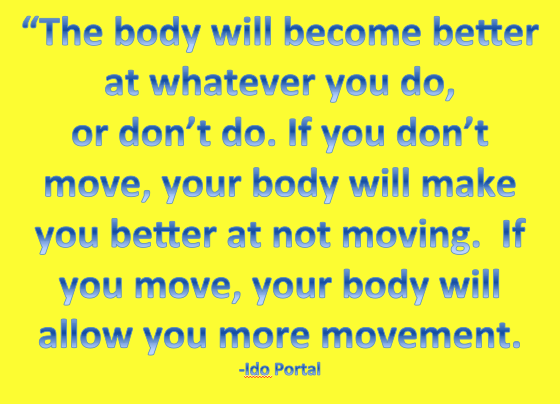
My personal feeling on this statement is quite simple…
Why subject yourself to proving this statement incorrect? When your ability to move is taken from you, what if you cannot get it back? Or worse?
Don’t bet the farm, keep moving people.
Cheers you moving because you can…
KG

 M(eaux)tion Fitness