I had to post this hilarious review from MMA fighter Forrest Griffin, who the video, proudly supports Kelly Starrett’s new book “How to Become a Supple Leopard“…
Enjoy…
KG
One paragraph blurbs that are straight to the point. Add these tips up, and you have yourself a pretty solid foundation for fat loss and getting lean.
I had to post this hilarious review from MMA fighter Forrest Griffin, who the video, proudly supports Kelly Starrett’s new book “How to Become a Supple Leopard“…
Enjoy…
KG

Yesterday, I caught a couple of clips of the segment that Kelly Starrett (creator of mobilitywod.com) led on The View.
Yes, that’s right, The View. I couldn’t be happier for the guy. He put out free content for 365 days straight before building an audience that allowed for a website makeover, fitness product launch and a subscription based service to his content. Awesome.
I have spoken highly of Kelly on this blog in the past, and my opinion has not changed. Some of his methods seem to cater to the extreme fitness seekers, but for the most part, I value a lot of his concepts. I think that he is a breath of fresh air in the fitness industry, and many of his ideas will stick.
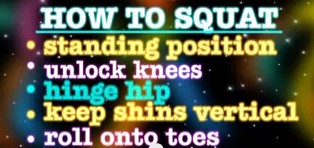
The picture above is a snapshot that I took during the segment.
I think that it is brilliant, and Kelly’s commentary during the segment was slightly more polished with less jargon than his famous YouTube videos are. It was funny watching the co-hosts attempt to follow Kelly’s lead and squat.
Forgive me, but I don’t know their names, but the male host was blabbing his mouth the entire time, essentially avoiding the squat drill. I like his fabricated joke about calling his gardener to tend to his garden instead of doing it himself… I bet the “audience applause” sign lit up like a Christmas tree on that one. If his writers didn’t set him up with that one, I bet he walked into the studio that morning bursting at the seems to crack that one-liner.
Real talk: In my experience, if a person will not participate in a movement sensitive drill on my asking, it is typically for a reason. No one wants to feel dumb, and that is never my intention of implementing the drill. When the person refuses to participate after verbal instruction and my visual demonstration, that is a red flag to me that they probably lack the movement capability to successfully complete the movement.
I would bet that Mr. Jokey cannot squat for shit.
The female co-host, Kelly I believe is her name, did her best. Hell, at least she participated. I found it ironic that she was wearing giant stilettos, which most of us know by now have wrecked females feet since their creation. Fixing the ankle joint in that static/plantar flexed position all day will strip you of your ankle mobility faster than you can imagine. Factor in that a lot of females wear heels for their careers and also out on the weekends, and that is a lot of poor ankle mobility we have on our hands.
Anyways, Kelly tried to squat and she maybe broke a depth that allowed for the backside of her thighs to reach parallel to the ground (which doesn’t mean that her femur bones reach that depth). At that point, she hunched and locked up.
For your viewing pleasure, here are the clips:
I also love that Kelly announced that sitting is the new smoking. I probably didn’t coin that term, but in my social circle, I have been saying it for years. I should get shirts made and a website set up.
Another important point in Kelly’s brief segment where he says that many of the orthopedic problems that people experience today can be prevented, by that person, on their own, at home.
Brilliant.
We can take care of ourselves, we just need to take the time to seek out good information and then execute that information and make change.
How to you know what classifies “good information”? Let me guide you here folks… I will continue to post links on this blog to resources that I truly value while giving my take on things, and hopefully you can find some value in all of it.
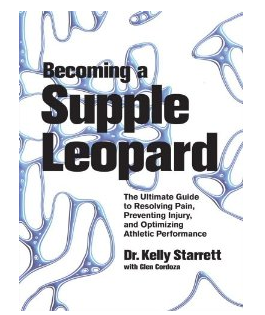
Here is the first resource of value… buy his book:
Cheers to doing your own gardening and supple leopards!
KG


Photo Credit: stressfreekids.com
I love the television show “Shark Tank”.
I love everything about it.
Here is how it works:
1) The entrepreneur enters the “shark tank” (a room to present to five different successful millionaires) seeking to gain valuable business partners and investment capital for their business.
2) The entrepreneur makes their product/idea pitch.
3) Post-pitch, the sharks give feedback and ask questions about the business/idea.
4) The Sharks decide whether the idea is valuable enough to earn them profit on their investment.
I am absolute fascinated by people who find their calling and begin creating and designing gadgets, apps or services that can solve everyday problems, improve old products or pave the way for a new way of doing things. I have such a respect for an entrepreneur that can sacrifice everything for their passion, refusing to give up through thick and thin. It takes amazing courage to build a dream from scratch and see it through to the end.
Many of these people have given everything to pursue the American dream.
That’s passion.
Another aspect of Shark Tank that I love is the negotiations. Sure, the pitches that introduce the entrepreneur’s idea to the Sharks (who are millionaire/billionaire investors themselves) are great, but the negotiations after all of the glitz and glamour is what I get sucked into.
The questions from the Sharks are direct and typically no non-sense. The Sharks want to know if the investment opportunity has gotten results in the past and what the plan is to grow on those results (the forecast). The entrepreneurs that do the best on the show tend to answer the questions with sharp, crisp and clear answers. They have a plan and they have results to show positive growth and execution of that plan.
Those who respond with wishy washy answers get crucified on national television.
You’re probably wondering why I am talking about the Shark Tank on a active/fitness related blog…
… and to that I say: settle down and let me get there. It might be choppy.
Here is an un-organized collection of my thoughts that I had earlier today…
As I briefly touched on above, shortly after the entrepreneur shares their product or idea, the Sharks take their gloves off and begin poking and prodding into exactly what they- the entrepreneurs- need (money and connections to influential networks), why they need it, what they will do with it when they get it, and most importantly, their past efforts and the results of those efforts.
I have seen countless entrepreneurs lose out on investments by the Sharks just because they didn’t have results (sales/income/revenue) from their product or idea. Maybe the product is being treated too much like a hobby, or maybe the entrepreneur has got some serious flaws and gaps in their business and how they have been going about growing it and scaling it.
Either way, the Sharks always crack me up because they can sniff out flaws in a matter of minutes, and a few simple questions. The numbers add up. The numbers make the flaws glaringly obvious.
What have I learned from Shark Tank is the difference between an entrepreneur who is rejected out of the board room and an entrepreneur who makes a deal, and acquires one of the Sharks as a business partner…
Results matter.
If the entrepreneur hasn’t sold jack-squat in years, the reception of their product/idea pitch is typically lauded at.
In the fitness world, I hear and read a lot of people talking about how “results based” fitness is a scam.
Really? How?
How is getting the results that you seek a scam?
How is stripping fat, running your first 5k, followed by your first 10k, followed by your first half-marathon, restoring function and posture, etc… a scam?
We measure success in anything based on results.
I can see how getting the results that you seek at the expensive of bodily harm might be a scam, but I would call that recklessness, absent minded or possibly neglect.
There is plenty of that going around for sure.
If you set out on a journey to build a body (and I don’t mean stage show bodybuilding) and you are getting great results… Why would you change anything that you are doing until you observe that change is necessary? Don’t stay in your comfort bubble forever, but stick to the plan if it is working for heavens sake.
Again, you have to be getting results to maintain your same course of action.
If you’re a person that is interpreting this as pass to continue the same ineffective workout habits that incorporate the same weight for the same amount of time for the same days per week…
… you are mis-understanding what I am trying to say, and maybe it’s an error in my ability to communicate effectively.
I wrote an article a while back where I described a 90 day kettlebell complex training program where I basically leveraged the same kettlebells (24kg Lifeline KB’s) for a full three months, making gains the entire time. If you read back into some of my older posts, you’ll find that I love acting as the guinea pig.
I will always try something on myself before I ever recommend anyone else to do it. Not everyone can say that. I am willing to put myself through the gauntlet prior to suggesting someone else try it. I take pride in that. That’s how I formulate my opinions on certain things, one of those being some aspects of Cross-Fit.
That being said, I always caution everyone that what I do while training is not always a good fit for what they should be doing, and what their colleagues are doing in the gym might also not be what they should be doing. Do what you can do, not your what your network can do or the random fit guy at the gym can do. You’re not him, you’re you.
Sidenote: I actually know a cosmetic surgeon in town locally who tries all of her techniques on herself first, prior to offering it out to her paying customers. How bad ass is that? She puts herself through the gauntlet before bragging about it to her customers just to make a buck.
I have a deep respect for that. This surgeon’s face is constantly puffy and inflamed from all of the new treatments, but hey, at least she can say that it works or it doesn’t, which makes her far more credible to the patients who come to her for solutions. Again, I love that.
Back to it…
During the 90 days of kettlebell complex glory, I leveraged the same general movements while I continued to tweak the reps, time under tension, sets, recovery time, etc.
My results graph was steadily climbing in a positive direction , so why would I alter anything.
I know that staying in the vortex of the same workout for 90 days might sound crazy, and I definitely could have bumped up weights during that time, but I couldn’t resist giving it a go.
What is the worst that would happen? Maybe I would simply flat line and maintain my current fitness and body composition levels? So what? I was lean going in and the experiment wasn’t going to make me less lean or less strong.
Tweaking the variables can really take a program a great distance, and I think manipulating the variables of exercise is far less scientific than most people think. Often, the point of improving your body, both performance and aesthetically, is to simply add or subtract. Add weight, add time under tension, add reps… or… subtract rest period time, subtract volume, subtract paralysis by analysis.
The last subtraction point is a huge hold up for most people’s results. What are you waiting for? The next big study? We lean on studies and research like crutches. It drives me nuts. It’s like we can’t take action until we can justify it with a massive study. That my friends, is an excuse in disguise. You can call it being educated and precise, but in my world, someone who doesn’t take action and bases it on lack of research is an excuse maker.
Trust me, you don’t need a landmark study to justify swapping an hour of TV time for a decent sweat. And if you’re a person that wishes that you could shrink down, swap fat for muscle and become more athletic, then your results are sitting on the couch right next to you.
Exercise + eating properly + H20 hydration = Authentic Health.
It’s that simple. Screw complexity. Follow the above formula for four weeks without falling off the wagon and see what happens. You won’t be disappointed that is for sure.
Results require action, and the right kind of action. On Shark Tank, the interesting part about some of the products/ideas (and the people that are behind them) is that they aren’t bad products/ideas and the business owners are putting in massive amounts of effort and time. The business plan/strategy is just plain wrong.
In these situations the Sharks have the jam to call these people out when they have sold less than $10,000 in 4 consecutive years of being in business. That’s a red flag that something isn’t right.
Then you’ll get people that have sold $10,000 in their first month after launch, and they just don’t have the capital to take things to the next level. Very interesting to see those situations.
Sidenote: In the case of building fitness, you don’t need capital. That’s the beauty of it. You can honestly get amazing results by buckling down and doing the work with your own bodyweight. Heck, if you’re on a tight budget, I will even recommend going for a run.
Running isn’t all that bad really, we sort of blow that out of proportion, just don’t expect to build much muscle by running. Many times, running along with other long duration represents the entrepreneur who is willing to put forth the effort and time for their results, yet always ends up disappointed because they are operating off of the wrong business plan.
Is that you? I bet that statement connects with some of you out there… no doubt about that.
If you’re just starting to get serious about being purposefully active and building your fitness… and you’ve got decent mobility and stability where you need it while being proficient with the lifts, you are probably good to go. In fact, you’re more than good to go. Start with a simple strategy and build out from there. Once you lay a solid foundation, the rest of the house can be built over time without crumbling.
For example, building strength is simple, it really is. It isn’t always the most comfortable process and it takes effort to continue added weight over time, but it is simple. Building cardiovascular endurance is simple. It isn’t always enjoyable to shave time off of your efforts, but it is simple.
Sidenote: Exercise professionals often overreact and preach about the details a little too much for my liking (I am guilty of this). Sometimes I feel like it might be because they are dry on content or looking to stir up the pot somehow. I love attention to detail as much as anyone, but it gets old after a while.
Segue…
So as the Sharks on Shark Tank seek investment opportunities that have seen results in acceptable periods of time, so should the person who seeks fitness. Results are damn important. If you aren’t seeing results, something is not right with your plan. Your strategy isn’t working for you.
People who are fit despite busy careers and family, while working in a much needed social life also, have effective plans.
Go back to the drawing board, analyze your strategies and get back to it.
But remember, results matter.
Cheers to results and The Shark Tank!
KG
(Sorry for being away for so long)

I wanted to share this email that I received today.
As much as this is a blog heavily directed at movement and lifestyle shifts, it is also about sharing what others have to say. I value speaking with the older generation. They have so much to teach us, and we have so much to learn from them. My advice is to take the time to sit down and experience how great our elders are… they have maneuvered through this beautiful struggle that we call life, and chances are good that they might have a pearl or two to share with you.
The times are much faster paced now, but the principles of a life fulfilled never seem to change.
I hope you enjoy reading through this as much as I did…
-KG

—> Written by Regina Brett, 90 years old, of the Plain Dealer, Cleveland, Ohio .
“To celebrate growing older, I once wrote the 45 lessons life taught me. It is the most requested column I’ve ever written.
My odometer rolled over to 90 in August, so here is the column once more:
1. Life isn’t fair, but it’s still good.
2. When in doubt, just take the next small step.
3. Life is too short – enjoy it.
4. Your job won’t take care of you when you are sick. Your friends and family will.
5. Pay off your credit cards every month.
6. You don’t have to win every argument. Stay true to yourself.
7 Cry with someone. It’s more healing than crying alone.
8. It’s OK to get angry with God. He can take it.
9. Save for retirement starting with your first paycheck.
10. When it comes to chocolate, resistance is futile.
11. Make peace with your past so it won’t screw up the present.
12. It’s OK to let your children see you cry.
13. Don’t compare your life to others. You have no idea what their journey is all about.
14. If a relationship has to be a secret, you shouldn’t be in it.
15. Everything can change in the blink of an eye, but don’t worry, God never blinks.
16.. Take a deep breath. It calms the mind.
17. Get rid of anything that isn’t useful. Clutter weighs you down in many ways.
18. Whatever doesn’t kill you really does make you stronger.
19.. It’s never too late to be happy. But it’s all up to you and no one else.
20. When it comes to going after what you love in life, don’t take no for an answer.
21. Burn the candles, use the nice sheets, wear the fancy lingerie. Don’t save it for a special occasion. Today is special.
22. Over prepare, then go with the flow.
23. Be eccentric now. Don’t wait for old age to wear purple.
24. The most important sex organ is the brain.
25. No one is in charge of your happiness but you.
26. Frame every so-called disaster with these words ‘In five years, will this matter?’
27. Always choose life.
28. Forgive.
29. What other people think of you is none of your business.
30. Time heals almost everything. Give time time.
31. However good or bad a situation is, it will change.
32. Don’t take yourself so seriously. No one else does.
33. Believe in miracles.
34. God loves you because of who God is, not because of anything you did or didn’t do.
35. Don’t audit life. Show up and make the most of it now.
36. Growing old beats the alternative of dying young.
37. Your children get only one childhood.
38. All that truly matters in the end is that you loved.
39. Get outside every day. Miracles are waiting everywhere.
40. If we all threw our problems in a pile and saw everyone else’s, we’d grab our’s back.
41. Envy is a waste of time. Accept what you already have, not what you need
42. The best is yet to come…
43. No matter how you feel, get up, dress up and show up.
44. Yield.
45. Life isn’t tied with a bow, but it’s still a gift.”


Finding time and space to workout while on the road can a real nightmare.
For those of you who travel often for your career, you undoubtedly know exactly what I am talking about.
It’s a constant challenge to find the motivation and the square footage.
Nothing is ever ideal while traveling, and maintaining positive progress is difficult. It’s a real shame that it has to be this way, because so many of us travel frequently.
Not every hotel has made a conscious effort to provide its customers with adequate fitness equipment. It’s disturbing to think about, especially since the active approach to life is gaining momentum.
For those hotels that currently have (and always have) provided paying customers with quality/spacious amenities like well equipped fitness rooms… I would like to say… thank you.
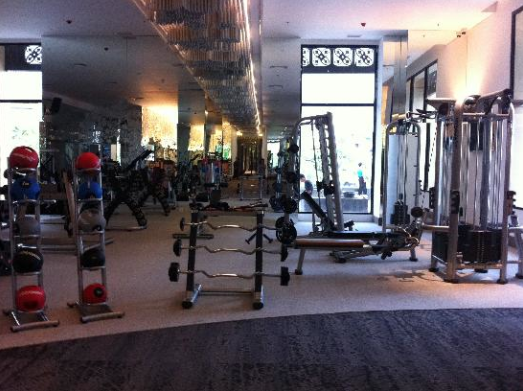
Few and far between…
Thank you for taking the time to appreciate that not everyone who travels wants to sit in the hotel bar and waste away all night. I’m not saying that I don’t enjoy a beer or two to come down after a long day of travel, but it’s typically not the first on my priority list.

We’ve all been there…
Traveling is the definition of being force to be lethargic. When we travel, we are crammed in narrow/uncomfortable seats on an airplane or stuck behind the wheel of a car. We are forced in a static position that smashes our asses flat like pancakes and reeks havoc on our hips, lower backs and necks. Maintaining this sitting posture can deeply effective our overall posture which is not a good things.
We develop knots, muscles firing out of whack or not firing at all, stiff and immobile joints along with a decrease in our overall energy levels. Sitting makes the best of us lethargic. It sucks.
Personally, when I arrive to hotel, I typically snap out of it and realize that I am not tired or groggy, but I am desensitized from lack of movement for hours on end.
The traveling businessman or businesswoman understands this feeling, I have no doubt.
Sometimes we just want to hop on the treadmill (yes I said the treadmill) and log a few miles with the headphones in, do some squats, push ups, pull ups, presses and unwind the damage caused from long days of travel. It feels good to open up the lungs and get a good sweat in after being confined in the jail that we refer to as airports.
One of the reasons that I push so hard for people to purchase suspension trainers is because a suspension trainer allows you to take your strength training anywhere. The resistance based moves that you’re able to perform with a suspension trainer might be sub-maximal and far from the weight that you’re capable of lifting, but at the very least you can execute one hell of a workout that will get your blood pumping, aid in maintaining strength and offset the detrimental effects that traveling posture can have.
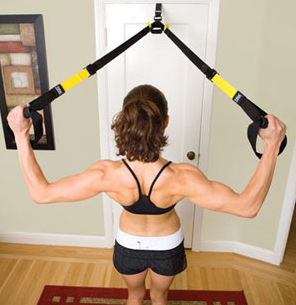
Just hook your trainer to your door and get after it. It’s that simple.
Fire up your iPhone with Pandora, Spotify or music from your iTunes library and you’ve brought your home gym with you.
If you’ve got room, you can add a jump rope and a timer of some kind and now you’ve just set up a quality gym… all from the comfort of your hotel room.
The portability (is this a word?) of suspension trainers and jump ropes is a major turn on for active folks. It’s fitness without bulk.
You can pack a suspension trainer, jump rope and timer in a bag not much larger than a quart sized zip loc. Seriously. These items pack like a charm and really provide the most benefit in situations where the equipment is not ideal. I rarely travel without packing my suspension trainer and jump rope. Even if I don’t end up using it, I know that it is in my bag if I need it. That’s a good feeling for someone who places priority on staying active no matter what. If it’s important, you should do it every single day.
You can’t put a price on that… well actually you can… because a suspension trainer is about $99 and a quality jump rope shouldn’t cost more than about $10-15 reasonably.
So for less than $115, you can have a fully functioning gym that you can take anywhere in the world and get a kick ass training session in.
Bad ass I’d say.
I have worked out in hotel rooms more times that I can count. While it may be unpopular with your roommates and neighbors, I can honestly say that I have never regretted getting a workout in while on the road… and that just might be the point. Rarely do people ever regret how they feel after getting a simple and effective training session in. Can you remember the last time that you regretted getting a sweat and opening up the lungs? Probably not, we almost always feel better post-workout.
Be willing to adapt. Training at home, everything is ideal. You have what you need tool-wise and you’re neatly situated in your comfort zone. On the road, it is almost always the opposite. Space is tight, equipment is foreign and motivation is lacking. It’s important to be able to adapt to your environment. Your body will seriously thank you for making the effort. The proof of your efforts will be visible to onlookers, I guarantee it.
The Wrap Up…
So if you’re a hotel (or hotel chain) that has taken the time to supply a fitness room that has properly functioning equipment… thank you.
Sincerely, thank you.
We travelers aren’t asking for much. Just a simple space to take care of our bodies physically. We enjoy being active, and just because we are away from home, doesn’t mean that we don’t give a shit about our health. Sure, it might be a vacation and we are staying in your hotel to relax and have fun, but please realize that an increasing number of us really do want to stay active whole host of reasons that differ from person to person.
It’s become a part of our lifestyles, fully integrated into our lives just like showering or eating breakfast.
Hotels, thank you for recognizing this. And if not, thank you for making the hotel door solid enough, and the lock with such quality that we are able to hang our suspension trainers from them and really get after it when you forget to include fitness rooms on your premises. We appreciate that too…
Sorry for ruining your doors.
Cheers to keeping up with your movement while on the traveling…
KG

What follows is a “flip side” discussion my recent post: The Brilliance of CrossFit.
Crossfit is big business right now. It’s tough to page through a fitness magazine or online fitness resource without coming across something pertaining to Crossfit. It’s becoming big business, attracting a lot of clients and opening gyms in new locations at a feverish pace.
But with all of the buzz about Crossfit, I have to admit that there are things that I admire about it, and things that I flat-out disagree with. Part of my ongoing personal development as a writer is to avoid letting my emotions take control of the keyboard. Just because I am sitting behind the computer screen doesn’t mean that I should hide behind it.
What I believe to be best right now is what I believe to be best right now… not what I will believe in five years or even five weeks. So before you think that this post is pure hatred toward the fitness giant we all know as Crossfit, please take the time to visit the link provided in the first sentence of this post.
Here. We. Go.
It wasn’t that long ago that mixing handstands and rowing into a training session was a novel idea for me. I didn’t fully grasp it, but it looked cool. I had just start poking my nose deeper into the rabbit hole of fitness, and had decided that I wanted to go deeper. It was pure curiosity. Coming out of college, I knew the basics of physical development but not nearly enough to take a stance for one method or another. It’s like politics, you’ve got to spend some time learning about what each party stands for and then decide what you stand for (or vice versa).
I’ll admit it, I was a traditionalist with fitness at that point. I was primarily familiar with straight bars, dumbbell work and occasionally throwing in some cable movements. The idea was that you should lift some weight, rest, towel off, change the track on your iPOD, set up, lift again. Rinse and repeat. This was my idea of how we were to build fitness.
My education in fitness and nutrition consisted of what was being taught in the University Kinesiology program, which was “ok” I suppose. Once I left school for the real world, I soon figured out that the teachings in college were great for building a foundational base of knowledge, but they were holding on to methods of the past.
Standard protocols. Ancient protocols. I think that the program was timid to move off the grid and explore concepts like movement screening, functional strength training and more effective methods for developing cardiovascular performance. My education in effective plyometric training consisted of bunny hops on a rubber mat that had colored dots.
Like I said, it was pretty basic, and outdated.
The first major book of impact came when it was recommended that I read work from Mike Boyle (Functional Training for Sports) and Mark Verstegen’s landmark work (Core Performance). These two books, among a whole bunch of other works, changed the landscape of how I approached training athletes, Mom’s and Dad’s, working professionals of all ages, kids, etc. Heck, it changed the way that I approached building physical fitness myself.
It wasn’t all for good. Some of it, yes. All of it, no.
I got caught up in that world also. The world of strength coaches. Sucked in. I share this with you because I have become aware that my significance and purpose to my reading audience has got to be one that avoids harsh negativity toward methods. If you dive deep enough into the archives of this blog, you’ll find some aggressive lash outs. I won’t remove them, because I would like readers to see my progression as a writer.
It’s important to realize that we are all human, and as humans we have the right to change our tune. Especially if it moves you closer to your Right Mind. Right mind is something worth pursuing in my opinion.
While I may not believe in everything, I can certainly discuss methods that I express caution to in such a way that will allow you to formulate your own opinions. Because at the end of the day, you shouldn’t join a Cross-Fit gym because I tell you too, or avoid a Cross-Fit gym because I tell you to. Crossfit is not the saviour to mankind, nor is it the modern-day Black Plague of fitness.
My hope is that I can provide simple information about a few topics that can serve to help guide your decision-making one way or the other.
Hopefully, the path that you choose is one that serves you best, you thoroughly enjoy and will last a lifetime.
—> The Cautions of Cross-Fit
Far and wide, tiny little gyms that are commonly referred to as “boxes” are popping up like dandelions in Summer.
If you’ve got a valid credit card and a weekend to learn a few simple ideas on physical fitness, you… yes YOU could own one of these “boxes” almost overnight. Talk about a career transition! I know that the growth of CrossFit is seeing “box” owners rake in income hand over fist.
In my recent post, The Brilliance of Cross-Fit, I touched on a few key points that I really do admire about CrossFit and the community that it has built. At the end of the day, it’s all about getting people moving and they are doing that in their own way.
Getting people off of the couch and out of their downward spiraling daily routine is a tough task. Breaking habit and routine and then reforming improved habits and routine can be quite a challenge. I come face to face with it frequently when writing.
Getting folks excited about being active and maintaining that activity level over the span of a lifetime should be a foundational goal of anyone who gives a rip about the health crisis of our nation.
Less lethargic humans would change a lot of things for the better.
Here come my cautionary words…
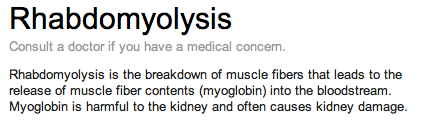
But I do have my cautions about Cross-Fit, even 7-8 years after I first came across a their website on the internet. At the time, I didn’t know what the heck CrossFit was, so I can’t say that I took the time to learn much about it. The website was pretty raw, with a few videos here and there, and workouts posted about doing hand stands, rowing, etc. There was a significant amount of bragging about puking during workouts and “battle” injuries during METCON’s, and even a few badges of honor sent out to individuals who sent themselves to the hospital from accumulated fatigue which led to something called Rhabdomyolysis.
Please click on the link above and read what Rhabdomyolysis is. Or if you want the summarized version, see the snapshot below:
Here’s a t-shirt print that is handed out (still to this day if I’m not mistaken) to “hardcore” Crossfitter’s who “earn” it:

Photo credit: Crossfit Southbay
The general theme of Crossfit in the early days, which a lot of people don’t know about now, was this idea that if you worked out and you failed to torch yourself, feel dizzy and fall over from exhaustion, then you weren’t working hard enough. It was disturbing to say the least.
Now put yourself in my shoes. Imagine the first impression that you’d receive from reading something like that? They say that first impressions are everything, and well, my views on Crossfit were tarnished before I ever made it to the methodology behind its existence.
It flew in the face of my beliefs, about the responsibility that personal trainers and strength coaches have with taking care of their clients. Clients were handing us their hard-earned money with the thought that they were going to be taught/instructed/coached, reshaped and taken care of in a responsible manner. What I initially saw from Crossfit, were a bunch of randomized workouts thrown together with the sole intent of burning out a client.
They were leveraging the idea that so many people have with fitness… that soreness, fatigue to the point of exhaustion and “extreme” is how the best bodies are built.
Soon after, it became obvious that Crossfit was tugging on the heart-strings of the military. The hardcore and “extreme” training attitude was appealing to this sector. I’ve never had to fight in war or been stationed in a war zone, but I know many who have. It’s a hard knock existence in these environments. It’s hardcore, especially when compared to most of us watching our favorite sitcom on Sunday night with a bowl of popcorn. The soldier is praying to endure the extreme physical demands and mental emotions (not to mention gunfire and explosives) long enough to see their loved ones again.
That is hardcore in my world, and that is partly the appeal of Crossfit to individuals who have been in those situations. At least that is how I see it.
*** First let me say that I fully support and value anyone who has served our country. We owe you everything for the freedoms that we enjoy daily, so don’t let this piece of this post rub you the wrong way.
What follows are topics and brief points about those topics which I always caution people of when considering Crossfit.
Olympic lifting for cardio.
This is the first thought that crosses my mind when people ask me what I “think” about Crossfit. I cannot support olympic lifting as a vehicle to develop work capacity or cardiovascular resilience. I have read a few of their articles on their site where they attempt to make the justification for such practices, but to me, I feel like I am trying to be convinced (or “sold”) on the idea every time I read it. The articles lack support and quite honestly seem like a bunch of jargonistic (is that a word?) paragraphs that few people will ever really understand, but these people back it up because it seems like a brilliant reasoning for using olympic lifts to create a work capacity training effect.
Olympic lifting is highly technical. A few of the lifts are in the Olympics themselves. Athletes train for YEARS to perfect their form, timing, mobility, stability, etc… in hopes of winning a gold medal at the highest level of sport competition.
Now, take a 35-year-old de-conditioned working professional who sits all day and can hardly run 1-2 miles without feeling faint. Ask them to clean a barbell (of a standard protocol weight) for 30+ repetitions. Tack on 50 box jumps (maybe 50 pull ups) and return to that barbell for 30+ more hang cleans and you’re putting that person at risk for a MASSIVE injury.
In my experience, fatigue while under load (along with asymmetries and muscular timing/firing) is the greatest predictor of an injury. When a person gets tired, technique and form go out the window in an effort to maintain output.
Humans are survivalist at heart. Our bodies will continue to push through physical adversity through any means possible, even if that means that we are moving weight with the wrong muscles and mechanics. Especially if the mind is conditioned to withstand physical stress. I am telling you, when you mix fatigue with weight and poor technique, whether you are aware of it while it is happening or not, you are dangerously close to the bomb going off (injury).
And trust me, it will only take one massive blow out of a shoulder, back, knee, ankle or hip to understand the point that I am attempting to make. We fail to realize that these injuries are lifelong injuries. We aren’t Adrian Peterson. We won’t blow out our lower back and be the same afterwards. We won’t tear our rotator cuff moving weight overhead or jerking our body around on a the 30th rep of a set of kipping pull-ups and return to action without being constantly reminded (via chronic pain, poor performance or range of motion) that it happened in the first place.
At this point, I also don’t buy two other arguments for these practices:
1) High rep olympic lifting is primarily performed using sub maximal weight.
2) It’s an evolution in fitness.
Response to #1: It doesn’t matter to me. It still goes back to poor technique when tired. You can’t even make a legitimate excuse for high rep olympic lifting to have great carry over into every day activities. When was the last time you had to clean a common daily object 30+ times in a day. How about in a week? Month? Year? Lifetime? When you’re not in the gym, you rarely clean anything. I watched a Crossfit video some years back where they were making the point that if you can clean a barbell, you can clean a log, a rock, a sack of potatoes… and on and on. They have tools that helps us do these things. If you can’t find a tool to move pick something from a resting floor position to a standing carrying position, just simply ask someone who is stronger than you. If you don’t know anyone that is strong enough to move the object, use your common sense and get a tool.
Response to #2: Many are preaching this, but I will say this. We thought that Nautilus machines were a godsend until some smart folks realized that trapping your joints into a machine’s fixed range of motion was not healthy for your joints. It wasn’t natural in the least bit and actually shutting down valuable stabilizing muscles in the process. Now most machines are rendered useless. We also thought the earth was flat at one point. I could say that brushing your teeth with motor oil is an evolution for whitening and cavity prevention.
There will be many evolutions in fitness. It is a constantly evolving industry. Much of the evolutions we see in fitness are efforts to attract business and revenue while selling new products. Very few ideas or products ever stick for the long-term. They come and go. I can’t say that using olympic lifting for a work capacity training effect is going to extinguish itself any time soon (I am not a fortune teller), but you should know that it is an “evolution” that the jury is still out on. It’s more like a small shift with a select group of people.
Kipping pull-ups.
I recently slowed down and analyzed the motion of a kipping pull-up from a Crossfitter who I was told is a “beast”. I attempted to replicate this motion without kipping, but instead receiving what I believe is an adequate amount of assistance from a jump stretch band. I pulled the band down around my feet and performed strict pull-ups. All of the way up, pause, all of the way down, pause. The assistance made me feel like a hero. I could have down 20+ this way no problem.
In the kipping pull-up, the momentum of the leg kick transfers force up through the body to the arms where only a slight pull is needed to finish the movement. Nothing like a strict pull-up. I actually see a variation of a cheating inverted row during the kipping pull-up, pictured below…

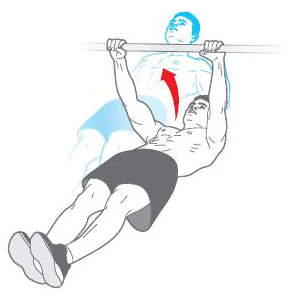
Inverted row… looks similar to kipping pull-ups doesn’t it?
Kicking the legs forward for a body whip-lash makes pull-ups easier. Some people would say that it’s cheating. I would agree. I do see a technique to it, but again, the problem is that most people have awful technique and the stress that is being placed on the shoulder region with poor form has to cause some damage over time. Crossfit, in my experience with talking to clients who are regular attendees, rarely assesses their clients for past injuries or movement restrictions. If you put a person on a pull-up bar that walked into the Crossfit gym with slight shoulder dysfunction, past injuries or poor mobility in surround joints that will affect shoulder range of motion and stability… boom goes the dynamite.
A person very close to me experienced a re-tear of an old biceps injury because he was instructed to rip out some kipping pull-ups. Total disregard for the past injury. Now this gentleman is back in the same boat that he was in when he initially tore his biceps. You could make the argument that it wasn’t kipping pull-ups that are at fault here, and I would largely say that it is the neglect of the owner of the gym, but for giggles, I blame both.
Now I also understand that my friend with the biceps tear could have easily gone a non-affiliated Crossfit gym and experience the same injury. I am aware of that. No reminders needed.
No ramp up.
If you’re de-conditioned or new to Crossfit style workouts, you’ve got to prepare yourself. There is no ramp up for a new person. There is a set protocol of lifts and workouts that are performed (with variations from gym to gym) regardless of your fitness level. If you haven’t jumped in the past year, it doesn’t matter because baby… you’re going to be jumping for reps on boxes today. And probably to a box that is too high, causing poor landing mechanics and increased stress to your joints when you’re asked to repeat that jump for high reps as fast as possible. The impact forces during jumping, and particularly landing are extremely high.
There is also very little ramp up for the intensity of the WOD’s (as they are referred). Sure, some gyms conduct baseline tests for your ability to perform a circuit of movements in a set amount of time, row a distance for time or run a distance for time, but to start someone on a work capacity based workout is too much. Especially when the lifts incorporated are loaded movement like cleans, squats, overhead presses, snatches and pull-ups. You can argue with me that a pull-up is a bodyweight movement just like a squat, but I will argue with you that they are nothing alike.
Perform a bodyweight squat. Now perform a pull-up. Seriously, go and do it, because it will help make my point here. Which one did you successfully complete with ease and good form? Probably the squat. Most people cannot perform a smooth rep of a pull-up. The legs are the dominant extremities of our bodies and they should be since we rely on them for daily movement.
Asking a de-conditioned client to flail around on the pull-up bar and referring their flopping action as “pull-ups”, is bogus.
I guess the summarized version of my point is that while some Crossfitters have outstanding technique during these WOD’s, the rest of the folks are just engaging in a mess of poorly performed exercises to induce sweat and fatigue, referring to it “forging”.
Battle scars.
I alluded to my dislike for how Crossfit projects injury while pursuing fitness. I have heard multiple Kool-Aid drinkers express in videos that “shit happens when you train hard like we do”.
It does? Or does it just happen to you because of the choices that you are making? Does it have to happen to the 40-year-old Mom with two young children? What about the 50-year-old mailman?
Primum non nocere… First do no harm. That’s one of the primary teachings of the Hippocratic Oath, which covers basic medical ethics that all medical students are taught in medical school, around the world.
Cutting some skin on the plyometric box happens. It happen to me and some of my clients/athletes in the past. You occasionally lose focus and miss your footing. But it wasn’t because I was barking at them to perform 50 consecutive box jumps “unbroken” without rest. It was because an innocent accident happened and they lost their footing.
I didn’t ask my client to wear their shin scrapes like a badge of honor, or demand that they suck it up and stop acting like a pussy. That would have been weird and completely out of line. First do no harm.
Bleeding, puking, dizziness, fainting are not things to be proud of while working out, in my humble opinion. Do people become dizzy or faint while training hard? Yes, it does happen. But it shouldn’t be a common occurrence nor should it be promoted as the sign of a successful workout. But this sort of goes back to the militaristic vibe that Crossfit projects.
Finish the workout at the cost of anything, including your body.
Intensity doesn’t cure all.
High intensity training has nothing to quality training.
I will leave that right there. Think about that.
The wrap up…
Let’s be clear about what this post represents.
This is the Ying to the Yang of my previous post, which I link to multiple times above and once again link to down below.
In no way am I telling you NOT to join a CrossFit gym. I am informing you about my opinion as I have them at this very moment in time. Crossfit has come a long way to clean up its image from the early days, but as I mentioned, I may always have distaste for it because of how they projected themselves early on. You just don’t forget things like that. It’s like when go into a local restaurant for the first time and you witness the owner tell a nice young family with a crying baby, “Shut that kid up because it’s pissing off the rest of my paying customers”.
I would consider never patronizing that restaurant again.
Again, I encourage you to hop over to my previous Crossfit post where I praise many things about the fitness giant…
Feel me? 🙂
Cheers to having the right to choose…
KG


The day that I opened by mind and stopped hating on other methods of building physical fitness is the day that I realized that I could write a book, teach it and be a resource to the masses.
If you’ve spent any time lurking around this blog, you’ve undoubtedly come across some posts where I take some jabs at the fitness phenomena known as CrossFit.
While I am not endorsing CrossFit in this post, I do have to pay this fitness monster a few compliments.
Because you see, CrossFit, while not completely in line with my thought process and methodology, has achieved some feats (in a matter of a few years) that hundreds of other fitness fads have failed at miserably.
This post is devoted to acknowledging these feats. Yes, CrossFit, I am going to pump your tires for a bit here, but that doesn’t meant that you and I are buddies by any means…
Community.
The first thing that I noticed about CrossFit, all silly training methods aside, is that they have built a community that is unlike any other. And they did it record time, as CrossFit was founded in 2000. We all probably know someone who is a member of a CrossFit “box”, and you have probably heard this person (in conversation) talk about how great it is to workout with the support and encouragement of other CrossFitters. I hear it all of the time. It’s the same attitude and encouragement that you receive when you are apart of an athletic team. No one wants to see anyone else fail. The attitude seems to be that although the workouts are accomplished on the individual level, the greater victory is that everyone finishes the race. I can get on board with that.
Intensity.
CrossFit has given people the hope that working out doesn’t have to be centered around cheesy aerobic bars and headbands, water weights, hamster training (withering away for life on the treadmill), or Jazzercise while blasting the Tina Turner on a treble dominant boom box. It brought “cool” back to giving a training session an all out effort, using every god-given muscle to complete physical tasks. It brought the idea that it’s ok to put the “work” back in working out. A little effort never killed anyone, although pushing it too far has definitely hurt some people. Breathe a little intensity back into your training. You’ve probably got another safe gear to switch in to.
Positive body composition shift.
This builds off of intensity. I like that Cross-Fit doesn’t preach the same old song and dance about working out and it’s benefits for fat loss. Yes, I talk about this a lot on this blog, but I also stress the importance of fat loss as BY PRODUCT of working both hard and smart. Work capacity style training sessions will burn fat like none other, especially when using total body lifts and sub-maximal loading. Assuming the person doesn’t injure themselves or cause long-term internal damage from the training stimulus, it is safe to say that training sessions that involve metabolic resistance-like efforts are going to rip fat off of your body. I’ll even go as far as saying that you can avoid an alterations in your diet (for a little while) and see great results. Lord knows the number of people who would rather exercise over tweak the basics in their diet. It’s habit, I get it, change is difficult for me too.
Iron and women.
Women are afraid of rough hands and bulky bodies. Okay, this might be a bad stereotype, but in my experience most women hate the idea of loading a barbell and lifting it with their silky soft hands. Heaven forbid ladies, you roughen them up a bit. CrossFit made this cool also. When you walk into a CrossFit gym, it’s common to see no cable machine or rubber coated handles of any kind. It’s mostly iron. Skin on iron. Those women who survive the first few weeks of torture, seem to end up becoming addicted to moving weight with hands on iron. You wouldn’t believe the kind of resistance that most strength coaches and personal trainers get when attempting to integrate barbell work into a clients training regimen. I applaud you CrossFit.
Crazy lifts.
CrossFit has done what even strength coaches and highly educated personal trainers could not. They made olympic lifting “cool”. The people in my social network that regularly attend CrossFit training sessions think that Olympic lifting (snatches, cleans, jerks, etc) is the greatest thing ever. In CrossFit’s infancy, I know for a fact that these lifts were being taught half-ass. It was disturbing to think that they were even posting videos on their website, basically showing the crime being committed. Over the years, however, I have noticed that they have progressively taken steps forward in the reinforcement of technique during such lifts. If nothing else, it’s encouraging to see gym owners/trainers taking the time to coach before loading them up for a WOD.
Bright minds surface.
Guys like Kelly Starret are the greatest thing that has ever happened to CrossFit. I say no more.
Rogue.
Rogue training equipment is brilliant. I have been looking for rugged training gear that is meant for un-polished concrete for a while. I always wondered why I couldn’t find anything that could be used OUTSIDE of the controlled gym environment. The fact that the bumper plates from Rogue are recycled from used car tires and have minimal bounce when dropped, are a major turn on for me. I can support this. Part of the problem of a person’s struggling commitment to fitness is the dullness of the place where fitness happens. It’s like going to school when you were younger… you knew that you had to go but dreaded waking up for it every day. Get outside, train in your garage or your basement. Don’t be reckless, but don’t be afraid to switch up your scenery to keep your training fresh and interesting.
The Wrap Up…
I feel like I just went to confession. I purged myself on this blog just now. But as I alluded to earlier in the post, I have to stop holding grudges against ideas and methods that I don’t like. Life is too short, there is value is just about everything. The sad part is that the strength coach community does the same thing. I won’t fall victim to being narrow-minded.
Since adopting this sort of open-minded thinking, my writing skills (book-wise) have improved tremendously. I no longer feel pigeon-holed to writing about any one technique. “Cornered” might be a better description. All methods work just fine when executed properly, it’s just a matter of assessing yourself both physically and mentally, your goals and then getting to work.
Cheers to some positive things that Crossfit has brought to the table!
KG


In talking with a friend today about nutrition and how my eating habits have evolved over the last 7-8 years, I realized how simple eating should be, yet how complicated we make it.
I firmly believe that how you eat as a kid has a lot to do with how you end up eating as an adult, although I have seen plenty of people who make the shift to eating wholesome food as adults once they become fed up with nagging health, weight or poor self image. We all have our breaking points, it’s just a matter of when. I have to say that I cannot applaud these people who have made the positive shift from eating chips and soda to veggies and lean meat.
It always amazes me what the smallest of changes can do for a person’s body transformation.
I generally eat the same rotation of foods weekly. I never count calories and I generally eat until I feel satisfied.
Every single day, breakfast makes or breaks you…
My breakfast rarely ever changes from the usual 3 egg omelette with veggies, Ezekiel Bread toast with peanut butter and banana slices (dusted with cinnamon). I wash it down with 2-3 glasses of ice cold water and a few cups of coffee.
This breakfast is a meal that I look forward to every single day. I typically eat at 5:30am, taking my time to consume the meal while I write or read articles. This breakfast fuels me until about 11am/12pm, when I feel the need to refuel with some lunch. Lunch is usually a salad with meat (salad+meat makes it a MEAL) or a homemade protein bar.
I have written about my homemade protein bar recipe, which I originally got from Precision Nutrition’s awesome cookbook Gourmet Nutrition. I can’t say enough about the protein bars or any of the other meals that can be found in that book. The pesto pizzas are one of my favorite meals of all time. Incredible replacement for eating the highly processed stuff from a local pizza place.
Eating is an acquired taste (no pun intended)…
As I started to learn more about food and the power that food has on general health, performance and body composition, I began to realize that most of the recommendations were exactly the same, just reorganized.
I started to use simple guidelines to help direct my grocery shopping and food choices…



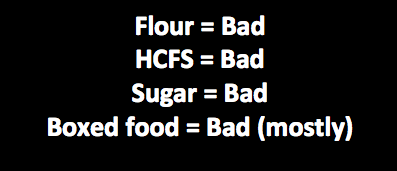
I still use these tips personally to remind myself and also to help others dial in their eating habits.
I get asked all of the time what foods I eat. I usually throw out the, “If it wasn’t grown from the earth or have a mother, I don’t eat it” line, or lately just to keep it short and sweet, I will say “plants and meat”. Why say any more than that? It’s not rocket science, so why complicate for a person that is already being bullied by a food industry that pumps out garbage advertising.
The response is sometimes, “But Kyle, you eat red meat?!”
My response, “Hell yes. Plenty of it”.
Using these reminders can take the anxiety and confusion out of grocery shopping (where you decide whether to make a monetary commitment to the food) and actual preparation and consumption of meals (which is determined what you have purchased).
I began to take notice that I would eat whatever was stocked in the house, as most of your probably do the same. I know for a fact that many of you also do this. Whatever is convenient and quick is going to be consumed. Right?
Learn how to cook, it’s probably the answer to most of your problems…
In my pre-cooking days, I began to notice that whatever was being prepared by someone else dictated what I was going to be eating. If it was chocolate chip pancakes wrapped around sausage links, cake, donuts, Hamburger Helper, Ramen and on and on… it didn’t matter, it was going to be eaten. It sounds like a dumb observation, but if you aren’t preparing your own food, you are eating whatever is being prepared by the person that is. Sometimes that means eating junk.
Once I took the responsibility and the initiative to cook my own food for each meal, I started eating clean. I saw tremendous positive changes in my body appearance and performance. Clean eating to me is eating food that is free of any processed crap (ingredients). Clean eating involves eating food that rots it if isn’t consumed fast enough. Clean eating can be a complete pain in the ass. You’ll have to grocery shop 2-3 times at the grocery store because you are eating food that has a shelf life of just a couple of days, or, you’re eating so much of these quality foods that you literally run out. It’s all worth it.
I learned through experience that if I ate quality food, I could eat just about as much as I wanted. My plates for dinner and breakfast are still piled high with quality food that does nothing more than nourish my body and refuel it for the next training session.
Here is another bold statement for all of you to chew on: Eating clean makes you shit.
And while you may giggle and blush when I say that, it really isn’t a laughing matter. Eating quality food will make you eliminate regularly, which is so incredibly vital to your digestive system and overall health. So many of us walk around with toxic food pooled up in our bodies. Open the lid to a restaurants dumpster on a hot and humid Summer day, take a big whiff. Now imagine what your stomach looks like after Doritos, Bagels and French Fries.
Our bodies can develop inflammation and sometimes aches and pains from the food that we eat! Who knew.
Ever heard of leaky gut syndrome? A lot of people have it and don’t know it. Years of processed food and sugar finally taking it’s toll on their intestinal lining.
I know people who have been damn close to going under the knife because they thought they were suffering from a rotator cuff injury, when in fact it was an awful inflammatory effect from their diet. They changed some things in their diet prior to surgery and boom shakalaka, pain free.
This isn’t hocus-pocus. I have talked about how some health professionals are proactive and some are reactive. I would suggest that you seek out good information from those professionals who are proactive. Holistic healthcare used to be a taboo topic, but more and more folks are finding that holistic practitioners may in fact not be crazy voodoo witch doctors after all.
We can complain about our healthcare system all we want, but we need to take look in the mirror at the individual level first. We, as humans in these modern times, should be able to take care of ourselves. We have to pull up our pants, comb our hair, brush our teeth and start being big boys and big girls when it comes to our discipline to be conscious of food and consistent with movement.
Start small and simple, build on the momentum gained.
Un-educated, computer-less cavemen could figure it out…
For thousands of years, people have been eating plants that were grown from the earth and adding in a little animal meat, eggs and nuts for protein. Our ancestors weren’t entirely sure when the next meal was going to come. True hunters and gatherers.
Plants and pastured meat is medicine (and fuel) and it can be leveraged (very simply) to bring your body composition and overall health back to center, despite your movement habits. Although adding in a simple movement regimen is like pouring gasoline on the fire. Mix both and you’re set up for success.
The wrap up…
So at the end of the day, I do suppose that the best nutritional intervention is the one that you are willing to stick to. Whatever and wherever your starting point is, your ground zero, just do something to shift your nutritional intake in a positive manner.
These days, I view nutrition as I do the purposeful workout. It is an acquired taste that you’ll become better and better at as you continue move deeper into the realm of nutrient dense foods and seasonings while slowly eliminating the sugary/processed foods of the past.
A pure trade out. In the good, out with the bad.
You’ll become better at identifying good food from bad food every single time you make a conscious effort to shop smarter at the grocery store.
Cooking becomes less chaotic and more systematic over time. Just like working out regularly to build physical fitness, cooking and eating wholesome food becomes more and more fun every time you do it. It’s just a matter of sticking it out long enough to make the habits stick for the long-term.
I am in no way talking about eating for six-pack abs and veiny arms, I am talking about fitting into your college jeans and feeling comfortable (and proud) about taking your shirt off at the lake. For some of us, maybe it’s eating to save our lives (literally). For most of us, body restoration means regaining our self-confidence and our pride in a body that we worked hard to develop. Improving how you feel about yourself and how you perceive others feeling about your bodily image with do wonders for your happiness.
It’s a feel good story for everyone. When was the last time someone regretted taking back control of their body?
Cheers to common sense eating for life!
KG
(This article in no way implies that I am supporting Paleo or any other diet trend).

While combing over the internet, I noticed that there aren’t many updated resources that share how to properly use a suspension trainer.
Since I am a huge fan of suspension training, both for beginners and advanced trainees alike, I thought I would share the need-to-know information on how to successfully use a suspension trainer.
Here we go…
1) Buy one.

I know this sounds elementary, but you have got to actually buy a suspension trainer for rest of this post to have any positive effect. Stop hovering and purchase yourself a nice unit. I highly suggest buying from a couple of manufacturers… LifeLine Fitness and TRX are the major players. My suggestions for these units are based on personal experience and also a simple observation of what the best coaches in America are using with their athletes and clients. I am a LifeLine Jungle Gym fan (pictured above).
You can build your own suspension trainer if you like. They are really nothing more than tough nylon/kevlar straps with handles and loops. Not rocket science. However, if you choose to build your own suspension trainer, I will caution you that your fate rests in the quality of your craftsmanship and material you choose to use. Build at your own risk.
Below are links to the different brands that I mentioned, along with a link to a
2) Anchor the suspension trainer.
Suspension trainers are effective because you’re able to leverage your body mass against the directional pull of gravity, which creates the resistance during exercises, demands stability and mobility, etc. If your anchor point is sketchy, your suspension training is going to suffer. Trust me, you don’t want to be in the middle of a set of body rows wondering if the anchor point is going to collapse. The nice part about suspension trainers is that you can anchor to a closed door, or directly overhead, so you have options.
From personal experience, only anchor the suspension trainer on the door if you have no other options. Why? Because anchoring on the door limits your exercise selection, and can make a lot of the exercises, well, awkward. Anchoring to a door means that the suspension trainer will never cross the mid-point of its range of motion, so exercises will start with arc built into them. The door prevents any backswing, and any low hanging movements will have arc built into them no matter what. Due to the arc, exercises like push-up+knee tucks (aka: atomic push-ups) and suspended hamstring curls now become much more difficult. If you’re a beginner, your technique may suffer because of the increased difficulty of these movements.
Hanging the suspension trainer directly overhead gives you immediate freedom to not only progress all movements, but also regress movements to make exercises more effective. The overhead position also allows for an infinite number of body positions that will serve to increase or decrease the training stimulus for any given exercise. Take a simple (yet awesome) movement such as body rows. For a beginner, I would suggest starting in a lean back position where the heels are firmly planted into the ground surface, while the pulling action is angled to anchor point. Angling the pull will decrease the resistance of the exercise, increasing the likelihood of successful reps. For an advanced trainee, I would suggest moving your body directly underneath the anchor point so that the pulling action is completely vertical (up and down). In this position, the resistance is completely vertical. The loading is therefore increased the exercise is much more difficult.
*** It is also worth mentioning that increasing horizontal (in relation to the ground) body position (supine or prone) with exercises like push ups and body rows increases the challenge of keeping the body rigid and straight from head to toe. In other words, there is an increased demand on the torso musculature to maintain this static posture while work is being done elsewhere.
The suspension trainer, based on the body row example, is highly adjustable to fit any strength level. The stimulus presented to the beginner is just as intense (based on their fitness level) as the stimulus received to the advanced trainee (based on their fitness levels).
3) Angles
Suspension training is all about body position in relation to the anchor point of the straps.

Figuring out the angles to increase or decrease the difficulty of movement is part of the beauty of suspension training. Using the body row example, the more your move your feet underneath the anchor point, the harder the exercise becomes. Push-up + knee tucks become more difficult based on your starting position. When your feet start directly underneath the anchor point, the effort to complete the knee tuck decrease. If you walk your hands out and start with feet ahead of the anchor point, the knee tuck becomes increasingly resisted based on the natural arc of motion. Move your feet behind the anchor point, and arc becomes an assistance aid for the knee tuck.
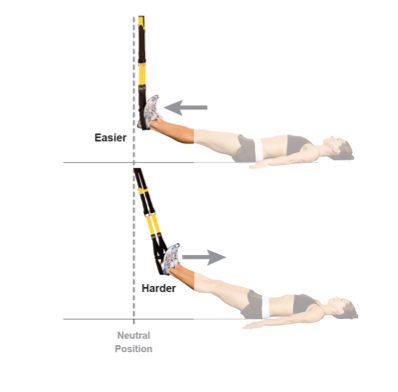
The feedback from the suspension trainer is immediate. If you know your target reps for a given exercise, it becomes trial-and-error to locate the proper body position that allows for completing those reps without sacrificing technique and challenging your body through the entire range of motion.
4) Integrated movement.
One beef that I have heard from others regarding the use of suspension trainers, is the lack of real world carry over. The argument is that a suspension trainer workout regimen lacks a loaded vertical posture (thinking standing) during most exercises. This is true. However, we often forget that not every exercise needs to look like something that we are doing in real life.
Example: I often reach for and return water glasses to the highest cabinet of my kitchen, but do I need to lift dumbbells on my tippy toes to train for that? No. I push a lawnmower around my yard in the Summer. Do I need to push a heavy sled to train for that? No. This is a personal beef that I have with people who attempt to make exercise look like real world activities.
The suspension trainer is a tool, and as a tool you need to understand that it is not going to be the be all end all of fitness.
Using a suspension trainer will accelerate and enhance your ability to successfully perform other physical tasks in life, no doubt about that.
The suspension trainer provides a low-cost, high reward training stimulus to its users that incorporates movements that are safe and effective. The workouts are meant to enhance the physical function of our bodies, and as a byproduct you’ll improve your body composition. Building strength, stability and mobility with a multi-dimensional approach will yield high carry over into daily life.
Besides, if you enjoy suspension training and you’re making progress, why worry about anything else? The grass is not always greener on the other side, keep it simple and stick to your recipe. Trust your training.
5) Buy a book or reference a website for exercises/workouts.
There are thousands of free resources on the internet that share knowledge about suspension training. I am an exercise technique junkie, so I am going to recommend that you keep checking my YouTube page of updated videos of suspension training exercises, but the choice is yours.
As I always do on this blog, I will remind you to keep your efforts on the suspension trainer simple. Avoid going fancy with your movement. Lock in technique for basic movements and then progress (using common sense) from there. To this day, I still use the simplest of movements which include (but are not limited to):
If you are finding that you have progressed beyond the basics, add a weight vest and work through the same exercise variations once again. It’s that simple. Keep progressing in an intelligent manner.
It’s just a matter of challenging yourself each time you use your suspension trainer.
Cheers to suspending yourself!
KG

I am an advocate of the waging war against autopilot living.
You know, the little thoughts that circle around inside of our head that tell us that we are somehow pre-disposed to having what we have and experiencing what we experience.
That we will never be anything more than average at best.
Forget that. Shoot for the moon.
Humans are the most powerful creatures on the planet because we have the ability to re-route the road map of our live, and we can do this at any age, as long as we consciously comprehend that we have the power to do so.
Here are 3 extremely powerful (yet simple) videos from one of the greatest visionaries this planet has ever seen: Steve Jobs.
1) Steve Jobs: Secrets of Life
2) Steve Jobs: Failure
3) Steve Jobs: Passion for Life’s Pursuits
It’s an incredible thought we can re-program our minds and move in an entirely different direction from where we are now.
Life’s rough sometimes, there is no denying that, but it’s also way too short to spend any time being miserable.
Life is a game to be played, so get your ass off the bench and get yourself in the game.
Cheers to squeezing just a little more out of life!
KG
 M(eaux)tion Fitness