
Redemption: The Matthew McConaughey Ninja Bodyweight Workout

Quick Tips

Ninja Workout

I have to start by offering an apology for misleading many of you on my previous article about Matthew McConaughey’s training philosophy.

All I did in that post was mention that “he sweats”, which I suppose made complete sense to me as the main point of the article, but left many of you readers wanting to know some specifics.  After reading it, I feel that the message was received, but it was lacking in “how-to” knowledge.  That is my error.  I hope to redeem myself by sharing a decent little bodyweight workout with you today.

In honor of Spring of course.

Hopefully I can redeem myself here.  I’m nervous.

Wisconsin Mecca

The Mecca of the Midwest

As the weather warms up here in “God’s Country”, Eau Claire, WI, the doors begin to open to all sorts of opportunity for engaging in physical activity outside.

Training outside is the greatest.  It’s freeing.  The air is fresh (depending on where you live), the sun is beaming, and quite honestly, when you train outside the workout seems less monotonous than training indoors.  Training inside year round can make you feel like a rat in a laboratory.

[Segue…]

Alright, let’s talk about Matthew McConaughey’s workout, because that is why we are gathered here today.

Screen Shot 2013-04-05 at 6.54.52 AM

Super awkward that I had to post this pic, but needed the visual.

Let’s face it, guy has the kind of body aesthetics that women drool over and men want, yet his theory on physical activity and what it takes to maintain his physique is so incredibly simple.  I love that.  Why complicate matters?

Performance-wise, I’m not entirely sure how strong the guy is, if he has aches and pains or any sort of endurance.  But aesthetically he is doing alright.

Just sweat everyday… doing something.

I received a lot of interest in the previous article, so I should probably man up and post a workout of his… ahemmmm… or at least a workout that I believe he may enjoy participating in.

Well, ok… maybe it’s just a workout that I designed with the thought that if he and I were hanging out, he would enjoy working through it with me.  Based on some of his older interviews in Men’s Health, he tends to avoid the gym whenever possible in favor of training outside in a more natural environment.

Workout structure

Equipment:  None (although a heart rate monitor is highly encouraged)

Time commitment:  30 minutes-ish

Difficulty:  3/5

Screen Shot 2013-04-02 at 7.01.47 AM

*** Warm up***

Start with a 5 minute run at 70-75% of your HRM (heart rate max)

  • Run #1)  2 minutes at 80-85% of your HRM (heart rate max)

—>  Recover to 130 bpm

a)  20 Push Ups (no rest leading into the run)

  • Run #2)  2 minutes at 80-85% of your HRM (heart rate max)

—>  Recover to 130 bpm

b)  20 Reverse Lunges (no rest leading into the run)

  • Run#3)  2 minutes at 80-85% of your HRM (heart rate max)

Recover to 130 bpm

c)  20 Bodyweight Squats (no rest leading into the run)

  • Run#4)  2 minutes at 80-85% of your HRM (heart rate max)

–> Recover to 130 bpm

d)  20 Burpees (no rest leading into the run)

Finish with a 5 minute run at 70-75% of your HRM (heart rate max)


Fitness thoughts

Buy a heart rate monitor.

If you are going to take your cardio training seriously, you need to be monitoring your work bouts and your recovery time with a heart rate monitor.  Buy the cheapest version Polar sells if you are concerned with cost.  It will work just fine and help guide your training.  The heart rate monitor will give you insight into your progress.

On the 2 minute run, which is the “work” portion of the session, you’ll notice that I suggest running at a pace that is 80-85% of your heart rate max.  The easiest way to figure out your heart rate max is to get on a treadmill, crank it up to a ridiculously high speed and incline, and sprint until your vision becomes blurry.  The test ends when the treadmill spits you off.

JUST KIDDING!

Seriously, don’t do that.  However, there are some equations that you can use.  Most heart rate related formulas have some flaws in them.  They are just formulas, estimations, so this makes sense.  The Karvonen formula is “the best of the worst” when it comes to finding max heart rate.  No matter which formula you choose, remember that your heart rate “training zones” are going to be ESTIMATED.  I’d rather you use these formulas than the really old school method of finding heart rate, which is nothing more than 220-(Your Age).  220-your age is quick, but there is a lot of room for error.

Recover to 130 bpm after each run prior to working through each bodyweight exercise.  Recovering to 130bpm will keep your training efforts aerobically challenging and also provide an beats per minute (BPM) mark to green light the next work bout.  Recovering based on time is ok in a pinch, but recovering based on when you heart is ready to go again is preferred.  Your body will let you know when it’s time to go back to work.

The bodyweight strength movements that follow the rest periods are integrated to break up the monotony of running and provide a low load resistance based training stimulus.  Don’t expect to build great amounts of strength from just 20 reps of any of those movements.  If fact, let me re-phrase that last sentence… You will not build strength from those exercises.  Not at that rep count, with bodyweight load, etc.  Unless you are relatively reconditioned (which isn’t a bad thing) or new to purposeful exercise.  You may experience some strength gains, but I would rather see you work through a dedicated strength program at that point.

Scale the workout.  Run for less time if you need to.  Decrease the reps on the bodyweight moves if you need to.

Or, if you are battle hardened, increase the running time, add a few more rounds of bodyweight moves, etc.

Take your training outside and get some fresh air.  It will change the training experience.


Cheers to breaking up the monotony of running!


KG

Inspiring the Unknown

Quick Tips


Old video, timeless lesson.

The greatest reward of conquering something epic in life often goes unknown to the person that accomplished it.

Huh?

Let me explain this a for quick second.  Hold on tight it might get a little messy (you’ve been warned).

Crushing a task that seems so challenging, so lofty that you’re not even sure how you are going to achieve it (even though you know you’re going to scratch and claw to get there) provides a valuable lesson in character building.

However, attaining goals also inspires onlookers (known or unknown) to initiate an all out attack their goals, dreams, aspirations.

Seeing is believing, and when we see our peers accomplish something epic, it provides just enough of a motivational nudge for us to follow suit.

I call it inspiring the unknown, and it happens every single day.

Screen Shot 2013-04-08 at 6.28.43 AM

Paying it forward.  Nearly 2 years ago, while waiting in line at a coffee shop in Minnesota, I watched my best friend buy a lady’s coffee who was waiting in line behind us.  When she asked why he would be so generous, he proudly announced, “It’s my pleasure, I am paying it forward and maybe you can do the same”.  As he said this, 5-6 other people who were also waiting in line overheard his remarks.  The lady was floored by his random act of kindness.  I was floored at the impact of the event.  I think about it often.

Imagine that.  A single gesture can spread to 6-7 onlookers who then go on to tell all of their friends and family of what they had seen, which then spreads like wildfire to their social networks and beyond.  Inspiration.

These days, I am more impressed by the average person’s journey to greatness than another superstar athlete or hotel mogul.  

(Please know that no one is “average” and that we are all unique.  We become average in our day-to-day actions/behavior).

Average people inspiring other average people to demand more of themselves.

We can all relate to the average person.  The ripple effect of an average person pursuing greatness is amazingly simple.  We see a person achieve their goals, then we want to achieve our goals.  It becomes fuel.  We witness their own personal victory, than we desire that same success.

That’s cool.

That’s a fantastic reason to set targets in life and work relentlessly place the arrow dead center in the bullseye.

Screen Shot 2013-04-06 at 11.06.26 AM

You’re killing two birds with one stone.

Bird #1)  You’re proving to yourself that you’re capable of achieving more than you once thought possible.

Bird #2)  You’re (without awareness) inspiring others to stop testing the temperature of pool and finally jump in.

Screen Shot 2013-04-05 at 11.08.26 AM

It’s scary when standing at the bottom of the mountain, gazing up at the rocky terrain that you’ll have to traverse in order to get to the peak.  Dead scary.  It can be crippling actually, to the point that you never take action.  We all approach these obstacles with a different mindset.  Some people see them as speed bumps and some people see them as 20 foot walls.

But having the conviction to traverse that rocky terrain is what inspires other people to do the same.

If you have a pulse, you’ve undoubtedly run into that 20 foot wall and thought, “shit”.  It’s easy to throw in the towel when that happens.  In fact, it’s a hell of a lot easier folding your cards at the first sign of adversity than it is to grind it out until the bitter end.

A hell of a lot easier.  But that doesn’t build character and that doesn’t inspire others.  That creates feelings of regret.

Screen Shot 2013-04-08 at 6.28.51 AM

As it relates to physical activity, I have thought about quitting more times than I’d like to admit during a workout/run/bike.  More than I can remember. In fact, every single time I squat I feel like racking the bar 3 reps short of my scheduled reps for the day.  It would be so easy.  No one would notice, right?

Or how about eating habits?  I would love to eat pizza everyday and wash it down with a couple of craft beers.  Or eat raw cookie dough for breakfast every single morning.  That would be great.  But I cannot do that.  It’s not conducive to achieving my goals nor is it the example/standard that I have chosen to set on this blog.  I’d be letting you down and letting myself down.

In my athlete days, we would condition ourselves to the point of exhaustion early in the season to prepare for the physical demands of the season.  There were many occasions, with my lungs in my throat, I considered dogging these conditioning practices just enough just to get by.  My teammates wouldn’t notice, right?  I could finish in the middle of the pack, not first but definitely not last.  I didn’t have the heart to do it.  Because if I chose that path, then the next guy would do it, then the guy after that would do it, and on and on.

If I dogged it, who does that serve well?  Who draws inspiration to push on from someone else’s average effort?

keep calm and workout

It took me a really long time to realize that most shitty hands that we are dealt in life rarely involve events that we can’t handle.

We are equipped with the tools and capacity to endure mental and physical stress.

But occasionally, our internal wiring gets mixed up and our systems begin to malfunction.  Our attitudes become vulnerable and we feel ourselves start to stumble toward what we want.  Then crawl.  Things get difficult.  That 10 foot wall turns into a 15 foot wall, then a 20 foot wall.  The negative self-talk appears.

When this happens, remember all of the people who need the motivation of your success to start making moves to achieving their own.

Someone is watching you, wondering if you’ll have the courage to keep pushing forward.

And when you do, that someone who has been lurking, waiting for inspiration, is going to spread their wings and take flight for no other reason than they saw you do it.

That’s one kind of trendy domino effect that this world needs.

Just like my good friend that chose to pay it forward.

Conquering and inspiring.  Two great words to add to your life resume.


Cheers to inspiring average people to accomplish amazing things!


KG

De-Rustifying Your Spine: The Second Greatest Warm Up Drill of All Time

Quick Tips

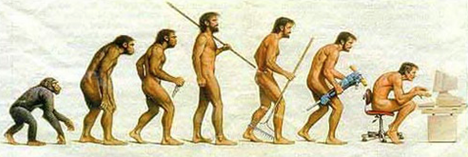
de-evolution of the desk jockey

Isn’t this the truth?

I would say that the following drill is the greatest of all time, but I can’t.

That honor goes to the old lacrosse ball on the feet trick.

However, I am probably incorrect in saying that the drill that I am about to share with you is a “release” per se.

It’s actually a mobility drill, but every time I work it into my warm  ups (almost every workout), I feel like I have released built up pressure from my thoracic (mid-back) spine.  It’s crazy.  When you start paying attention to your body and what it needs, most of us will find that we can benefit greatly from a simple mobility drill like this.

Here’s the drill…

—>  Tennis Ball Thoracic Extension/Flexion

Find two tennis balls (or buy some tennis balls) and tape them together to form a “peanut”.  Set the peanut at mid-back, with your spine rested in between the “valley” created by the taped tennis balls.  You may feel extremely… “locked up” at first.  Fear not.  Move within a comfortable range of motion.  Typically, this “locked up” sensation will alleviate after the first few repetitions.  Exhale and wrap your spine around the ball as you fall into extension.  On the crunch up (flexion), take a belly breath and repeat the exhalation once again, moving back into extension.  Rinse and repeat.

Awesome drill for those who sit a lot.

Movement cues:

  • Start at the mid-back and work up to just below the top of your shoulder blades.
  • Roll in half turn increments on the tennis ball peanut as you make your way to the top.
  • Keep your butt and as much of your lower back pressed firmly against the ground.  Hinge around the tennis balls.
  • Perform 5 hinged crunches, 5 overhead extensions and 5 alternating arm raises at each level.

How often should you work this drill throughout the week?

In my personal opinion- and it will vary from person to person- I think that the following a mobility plan based on your age is a great recommendation.  It would look like the following:

Mobility per week chart


Closing Thoughts

The key with this mobility drill is to get aggressive with it.  By aggressive, I am not saying to gore yourself on the tennis balls and be ruthless with your crunches.  I am saying that it’s important to accumulate some repetitions as you slowly move the peanut up your spine.  Work through the 5 rep recommendation (multiplied by the 3 exercises per level) and be diligent with it.

Just to reiterate the movement of the tennis ball, I give it a half roll starting at the mid-back, moving all of the way up to the top of my shoulder blades.  It’s incredible how “locked” up our bodies can become and this mobilization is fantastic for helping to relieve some of the effects brought on by poor posture and sitting.  There is other work to be done beside mobilizing, but this is a great place to start.

This drill addresses primarily flexion and extension through the hinging effect.  Remember that your spine also rotates and flexes laterally, and we can chat about some simple drills to work through for regaining rotational/lateral flexion freedom in another post.

We sit way too much.  We sit in our cars, sit at our desks, at the dinner table and then on the couch.  Then, then the day is over, we head to bed for the night and lay in less than desirable postures.

Please don’t feed me some bull crap about not being able to avoid sitting.  I get it.  Just as we are all too busy to workout, I get that too.

The point is that you’re becoming aware of simple home remedies that can help to off-set some of the undesirable effects of growing your butt cheeks to the chair.  It takes all of 2 minutes to work through the tennis ball thoracic extension/flexion mobility drill.  2 minutes.

Screen Shot 2013-04-04 at 6.38.35 AM

Seeing is believing.  This is not a good posture to take to the gym. 

We have to make a conscious effort to unwind these issues before they manifest themselves into disaster… ahemmm… injury or degeneration.

Maintaining joint mobility is important for long-term health, so don’t give a weak effort on this.  Moving the way that your body was designed improves performance and appearance.  Steal some tennis balls from your neighbors garage, a local high school or just buck up and buy a fresh can of tennis balls for $5 or so.  It’s worth it.


Cheers to re-greasing that rusty spine!

KG

Warm Up Makeover: “Activation” w/ Mini Band Walks and Wall Slides

Quick Tips

Wasn’t sure what to entertain you with out of the gates, so Killers it is…

The warm up is a crucial part of the workout, so stop treating it like it’s not. 🙂

There are many people who still skip warm ups prior to intense weight training, and if they do warm up, it involves a few neck rolls, arm swings and knuckle cracks.  You know who you are, no need to point fingers.

I have touched on the importance of the warm up’s importance leading into training session in the past, and you can find those older posts here:

Today’s tips are about activation.  Activation is the equivalent of flipping the power switch to muscles that otherwise lay dormant throughout the day, or have been found to be weak.  Again, think about the concept of activation before the workout as “turning on your muscles”.

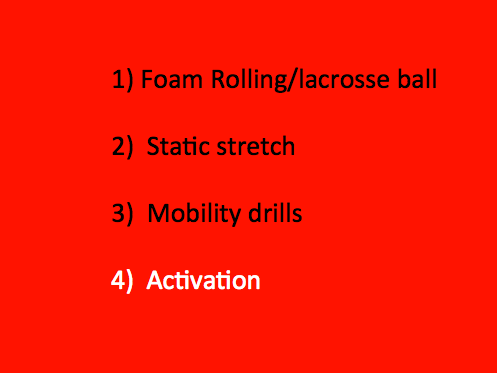
Just as the work-portion of the workout is often divided up into different sections (power, strength, cardio development), so is the warm-up.  I typically place activation after my foam rolling/lacrosse ball, static stretching and mobility work.  Taking my joints through a range of motion using targeted mobility drills prior to activating muscles like my glutes and my shoulders.

So, the order would look something like this:

Screen Shot 2013-04-03 at 6.27.35 AM

Activation improved my training and the training of my clients.  Ironically, activation exercises might make you more sore than the actual strength training or cardio work.  Flipping the switch on dormant muscles

Activation in the warm up represents the first few drills where the muscles are moving against light resistance prior to experiencing increased loading during dedicated power or strength exercises.

Foam rolling changes density and relieves restrictions (trigger points, muscle lesions, etc), static stretching changes the length of the muscles after foam rolling, mobility drills take joints through a range of motion while delivering essential nutrients and lubrication to the joint, while activation “wakes up” inhibited muscles for the workout and a quick correction of identified weakness.

Inhibited muscle

A little definition on “inhibited”, straight from the almighty Google.

I may have made this slightly more complicated than you would have liked, but trust me, the two activation drills that I am about to describe are both simple and extremely effective.  They are well worth your time investment.

The first time that you add these two drills to your training, you’ll notice a difference immediately.

You're gonna like the way you look guy

Seriously though, you gonna feel great, I guarantee it.

Few things in life are guaranteed (except for suits from Men’s Wearhouse), but I guarantee that you’ll feel great after executing these two activation drills.  It might be an “aha” moment (as it was for me)that muscles are can become weak without us being aware of it.  Well, now that you read that sentence, you are consciously aware of it.  See how that works?  🙂

—>  Mini Band Walks

Mini band walks involve positioning a small rubber band around the outside of the tops of your knees, shins or ankles in an effort to wake up the muscles that encapsulate your powerful hips, particularly the glute medius.  The band is positioned in the three different positions based on your ability to exhibit proper technique during the drill.  The lower the band moves on the legs, the more difficult the drill becomes.  Placing the band above the knee would be easiest, followed by around the shin and finally around the ankle would be most difficult.  I have performed this drill with knees flexed (athletic stance) and stiff-legged (like Herman Munster), both versions work well.  Avoid excessive shifting of bodyweight during the reach of the lead leg and the resist of the trailing leg.  Simulate a full glass of water balancing on your head as you move laterally.

Movement Cues:  

  • Walk lightly and resist the pull of the band on the trailing leg/foot.  
  • Keep toes pointed straight ahead.
  • Keep weight on the mid-foot and heel.
  • Walk about 10 yards in one direction, then 10 yards back.
  • If movement form breaks, stop.  Nothing good happens by forcing crappy movement in search of a muscular burn.
  • ***  Chances are quite high that if your form broke down during your first attempt, you need to decrease the band tension (aka:  use a lighter band)

—>  Wall Slides

If you really want to feel bad about the fact that you have ignored your slouching upper body posture, do some wall slides.  For some of you, just getting yourself into the starting position will be a challenge.  Years of slumping at a desk has cut up to you, and you may be moving toward becoming a hunchback.  No offense.  However, wall slides can provide a simple fix (along with plenty of pulling movements).  Wall slides, much like mini band walks, should be a staple in everyone’s training regimen.  Wall slides will tax the external rotators along with the scapular (shoulder blade) retractors and depressors.  Addressing weak or inhibited scapular retractors and depressors with a few sets of wall slides throughout the week will do wonders for injury prevention and performance.

Enough jargon!  Watch the video a couple of times, check out the coaching cues and do them for yourself.

Movement Cues:

  • Place heels about 8-10 inches from the wall that you’re pressed against.
  • Body contact points on the wall are:  tailbone, mid/high back, elbows/forearms/backs of hands, head.
  • Actively press your forearms against the wall.
  • Imagine attempting to “sand the hair” off of your forearms as you reach overhead and return back to the starting position.
  • Only go through a range of motion that you can maintain the contact points listed above.
  • Breathe.  Don’t forget to breathe.
  • Get 8-10 reps, slow and controlled throughout the movement.
  • Breathe.
  • Breathe.
  • Did I say… breathe?

Closing Thoughts

Wall slides will make just about everyone sore.  Welcome to the world of posture and weak/inhibited muscles.  They are a million dollar exercise if I do say so myself.  I have seen tough guys, soccer moms, pro athletes and everyone in between be humbled by wall slides.  Just getting into position can be mind-boggling for some people.  Reason?  They are becoming a product of their daily posture.  A consistent daily dose of wall slides would be a great addition to just about everyone on the planet.

I have to admit that during my college athletic years, we hardly warmed up.  I mean, we got the blood circulating by doing something before each workout, but nothing close to the methods that I describe above.  I can’t say that warming up with mini band walks and wall slides would have helped me score more goals, play better defense or winning more games, but I would have definitely felt some kind of improvement.  No doubt about that.  Hindsight is always 20/20.

My first attempt at warming up with lateral (sideways) mini band walks left my hips sore as hell.  Years of hockey, where the hips are the dominating producers of force, and I perform 10 yards (down and back) of mini band walks and my hips were almost too tender to touch in the days following.  Unreal.  It was a major indicator that I was weak in this area.  Yikes.

My warm ups today are brutally simple.  They address both upper and lower extremities all in one shot.  I prefer to warm up this way, with the total body approach.  You’ll notice that some professionals will suggest tailoring the warm up to the specific demands of the day’s workout (and this works fine also), but I find that whipping through a total body warm up gets me engaged and leaves me feeling prepared.  I enjoy leaving the warm up with sweat on my shirt.

Personal preference.

Don’t waste time.  Buy a mini band (or two) and find a flat open space on a wall.  Do it.

The best advice I can ever give someone who reads anything on this blog is to get off your butt and try it.  Get active.  Get engaged.

What’s the worst that is going to happen?


Cheers to walking like a duck and vertical snow angels!

KG

The Squat Exercise Progression: 3 Movements to Build Lower Body Performance

Quick Tips

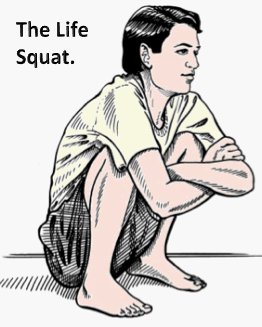
LIfe Squat

The squat is arguably the most important movement pattern known to man.

I typically try to avoid making bold statements like that, but squatting is vital to a physical life.

Squatting will build a bulletproof body, from head to toe.  A successful squat demands lower body strength, but it also requires a mobile, stable upper body.  Building strength in the squat is a total body affair.

Working to build lower body performance should be at the top of everybody’s priorities.  If you are going to the gym and avoiding working on your squat, shame on you.  You’re leaving a lot on the table.  Even if you’re not an aspiring athlete outside of the workplace, life happens on your feet.

In an effort to keep my posts slightly more direct and to the point, lets waste no time and get into a few squat progressions that I know that you will find to be extremely valuable…


1)  Goblet Squat

The goblet squat is favorite exercise for introducing beginners to bilateral (two legs) squatting.  I have found that the goblet squat can work out the kinks in a person’s squat form.  If you have trouble performing a bodyweight squat to a decent depth while keeping upright posture, the goblet squat can help to correct this.  It’s easiest to select the dumbbell or kettlebell that you’ll be using, set it on a bench and then position yourself underneath the weight in order to hold the weight correctly.  Don’t try to “pop” it up to chest height from the rack or waist level… I have seen bad things happen to good feet in these scenarios.  Keep the weight close to your chest with elbows tucked in tight during the ascent and descent of the movement.


2)  Front Squat

The front squat is similar to the goblet squat position-wise, except that the front squat places a greater amount of flexibility and mobility from the shoulders, elbows and wrists, while reducing loading to the lower back.  The starting posture of the lift is referred to as the “rack” position.  It is often uncomfortable for a newbie to get into a proper starting position if you’ve never been there before.  As you descend down into the squat, thoracic mobility (mid-spine) becomes increasingly important.  If you lack of mobility at the mid-spine, you’ll often begin to round your back or have a “locked up sensation”.  Rounding of the back will be more noticeable during an exercise like the overhead squat.  Compensating to complete the movement is undesirable.  The front squat differs from the goblet squat mainly in the holding position of the weight and the ability to apply a greater loading stimulus which will accelerate your strength gains and body transformation.


3)  Split Squat

The split squat is the first squat-like progression that challenges our base of support.  It moves the squat pattern away from the two-foot stance and into a modified lunge/squat type stance.  Now we are moving toward single leg training.  This is a good thing… very good.  The split squat is commonly performed with arms at your side and weight in hand, although the position of the weight can be moved to other positions (goblet style, rack positions, overhead).  Notice that the front and back leg/feet remain fixed.  The back leg serves as a support rudder, not as a load bearing leaning pole.  Keep as much of the effort coming from the front leg as possible.  The split squat will place a higher demand on the adductor group (think groin area), which can leave some soreness in the days following.  Nothing that you can’t handle if you’re expecting it.

Closing Thoughts

Progressing the squat, or any movement for that matter, is important for challenging the lower body.  Increasing the demands of the exercise will accelerate performance, along with body composition.  Bottom line, you’ll feel stronger and keep yourself moving toward a leaner body in the process.

The squat is also a fantastic tool for identifying mobility and stability issues.  As you move through range of motion, you may find that you are restricted in some way.  It’s not a the end of the world, so don’t beat yourself up over it if you are.  Pay attention to where on your body you feel restricted and at what point in the movement.  Our bodies give us clues about their inefficiencies all day long, you just have to take time to notice.

These restrictions will become a problem if you do not address them with a foam roller, flexibility, stability or mobility drills.

Add in these interventions and then test and re-test.  Look for improvement.  It’s that simple.


Cheers to smart squat progressions to improve performance in life!

KG

A Simple Kettlebell Drill to Light Up Your Mid-Section

Quick Tips

Screen Shot 2013-04-01 at 5.37.26 PM

My interest in kettlebells is quite obvious on this blog.  They are such a great training tool.  I pump the kettle bell’s tires regularly because I think that they are the perfect representation of what multi-dimensional movement can and should be.  Paired with a suspension trainer, you’ve got a complete home gym.  That’s cool.  Doing more with less.  The future of training.  Simplicity.

Speaking of simplicity, the kettlebell drill that I describe in this post is about as complicated as my training gets.  It doesn’t need to be complicated when you are paying attention to the details, your technique, your movement.

Well, actually there is one movement that might top this for complexity, but it isn’t that crazy.  I’ll write about it soon.

Multi-dimensional movement is something that most gym goers have never experienced, which is something that I am working to change… post by post.

Image

The ability to move with stability, mobility and strength in all 3 possible planes of movement (shown above) is important.  It keeps our bodies balanced and capable of handling physical stress in many different postures, both statically (not moving) and dynamically (moving).

Part of multi-dimensional movement is not only being able to initiate movement in all 3-planes (create force), but to be able to resist forces acting upon us in all 3-planes.  The ability to absorb force without sacrificing posture- vulnerable positions where injury may lurk- is important.

One of the ways to train the body to resist external forces is to mix in a healthy amount to carrying, both dynamic and static.  Carrying refers to loading either one side or both sides of the body with a challenging amount of weight, staying rigid with upright posture, and either holding the position without moving or walking for a specified distance.  I suppose if you were not moving, you wouldn’t refer to the drill as a “carry”, but more of a “hold”.

There are many different variations of carrying which are phenomenal for building a body that functions as good as it looks, but touching on each will have to wait for another post.

For the purpose of this post, the kettlebell drill that I am learning to love involves a static posture (no movement) and one kettlebell.  So as you can see, it’s simple.  Simple is good.

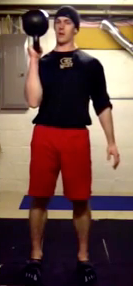
The drill is can be referred to as a “Bottom’s Up Waiter Hold” (with kettlebell).

Screen Shot 2013-04-01 at 5.34.06 PM

Kettlebell Bottoms Up Waiter Hold

1)  Grab a kettlebell of a challenging weight (experiment with what “challenging” is for you)

2)  Clean the kettlebell to chest height, or use both hands to position the kettlebell upside down (bottoms up)

3)  Hold the kettlebell just lateral to your midline/in front of your working arm’s shoulder, upside down, and balance for a specified amount of time.

4)  Grip the bell hard with your hand, pull your elbow in tight to your side, and create total body tension.

5)  Brace your core musculature and breathe through pursed lips

Time of hold:  15-45 seconds

Sets per side:  3-4 per arm

Where in the workout?:  After the warm up, before the workout, when you are fresh.

Front view

Lateral view


Fitness thoughts

Flipping the kettlebell upside down will instantly make everything in your world unstable.  Not quite “massively destabilized”, but you’ll quickly feel the need to stay rigid in order to keep the bell balanced.  During this time, your entire body is fighting to maintain an upright posture.

The mass of the kettlebell is typically located underneath the handle in most kettlebell exercises, so inverting the bell moves the mass above the handle.  It’s the arms equivalent of putting your feet on a balance beam.  (I hope this makes some kind of sense, I’m going with it)

As for coaching cues of staying tight and rigid… there is no other way to do this drill successfully.  If you’re loose, you fail.  You can’t fake it till you make it with this drill, which is why I love what it re-enforces.  Tension.  Don’t forget to learn how to breathe against that tension that you’ve created.  That is important also.

Anytime you load one side of the body and not the other, the core fires in an effort to off-set the loading and protect the spine.  It’s a natural reaction that should happen in most healthy functioning people, although our sitting epidemic is really hurting this.  Pick up a suitcase, milk jug or anything else that has some decent weight, put your fingers into your stomach on the opposite and tell me what happens.  Do you see now?  The opposite side should feel noticeably contracted, hard.

Screen Shot 2013-04-01 at 5.50.55 PM

One other fantastic benefit of flipping the kettlebell “bottom’s up” is the stability and packing component that the shoulder receives during the hold.  Again, gripping the bell tight and packing the shoulder sends signals to the rest of the body, particularly the shoulder which is located in close proximity to the hand grip.  The hand grip relays information that “something” is going on and it’s time to go to work.

Lastly, the move is completed in a standing position.  What does that remind you of?  Real life.  I am ALL for re-training people on how to fire their core in sequences (rolling patterns, etc), but life happens on your feet.  Training your body in the standing position, with feet firmly dug in, posture tall and rigid, is invaluable to me.

**  Train on a surface that allows you to ditch the kettlebell if it falls or slips.  I prefer grass or a thick rubber floor.  Your nice hardwood or new tile in your home is not the place for this.  Be careful in your attempt to catch the bell if it falls at any point.  Attempting to save the bell is like catching a 40+ lb basketball with a handle, which can be disastrous.

***  If you use a dumbbell or anything other than a kettlebell for this, you’ll receive SOME benefit, but it will be watered down significantly compared to using a kettlebell.  The challenge of balancing the kettlebell in the bottoms up position is what makes this drill effective.  It will be hard to re-create that unstable environment with a dumbbell.

Give it a shot.  Tell me what you think.


Cheers to going vertical with your core training!

KG

The Matthew McConaughey Workout Plan

Quick Tips

Screen Shot 2013-03-31 at 10.37.10 PM

I will never forget the day that I picked up a Men’s Health magazine in college and read an article about Matthew McConaughey’s workouts.

Like many young males, I was fascinated by what Men’s Health was writing about health.  I spent a decent chunk of cash (which I had very little of) to keep my subscription, buying training manuals and such

I don’t remember what the guy does to stay in shape, but it is pretty obvious:

  • He eats clean.
  • He moves frequently.

You might be disappointed by my repetitive preaching of eating clean and moving smart, but it’s the only real formula that you need to reverse years of body pollution.

It’s a bullet proof technique for restoring your body.

In the Men’s Health article, I remember Matthew McConaughey commenting on his training regimen by saying…

The Matthew McConaughey Workout

The print is tiny, so in case you can’t quite make out what the quote is, I will help you.  It says:

Get a sweat everyday

What a great training plan!

After I read that quote, I distinctly remember being pissed.

I thought for sure- as many guys probably did- that he was going to disclose some sweet top secret workout regimen.

I was convinced that he was doing something special that the rest of us were aware of.  There had to be something else going on there.

You probably have had that feeling before, right?  The feeling where you are convinced that someone- who has achieved something that you also want to achieve-knows some kind of voodoo magic that you flat out don’t know anything about.  And because of the fact that they have harnessed the power of this voodoo magic, they’ve got an edge over everyone else on the planet.  You, in turn, want to know what this voodoo magic is so that you yourself can experience the kinds of results that they have.

Then you you realize that none of this is true.  A lean person’s (famous or not) recipe for success is the same as nearly every other successful person on the planet… they created good habits, worked relentlessly, learned along the way and rinsed and repeated that process.  They figured out that they have to do un-aveerage things to achieve un-average results.

I have to admit that I was brutally disappointed with the Matthew McConaughey “sweat theory”.  Again, pissed, might be a much better description.

Genetically, he is blessed to stay as lean as he does, but he also makes a dedicated effort to give his body decent food and he sweats!  So his body aesthetics are by chance.  He worked for it and now he performs a simple maintenance whenever he gets the opportunity.

Everyday, he sweats.

This has actually stuck with me ever since I read that article, and I am glad that it did.

I get a sweat every single day.  Even after a night of socializing with friends (and a boatload of craft beers) it is mandatory to sweat the next day.  It’s a simple theory that I took action on long enough to make it a lifelong habit.

Voodoo fitness

It’s so easy to fall into the “there has to be something out there that I am not doing that would make all of the difference in the world” trap.  So easy.  We trick ourselves into thinking this sort of thing.  We then begin to search and search and search for the “secrets”.  We try different diets, different personal trainers, different gyms, shoes, training equipment, workout plans, etc.  When it’s all said and done, a lot of people have blown mountains of money on “secrets”.  It’s enough to drive a person crazy, and I have met a lot of people that are slowly driving themselves insane looking for these secrets.

But the recipe is simple:  eat clean and move enough to sweat.

Take that and do it EVERY SINGLE DAY.

It will blow your mind what a recipe like that will do for you over the long-term.

Cheers to Matthew McConaughey and the daily sweat!

KG

A Simple Workout to Help Lessen the Damage from Easter Sugar

Quick Tips

Yes, it’s a kangaroo, but it hops like a bunny.

Happy Easter and here is a dose of reality…

You won’t be able to out work the amount of sugar that most of us will consume on this wonderful Easter Sunday.

Sorry.

Bless the lord, bless your family and loved ones, but you won’t be able to do it.  The damage is done.

Well, maybe you could, if you were training for an Iron Man or some other activity that has a similar caloric expenditure.  But most of the population isn’t into the Iron Man scene, so we have to accept that the sugar that we pounded like starved dogs is going to cause some damage.

Sugar and bread are two “foods” that sabotage our internal health and our external aesthetics.

Screen Shot 2013-03-31 at 10.02.13 PM

But hot damn if those Reese’s peanut butter eggs aren’t ridiculously good, right?  I’m a sucker for peanut butter, as I am sure that some of you reading this are also.  It’s a snowball effect if I even eat just one of those things.  One turns into two, two into three, and on and on we go.  So, I tend to avoid them completely.  It would seem like torture for most, but after you dodge sugar for a long enough period of time, you become hyper-sensitive to the sweetness of most candy.  The taste is almost too much to handle.

Anyone that has gone cold turkey on sugary snacks will no doubt agree with me here.

Screen Shot 2013-03-31 at 10.07.14 PM

 Load up the slingshot, aim at the tank…

You’ve probably read about my mandatory rule of training after nights with friends and during the holidays, when food tends to be a little less nutritious than other times of the year.  It basically involves me torturing myself after a night of excess.  I’m human, it happens.

I have ZERO research to prove that my ability to stay lean over the years has anything to do with these “next day workouts”, but I have to believe that getting up early and grinding through a solid workout has helped to off-set some of the damage.

At the very least, busting through a challenging training session is never a bad thing, right?

Always moving forward, except for holidays.  Then we hover.  🙂

Screen Shot 2013-03-31 at 10.11.09 PM

Time: >30 minutes

Warm-Up:  10-15 minutes

Workout:  10 minutes (up to 15 minutes when scaled to your training level)

Equipment:  Bodyweight and interval timing device of some kind (this one works just fine and it’s free)

Structure:

  1. 10 Squats
  2. 10 Push Ups
  3. 20 Jumping Jacks
  4. 10 Alternating Reverse Lunges (5 each leg)
  5. 10 Burpees (push up + jump)
  6. 20 Jumping Jacks

* Rinse and repeat without rest between exercises or rounds.

** Complete as many rounds as possible in the time frame that you set for yourself.

*** Don’t stop until the clock hits 10 minutes (or longer if you choose).


Fitness thoughts

The first thing that I want you to notice about a pure bodyweight workout like this (with no equipment present) is the lack of upper body pulling movements.  For me, no equipment means no pulling.  It’s the sacrifice that you make by using your body mass (and gravity) as the sole source of the training stimulus.  If you have access to something that can be used for chin ups, I would place them after the reverse lunges, or better yet, I would move the push ups after the reverse lunges and have the chin ups be placed immediately after squats.  Vertical pulling is a much more challenging movement for most people, considering you are pulling your full weight with each repetition.  Keeping yourself as fresh a possible before the chin ups will make it a much more enjoyable experience.

Second, attack this workout.  It’s 10 minutes of movement.  There is no reason to leave anything in the tank early on.  This is a variation of short burst training.  Your work output in the allotted time frame will largely determine the training sessions effectiveness.  Your fatigue levels are going to accumulate as the minutes pass by, so get after it and expect your fatigue to peak toward the final minutes of the workout.  Ideally, you’ll experience a large amount of system-wide fatigue around the 8-9 minute mark, leaving you perfectly cooked by the time the beeper sounds.

Third, the jumping jacks are a filler exercise.  They are by far the easiest movement in the workout and this is by design.  The jumping jacks  for a few seconds of active recovery before moving back into the strength based moves.  Don’t dog the jumping jacks.  Get your arms overhead, feet at least shoulder width on the jump and focus on calming your breath from the previous work performed.  Breathe in deep to your belly, and force it out from your belly.  Focus.

Fourth, scale the workout to your abilities.  Don’t be a hero, yet don’t coast.  It’s ten minutes of effort, so if you dog the first five minutes, you’ve lost half of the workout and remained in your comfort zone.  If technique breaks or you are not completing a full range of motion for any movement, well, you need to take a breather until you can complete a full range of motion.

Fifth, warm-up.  I will do a better job of describing what an effective warm up should look like, but in the mean time, this is a variation of a staple warm up for me…

Cheers to Easter bunnies, kangaroos, family and training hard as punishment for eating junk!


KG
Start Stretching for Breath

Quick Tips

Screen Shot 2013-03-29 at 12.57.55 PM

I still believe in static stretching.

It continues to bring value to the quality of my movement, so I won’t go extreme and throw it out like so many have, yet.

Yoga is heavily built around a static-stretch-like model, and yoga has been practiced for thousands of years.  So again, I won’t ditch it right now.  There is some value in stretching.

In fact, if you do a quick Google search, you’ll realize that static stretching is as controversial as aerobic conditioning, and that is saying something because aerobic training is the red-headed step child of the fitness industry.

—>  The foolishness of static stretching…

We are foolish to think that we can unwind a body that has been situated in a fixed position for 7-8+ hours most days of the week, by stretching for a mere 30 seconds.  I think that is foolish.

Screen Shot 2013-03-31 at 8.20.54 AM

Many of us assume a posture similar to this for 7+ hours/day.

It’s like trying to stop a tank by throwing rocks at it.

7-8+ of keeping your muscles in a lengthened or a shortened state.  That is a long time to keep muscles in a dormant and lengthened state.  When we feel tight muscles, instinctually most of us will attempt to stretch those muscles in some way.  The attempt to restore shortened muscles back to proper length by holding a position of mild discomfort for 30 seconds, is too little too late.  It doesn’t make sense if you think about it really.

Before we go any further, it’s important that we have an understanding of what static stretching entails:

  • Static stretching involves stretching a muscle (or group of muscles) to the farthest point and then maintaining or holding that posture.

Not a horrible definition, uh?  Sounds like static stretching could provide some benefit, right?

I do advocate people to statically stretch, especially if you know for sure that certain muscles are short and tight.  However, with that being said, I also remind folks that static stretching is just a tool and should be treated as such.  It’s not the end all be all.  Use it when it’s needed, don’t when it’s not.

—>  Change the density of the muscle, then change the length.

At this point in time, I still advocate smashing the muscles down with a foam roller or a ball of some kind, followed by a controlled/technique conscious effort to change the length of the muscle that you just smashed.  Smashing is my slang terminology for “massage”.  So, we are going to change the density of the muscle and attempt to decrease the activity of overactive areas (aka:  trigger points, knots) prior to increasing the length of it.

Screen Shot 2013-03-29 at 12.45.02 PM

Foam rolling the IT band

—>  Trade time for breath.

But instead of holding for time, which you are more than welcome to do, I have changed my approach.  I now hold static stretches for breath counts.  Many of my notoriously tight areas I will hold for 10+ breaths.  I have actually worked up to 20-30+ breaths in some areas.  Deep breathing is something that we are supposed to be doing anyways while stretching statically.

Calming our system and relaxing into stretch.

I have also found that most people confuse what “mild discomfort” means when stretching. Mild discomfort means… mild discomfort.  Not stretching to the max, shaking like a leaf, causing the body to increase tension.

—>  Setting up for the breath based stretch.

When you settle down into a stretch, your threshold of the initial stretching position should be determined by any changes in your breathing to get into that position.  Meaning, if you breath changes drastically, to the point where you aren’t breathing naturally because the stretch is so intense, you’ve overstepped your boundaries.  Find the point of mild-discomfort in your stretch where your breathing can remain deep and controlled, and other muscles around your body can also remained relaxed.  If you want to call it a “sweet spot”, feel free to do so.

Settle into the stretch by inhaling and pushing the air deep into the pelvic floor of your tummy, and exhaling by forcing air out from the deep well of your stomach.  In deep, out deep.  I always breath through my nose, envision the air bypassing my chest on its way down to the stomach, where it will inflate your abdominal region like a balloon.

As you exhale sink deeper into the stretch.  Once you’ve reached a discomfort of the stretch, start the next inhalation deep into your stomach.  Repeat the exhalation process.

Westerners are chest breathers.  We leave a lot on the table by stopping our inhalations short of our pelvic area.  It’s like having 14 gallon gas tank and only putting 7 gallons in it when you fill up.

Next time you are in from of a mirror, take a deep breath and watch your mid-section.  What expands as you inhale?  Look closely.

I bet it is your chest.

Is it?  Did you even look?  Get up and go look right now.

I had to re-train my breathing patterns, so again, don’t feel bad about yourself.  Once I started breathing correctly (or at least better than I was) I relieved a lot of tension that I had built up around my neck and upper traps.  For quite some time, I thought that that the tension was from my workouts, but now I think I was clinching my jaw throughout the day and breathing shallow.  The tension dissipated significantly over time and hasn’t been back since.

Breathing mechanics has become a major player to unlock range of motion and other restrictions during movement.  It gives us valuable feedback when assessing our movement.  When a person becomes short on breath or stops breathing during a movement pattern, that’s a stress response.  Something isn’t jiving.  The body is saying… “Oh shit, not sure if I can do this”.

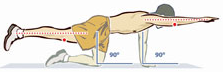
This response is seen a lot when people attempt the deep squat, inline lunge or the rotational stability tests (shown below)…

Screen Shot 2013-03-31 at 9.10.25 AM

Same leg, same arm.  A lot harder than it looks.

—>  Fastest closing thoughts ever.

Many of us are chest breathers… “straw breathers”.

Screen Shot 2013-03-29 at 12.43.36 PM

“Straw Breather”

Don’t be a straw breather.

Breath controls more than you think.

Cheers to the breath and the stretch!

KG
Crushing Your Workout’s Comfort Zone

Quick Tips

Image

Aaaaahhh comfort.  What a great word.  It brings such a heart warmed feeling just thinking about it.  We all love comfort.  The comfort of home, the comfort of socializing with long time friends and family, the comfort of driving the same route to work everyday and the comfort of knowing that everything is going to be alright.

Image

… and here come the black clouds… 😦

Let’s do a u-turn and get real for a few minutes…

… because this post is about identifying and breaking comfort to strive for more.

Comfort is the enemy of building fitness:  getting stronger, running farther/faster, stretching longer, assessing smarter, conditioning harder or choosing to eat wiser.

When you get comfortable in your pursuit body transformation or performance enhancement, you are essentially saying that your work is done.  You slip, lose control, let important things fall to the wayside.

But your work is never done because you are always are work in progress, always.  You have to be, otherwise you have submitted.

I read a Facebook post by Scott Sonnon where he describes himself as being “always a white belt mind”.  If you aren’t familiar with Scott’s background, he is a world champion martial artist turned strength and conditioning innovator.  I don’t agree with everything that he teaches, but he does push the boundaries of what we consider to be “functional” in the training world.  He’s got a bunch of other accolades and awards under his belt (no pun intended) that you can Google if you’re interested further.  He’s extremely bright guy and I enjoy reading this work.

It’s been said that exercising and eating properly is a “lifestyle choice”, and well, as shitty as it is for me to admit this, it really is.  I really don’t like dropping that line because everywhere you walk some donkey is preaching that same old song and dance.

Image

Got lost there for a second… sorry… back to comfort…

Getting comfortable leads to all kinds of silly workout habits that can become hard to break:

  • Lifting the same dumbbells over and over.
  • Never switching your training variables… same reps, sets, etc.
  • Skipping reps and sets, or even entire workouts.
  • Resting for the same amount of time after each effort.
  • Running the same mph, for the same amount of time, for the same distance.
  • Biking for the same amount of time, at the same RPM, for the same distance.
  • Refusing to evolve and try new movements or methods.
  • *** Refusing to change or FEAR of change.

***  This is a big one.  There are a lot of people out there who are scared of the unknown.  They fear the thought of working to improve themselves.  They fear the anticipation of how difficult it will be to lift more weight, condition harder or uncover weak points in their movement.  We end up tricking ourselves into thinking that we are “doing the best that we can”, but there is always another level that we can get to.  Check out this post regarding success, it has a lot of carryover into breaking through the comfort zone in your workouts.

—>  My own story

I’ll step up here… I was scared to put myself out to the world, start a building an audience (again) and take my writing seriously.  I cared too much about what people thought, or how my message would be received, so I threw away nearly 100 pages of written material.  Now I realize that I am on the right track, my writing does serve a purpose and all of this “practice” will force me to break through my own comfort zone.  I learn something new every single day and I love it.

Fear is paralyzing… and it is also just a feeling.  I repeat, fear is just a feeling.

So the next time you step foot in the gym, bring that new strength program with you and give it a shot.  What is the worst that could happen?  You get tired and realize that you’re a little weaker, unstable, immobile than you thought you were?  Who cares.  People care a lot less than you would think.  Go for it.

Most of the bulleted points above are representative of a person who has already committed to fitness at one point in their life and are now stuck in the rut.  They get stuck in a rut and it gets tough to wake up and dig out.  Waking up only happens when you become aware that your current workout habits are no longer serving you well.  You’ve got to realize that your body is really good at adapting to the stresses that are constantly placed on it.  Especially if those stresses never change.

Screen Shot 2013-03-29 at 7.09.46 AM

Experts of developing bad habits.

We become experts are what we repeatedly do, which in some cases is a good thing (good habits), but in a lot of cases, we have become experts of carrying through with poor habits.  Less than optimal habits. (I’ll be the first to stand up here too).  Breaking habits is a billion dollar industry.  Look at guys like Tony Robbins.  He’s built his entire career around teaching people how to break bad habits and develop habits that are more conducive to achieving success.

Change it, don’t be afraid to change it.

But not all of you have begun your pursuit of fitness yet.  Some of you don’t know where to start.  You’re searching for that beginning point to build from. For you folks, you can learn from the mistakes of the folks who are currently stuck in their comfort zone.  Avoid it.  Learn how to progress your exercises, add reps, sets, weight and difficulty of movement.  Train on one leg, two legs, sprint up hills, jump over hurdles, pull your body up to a bar, push your body away from the floor, hold a core demanding static position for time, take joints through a full range of motion even when they feel “locked” up, smash your tissue with a foam roller and then take a lacrosse ball to your feet for a few minutes

Keep progressing, keep pushing forward.

You get the point.

Image

In my own training, I have plateaued.  It is time to move on.  I would’t say that I was in a “comfort zone”, but I definitely reached a point of no return where going longer and harder was foolish… I need to increase the poundage.  Making myself increasingly tired by adding volume during my sessions isn’t accomplishing anything, other than making me… more tired.  Those double 24kg Lifeline Kettlebells have officially become too light.  It sucks to say it, because we had a great run, but it is time to move on to bigger and better kettlebells/barbells/etc.  My conditioning has never been better (except in my hockey playing days) but my backside is weak as hell (article about that coming soon) and my upper body pulling strength is lacking.  It is time to upgrade the gym and increase the demands of my training.  I made it last a while, and it was a great experiment.

Getting comfortable in anything in life can have disastrous outcomes.  Whether it’s career, working at building relationships or making your time worthwhile in the gym, if it is worth pursuing, it is worth pursuing aggressively.


—>  The irony of “having no time” and the comfort zone…

If you’re a person that’s pressed for time and you’re caught in the black hole of a workout comfort zone, you’re committing the ultimate sin.  Do you see the irony in not having any time to workout and then when you do finally workout it is same generic routine that you always use?  No wonder people are depressed and confused from their progress in the gym.

You’re going through the motions… stop now.


—>  Here are 5 quick tips to crushing comfort zone syndrome:

1)  Increase the load of your lifts, now.  (add roughly 2.5-5lbs to each lift every couple of workouts)

2)  If engaging in aerobic:  decrease the time to cover the same distance (move your ass!), increase incline or resistance, monitor your heart rate (effort) or ditch aerobic training altogether and throw down with some interval training sessions.

3)  Trade machines for free weights.  (Machines are for rehab patients and the elderly)

4)  Find someone that trains harder than you do.  (You become who you hang around)

5)  Set a goal with a date and read that goal 2-3 times a day.

If you felt like I was calling you out at any point, you’re guilty.  I feel the same way when I read articles about taking actions to the next level, especially the link I shared early in the article related to success.  There is always room for improvement, room to grow, another gear…


Cheers to crushing comfort in your workouts!


KG