CrossFit Review: The Cautions Against “CrossFit” Training

Quick Tips

What follows is a “flip side” discussion my recent post:  The Brilliance of CrossFit.

Crossfit is big business right now.  It’s tough to page through a fitness magazine or online fitness resource without coming across something pertaining to Crossfit.  It’s becoming big business, attracting a lot of clients and opening gyms in new locations at a feverish pace.

But with all of the buzz about Crossfit, I have to admit that there are things that I admire about it, and things that I flat-out disagree with.  Part of my ongoing personal development as a writer is to avoid letting my emotions take control of the keyboard.  Just because I am sitting behind the computer screen doesn’t mean that I should hide behind it.

What I believe to be best right now is what I believe to be best right now… not what I will believe in five years or even five weeks.  So before you think that this post is pure hatred toward the fitness giant we all know as Crossfit, please take the time to visit the link provided in the first sentence of this post.

Here.  We.  Go.

It wasn’t that long ago that mixing handstands and rowing into a training session was a novel idea for me.  I didn’t fully grasp it, but it looked cool.  I had just start poking my nose deeper into the rabbit hole of fitness, and had decided that I wanted to go deeper.  It was pure curiosity.  Coming out of college, I knew the basics of physical development but not nearly enough to take a stance for one method or another.  It’s like politics, you’ve got to spend some time learning about what each party stands for and then decide what you stand for (or vice versa).

I’ll admit it, I was a traditionalist with fitness at that point.  I was primarily familiar with straight bars, dumbbell work and occasionally throwing in some cable movements.  The idea was that you should lift some weight, rest, towel off, change the track on your iPOD, set up, lift again.  Rinse and repeat.  This was my idea of how we were to build fitness.

My education in fitness and nutrition consisted of what was being taught in the University Kinesiology program, which was “ok” I suppose.  Once I left school for the real world, I soon figured out that the teachings in college were great for building a foundational base of knowledge, but they were holding on to methods of the past.

Standard protocols.  Ancient protocols.  I think that the program was timid to move off the grid and explore concepts like movement screening, functional strength training and more effective methods for developing cardiovascular performance.  My education in effective plyometric training consisted of bunny hops on a rubber mat that had colored dots.

Like I said, it was pretty basic, and outdated.

The first major book of impact came when it was recommended that I read work from Mike Boyle (Functional Training for Sports) and Mark Verstegen’s landmark work (Core Performance).  These two books, among a whole bunch of other works, changed the landscape of how I approached training athletes, Mom’s and Dad’s, working professionals of all ages, kids, etc.  Heck, it changed the way that I approached building physical fitness myself.

It wasn’t all for good.  Some of it, yes.  All of it, no.

I got caught up in that world also.  The world of strength coaches.  Sucked in.  I share this with you because I have become aware that my significance and purpose to my reading audience has got to be one that avoids harsh negativity toward methods.  If you dive deep enough into the archives of this blog, you’ll find some aggressive lash outs.  I won’t remove them, because I would like readers to see my progression as a writer.

It’s important to realize that we are all human, and as humans we have the right to change our tune.  Especially if it moves you closer to your Right Mind.  Right mind is something worth pursuing in my opinion.

While I may not believe in everything, I can certainly discuss methods that I express caution to in such a way that will allow you to formulate your own opinions.  Because at the end of the day, you shouldn’t join a Cross-Fit gym because I tell you too, or avoid a Cross-Fit gym because I tell you to.  Crossfit is not the saviour to mankind, nor is it the modern-day Black Plague of fitness.

My hope is that I can provide simple information about a few topics that can serve to help guide your decision-making one way or the other.

Hopefully, the path that you choose is one that serves you best, you thoroughly enjoy and will last a lifetime.


—>  The Cautions of Cross-Fit

Far and wide, tiny little gyms that are commonly referred to as “boxes” are popping up like dandelions in Summer.

If you’ve got a valid credit card and a weekend to learn a few simple ideas on physical fitness, you… yes YOU could own one of these “boxes” almost overnight.  Talk about a career transition!  I know that the growth of CrossFit is seeing “box” owners rake in income hand over fist.

In my recent post, The Brilliance of Cross-Fit, I touched on a few key points that I really do admire about CrossFit and the community that it has built.  At the end of the day, it’s all about getting people moving and they are doing that in their own way.

Getting people off of the couch and out of their downward spiraling daily routine is a tough task.  Breaking habit and routine and then reforming improved habits and routine can be quite a challenge.  I come face to face with it frequently when writing.

Getting folks excited about being active and maintaining that activity level over the span of a lifetime should be a foundational goal of anyone who gives a rip about the health crisis of our nation.

Less lethargic humans would change a lot of things for the better.

Here come my cautionary words…

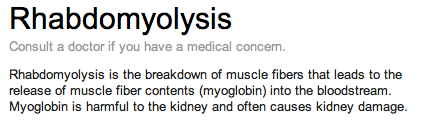
But I do have my cautions about Cross-Fit, even 7-8 years after I first came across a their website on the internet.  At the time, I didn’t know what the heck CrossFit was, so I can’t say that I took the time to learn much about it.  The website was pretty raw, with a few videos here and there, and workouts posted about doing hand stands, rowing, etc.  There was a significant amount of bragging about puking during workouts and “battle” injuries during METCON’s, and even a few badges of honor sent out to individuals who sent themselves to the hospital from accumulated fatigue which led to something called Rhabdomyolysis.

Please click on the link above and read what Rhabdomyolysis is.  Or if you want the summarized version, see the snapshot below:
Image

Here’s a t-shirt print that is handed out (still to this day if I’m not mistaken) to “hardcore” Crossfitter’s who “earn” it:

Image

Photo credit:  Crossfit Southbay

The general theme of Crossfit in the early days, which a lot of people don’t know about now, was this idea that if you worked out and you failed to torch yourself, feel dizzy and fall over from exhaustion, then you weren’t working hard enough.  It was disturbing to say the least.

Now put yourself in my shoes.  Imagine the first impression that you’d receive from reading something like that?  They say that first impressions are everything, and well, my views on Crossfit were tarnished before I ever made it to the methodology behind its existence.

It flew in the face of my beliefs, about the responsibility that personal trainers and strength coaches have with taking care of their clients.  Clients were handing us their hard-earned money with the thought that they were going to be taught/instructed/coached, reshaped and taken care of in a responsible manner.  What I initially saw from Crossfit, were a bunch of randomized workouts thrown together with the sole intent of burning out a client.

They were leveraging the idea that so many people have with fitness… that soreness, fatigue to the point of exhaustion and “extreme” is how the best bodies are built.

Soon after, it became obvious that Crossfit was tugging on the heart-strings of the military.  The hardcore and “extreme” training attitude was appealing to this sector.  I’ve never had to fight in war or been stationed in a war zone,  but I know many who have.  It’s a hard knock existence in these environments.  It’s hardcore, especially when compared to most of us watching our favorite sitcom on Sunday night with a bowl of popcorn.  The soldier is praying to endure the extreme physical demands and mental emotions (not to mention gunfire and explosives) long enough to see their loved ones again.

That is hardcore in my world, and that is partly the appeal of Crossfit to individuals who have been in those situations.  At least that is how I see it.

*** First let me say that I fully support and value anyone who has served our country.  We owe you everything for the freedoms that we enjoy daily, so don’t let this piece of this post rub you the wrong way.

What follows are topics and brief points about those topics which I always caution people of when considering Crossfit.

Olympic lifting for cardio.

This is the first thought that crosses my mind when people ask me what I “think” about Crossfit.  I cannot support olympic lifting as a vehicle to develop work capacity or cardiovascular resilience.  I have read a few of their articles on their site where they attempt to make the justification for such practices, but to me, I feel like I am trying to be convinced (or “sold”) on the idea every time I read it.  The articles lack support and quite honestly seem like a bunch of jargonistic (is that a word?) paragraphs that few people will ever really understand, but these people back it up because it seems like a brilliant reasoning for using olympic lifts to create a work capacity  training effect.

Olympic lifting is highly technical.  A few of the lifts are in the Olympics themselves.  Athletes train for YEARS to perfect their form, timing, mobility, stability, etc… in hopes of winning a gold medal at the highest level of sport competition.

Now, take a 35-year-old de-conditioned working professional who sits all day and can hardly run 1-2 miles without feeling faint.  Ask them to clean a barbell (of a standard protocol weight) for 30+ repetitions.  Tack on 50 box jumps (maybe 50 pull ups) and return to that barbell for 30+ more hang cleans and you’re putting that person at risk for a MASSIVE injury.

In my experience, fatigue while under load (along with asymmetries and muscular timing/firing) is the greatest predictor of an injury.  When a person gets tired, technique and form go out the window in an effort to maintain output.  

Humans are survivalist at heart.  Our bodies will continue to push through physical adversity through any means possible, even if that means that we are moving weight with the wrong muscles and mechanics.  Especially if the mind is conditioned to withstand physical stress.  I am telling you, when you mix fatigue with weight and poor technique, whether you are aware of it while it is happening or not, you are dangerously close to the bomb going off (injury).

And trust me, it will only take one massive blow out of a shoulder, back, knee, ankle or hip to understand the point that I am attempting to make.  We fail to realize that these injuries are lifelong injuries.  We aren’t Adrian Peterson.  We won’t blow out our lower back and be the same afterwards.  We won’t tear our rotator cuff moving weight overhead or jerking our body around on a the 30th rep of a set of kipping pull-ups and return to action without being constantly reminded (via chronic pain, poor performance or range of motion) that it happened in the first place.

At this point, I also don’t buy two other arguments for these practices:

1)  High rep olympic lifting is primarily performed using sub maximal weight.

2)  It’s an evolution in fitness.

Response to #1:  It doesn’t matter to me.  It still goes back to poor technique when tired.  You can’t even make a legitimate excuse for high rep olympic lifting to have great carry over into every day activities.  When was the last time you had to clean a common daily object 30+ times in a day.  How about in a week?  Month?  Year?  Lifetime?  When you’re not in the gym, you rarely clean anything.  I watched a Crossfit video some years back where they were making the point that if you can clean a barbell, you can clean a log, a rock, a sack of potatoes… and on and on.  They have tools that helps us do these things.  If you can’t find a tool to move pick something from a resting floor position to a standing carrying position, just simply ask someone who is stronger than you.  If you don’t know anyone that is strong enough to move the object, use your common sense and get a tool.

Response to #2:  Many are preaching this, but I will say this.  We thought that Nautilus machines were a godsend until some smart folks realized that trapping your joints into a machine’s fixed range of motion was not healthy for your joints.  It wasn’t natural in the least bit and actually shutting down valuable stabilizing muscles in the process.  Now most machines are rendered useless.  We also thought the earth was flat at one point.  I could say that brushing your teeth with motor oil is an evolution for whitening and cavity prevention.

There will be many evolutions in fitness.  It is a constantly evolving industry.  Much of the evolutions we see in fitness are efforts to attract business and revenue while selling new products.  Very few ideas or products ever stick for the long-term.  They come and go.  I can’t say that using olympic lifting for a work capacity training effect is going to extinguish itself any time soon (I am not a fortune teller), but you should know that it is an “evolution” that the jury is still out on.  It’s more like a small shift with a select group of people.

Kipping pull-ups.

I recently slowed down and analyzed the motion of a kipping pull-up from a Crossfitter who I was told is a “beast”.  I attempted to replicate this motion without kipping, but instead receiving what I believe is an adequate amount of assistance from a jump stretch band.  I pulled the band down around my feet and performed strict pull-ups.  All of the way up, pause, all of the way down, pause.  The assistance made me feel like a hero.  I could have down 20+ this way no problem.

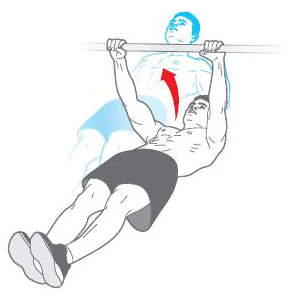
In the kipping pull-up, the momentum of the leg kick transfers force up through the body to the arms where only a slight pull is needed to finish the movement.  Nothing like a strict pull-up.  I actually see a variation of a cheating inverted row during the kipping pull-up, pictured below…

Image

Image

Inverted row… looks similar to kipping pull-ups doesn’t it?

Kicking the legs forward for a body whip-lash makes pull-ups easier.  Some people would say that it’s cheating.  I would agree.  I do see a technique to it, but again, the problem is that most people have awful technique and the stress that is being placed on the shoulder region with poor form has to cause some damage over time.  Crossfit, in my experience with talking to clients who are regular attendees, rarely assesses their clients for past injuries or movement restrictions.  If you put a person on a pull-up bar that walked into the Crossfit gym with slight shoulder dysfunction, past injuries or poor mobility in surround joints that will affect shoulder range of motion and stability… boom goes the dynamite.  

A person very close to me experienced a re-tear of an old biceps injury because he was instructed to rip out some kipping pull-ups.  Total disregard for the past injury.  Now this gentleman is back in the same boat that he was in when he initially tore his biceps.  You could make the argument that it wasn’t kipping pull-ups that are at fault here, and I would largely say that it is the neglect of the owner of the gym, but for giggles, I blame both.

Now I also understand that my friend with the biceps tear could have easily gone a non-affiliated Crossfit gym and experience the same injury.  I am aware of that.  No reminders needed.

No ramp up.

If you’re de-conditioned or new to Crossfit style workouts, you’ve got to prepare yourself.  There is no ramp up for a new person.  There is a set protocol of lifts and workouts that are performed (with variations from gym to gym) regardless of your fitness level.  If you haven’t jumped in the past year, it doesn’t matter because baby… you’re going to be jumping for reps on boxes today.  And probably to a box that is too high, causing poor landing mechanics and increased stress to your joints when you’re asked to repeat that jump for high reps as fast as possible.  The impact forces during jumping, and particularly landing are extremely high.

There is also very little ramp up for the intensity of the WOD’s (as they are referred).  Sure, some gyms conduct baseline tests for your ability to perform a circuit of movements in a set amount of time, row a distance for time or run a distance for time, but to start someone on a work capacity based workout is too much.  Especially when the lifts incorporated are loaded movement like cleans, squats, overhead presses, snatches and pull-ups.  You can argue with me that a pull-up is a bodyweight movement just like a squat, but I will argue with you that they are nothing alike.

Perform a bodyweight squat.  Now perform a pull-up.  Seriously, go and do it, because it will help make my point here.  Which one did you successfully complete with ease and good form?  Probably the squat.  Most people cannot perform a smooth rep of a pull-up.  The legs are the dominant extremities of our bodies and they should be since we rely on them for daily movement.

Asking a de-conditioned client to flail around on the pull-up bar and referring their flopping action as “pull-ups”, is bogus.

I guess the summarized version of my point is that while some Crossfitters have outstanding technique during these WOD’s, the rest of the folks are just engaging in a mess of poorly performed exercises to induce sweat and fatigue, referring to it “forging”.

Battle scars.

I alluded to my dislike for how Crossfit projects injury while pursuing fitness.  I have heard multiple Kool-Aid drinkers express in videos that “shit happens when you train hard like we do”.

It does?  Or does it just happen to you because of the choices that you are making?  Does it have to happen to the 40-year-old Mom with two young children?  What about the 50-year-old mailman?

Primum non nocere… First do no harm.  That’s one of the primary teachings of the Hippocratic Oath, which covers basic medical ethics that all medical students are taught in medical school, around the world.

Cutting some skin on the plyometric box happens.  It happen to me and some of my clients/athletes in the past.  You occasionally lose focus and miss your footing.  But it wasn’t because I was barking at them to perform 50 consecutive box jumps “unbroken” without rest.  It was because an innocent accident happened and they lost their footing.

I didn’t ask my client to wear their shin scrapes like a badge of honor, or demand that they suck it up and stop acting like a pussy.  That would have been weird and completely out of line.  First do no harm.

Bleeding, puking, dizziness, fainting are not things to be proud of while working out, in my humble opinion.  Do people become dizzy or faint while training hard?  Yes, it does happen.  But it shouldn’t be a common occurrence nor should it be promoted as the sign of a successful workout.  But this sort of goes back to the militaristic vibe that Crossfit projects.

Finish the workout at the cost of anything, including your body.

Intensity doesn’t cure all.

High intensity training has nothing to quality training.

I will leave that right there.  Think about that.

The wrap up…

Let’s be clear about what this post represents.

This is the Ying to the Yang of my previous post, which I link to multiple times above and once again link to down below.

In no way am I telling you NOT to join a CrossFit gym.  I am informing you about my opinion as I have them at this very moment in time.  Crossfit has come a long way to clean up its image from the early days, but as I mentioned, I may always have distaste for it because of how they projected themselves early on.  You just don’t forget things like that.  It’s like when go into a local restaurant for the first time and you witness the owner tell a nice young family with a crying baby, “Shut that kid up because it’s pissing off the rest of my paying customers”.

I would consider never patronizing that restaurant again.

Again, I encourage you to hop over to my previous Crossfit post where I praise many things about the fitness giant…

Feel me?  🙂

Cheers to having the right to choose…

KG

The Brilliance of CrossFit

Quick Tips

crossfit logo

The day that I opened by mind and stopped hating on other methods of building physical fitness is the day that I realized that I could write a book, teach it and be a resource to the masses.

If you’ve spent any time lurking around this blog, you’ve undoubtedly come across some posts where I take some jabs at the fitness phenomena known as CrossFit.

While I am not endorsing CrossFit in this post, I do have to pay this fitness monster a few compliments.

Because you see, CrossFit, while not completely in line with my thought process and methodology, has achieved some feats (in a matter of a few years) that hundreds of other fitness fads have failed at miserably.

This post is devoted to acknowledging these feats.  Yes, CrossFit, I am going to pump your tires for a bit here, but that doesn’t meant that you and I are buddies by any means…

Community.

The first thing that I noticed about CrossFit, all silly training methods aside, is that they have built a community that is unlike any other.  And they did it record time, as CrossFit was founded in 2000.  We all probably know someone who is a member of a CrossFit “box”, and you have probably heard this person (in conversation) talk about how great it is to workout with the support and encouragement of other CrossFitters.  I hear it all of the time.  It’s the same attitude and encouragement that you receive when you are apart of an athletic team.  No one wants to see anyone else fail.  The attitude seems to be that although the workouts are accomplished on the individual level, the greater victory is that everyone finishes the race.  I can get on board with that.

Intensity.

CrossFit has given people the hope that working out doesn’t have to be centered around cheesy aerobic bars and headbands, water weights, hamster training (withering away for life on the treadmill), or Jazzercise while blasting the Tina Turner on a treble dominant boom box.  It brought “cool” back to giving a training session an all out effort, using every god-given muscle to complete physical tasks.  It brought the idea that it’s ok to put the “work” back in working out.  A little effort never killed anyone, although pushing it too far has definitely hurt some people.  Breathe a little intensity back into your training.  You’ve probably got another safe gear to switch in to.

Positive body composition shift.

This builds off of intensity.  I like that Cross-Fit doesn’t preach the same old song and dance about working out and it’s benefits for fat loss.  Yes, I talk about this a lot on this blog, but I also stress the importance of fat loss as BY PRODUCT of working both hard and smart.  Work capacity style training sessions will burn fat like none other, especially when using total body lifts and sub-maximal loading.  Assuming the person doesn’t injure themselves or cause long-term internal damage from the training stimulus, it is safe to say that training sessions that involve metabolic resistance-like efforts are going to rip fat off of your body.  I’ll even go as far as saying that you can avoid an alterations in your diet (for a little while) and see great results.  Lord knows the number of people who would rather exercise over tweak the basics in their diet.  It’s habit, I get it, change is difficult for me too.

Iron and women.

Women are afraid of rough hands and bulky bodies.  Okay, this might be a bad stereotype, but in my experience most women hate the idea of loading a barbell and lifting it with their silky soft hands.  Heaven forbid ladies, you roughen them up a bit.  CrossFit made this cool also.  When you walk into a CrossFit gym, it’s common to see no cable machine or rubber coated handles of any kind.  It’s mostly iron.  Skin on iron.  Those women who survive the first few weeks of torture, seem to end up becoming addicted to moving weight with hands on iron.  You wouldn’t believe the kind of resistance that most strength coaches and personal trainers get when attempting to integrate barbell work into a clients training regimen.  I applaud you CrossFit.

Crazy lifts.

CrossFit has done what even strength coaches and highly educated personal trainers could not.  They made olympic lifting “cool”.  The people in my social network that regularly attend CrossFit training sessions think that Olympic lifting (snatches, cleans, jerks, etc) is the greatest thing ever.  In CrossFit’s infancy, I know for a fact that these lifts were being taught half-ass.  It was disturbing to think that they were even posting videos on their website, basically showing the crime being committed.  Over the years, however, I have noticed that they have progressively taken steps forward in the reinforcement of technique during such lifts.  If nothing else, it’s encouraging to see gym owners/trainers taking the time to coach before loading them up for a WOD.

Bright minds surface.

Guys like Kelly Starret are the greatest thing that has ever happened to CrossFit.  I say no more.

Rogue.

Rogue training equipment is brilliant.  I have been looking for rugged training gear that is meant for un-polished concrete for a while.  I always wondered why I couldn’t find anything that could be used OUTSIDE of the controlled gym environment.  The fact that the bumper plates from Rogue are recycled from used car tires and have minimal bounce when dropped, are a major turn on for me.  I can support this.  Part of the problem of a person’s struggling commitment to fitness is the dullness of the place where fitness happens.  It’s like going to school when you were younger… you knew that you had to go but dreaded waking up for it every day.  Get outside, train in your garage or your basement.  Don’t be reckless, but don’t be afraid to switch up your scenery to keep your training fresh and interesting.

The Wrap Up…

I feel like I just went to confession.  I purged myself on this blog just now.  But as I alluded to earlier in the post, I have to stop holding grudges against ideas and methods that I don’t like. Life is too short, there is value is just about everything.  The sad part is that the strength coach community does the same thing.  I won’t fall victim to being narrow-minded.

Since adopting this sort of open-minded thinking, my writing skills (book-wise) have improved tremendously.  I no longer feel pigeon-holed to writing about any one technique.  “Cornered” might be a better description.  All methods work just fine when executed properly, it’s just a matter of assessing yourself both physically and mentally, your goals and then getting to work.


Cheers to some positive things that Crossfit has brought to the table!

KG

How to Eat To Stay Lean for Life

Quick Tips

In talking with a friend today about nutrition and how my eating habits have evolved over the last 7-8 years, I realized how simple eating should be, yet how complicated we make it.

I firmly believe that how you eat as a kid has a lot to do with how you end up eating as an adult, although I have seen plenty of people who make the shift to eating wholesome food as adults once they become fed up with nagging health, weight or poor self image.  We all have our breaking points, it’s just a matter of when.  I have to say that I cannot applaud these people who have made the positive shift from eating chips and soda to veggies and lean meat.

It always amazes me what the smallest of changes can do for a person’s body transformation.

I generally eat the same rotation of foods weekly.  I never count calories and I generally eat until I feel satisfied.


Every single day, breakfast makes or breaks you…

My breakfast rarely ever changes from the usual 3 egg omelette with veggies, Ezekiel Bread toast with peanut butter and banana slices (dusted with cinnamon).  I wash it down with 2-3 glasses of ice cold water and a few cups of coffee.

This breakfast is a meal that I look forward to every single day.  I typically eat at 5:30am, taking my time to consume the meal while I write or read articles.  This breakfast fuels me until about  11am/12pm, when I feel the need to refuel with some lunch.  Lunch is usually a salad with meat (salad+meat makes it a MEAL) or a homemade protein bar.

I have written about my homemade protein bar recipe, which I originally got from Precision Nutrition’s awesome cookbook Gourmet Nutrition.  I can’t say enough about the protein bars or any of the other meals that can be found in that book.  The pesto pizzas are one of my favorite meals of all time.  Incredible replacement for eating the highly processed stuff from a local pizza place.


Eating is an acquired taste (no pun intended)…

As I started to learn more about food and the power that food has on general health, performance and body composition, I began to realize that most of the recommendations were exactly the same, just reorganized.

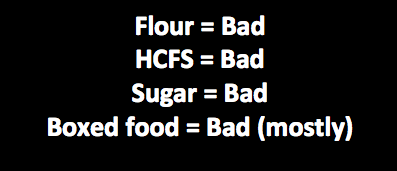
I started to use simple guidelines to help direct my grocery shopping and food choices…

Screen Shot 2013-04-25 at 8.13.09 PM

Screen Shot 2013-04-25 at 7.48.39 PM

Screen Shot 2013-04-25 at 7.45.20 PM

Best food tips grandma

bad food list


I still use these tips personally to remind myself and also to help others dial in their eating habits.

I get asked all of the time what foods I eat.  I usually throw out the, “If it wasn’t grown from the earth or have a mother, I don’t eat it” line, or lately just to keep it short and sweet, I will say “plants and meat”.  Why say any more than that?  It’s not rocket science, so why complicate for a person that is already being bullied by a food industry that pumps out garbage advertising.

The response is sometimes, “But Kyle, you eat red meat?!”

My response, “Hell yes.  Plenty of it”.

Using these reminders can take the anxiety and confusion out of grocery shopping (where you decide whether to make a monetary commitment to the food) and actual preparation and consumption of meals (which is determined what you have purchased).

I began to take notice that I would eat whatever was stocked in the house, as most of your probably do the same.  I know for a fact that  many of you also do this.  Whatever is convenient and quick is going to be consumed.  Right?


Learn how to cook, it’s probably the answer to most of your problems…

In my pre-cooking days, I began to notice that whatever was being prepared by someone else dictated what I was going to be eating.  If it was chocolate chip pancakes wrapped around sausage links, cake, donuts, Hamburger Helper, Ramen and on and on… it didn’t matter, it was going to be eaten.  It sounds like a dumb observation, but if you aren’t preparing your own food, you are eating whatever is being prepared by the person that is.  Sometimes that means eating junk.

Once I took the responsibility and the initiative to cook my own food for each meal, I started eating clean.  I saw tremendous positive changes in my body appearance and performance.  Clean eating to me is eating food that is free of any processed crap (ingredients).  Clean eating involves eating food that rots it if isn’t consumed fast enough.  Clean eating can be a complete pain in the ass.  You’ll have to grocery shop 2-3 times at the grocery store because you are eating food that has a shelf life of just a couple of days, or, you’re eating so much of these quality foods that you literally run out.  It’s all worth it.

I learned through experience that if I ate quality food, I could eat just about as much as I wanted.  My plates for dinner and breakfast are still piled high with quality food that does nothing more than nourish my body and refuel it for the next training session.

Here is another bold statement for all of you to chew on:  Eating clean makes you shit.

And while you may giggle and blush when I say that, it really isn’t a laughing matter.  Eating quality food will make you eliminate regularly, which is so incredibly vital to your digestive system and overall health.  So many of us walk around with toxic food pooled up in our bodies.  Open the lid to a restaurants dumpster on a hot and humid Summer day, take a big whiff.  Now imagine what your stomach looks like after Doritos, Bagels and French Fries.

Our bodies can develop inflammation and sometimes aches and pains from the food that we eat!  Who knew.

Ever heard of leaky gut syndrome?  A lot of people have it and don’t know it.  Years of processed food and sugar finally taking it’s toll on their intestinal lining.

I know people who have been damn close to going under the knife because they thought they were suffering from a rotator cuff injury, when in fact it was an awful inflammatory effect from their diet.  They changed some things in their diet prior to surgery and boom shakalaka, pain free.

This isn’t hocus-pocus.  I have talked about how some health professionals are proactive and some are reactive.  I would suggest that you seek out good information from those professionals who are proactive.  Holistic healthcare used to be a taboo topic, but more and more folks are finding that holistic practitioners may in fact not be crazy voodoo witch doctors after all.

We can complain about our healthcare system all we want, but we need to take look in the mirror at the individual level first.  We, as humans in these modern times, should be able to take care of ourselves.  We have to pull up our pants, comb our hair, brush our teeth and start being big boys and big girls when it comes to our discipline to be conscious of food and consistent with movement.

Start small and simple, build on the momentum gained.


Un-educated, computer-less cavemen could figure it out…

For thousands of years, people have been eating plants that were grown from the earth and adding in a little animal meat, eggs and nuts for protein.  Our ancestors weren’t entirely sure when the next meal was going to come.  True hunters and gatherers.

Plants and pastured meat is medicine (and fuel) and it can be leveraged (very simply) to bring your body composition and overall health back to center, despite your movement habits.  Although adding in a simple movement regimen is like pouring gasoline on the fire.  Mix both and you’re set up for success.


The wrap up…

So at the end of the day, I do suppose that the best nutritional intervention is the one that you are willing to stick to.  Whatever and wherever your starting point is, your ground zero, just do something to shift your nutritional intake in a positive manner.

These days, I view nutrition as I do the purposeful workout.  It is an acquired taste that you’ll become better and better at as you continue move deeper into the realm of nutrient dense foods and seasonings while slowly eliminating the sugary/processed foods of the past.

A pure trade out.  In the good, out with the bad.

You’ll become better at identifying good food from bad food every single time you make a conscious effort to shop smarter at the grocery store.

Cooking becomes less chaotic and more systematic over time.  Just like working out regularly to build physical fitness, cooking and eating wholesome food becomes more and more fun every time you do it.  It’s just a matter of sticking it out long enough to make the habits stick for the long-term.

I am in no way talking about eating for six-pack abs and veiny arms, I am talking about fitting into your college jeans and feeling comfortable (and proud) about taking your shirt off at the lake.  For some of us, maybe it’s eating to save our lives (literally).  For most of us, body restoration means regaining our self-confidence and our pride in a body that we worked hard to develop.  Improving how you feel about yourself and how you perceive others feeling about your bodily image with do wonders for your happiness.

It’s a feel good story for everyone.  When was the last time someone regretted taking back control of their body?


Cheers to common sense eating for life!


KG

(This article in no way implies that I am supporting Paleo or any other diet trend).

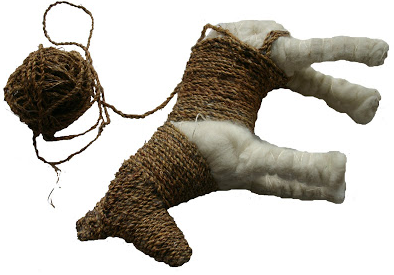
Stop Dragging that Horse Around, Bury It.

Brain Training

burying the horse

No horses were harmed in the creation of this post…

The mind controls the body.

The more that I read strength and conditioning, physiology, physical therapy related books like Diagnosis and Treatment of Movement Impairment Syndromes (who the hell reads stuff like that for fun?), anatomy, blah blah blah…

The more I realize that this material is all pretty similar.  It hasn’t changed much, and most of the information is just a new angle on an old topic.  Not that taking that approach is bad thing, because anything that gets you to think differently about your habits is definitely worth a read, whether you choose to adopt that new way of thinking or not.  It’s important to explore all angles before deciding on what you believe personally (at least that’s my opinion).

However, reading all of these fitness/movement related books has made me realize that I might be missing something, which is the mind’s powerful control over the body.

I have come to realize that fit people or those people who have decided to commit to a life of health think differently than those folks who don’t care so much.  It’s a mindset.

Personal development is another major interest of mine.  I’ve spent much of the last few years trying to figure out what drives my own thought processes and habits in an effort to break through to higher levels of my own success.  I am not talking about money here.  I am taking about developing every aspect of my life.

  • Relationships
  • Interests and passions (achievement drive)
  • Stress
  • Financial
  • Physical development

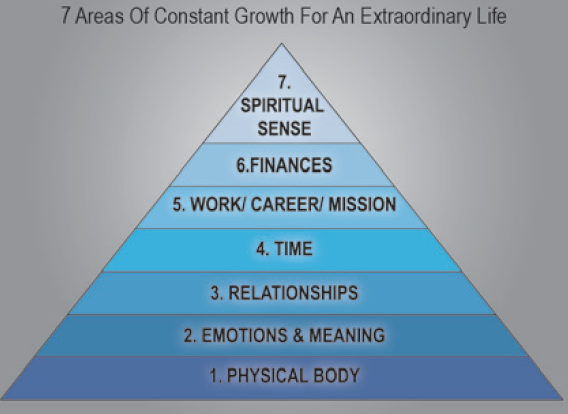
I had been thinking about my need to improve upon the  bulleted points (above) for quite some time, so I started to seek out coaches and methods to help me in my quest.  I stumbled upon a hierarchy that absolutely hit the nail on the head…

Personal development

Photo credit:  Tony Robbins

I used to think that personal development gurus like Tony Robbins were real clowns… then I grew up and realized that they know their shit.  They live what they speak on, and their results transform people’s lives.  Live and learn Kyle.

Personally, I discovered that I had hit barriers in my effort to move to the next level in all seven categories (above), and it largely because I was dragging numerous “horses” around.  The barriers were all mental restrictions.

mental thoughts control us

My aspirations of what I wanted be in the future were being clouded by the thoughts circling inside of my own head in the present.  Like dead weight, I was limiting my ability to think creatively, see opportunity and therefore achieve.  It’s frustrating to think that we can hold ourselves back from achieving greatness simply by generating poor thoughts about ourselves.  It’s crazy actually.  So many naturally talented people fall victim to this kind of thinking for an entire lifetime.

The mind is more powerful than you can ever imagine, and it most likely the main reason that your body isn’t where you want it to be.

With that being said, this blog is heavily centered around building a physical lifestyle that can complement all other areas of your life.  If you look at Tony Robbins theories on achieving mastery, developing the physical body is #1 on the depth chart.

Think about that.  How you perceive yourself physically speaking, and how you think about others perceiving you physically can impact all six of the other areas of personal growth.  Much of this perception is either a drain or a boost to your self-confidence and posture that you carry around daily.

Screen Shot 2013-04-20 at 12.47.05 PM

Hair not included.

You don’t need six-pack abs to have confidence in your appearance.  In fact, six-pack abs are overrated.  Let the Jerry’s down at the Jersey Shore  enjoy their baby-oiled bodies and six packs.

Start your journey by burying the horses that you continue to drag around.  Whatever those horses are.  Bury them.  Put them behind you and head for greener pastures.

In the past, I thought that talk like this was dumb.  “I didn’t need it”, I told myself.  Boy was I wrong.

Thankfully I snapped out of that cocky attitude and realized that burying the past is the first action step to achieving anything you can dream up for the future.

For example, if you’ve been struggling with sticking to a healthful recipe of exercise and eating nutritious food, you should take a look at your social circle.  What are they doing?  Are they exercising and eating well?

You become like the people who you hang with the most.  Behavior is contagious.  It’s been a concept that has been written about extensively, so this is not made up B.S.

—>  Read an article from the New York Times here:  Are Your Friends Making You Fat? 

If your social circle eats like crap and is proud of it, you’re likely to follow suit.

If your social circle spends most waking hours in the recliner watching reality shows, you’re like to do the same.

If your social hates like and constantly plays the “victim card”, you’ll throw that card out at the first road bump you come across.

the human domino

Get out of this line.

Don’t become the human domino… have the courage to break the cycle and step out of line.  You’ll find that it is extremely uncomfortable and you may want to quit at times, but I am constantly reminded that nothing amazing in life (that is worth doing) is ever easy or free of growing pains.

It’s the beautiful struggle.

Go for it.  Less talk, more walk.  All of the tools are right there in front of you, pick them up and use them.

I will do the same and let’s see where it gets us, I bet we will all be thrilled with our end result.

Cheers to  breaking the bad and breathing in the good…

KG

Secret Service Kettlebell Snatch Test

Kettlebell Training

The Secret Service Snatch Test, which I’ll refer to as the SSST (so I don’t have to keep spelling it out) is a brutal workout.  

More of a test of will power, really.  

The SSST is a test of how many snatch reps can be accumulated inside of a 10 minute time limit usig a 24kg (53lb) kettlebell.  

That’s it.  

Set the timer for 10 minutes… and go.  

Achieving your best finish in the SSST will require a combination of:

  •  Kettlebell Snatch Technique
  •  Work capacity
  •  Conditioning 
  •  Luck with skin integrity (if the skin rips, it’s painful)
  •  Courage to suffer, and keep suffering, and keep…

The courage aspect of conditioning tests like this is a huge determining factor of your score.

Are you able to center yourself, refocus your thoughts when the fatigue and discomfort pile on?   

When I say “discomfort”, I’m primarily referring to the hand discomfort.  

The micro motion between the palm of the hand and kettlebell handle gets worse sensitive as the minutes pass by.     

Chalk helps, but only to a point.  The more you stop to re-chalk the hands, the more time you’re losing where snatch reps could be completed.  

Some people will crack because of the fatigue.  Hitting 200+ snatch reps in such a short timeframe is aggressive.  

There’s little… wait… likely no rest to be taken.  

For those who have tested their conditioning in competition or periodicially in a training cycle, you know what redlining your engine’s capacity feels like.  

Achieving a personal best with the SSST is going to require redlining.  

Ideal for removing callouses…

If you’ve been wondering how to remove built up hand callouses, you’ve come to the right place.  The SSST will remove skin in less than 5 minutes or your money back. 

From a hand care standpoint, this isn’t a workout you’d want to try that frequently.  Probably not even monthly.  Testing your toughness 2-3 times per year is probably more than enough.  

When I was really heavy into kettlebell training, I was testing my SSST 2-3 times per year at very sporadic times.  

It’s not like you’re going to wake up and feel the desire to snatch hardcore for 10 minutes.  I’d pick a day, maybe 7-10 days out where I knew I would be giving the SSST another attempt.  Then I’d section off 1-2 days after for rest, recovery and hand caudling.   

Best case scenario, you’ll have some juicy blisters on both hands.  Worst case scenario, you can expect to rip plenty of skin.

This attempt shows approximately 238 repetitions.  I say “roughly” because counting slow to 238 can cause your eyes to play tricks on you.  So if you have 10 minutes to spare to watch the video, feel free to call me out if I did less or throw me a bone if I did more.

It’s an “approximation” because I’m too lazy to keep double checking the reps.  Counting to 238 across 10 minutes is something I don’t have the attention span to do 3-4 times.   

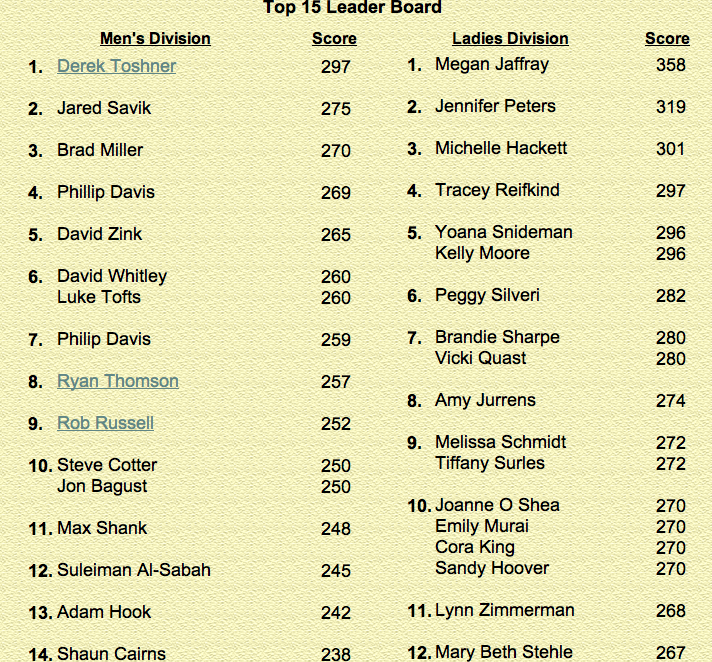
Some of the top dogs in the kettlebell community are snatching get around 270+ reps, documented through video.    

Secret Service Snatch Test Leaderboard

If you want to paste your name amongst the leaders, film it.  It’s important to document your performance with un-edited video.  No one cares about word of mouth reporting.  Prove it.

Breaking down my SSST attempt….

In the early minutes of the test, I typically aim for 10 snatches per arm before switching.  

Honestly, this is for counting reasons only.  After watching the video, I start miscounting the number of snatches per arm pretty quickly.  

The biggest mistake in this attempt was taking a break.  It’s obvious why.  When you’re timing and aiming for most reps, taking a break doesn’t help anything.  

A combination of boiled over physical stress and mental conflict led me to resting for a brief time.  Getting to the root of the why I stepped away, it’s purely mental.  My body could have tolerated the pain, my mind talked me stopping.  

Based on tempo, I’m guessing it cost me 5-10 reps at least.  

It get’s hard to get your thoughts in order during a conditioning test like this.  The mental governor is begging you to quit, your hands are pleading you to quit.    

I could feel the skin loosening up, blisters forming and eventually the ripping on my hands towards the end.  The impact of this impacted my outcome.

Kettlebell Snatch Lockout

Critiques…

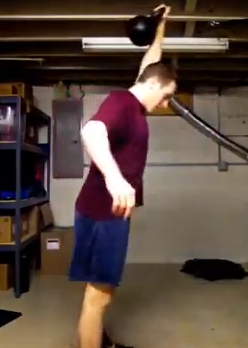
My posture at the top of the snatch is not great.  

But, I’m going to cut myself some slack on this because the ceiling in my basement is exactly 7 feet 4 inches high at the lowest point of the trusses.  When snatching indoors, I make sure I’m locking out in between the beams, just in case.  

My personal decision to green light kettlebell snatches in my basement at this ceiling height were made based on snatch technique.  The kettlebell turns over the hand prior to reaching full shoulder extension which the highest my hand will be.

Check out this post for a freeze frame depiction of the snatch.

My worst fear is bouncing the kettlebell off the trusses and losing control.  Lord knows what comes next, but I have an idea.  

The fatigue is so high during an SSST, it wouldn’t be good.  

The forward body lean is a counterbalance to the kettlebell, but I also think it’s a precautionary measure to avoid impact with the ceiling.  The kettlebell is not traveling straight up and down, it’s traveling in an arc.  

Counterbalance like this is because the kettlebell is not traveling straight up and down, it’s traveling in a subtle arc.  

I’m counterbalancing to avoid being thrown backward.  On the downward descent, a slow motion video or a keen eye at full speed should show an opposite reaction, where I’m leaning back slightly as a counterbalance.  

The obvious:  Later in the SSST, technique erodes to ugliness and it’s survival time.  

I accept the risk in this. 

BODY FATIGUE IS A TECHNIQUE KILLER.

If you’re training MetCon, you must be able to look yourself in the mirror and accept the risk of doing so.  

To my knowledge, it hasn’t been directly pinpointed in studies but injuries become more predictable as fatigue alters the control you have over your movement.  

Performing a box jump when 100% fresh is a lot different than the same box jump after you’ve done 25 thrusters and a 500-meter row.  

Plain and simple.  If you accept the risk of your actions, then you’re taking ownership for the injury.  

Decreasing the number of times I switch hands with the kettlebell would get me more reps.  Every hand transition is essentially a lost repetition to the final tally and wasted energy in doing so.  

If I was working longer sets per arm before switching, say 15-20 reps, I could gain an additional 10-15 snatches across the 10 minutes.  

Years ago, the first time I attempted the SSST,  I was hovering around 180-185 reps. 

Kettlebell training was relatively new, snatch technique wasn’t as great and I was unfamiliar the demands of 10 minutes of torture.   

The repetitions gained is progress.  Progress is always the goal, no matter how small or large.  A step forward is a step in the right direction.  

Make sure you subscribe to my YouTube channel, where I detail the kettlebell snatch along with many other exercises discussed on this blog.  

Cheers to The Secret Service Snatch Test,

Kyle

How to Use a Suspension Trainer: The Set Up and Basic Tips

Quick Tips

While combing over the internet, I noticed that there aren’t many updated resources that share how to properly use a suspension trainer.

Since I am a huge fan of suspension training, both for beginners and advanced trainees alike, I thought I would share the need-to-know information on how to successfully use a suspension trainer.

Here we go…


1)  Buy one.

Jungle Gym XT

I know this sounds elementary, but you have got to actually buy a suspension trainer for rest of this post to have any positive effect.  Stop hovering and purchase yourself a nice unit.  I highly suggest buying from a couple of manufacturers… LifeLine Fitness and TRX are the major players.  My suggestions for these units are based on personal experience and also a simple observation of what the best coaches in America are using with their athletes and clients.  I am a LifeLine Jungle Gym fan (pictured above).

You can build your own suspension trainer if you like.  They are really nothing more than tough nylon/kevlar straps with handles and loops.  Not rocket science.  However, if you choose to build your own suspension trainer, I will caution you that your fate rests in the quality of your craftsmanship and material you choose to use.  Build at your own risk.

Below are links to the different brands that I mentioned, along with a link to a


2)  Anchor the suspension trainer.

Suspension trainers are effective because you’re able to leverage your body mass against the directional pull of gravity, which creates the  resistance during exercises, demands stability and mobility, etc.  If your anchor point is sketchy, your suspension training is going to suffer.  Trust me, you don’t want to be in the middle of a set of body rows wondering if the anchor point is going to collapse.  The nice part about suspension trainers is that you can anchor to a closed door, or directly overhead, so you have options.

From personal experience, only anchor the suspension trainer on the door if you have no other options.  Why?  Because anchoring on the door limits your exercise selection, and can make a lot of the exercises, well, awkward.  Anchoring to a door means that the suspension trainer will never cross the mid-point of its range of motion, so exercises will start with arc built into them.  The door prevents any backswing, and any low hanging movements will have arc built into them no matter what.  Due to the arc, exercises like push-up+knee tucks (aka: atomic push-ups) and suspended hamstring curls now become much more difficult.  If you’re a beginner, your technique may suffer because of the increased difficulty of these movements.

Hanging the suspension trainer directly overhead gives you immediate freedom to not only progress all movements, but also regress movements to make exercises more effective.  The overhead position also allows for an infinite number of body positions that will serve to increase or decrease the training stimulus for any given exercise.  Take a simple (yet awesome) movement such as body rows.  For a beginner, I would suggest starting in a lean back position where the heels are firmly planted into the ground surface, while the pulling action is angled to anchor point.  Angling the pull will decrease the resistance of the exercise, increasing the likelihood of successful reps.  For an advanced trainee, I would suggest moving your body directly underneath the anchor point so that the pulling action is completely vertical (up and down).  In this position, the resistance is completely vertical.  The loading is therefore increased the exercise is much more difficult.

***  It is also worth mentioning that increasing horizontal (in relation to the ground) body position (supine or prone) with exercises like push ups and body rows increases the challenge of keeping the body rigid and straight from head to toe.  In other words, there is an increased demand on the torso musculature to maintain this static posture while work is being done elsewhere.

The suspension trainer, based on the body row example, is highly adjustable to fit any strength level.  The stimulus presented to the beginner is just as intense (based on their fitness level) as the stimulus received to the advanced trainee (based on their fitness levels).


3)  Angles

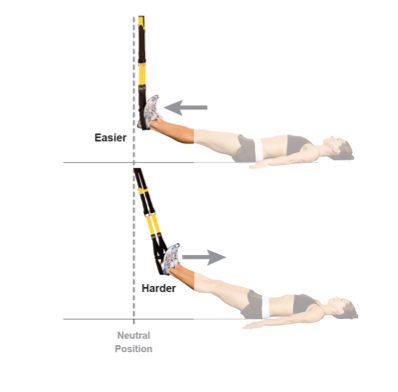
Suspension training is all about body position in relation to the anchor point of the straps.

Suspension Training Angles

Figuring out the angles to increase or decrease the difficulty of movement is part of the beauty of suspension training.  Using the body row example, the more your move your feet underneath the anchor point, the harder the exercise becomes.  Push-up + knee tucks become more difficult based on your starting position.  When your feet start directly underneath the anchor point, the effort to complete the knee tuck decrease.  If you walk your hands out and start with feet ahead of the anchor point, the knee tuck becomes increasingly resisted based on the natural arc of motion.  Move your feet behind the anchor point, and arc becomes an assistance aid for the knee tuck.

Screen Shot 2013-04-19 at 9.53.25 AM

The feedback from the suspension trainer is immediate.  If you know your target reps for a given exercise, it becomes trial-and-error to locate the proper body position that allows for completing those reps without sacrificing technique and challenging your body through the entire range of motion.


4)  Integrated movement.

One beef that I have heard from others regarding the use of suspension trainers, is the lack of real world carry over.  The argument is that a suspension trainer workout regimen lacks a loaded vertical posture (thinking standing) during most exercises.  This is true.  However, we often forget that not every exercise needs to look like something that we are doing in real life.

mowing the lawn

Example:  I often reach for and return water glasses to the highest cabinet of my kitchen, but do I need to lift dumbbells on my tippy toes to train for that?  No.  I push a lawnmower around my yard in the Summer.  Do I need to push a heavy sled to train for that?  No.  This is a personal beef that I have with people who attempt to make exercise look like real world activities.

The suspension trainer is a tool, and as a tool you need to understand that it is not going to be the be all end all of fitness.

Using a suspension trainer will accelerate and enhance your ability to successfully perform other physical tasks in life, no doubt about that.

The suspension trainer provides a low-cost, high reward training stimulus to its users that incorporates movements that are safe and effective.  The workouts are meant to enhance the physical function of our bodies, and as a byproduct you’ll improve your body composition.  Building strength, stability and mobility with a multi-dimensional approach will yield high carry over into daily life.

Besides, if you enjoy suspension training and you’re making progress, why worry about anything else?  The grass is not always greener on the other side, keep it simple and stick to your recipe.  Trust your training.


5)  Buy a book or reference a website for exercises/workouts.

There are thousands of free resources on the internet that share knowledge about suspension training.  I am an exercise technique junkie, so I am going to recommend that you keep checking my YouTube page of updated videos of suspension training exercises, but the choice is yours.

As I always do on this blog, I will remind you to keep your efforts on the suspension trainer simple.  Avoid going fancy with your movement.  Lock in technique for basic movements and then progress (using common sense) from there.  To this day, I still use the simplest of movements which include (but are not limited to):

  • Push ups
  • Body Rows
  • Planks (and variations)
  • Shoulder activation exercises
  • Chin Ups
  • Knee tucks
  • Explosive jump variations
  • Squat variations
  • etc.

If you are finding that you have progressed beyond the basics, add a weight vest and work through the same exercise variations once again.  It’s that simple.  Keep progressing in an intelligent manner.

It’s just a matter of challenging yourself each time you use your suspension trainer.


Cheers to suspending yourself!

KG

Life Should Be Lived: Steve Jobs Shares 3 Life Lessons We All Need to Hear… Again

Quick Tips

I am  an advocate of the waging war against autopilot living.

You know, the little thoughts that circle around inside of our head that tell us that we are somehow pre-disposed to having what we have and experiencing what we experience.

That we will never be anything more than average at best.

Forget that.  Shoot for the moon.

Humans are the most powerful creatures on the planet because we have the ability to re-route the road map of our live, and we can do this at any age, as long as we consciously comprehend that we have the power to do so.

Here are 3 extremely powerful (yet simple) videos from one of the greatest visionaries this planet has ever seen: Steve Jobs.


1)  Steve Jobs:  Secrets of Life

2)  Steve Jobs:  Failure

3)  Steve Jobs:  Passion for Life’s Pursuits

It’s an incredible thought we can re-program our minds and move in an entirely different direction from where we are now.

Life’s rough sometimes, there is no denying that, but it’s also way too short to spend any time being miserable.

Life is a game to be played, so get your ass off the bench and get yourself in the game.

Cheers to squeezing just a little more out of life!

KG

Redemption: The Matthew McConaughey Ninja Bodyweight Workout

Quick Tips

Ninja Workout

I have to start by offering an apology for misleading many of you on my previous article about Matthew McConaughey’s training philosophy.

All I did in that post was mention that “he sweats”, which I suppose made complete sense to me as the main point of the article, but left many of you readers wanting to know some specifics.  After reading it, I feel that the message was received, but it was lacking in “how-to” knowledge.  That is my error.  I hope to redeem myself by sharing a decent little bodyweight workout with you today.

In honor of Spring of course.

Hopefully I can redeem myself here.  I’m nervous.

Wisconsin Mecca

The Mecca of the Midwest

As the weather warms up here in “God’s Country”, Eau Claire, WI, the doors begin to open to all sorts of opportunity for engaging in physical activity outside.

Training outside is the greatest.  It’s freeing.  The air is fresh (depending on where you live), the sun is beaming, and quite honestly, when you train outside the workout seems less monotonous than training indoors.  Training inside year round can make you feel like a rat in a laboratory.

[Segue…]

Alright, let’s talk about Matthew McConaughey’s workout, because that is why we are gathered here today.

Screen Shot 2013-04-05 at 6.54.52 AM

Super awkward that I had to post this pic, but needed the visual.

Let’s face it, guy has the kind of body aesthetics that women drool over and men want, yet his theory on physical activity and what it takes to maintain his physique is so incredibly simple.  I love that.  Why complicate matters?

Performance-wise, I’m not entirely sure how strong the guy is, if he has aches and pains or any sort of endurance.  But aesthetically he is doing alright.

Just sweat everyday… doing something.

I received a lot of interest in the previous article, so I should probably man up and post a workout of his… ahemmmm… or at least a workout that I believe he may enjoy participating in.

Well, ok… maybe it’s just a workout that I designed with the thought that if he and I were hanging out, he would enjoy working through it with me.  Based on some of his older interviews in Men’s Health, he tends to avoid the gym whenever possible in favor of training outside in a more natural environment.

Workout structure

Equipment:  None (although a heart rate monitor is highly encouraged)

Time commitment:  30 minutes-ish

Difficulty:  3/5

Screen Shot 2013-04-02 at 7.01.47 AM

*** Warm up***

Start with a 5 minute run at 70-75% of your HRM (heart rate max)

  • Run #1)  2 minutes at 80-85% of your HRM (heart rate max)

—>  Recover to 130 bpm

a)  20 Push Ups (no rest leading into the run)

  • Run #2)  2 minutes at 80-85% of your HRM (heart rate max)

—>  Recover to 130 bpm

b)  20 Reverse Lunges (no rest leading into the run)

  • Run#3)  2 minutes at 80-85% of your HRM (heart rate max)

Recover to 130 bpm

c)  20 Bodyweight Squats (no rest leading into the run)

  • Run#4)  2 minutes at 80-85% of your HRM (heart rate max)

–> Recover to 130 bpm

d)  20 Burpees (no rest leading into the run)

Finish with a 5 minute run at 70-75% of your HRM (heart rate max)


Fitness thoughts

Buy a heart rate monitor.

If you are going to take your cardio training seriously, you need to be monitoring your work bouts and your recovery time with a heart rate monitor.  Buy the cheapest version Polar sells if you are concerned with cost.  It will work just fine and help guide your training.  The heart rate monitor will give you insight into your progress.

On the 2 minute run, which is the “work” portion of the session, you’ll notice that I suggest running at a pace that is 80-85% of your heart rate max.  The easiest way to figure out your heart rate max is to get on a treadmill, crank it up to a ridiculously high speed and incline, and sprint until your vision becomes blurry.  The test ends when the treadmill spits you off.

JUST KIDDING!

Seriously, don’t do that.  However, there are some equations that you can use.  Most heart rate related formulas have some flaws in them.  They are just formulas, estimations, so this makes sense.  The Karvonen formula is “the best of the worst” when it comes to finding max heart rate.  No matter which formula you choose, remember that your heart rate “training zones” are going to be ESTIMATED.  I’d rather you use these formulas than the really old school method of finding heart rate, which is nothing more than 220-(Your Age).  220-your age is quick, but there is a lot of room for error.

Recover to 130 bpm after each run prior to working through each bodyweight exercise.  Recovering to 130bpm will keep your training efforts aerobically challenging and also provide an beats per minute (BPM) mark to green light the next work bout.  Recovering based on time is ok in a pinch, but recovering based on when you heart is ready to go again is preferred.  Your body will let you know when it’s time to go back to work.

The bodyweight strength movements that follow the rest periods are integrated to break up the monotony of running and provide a low load resistance based training stimulus.  Don’t expect to build great amounts of strength from just 20 reps of any of those movements.  If fact, let me re-phrase that last sentence… You will not build strength from those exercises.  Not at that rep count, with bodyweight load, etc.  Unless you are relatively reconditioned (which isn’t a bad thing) or new to purposeful exercise.  You may experience some strength gains, but I would rather see you work through a dedicated strength program at that point.

Scale the workout.  Run for less time if you need to.  Decrease the reps on the bodyweight moves if you need to.

Or, if you are battle hardened, increase the running time, add a few more rounds of bodyweight moves, etc.

Take your training outside and get some fresh air.  It will change the training experience.


Cheers to breaking up the monotony of running!


KG

Inspiring the Unknown

Quick Tips


Old video, timeless lesson.

The greatest reward of conquering something epic in life often goes unknown to the person that accomplished it.

Huh?

Let me explain this a for quick second.  Hold on tight it might get a little messy (you’ve been warned).

Crushing a task that seems so challenging, so lofty that you’re not even sure how you are going to achieve it (even though you know you’re going to scratch and claw to get there) provides a valuable lesson in character building.

However, attaining goals also inspires onlookers (known or unknown) to initiate an all out attack their goals, dreams, aspirations.

Seeing is believing, and when we see our peers accomplish something epic, it provides just enough of a motivational nudge for us to follow suit.

I call it inspiring the unknown, and it happens every single day.

Screen Shot 2013-04-08 at 6.28.43 AM

Paying it forward.  Nearly 2 years ago, while waiting in line at a coffee shop in Minnesota, I watched my best friend buy a lady’s coffee who was waiting in line behind us.  When she asked why he would be so generous, he proudly announced, “It’s my pleasure, I am paying it forward and maybe you can do the same”.  As he said this, 5-6 other people who were also waiting in line overheard his remarks.  The lady was floored by his random act of kindness.  I was floored at the impact of the event.  I think about it often.

Imagine that.  A single gesture can spread to 6-7 onlookers who then go on to tell all of their friends and family of what they had seen, which then spreads like wildfire to their social networks and beyond.  Inspiration.

These days, I am more impressed by the average person’s journey to greatness than another superstar athlete or hotel mogul.  

(Please know that no one is “average” and that we are all unique.  We become average in our day-to-day actions/behavior).

Average people inspiring other average people to demand more of themselves.

We can all relate to the average person.  The ripple effect of an average person pursuing greatness is amazingly simple.  We see a person achieve their goals, then we want to achieve our goals.  It becomes fuel.  We witness their own personal victory, than we desire that same success.

That’s cool.

That’s a fantastic reason to set targets in life and work relentlessly place the arrow dead center in the bullseye.

Screen Shot 2013-04-06 at 11.06.26 AM

You’re killing two birds with one stone.

Bird #1)  You’re proving to yourself that you’re capable of achieving more than you once thought possible.

Bird #2)  You’re (without awareness) inspiring others to stop testing the temperature of pool and finally jump in.

Screen Shot 2013-04-05 at 11.08.26 AM

It’s scary when standing at the bottom of the mountain, gazing up at the rocky terrain that you’ll have to traverse in order to get to the peak.  Dead scary.  It can be crippling actually, to the point that you never take action.  We all approach these obstacles with a different mindset.  Some people see them as speed bumps and some people see them as 20 foot walls.

But having the conviction to traverse that rocky terrain is what inspires other people to do the same.

If you have a pulse, you’ve undoubtedly run into that 20 foot wall and thought, “shit”.  It’s easy to throw in the towel when that happens.  In fact, it’s a hell of a lot easier folding your cards at the first sign of adversity than it is to grind it out until the bitter end.

A hell of a lot easier.  But that doesn’t build character and that doesn’t inspire others.  That creates feelings of regret.

Screen Shot 2013-04-08 at 6.28.51 AM

As it relates to physical activity, I have thought about quitting more times than I’d like to admit during a workout/run/bike.  More than I can remember. In fact, every single time I squat I feel like racking the bar 3 reps short of my scheduled reps for the day.  It would be so easy.  No one would notice, right?

Or how about eating habits?  I would love to eat pizza everyday and wash it down with a couple of craft beers.  Or eat raw cookie dough for breakfast every single morning.  That would be great.  But I cannot do that.  It’s not conducive to achieving my goals nor is it the example/standard that I have chosen to set on this blog.  I’d be letting you down and letting myself down.

In my athlete days, we would condition ourselves to the point of exhaustion early in the season to prepare for the physical demands of the season.  There were many occasions, with my lungs in my throat, I considered dogging these conditioning practices just enough just to get by.  My teammates wouldn’t notice, right?  I could finish in the middle of the pack, not first but definitely not last.  I didn’t have the heart to do it.  Because if I chose that path, then the next guy would do it, then the guy after that would do it, and on and on.

If I dogged it, who does that serve well?  Who draws inspiration to push on from someone else’s average effort?

keep calm and workout

It took me a really long time to realize that most shitty hands that we are dealt in life rarely involve events that we can’t handle.

We are equipped with the tools and capacity to endure mental and physical stress.

But occasionally, our internal wiring gets mixed up and our systems begin to malfunction.  Our attitudes become vulnerable and we feel ourselves start to stumble toward what we want.  Then crawl.  Things get difficult.  That 10 foot wall turns into a 15 foot wall, then a 20 foot wall.  The negative self-talk appears.

When this happens, remember all of the people who need the motivation of your success to start making moves to achieving their own.

Someone is watching you, wondering if you’ll have the courage to keep pushing forward.

And when you do, that someone who has been lurking, waiting for inspiration, is going to spread their wings and take flight for no other reason than they saw you do it.

That’s one kind of trendy domino effect that this world needs.

Just like my good friend that chose to pay it forward.

Conquering and inspiring.  Two great words to add to your life resume.


Cheers to inspiring average people to accomplish amazing things!


KG

De-Rustifying Your Spine: The Second Greatest Warm Up Drill of All Time

Quick Tips

de-evolution of the desk jockey

Isn’t this the truth?

I would say that the following drill is the greatest of all time, but I can’t.

That honor goes to the old lacrosse ball on the feet trick.

However, I am probably incorrect in saying that the drill that I am about to share with you is a “release” per se.

It’s actually a mobility drill, but every time I work it into my warm  ups (almost every workout), I feel like I have released built up pressure from my thoracic (mid-back) spine.  It’s crazy.  When you start paying attention to your body and what it needs, most of us will find that we can benefit greatly from a simple mobility drill like this.

Here’s the drill…

—>  Tennis Ball Thoracic Extension/Flexion

Find two tennis balls (or buy some tennis balls) and tape them together to form a “peanut”.  Set the peanut at mid-back, with your spine rested in between the “valley” created by the taped tennis balls.  You may feel extremely… “locked up” at first.  Fear not.  Move within a comfortable range of motion.  Typically, this “locked up” sensation will alleviate after the first few repetitions.  Exhale and wrap your spine around the ball as you fall into extension.  On the crunch up (flexion), take a belly breath and repeat the exhalation once again, moving back into extension.  Rinse and repeat.

Awesome drill for those who sit a lot.

Movement cues:

  • Start at the mid-back and work up to just below the top of your shoulder blades.
  • Roll in half turn increments on the tennis ball peanut as you make your way to the top.
  • Keep your butt and as much of your lower back pressed firmly against the ground.  Hinge around the tennis balls.
  • Perform 5 hinged crunches, 5 overhead extensions and 5 alternating arm raises at each level.

How often should you work this drill throughout the week?

In my personal opinion- and it will vary from person to person- I think that the following a mobility plan based on your age is a great recommendation.  It would look like the following:

Mobility per week chart


Closing Thoughts

The key with this mobility drill is to get aggressive with it.  By aggressive, I am not saying to gore yourself on the tennis balls and be ruthless with your crunches.  I am saying that it’s important to accumulate some repetitions as you slowly move the peanut up your spine.  Work through the 5 rep recommendation (multiplied by the 3 exercises per level) and be diligent with it.

Just to reiterate the movement of the tennis ball, I give it a half roll starting at the mid-back, moving all of the way up to the top of my shoulder blades.  It’s incredible how “locked” up our bodies can become and this mobilization is fantastic for helping to relieve some of the effects brought on by poor posture and sitting.  There is other work to be done beside mobilizing, but this is a great place to start.

This drill addresses primarily flexion and extension through the hinging effect.  Remember that your spine also rotates and flexes laterally, and we can chat about some simple drills to work through for regaining rotational/lateral flexion freedom in another post.

We sit way too much.  We sit in our cars, sit at our desks, at the dinner table and then on the couch.  Then, then the day is over, we head to bed for the night and lay in less than desirable postures.

Please don’t feed me some bull crap about not being able to avoid sitting.  I get it.  Just as we are all too busy to workout, I get that too.

The point is that you’re becoming aware of simple home remedies that can help to off-set some of the undesirable effects of growing your butt cheeks to the chair.  It takes all of 2 minutes to work through the tennis ball thoracic extension/flexion mobility drill.  2 minutes.

Screen Shot 2013-04-04 at 6.38.35 AM

Seeing is believing.  This is not a good posture to take to the gym. 

We have to make a conscious effort to unwind these issues before they manifest themselves into disaster… ahemmm… injury or degeneration.

Maintaining joint mobility is important for long-term health, so don’t give a weak effort on this.  Moving the way that your body was designed improves performance and appearance.  Steal some tennis balls from your neighbors garage, a local high school or just buck up and buy a fresh can of tennis balls for $5 or so.  It’s worth it.


Cheers to re-greasing that rusty spine!

KG