Some of the Greatest Workout Habits of Effective Fat Loss and Athletic Performance

Quick Tips

I transferred this post away from the static page tabs above and into a post.


1)  Resistance/Ground Based/Closed Chain  

  • Train with some kind of load or resistance as much as possible.  Push, pull, pick up, drag, carry, swing, squat, throw, slam… All with resistance and all with your feet on the ground whenever possible.  Lean muscle tissue from resistance training.
  • Women… (sigh)  You are not going to get “bulky” from picking up some weight.  Don’t be afraid of it.  If you knew what it takes to look like a bodybuilder you would laugh.  You’ll never get there.  If you want the “toning” effect… pick up some weight and get after it.  Nothing is sexier than a woman who is confident in the gym.  Ease into it with some effective bodyweight movements and progress from there… you’ll quickly realize what I am talking about.

2)  Aerobic/Anaerobic (Cardiovascular improvement)

  • Aerobic training isn’t the devil… it just isn’t the most effective way to drop fat and look better.  If time is a factor, and it often is, choose other methods.  Stress your cardiovascular system using as many different methods as possible.  Run, bike, paddle, swing kettlebells, use battling ropes, row, etc.  Train yourself to be effective for short distances, up inclined hills and stairs, flat surfaces, etc.  Run for distances that develop endurance-like qualities.  Do it all.  Tweak the variables:  distance, work periods, rest periods, direction, speed, heart rate recovery etc.
  • Grandma was right, “All things in moderation”.  Too much of anything can be bad.  Too little can be bad too.  Find the balance.

3)  Multi-joint (movements not muscles)

  • Unless you are rehabilitating an injury or training for a bodybuilding competition, avoid training your body in isolation.  The body is a single unit made up of many moving parts.  Train your body to push, pull, squat, hip hinge, lunge, carry, sprint, etc… and your body composition will change and performance will improve. Muscles and joints love working together (synergistically) to accomplish physical tasks.

4)  Joint-by-Joint Approach

  • The body is a vertical Jinga tower of joints.  Some joints need stability and some need mobility.  Improve your joint stability where you need it and improve your joint mobility where you need it.  Failure to obey this simple rule puts you at risk for injury and decreased performance.  Generalized approach, but simple and crazy effective.  Freedom to move effortlessly in all 3 planes will keep you functional in the game of life, and most of all, injury free.

5)  Progression

  • In simple terms, every movement/exercise has an easier or more difficult variation.  You just have to know where to start based on your abilities.  Beginners must spend time mastering the basics before they earn the right to step up to a more difficult variations.  Proper progression means leaving your ego at the door.  Do what YOU can do, not what you WANT to do or what you saw someone else do.  This is a hard lesson to learn and implement (even for myself a long time ago), but in the long run, you’ll thank me on this one.  All in good time.

6)  Rest—Recovery—Regeneration

  • Train hard… Recover harder.  If you train hard enough, you can elicit a training effect worthy of fat loss, injury prevention and performance.  If you recover hard enough, you will give yourself the opportunity to continue to train hard week in and week out.  Recovery is also where the magic happens.  Nutrition, sleep, hydration and soft tissue maintenance allows for a life-time of physical success.
  • Foam roll, roll a lacrosse ball on your feet, iron out your muscles with Tiger Tail.  Keep your tissue healthy and circulation flowing.  Stretch and elongate.  Soft tissue restrictions are uncomfortable and breed dysfunctional movement.
  • Think of it this way:  You have a full glass of water prior to a workout (water= energy levels/fatigue, etc).  After completing your workout, you have now poured out have of the glass of water (fatigue, hormones, muscular health, etc).  It is important to put more water back in your glass before the next training session (rest, recovery, regeneration). If you pour all of the water out of your glass before you replenish what you have poured out from your workout, you increase the likelihood of injury, over-training and increased fatigue, sub-optimal hormone balance, decreased performance, etc.  Keep your glass full and your body will be happy.  Keep the balance.

8)  System

  • Just like movements over muscles… choose systems over workouts.  Following a system will always get you further in the long-term than “winging” it.  A system is a road map to body re-design.  It’s a plan.  A system allows a person to experience continued improvement in a scheduled, intelligent, measurable and safe method.  A system is sustainable and built for the long-term.

*  There are a TON of variables to consider when designing a training program.  Getting yourself adjusted to healthy habits takes repetition/practice and body re-design takes time.  Be patient but don’t get complacent.  Attack the hell out of it.  You have to be all in on this.  Focus on doing the simple things really well and be patient as your body begins to experience positive aesthetic change and performance.


Cheers to the full integration of these habits…

KG

Crushing Your Workout’s Comfort Zone

Quick Tips

Image

Aaaaahhh comfort.  What a great word.  It brings such a heart warmed feeling just thinking about it.  We all love comfort.  The comfort of home, the comfort of socializing with long time friends and family, the comfort of driving the same route to work everyday and the comfort of knowing that everything is going to be alright.

Image

… and here come the black clouds… 😦

Let’s do a u-turn and get real for a few minutes…

… because this post is about identifying and breaking comfort to strive for more.

Comfort is the enemy of building fitness:  getting stronger, running farther/faster, stretching longer, assessing smarter, conditioning harder or choosing to eat wiser.

When you get comfortable in your pursuit body transformation or performance enhancement, you are essentially saying that your work is done.  You slip, lose control, let important things fall to the wayside.

But your work is never done because you are always are work in progress, always.  You have to be, otherwise you have submitted.

I read a Facebook post by Scott Sonnon where he describes himself as being “always a white belt mind”.  If you aren’t familiar with Scott’s background, he is a world champion martial artist turned strength and conditioning innovator.  I don’t agree with everything that he teaches, but he does push the boundaries of what we consider to be “functional” in the training world.  He’s got a bunch of other accolades and awards under his belt (no pun intended) that you can Google if you’re interested further.  He’s extremely bright guy and I enjoy reading this work.

It’s been said that exercising and eating properly is a “lifestyle choice”, and well, as shitty as it is for me to admit this, it really is.  I really don’t like dropping that line because everywhere you walk some donkey is preaching that same old song and dance.

Image

Got lost there for a second… sorry… back to comfort…

Getting comfortable leads to all kinds of silly workout habits that can become hard to break:

  • Lifting the same dumbbells over and over.
  • Never switching your training variables… same reps, sets, etc.
  • Skipping reps and sets, or even entire workouts.
  • Resting for the same amount of time after each effort.
  • Running the same mph, for the same amount of time, for the same distance.
  • Biking for the same amount of time, at the same RPM, for the same distance.
  • Refusing to evolve and try new movements or methods.
  • *** Refusing to change or FEAR of change.

***  This is a big one.  There are a lot of people out there who are scared of the unknown.  They fear the thought of working to improve themselves.  They fear the anticipation of how difficult it will be to lift more weight, condition harder or uncover weak points in their movement.  We end up tricking ourselves into thinking that we are “doing the best that we can”, but there is always another level that we can get to.  Check out this post regarding success, it has a lot of carryover into breaking through the comfort zone in your workouts.

—>  My own story

I’ll step up here… I was scared to put myself out to the world, start a building an audience (again) and take my writing seriously.  I cared too much about what people thought, or how my message would be received, so I threw away nearly 100 pages of written material.  Now I realize that I am on the right track, my writing does serve a purpose and all of this “practice” will force me to break through my own comfort zone.  I learn something new every single day and I love it.

Fear is paralyzing… and it is also just a feeling.  I repeat, fear is just a feeling.

So the next time you step foot in the gym, bring that new strength program with you and give it a shot.  What is the worst that could happen?  You get tired and realize that you’re a little weaker, unstable, immobile than you thought you were?  Who cares.  People care a lot less than you would think.  Go for it.

Most of the bulleted points above are representative of a person who has already committed to fitness at one point in their life and are now stuck in the rut.  They get stuck in a rut and it gets tough to wake up and dig out.  Waking up only happens when you become aware that your current workout habits are no longer serving you well.  You’ve got to realize that your body is really good at adapting to the stresses that are constantly placed on it.  Especially if those stresses never change.

Screen Shot 2013-03-29 at 7.09.46 AM

Experts of developing bad habits.

We become experts are what we repeatedly do, which in some cases is a good thing (good habits), but in a lot of cases, we have become experts of carrying through with poor habits.  Less than optimal habits. (I’ll be the first to stand up here too).  Breaking habits is a billion dollar industry.  Look at guys like Tony Robbins.  He’s built his entire career around teaching people how to break bad habits and develop habits that are more conducive to achieving success.

Change it, don’t be afraid to change it.

But not all of you have begun your pursuit of fitness yet.  Some of you don’t know where to start.  You’re searching for that beginning point to build from. For you folks, you can learn from the mistakes of the folks who are currently stuck in their comfort zone.  Avoid it.  Learn how to progress your exercises, add reps, sets, weight and difficulty of movement.  Train on one leg, two legs, sprint up hills, jump over hurdles, pull your body up to a bar, push your body away from the floor, hold a core demanding static position for time, take joints through a full range of motion even when they feel “locked” up, smash your tissue with a foam roller and then take a lacrosse ball to your feet for a few minutes

Keep progressing, keep pushing forward.

You get the point.

Image

In my own training, I have plateaued.  It is time to move on.  I would’t say that I was in a “comfort zone”, but I definitely reached a point of no return where going longer and harder was foolish… I need to increase the poundage.  Making myself increasingly tired by adding volume during my sessions isn’t accomplishing anything, other than making me… more tired.  Those double 24kg Lifeline Kettlebells have officially become too light.  It sucks to say it, because we had a great run, but it is time to move on to bigger and better kettlebells/barbells/etc.  My conditioning has never been better (except in my hockey playing days) but my backside is weak as hell (article about that coming soon) and my upper body pulling strength is lacking.  It is time to upgrade the gym and increase the demands of my training.  I made it last a while, and it was a great experiment.

Getting comfortable in anything in life can have disastrous outcomes.  Whether it’s career, working at building relationships or making your time worthwhile in the gym, if it is worth pursuing, it is worth pursuing aggressively.


—>  The irony of “having no time” and the comfort zone…

If you’re a person that’s pressed for time and you’re caught in the black hole of a workout comfort zone, you’re committing the ultimate sin.  Do you see the irony in not having any time to workout and then when you do finally workout it is same generic routine that you always use?  No wonder people are depressed and confused from their progress in the gym.

You’re going through the motions… stop now.


—>  Here are 5 quick tips to crushing comfort zone syndrome:

1)  Increase the load of your lifts, now.  (add roughly 2.5-5lbs to each lift every couple of workouts)

2)  If engaging in aerobic:  decrease the time to cover the same distance (move your ass!), increase incline or resistance, monitor your heart rate (effort) or ditch aerobic training altogether and throw down with some interval training sessions.

3)  Trade machines for free weights.  (Machines are for rehab patients and the elderly)

4)  Find someone that trains harder than you do.  (You become who you hang around)

5)  Set a goal with a date and read that goal 2-3 times a day.

If you felt like I was calling you out at any point, you’re guilty.  I feel the same way when I read articles about taking actions to the next level, especially the link I shared early in the article related to success.  There is always room for improvement, room to grow, another gear…


Cheers to crushing comfort in your workouts!


KG

3 Conditioning Workouts to Check Your… Conditioning.

Quick Tips


One of my favorite things to do when I am training in a commercial gym is to use machines for everything but what they are intended to be used for.

Take the infamous Smith Machine for example.  I have never performed a Smith Machine specific exercise on this piece of equipment, and I never will.

The Smith Machine

The $2,000 “coat rack”

Why?  Because…

1)  I am an able bodied individual and should therefore be working with free weights.

2)  I value moving the through a natural range of motion with and without external resistance. (Smith machine is guided on tracks)

Squats, lunges, curling (I don’t even know how this would work) rowing are not for the Smith Machine, assuming you are an able bodied individual.  A Smith Machine to me is a glorified Nautilus machine.  They make great coat racks and leaning stations for recovering trainees in most gyms.

However, I have used the Smith Machine to execute movements such as:

  • Inverted rows (2 arm and 1 arm)
  • Plyo-like Bench Throws
  • Lateral torso holds
  • 1-Arm Push-Up progressions
  • Mountain climber progressions
  • Hip mobility warm ups

I may have to whip up a post about how to leverage a Smith Machine for executing different movements, we’ll see.

But whatever, this post wasn’t intended to bash Smith Machines.

The goal here was to provide you with some non-traditional ways to use some common pieces of equipment.

Enjoy…

 Screen Shot 2013-03-26 at 1.36.00 PM

Better use of treadmills… Incline + MPH

—> Treadmill Hill Sprints:

  • Set the speed of the treadmill to 8-10mph.
  • Set the incline to 8-10 degree of inclination.
  • Sprint for 15 seconds, step off and rest for 15 seconds (this equals 1 round)
  • Perform 10-12 rounds.

Screen Shot 2013-03-26 at 1.36.23 PM

The greatest low impact conditioning tool of all time.

—>  Stationary Bike 20:10 Protocol (I will not refer to it as the Tabata Protocol!)

  • Set the bike to medium resistance (you should be able to pedal around 90-100 rpm)
  • Spin as hard as possible for 20 seconds, follow that will 10 seconds of rest (this is one round)
  • Complete 8 total rounds and check fatigue levels.
  • If you have more in the tank, complete another 8 rounds or modify as needed.
  • *** I have commonly modified this type of workout to 6 rounds x 2-3 sets with 2 minutes rest in between.
  • Stay seated the entire time.


—>  5 Mile Ride for Time

I have talked about this conditioning test before on this site, somewhere, but it deserves to be talked about again.  Here are the specs on this challenge:

  • Ideally you’ll use a Schwinn Airdyne, but you can use any other stationary bike in a pinch.  Make sure that the bike has a mileage gauge on it, otherwise you won’t know when you’ve completed the 5 miles.
  • Set to light-medium resistance… and GO.
  • Again.. pedal pedal pedal and keep pedaling.  There isn’t much else to say here.
  • Chart the time that it takes to ride the full 5 miles, record it, attempt to beat it the next time around.
  • *** On the big fan Airdyne, my best is 11min30sec.  It was a bear.  I think my friend and fellow strength coach Joe Gorshe (Bemidji State Hockey) finished around 12:15-12:30min if I am not mistaken.


—>  Kettlebell Swing Breath Ladder

  • Grab a kettlebell that you know you can swing for at least 20 reps.  
  • Match the number of swings with the number of breaths for each round.
  • Set the kettlebell down after each round of swings and take an equal number of breaths.
  • Begin the next round of swings once you finish your breathing reps.
  • ***  This is high volume swinging, but shifting focus to calming your breathing really slows things down nicely
  • Focus on your swing technique.  Move from hips, stay tall and rigid at the top of the swing.

Kettlebell Swing Breath Ladder


—>  Closing thoughts…

A couple of these methods incorporate interval style training.  Go hard during the work sets of an interval training session.  Rest is coming don’t you worry, but go hard when it is time to work.

Always wear a heart rate monitor if you can.  It’s a great way to gauge your efforts and your ability to recover from those intense efforts.  It also keeps you honest during your training sessions.  Monitor your progress, how long it takes to recover, how high your heart rate reaches during each work set, etc.  You can learn a lot about your conditioning levels/progress by checking keeping an eye on this information.

On the treadmill conditioning workout, remember that the incline of the treadmill is going to require that you drive your knees all the way through with each stride.  If you get lazy, even just for one stride, you could catch your toe on the belt of the treadmill and get spit off and look ridiculous.  Avoid this.  Drive your knees, drive your arms, extends you hips with each powerful stride.

Use your head during these training sessions.  Don’t be afraid to scale the intensity down to suit your needs.  There is no shame in that.  It’s a process, you’ll get there.  If you have questions on how to go about doing this, just ask… I will field any and all questions…


Cheers to building up your conditioning!


KG

*** Coming up next:  The next Saga in the Coach Hacker series…***

Is Aerobic Training Bad? (a completely non-evidenced based discussion)

Quick Tips

Screen Shot 2013-03-23 at 1.30.41 PM

Aerobic Training!

Aerobic training was a hot topic a few months ago, and it will continue to be talked about topic for years to come.

First it’s bad, then its’s good, then it’s bad, then it’s good.  Back and forth, back and forth.

There is a thought process among many fitness professionals- mainly strength coaches and personal trainers- that striving to improve aerobic conditioning is a bad thing.  Actually, some magazines and websites have almost labeled it as sinful.

—>  The Most Useless Exercise Ever for Fat Loss

Activities like biking and running are the probably the most popular methods used to improve aerobic fitness, with running taking the cake for popularity it would seem.

I’ll just come out and say it:  Aerobic training is not bad.

It isn’t!  It’s just not the optimal choice for certain goals.

In my humble opinion, fat loss is one of those goals, along with sports performance.

There are other methods, depending on your goals, that would be a much better fit for moving your closer to those goals, especially if you are in the market for dropping useless tissue like fat and uncovering your abdominals.  If you’re aiming at fat loss, there are better methods to choose from than just steady state cardio.

A simple (but smart) strength training routine will crush aerobic training if you’re shooting for body transformation.

You may have seen this side by side comparison between these two athletes.  One athlete races in an aerobic dominated sport and the other races in a sprint (anaerobic) dominated sport:

sprinter versus a marathon body

Some time ago, aerobic training was labeled as a junk method of conditioning for athletes who play fast-twitch sports.  The premise was that if you train slow, you’ll be slow.  There is some truth to this I must admit.  For athletes that need to be fast, aerobic training should make up far less of the off-season training pie than other more effective training methods like strength and power training, sprinting, anaerobic conditioning.

—>  Admirable goals, wrong vehicle 

Again, the problem is that most people say that they want to lose weight (or fat) and put on some lean muscle, then all they do is participate in aerobic activities in an effort to burn calories.  Over time, they see the weight scale move, but quickly become confused because they still don’t like what they see in the mirror.  Frequently aerobic training will cause an “atrophied” look over time.  If all you did was train aerobically, you’d get skinny, decrease muscle mass and lose strength.  I’ve seen it happen time and time again.

Confused by the image in the mirror, these people then panic and jack up the duration and frequency of their aerobic training, pushing harder and harder in hopes of seeing positive changes in the mirror.  It still doesn’t happen.  Weight is dropping, but they look like they haven’t eaten in days.

When all they see is weight loss and muscle atrophy, they become discouraged and render exercise ineffective.

It’s not aerobic exercise’s problem that you didn’t achieve your goals, it’s your problem.   You chose the wrong vehicle to get you to your destination.  So choose another vehicle.  It’s not the end of the world, but you’ve got to adjust your training habits to get your body back where you want it.  Just don’t point the finger at aerobic training.  The bodily changes that occur from high frequency, long duration steady state exercises are quite predictable.

Here is a great article from Jason Ferrugia about why he avoids aerobic training:  10 Reasons Why I Don’t Do Aerobics

—>  Aerobic training has a place in my workout regimen, absolutely…

Personally, I engage in an aerobic training session- usually riding the Schwinn Airdyne or jumping rope- about 1-2 days per week.  It fluctuates depending on my workout schedule, but aerobic training is still very much a part of my training routine.  I throw on my heart rate monitor to keep my efforts measured- not too high and not too low on the bpm- and I get to work.  The aerobic effort will last anywhere from 30-45min depending on how I feel.  The goal is to flush my body from the previous days of hard training, increase blood circulation and just sweat.

In all honesty, sometimes I train long and slow just to sweat.

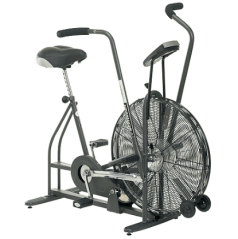
Schwinn Airdyne

Awkward lady not included.

I never try to set records, although I have ridden the Airdyne frequently enough to know how far I should be riding (mileage-wise) for a give time period.  If I am training aerobically, I am ALWAYS wearing a heart monitor, keeping my BPM (beats per minute) within my aerobic range.

This is what my typical training week looks like right now:

Aerobic, Anaerobic, Strength Training

This chart changes depending on what my goals are…

Remember, I can change these efforts based on physical needs for races/events/hockey season, the time of year (Summer, Winter, etc) or if I am simply interested in pursuing a different body appearance.  I am my own guinea pig.  Self-experimentation with physical effort has always been an interest of mine.

One of the biggest concerns I have with aerobic training is overuse.  Especially folks who run or bike for hours and hours every week.  The risk for overuse injuries skyrockets for those people who long duration exercisers.  These injuries can develop for a number of reasons, including:  impact of activity (running is high impact), muscular imbalances, poor fitting footwear (causing compensations), poor cycling mechanics (poor set up, posture), pre-existing imbalances that begin to surface as chronic pain, etc.

There’s an old saying:  You can’t run to get fit, you have to get fit to run.

Consider what that means for your situation.  Is your body fit enough to begin training for long durations?  Are your joints primed to withstand the ground impact forces from activities like running?

It’s well known that running is great for increasing bone density, yet conversely running with poor form (aka: slapping the pavement) is nothing more than repeated high impact stress.

Check out this snippet from a comparative running study:

Screen Shot 2013-03-26 at 8.47.52 AM

“During each foot strike the body is exposed to repeated impact forces of estimated to be two to three times the body weight of a runner”.

Again, I am not singling out running or saying that it’s a sin, I just want you to consider your training vehicle.  It might be something that you need to consider seriously, especially those of you who are battling aches and pains like shin splints, hip strains and or knee pain.

Aerobic Training Sucks!

Before you bash aerobic training, consider what results you want from your training efforts.  At the very least, aerobic training initiates rapid circulation in the body, which is a benefit that you cannot put a price on.  Rapid circulation helps promote proper internal functioning of your body.  It’s a really great thing to get the blood pumping as much as possible.

Screen Shot 2013-03-26 at 8.52.41 AM

Rapid circulation is a crucial reason to exercise in the first place.

Is this a bird’s eye view of aerobic training?  Yes, but you have to keep an open mind.  Training should be customized to you and you only.

While a lot of people do have the same training goals, you should take the time to investigate if your workout methods are in fact the right fit for your goals.

If they aren’t, switch them.  Easy as that.

Don’t over-complicate something that should be kept simple.

Cheers to accepting the red headed step child of fitness… aerobic training!

KG

*** Coming up next:  Creating stakes to create incentives for getting into shape…