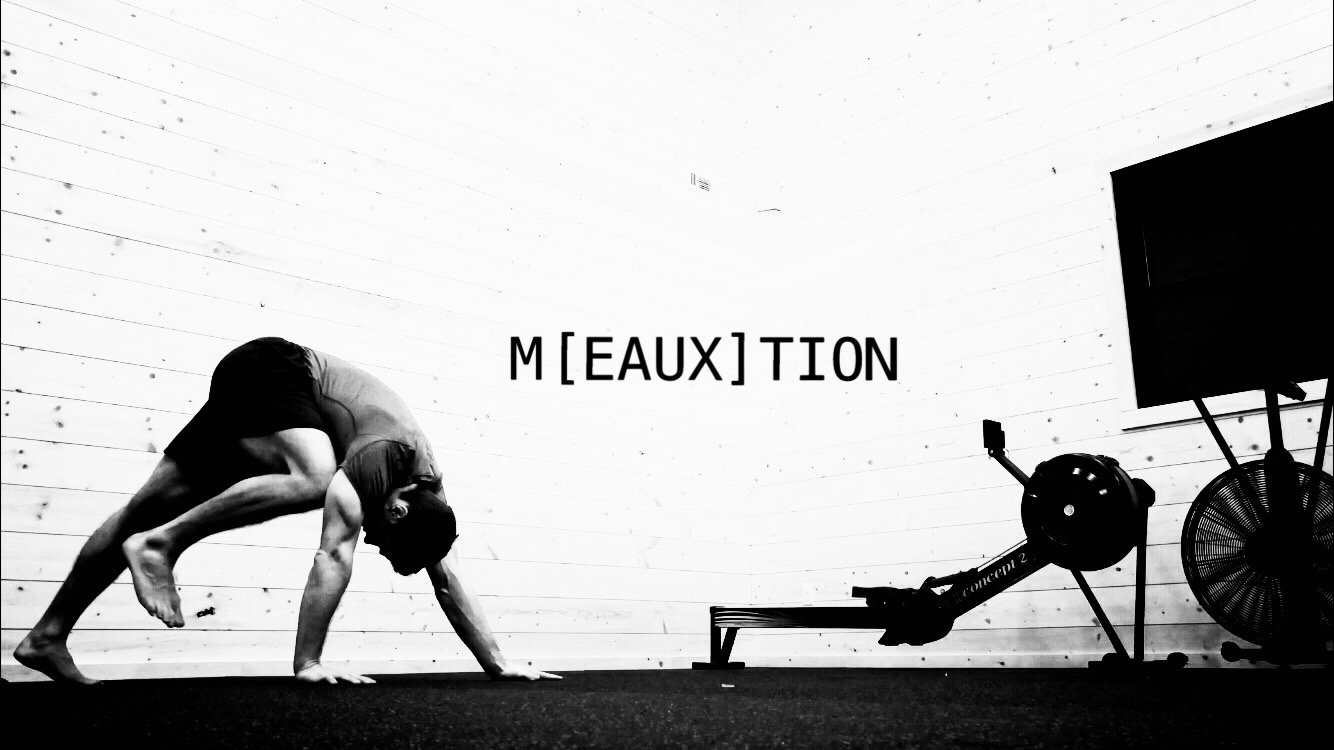
The Crab Reach is a great bodyweight exercise with a whole bunch of options of use before, during and after a workout.
For a simple bodyweight move, this exercise offers a lot of benefits.
Benefits of the Crab Reach
Posterior chain activation and hip extension
Active Thoracic Mobility
Anterior body stretch (hip flexors, quads, torso)
Shoulder stability/endurance emphasis in loaded shoulder
Trunk rotation
Right and Left Side
Low-impact
Combat Sitting
The Crab Reach is a great exercise to battle/off-set the negative effect of long duration sitting.
It’s not “the cure”, the only tool or the “best” tool, but it’s a good one to implement on a regular basis.
Reversing aches and pains caused by primarily long duration sitting requires dedication, discipline, and volume.There is no quick fix.
A quick hip flexor stretch, thoracic mobilization, and glute bridge are not going to cancel out 8+ hours of sitting in the same turtle-like, wound up position.
Body restoration takes time, effort, consistency and volume.Lots of repetitions, likely lots of time and an aggressive mindset.Assuming you’re doing everything right, expect improvements over time.
Most people slump like a turtle while sitting. Sitting like a slouchy turtle for 8-10 hours per day, 5 days per week isn’t good for our bodies.
We become the positions we use most.
Fill in Gaps with Movement Training
Strength and conditioning built from traditional resistance training can benefit greatly from practicing multi-planar movements like the crab reach.
Deadlifts are great. Chin-ups are great. Rows, push-ups and rotational core training are all great.
These are fundamental movements to build a strong body.
But there are movement gaps leftover from each of these exercises.
Once you’re on the floor crawling, transitioning between locomotion exercises, you find out pretty quick there’s a difference between squatting up and down with lots of weight on the bar and moving gracefully through space.
It’s humbling.
Exploring bodyweight oriented movement is a key piece of the fitness puzzle that will improve your movement IQ and create a well-functioning body.
What’s a well-functioning body?
Strong (proportionate to what a person needs to thrive in daily life), mobile, confident in many different postures/positions/patterns, conditioned, free of aches and pains.
Ground-based conditioning is a great way to backfill any gaps resistance training is not designed to address.
Free-flowing, multi-planar fitness.
Practicing postures and movement patterns less common to daily life.
Improving strength, mobility and stability in uncommon movements make everyday exercises feel easy.
Rotation
Looking at the average person’s exercise favorites, it’s usually a shortlist made up of linear resistance training and a sprinkling of cardio.
Break out of the linear matrix.
Every repetition of Crab Reach moves the body through a multi-planar, active range of motion.
Through the range of motion, the body will extend and rotate.
The twist is visible from the hip flexor, moving diagonally through the mid-section to the loaded shoulder.
How to Use Crab Reach in Workouts
Ground-based bodyweight movement is extremely versatile.
Keeping it simple, here are a few different options to integrate the crab reach into daily fitness:
In the warm-up
Filler exercise during a lifting session
As part of a flow sequence
Crab Reach can be practiced in isolation or as a combination.
I recommend practicing new movements in isolation to increase focus on technique.
Practicing an exercise in isolation is better to understand the mechanics and demands is best.
Isolating the exercise will give you the opportunity to focus on the mechanics of the movement and spatial awareness.
Warming Up with the Crab Reach
Movement flow exercises are perfect for pre-workout warm-ups.
These movements are generally dynamic, full range of motion exercises that require movement into and out unique body positions, angles and tempo.
Crab reach can serve as a valuable movement prep before exercises like deadlifts or kettlebell swings.
Crab Reach as Part of the Workout
Positioning the Crab Reach as part of a Tri-Set is a great way to isolate and practice the exercise while staying active/productive during a strength training session.
Here’s an example a simple Tri-Set:
Exercise A) Front Squats
Exercise B) Chin-Ups
Exercise C)Crab Reach
Crab Reach acts as a non-competing exercise with the front squats and chin-ups.
Focus on a slow and controlled tempo through the fullest range of motion you can make happen.
After you are feeling good about the mechanics, increase the volume.
Don’t be shy about bumping up the reps to 15-20 reps per side. Setting a timer can be a nice option.
Not interested in counting reps?
Set a timer and go. Alternating right and lefts for 2-5 minute timed sets can free’s you up from having to count reps.
Summary…
Bodyweight ground-based movements are effective for building strength, mobility, endurance, and movement IQ
Crab Reach is a versatile exercise that can be performed anywhere and anytime.
Benefits of the Crab Reach include posterior chain activation, anterior body lengthening, thoracic mobility, body awareness in space.
The Crab Reach is great to include in warm-ups, during the workout or as flow training.
The Crab Reach is an effective exercise to help mitigate aches/pains from sitting, restore function.
Want to Go Deeper? Check This Out…
Vahva Fitness has created a fully streamable bodyweight-based movement program called Movement20XX.
The movement curriculum in Movement20XX is progressive, challenging, and scalable for beginners, intermediates and all the way up to people seeking movement mastery.
Movement training is easily scaled to suit each person’s skill level.
Movement20XX is one of a small number of hand-picked online fitness programs I support.
The beginner mindset, frequently called the White Belt mindset, is extremely powerful.
So while the title of this blog post may be directed at “beginners”, the content is for everyone.
I intend to share a 20,000-foot view of movement training.
It’ll be packed with exercise and movement sequence videos, descriptions, pictures, links to valuable resources and ideas on why movement, a rarely talked about sub-category of fitness, might be exactly what you need.
And nothing expert-level here, just a few basics of movement training.
I believe in integrating many different methods.
Over the years, I’ve evolved from being a “traditional resistance training + high-intensity interval training” advocate, to:
a crawling, climbing, steady-state aerobic enduring, macebell wielding, kettlebell flow, rowing, running, skierg shredding, brachiating, flow sequence dabbling, active mobility training, gymnastics exploring movement enthusiast.
The day I stepped outside the box of traditional resistance training, a whole world of exciting physical challenges began to appear.
Locomotion and ground-based conditioning changed my entire outlook on what a workout can be.
All fitness gains accomplished from my home gym.
I started combining the better elements of yoga, gymnastics, locomotion/crawling, strongman, natural movement methods, and bodyweight strength training.
Today, my daily workouts look NOTHING like the days of old, yet I couldn’t be happier with the way I move and the transfer it’s made into my daily living. Training should enhance life in some capacity.
My body feels stronger, resilient, better conditioned, and more capable than it ever has.
Yesterday’s workout looked like this:
1a) Hybrid Turkish Get Ups
2a) Box Elevated Dragon Squats
3a) Parallette Bar L-Sits
4a) Lizard Crawl Flow
All of these “GAINZ” were earned after competitive college athletics, a time when a lot of people would say, “That was my peak athletically and physically”. Blah blah blah.
You’re done with competitive sports, not dead. Keep moving and moving often.
The human body will either adapt and allow you to expand, or it will adapt to stagnation/lack of effort and constrict.
Success leaves clues, and habits compounded are powerful.
James Clear’s book, “Atomic Habits” does an amazing job articulating the power of building good habits.
Either way, our bodies are products of what we repeatedly do, good or bad.
Weekly, I’ve experienced incremental improvements with strength, expanding movement capacity, joint range of motion control, and endurance.
And I love my workouts, they’re hybrid in how they mix a little bit of this and a little of that.
The movement rich training I’ve integrated into my workouts keeps sessions fresh without losing discipline, challenging and effective. Most of all, it’s engaging. Taxing for the body, but also for the mind. A deadly combination.
The lizard crawl (and variations) is now my favorite upper body exercise.
Interestingly, I’ve lost absolutely NOTHING when it comes to basic lifts (squats, pressing, deadlifts, pulling core strength, and stability).
Hmmmm…
Beginner Movement Patterns
The list below is not everything. But does highlight some of the more notable movement patterns a beginner should begin to familiarize with.
Crawling
Reaching
Twisting
Balancing
Rolling
Climbing
Jumping
Transitions between movement (common and uncommon)
Movement Sequences
Improvised Movement
Beginner Movement Training
This blog post is all about the beginner. The newbie to the movement training.
The rolling, crawling, transitioning, exercises, and flowing sequences rarely written about in fitness magazines.
Why don’t fitness magazines grab ahold of movement training methodology?
I have my own theories, but the infatuation with luring people in to read about the next great muscle building routine, fat loss and weight loss is addicting. Pure aesthetic trickery.
And there’s nothing wrong with using exercise for body transformation.
It’s the fact that these magazines repetitively create new angles on the same old, worn out, tired topics. Plus, judging by the exercise videos I’ve watched from some of the better known mainstream fitness magazines, the fitness editors might sport lean bodies, but they DO NOT MOVE WELL.
Standing bicep curl technique? Expert level.
Transitioning from a low crawl into a single leg squat variation back down into a 90/90 position? Nope.
Movement training encompasses a lot of the stuff that exists BEYOND lifting weights, sets/reps/rest, racing the clock, WODs, and treadmills.
Crawling. We crawl as babies, but revisiting basic crawling patterns in adulthood is packed with benefits.
Ground-based movement training is missing from the average person’s workout regimen, and it’s a key element.
Free of equipment and fancy gadgets.
Just your body moving around a space.
Squatting on uneven surfaces, with a staggered stance.
Pressing up from the floor, stepping through, dropping back down into a Cossack squat, sliding the legs across, and mirroring this combo on the other side. You could do this for 5 minutes straight.
Rotation. A lot of exercise and workouts lack rotational training. Some workouts overly stress the importance of anti-rotation exercises, paying little attention to the fact that we must be able to produce rotation also.
Injuries. People often injury themselves (to varying degrees) when the stress exceeds the body’s tolerance to handle the stress.
Progressively expanding movement by introducing manageable patterns, loading and positions can help mitigate injuries.
Pertaining to injury mitigation, active mobility training becomes essential. Increasing range of motion and CONTROLLING (building strength and stability) in these newfound ranges.
Supplementing resistance-based exercise and natural bodyweight movement with a progressive mobility-focused regimen is the gold standard in injury prevention.
With this recipe, you’re gaining strength, movement IQ, and establish a useable joint range of motion.
Movement Training For Life
On one hand, I believe in general physical conditioning versus attempting to mimic the exact movements of daily living.
On the other hand, conditioning the body for common everyday movements makes a ton of sense.
Exertion in daily life often doesn’t look like the average gym routine.
There are no symmetrically weighted barbells, chalked up kettlebells or dumbbells waiting to be lifted and move.
Real-world movement is less predictable.
We fall into and out of weird positions, often require on-the-go improvised corrections, rebalancing, and constant transitions in and out of body positions. On top of that, toss unique environments with uneven surfaces and odd-shaped objects.
This is not to say barbells, kettlebells and dumbbells are bad. There are FANTASTIC tools to leverage. But at some point, you’re no longer in the gym, you’re no longer pistoning a barbell up and down for robotic reps.
And how about that gym perfect, flat-backed, technically sound bodyweight squat?
Squatting in my life looks like something else entirely. A hybrid combination of movements and transitions.
Maybe you’ve got to navigate moving from the floor to standing without the use of your arms.
Every day, real-world movement is full of imperfections.
Interestingly, years of pounding on movement patterns didn’t make me a more efficient mover in the real world. I mean, to some extent it did, but I started to encounter a lot of different scenarios where I felt weak, uncoordinated, and immobile.
We cannot train for every quirky experience in life, but I strongly believe supplementing resistance and cardio training with movement rich tasks, challenges, and ground-based conditioning would help a lot of people increase their
I find myself squatting out of mechanical alignment, twisting, bending, reaching, rolling, lifting, and moving objects with a technique that most gym fanatics would consider unacceptable.
Picking up heavy, awkward shaped, slippery sh*t from the garage requires a creative approach, which is rarely addressed in a structured workout.
Fully flexing the lumbar spine while assuming a modified lunge stance, driving off the forefoot while my feet slide inside of my Crocs.
This is life.
Sometimes I’m moving by fusing 2-3 of those patterns at one time.
When it’s time to perform in life, it’s time to perform. Sometimes we get to step up to a heavy object, get situated and lift similar to our gym lifts. Most times, this is not the case.
Much of movement in daily life is reaction-based, rarely planned, and happens quickly. There’s no time to externally rotate the hands, pull the shoulder blades down and back, tuck the rib cage, etc.
Real-life movement is unpredictable, deviating from “flat neutral spines”, perfect posture, and ideal foot placement.
It’s life.
The human body is a movement machine.
Ground-based movement drills improve a person’s movement capacity and address a lot of these in-between life moments that a barbell squat or deadlift simply doesn’t.
Improving your ability to interact with the ground, using nothing but bodyweight will help you as a mover, and probably make your traditional lifts that much better.
And to be completely honest, engaging in movement-based training is as fun as it is challenging.
One great benefit of practicing movement based drills is how quickly a person builds confidence in unique and unfamiliar body positions.
We knowingly (and unknowingly) avoid activities we know our body isn’t suited for. After a few months of movement training, this starts to shift. You begin to look at daily tasks differently. Situations you used to avoid become worthy challenges you’ll meet head-on with a new-found confidence in your abilities.
Twisting and rotational movements are absent from most workouts.
Walk into a big box membership-based gym and you’ll witness 95% of the members slaving away on fixed range of motion cardio machines, ab machines, or and crowding the bench press area..
I’d shred my chest and core by ramping up the volume of lizard crawl versus laying lifeless on a bench while pressing the weight up and down… ANY DAY OF THE WEEK.
Rotation is a basic human movement action and training it consistently can provide some noticeable benefit with regard to performance and postural integrity. It’s quite common to have people comment on their spine feeling “locked up” or “stiff”.
Insufficient mobility at the mid-back region can cause excessive motion at the lower back, as the lower back tries to pick up the slack to make everyday movements possible.
Rotational drills are great for training mid-back mobility while opening up the hip flexors and activating the powerful glute muscles. The stretch from the hip to the shoulder is incredible.
Injecting multi-planar and multi-joint exercises into a workout regimen can (and will)_ bridge the gap that many traditional compound lifts simply do not address.
More examples…
Training movement patterns in isolation is best for learning mechanics and giving the body an opportunity to adapt.
The range of motion of each exercise can be modified to suit what you can comfortably handle at this moment and will improve with time and consistent practice.
The human body is a brilliant adaptation machine.
Most of my early ground-based movement flow practice involved spending focused time on 1 or maybe 2 movements in isolation. I like to work new exercises with a “do less but do it better” type approach.
As my movement efficiency improved, I began to string together 2, 3 even 4 exercises in a row, flowing and transitioning between each for reps or time.
Every exercise has progressions leading up to mastery. I cannot stress this enough. Movements can be progressed for YEARS.
Interested in getting a cardio conditioning effect from the workout? Great. Increase the tempo of each exercise or add time to the work set. Flowing around a room for 8-10 minutes will elevate your heart rate as much as traditional cardio. With the added benefit of training more movement patterns and improvisation to increase the brain’s processing speed.
Crawling is great for loading the upper extremities, core, and sequencing. Extremely slow tempo crawling remains one of the most eye-opening physical challenges for people.
10-15 minutes of ground-based movement training will leave you exhausted, particularly if you’re new to it and inefficient.
Are you going to be sore all over from this? Yes. Expect soreness in the days that follow.
Newbies to ground-based movement training should consider implementing such training after the warm-up, but before resistance training in the day’s workout.
Movement 20XX
Movement 20XX is a program I’ve become a huge fan of across the last year.
Eero Westerberg and I have a lot of similar ideas and approaches to building physical freedom, exploring different avenues of exercise and how to integrate those methods into a pre-existing regimen.
Movement 20XX is loaded with exercise progressions, bodyweight strength training, moving into ground-based movement, and sequences.
Sequences are a series of pre-planned movements fused together. Like a movement sentence.
Everything in Movement20XX can be adjusted for beginners/novice movers or progressed to challenge the elite mover.
Movement training will improve all other areas of fitness.
Watch for more posts sharing exercises, combinations, and flow!


 M(eaux)tion Fitness