In this article you’ll find:
- Technique for Skater Squats
- Common technique flaws and how to correct them
- Benefits of skater squatsBeginner skater squat variations
- Skater squat progression ideas
- How to organize skater squats in workouts
Skater squats are a less frequently explored single leg squat variation, yet very challenging and worth anyone’s time.
Pavel Psatsouline ruined it when he popularized Pistol Squats back in the mid-2000s.
I’m here to re-popularize Skater Squats.
Unilateral squat training is a resourceful way to increase the demands of traditional bilateral squats, build strong legs, improve balance, stability and coordination.
Single leg squats are no joke.
Skater squats fall under the single leg squat category, and to the extent that you don’t add external loading, also can be categorized as a bodyweight based exercise.
Skater Squat Technique
Skater Squat coaching cues are:
1) Lowering into the squat with control, raise arms as you descend
2) Keep the chest up, spine straight and avoid hunching
3) Allow the working leg knee to track over the toes
4) Lightly “kiss” the airborne kneecap to the floor
5) Stand up
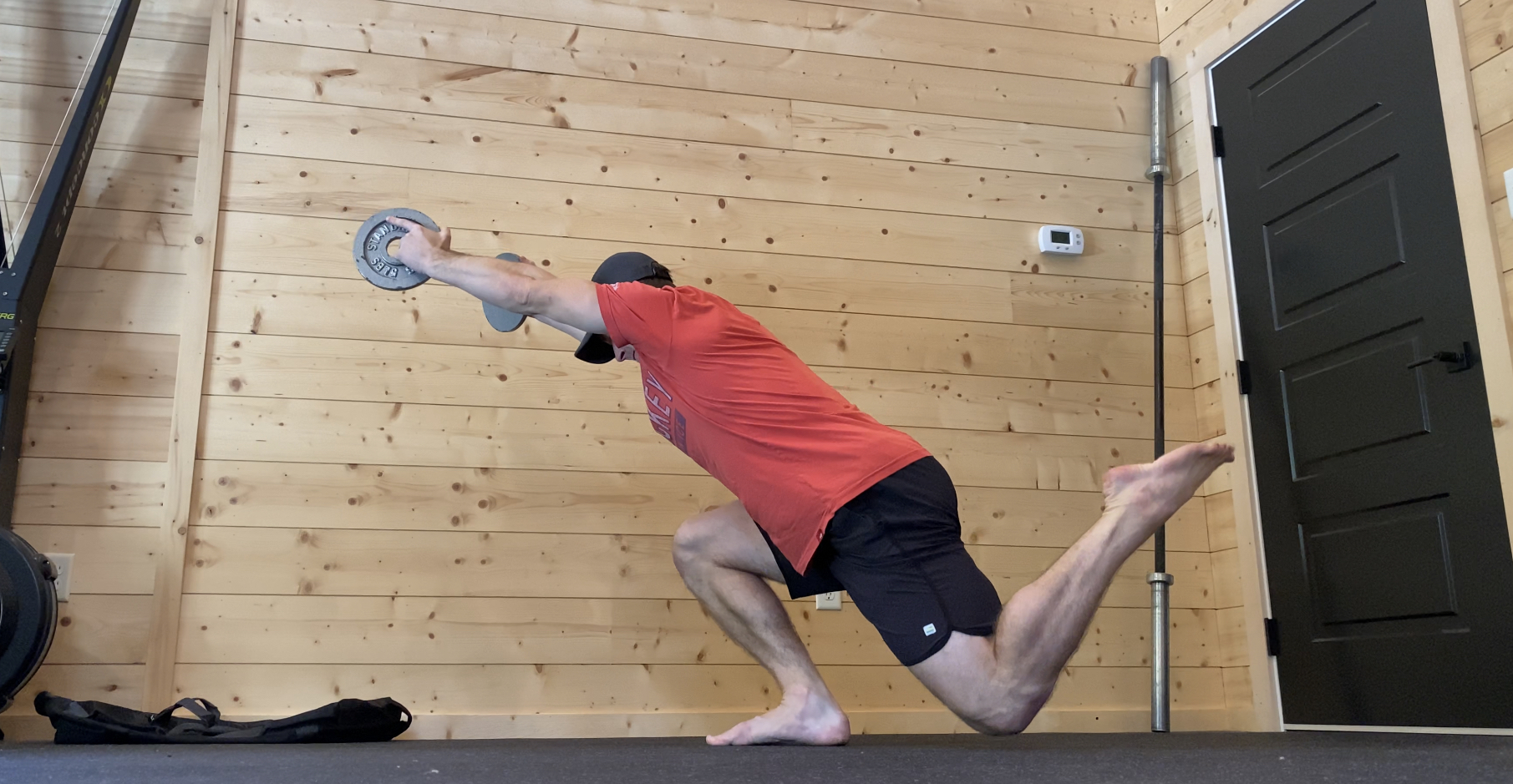
Counterbalance. Raising the arms with weight during skater squat creates a counterbalance to help distribute wait, remain stable and balanced.
Be mindful to avoid excessive hunching or rounding of your back.
The upper body will lean forward slightly for balance.
Most Common Technical Difficulty
By far, the most common technique mistake with skater squats is overly rounding (hunching) the back.
The fix is simple.
Decrease the demands of the exercise and try again. If you’re struggling to maintain ideal shape during a movement, the movement is too aggressive (somewhere) for you.
Options to decrease the demands:
- Increase the height of the surface behind you to decrease the range of motion of the knee touch.
- Use a door, couch, suspension trainer or resistance bands to help stabilize, keep balance and reduce the load.
- Or, both.
When the demands of an exercise exceed a person’s current ability to meet those demands, exercise technique suffers.
Practicing a regression of an exercise is helpful, but including dedicated mobility training in addition to the attacking the exercise can speed up the process significantly.
I’m said it before, but mobility training is a game changer.
Learn more about effective joint mobility training here if you want.
Benefits of Skater Squats
Skater squats are a unilateral lower body exercise.
Unilateral exercises, or in this instance single leg squats, have many benefits, including (but not limited to):
- Effective strength builder for the legs
- Improving balance
- Avoiding overuse of a dominant side
- Injury mitigation
- Improving movement capacity
- Cross-education training effect
- Resourceful strategy to add load and demand to the squat pattern
Cross Education Effect
The cross-education benefits of unilateral training are fascinating.
Simplified, the cross education effect is when you train one side of the body, but the other side is also stimulated.
A person with a lower leg injury might still be able to practice skater squats (and other unilateral strength exercises) with the healthy leg, indirectly receiving strength benefits via cross-education.
Assisted Skater Squat Variations for Beginners
Beginners to unilateral training need to consider the increased balance, stability and load demands of such exercises.
To help ease into single leg squats, it can be helpful to hold onto something.
A chair, door or a suspension trainer can be used to assist with each repetition, allowing the body a chance to familiarize and adapt to the demands.
Here are few ideas on how beginners can dive into skater squats using assistance.
Couch assisted:
Door assisted:
Baseline Skater Squat
This a run of the mill, baseline skater squat.
I’m using 5lb weight plates as counterbalance, lowering my trailing knee to the floor, kissing the knee cap, standing back up.
Again, the weight plates keep me steady from front to back while I perform the movement.
Advanced Skater Squats
Progressing the skater squat into the “advanced” realm can be achieved by adding more weight or increasing the range of motion.
There’s no secret sauce here, either add weight or lower down further (increase range of motion).
I recommend exploring both options to see how you do.
If you don’t have access to a weight vest, heavier dumbbells or kettlebells, play around with skater squats from a deficit like you see in this video.
The only real change here is the range of motion. I’m standing on a 45lb bumper plate, which elevates my position 4-5 inches above the floor, yet, makes a HUGE difference with difficulty.
Adding a few inches of motion to an exercise can change A LOT.
Worst case, if you’re struggling to stand back up from an elevated position, use a SLOW eccentric ONLY skater squat variation.
For a painful 8-10 second count, resist gravity down to the floor.
Place a focus on the last 4-5 inches of the exercise and really fight off gravity’s pull.
If you do have access to heavier weights or a weight vest, check out these loaded variations.
Minutiae: Other Names for Skater Squats
“Skater squats” have been referred to as airborne lunges or shrimp squats.
Shrimp squats, in my opinion, are quite different compared to skater squats, but I’ve seen the terminology used interchangeably.
Shrimp Squats:
I’m sharing this with you to avoid confusion.
At the end of the day, single leg squats are single leg squats.
It’s just a matter of body position, where the arms/legs are positioned and the path of motion.
Both Skater Squats and Shrimp Squats will put your ankle mobility to the test. You’ll find out pretty quickly if the ankle is the weak link.
Don’t get hung up on exercise name semantics.

 M(eaux)tion Fitness