Basics of The Ido Portal Training Method

Ido Portal

Ido Portal

{Photo Credit:  http://www.idoportal.com}

Ido Portal Method training is taking off like rocket and growing in popularity every single day.  

There’s a moutain of Ido Portal movement videos and articles all over the internet describing his techniques and teaching. 

[I do not speak for Ido Portal in any way.  Ido is a man with his own original thoughts and ideas.  Anything I write or discuss on this blog is my interpretation of information he’s published on his social media page, his old blog, Youtube interviews and various other sources.]

My background…

I have an extensive background in strength and conditioning, but it’s traditional in every sense of the word.  

It took years for me break away from deadlifts, squats, pushing, pulling, and core work… and expand into movement training.

Old habits die hard, but eventually, I dove head first into movement training.  

Gradually, I rebuilt my body, peeling away layers of stiffness, improving range of motion, coordination and newfound strength.

Thousands of people have done the same, many through the information in this article.

It’s amazing to see the feedback of those who’ve decided to take actionable steps toward building up their movement arsenal. 

The first time I encountered Ido Portal Method, I knew I was watching something different.  This was a much different approach to building fitness.  The training tactics were unlike anything I’d seen. 

Crawling, sprawling, twisting/turning, reaching, flowing, strength movements paired with Capoeira, gymnastics, hand balancing, dance, gymnastics, etc.

Ido Portal Method was like an open platform for many differnet styles of movement.  

Just when you think you’ve got it figured out, it changes shape, moves in a different direction.  

Since my initial exposure, I’ve spent a significant amount of time reading, watching, practicing and digesting Ido’s methodology.

This article is my translation of the basics of the Ido Portal Method. 

IMG_4167 

Ido Portal Training Methodology…

If you’re looking to get the summarized view of what drives Ido Portal’s movement methodology, the formula looks something like this:

Isolation—> Integration—> Improvisation

Step 1:  Isolation

Step 2:  Integration

Step 3: Improvisation

What I currently comprehend, the movement paradigm is a series of transitioning from phases.  

Isolation to integration to improvisation.

Ido Portal Method raised the bar with movement standards.

Most systems teach isolation (do this squat, then do this deadlift, then run up that hill, then do a pull-up) and stop there.   

Ido Portal Method takes it a step further.

Here are details on each phase.

Isolation

In the Ido Portal Method, Isolation based movement is essential for making progress.  

This is the base of the hierarchy.

Strength is a prerequisite for movement.

Being strong enhances movement capacity because you OWN every position.  

Isolation = building strength with movement patterns.

Movement patterns:  

  • Squats
  • Deadlifts
  • Lunges
  • Carrying
  • Crawling
  • Vertical Pulling
  • Vertical Pressing
  • Horizontal Pulling
  • Horizontal Pressing
  • Bent Arm and Straight Arm Upper Body Training
  • Glute-ham raises
  • Rotational patterns
  • Core training
  • Power Training (cleans, snatches, jerks, kettlebell swings, etc)
  • Stabilization drills

This is isolation.

You might be familiar with these exercises.  

There’s also a heavy emphasis on high tension bodyweight-based strength training exercises.

Body levers, hanging and climbing, dips, muscle ups, parallette work such as L-Sits, and Tuck Planches, single leg squats, single arm pressing, handstand push-ups and various locomotion patterns (crawling, rolling, etc.)

Gymnastics strength training.

Mixing traditional strength training with body-weight based exercise is a potent combination.  

These are time-tested, proven strength builders essential to physical development. 

Improving athleticism with Isolation style training opens doors to building movement sequences (performing several movements in a row) and evnetually fully improvised movement flow.   

Multi-planar strength and movement freedom.

The bottom rung of Ido’s movement classification system is often the highest rung for other training systems.  

HIGH. STANDARDS.

There’s a realm of physical expression that exists beyond getting fixated on sets, reps, putting more weight on the bar, numbers numbers numbers, or racing the clock to set new P.R.’s in a WOD.  

Handstands, leg-less rope climbing, ground-based movement flow training packed with locomotion patterns and bodyweight movement patterns are here.  

Our bodies are designed to move freely.   

 Flow

Ido Portal Method combines the best of many movement disciplines.

Integration

Integration is the point where movement sentences are formed from the words (isolation).  

A squat, is no longer just a squat.  

A squat is a stepping stone to another movement, and another, and another.  

The practice is evolves into a seamless flow, moving about.

More movements are integrated, creating series of movement patterns formulating a “sentence” of movement.  

  • Sidenote: There’s a heavy Capoeira influence. 

The ground conditioning (locomotion patterns, Capoiera, etc) combined with gymnastics/bodyweight/traditional strength training, fused with flexibility and mobility work is NOT NEW, but since it’s being repackaged and people are seeing incredible results, it’s definitely creating a paradigm shift in fitness.  

“Fitness” is less about who can build the best looking body or lift the most weight (both respectable pursuits), it’s about moving and how your body can perform when confronted with the known and unknown.

The shift is on and people are taking notice.

Nike has…

Ido Portal Nike

More Integration…

Integration builds on the physical preparation from isolation training.  

Pre-planned movement sequences make up part of the Integration phase.  This is similar to a dancer demonstrating a choreographed routine.  Just because the routine has been practiced for months doesn’t make it any easier to execute.  

I’ve watched the “Locomotion Research” video 50+ times.  Watching someone move like water is inspiring.  The movement sequences demonstrated in the video are deceptively difficult.  

Ground-based locomotion is a multi-planar movement requiring a level of body awareness, joint range of motion and on again/off again body tension most people rarely practice.  

Many of these dynamic patterns are animal-like.

People are often humbled by the amount of mobility and strength needed for locomotion patterns.

After the first few sessions, locomotion practice will leave you sore.  

The Lizard Crawl bridges the gap between “lifting weights” and putting those gains toward challenging movement patterns.

Crawling is difficult.  

If you’re not yet crawling, get into it.

Crawling patterns are effective for building coordination, spatial awareness, strength and movement capacity.  

Improvisation…

Ido has commented on numerous podcasts that improvised movement represents the highest form of human movement.  I couldn’t agree more.

Dominating isolation exercises makes the transition to integration significantly easier.  

With consistent practice of Isolation and Integration, one will arrive at the final progression of Ido’s movement philosophy… improvisation.

World-class gymnasts (pound for pound the strongest people on the planet) are rarely expressing improvised movement.  Competition routines are all pre-planned, practiced and choreographed prior.  

Improvisation is the combination of isolation and integration.  You’re essentially making it up as you go, or “flowing”.  Though it will likely take years of dedicated practice, improvised movement flows are achievable.  

This is where progression becomes important.  

Flowing like Ido Portal doesn’t happen overnight.  

Practice is king.  

I’ll spend less time describing the Improvisation phase of the Ido Portal Method because most folks need to focus on nailing down the elements of Isolation and Integration.  

In interviews, Ido has mentioned several times he thinks there is a dimension to be explored beyond Improvisation.  

Isolation and Integration Progress

The Ido Portal Method represents an incredible shift with how we view and define fitness.  

Humans are made to move (climb, run, jump, roll, carry, etc) and I think there is an emerging sector of people who want to experience the thrill of moving in this way.  

It’s important to clarify that traditional physical fitness modalities aren’t obsolete.  Nor should they be.  

A person should spend a great deal of time gaining ground in the Isolation phase, grooving technique, building strength, improving joint control throughout a range of motion.  

Hammering away on the basics (squats, pulling, pressing, etc) is fundamental to progress.  

The goal is to build strength, stability, mobility (the missing link of fitness), conditioning and constantly expand movement capacity.  

Conditioning is also important, and should never be overlooked.  

Train Like Ido Portal Method without the Pricetag

Several years ago, I started looking for alternatives to the Ido Portal Method for several reasons.

  1.  Ido Portal doesn’t offer programs through his website.
  2.  Training privately with Ido and his team is EXPENSIVE ($2500+)

Like many of you, I couldn’t afford $2500 for a workout program, no matter how spectacular. 

I started researching alternative programs with the belief that similar results could be achieved while investing less money.

With enough research, I found what I was looking for, and what I felt other people could benefit from as well.

Here are two amazing programs to check out:

  • Movement20XX
  • The Movement Athlete

Combining all of these programs creates a comprehensive training system.

Strength, movement training and mobility.   

Movement 20XX  teaches ground-based movement, locomotion patterns (lizard crawl, etc),movement sequences and improvised flow work. 

The Movement Athlete will build strength using bodyweight exercises.  Strength is critical for performance and long-term health.  Pistol squats, one arm push ups, handstands, l-sits, body levers, upper body pulling, etc.  

Here’s a little more about each program. 

Movement 20XX
Screen Shot 2019-11-15 at 11.12.03 AM

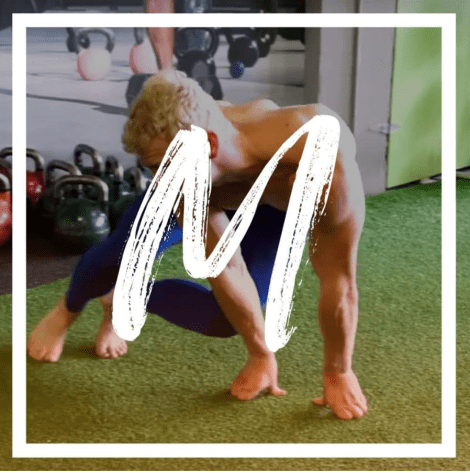
Movement 20XX is a ground-based bodyweight training system that teaches many of the locomotion patterns and flow work found in Ido Portal Method.   

Locomotion mainly consists of quadrupedal ground-based exercises like crawling (lizard Crawl, etc), switches, transitions, etc.

Integrating Movement 20XX into my own workout regimen has been awesome.  

I started by supplementing my traditional resistance training workouts with a few basic crawling exercises, and built up from there.  

Over time I strung together exercises to create repeatable movement sequences.  

Movement 20XX integrates the best elements from different movement disciplines to create a hybrid system of movement training.  

Crawling, transitions, switches, flow, etc. 

I started Movement 20XX with a stiff spine, poor hip and shoulder mobility, tight hamstrings, and mediocre movement capacity.  

After about 4 weeks of dedicated movement practice, my body acclimated to the mechanics and demands of the patterns.

Using the curriculum from Movement20XX, I made more movement gains in 2 months then I had in the previous 5 years.  

Interestingly, my traditional lifts saw boosts in performance.  Deadlift, squat, pull-ups and pressing all improved, felt smoother, etc.

If you want to explore movement, this is the program to get. 

👉 Learn more: Movement20XX

The Movement Athlete  
The Movement Athlete

Strength is critical for improving movement performance.

If you get nothing else from this article, please, remember that. 

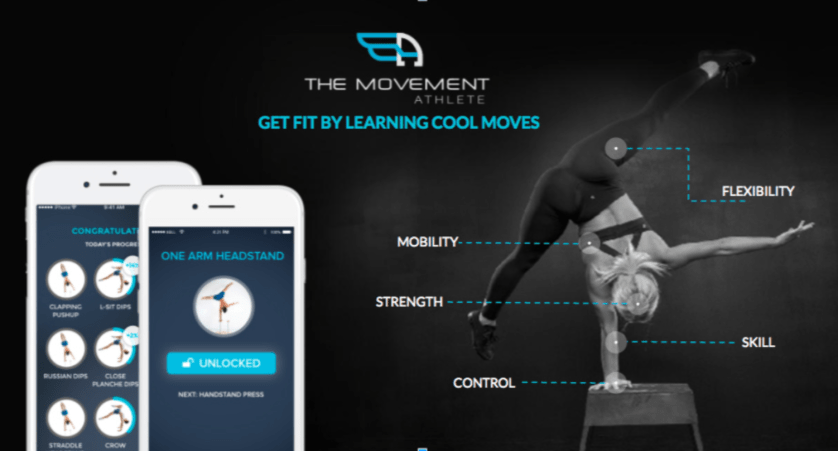
Movement Athlete Academy is a bodyweight-based strength program designed to improve performance in high powered movement patterns:

  • Muscle Ups
  • Handstand Push Ups
  • Single Arm Push Ups
  • Single Arm Body Rows
  • Pistol Squats
  • Handstands
  • L-Sits
  • Human Flags (aka: body levers)
  • Back Levers

Sadly I used to think bodyweight training was dumb.  If I wasn’t lifting weights, I was wasting time in the gym.

When I committed myself building effective bodyweight movements, my strength increased, everywhere.

The human body is adaptation machine. 


Movement Athlete Academy is a smart training system, built on the principles of:

  • Smart exercise progression.
  • Progressive overload.
  • Progressive exercise complexity and volume.
  • Rest and Recovery.

The workout design, exercise progressions and step-by-step tutorials make Bodyweight Athlete a great bodyweight-based program to invest in.    

Bottomline…

Find a program and follow the details.  

Invest the money in learning effective training techniques, commit yourself to the curriculum and you’ll get phenomenal results.

Stay Tuned 

If you’ve enjoyed this post, check out:

Cheers to the Basics of The Ido Portal Training Method…

KG

SaveSave

Saturday always provides adequate time to explore different combinations of work capacity style circuits.

I like to take the governor off and push myself on Saturday mornings.

This past Saturday didn’t disappoint.

The goal was to accumulate 25-30 minutes of a work:rest style circuit.  I didn’t feel like being monotonous with the exercise selection so included 10 different exercises, stringing them together strategically so that I could give an honest effort to each exercise without sacrificing anything (mostly due to fatigue) to the next exercise in the circuit.

It really worked out well and challenged a number of movement patterns.

The equipment that I used:  24kg kettlebells x2, jump rope, Jungle Gym Suspension Trainer

Here is how the workout was structured…

—> 20 seconds of work: 20 seconds of rest of the following:

24kg kettlebell snatch right hand

rest

24kg kettlebell snatch left hand

rest

Bodyweight Chin Up

rest

Double 24kg kettlebell squat-to-press (aka: Thrusters)

rest

Mountain Climbers

rest

Kettlebell Figure-8 (advanced and technical, but great drill)

rest

Bodyweight Push Ups

rest

Double 24kg Lunge (alternating sides)

rest

Hand-to-Hand 24kg Swings (alternating every rep)

rest

Burpees (jump and push up)

rest

Jump Rope (combination of two foot bounce and running)

—-> Repeat 4 complete cycles of the above…

The best part about this workout is that you don’t have to worry about keeping track of reps.  When I am doing work capacity style training, counting reps can be a major pain.  It’s really the last thing I want to be doing while I am huffing and puffing.  Instead, the work starts on the buzzer and ends on the buzzer.  It’s really convenient.

Know thyself… If you’re a beginner, this workout might not be scaled to suit you.  If you’ve been working out for a while, this might work great for you.  If you’re a tough guy or gal, bump up the weight for kettlebell exercises, add a weight vest to chin ups and push ups, use a weighted jump rope, etc.  I can provide exercise progressions to bury anyone if that is what you are seeking, hopefully that isn’t the case though.  Smart training reigns supreme.

You might see a lot of volume in a workout like this, and you’re absolutely right, so nice observation.  However, I preach workouts that can be managed.  I managed this one nicely.  Notice how explosive work is ordered first in the workout.  That is on purpose.  People tend to get hurt when they attempt to move weight quickly under fatigue and will poor form.  I am not foolish enough to place a highly technical lift at a place in the workout when I am most fatigued.

Also notice that all of the exercises are non-competing, and ordered in such a way to respect that.  In fact, look at the kettlebell figure-8 + bodyweight push ups + double 24kg lunge… sequence.  Very different muscles are being taxed there.  Figure-8’s are combination of squats with rotational power where the kettlebell moves from a high front to low back to side and finally diagonally across body to high position (hybrid movement).  Push ups are an upper body push dominant exercise, and lunges are mainly a lower body hip dominant exercise.  This allows for an increase in heart rate and work, without gassing out the body for the next exercise.  You tax one movement pattern, than move on to the next.

Different movement patterns, different muscles, quality technique, short rest, big training effect.

Now I don’t own a calorimeter or a metabolic analyzer, but I would guess that the calorie burn from a workout like this was quite high.  Maybe 650-800kcals total, and that doesn’t include the residual calories that are burned post-workout.  Shortened rest periods combined with resistance based lifts that leverage a sub-maximal muscle contraction are notorious for creating an after-burn effect, it’s been studied quite extensively in the last few years as the concept of fat loss slowly gains momentum versus weight loss.

Metabolism can stay elevated for several days leveraging workouts like this.

If you leverage some quality eating habits during that period of elevated metabolism, you’ll burn some fat no doubt.  Rinse and repeat the process and you’re going to end up burning a bunch of fat.

I should also note that I designed this workout knowing that the coming days were going to be either complete rest (no workouts) or at the very most, a short yoga/static stretch session.  It’s important to rest, recover and let your body heal in between workouts.  Your body can only handle so much stress before adverse events begin to occur.  You really don’t want to play chicken with overtraining or chronic fatigue in general.  The point of recovering in between workouts is to give your body the best possible chance to leverage the work done in the previous workout, while allowing enough time to enter the next training session and make gains.

I think that a lot of people could lose greater amounts of body-fat (faster) while boosting performance if they decreased the amount of cumulative stress from workouts.  You want your body to recover in full.  Always entering a workout in a state of recovery is bad for business.  If you haven’t acquired a full taste for physical activity, this is good news for you, as each dedicated workout can be used to accelerate

Instead, choose fewer weekly workouts that create a larger (but quality) training effect.  Make them count.

Focus on accelerating other areas of life while you recover in between sessions.  Focus on establishing quality eating habits.  Re-think your water intake.  Read more books on success and self-growth.  Calm the mind with yoga, foam rolling and a long static stretch session.  Get more sleep.

Learning how to workout is great, and building fitness is empowering.  But keep your training efforts sustainable.  Win the war, not just the battle.

Give this workout (or a variation of it) a go.

Cheers to kettlebell and bodyweight workouts!

KG

30 Minute Workouts, Bodyweight Workouts, Kettlebell Training, Quick Tips

A Quick (and effective) Kettlebell Swing + Bodyweight Movement Workout

Quick Tips

I’ve started to trend some of my posts toward topics that people are searching for in Google, which I am informed of on my blog.  You cannot see these stats and search terms, but I can, so advantage to me!

I won’t sell out and write what I think will drive more traffic to this blog (a lot of fitness bloggers do), but I am interested in what kind of traffic numbers will arrive if I direct some of my posts toward the needs of the people.  My goal has always been to write authentically and reach as many people as possible.  We will see how it turns out.

Ha, listen to me… “The needs of the people”.

Photo Credit:  tv.com

Photo Credit: tv.com

I sound like I should run for city office, or city treasurer on Boardwalk Empire.

Anyways, I put myself through what I would consider an intermediate workout tonight.

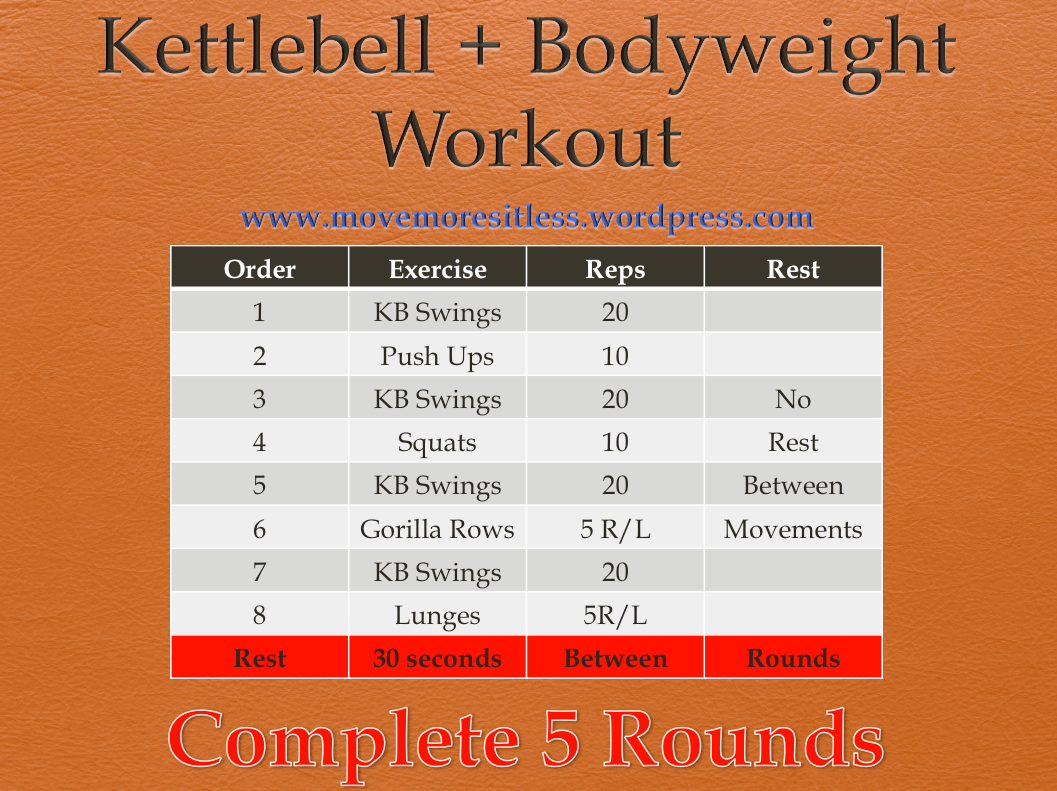
This workout was heavily centered around kettlebell swings, and supplemented with various other bodyweight movements.  I feel like “supplemented” is the proper terminology in this particular situation, as you’ll see from the workout below.

The bodyweight movements that separate the kettlebell swings are nothing more than filler exercises used to keep my heart rate elevated in between bouts of swings.  More muscles worked, more calories burned during and after training.

I tend to choose both upper and lower body bodyweight movements to disperse the training stress to  more of a total body approach.  Splitting the movements to upper and lower allows for a brief period of training stress directed at a specific movement pattern (horizontal push, squat, vertical pull, etc) without exhausting that pattern completely.  This allows for intelligent fatigue management during other bodyweight movements and more importantly during kettlebell swings.

When fatigue sets in, technique gets ugly, people are exposed to bad habits and injury.

So, without blabbing any further, here is the structure of the workout, please notice that it is very similar to the multi-method cardio approach:

sample kettlebell and bodyweight workout

A couple of points…

First, there is a lot of work being done here, as you can see.  There is a lot of muscle being stressed and the rest is light.  A workout like this could be a complete training session for a beginner or an intermediate, or scaled up for an advanced lifter.  Scaling up for an advanced trainee might involve a bump up in bodyweight exercise progression or adding a weight vest to those movements.  It’s all a matter of tweaking the variables based on your unique situation and needs.

Second, I kept the reps to even numbers, 10’s and 20’s.  Why?  Because it is annoying having to check your notebook after every movement.  I want you to be focused on what you’re doing during the training session not counting reps like people count food calories.  Focus on your movement, your breathing, your recovery.  Forget about complicated rep schemes… I have plenty of those that I will post in good time.

Third, go sub-maximal but not too light on your kettlebell swings.  Grab a bell that you could swing for 30 reps and focus on hip snap during those suggested 20 reps.  Guys you might grab a 24kg or a 28kg, gals you might grab a 16kg or a 20kg.  Both guys and gals, you’re allowed to grab more or less than that, but on average, males and females will use those weights.

Remember, don’t gauge your energy expenditure on the first set of swings because you’ve got 3 more sets of swings and 4 different bodyweight movements lying ahead.  Manage your fatigue appropriately.  If you have a heart rate monitor, I would suggest using it to check you heart rate.  Of course, you’d want to already have an idea of the beats per minute that separate you from exhibiting crappy movement technique.  When you reach that heart rate, you can back off, rest for a few seconds, then get back into the workout once you can control and OWN the movement.

Why 20 reps of swings?  Because I personally feel that anything more than that really doesn’t provide much benefit other than poor technique (lack of finishing in full hip extension, slouching, etc) and a rising risk of losing the bell on the backswing or at the highest point of the arc.  One slip will kill your pet or put a hole in your wall, and the other will destroy your brand new LED TV.

20 reps (or less depending on your conditioning level) seems to allow for a sufficient elevation in heart rate without making the swings pointless from lack of load and endless volume.  There will be plenty of work performed in this training session, it doesn’t all need to be accomplished with kettlebell swings.

If you’re bored with your typical cardio routine, I would highly recommend giving a workout like this a real shot.  You will be pleasantly surprised at how hard your cardiovascular is taxed during a training session like the one described below.  20 minutes seems to be the sweet spot for me.  I have tested up to 30+ minutes of work like this, and it just doesn’t work for a couple of reasons…

1)  I feel like I am just going through the motions with regard to loading (aka weight used).

2)  I feel like I am adding  volume for an unjustified purpose.

These days, workouts like this serve as a great follow-up to my 2-day on/1-day off training schedule.

Day 1 is a heavily focused on strength work with a splash of jump rope or Airdyne cardio work, while day 2 (this workout) is dedicated to sub-maximal movements strung together to work cardio-strength (traditional strength moves with incomplete rest periods).

Ultimately, the goal is to stay physically prepared until I shift my training toward a particular goal.

Also, although the 20-25 minutes of work being completed in a workout are definitely stressful and draining, I feel as though it’s a short enough bout that allows for adequate recovery between training sessions, avoiding over-training.  The full 24+ hours of rest is also a motivating factor to work hard during this type of training session.  The rest day is just that… a rest and recovery day.

Be a perfectly golden marshmallow at the end, not a crusted black scabby marshmallow.

Give it a shot and let me know how you make out!

Cheers to short effective bouts of exercise!

Kyle

The Devil’s Ass Crack is Sitting on Wisconsin and There’s Nothing Wrong with Working Out Indoors

Quick Tips

Image

Blog post title is inspired by this viral “It’s Hot As Hell” YouTube video

(you can find the link to the video at the end of the post)

All of my Apple devices say that it’s 89 degrees in the EC (Eau Claire, WI), but there is no way in hell it is 89 degrees.  I could cook an egg on the sidewalk and I nearly lost skin to the seat of my Volkswagen Jetta (TDI I might add).  Just for clarification, TDI means diesel:)  It’s got to be closer to 94-95 degrees at least.

In a nutshell, it is stupid hot in Wisconsin at the present moment.   It’s down right suffocating outside.

***  Please grant me this moment to bitch about the weather… I am well aware that it is hotter elsewhere.

I preach about how refreshing it is to get take your workouts outside, but not in this kind of heat and humidity.  You’ll bury yourself in the first ten minutes.  Plus, if you’re a sweater like I am, any movements that require grip become annoyingly unsafe.  When I say sweater, I mean wet.  Not damp or slight lower back sweat stain, I’m talking about ring out my t-shirt wet.  Squeaky sneakers wet.

Swinging a kettlebell with sweat sliding between the palms of your hands and a heavy cast iron cannonball is nerve-racking.  It’s not fun to re-grip at the apex of your swing.  Also, if the bell slips, it’s going to slip on the backswing, where gravity is re-introduced and the hands are taxed to maintain grip.  Smashing the bones in your feet would not be fun.  I’ve been swinging for a while, and I’ll still grind through a few extra swings with wet hands despite knowing better.  It’s not good practice, but I’ll commonly pull the plug on any ballistic kettlebell movements (snatches, cleans, swings, etc) when the sweat is really pouring out of me.

So, the game plan today is an indoor workout.  No question about it.

My sacrifice for training indoors is that my ceilings are not of the ideal height for a select few kettlebell exercises.  If I was working in max effort squat jumps (which I never do) or snatches (which I love to do but can’t), I would have to find alternatives or take my workout outside.  But not today.

Today is going to be totally improvised.

Image

  • Continuous movement for 15 Minutes
  • No rest between movements, reset back to squat jumps after finishing the Schwinn Airdyne ride.
  • Monitor heart rate for effort.
  • Monitor exercise technique for muscular fatigue/breaking of form.

*  I don’t claim to have invented this, and I don’t typically mix multiple movements together that take a great deal of thinking, but this seemed like a nice combination.  I wanted a total body movement combination, and this seems to serve that purpose.

First, I put this workout together using my same general template that I use for all of my program/workout design.  All movement patterns are represented in the workout, including a cardio effort with the 60 second Schwinn Airdyne ride (in honor of the Tour de France).  Nothing is maximal effort.  That would ruin the point of the workout.  Burning out in the first round does little for you.  By monitoring my heart rate, I can verify that I am in fact working as hard as I think I am.  It’s not a perfect gauge effort, it has it’s flaws, but it works extremely well for me and a lot of other people.

Second (and to my last point), I chose sub-maximal reps and sub-maximal loading on all exercises.  This decision was influenced by the duration of time that I targeted for the session (15 minutes).  Again, the point is to move a pace that allows for:

1)   Quality technique in each rep of every exercise.

2)   The accumulation of an afterburn-like effect that will lend itself to staying lean, maintaining strength, improving work capacity through various exercise variations and while leveraging my body’s reaction to the training stimulus (calories expended post-workout). 

Third, all movements are bodyweight based the entire way through.  I have fallen back in love with bodyweight training.  Bodyweight training goes wherever you go, has simple progressions and leverages the most effective movement patterns in a brutally effective manner.  Bodyweight training is the foundation of all other modes of training, so it’s probably best be capable of executing sound technique using just bodyweight against gravity’s pull.

Also, I enjoy having and building strength as much as the next person, but at the present time, the strength that I have developed and maintained through bodyweight based exercise progressions is more than enough to meet my daily needs.  If I ever want to develop higher levels of strength, I will have to move heavier loads and adjust other training variables.  Simple as that.

Fourth, the entire workout takes 15 minutes.  Now, I won’t con you (yes con you) into thinking that the whole ordeal takes 15 minutes only, because it doesn’t.  I typically spend 10-15 minutes before the actual effort driven portion of the training session hammering home joint mobility, soft tissue restrictions and activation of weaker muscles.  I also whip through a series of staple dynamic flexibility drills that prepare my body for what’s ahead.

You can argue that warming up doesn’t prevent injuries, but in reality, why risk it?  Do you really want to find out through experience?  It’s just not worth it.

Lastly, take a look at the final two bullet points above.  Here is a snapshot so that you don’t have to scroll up (the things I do for my readers):

Image

What’s going to burn out first?  Lungs or muscles.  It will vary from person to person depending on what your past training regimen was and current fitness status is.  In other words, will your cardio or your ability to successfully and repeatedly execute each rep of each exercise (muscular contraction) give way first?

For me, it’s a combination.  Muscles seem to go first, especially when I am toying around with higher volume training sessions.  Some of you may find that you haven’t open up your lungs aggressively for quite some time, so the feeling of not getting enough air may cause you to tap out first.  In this case, focus on relaxing your neck.  Push your oxygen through your neck and chest down to the lowest part of your stomach.

Breathe deep.

So there you have it, a simple yet effective training session for all the land to enjoy.  Feel free to substitute your favorite or most accessible cardio alternative for the Schwinn Airdyne sprint.  Some days, low impact/high reward conditioning tools are the ticket.  High impact all of the time may mean high risk for some of you who have not yet adapted.  Jumping rope would fit the bill nicely, so would a treadmill sprint set to an incline.  Your choice.

Cheers to training inside when it’s Image outside!

KG

(As promised:  “It’s Hot As Hell”)

The Scientific 7 Minute Workout and Shortcuts

Quick Tips

Screen Shot 2013-06-05 at 1.29.46 PM

I don’t mind shortcuts.

If there is a more efficient way of completing a task or achieving a goal, I am all for it.

But shortcuts aren’t meant for everyone.  Some of us are always looking for shortcuts, the path of least resistance.  We abuse the shortcuts, and when the shortcuts become too challenging, they look for a shortcut to the shortcut.  Some people are always looking for shortcuts, a way out from doing the work.

When building fitness, I think that shortcuts are not appropriate for everyone.  People avoid physical exertion like the plague as it is, and now science is telling us that we can comfortably fulfill our daily activity needs in a matter of… wait for it…

Image

I respect science, but I cringe at how information like this is received by the public.  Now every personal trainer in America is going to be put on trial by their clients for holding 60 minute training sessions when The New York Times says that an effective workout can be achieved in 7 minutes flat.

With fitness, you get what you put in.  If you put forth an exceptional effort, you’ll get an exceptional reward.

If you put forth a crap effort, you’ll get a crap reward.  No secrets here.

In my experience, it’s tough to get a complete warm-up in 7 minutes time, especially when you are working to fix mobility and stability issues, let alone make a 7 minute workout change your body.

Is 7 minutes better than 0 minutes?  Of course it is.  If reading that New York Times article is the spark that you need to get you off the couch and moving, then god bless it.  Run with that motivation.  I can support that.

I have to assume that the article is only referring to building fitness, which is different than body transformation or fat loss.  Fitness does go hand in hand with accelerating body transformation, but 7 minutes won’t hold up against even an average nutritional effort.  If nutrition was perfect, you could make some decent gains (or should I say losses) with body transformation.

The main takeaway from the article (and the original research) was that short burst high intensity interval training can produce comparable health benefits to prolonged endurance training, if not better.

I know I have said this on this blog before, but I will continue to say it… what’s happening in innovative gyms across the country (and the world) at this very moment won’t be researched  for 2-3 years at least.  We have been executing -with great success- strength based workouts like the one below for years, and now the research comes.

In case you were wondering what the 7 minute workout entails, here is a snapshot from the New York Times site:

Image

With the exception of the abdominal crunches, I actually like all of the exercises listed in the workout.  It represents a minimalist total body (bodyweight) workout.  Not a bad little program.     The movements are require bodyweight strength based movements organized with minimal rest between movements.  Cardio strength.  I know you’ve heard that before.

Taxing your muscles to a high degree with minimal rest is an extremely effective way to accomplish performance improvement, body fat reduction and lean muscle gain in one shot.

Now that I think about it, this fitness news reminds me a lot of the Tabata intervals over-reaction that the fitness industry went through some years ago, but most of us have poured water on that fire.  Be careful not to mis-interpret the information and transform it into something that it was never intended to be.

And for someone who lacks the workout know-how, the diagram that was provided is perfect for that person.  My beef with still frame exercise tutorials has always been that it leaves A LOT unexplained.  You see the start of the movement, a mid-point and an end, but what does the entire movement look like?  What’s going on with the body in between those still shots?

In my early days of learning functional training, I used the still shot pictures of movements out of Mark Verstegen’s book (Core Performance), yet I never felt completely confident with what I was doing.  It was hard to know if what I was doing was an exact replication of what Mark wanted us to be doing.

Watching a video is better than still frame, and working with a knowledgeable professional is better than a video.  Hands on coaching from a good personal trainer is priceless, assuming they know what they are talking about.  If you are going to spend any money on a personal training, use it to learn the movements and get your technique down if nothing else.  Knowing how to execute basics movements like:  squats, lunges, chin ups, planks, push ups, cable movements, etc is well worth the money.  Learn how to execute big movements like deadlifts, front squats, split squats, bench press, rows, etc.

That’s an investment in your body for years to come.

Wrapping it up, give the 7 minute workout a shot, but don’t be afraid of physical exertion and increasing your body’s ability to handle that exertion.  Don’t shy away from training longer than 7 minutes, because that is just a recommendation.  Take your training to another level and see how it goes, learn something about yourself.

There is great long-term reward in pursuing physical endeavors throughout life.


Cheers to doing more than 7 minutes of exercise…


KG


A Simple Workout to Help Lessen the Damage from Easter Sugar

Quick Tips

Yes, it’s a kangaroo, but it hops like a bunny.

Happy Easter and here is a dose of reality…

You won’t be able to out work the amount of sugar that most of us will consume on this wonderful Easter Sunday.

Sorry.

Bless the lord, bless your family and loved ones, but you won’t be able to do it.  The damage is done.

Well, maybe you could, if you were training for an Iron Man or some other activity that has a similar caloric expenditure.  But most of the population isn’t into the Iron Man scene, so we have to accept that the sugar that we pounded like starved dogs is going to cause some damage.

Sugar and bread are two “foods” that sabotage our internal health and our external aesthetics.

Screen Shot 2013-03-31 at 10.02.13 PM

But hot damn if those Reese’s peanut butter eggs aren’t ridiculously good, right?  I’m a sucker for peanut butter, as I am sure that some of you reading this are also.  It’s a snowball effect if I even eat just one of those things.  One turns into two, two into three, and on and on we go.  So, I tend to avoid them completely.  It would seem like torture for most, but after you dodge sugar for a long enough period of time, you become hyper-sensitive to the sweetness of most candy.  The taste is almost too much to handle.

Anyone that has gone cold turkey on sugary snacks will no doubt agree with me here.

Screen Shot 2013-03-31 at 10.07.14 PM

 Load up the slingshot, aim at the tank…

You’ve probably read about my mandatory rule of training after nights with friends and during the holidays, when food tends to be a little less nutritious than other times of the year.  It basically involves me torturing myself after a night of excess.  I’m human, it happens.

I have ZERO research to prove that my ability to stay lean over the years has anything to do with these “next day workouts”, but I have to believe that getting up early and grinding through a solid workout has helped to off-set some of the damage.

At the very least, busting through a challenging training session is never a bad thing, right?

Always moving forward, except for holidays.  Then we hover.  🙂

Screen Shot 2013-03-31 at 10.11.09 PM

Time: >30 minutes

Warm-Up:  10-15 minutes

Workout:  10 minutes (up to 15 minutes when scaled to your training level)

Equipment:  Bodyweight and interval timing device of some kind (this one works just fine and it’s free)

Structure:

  1. 10 Squats
  2. 10 Push Ups
  3. 20 Jumping Jacks
  4. 10 Alternating Reverse Lunges (5 each leg)
  5. 10 Burpees (push up + jump)
  6. 20 Jumping Jacks

* Rinse and repeat without rest between exercises or rounds.

** Complete as many rounds as possible in the time frame that you set for yourself.

*** Don’t stop until the clock hits 10 minutes (or longer if you choose).


Fitness thoughts

The first thing that I want you to notice about a pure bodyweight workout like this (with no equipment present) is the lack of upper body pulling movements.  For me, no equipment means no pulling.  It’s the sacrifice that you make by using your body mass (and gravity) as the sole source of the training stimulus.  If you have access to something that can be used for chin ups, I would place them after the reverse lunges, or better yet, I would move the push ups after the reverse lunges and have the chin ups be placed immediately after squats.  Vertical pulling is a much more challenging movement for most people, considering you are pulling your full weight with each repetition.  Keeping yourself as fresh a possible before the chin ups will make it a much more enjoyable experience.

Second, attack this workout.  It’s 10 minutes of movement.  There is no reason to leave anything in the tank early on.  This is a variation of short burst training.  Your work output in the allotted time frame will largely determine the training sessions effectiveness.  Your fatigue levels are going to accumulate as the minutes pass by, so get after it and expect your fatigue to peak toward the final minutes of the workout.  Ideally, you’ll experience a large amount of system-wide fatigue around the 8-9 minute mark, leaving you perfectly cooked by the time the beeper sounds.

Third, the jumping jacks are a filler exercise.  They are by far the easiest movement in the workout and this is by design.  The jumping jacks  for a few seconds of active recovery before moving back into the strength based moves.  Don’t dog the jumping jacks.  Get your arms overhead, feet at least shoulder width on the jump and focus on calming your breath from the previous work performed.  Breathe in deep to your belly, and force it out from your belly.  Focus.

Fourth, scale the workout to your abilities.  Don’t be a hero, yet don’t coast.  It’s ten minutes of effort, so if you dog the first five minutes, you’ve lost half of the workout and remained in your comfort zone.  If technique breaks or you are not completing a full range of motion for any movement, well, you need to take a breather until you can complete a full range of motion.

Fifth, warm-up.  I will do a better job of describing what an effective warm up should look like, but in the mean time, this is a variation of a staple warm up for me…

Cheers to Easter bunnies, kangaroos, family and training hard as punishment for eating junk!


KG

A Quick Cardio-Strength Workout: Suspension Training + Bodyweight Training

Quick Tips

Screen Shot 2013-03-28 at 9.36.02 AM

Time is a limiting factor when it comes to staying active.  Whether the lack of time is a perceived or it is legitimate, it is still a limiting factor.

Proving that a short and intense training session is highly effective for creating forward motion is important.

That’s why I will continue to throw together small installments of workouts like the one below, because you need to know that you’ve got solutions.

Not every workout has to be a 2 hour affair.

Once you see results from these short burst training sessions, you’ll begin to see opportunity in every small window of free time to sneak in a quick workout.

Let’s get into it.

Here is a simple workout that integrates the suspension trainer with more traditional bodyweight movements.  It’s deceptively taxing.

Enjoy…

Equipment:  Suspension trainer, bodyweight, timer

Space:  8x8ft

Time: 15-20 minutes

Impact:  Low-Moderate

Complete at least 3 rounds (up to 5 round) of the following reps/exercises with no rest between exercises:

  • 20 Push-Ups
  • 20R/L Rear Foot Elevated Single Leg Split Squats (Suspension Trainer)
  • 20 Inverted Rows (Suspension Trainer)
  • 10 Ab Wheel Rollouts
  • 20R/L Mountain Climbers or 20 Burpees

Rest:  1-2 minutes before starting the next round.

Repeat for 3-5 total rounds

Here is an unedited/summarized video clip of the workout….

A couple of things:

  1. Scale the workout.  If you are new to training, perform 10 reps of each instead of the recommended 20 reps.  Switch single leg squats for traditional bodyweight squats.  Perform as many regular push-ups as possible, when you get tired, move to knee push-ups. If you’re advanced, aim for 5 rounds.  If you’re still not impressed with the difficulty, add a weight vest.  I can keep going all day with progressions to help increase the difficulty of a workout like this, if you have questions, just ask me!
  2. Buy a suspension trainer.  Some of you won’t see the value in this, but trust me, there is value in this.  It opens up a whole other world of working out that you didn’t know existed.  It makes a lot of exercises far more natural and enjoyable.  I prefer the Lifeline Jungle Gym XT because of price and quality.
  3. 10 reps for ab wheel roll outs.  Please take notice of the decreased reps for this movement.  I have completed this workout using 20 reps before, and quite honestly, it just took too long.  All of the other movements are up tempo and then boom… slow on the roll outs.  Plus, form breaks down quickly with high rep anti-extension core work.
  4. Go for it.  Assuming you’re using your head (aka: common sense) and you’ve been cleared by a physician to participate in physical activity, just go for it.  Warm up, and get to it.  The more you think about it, the greater the likelihood that you’ll talk yourself out of it.  Less reading, prepping and planning.  Sometimes you’ve got to take the road map and get behind the wheel.  I already gave you the road map, now get driving.


—>  Some thoughts…

I love training sessions like this, they are quick and to the point.

If you travel, training like this is cash money.

We address the entire body in a short time frame, using mostly unloaded movements that are resistance based.

One important thing to remember:  Don’t under-estimate the effectiveness of bodyweight training, yet don’t expect too much from bodyweight training.  Keep everything in perspective.

Just do the workout and see how your body reacts to it.  Your body will tell you what needs to be tweaked the next time around.


Cheers to finding a way to get it done!

KG

A Time Based Bodyweight Workout for Boosting Fitness and Fat Loss

Quick Tips

Let’s face it, time is a commodity.  It’s our most precious commodity.  The clock will continue to tick no matter what we do.

I used to think that people who claimed that they “have no time to work out” were just dishing out lame excuses.  I might be conditioned though.  I have heard this time and time again from people who ask me for fitness advice.  Once I give them a rough outline of what they need to be doing in the gym or at home workout-wise, they raise their eyebrows and throw out the “I have no time for that” card.

What did you expect?  Hahaha.  It makes me laugh every time.

Enter:  Time based training.  

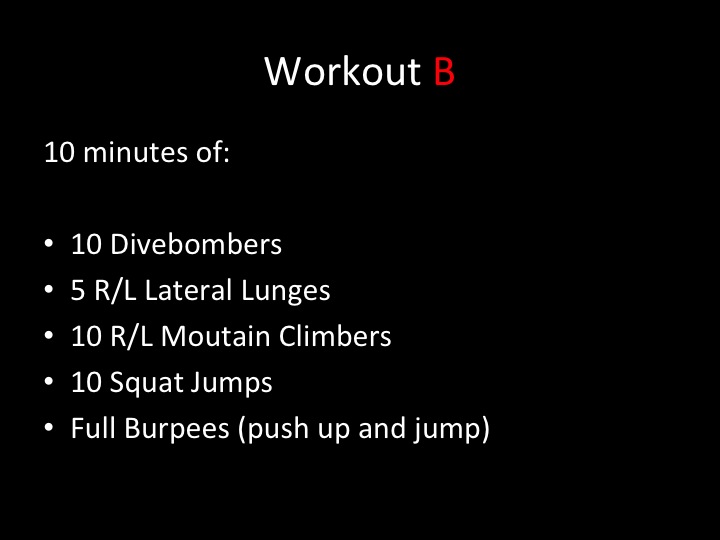
What follows is a simple time based workout program that is an immediate solution for anyone leery of investing decent time in a workout or for people who are legitimately short on time (because I know that you are out there folks).  

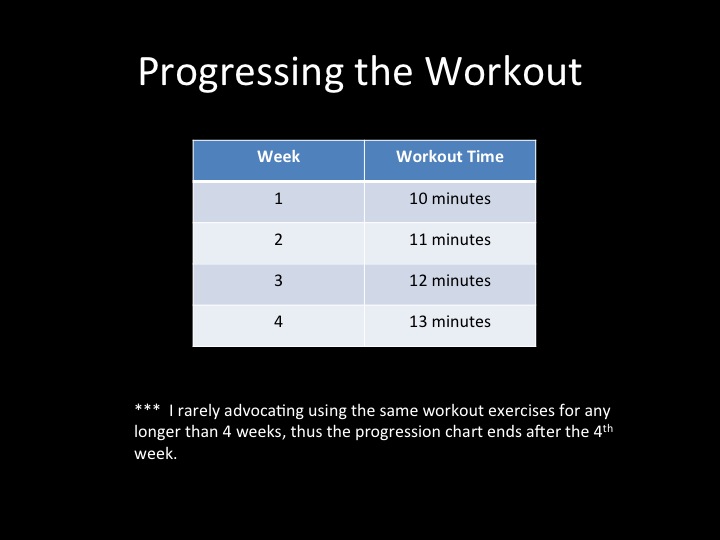
You’ll be able to progress this training plan for about four weeks while avoiding stagnation and adaptation.  The body tends to get really efficient at activities that we repetitively engage in, so don’t be silly and try to ride this program out for a year or something crazy like that.  

Building fitness demands that you constantly keep tweaking the variables.

Here you go… 

ImageImageImageImageImage


Essentially you are increasing the volume of your training sessions by adding one minute per week for four weeks straight.  I like workouts like this for beginners or advanced individuals alike because everyone can move at a pace that is appropriate to them.  Beginners can grab a breather and some water if need be, and advanced trainees can whiz through at break neck pace to get their training effect from the workout.

Best of all?  You can do this type of workout anywhere.  

Worst of all?  No pulling and no hip hinging movements.  Without equipment, it’s really hard to work upper body pulling movements into a workout.  Suspension trainers like the Jungle Gym XT really help this issue.  

Hip hinging is the motion you’d make if you were butt bumping a car door shut.  You’re hinging at your hips.  Without weight, it’s hard to train this movement pattern, which really sucks because hip hinging is one of the most beneficial movement patterns that we humans can train.  

You’ll find that every style of training sacrifices something.  Nothing is perfect.  

The key with short workouts like this is leveraging the training effect of the session.  Short training sessions like this need to be high tempo since you are cramming a lot into short duration. 

If you’re not willing to buckle down on your eating habits, well, prepare to be awfully disappointed by every workout program ever created.  Physical activity is a supplement to eating food worthy of fat loss.  The changes that take place post-workout are just as important if not more important than what takes place during the workout.

Sure, you can reduce body fat and increase performance without any dietary intervention (yes it is possible), but you’ll sell yourself short in the long run.  Sooner or later you’ll reach a plateau.  Eating crap food and training like a crazy person only gives off the perception of health.  Food is the key to the body aesthetic universe and long-term health and wellness. 

Any honest personal trainer or fitness advocate in the world will tell you that nutrition makes up the bulk of the foundation of any athletic or fit-looking body.  We cannot train hard enough or long enough to offset poor eating habits.  Unless you are an Iron Man athlete, in which case you are training for 3-5+ hours per day, almost daily and you have no real world career other than your sport.

Less than 1% of us fit that description, so lets just be big boys and girls and eat nutrient rich foods.  Ok?  Make the food that enters your pie hole primarily veggies and plants mixed with some animal protein and nuts.  Perfect little diet solution that will work wonders.

Plus, it would be so stressful to think about having to workout so ridiculously hard to combat all of the junk food eaten.  

If the food grew from the earth or has a mother, eat it. That’s your checklist to decipher through the food trickery that has saturated our restaurants and supermarkets.  

Rock this workout plan for at least 2 weeks.  Training for any period of time shorter than that isn’t even worth lacing up your shoes for the first training session, and it really shows that you aren’t prioritizing to make some changes.  Stay committed and trust yourself and your program.  

All in good time.


Cheers to leveraging our body’s natural ability to burn fat…


Kyle

Completely Un-Organized Kettlebell Training For Fat Loss and Athlete-Like Conditioning: Part 1

Quick Tips

I am a huge believer in following a system.  Sticking to the game plan if you will.

There is nothing like a well executed game plan.  If you have ever played sports you know what I am referring to.  If you are fortunate enough to have a career with an employer (or as an entrepreneur) that preaches game plan for success and then the entire company comes together and follows through on executing it, well, it feels damn good.  

Sticking to your systems is the best way to measure your progress.  A system can tell you where you have been and also points you in a focused direction of where you are going.  For a beginner or even a novice aspiring to reach new levels of health and wellness, there is nothing more effective at creating change than executing a system to perfection.  

I love systems.  Did I say that already? 

But let me ask you something that I often think about in my own life…

  • What’s wrong with being sporadic about your exercise selection, sets, reps, interval length, rest periods, etc?
  • Does everything have to follow a set system?
  • Can I still maintain strength and conditioning levels and leanness improvising workouts?

I know those seem like a silly questions, some that most people will never think about, but after you make so many visits to the gym, work through workout after workout following a set progression to an end goal, systems get boring.  

Once I took a step back to get a deeper understanding of how and why we humans move, what our movement options were once we choose to train movement and what seemed to be the most effective at creating total body change… I realized that building high functioning lean bodies can be achieved in a completely un-organized way.  System-less if you will.  Cross-Fit does it in every single workout.  Besides following their two days on, 1 day off (rinse and repeat) training schedule, they seem to be building some pretty resilient humans.  I can’t say that I agree with everything that they are teaching and coaching, but the system-less approach seems to work pretty well for them.

If I can ever focus long and hard enough to put the final touches my books (they are coming I promise), you’ll find that I love simple advice.  Once you become more than a recreational exerciser and decide to invest time in learning about more serious forms of fitness and nutrition, topics can get really complicated, confusing and blurry.  The fitness and health pool is really deep.  There is a lot of conflicting advice, methods and even research.  

But it doesn’t have to be complicated, confusing and blurry.  At least I don’t think it does personally.

I spent years (and still do) reading heavy literature for no other reason than I enjoy reading it. I have a major chip on my shoulder from years and years of personal athletic endeavors that had no real guidance in strength and conditioning.  I didn’t know what a power clean was until Senior year of high school.  That sucks, because I no know what a dramatic difference a simple program can make a young athlete.  It’s incredible.

Sorry, sidetracked for a second there… Where was I?

Oh, I know…  I was just about to finish discussing the title of this post.

I love systems and I love simple training and eating advice.  Give me the meat and potatoes of what I need to know and I can figure the rest out as we move forward.  “Learn by doing” kind of thing.

I have also found that I love the concept of physical preparedness and completely un-organized kettlebell training.  I love heading to the basement, drawing up the workout based on my goals, and getting after it.  Sometimes there is good flow to the training session and sometimes it is full of sticking points, causing a much choppier workout.  Either way, I really never know what I am going to be doing until I get down there.  

However, that being said… I do stick to some key guidelines that help me get away with this un-systematized approach.  Here they are:

1)  Train big movements with challenging resistance

2)  Multi-planar core training

3)  Mobility Mobility Mobility

4)  Conditioning using many different methods

5)  Rest and recover harder than I workout


1)  When I say big movements, I am talking things like squats, kettlebell swings, snatches, presses, pulls, etc.  Stop messing around with tricep extensions and bicep curls, you have to eat your main course before you can have dessert.  

2)  I train my torso region in all directions and planes of movement.  I train my core for force production and force absorption.  I train my core to reinforce stability I can transfer as much force with any energy leaks from my lower extremity to my upper extremity.  

3)  Mobility.  I train mobility so that I can experience life as it should be experienced physically.  Loss of mobility is a prerequisite to pain through faulty movement  Loss of mobility is loss of life to me.  

4)  I condition myself with as many methods as I have resources.  When I was an athlete, I conditioned myself using set methods.  Running early in the off-season, slide boarding and then biking as the season drew closer.  It was scheduled and systematic because that was what my sport (hockey) demanded.  It made sense.  But, now I don’t have a sport.  I simply want to be physically prepared for anything.  It feels damn good to go for a 50 mile bike ride, run a 10k or play hockey 3-4 nights a week without feeling like a slug.  I use many methods to achieve both aerobic and anaerobic-like qualities.  I want to be able to endure long duration activities as much as short burst activities that get my heart rate sky high.

5)  I rest and recover much harder than I train.  Sleep, tissue work, hydration and nutrition are all important to me.  I am what I eat, drink and how I recover from my training sessions.  The green light isn’t always on.  You have to learn how to sit at the red light patiently until it is time to accelerate once again.  Rest, recovery and regeneration.  

Do you see what I am getting at?

I can train myself using a simple set of rules to keep myself lean and athletic, without experiencing the boredom of a system.  Training smart and slightly sporadic will keep me athletic for the rest of my life.  Sure, age will catch up with me as it does everybody at some point, but each training session will be fresh and purposeful.  Movement longevity is something that I am fully invested in, and I encourage you do invest in the same. 

I will say this however, I HIGHLY recommend systems to everyone.  You’ll never get better results as you will when following a system step by step.  My books leverage systems.  Systems get results.  They keep the main thing… the main thing.  Following a system takes discipline, and discipline is something worth developing throughout life.

I treat myself like test rat for variations of time tested methods.  I enjoy seeing if my 5-mile Airdyne ride for time improves or suffers after I train high repetition kettlebell snatches for 3-weeks versus metabolic body-weight circuits.  That kind of comparison scenario is interesting to me, but it isn’t for everyone.

(Any strength coach that reads this is going to grind their teeth)


Cheers to moving more and with purpose,


KG 


Simple Tests to Measure Your Fitness/Performance

Bodyweight Workouts, Human Performance Discussion

I have never liked the word fitness.  It just reminds me of people like Tony Little and Richard Simmons bouncing around like circus clowns.

I think I might go as Tony Little this year for Halloween now that I think about it.  Interesting.

A net worth of $200 million. Unreal.

Anyways…

What I want to talk about today is how to measure your training to make sure that you are moving forward.  Just like improving your eating is going to help your body composition and weight issues, measuring improvements in your training goals is also going correlate with the amount of fat you lose.  I suppose this is assuming that you don’t ruin your workout by eating an ice cream sundae.

If I were you, these are some simple measures of physical fitness that I would measure…

  • 1 mile run
  • 400 meter run for time
  • Distance ride for time (amount of time it takes to ride 5 miles on a stationary bike)
  • Maximum # of push-ups (full reps)
  • Maximum # of bilateral squats (bodyweight and 2-legs)
  • Maximum # of single leg squats (are both sides equal?)
  • Maximum # of pull-ups and chin-ups
  • Maximum # of inverted rows (aka:  body rows)
  • Time to complete:  24 squats, 12 fw lunges r/l, 12 split squat jumps r/l, 24 squat jumps (beginners= 1 set, intermediate/advanced=2-3 set repeats)

Take note of the last bullet where I recommend that an intermediate or advanced trainee complete the circuit 2-3 times.  Record the time it takes to complete one full circuit.  Your rest period before starting the next circuit will be twice the time it took for you to complete the prior circuit.

Example: Intermediate trainee required 96 seconds to complete circuit…  2 x 96 seconds=  3:20/rest

This is a lower body work capacity circuit for an intermediate or an advanced trainee, and probably a combination of strength and work capacity for a beginner.  If you are beginner, GREAT!  You may have to modify it a bit to complete the circuit, but that is no problem.

Kudos to you for taking action.  

Most people don’t.

Just remember that what is easy for one person, may be difficult for another.  It is quite common for a beginner to get one hell of a training stimulus from simple bodyweight moves.  Heck, I still use bodyweight moves in my own training just because they are so effective and require zero equipment.

Very simple to implement.

Let me be clear that there are far more extensive tests that I could recommend, there are.  But, when it comes to training at home, not everyone has the equipment necessary to properly measure your performance. That’s fine.  You’re not training for the olympics, I wouldn’t worry about it.  Use what you have.  That will work.

If you are making solid improvements in most of the performance based tests I listed above, I guarantee something great is happening to your body.  The correlation between increasing performance is closely tied with leaning out and getting fit in my opinion.

Especially when you begin to make significant improvements in load lifting, work capacity efforts and

Improved performance comes with this great little by-product called leanness.

With the olympics still rolling in London, now is as good of time as ever to make that point.  Performance and leanness seem to go hand in hand.  Take a look at 99% of the athletes in the olympics.  Of course I would exclude the olympic lifting, archery and table tennis, but hey, most of those athletes are pretty lean also.  I should probably add in the ridiculously skinny/atrophied long distance guys/gals too.

Maybe we should all train like athletes?  (Hint, hint)

Don’t be afraid of sweat and effort. 🙂

Let me know how it goes…


KG

(P.S.  This is performance based testing.  Keep in mind that movement quality should be evaluated also, I will show you how to measure that in a future post).