Workout Finisher: Kettlebell Swings, Push-Ups and Rowing

Motion

A workout finisher is a short burst bout of high(er) intensity positioned at the end of a workout. It usually consists of 2-4 exercises, using minimal equipment (or no equipment).

There are thousands ways to design a workout finisher, and I intend to share them all!

Kettlebell swings, push-ups and rowing are timeless exercises. They also happen to make a perfect workout finisher.

Push Ups

Push-ups are an upper body horizontal pushing exercise. They work the chest, arms and core. Push-ups are easy to modify for any level of fitness. Beginner? Elevate the hands, reduce the weight and limit the challenge to the core. Advanced? Add weight to move on to single arm variations. A set of push-ups is seamless to start and end, making them a great option for a workout finisher.

Kettlebell Swings

Kettlebell swings are an explosive hip hinging exercise. I’ve been swinging kettlebells for 13 years and it’s still one of my favorite movements. Swings are a great choice for workout finishers because they are easy to set up, start/stop and train the entire body. Walk up to the kettlebell, grab the handle, swing. Plus when you’re using weights for cardio, I prefer swings because they are more forgiving with technique (compared to barbell cleans, etc).

Rowing

Rowing is one of the best cardio activities a person can do. Rowing is taxing for the entire body. Rowing isn’t as quick to get set up (compared to push-ups and swings). Put your butt on the seat, strap the feet, grab the handle and row.

Push-ups and kettlebell swings make a fantastic pairing. Upper body push with a hip hinge. Grip is preserved for the swings, pushing muscular is preserved for the push-ups, lots of muscle being taxed with two basic exercises.

You could (and I have) combined push-ups and kettlebell swings in an alternating fashion and created one hell of a training effect in about 5 minutes.

Workout Finisher| Swing-Push-Row

Aim for completing 5 rounds using an 8 minute time limit.

In other words, you get 8 minutes to complete 5 rounds, and if you fall short, the workout finisher ends.

Is this workout finisher too aggressive?

Cut the push-up and kettlebell swing reps down to 5. Lower the rowing distance to 150-200m.

Do not be afraid to tweak workouts to suit your fitness level.

You don’t need permission to do this.

Flow and Non-Competing Exercises

The best workout finishers have a good flow/transition between exercises.

Remove as much set up fiddle factor as possible.

The goal of a workout finisher is constant movement. Transition from one exercise to the next until it’s over.

Don’t waste time with exercises that have a long set up time.

Choosing non-competing exercises allows you to give more energy to each exercise and take a total body approach to the finisher.

3-4 exercises is perfect for a workout finisher. Remember, workout finishers are supposed to be the icing on the cake, not the meal.

Non-competing exercises can help with safety. You’ll be tired, but not overly tired in any one movement pattern or muscle group.

Here are a two simple non-competing exercise strategies:

  • Upper and lower body exercises
  • Push and pull exercises

Non-competing exercises:

  • Squats + pull-up
  • Lunges + overhead press
  • Push-Up + kettlebell swings 😉
  • Crawling + loaded carries

⚠️ CAUTION ⚠️

A workout finisher should be brief. By definition, a workout finisher is the ending to a workout, meaning you completed other activities leading up to it.

What might those “other activities” be? 👉 mobility, resistance training, ground based movement, etc.

If a workout finisher drags on for 15-20 minutes… it tells me it’s over-engineered, didn’t do enough quality during the middle of the workout, and set yourself up for unrecoverable fatigue in the coming days.

People make the mistake of biting off more than they can chew. They step up to workouts that don’t account for the days ahead or their current fitness level.

Fitness is a long-term play.

Hundreds of workouts (and diet) will create the body and performance you desire. This is the #truth, depressing for some, but realistic and honest.

Like this workout finisher??? It’s just the tip of the iceberg for options.

Here are some other workout finishers to try.

A Quick (and effective) Kettlebell Swing + Bodyweight Movement Workout

Quick Tips

I’ve started to trend some of my posts toward topics that people are searching for in Google, which I am informed of on my blog.  You cannot see these stats and search terms, but I can, so advantage to me!

I won’t sell out and write what I think will drive more traffic to this blog (a lot of fitness bloggers do), but I am interested in what kind of traffic numbers will arrive if I direct some of my posts toward the needs of the people.  My goal has always been to write authentically and reach as many people as possible.  We will see how it turns out.

Ha, listen to me… “The needs of the people”.

Photo Credit:  tv.com

Photo Credit: tv.com

I sound like I should run for city office, or city treasurer on Boardwalk Empire.

Anyways, I put myself through what I would consider an intermediate workout tonight.

This workout was heavily centered around kettlebell swings, and supplemented with various other bodyweight movements.  I feel like “supplemented” is the proper terminology in this particular situation, as you’ll see from the workout below.

The bodyweight movements that separate the kettlebell swings are nothing more than filler exercises used to keep my heart rate elevated in between bouts of swings.  More muscles worked, more calories burned during and after training.

I tend to choose both upper and lower body bodyweight movements to disperse the training stress to  more of a total body approach.  Splitting the movements to upper and lower allows for a brief period of training stress directed at a specific movement pattern (horizontal push, squat, vertical pull, etc) without exhausting that pattern completely.  This allows for intelligent fatigue management during other bodyweight movements and more importantly during kettlebell swings.

When fatigue sets in, technique gets ugly, people are exposed to bad habits and injury.

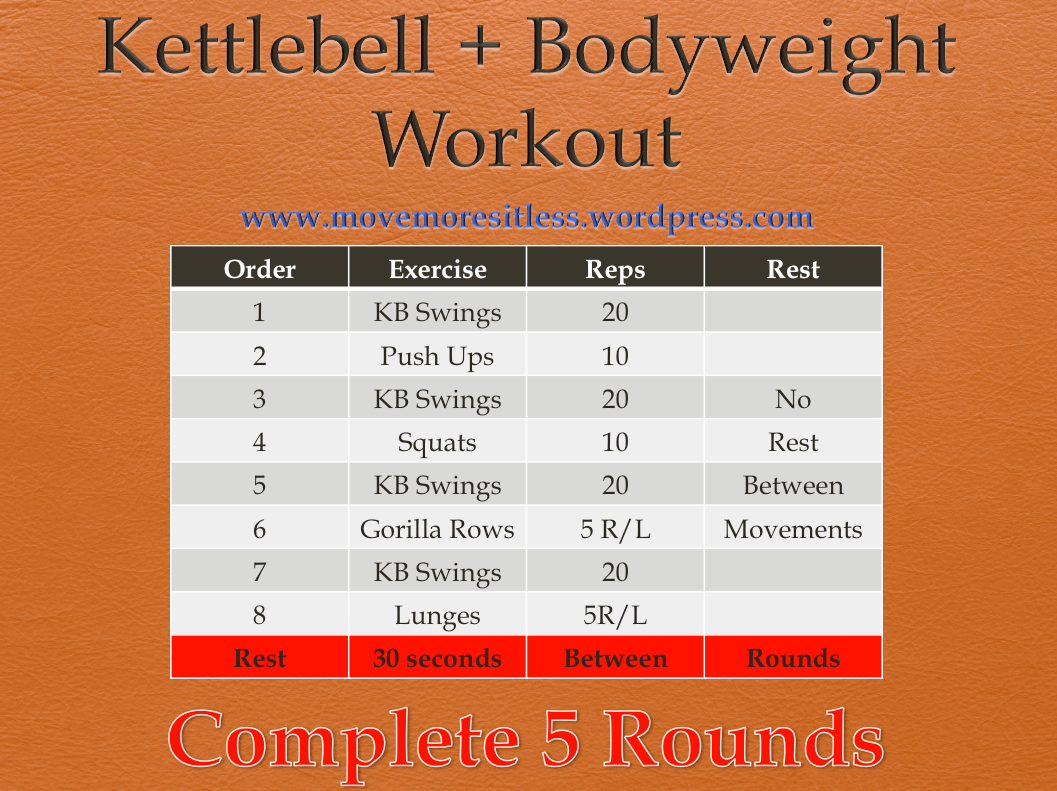
So, without blabbing any further, here is the structure of the workout, please notice that it is very similar to the multi-method cardio approach:

sample kettlebell and bodyweight workout

A couple of points…

First, there is a lot of work being done here, as you can see.  There is a lot of muscle being stressed and the rest is light.  A workout like this could be a complete training session for a beginner or an intermediate, or scaled up for an advanced lifter.  Scaling up for an advanced trainee might involve a bump up in bodyweight exercise progression or adding a weight vest to those movements.  It’s all a matter of tweaking the variables based on your unique situation and needs.

Second, I kept the reps to even numbers, 10’s and 20’s.  Why?  Because it is annoying having to check your notebook after every movement.  I want you to be focused on what you’re doing during the training session not counting reps like people count food calories.  Focus on your movement, your breathing, your recovery.  Forget about complicated rep schemes… I have plenty of those that I will post in good time.

Third, go sub-maximal but not too light on your kettlebell swings.  Grab a bell that you could swing for 30 reps and focus on hip snap during those suggested 20 reps.  Guys you might grab a 24kg or a 28kg, gals you might grab a 16kg or a 20kg.  Both guys and gals, you’re allowed to grab more or less than that, but on average, males and females will use those weights.

Remember, don’t gauge your energy expenditure on the first set of swings because you’ve got 3 more sets of swings and 4 different bodyweight movements lying ahead.  Manage your fatigue appropriately.  If you have a heart rate monitor, I would suggest using it to check you heart rate.  Of course, you’d want to already have an idea of the beats per minute that separate you from exhibiting crappy movement technique.  When you reach that heart rate, you can back off, rest for a few seconds, then get back into the workout once you can control and OWN the movement.

Why 20 reps of swings?  Because I personally feel that anything more than that really doesn’t provide much benefit other than poor technique (lack of finishing in full hip extension, slouching, etc) and a rising risk of losing the bell on the backswing or at the highest point of the arc.  One slip will kill your pet or put a hole in your wall, and the other will destroy your brand new LED TV.

20 reps (or less depending on your conditioning level) seems to allow for a sufficient elevation in heart rate without making the swings pointless from lack of load and endless volume.  There will be plenty of work performed in this training session, it doesn’t all need to be accomplished with kettlebell swings.

If you’re bored with your typical cardio routine, I would highly recommend giving a workout like this a real shot.  You will be pleasantly surprised at how hard your cardiovascular is taxed during a training session like the one described below.  20 minutes seems to be the sweet spot for me.  I have tested up to 30+ minutes of work like this, and it just doesn’t work for a couple of reasons…

1)  I feel like I am just going through the motions with regard to loading (aka weight used).

2)  I feel like I am adding  volume for an unjustified purpose.

These days, workouts like this serve as a great follow-up to my 2-day on/1-day off training schedule.

Day 1 is a heavily focused on strength work with a splash of jump rope or Airdyne cardio work, while day 2 (this workout) is dedicated to sub-maximal movements strung together to work cardio-strength (traditional strength moves with incomplete rest periods).

Ultimately, the goal is to stay physically prepared until I shift my training toward a particular goal.

Also, although the 20-25 minutes of work being completed in a workout are definitely stressful and draining, I feel as though it’s a short enough bout that allows for adequate recovery between training sessions, avoiding over-training.  The full 24+ hours of rest is also a motivating factor to work hard during this type of training session.  The rest day is just that… a rest and recovery day.

Be a perfectly golden marshmallow at the end, not a crusted black scabby marshmallow.

Give it a shot and let me know how you make out!

Cheers to short effective bouts of exercise!

Kyle

The 5 minute Kettlebell Swing + Burpee Challenge

Quick Tips

I love metabolic challenges, especially ones that incorporate kettlebells and burpees.

If you didn’t get a chance to check out the burpee challenge from a few days ago, I suggest that you do.  It’s a tough workout that will definitely get your heart rate up.

—>  Metabolic Challenges/Finishers Over Boring Cardio

I favor metabolic challenge workouts, sometimes referred to as “finishers”, because they test your mind and body in a controlled setting.  The movements and reps/sets (aka: volume) should always be structured to YOUR own physical abilities, not someone else’s.  Nothing during a metabolic workout should be forced.

It is crucial that a high tempo work capacity style training session have progressions and regressions.  One size does not fit all.  The workout should be scaled to fit each of us on an individual level.  This will decrease the likelihood of injury while promoting physical transformation and improvements in performance.

Once you have proven that you can move efficiently without pain and have acquired adequate strength, stability and mobility to execute basic exercise like squats, push-ups, chin-ups, lunges and planks, it may be time to consider mixing in some metabolic work.

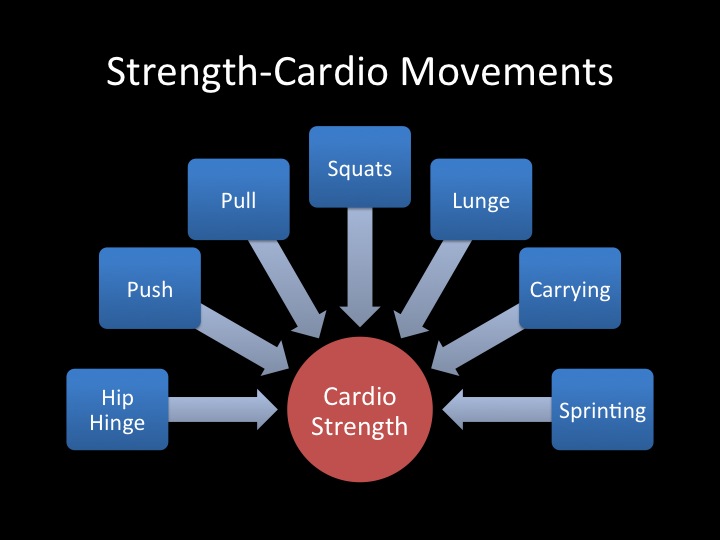
Remember this picture from a recent post?…

Strength Cardio Movements

I use “cardio-strength” and “metabolic” interchangeably…

At the very least, you can mix in some short burst finishers toward the end of your strength training session.  Adding finishers to the end of a workout will shift the way that you think about conditioning.  I know that it did for me.  It was a game changer.

There is nothing wrong with traditional activities like bike and hill sprinting, but to be honest, I find it painfully boring.  I know for a fact that I do not sit alone with these feelings.  Boring cardiovascular training can actually do more harm than good.  If you dread boring cardio to the point that you choose not to workout at all, that’s bad.  It shouldn’t have to be this way.

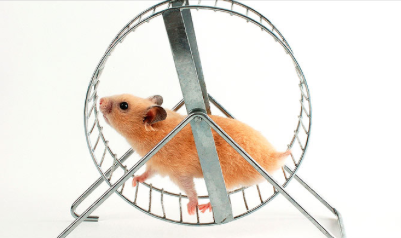
Boring Cardio Hamster Wheel

Do you ever feel like this while working out?

You don’t have to be a fanatic about your training habits, but long-term adherence to a life full of movement requires that at the very least you find some amount of enjoyment from your workouts.

The main point is that you have great alternatives to the long, slow, boring treadmill trot.  Finishers will keep your training fresh and challenging.  The return on investing in finishers is large.

I will always encourage beginners, novice and even advanced trainees to continue to make conscious efforts to improve strength and power.  This will never change.  So much good comes from building basic strength.

In a normal training session, after working through a complete warm up, strength and power work should be next on the day’s agenda.  Most workouts will require anywhere from 15-20 minutes to work through 2-3 tri-sets of strength/power enhancing movements.

—>  Kettlebells and burpees collide

Lifeline Kettlebells

Lifeline Kettlebells…

I am a huge kettlebell fan.

Kettlebells changed my perception of working out.  Kettlebells brought  the importance of strong, stable, free-flowing movement back into the fitness equation.  You have to be 3-dimensionally strong to lift, swing and carry a kettlebell.  My gym sessions transformed from a of time devoted to the typical big lifts- squats, pressing and pulling- to ground based movement sessions that built strength and stability using in greater ranges of motion.

I now have a level of stability, mobility, and functional strength that I didn’t know was possible for me to have.  Kettlebells aren’t a miracle, but the shift that they caused in my views on what an effective workout could be certainly make them one of the most influential pieces of training equipment I have ever used.

Kettlebell training is represents true movement.

The Turkish Get Up

Segue…

Next, the reason that we’re gathered here in the first place.

—>  The kettlebell swing + burpee metabolic challenge

I cannot remember where I first saw a version of this challenge posted, so please forgive me.

Credit belongs to someone out there, so take it if you’re deserving of it.

I’ve adapted it to fit my needs over the years, as I do with most everything related to training.


Tools needed:  To complete this challenge, you’ll need a kettlebell that you can swing for about 15-18 reps continuously for multiple sets.  I use a 24kg or a 28kg kettlebell for a finisher like the one described below.  Have some kind of timing device on hand.  I always go with my trusty GymBoss.

You’ll also need an open space of about 8ft x 8ft.  This should work just fine.  You can get by with less- and I have- but the more the merrier.  The ceiling of the space you are training in should be high enough to avoid hitting the top of your head when jumping.  If you’ve got clearance, you’re in business.

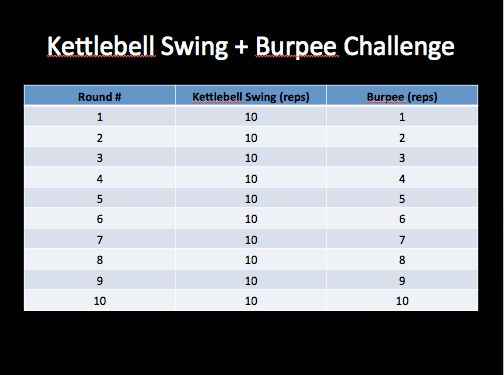
Here is how the challenge is formatted…

kettlebell + burpee workout

Make sense?

Take note of how each round accumulates burpee reps while the kettlebell swings remain the same.  It’s a very simple format to remember.  Two exercise finishers work great because they take very little thought.

The weight of kettlebell used will vary from person to person, but in general I would go with the following:

Females:  12-16kg

Males:  24-28kg

Of course there are going to be those of you who can use heavier kettlebells than what I suggested, but these are common weights for each gender.

The ultimate goal is to finish in 5 minutes.

I won’t p that I “think” a beginner, novice or advanced trainee should be able to finish a challenge like this in.  That’s not the point.  The goal is to finish in 5 minutes, end of story.  Anything longer than that indicates that you have a goal to work toward.  Sound good?

Stop Sign Warning

—->  Mandatory warnings to this workout

If you have never swung a kettlebell before or you aren’t proficient in swinging kettlebells for higher volumes or while under fatigue, this is not the time to test yourself.  Work up then work in.

Lastly, technique breakdown automatically initiates rest until technique can be maintained.  Fatigue kills exercise technique.  Leave your ego at the door when you train, it will save your body from injury.

Work smart and hard, not smart and reckless.

Give it a shot, have some fun and post how you finish up…

Cheers to the conditioning without boredom!

KG