
The stationary bike is not the devil.
Riding the stationary bike might be on the lower end of eventfullness and brutally repetitive, but it is not the devil.
I’m about to share completely unscientific and unsupported Jedi Mind trick for your next stationary bike workout that will boost your conditioning efforts.
I use it extensively in my home training sessions on my trusty Schwinn Airdyne. If you’ve read any of my work in the past, you know by now that I believe that the Airdyne (yes the old school Schwinn Airdyne) is one of the best conditioning tools on the market.
Browse on Craigslist and I best you can find one dirt cheap.

It’s well worth the investment assuming you give it a little TLC to ensure that the nuts and bolts stay tight and the chain is lubed.
But you don’t need the almighty Schwinn Airdyne to reap the benefits of making this simple switch to increase the effectiveness of your biking sessions.
The fact is, although it might not be the BEST option, you can get yourself into excellent cardiovascular shape by riding the stationary bike on a regular basis. At the very least, you can lay a great foundation of conditioning to build from. If you’re a runner, you might find that the carryover from the bike to the pavement isn’t the greatest, as it really isn’t.
The demands of running and cycling are different. Just because you are efficient at one doesn’t mean you’ll be efficient at the other. Look at Lance Armstrong’s (all doping aside) plunge into the running world. A lot of people thought based on lab statistics that he could finish quite high in the marathons that he ran, but this just wasn’t the case. Lance was quoted to say post-marathon, “that was the most challenging thing I’ve ever done”.
Interesting don’t you think.?
But anyways, the stationary bike is a low impact alternative to other higher impact methods of cardio such as running. Running also isn’t the devil, but high impact all of the time can agitate and overwhelm a person’s body. The stationary bike becomes a valid alternative in these situations, and with the properly prescribed training session, it delivers.
At some point, despite your personal preferences, you may find yourself forced to ride a stationary bike, and I am here to tell you that it really doesn’t have to be a nightmare. Embrace it, make the best of the situation. Put in your headphones and get to it.
As mentioned in past posts, a person doesn’t need special equipment to leverage the benefits of a workout… but you have to be wiling to adapt on the fly and try something new occasionally.
So, here is a subtle trick for you to squeeze even more out of that dreaded pedal session…
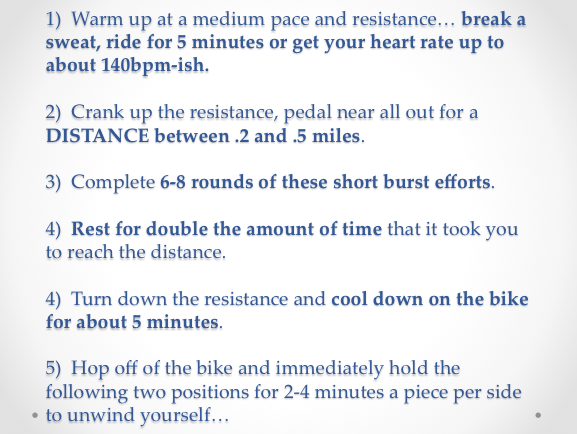
What’s different you ask?
Riding for distance, that’s what. I want you to ride hard for a distance versus riding for time.
In fact, forget about riding for time, ride for distance for the next 4-weeks. When you ride for time, people tend to give a much lower effort, just “surviving” against the clock. A lot of us will quit pedaling well before the clock hits our target work time. I’m guilty of it.
When you pedal for distance, you want to get the pedaling over with a quickly as possible. This is a natural tactic that promotes effort beyond what you may have given had you been riding against the hands of the clock.
Although I have a sickening love for the infamous 5-mile Airdyne Trek for time, if I am performing short burst work, I typically keep the distances between .2-.5 miles. On the big fan, .3 miles typically takes me between 39-45seconds to complete.
That is a long time to be pushing it hard. Remember to remind yourself not to judge the demands of the workout based on the first set, second set or even the third set either. As I have said before…
… the fatigue is coming, be patient, it is coming.
If you are curious about the timing of fatigue in a work capacity style workout, read about the golden marshmallow. Although that I wasn’t referring to stationary bike conditioning… fatigue is fatigue. The article still applies.
So as you can see, the concept is beautifully simple. Switch your target effort markers of hard pedaling from time-based to distance-based. Spin to that .3 mile mark as hard as possible, then verify the time that it took to get there.
It’s just a simple mind trick and it works.
Give it a shot… reading without implementation will yield the same results. You have to actually do it to see reward!
Cheers to tricking yourself to boost the reward of your workout investment!
KG


 M(eaux)tion Fitness