What is Ido Portal’s Training Philosophy Doing To Me?

Quick Tips

Ido Portal

I’ve been following Ido Portal for nearly 2 months and I’m starting to question how we “practice” fitness, what it means to be “fit”, how we get to the point of being considered fit, what humans should be able to do movement-wise, and on and on  and on.

I have to admit, thought process-wise, I am going through a shift.

Ido makes incredibly great points about movement and body control.  It’s a raw thought process, completely stripped down to just… movement.

The point that Ido conveys time and time again is that we should be able to move freely.  He references movement patterns, but I know from reading through his blog and watching his YouTube videos that he isn’t referring to the “safe” movement patterns that we fitness professionals beat into the ground.  He’s expanding far beyond that thought process.

Here are some snapshots of Ido-style movement…

I realize now, more than ever, that the modern-day human really doesn’t know how to handle their body.

We are slaves to sitting in chairs, cubicles, in front of the television and in cars.  If you really stop and think about how much we sit on any given day, it’s nauseating.  Even if we have no choice but to sit for our careers, when the weekend comes we still choose to grab a lawn chair and sit, sit at the bar, sit at restaurant.  Sit.

I can partially throw myself into this group also because I have to sit down to write on this blog.

I consider myself to be an athletic dude, but watching some of these videos leads me to believe that I have handicapped my own movement performance.  I am not even in the same realm as some of the people that have been under the Ido Portal tutelage for as few as a few months.

I can squat (ass to grass) and rest in the squatting position for long periods of time, elevate my arms overhead without breaking at the low back, and exhibit rotational range of motion at my thoracic spine when it’s required… but integrating of all of these elements into a free-flowing long sequence without making it look painfully difficult was humbling for me.

The low lizard crawl is a basic locomotion pattern in the Ido Portal Training Method, and it’s basically used as warm-up!  I am here to tell you that it is humbling how difficult it is to crawl 10-15 yards like this (fast forward to 1:56)…

Are the followers of the Ido Portal Method been practicing different techniques than I am?

Yes, of course.  They are following strict progressions that allow for a appropriate movement education.  A repetitive approach to learning movement in a progression-friendly manner will ensure that no fundamental steps were skipped along the way, all while achieving desired results.

The human body will adapt and increasingly better how we ask to move, or how we don’t it to move.  That is why a lot of people have back pain, poor hip mobility and loss of muscle activation from sitting.  But humans naturally want to stand up straight, so in order to make this possible, we compensate to achieve.

So I think that over time my movement will begin to flow like some of his videos, but it is going to take some work, some practice, dedication and time.

Many of Ido’s students YouTube videos display what I would consider to be “test-outs” or results from following his teachings, so I think that it’s important (when watching these videos) to keep in mind that there was an incredible amount of dedication and work put in prior to shooting each person’s testimonial of the Ido Portal Method.

It didn’t happen over night, in a week or in a month.

The other night, I was trying to find the words to describe my perception of how we pursue health and wellness, and where I stand on the matter.  It’s a difficult topic to discuss because there are so many elements that combine to form, health.

I continue to find myself veering away from “safe” more and more.  Now, I don’t mean that I am moving toward “unsafe” and negligent, but I really am questioning why we do what we do in the gym or outside of the gym (wherever we train).  It’s cookie cutter and robotic in nature.  It’s lacking exploration.  Reps, sets and rest cannot be the pot of gold at the end of the movement continuum.

Who established these rules that we follow so closely?  Science?  Industry leaders?

Do we continue to teach and preach these methods because that is what the masses want?  Or are we lacking in our own understanding of more complex movement patterns, integration and improvisation?  Are we aiming for the wrong target?  What does fitness mean anyways?

We aim for reproducible results- and I don’t think that we should be aiming for anything different- but we have become robots in our pursuit of fitness.  The entire idea is skewed.  Everything that we preach for people to do is cookie cutter and safe.

There is very little room for anyone to stray from the path, and if you do (as I am exploring currently), you’re branded and thrown out to the wolves.

We preach moving within our means, avoiding compromising body positions and alignment, moving weight safely, employing safe rep and set ranges for maximizing our goals, adequate rest to perform that work safely, etc.  Safe, safe, safe.

Before you label me a hippocrate, let me say that I actually also believe in safe.

Ido Portal’s methods of movement might be right for everyone at some point, but maybe not at this moment.

The human race have never moved less or eaten worse.

We sit more, we move less. We are walking time bombs with regard to our ability to move effectively or for any duration (endurance, etc).  We eat food created in factories, food that has never seen the earth’s soil, food that contains ingredients that we cannot pronounce much less identify… and because we eat so much of this food, our body’s have become a reflection of these poor choices.

Make no mistake, we are what we eat.

But the problem is that we don’t even know we are heading down a path of self-destruction.  Eating crap has become the norm, and we don’t even know it.  But food chatter is outside of the scope of this blog post.  I’m not a nutritionist nor do I really want to be.  I’ll end the nutrition talk here.

We walk around commenting that a person is “in shape” if they don’t cast a bubbly shadow on pavement on a sunny day.  Not everyone needs to have a six-pack, but we are desensitized to what health looks like.  “Lean” is almost taboo is some areas of America, and the world.  One look back in history will show that most of civilization is getting bigger.  And by bigger, I am not referring to taller.

In many instances, our body shape is actually limiting our ability to move.  Yes, the amount of tissue that we are carrying on our bodies are preventing us from moving the way that we are supposed to move.

Studies like this support my bantering…

I started thinking like this a few years ago, and I thought I was crazy, because my background is strength and conditioning.  Strength and conditioning workouts and programs are EXTREMELY structured, and EXTREMELY safe.  There is very little room for movement exploration in the eyes of strength coach.  Strength based programs, as I mentioned, are extremely structured.  You work through phases that place focus on building different athletic qualities (hypertrophy, strength, power, work capacity, etc).  The reps and sets are calculated, training days, rest, etc.

I got trapped in that way thinking for everyone, athlete or otherwise.  More like handcuffed.  To the point that I felt like if I explored anything outside of a 4-phase workout program, a barbell squat or a systematic approach to “core training”, then I was a Looney Tune.

Then I picked up a kettlebell for the first time.  Kettlebells had been around for a little while, but they were still considered taboo by some of the leaders in the strength and conditioning industry.  After executing some kettlebell swings and some turkish get ups in a hotel room after a performance conference, I realized that movement was different from exercise.

Movement is different from exercise.

This is movement:

This is exercise:

I was strong, but my integrated movement was shit.  In fact, I wasn’t graceful at all.  My muscles were powerful and my joint were mobile and stable, but I had zero grace in pure movement.  I was powerful, strong and stable within the confines of identified movement patterns, but when I challenged myself outside of these confines, I was at beginner level.

Again, I realized that movement is different from exercise. I was certainly moving when I exercise, but I was trapping and limiting my ability to move freely with traditional exercise.

In fact, I don’t even like the word exercise.  I use it but I don’t like it.  I use the word “movement” on this blog over and over again.  I would even prefer to say “train” or “practice” or “drills” over the word exercise.  Exercise makes me cringe.  “Exercise” makes me think of automated robots on a treadmill.  I don’t want to be an automated robot.  I want to move.  I want to move because I enjoy moving, and seeking out new methods of movement is challenging.  I want to move in an unrestricted 3-dimensional manner.

I’m not going to discard structured movement training using such drills as push ups, squats, and lunges, because they have their place.  But I am damn well going to explore un-traditional forms of movement from here on out.  Climbing, hanging, swinging, etc.  Full integration of movement play and practice starts now.

We fitness professionals think that we know movement and that we are teaching people how to be “functional”, shame on us.  We stop our teachings at “flat back”, “shoulders down and back” and “pressurize your core”!

I learned a long time ago, after crumpling up and throwing away probably 2-3 books worth of writing material that I should trust my thinking.  I feel that I should trust my thinking now.  I have grown to appreciate being exposed to new ideas that initiate an evolution in my own thinking.

Why be trapped?  Go explore, go move…

Oh and here is that picture that I promised some 910 words ago…

Screen Shot 2013-08-17 at 12.01.58 PM


Cheers to stumbling onto ideas that open our minds!

KG

A Glimpse of a Sample Staircase Interval Workout

Quick Tips

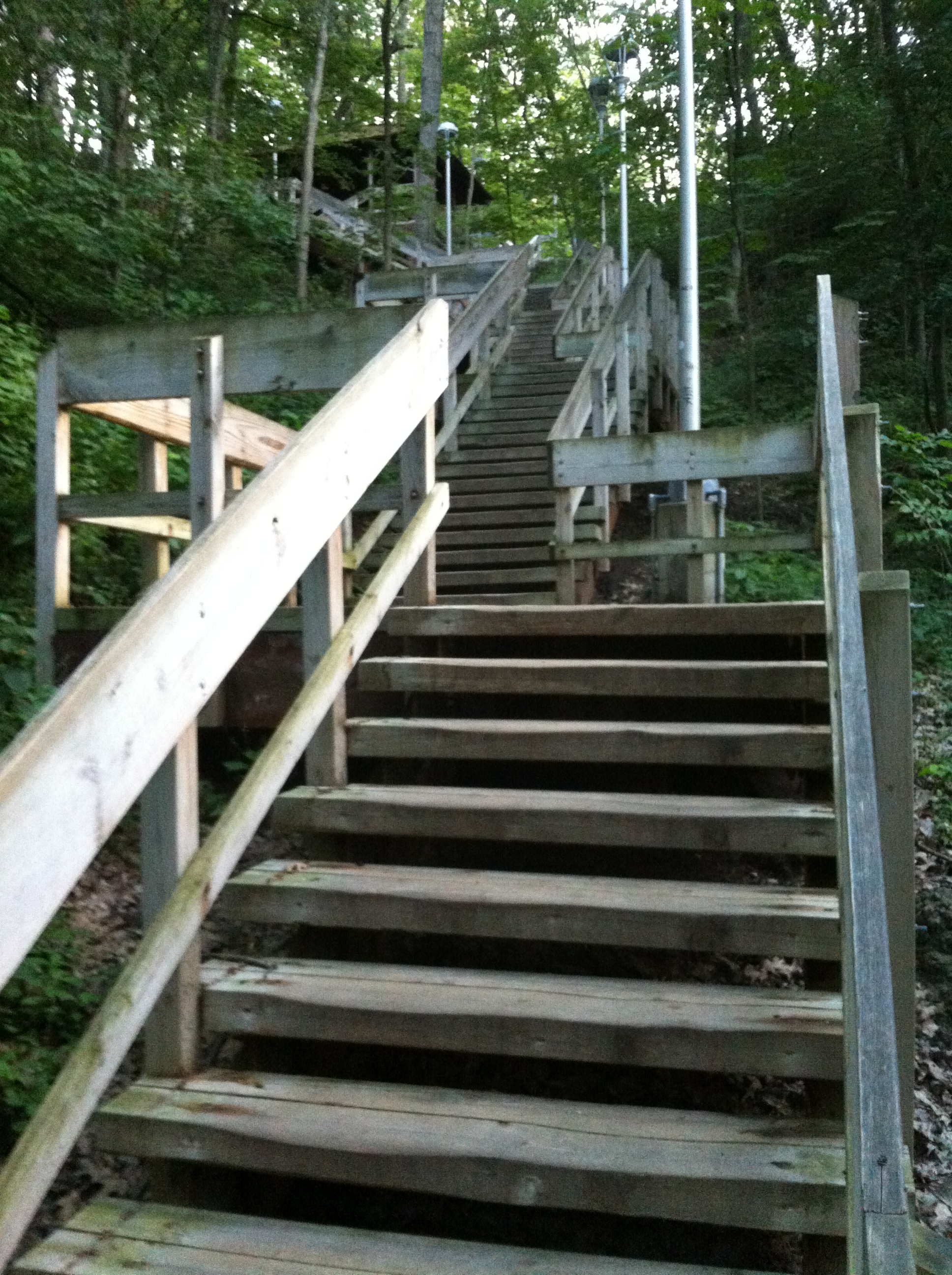
There is really nothing like sprinting up and down a long staircase.

If you’re fortunate enough to have a staircase near you that is of decent length, congrats, you’re in luck.

By decent length, I am referring to a staircase that takes about 30 seconds or longer to run up at a brisk pace.

If you’ve never treated yourself to a staircase training session, you’re going to find that running vertically is nothing like running horizontally.  Every step/stride requires brute force and attention to detail.

Why attention to detail?

Because the split second that you get lazy or lose focus on what you’re doing, you’re going to miss a step and leave shin skin on the staircase.

Staircase running requires hip extension.  You can fake to make it for a little while, but you’ll find that opening up the hips and driving “down and back” with every stride is going to get you to the top faster and with a higher efficiency.  The hips are the powerhouse of the body, so you might as well use them if you have them, right?

Besides, your quads are overworked.  Let’s build a backside.

If you are finding that you cannot comfortable achieve hip extension, I would suggest regressing and addressing these issues quickly…

Here are some videos that might help…

Thanks KStarr.

Now on to the workout…

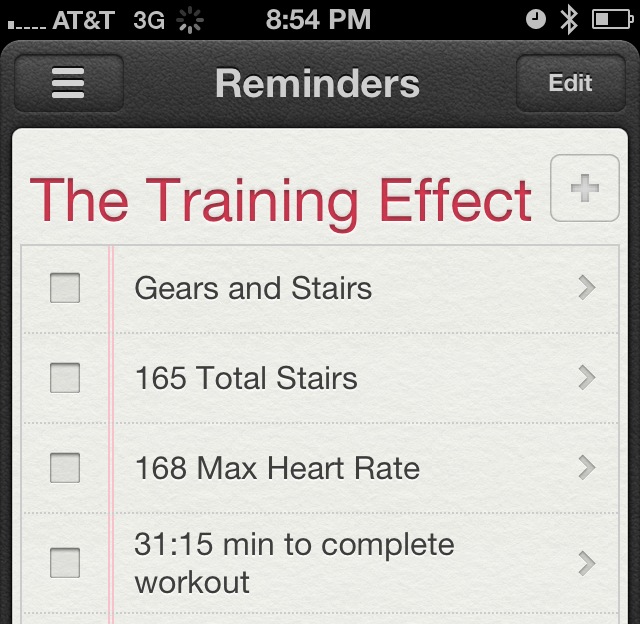
Staircase Interval Training165 glorious stairs

Staircase interval training

Total time from start to finish for this workout.

Staircase Interval Training

This is the break down of the workout.  30 minutes of work was my initial target.  I hit that.

My heart rate peaked at 168bpm, which I thought was surprising.  I thought that it would have been much higher.  I’ve seen it 175bpm while running trails.  Interesting.  I suspect that had the staircase taken me longer to run, I may have seen higher heart rates.

I have to disclose that I probably whipped through 12-13 rounds.  2 of these round were loaded up with kettlebells.  I brought my trusty 24kg LifeLine kettlebells with me for some fun carrying variations.  After looking at the length of the staircase and evaluating what I wanted from the workout, I decided that I would only use one kettlebell for these carrying drill.

I worked overhead, racked position and farmer carries, switching hands using a single arm swing hand transition + KB clean + Press.  I can explain this later, but I prefer using this method for switching hands during single kettlebell workouts.  Always loaded this way.

The general structure of the workout look like this:

  • Running the stairs took around 60 seconds (I think)
  • Rest periods were 1.5x-2x the length that it took to climb the stairs (or recovery to 130bpm)
  • Upper body focus was placed on arm action (elbow drive and hands to face) and keeping posture vertical versus slouching once fatigue set in.
  • Lower body was all about putting force into each stair and extending the hips aggressively, picture your feet as springs… explode!

Men’s Health ran an article almost a year and a half ago that I thought I would share because they included a research study out of the British Journal of Sports Medicine which concluded that stair climbing was pretty bad ass, even at relatively low output (just walking up).

Here is that article

One interesting thing to think about here.  Keep in mind that the speed with which you run the stairs is not the only quality we are aiming to build here.

We are also aiming to reduce the time it takes for you to recover, and repeat that effort.  Faster recovery is a sign of improving conditioning.

If you’re a weekend athlete or a movement enthusiast, increasing your ability to recover quickly from multiple bouts of vigorous activity is beneficial for performance and your body composition.

Runners, I would consider this an amazing supplement to improving your running endeavors.  You’re essentially lifting yourself with every stride while running a staircase, and focusing on explosive hip extension is what most of you could benefit from.  Get the hips involved people.


Cheers to training where other people aren’t…


KG

The Gym is Dead to Me

Quick Tips

It’s not really, and it never will be, but the point here is that the gym reminds me of a jail cell.

When I first started training, it was very traditional.  Barbells, cable machines, stationary bikes and treadmills were the ticket.  It was how people stayed “fit”, strong and athletic.

Again, these tools still work, but the deeper you go into the rabbit hole, the more you question why building high functioning bodies has to be such a cookie cutter process.

Barbells will never go away.  Why?  Because a barbell’s design is perfect for lifting heavy things off of the ground, loading up the squat pattern and building explosive power through exercises like the clean, snatch and push press.  We need tools like barbells.  Barbells are safe.  A quality barbell isn’t going to break mid-rep, and there are a series of checks that a person can run through to make sure that  replicate their technique every single time.

But what I am beginning to question- and the better term might be “explore”- is why movement should be so cookie cutter.

Because that is how I am seeing it these days.  It’s cookie cutter.  We preach posture, we preach exercise technique, we preach moving within manageable ranges of motion.  But how about this… let’s get out of the gym and move.  Forget about all of the in-depth information, get off of the couch and out of the house.  It’s sunny and 80 degrees outside and it’s a prime opportunity to use your god-given right to move yourself around.

If you’re a newer to training , and you cannot handle your bodyweight… the load that you carry around with you 24/7/365… forget about barbells, cable machines and kettlebells.  You have bigger fish to fry than worrying about the next great exercise.

When I left the gym I started to LOVE training again.  When you’re done with organized athletics, working out just for the sake of working out is a sure-fire way to burn out.  Boredom sets in and you start to wonder what all of the effort is for?  A six-pack?  Honestly, who cares.

Six packs are nothing without function.

You can have a rippled six-pack and blow out your back in a heart beat, tear a rotator cuff, etc.

It’s like, “Congratulations, you can see your stomach muscles through your skin, but you can’t run a mile or pull yourself up to a bar or pull yourself out of Quasimodo posture”.

In fact, these days, I think that dedicating your training to achieving a six-pack is comical.

Once you get in this “I’m training for a six-pack” mindset, you’ll go insane trying to get it or attempting to maintain.  It will elude most people not because their workout program sucks, but because their eating habits suck.  You wouldn’t believe how hard that is for people to swallow (no pun intended).  If you want a six-pack and don’t have it despite insane physical efforts, it’s most likely because your eating is not conducive to having a six pack.  Ok?

It would be like if you started a business only with the goal of getting uber-rich and but ignored your customer service.

It’s short-sighted.

Get yourself out of the gym and start moving more.  What do parents tell their kids when they are inside for way too long?… “Go play outside”.  Adults should take their own advice.

Once you’re outside bodyweight training is an amazing method to leverage when you use the correct formula.  Climb some stairs, hills or jog flat ground.  Get your heart rate up and get the blood circulating rapidly.  Mix in some squats.  If you cannot squat, grab onto a pole, hinge your hips down and back, keep your chest tall without folding at the lower back and feel the movement.  Use the pole to help groove that squat pattern, and what it should feel like.  Gradually let go of the pole and continue to “feel” the movement.

Face the wall squats

“Face the Wall” squats are great for learning technique.

If you cannot perform a certain movement- and I use the squat as a common example because it seems to give people the most trouble- you have got to practice it.  Occasionally, you’re going to find that your internal wiring is all mixed up.  In this case, you need to implement corrective exercises, which I why I promote The Functional Movement Screen so much.

Everyone should be able to squat, among other things.  This isn’t a circus move that is exclusive to fitness buffs, this is exclusive to all humans.  If you cannot squat, you need to figure out why and restore your ability to squat.

Screen Shot 2013-08-04 at 1.32.21 PM

Gym memberships.  We seem to think that just because we buy a gym membership we have just bought ourselves a fit body.  But you haven’t.  What you did is you bought yourself a gym membership, a contract that says you can walk into a brick and mortar structure where a bunch of fitness equipment resides, waiting for the next person to pick it up, push it, pull it or run on it.

But most people who purchase memberships never go.  Buying the membership is the easiest part of the process.  Anyone can hand over a credit card, swipe it and feel great about their decision.  Especially credit cards, because when you don’t physically see the money being handed over, the impact of the purchase is dampened.

The real work begins when you make it a priority to go that gym over and over again.  Daily.  Every other day.  Or at least on some kind of consistent schedule.

But most people burn out or never commit from the beginning.  Out of the gates hard and fizzle, or they purchase the membership and never go in the first place.  But they have the membership, so they will go “someday”.  The membership is comforting because they always have it in their back pocket, never to be used… but it’s “there”.

Ido Portal

In the back of my mind, I have long thought movement should be explored.  We should be able to execute movements that require power and strength, yet exhibit a stable full range of motion and gracefulness regardless of the environment or the obstacle.  And let me tell you something flat-out, one brief glimpse at how life happens in real-time when you are actively engaged in movement (outside of the confines of the gym) will reveal that you need to be able to adapt to the unknown.

However, I also believe that exploring movement should be done unloaded.  External loading in really awkward positions can cause injury, and that erases any ground that you’ve made.  Move with your body, and your body only.

Unknown stress, unknown range of motion, etc.

You’ll never be running on a trail and find a barbell neatly loaded with a chalk container sitting next to it.  You’ll find a rock with shitty hand holes for gripping that is weighted heavier on one side than it is on the other, and wet.  Or maybe that rock isn’t on the running trail, but it’s a part of the magnificent landscaping in your yard.  Maybe you’re gripping 40lb bags of mulch carrying for 30 yards up an incline, shoveling gravel or raking a 2 acre yard.

You cannot train for this stuff.  You can prepare, and barbell training and other more traditional forms of gym work can aid in your completing of these tasks, but we have to develop succeed in raw movement.  It’s life.  Movement is part of life.  So I have embarked on my dabbling of increasing my ability to move, mixing in Ido Portal-like methodology (logo seen above, great logo).

I believe that there is something to be learned here.  Getting out of the cookie cutter mindset and into the movement mindset.  Exploring the bear crawl, moving into a lateral lunge flowing into a crab crawl, gorilla hops and then into single leg pistol followed by a pull up to a bar where you pike out and lower yourself with a graceful strength.

Got that?  🙂

I value the building of systematic strength.  I value programs that are geared toward making damn sure that strength progress and conditioning progress can be measured and evaluated.  We call this “periodization”.  We move through 3-4 week phases where focus is placed on building a certain quality, such as strength or hypertrophy.  But all of this work needs to transfer over into the unknown, into life.

Systematic strength building and conditioning will always have a place for every human, and I will never stop promoting that to athletes, Mom’s and Dad’s and the elderly.  We should place some focus on this method of building physical fitness.

But once we leave the gym, we have to realize that movement is more than bending over to pick up a piece of iron, grunting, standing up with it, then dropping it back on the floor.

Blip on the fitness map

Fitness is a blip on the movement map.

Fitness doesn’t mean that you can move.  

In fact, I really don’t know what fitness means?  Who’s considered fit?  The powerlifter who can pick up 1,000lbs in a deadlift?  The marathon runner who can win the Boston marathon?  The UFC fighter?  Usain Bolt?  The kettlebell guru?  The Crossfit Games champ?

I know this might not make sense right now, but fitness does not mean that you can move.

Ah, the gym.  It’s really dead to me at this point.  I value the tools found in the gym, particularly cable machines that can be used for movements that cross the midline, such as chops and lifts, but not the gym itself.  I think there are better places to train.  Places that inject an energy into your sessions.

With the evolution of  training equipment that is capable for training outdoors, I’ve never been more motivated to explore movement in different environments, using different tools and lately with others who value the same approach.  It’s a great bonding experience to train outside with someone else and finish the workout together, just as it is to climb a 14,000 foot mountain, bike 100 miles or complete a marathon.

SUP ATX Stand Up Paddleboard

With the popularity of unique outdoor activities like stand up paddleboards on the rise, I’ve never felt more justified about my decision to leave the gym in my rearview.

Come join me out here.

Cheers to movement and your ability to do it anywhere!

KG

Some of the Greatest Workout Habits of Effective Fat Loss and Athletic Performance

Quick Tips

I transferred this post away from the static page tabs above and into a post.


1)  Resistance/Ground Based/Closed Chain  

  • Train with some kind of load or resistance as much as possible.  Push, pull, pick up, drag, carry, swing, squat, throw, slam… All with resistance and all with your feet on the ground whenever possible.  Lean muscle tissue from resistance training.
  • Women… (sigh)  You are not going to get “bulky” from picking up some weight.  Don’t be afraid of it.  If you knew what it takes to look like a bodybuilder you would laugh.  You’ll never get there.  If you want the “toning” effect… pick up some weight and get after it.  Nothing is sexier than a woman who is confident in the gym.  Ease into it with some effective bodyweight movements and progress from there… you’ll quickly realize what I am talking about.

2)  Aerobic/Anaerobic (Cardiovascular improvement)

  • Aerobic training isn’t the devil… it just isn’t the most effective way to drop fat and look better.  If time is a factor, and it often is, choose other methods.  Stress your cardiovascular system using as many different methods as possible.  Run, bike, paddle, swing kettlebells, use battling ropes, row, etc.  Train yourself to be effective for short distances, up inclined hills and stairs, flat surfaces, etc.  Run for distances that develop endurance-like qualities.  Do it all.  Tweak the variables:  distance, work periods, rest periods, direction, speed, heart rate recovery etc.
  • Grandma was right, “All things in moderation”.  Too much of anything can be bad.  Too little can be bad too.  Find the balance.

3)  Multi-joint (movements not muscles)

  • Unless you are rehabilitating an injury or training for a bodybuilding competition, avoid training your body in isolation.  The body is a single unit made up of many moving parts.  Train your body to push, pull, squat, hip hinge, lunge, carry, sprint, etc… and your body composition will change and performance will improve. Muscles and joints love working together (synergistically) to accomplish physical tasks.

4)  Joint-by-Joint Approach

  • The body is a vertical Jinga tower of joints.  Some joints need stability and some need mobility.  Improve your joint stability where you need it and improve your joint mobility where you need it.  Failure to obey this simple rule puts you at risk for injury and decreased performance.  Generalized approach, but simple and crazy effective.  Freedom to move effortlessly in all 3 planes will keep you functional in the game of life, and most of all, injury free.

5)  Progression

  • In simple terms, every movement/exercise has an easier or more difficult variation.  You just have to know where to start based on your abilities.  Beginners must spend time mastering the basics before they earn the right to step up to a more difficult variations.  Proper progression means leaving your ego at the door.  Do what YOU can do, not what you WANT to do or what you saw someone else do.  This is a hard lesson to learn and implement (even for myself a long time ago), but in the long run, you’ll thank me on this one.  All in good time.

6)  Rest—Recovery—Regeneration

  • Train hard… Recover harder.  If you train hard enough, you can elicit a training effect worthy of fat loss, injury prevention and performance.  If you recover hard enough, you will give yourself the opportunity to continue to train hard week in and week out.  Recovery is also where the magic happens.  Nutrition, sleep, hydration and soft tissue maintenance allows for a life-time of physical success.
  • Foam roll, roll a lacrosse ball on your feet, iron out your muscles with Tiger Tail.  Keep your tissue healthy and circulation flowing.  Stretch and elongate.  Soft tissue restrictions are uncomfortable and breed dysfunctional movement.
  • Think of it this way:  You have a full glass of water prior to a workout (water= energy levels/fatigue, etc).  After completing your workout, you have now poured out have of the glass of water (fatigue, hormones, muscular health, etc).  It is important to put more water back in your glass before the next training session (rest, recovery, regeneration). If you pour all of the water out of your glass before you replenish what you have poured out from your workout, you increase the likelihood of injury, over-training and increased fatigue, sub-optimal hormone balance, decreased performance, etc.  Keep your glass full and your body will be happy.  Keep the balance.

8)  System

  • Just like movements over muscles… choose systems over workouts.  Following a system will always get you further in the long-term than “winging” it.  A system is a road map to body re-design.  It’s a plan.  A system allows a person to experience continued improvement in a scheduled, intelligent, measurable and safe method.  A system is sustainable and built for the long-term.

*  There are a TON of variables to consider when designing a training program.  Getting yourself adjusted to healthy habits takes repetition/practice and body re-design takes time.  Be patient but don’t get complacent.  Attack the hell out of it.  You have to be all in on this.  Focus on doing the simple things really well and be patient as your body begins to experience positive aesthetic change and performance.


Cheers to the full integration of these habits…

KG

Be A Perfectly Golden Marshmallow: Toying w/ BJ Gaddour’s Fat Loss Workout

Quick Tips

Screen Shot 2013-07-18 at 8.56.17 AM

BJ Gaddour

BJ Gaddour is the new Craig Ballantyne.

Craig Ballantyne created Turbulence Training back when it was personal trainers were not publishing material on the internet the way that they are now.  Now everyone has a product.

Hey, if you can write and you have the drive to stay motivated after working 9-10 hour days, why the hell not?  Everyone is selling something, product or self.  Doesn’t matter, it’s how we succeed.

BJ Gaddour currently works with Men’s Health as a consultant.  Essentially that means that he made enough noise doing his own thing that Men’s Health contracted him to write workouts, articles and programs for them.

BJ’s claim to fame is fat loss and boot camp style workouts.

A while back he posted a free PDF titled “The Seven Deadly Workout Sins”.

Pretty solid little article.

In it, he describes a general outline on how to design effective fat loss workouts.

When I read the article, it was a wake up call that I should have WAY more confidence in my writing and methods.  It was nearly identical to my training philosophy at the present time.  It was a great moment for me to realize that what I am cooking up here in Eau Claire (the mecca of the Midwest) is well seasoned (nice play on words) and spot on for what’s current in the training world.

Total body workouts, timed efforts and rest, 3-4 days a week.  No cardio.  Cardio is obtained as byproduct from the unique blend of incomplete rest periods and resistance based exercises.  

Again, this is a STYLE of training.  It’s not the law, but this kind of training gets results quickly.  If you buttoned up your eating habits, you would shed unwanted layers in very little time.

I enjoy giving other trainer’s workouts a run through, as it can get a little monotonous writing your own programs all of the time.  Sometimes, it’s nice to have someone else do the designing for you.  I just follow along for once.

BJ’s workout looked something like this:

Image

I talk about movement patterns on this blog all of the time, and a closer look at BJ’s template shows that he thinks along similar lines.  Hip hinging, squat, pressing, pulling, total body movements are all represented in this workout.  It’s a recipe that has endless variations and keeps your workouts interesting and effective.  The systemic effect of a workout like this is fantastic.

Most people will probably find that they are unable to keep moving all of the way through some of the 30 second work bouts with certain exercises.  Chin-ups continuous for 30 seconds doesn’t sound that hard, but talk to me about that in round 3 of the workout when your eyeballs are teetering on your orbitals.  It’s a different ballgame at that point of the workout.  You’re in the eye of the storm in round 3.

What I like about this workout is that is manageable.  The movements can be scaled up or down depending on a person’s training level and age.  Manageable fatigue is the key to successful fat loss workouts.  If you cannot control and OWN every movement in every rep, every round, every workout, you’re putting yourself at risk.  Posture collapses in a matter of a rep.  I’ve seen it in both my own training and others.  That’s all it takes to slip a disc, tear a rotator cuff or and break bones.  It’s a long, painful and expensive ride to the emergency room.

Injury during training is a tragedy.

Overall, this is a great workout.  The rest periods can be frustrating if you have to adjust your equipment in between exercises.  I was using my suspension trainer for a variation of this workout.  I found that adjusting the straps was a nightmare.  15 seconds is not a lot of time to gather yourself and set up for the next movement, especially when your hands are shaking like crazy.  The nervous system is on full alert.

The 60 second rest periods at the end of each round is also well thought out.  One minute gives adequate time to gather yourself, get a drink and towel off before entering into the next round of work.  In the later round, one minute feels like a blink of the eyes.

Successful work capacity based fat loss workouts seem to have peaking point with regard to exertion, whether in the middle of the circuit itself or as gradual accumulating fatigue that reaches a high point at the end of a workout.  The goal is to manage your output, giving an effort that challenges your body steadily in the early and later rounds.  Early burnout makes for sloppy exercise technique in later rounds and a serious lack of enjoyment.  The workout should be challenging but fun and engaging.  Purposeful.

Lately, I’ve been drawing similarities between the perfect “golden marshmallow” and a fat loss driven workout:

The golden marshmallow

When you cook a marshmallow for a s’more, some people enjoy perfectly cooked golden marshmallows and some people like the torched black marshmallows.  Cooking a perfectly golden marshmallow is a campfire art.  If the marshmallow gets too close to the fire it will burn.  If you don’t get it close enough it’s just a warm white marshmallow.

Peaking after the final rep of a workout (while still being able to own your movement) is an art.  We are all at different fitness levels so this is largely a judgment call by YOU, the trainee.  You need to make the decision on when to pull the plug on a set, a workout, or when it’s necessary to add more.

This is what a smart personal trainer can monitor for a client, and why good personal trainer add value to person’s fitness endeavors.  Personal trainers can take a client close to that edge, that fine line, without pushing them over.  The entire workout remains in control, yet impactful in its training effect.

The goal of a great workout is to be a perfectly golden marshmallow at the end.

BJ’s workout accomplishes this.


Cheers to golden marshmallows and better workouts!

KG

Stop Dragging that Horse Around, Bury It.

Brain Training

burying the horse

No horses were harmed in the creation of this post…

The mind controls the body.

The more that I read strength and conditioning, physiology, physical therapy related books like Diagnosis and Treatment of Movement Impairment Syndromes (who the hell reads stuff like that for fun?), anatomy, blah blah blah…

The more I realize that this material is all pretty similar.  It hasn’t changed much, and most of the information is just a new angle on an old topic.  Not that taking that approach is bad thing, because anything that gets you to think differently about your habits is definitely worth a read, whether you choose to adopt that new way of thinking or not.  It’s important to explore all angles before deciding on what you believe personally (at least that’s my opinion).

However, reading all of these fitness/movement related books has made me realize that I might be missing something, which is the mind’s powerful control over the body.

I have come to realize that fit people or those people who have decided to commit to a life of health think differently than those folks who don’t care so much.  It’s a mindset.

Personal development is another major interest of mine.  I’ve spent much of the last few years trying to figure out what drives my own thought processes and habits in an effort to break through to higher levels of my own success.  I am not talking about money here.  I am taking about developing every aspect of my life.

  • Relationships
  • Interests and passions (achievement drive)
  • Stress
  • Financial
  • Physical development

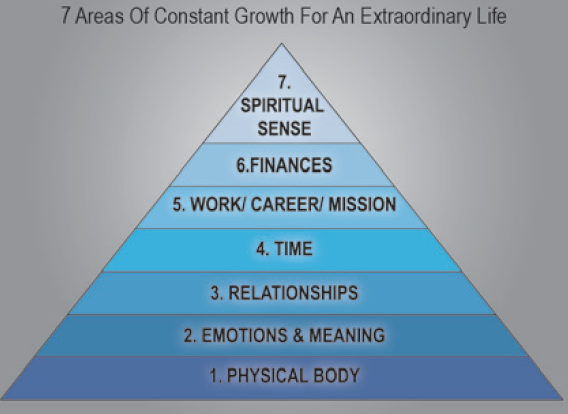
I had been thinking about my need to improve upon the  bulleted points (above) for quite some time, so I started to seek out coaches and methods to help me in my quest.  I stumbled upon a hierarchy that absolutely hit the nail on the head…

Personal development

Photo credit:  Tony Robbins

I used to think that personal development gurus like Tony Robbins were real clowns… then I grew up and realized that they know their shit.  They live what they speak on, and their results transform people’s lives.  Live and learn Kyle.

Personally, I discovered that I had hit barriers in my effort to move to the next level in all seven categories (above), and it largely because I was dragging numerous “horses” around.  The barriers were all mental restrictions.

mental thoughts control us

My aspirations of what I wanted be in the future were being clouded by the thoughts circling inside of my own head in the present.  Like dead weight, I was limiting my ability to think creatively, see opportunity and therefore achieve.  It’s frustrating to think that we can hold ourselves back from achieving greatness simply by generating poor thoughts about ourselves.  It’s crazy actually.  So many naturally talented people fall victim to this kind of thinking for an entire lifetime.

The mind is more powerful than you can ever imagine, and it most likely the main reason that your body isn’t where you want it to be.

With that being said, this blog is heavily centered around building a physical lifestyle that can complement all other areas of your life.  If you look at Tony Robbins theories on achieving mastery, developing the physical body is #1 on the depth chart.

Think about that.  How you perceive yourself physically speaking, and how you think about others perceiving you physically can impact all six of the other areas of personal growth.  Much of this perception is either a drain or a boost to your self-confidence and posture that you carry around daily.

Screen Shot 2013-04-20 at 12.47.05 PM

Hair not included.

You don’t need six-pack abs to have confidence in your appearance.  In fact, six-pack abs are overrated.  Let the Jerry’s down at the Jersey Shore  enjoy their baby-oiled bodies and six packs.

Start your journey by burying the horses that you continue to drag around.  Whatever those horses are.  Bury them.  Put them behind you and head for greener pastures.

In the past, I thought that talk like this was dumb.  “I didn’t need it”, I told myself.  Boy was I wrong.

Thankfully I snapped out of that cocky attitude and realized that burying the past is the first action step to achieving anything you can dream up for the future.

For example, if you’ve been struggling with sticking to a healthful recipe of exercise and eating nutritious food, you should take a look at your social circle.  What are they doing?  Are they exercising and eating well?

You become like the people who you hang with the most.  Behavior is contagious.  It’s been a concept that has been written about extensively, so this is not made up B.S.

—>  Read an article from the New York Times here:  Are Your Friends Making You Fat? 

If your social circle eats like crap and is proud of it, you’re likely to follow suit.

If your social circle spends most waking hours in the recliner watching reality shows, you’re like to do the same.

If your social hates like and constantly plays the “victim card”, you’ll throw that card out at the first road bump you come across.

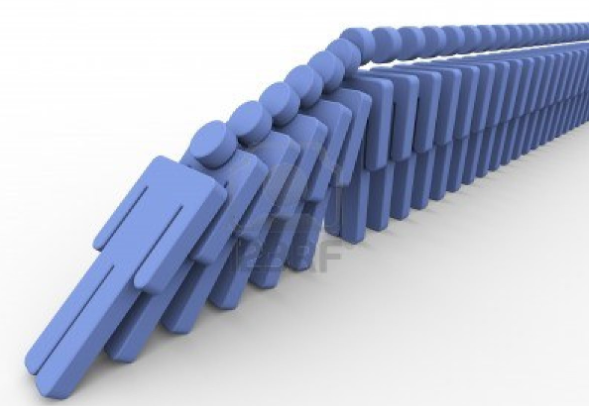
the human domino

Get out of this line.

Don’t become the human domino… have the courage to break the cycle and step out of line.  You’ll find that it is extremely uncomfortable and you may want to quit at times, but I am constantly reminded that nothing amazing in life (that is worth doing) is ever easy or free of growing pains.

It’s the beautiful struggle.

Go for it.  Less talk, more walk.  All of the tools are right there in front of you, pick them up and use them.

I will do the same and let’s see where it gets us, I bet we will all be thrilled with our end result.

Cheers to  breaking the bad and breathing in the good…

KG

Hybrid Suspension Training: Body Row + Anti-Extension Ab Roll Out

Quick Tips

Suspension training is probably the best training option for the home, travel or outdoors.

I used to feel a little guilty about promoting suspension training because I felt like I was turning into a guru.  Then I just came to the conclusion that I value the tool so much that it’s completely worth the time taken to talk about it.

As I have mention, I am an avid Lifeline Fitness product user.  I love the innovation coming from this company.  It’s innovation within reason, meaning that they are bringing products to consumers that solve problems and serve a purpose.  Best of all, they are made with quality and are affordable for just about anyone.  The portability of all of the products is a major benefit to people who love to workout at home without sacrifice.

Quality workouts in the comfort of your own home will change you life, literally.  

I will commonly work hybrid style suspension training exercises into my warm ups and the meat of my workouts.  The versatility of products like the Lifeline Jungle Gym suspension trainer make these hybrid movements safe and natural.  Nothing feels forced or out of control.

Jungle Gym Suspension Trainer

A strap with two handles and foot loops

In the video below, you’ll see me performing a sub maximal body row that flows into a standing anti-extension abdominal rollout.  The body row is best performed on a suspension trainer.  The hands are free to rotate, which adds a rotational component to the rotator cuff and shoulder muscles.  The standing anti-extension ab rollout (besides being a mouthful) is a tremendous movement for reinforce core stability and preventing extension in the mid-section.

Both exercises provide tremendous functional carry over to the demands of a physical lifestyle and sport.

I like the explosiveness of the body row.  You’ve got to put some force into the full in order to get yourself to the standing position, transitioning into the forward fall of the ab rollout.

With this movement, the upper body does the bulk of the work.  The feet should not move and the rest of the body should remain rigid.  After the aggressive pull on the body row, you’ll transition from the heel of your foot, to the mid-foot, then on the balls of your feet.  Pulling out of the ab rollout you will go in reverse order (ball, mid-foot, heel).

heel, midfoot, forefoot

Heel (hindfoot)— Midfoot— Ball (Forefoot)

***Wear non-skid soled shoes or perform on a non-slip surface to avoid any unnecessary slippage on the ground surface.  One slip and you’ll understand what I am talking about.  I am wearing my trusty Vibram Five Fingers in the video demo.


Cheers to pulling and resisting extension…

KG

3 Time Efficient Methods To Squeezing in a Workout While Building a Career

Quick Tips

One thing that I have learned about writing and consulting on topics related to fitness is this:  Not everyone thinks about training, eating and health as much as I do.

Not everyone cares about how great a kettlebell swing is, how bear crawling can restore function or jumping rope is 10x better for conditioning than a recumbent bike.

I think sometimes as professionals we forget that we care about fitness far more than any other people on the planet.  Hell, we made a career out of it.

One issue with training that comes up time and time again is time, or lack their off.

As I mentioned in a recent post, I completely understand the time issue.  I currently have a full-time career, write, train and am currently building an internet based fitness company/culture to help transition out of my existing career.  Time is short, just as it is for so many other career professionals.  I am in your shoes, which is why I feel so at home writing on this blog.  You and I are in the same boat.

We’ve got to find solutions to working out when time is really tight.

Here are a few ideas that can put you back on track for working out around a career…

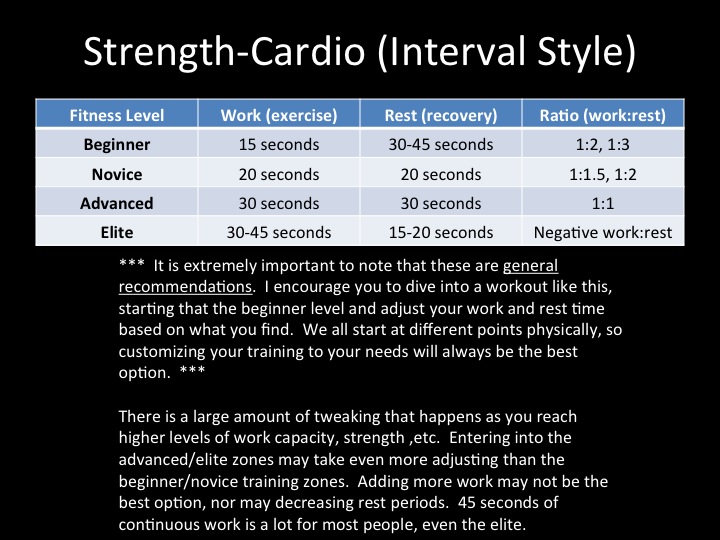
1)  Strength-Cardio Circuits

Interval training using strength based movements are amazing for building adequate levels of strength and power while stripping fat.  These workouts leverage our body’s natural ability to continue to burn fat for hours after the training session has ended.  Strength cardio circuits, sometimes referred to as metabolic training, involve short burst efforts and minimal rest periods between movements.  You’ll want the training session to be a total body experience, alternating exercises between upper body and lower body to increase performance by avoiding fatigue. By alternating movements, you’ll be able to hit more muscles in less time without sacrificing exercise technique.

Although the amount of time designated for work and rest during a strength-cardio workout will vary depending on your fitness and skill level, you should be able to find a sweet spot for yourself.

Here is a simple table to reference:

Strength Cardio Interval Training

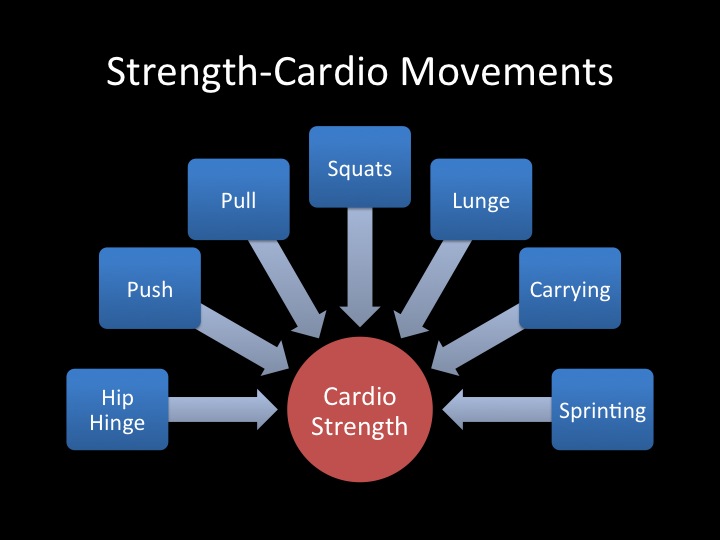
Choose from these simple movements…

Strength Cardio Movements

2)  Train on the weekends.

Nothing ground breaking here, but I just want you to start thinking about where you can fit in a training session.  The weekend usually provides some relief from the time commitments of the workweek, so look toward Saturday and Sunday for squeezing in a couple solid training sessions.  This will work wonders for your attitude as you enter into Monday and Tuesday.  You’ll have the confidence knowing that you put forth a solid physical effort that you can leverage for 24-48 hours.

I train on the weekends all of the time.  During this time, I feel no need to rush through the workout like I do during the week.  The training session becomes enjoyable.  Often times, I will spend a significant amount of time working on my mobility and addressing any muscles that feel overactive with knots.  It’s a time for training aggressively and regenerating my body.

Weekend Training Solutions

3)  Two Sessions Per Day

This might sound crazy, but incorporating two smaller training sessions into your day might provide some relief to your training efforts.  Rather than spend 60-90 minutes exercising once a day, try splitting the day into two smaller training sessions that last anywhere from 15-20 minutes.  The smaller window of time will keep you focused on moving forward throughout the workout and also motivate you to do more in less time.  Stoking your metabolism twice a day will work wonders.

Check out this recent post about that would help you coordinate a couple short training sessions:

—> Time Based Training

Having a career and committing to a life of physical fitness should be able to coexist with each other.  They have to.  Wealth without health is completely pointless, just as health without any wealth is stressful.  Find the balance that fits your situation, integrate the suggestions above and make an effort to not only maintain your body, but improve it.  Succeeding in career and physical performance will elevate your attitude and take your confidence to new heights.


Cheers to earning the $$$ and engineering a high functioning body in the process…

KG

Forget Fat Loss For Now! Quality of Movement Before Quantity of Exercise

Quick Tips

Out of the gates fast here.

Two things…

1)   Gray Cook is a genius.

2)   “People would do better if they knew better”.  –Jim Rohn

If you aren’t familiar with Gray Cook, it’s quite alright.  The trickling down of human performance and corrective exercise information coming from Gray isn’t targeted to the average Joe and Jane.  Gray is the guy that teaches professionals.  You can probably guess how influential he is judging by the fact that he is the person who is teaching the people who you folks think are the experts in their field.

Gray Cook FMS

Genius.

Did you catch all of that?  Make some sense?

Anyways, Gray developed a system of assessing human movement called the FMS, or Functional Movement Screen.  Some years ago, he noticed that the movement industry lacked a protocols for assessing the quality of a person’s movement.  There was no baseline from which to build from.  Sure, you could watch a person squat and determine that it didn’t look right, but what then?  What is the course of action to fix that squat?

All we really had outside of the rehabilitation setting were “quantity” protocols.  By quantity, I am referring to the stereotypical physical assessment that you can still get in many gyms around the world. These assessments commonly included:

–       # of squats to failure

–       # of push ups to failure

–       # of chin ups/pull ups to failure

–       some assessment of cardiovascular performance (treadmill, bike, etc)

–       flexibility testing

Sit and Reach Test

I enjoyed my time in my college Kinesiology program as much as the next person, but how relevant is the data that I’m gathering from Sit and Reach Test (pictured above)?  Look at that guy!  That test is largely designed to measure lower back and lower extremity (hamstrings, etc) flexibility.  Check out the amount of spinal flexion he’s got going on that will increase his numbers.  Sit up straight son!  Even if he did sit up straight, and the test was legit, what are you going to do with the data gathered from the test?  What is your course of action?  Stretch the hamstrings?

We know that the lower back demands (primarily not only) stability for health and the hamstrings have become long, weak, and dormant in most people (from sitting all day).

So, using something like the sit and reach rewards a person that has flexibility in the hamstrings and flexibility in their lower back.  Pure tunnel-vision.

It’s not enough.  Tests like this are ancient and it’s just not enough anymore.

Quantity.  Do you see what I am talking about now?  Everything was based on physical performance qualities like strength, endurance, flexibility, etc.  I have no beef with any of these qualities, as they are definitely worth improving, I simply have shifted my thought process of what we should be assessing on people from the beginning of our relationship.

Personally, I now promote establishing quality of movement, then adding quantity of movement.  Move right and then burn tons of fat.  It’s a pre-requisite of sorts.  Adding quantity of movement with high volume methods (circuits, complexes, interval based, etc) only serves to make pre-existing movement problems worse.

Dust under the rug

 It’s like sweeping dirt underneath the rug.  Dirt is still there, you just can’t see it.

That shift led me to favor the FMS and everything that it stands for. 

It took me a while to understand what the hell the Functional Movement Screen was all about.  It’s complex.  It takes a great deal of studying, reading and experimenting to grasp the concepts.  Every single time I listen to Gray speak; it’s easy to pick up that he is on a whole other level of knowledge and understanding.  He’s a pioneer for sure.

Messing around with the FMS and the associated corrective exercises is a blast.

Why?

Because in a matter of minutes you can fix a person’s faulty movement.  You can go from testing horribly in one of the seven FMS screens, to testing near perfect from leveraging a number of highly impactful corrective movements, each designed to improve a specific movement pattern test.


The FMS to me is the pre-assessment to the assessment. 

—> Personal Trainers:  Don’t Sell Yourself and Your Clients Short…

If you an exercise professional stopping by this blog, you need to get educated on the FMS.  It is a disservice to ask a client to perform bodyweight squats to failure when they can’t even squat properly in the first place.  I would also like to add that the inability of a person to squat often not a grooving problem.  In other words, having a person perform more and more ugly squats is not going to improve a person’s squat form.

Motor control definitely has something to do with movement technique, yes, but there are so many underlying issues revolving around primarily mobility and stability that need to be addressed to work out the kinks.

Personal trainers, you’ve got to establish your identity.  People come to you to lose weight and get “ripped”, but you’ve got to have standards.  Articulate the importance of moving properly and then moving to burn fat and lose weight.  We live in a world that feeds off instant gratification, but you’ve got to resist the urge to do the activities that make your clients happy at times.  You’re the professional, you’re in control.

So, my shift in thinking is from quantity to quality.  I adopted the concepts of the FMS quite a few years ago, and it’s been nothing short of fantastic.  I can’t even say that I am “drinking the Kool-Aid” anymore… I am officially doing a full-blown keg stand with the Kool-Aid.

You should to.  I’ll hold your legs while you drink.

—>  Average Joes and Janes read and watch now…

If you’re not an exercise professional, take a glance at this video from Gray.  Many of you are familiar with the Turkish Get Up, and Gray does a fantastic job describing how it fits into a training program.

Wrapping it up for now… address your movement quality and the ramp up your training regimen to burn fat, build muscles and all kinds of crazy athleticism.  Sustainable movement is more important than some rapid flash in a pan fat loss training program.  You’ve got the rest of your life to strip fat off your body.  Literally, years I tell you.  Habits are made over time and broken over time.  Stay dedicated and consistent in your workouts and fat loss with lean muscle gain will be pleasant reward.

*** If it feels like I only provided a hazy glimpse into what the FMS is and why we should apply it right now to our own situations, you’re accurate in with that feeling.  As I mentioned, the FMS is complex and articulating it’s importance and application to your own workouts is something that I want to address over time and multiple articles, not in one shot.

All in good time friends, all in good time.

—> Speaking of friends… if you like anything that you read or see on this blog, subscribe to it.  All subscribing does is notify you of a new posting when it drops.  I have stated that I want to build a community using this blog as my vehicle.  Humble beginnings, yes, but it will grow.  Let’s connect and move mountains together.<—


Cheers on this Superbowl Sunday 2013!


KG


Is a Rep Just a Rep?

Brain Training

The small details in life are often what seem to separate poor from average, average from good, and good from great.

So when I get the question of whether it is ok to miss/skip a rep in a work set, I have changed my tune quite a bit over the years.  On the surface, one might say, “Who gives a shit, it just a workout and it is just one rep”.

Is it?

I think that it is more than that.  I think that physical activity, and a person’s ability to finish a training session according to plan, is a clear indicator of someone’s behavior and habits.  The brain is so heavily connected to whether or not you get off the couch for a training session, run that extra 100 yards or finish that last set or rep.

So, if you consciously skip that last rep when you could have finished it, it would be interesting to see if you are doing the same thing in other areas of your life.

–      Are you missing opportunities to make that sale in your career?

–       Are you avoiding continuing to pursue your goals?

–       Are you eating processed foods because it takes work to cook a meal?

I am not an expert on behavior, but I observe everything.  I enjoy observing and trying to understand why humans do what they do.  I often think about why I do the things that I do in my own life.  Habits are hard to break, there is no doubt about that, but they can be broken.  It is never too late to create new and improved habits, it’s just a decision.  It’s uncomfortable to call yourself out, but sometimes that type of irritation can create a world of change.

I know this is a deeper way to think about exercise, but I also think that thoughts like this can stick and help to create change.  I believe that habits carry over into everything that we do.

So yea, I think that finishing that last rep can make you a better person. I think that having the conviction to complete your workout exactly as it is drawn up for that day can push you over barriers that may be holding you down in other areas of you life.  Absolutely.

It’s not just a rep.