I love all of the programs out there on the internet that claim to have the secret to rapid fat loss.
Guess what?
I am here to fully disappoint you…
There is no secret.
Yup, there is NO SECRET TO FAT LOSS.
In fact, fat loss is so incredibly simple that it would blow your mind.
Well, ok, there may be one little trick to fat loss…
Ready for it?
MASSIVE ACTION.
All you have to do is take massive action. You don’t need to read 100 books about working out and how to eat. Most of us know how to eat. It’s not a secret. Maybe you don’t know how to train smart, but hey, that is what blogs like this are for.
All you need is the courage to take MASSIVE ACTION.
I am talking about doing something out of your comfort zone and completely crazy.
Go home and throw away all of the shitty processed foods you have in your cupboard. Then go through your refrigerator and do the same thing. Don’t forget to dig through your freezer too.
After you have done that, go to the grocery store and shop the hell out of the perimeter. The perimeter is where you will find most of the earth grown foods and meat. That’s right… food comes from the earth (fruits/veggies). If it has a mother… eat that too (meat).
Clean eating is the one constant throughout nearly every legitimate fat loss program in the world. Eat clean and you have just put yourself in the top 75%.
Eat clean and you won’t have to workout for 6-8 hrs per week. How is that for being time effective? The thought of training 6-8 hrs per week stresses me out! And I love training.
I would even argue that the more time you have to train, the more time you are going to find to waste. Less time means you have to focus your efforts. Do what works. Get in and get out. Get on with your life.
Exercising isn’t life, it simply a vehicle to help improve our life and create healthy bodies that are less likely to fall victim to preventable diseases, build strength and endurance for physical activities that we enjoy and partake in daily, and even psychologically to give us confidence in our daily lives when we interact amongst other people.
Everyone always assumes that I train for 2 hours per day. WRONG.
30-40 minutes for 4-5 days per week. That includes a complete warm-up.
I eat clean and drink the heaviest craft beer in the world. I love it.
9.0% pure bliss
I am on a schedule. My schedule keeps me honest. Some days I train, and some days I rest.
My massive action is now a daily habit. I have repeated my massive action so much that it is now a natural lifestyle. It is what I am committed to.
Less is more people.
Stop complicating a problem that has a simple solution.
You have to get your mind in the game. You have time to workout. You have time to cook. You have time to drink more water.
Take massive action.
But it has to be a priority. If it isn’t important enough to you to become a priority, or you don’t create you “why” for creating healthy habits… nothing with ever stick. Ever.
You will end up on another 60-day crash-course liquid cleansing diet before beach season.
Take massive action.
“If it’s important, do it everyday”.
-Dan John
MASSIVE ACTION…
This is the secret to fat loss… (Don’t tell anyone)
I will waste no time here. Tear through this one folks…
Chin-Up x5
Push Up x10
KB Swing x15
BW Squat Jumps x20
KB Swing x15
Push Up x10
Chin Up x5
Beginners: 2-3 complete cycles with 90-120sec rest.
Intermediate: 3-4 complete cycles with 75-90 sec rest
Advanced: 5 rounds cycles with 60sec or less rest.
Equipment: Some kind of pull up bar, kettlebell (optional but recommended)
Including a full warm up which takes 10 minutes and the actual workout itself which takes 16 minutes, this entire training session will cost you 26 minutes of your life.
Throw the time excuse out the window I guess, right?
Watch out for the swings on this one. If you do not have kettlebells to play with or you are not comfortable with your kettlebell swing technique while fatigued, I would suggest substituting some kind of lunge. Lunges are still a hip-dominant movement. The only loss will be the explosive aspect that the kettlebell swing brings to the table.
I will talk about why I am a fan of kettlebell swings for loaded cardiovascular type work in a future posts.
If you were in a pinch, a properly prescribed dosage of kettlebell swings a couple of times per week might be all you need to strip fat.
This is of course assuming that your eating HABITS are in check.
In honor of our local Country Music festival here in Eau Claire, WI, I decided that I would throw together a workout.
The template for designing a crazy effective workout is simple.
My rule has always been… Keep it simple.
Simple means big bang movements using minimal equipment while closely considering loading (weight), rest period(s) and total time of workout.
Avoid complexity at all costs. Complicating a workout with fancy technical lifts only moves the risk versus reward pendulum deep into the RISK category.
I equate HIGH RISK with HIGH INJURY.
Enough babbling, start training.
Give this a go…
Country Jam Training
The Details…
—> Time: 14-20 minutes
—> Work-set: 2 minutes
—> Rest: Remaining time after work is completed
—>Rounds: 7-10
—>Equipment: Bodyweight + Suspension Trainer, Gymboss interval timer or equivalent
Procedure:
15 Push Ups
30 Mountain Climbers
15 Squats
30 Jumping Jacks
15 Full Burpees or 15 Inverted Rows (if you have a suspension trainer)
* Complete full reps of each movement for the set amount of reps. Pay attention to full range of motion and technical perfection. Your rest period is determined by the speed with which you complete the final rep of burpee. Rest begins then. Each round starts at the top of EVERY 2nd minute.
An example of what I am desc is seen below:
Minute 20… Start set
Minute 18… Start 2nd set
Minute 16… Start 3rd set
Minute 14… Start 4th set
… and so on.
Customize the workout to your training level…
Beginners/Intermediate: Start with 5-7 rounds of this (10min-14min total work)
—–> If it is easy, add more rounds of work.
Advanced: Go for the full 10 rounds (20min) and don’t look back.
—–> If it is easy, add load to the movements or add rounds (12-14rounds… 24-28 minutes)
Did you get your heart rate monitor yet?
Don’t underestimate the power of a bodyweight workout. No excuses, just get the work done and get on with your day.
Remember the equation:
Intense physical exertion + clean eating = Ramped up fat loss
If I absolutely had no choice but to run on a treadmill, which I have been forced to do before, I have a plan.
But there are some important things I would do before, rather than just jumping on cold. They are:
1) I would self massage using a foam roll and lacrosse ball on my feet thoroughly.
2) I would work my corrective exercise and pre-hab
3) I would mobilize the hell out of my joints to deliver nutrients.
4) I would turn on (activate) on musculature that will be engaged in my running efforts.
5) I would work through a series of dynamically oriented stretches.
6) I would make sure my inexpensive heart rate monitor is properly placed around my torso and the watch is reading the signal clearly.
7) I would begin at a slow running pace focusing on arm swing, breathing and smooth strides.
8) I would begin jogging on the treadmill, progressively increasing the speed of the treadmill until I reached about 80-85% of my max run speed (about 5 min), then I would step off and get ready for the following workout…
Heart Rate Based Treadmill Conditioning:
Details/Rules
Set the treadmill at speed and incline that requires a full stride (7.5-9.5mph @ 2.0-8.0 incline)
I prefer increasing incline over speed. Reason? Increased heart rate and forced knee drive and emphasis on arm mechanics.
Practice stepping off a couple of times, face plants are hurt and are embarrassing.
Get a heart rate monitor. I use the Polar FS1, the most simple/inexpensive model they make.
Stay tall when you sprint. Core engaged and vertically tall.
“Cheek to cheek” on arm swing (butt cheek to face cheek).
Procedure
* Complete 8-15 rounds depending on your current conditioning & peri-workout fatigue level.
Sprint 30 seconds.
Step off and rest until your heart rate recovers to 130 bpm (beats per minute).
Sprint 30 seconds.
Step off and rest until your heart rate recovers to 130 bpm (beats per minute).
etc…
Why so much emphasis on heart rate?
Let your heart rate monitor, your body’s natural physiology, tell you when you are ready to go again.
How hard are you working? Let your heart rate monitor tell you.
A few words on treadmills…
I have to admit that I am not completely anti-treadmill.
What bothers me about treadmills is that they remind me of hamster wheels, and people use them like hamster wheels. Same workout, same speed, same incline, same distance, same music, reading the same magazine… Same same same. “Same” is the enemy of progress. Trust that.
image credit: movnat
Also, recognize that there is an incredible difference between:
1) Running on a treadmill where you are simply keeping up with the speed of the belt and
2) Running on a real world landscape where you are having to put true force into the ground to create movement.
If it is nice outside, and right now it is, get your ass outside and perform a similar workout.
If you do head outside, be prepared for the intensity to be jacked up ten-fold if you are shooting for the same structured workout as I described above. Real world sprinting is fatiguing, especially when organized as a timed effort combined shorter than normal rest periods.
Is aerobic training bad?
There is nothing wrong with aerobic training assuming you are progressing, moving toward your goals and avoiding overuse injuries.
But why not challenge yourself a bit, melt some fat, preserve the lean healthy tissue you worked so hard to develop, and increase aerobic AND anaerobic pathways all in one shot?
Did I mention how time effective this type of training is?
Here is a great visual depiction to support my case…
What is so non-traditional about my workout you ask?
Well traditionally, a) Most people don’t use heart rate monitors (they guess) and b) Most people coast or “relax” on the hamster wheel for a few miles for a light sweat.
That being said, my workout is non-traditional. I am asking you to let your heart be your rest/work indicator along with requesting that you put forth an effort that is unfathomable for a lot of the population.
See you soon…
Just getting warmed up.
(P.S. As an end thought… if you are able to read any book or magazine comfortably while training, you aren’t working nearly hard enough)
I have to admit that the circuit in the video below has been adapted over the last few years to serve as a warm-up for me before my higher work capacity/short bout training sessions.
I use it for two reasons:
It gets my brain and eyes focused on what’s about to happen (hand to hand exchange helps this).
Physically, I warm-up every muscle in my body in one shot (after foam rolling/static/dynamic stretch)
In the video below, I am using my trusty 20kgkettlebell, that’s 44lbs for all of the Americans reading this.
This is my warm-up bell, my hand to hand swing bell, and my long cycle snatch bell.
Initially, when I started kettlebell training it was all I could handle weight-wise. That’s my indirect advice to you to start slow, and progressing at an your intelligent pace. Don’t “Hail Mary” your training or you may find yourself in the emergency room.
All in good time.
Enjoy the music…
The details:
5 reps of all movements (keep it simple!).
All movement patterns must be addressed (with exception of upper extremity pulling).
Don’t put the kettlebell down until the circuit is complete.
A couple tips…
Tip #1: Use a dry erase board to map out what movements you’ve programmed and what order you want to perform them. This helps a lot. Double clutching a 44lb kettlebell rarely has a positive end result.
Tip #2: Treadmills and ellipticals are $2,000 coat racks. Sell your old useless fitness equipment and go buy some Lifeline kettlebells or PowerBlocks.
Have fun, tell me how it goes…
Coming soon: Why single kettlebell/dumbbell training is where it’s at…
I am going to be starting a writing challenge for myself.
I will set my trusty Gymboss interval timer to 10 minutes, and I will write an improv article until the timer goes off.
Two things I want you to understand with this:
1) This is all information off the top of my head, so it will carry some opinion and could be more vulgar than normal.
2) It may or may not be nicely organized for your reading pleasure, and occasionally may end abruptly (assuming I run out of time before I can say what I want to say).
Another reason that I like the idea of writing against the clock is that it forces me to be honest and to the point. No bullshit. Short posts, probably under 500-600 words in each post. Quick reading for those that have a short attention span.
I realize that this is probably more fun for me than it will be for you to read, but so many people ask my opinion throughout the day that I decided to free-write about topics with a timer as my cut off.
I should be able to regurgitate enough information that you can find at least one little pearl in the post.
Obviously, I will have articles that I will research and keep as go-to reading material. These articles will be the foundation this webspace.
My goal with these types of articles is to make them timeless. Timeless meaning… you can flip back through the archives weeks, months, maybe even years from now, read the article and have it be relevant.
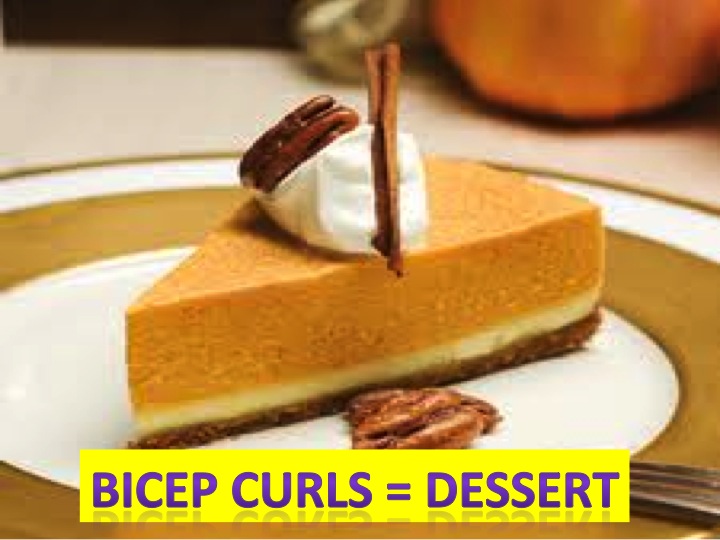
Ahhhhh, the “dessert” movements of the training world.
I will be blunt with this post.
Exercises like bicep curls, triceps extensions and deltoid raises provide very little bang for you buck. I don’t care how many different angles, rep schemes and loading patterns you choose for a bicep curl, you are NEVER going to lean out by performing bicep curls alone.
I used to have a rule at the sports performance complex in Detroit, my athletes could do all of the curls, triceps, and shoulder work they wanted AFTER we finished taking care of business with our regularly scheduled program which consisted of:
– Squats (one and two leg variations)
– Hip dominant lifts (deadlifts, swings, etc)
– Horizontal pressing (push ups, etc)
– Vertical Pulling (Chin-Ups, etc)
– Horizontal Pulling (Inverted Rows, etc)
– Turkish Get-Ups
– Energy System Development (aka: Anaerobic, aerobic, shuttle run conditioning)
The rule was simple. You give me what I want, and I will let you go play around by the dumbbell rack and work all of the muscles that you think the girls love.
Most times, the guys were too tired to complete any “dessert” type movements like bicep curls, but occasionally they would find the energy to bang out a few reps/sets.
Does this rule apply to the general population seeking fat loss?
Hell yes it does. I want you to change your view about training. Bicep curls, triceps extensions and deltoid raises need to be considered “dessert”. There is very little return on investment when performing these exercises.
Unless you are competing in a physique competition anytime soon, ditch them.
Replace them with total body movements, multi-joint movements that challenge your body as a single synergistic operating unit.
Run fast, lift heavy things from the floor, throw a medicine ball, work with a suspension trainer, use battling ropes, squat, push up, chin up, pull up, inverted row, push a heavy sled, pull a heavy sled, jump, run a long staircase, use a heart rate monitor to eliminate guesswork.
Image Credit: Core Performance
Do some of those things I just listed above, organized in a systematic way that prevents staleness, stagnation and keeps you progressing with weight, rest periods, exercise progression, mobility and flexibility, recovery until the next bout, etc…
Sooner than later you are going to see some results as a byproduct of your consistent development of strength, power and overall athleticism.
I apologize for the organization of the end of this post. I had to bullet each paragraph to separate it from the the previous paragraph. A glitch in WordPress I believe. I don’t know… Sorry about that…
Ok, where I left off…
Well, maybe nothing. Most of you will never push yourself to the point where your brain or body begins to tell you to, “fuck off”. It’s not a knock against you, it’s just a reality.
Two years ago I dove head first into the SSST (Secret Service Snatch Test), which is a kettlebell challenge not for the weak of heart. The SSST is comprised of:
24 kg (53lb) kettlebell
Perform as many snatches as possible in a 10 minute timeframe.
Simple and insane.
If you are a competitive minded person, this is something to shoot for. I got about 190 snatches into the SSST and my brain flooded with “just quit this shit” thoughts. I fought them off for another 1:30min or so, then tapped out. I destroyed my old snatch record, but still, the thoughts came and engulfed me.
It’s easy to succumb to your thoughts during physical activity.
Next time you are on a run or bike, pay attention to how many times you start thinking about how nice it would be to be finished already, or how you could just walk for a bit, or no one is looking so you can dog it for a minute or two, blah blah blah. I am human, I have these thoughts, so I know that you do too.
I think what the average person struggles with the most with is their thoughts. Just one negative thought that slips passed your “will-power filter” in your brain and will infect your entire body during a workout, or ever before you ever strap on your shoes pre-workout. Negative thoughts are infectious. Once you start thinking about quitting on a task, for most people, it’s ALL OVER.
Think about it. I know that everyone has had those thoughts during a long run, during a personal training session or even back in high school or college as an athlete.
When your brain quits, you quit.
Controlling your thoughts will build you a body, I firmly believe this.
Crazy.
***Go do something great today that your body will thank you for in the future.***
*** Keep reading if you don’t understand what I am asking.
Olympics Miracles!
With the Summer Olympics quickly approaching, I think that this topic is incredibly interesting.
Anyone who has ever watched a sport on TV has no doubt heard the announcer cry out, “Look at that finish! It was all heart on the last 50 meters! A new world record!”
Even if that isn’t word for word, it is pretty damn close. I am a sucker for these kinds of stories. I love seeing, reading, listening to stories about humans pushing themselves to new heights.
What about the average joe?
Yes, you probably understand that you are never going to be an Olympian. That’s ok. Neither will I.
Looking at what causes humans, Olympians or otherwise, to be able to accomplish or fail at physical tasks as they relate to our daily performance during body transformation, I often ask myself, “Is it physiology or all brain?”
Enter: The Central Governor
It wasn’t too long ago that I read an article about Dr. Tim Noakes and his ideas that human performance is controlled by something called the Central Governor. Essentially, he is saying that human performance may be controlled less by physiological limits and more by the brain. The brain will shut down physical output if it detects that the body is nearing a fatigued state that will damage the heart or homeostasis. If physical exertion exceeds what the brain deems as acceptable, it will turn down the dial on the whole program (fatigue).
Here is a more official description of the Central Govnernor Theory (as described by Wikipedia):
The central governor is a proposed process in the brain that regulates exercise in regard to a neurally calculated safe exertion by the body. In particular, physical activity is controlled so that its intensity cannot threaten the body’s homeostasis by causing anoxia damage to the heart. The central governor limits exercise by reducing the neural recruitment of muscle fibres. This reduced recruitment is experienced as fatigue. The existence of a central governor was suggested to explain fatigue after prolonged strenuous exercise in marathons and other endurance sports, but its ideas could also apply to other causes of exertion fatigue.
Begin rant…
—> You might be saying, “Come on Kyle, don’t cite Wikipedia!”
Let me remind you that I am writing posts with the goal of providing practical and simple information. If you read the studies behind the Central Governor Theory, most of you would experience early symptoms of head explosion. The research can get heavy, and I am not here to impress anyone with scientific jargon.
We can either take a complicated theory and apply it to give real-world results, or we cannot. Results-based information is what I am interest in sharing and results are probably what you are interested in experiencing.
End rant. 🙂
Criticisms to the Central Governor Theory:
Now, the Central Governor Theory is not flawless. Dr. Noakes has pissed off a lot of researchers around the world with his theories.
Here are is one of the major criticisms (also sniped from Wikipedia):
The existence of a central governor over physiology has been questioned since ‘physiological catastrophes’ can and do occur in athletes (important examples in marathons have been Dorando Pietri, Jim Peters and Gabriela Andersen-Schiess). This suggests that humans can over-ride ‘the central governor’.[16] Moreover, a variety of peripheral factors in addition to those such as lactic acid build up can impair muscle power and might act to protect against “catastrophe”.[17] Another objection is that models incorporating conscious control also provide an alternative explanation,[18] but also see Noakes’ reply.[19]
Exercise fatigue has also been attributed to the direct effects of exercise upon the brain such as increased cerebral levels of serotonin, reduced level ofglutamate secondary to uptake of ammonia in the brain, brain hyperthermia, and glycogen depletion in brain cells.[20][21]
The idea of exercise causing hypoxia at the heart, in the absence of arterial disease, moreover can be questioned due to the heart with every beat is delivering through coronary arteries that arise from first branches from the aorta freshly oxygenated blood to its own cells. Other factors exist that could in a self-limiting way limit oxygen uptake. For example, as more accessory muscles of respiration are recruited, (as occurs at near maximal values of VO2), the energy cost of increasing rib cage expansion is nearly equal to that gained by the oxygen obtained from doing so. Indeed, the Fick equation (see VO2 max) itself includes terms of limitation: Q (cardiac output) is determined by stroke volume and heart rate. Stroke volume has a natural, physically limited upper bound (the heart obviously has a maximal volume, and is restricted by surrounding structures such as the pericardium), while heart rate is limited by the ability rate at which cardiac cells can maintain rhythmicity. There are also natural limits to the rate at which oxygen can diffuse from the blood to the tissues, i.e. gas exchange is itself a limiting factor.
These criticisms suggest the potential exists for known physiological processes to adequately carry out what Noakes and others attribute to a complex, pre-calculated central mechanism of homeostasis. (Though they may be relevant for accounting for some types of observations such as the effects of altitude on cardiac and other muscular capabilities.)
Another criticism is that Hill’s original suggestion of a central governor uses a study in which a VO2 max test was conducted in which some of the subjects did not achieve a plateau in oxygen uptake. This failure led to his suggestion that VO2 max itself is a failure to account for their fatigue requiring the existence of another mechanism that could limit aerobic performance. However, this plateau requires that subjects are highly motivated, as the protocol of the test requires work at near maximal levels for protracted periods, and this might not have been the case.
I apologize for the long description, but there are some good points and I want anyone reading to be able to develop an opinion on it.
Honestly, I am a physiology kind of guy as it relates to this matter. I believe that exertion is mostly limited by our body’s natural processes as we experience fatigue.
To really confuse your decision-making on the matter even more, how do YOU explain this?…
Commonly know as “Bonking”
However, I have to say that I am extremely fascinated by what could come of Dr. Noake’s research. The brain is an incredible switchboard that controls so many daily processes, and the thought that it can be one of the limiting factors of performance is not out of the question by any means.
We just haven’t figured out where all of the pieces fit. It is going to be interesting to watch the research in the coming months/years as continue on our quest to figure out what makes us tick as humans.
This workout includes two foundational kettlebell exercises (Turkish Get-Ups and Kettlebell Swings) and is perfect for a home gym workout.
Who doesn’t love a home gym workout these days? Time-efficient and minimalistic workouts are PERFECT proving the superiority of the home gym workout experience.
Clearly, I’m an outspoken advocate for creating a home gym space.
In the kettlebell training world, turkish get-ups and swings are two of the best exercises a person could learn, practice, and improve on.
I stand firm on this statement. Call it “my truth” or whatever. I’ve spent years working these two movements and the benefits of my efforts include sustained power, strength, and a consistently lean and muscular physique.
Aesthetics might seem superficial, but no one trains hard to stay fat.
There are HUNDREDS of other great exercises, I support them all, but going full-on minimalistic mode, I know that attacking turkish get-ups and swings would make a lot of people happy with the time investment.
It’s a powerful combo.
Kettlebell swings are a ballistic hip hinging exercise that’ll improve power, train fast-twitch muscle fibers and if organized accordingly, build conditioning in a really unique way.
Turkish Get-Ups are a pure loaded movement-rich exercise. Few other exercises are as humbling, addicting, total body, and rewarding as practicing turkish get-ups on a regular basis.
You feel less like a Lego exercising while doing turkish get-ups, and more human.
Equipment needed: Timer and kettlebell
15 minutes Alternating Turkish Get-Ups
+
2-Hand Kettlebell Swings (24 rounds of 15sec on/15 sec off)
The TGU’s
15 minutes of continuous turkish get-ups is a lot of work, so if the duration needs to be decreased a bit, please do it.
Start with 5 minutes, see how you feel.
If 5 minutes is a breeze, add 2 more minutes and see how that feels.
There are very few secrets to fitness. Actually, there are none. Only what you know, and what do you don’t know… and how consistently and effectively you are at practicing what you know.
The key to building fitness safely, is auditing and be honest with your fitness level, and adjusting any pre-formatted workouts (like this one) to match your abilities.
Turkish get-ups, like any other exercise, are not supposed to be sloppy.
A full turkish get-up is a marathon of an exercise, multi-segmented, with many steps/moves/transitions on the way up and down.
The technique, timing, hand and foot placements, breathing and coordination are just a few key things to pay attention to while performing Turkish get-ups.
Poor technique… can result in tweaks, strains and injuries, which is not the point of exercising in the first place.
We exercise to improve our lives, not make it worse.
Regressions may be necessary, and the person who acknowledges they need to scale back a workout is a person I RESPECT!
The Swings
24 rounds of 15 seconds on (swinging) and 15 seconds off (rest) equates to 12 total minutes.
6 out of 12 minutes are spent performing kettlebell swings.
Pausing to think about how potent kettlebell swings are for fat loss (among other benefits), it’s pretty amazing a measly six minutes can have such a dramatic impact on body composition over time.
When I first started shaping this workout years ago, I used a 24kg kettlebell.
Today, I like to use a 32kg or my 40kg for the swings.
Exercise Variations for the Workout
Establish familiarity with both turkish get-ups and kettlebell swings BEFORE diving into a workout like this one.
Here are the recommended variations of each exercise:





 M(eaux)tion Fitness