The Howard Stern Diet

Quick Tips

Howard Stern Radio Logo

Howard Stern, on the radio is an entertainer. He knows how to attract listeners and boost ratings. Howard’s craziness on the radio often overshadows his intelligence, career success, and real world insight.

Lately, most of my driving has been accompanied by Howard Stern streaming through the airwaves.

If you don’t like Stern, I apologize. Keep in mind, he’s an entertainer. What you hear on the radio is not the REAL Howard Stern.

The Stern Show is ridiculously entertaining. His no bullshit unfiltered and uncensored interviews to world-famous people are second to none, mainly because of the Sirius censor-free platform.

For the last 4 years, I’ve renewed my Sirius subscription without batting an eyelash.

Howard is has mastered his craft, radio. Detailing it further, he’s a master of entertainment and communication. It’s got to be difficult to do.

One aspect of the Howard Stern show that’s fascinating is how frequently he talks about his personal life, more specifically his ongoing battle with nutrition and fitness.

It’s comical, but it’s reality.

The other day, I turned on the radio to catch him ripping apart one of his staffers, Benji Bronk. Benji is a long-time writer and content creator for the Stern show who’s famous for his clever public pranks and funny radio bits. Benji is an absolute character.

If you know the Stern Show at all, you know the staff feuding is as entertaining as the celebrity interviews.

In the radio bit, Benji told Howard that he’s depriving himself of eating in order to drop weight. Leveraging the old calories in versus calories out equation.

As is common with a lot of people, Benji lost focus with healthy habits. He had gained an unnecessary large amount of weight and now wants it gone ASAP.

Howard’s conversation with Benji evolved into a hardcore lashing of Benji’s extreme strategy.

Overall, I have to say that Howard didn’t miss the mark by much with his advice, which was…

  1. Find a mentor who understands nutrition and eat what they eat.
  2. Avoid the extreme in favor of simple, work into it, increase the intensity.
  3. Identify a health strategy he enjoys and can stick to over time.

One might read this and think, “duh”.

But common sense is not so common.

Humans overcomplicate and overanalyze EVERYTHING.

What makes perfect sense to you doesn’t make perfect sense to everyone else.

The perfect health plan doesn’t exist, so if you fall into the category of a person who’s constantly searching for the “truth”, call off the search.

We live in the age of computer, tablets and cell phones, all connected to the internet moving at break neck speed. Information is literally everywhere. It’s difficult to find focus on just one thing, especially if you’re desperate to lose weight.

There are so many strategies, it’s overwhelming for a lot of people.

Let’s briefly touch on why I valued Howard’s health advice to Benji…

#1. Role models are important.

Someone, somewhere, has already done what you are attempting to do, so why not learn from them?

Regarding the best approach to health, get around people that are already on the healthy path. Do what they do. Spending time with people who are not making health oriented decisions is going to send you in the same trajectory. YOU BECOME WHO YOU SPEND THE MOST TIME WITH.

Start teaming up with people in the gym who are getting after, and understand how to get after it. If they are a decent human being, they will take you under their wing and stretch your comfort zone. Eat as many meals with people who understand what simple clean eating is.

Learn from what they do. Study their habits, emulate those habits. Are they bringing healthy leftovers from last nights dinner in a Tupperware versus scrambling to the local fast food establishment for a burger and fries? Follow that lead.

One of the first steps to making incredible gains in fitness and nutrition is becoming aware. Once you know, you cannot un-know.

Role models can help guide you along the way.

#2. Begin with the long-term in mind.

If you want to put the pedal to the metal right out of the gates, go for it. It’s your life. But beware that many people fade with this approach.

It’s mentally draining to adopt healthier habits.

Health is a process. It takes time and it requires discipline. You have to trust the plan and stick to the plan.

Fast gains can be made, but there is no overnight success and there shouldn’t be.

Celebrate your efforts in the short-term, but understand that the real victory is in dedication the long-term.

Begin with the end in mind.

#3. Make an effort and enjoy it.

If you hate your workout program and your eating plan, it wil never last.

You will burnout. The resistance crush any will-power you have.

There is a happy-medium between making an effort and finding enjoyment in the efforts being made. Where those two intersect is where results reside.

But here’s another reality. Making a shift from sloppy eating habits and a sedentary lifestyle over to smart nutrition and daily workouts are going to be stressful in the beginning. It’s work, and it’s not always easy.

You can expect many days where the last thing you want to do is eat a salad, especially when everyone else is smashing a greasy burger. You can expect days where getting up an hour earlier to get a workout in before starting the day is the last thing you want to do, especially when other people are sleeping in.

There is great (perceived) pain in building healthy habits. It is a lot easier to ignore the details and be careless. But, doing so has a price.

So, in the beginning, find foods that fall into the realm of being nutritious. Eat them. If you don’t know what foods are nutrient dense, Google it. Seriously. Type in “healthy foods” and you’ll find millions of search results. Find a list, go to the grocery store and familiarize yourself with those foods, regularly.

As you gain confidence, expand. Find other foods that serve your health well.

Same goes for fitness. Don’t jump into a hardcore metabolic conditioning workout on the first day. Opt for yoga, a long walk or some simple body weight drills like Animal Flow.

Animal Flow is an ideal fitness program for beginners since it’s body weight based. Plus, you can learn how to exercise effectively in the privacy of your own home.

Crawling is a low-impact highly effective activity to build strength, motor control, and core stability.  Can you do this?  I bet you can.

Bodyweight training is ideal for everyone, particularly beginners because you can get your training in ANYWHERE. Stop thinking, buy the Animal Flow DVD and get going.

Mike Fitch, the creator of the program will teach you everything you need to know.

If you’re not there yet, at least subscribe to my YouTube channel. Watch me do it, then you do it. Simple.

Less thinking, more doing.

Not into Animal Flow? Fine. No matter what you choose, remember that YOU HAVE TO MAKE AN EFFORT. You have to.

The effort given will be proportionate to the reward, nothing more and nothing less.

So what does Howard Stern’s Diet consist of?

Plain and simple, Howard is a mono-eater, just like many other lean and healthy people I know. No surprise here. A lot of times, people who have a good grasp on healthy habits aren’t preparing extravagant meals like you see on the Food Channel or various social media platforms.

Howard knows the foods he likes and he eats those foods on a regular rotation. A lot of healthy people do this. It removes the decision fatigue from the situation.

Here’s a snapshot of a day in the life of the Howard Stern diet:

  • Breakfast- Egg Whites, half piece of toast and fruit
  • Lunch- Salmon with 1/4 baked potato and veggies
  • Mid-afternoon snack- Apple
  • Dinner- Eat out or at home (protein with veggies/fruit)

He keeps it simple. I can appreciate that.

If I could change one thing about Howard’s daily eating, I would add more protein. I would also encourage him to eat the yokes in the eggs. There is so much nutrition in egg yokes!

I’d also be curious to see if he’s consuming enough calories. Based on the example above, it seems like he’s a contestant on the TV show Survivor.

On the fitness side of things, I would encourage Howard to limit the long, slow distance cardio training. In general, adults need more resistance training to preserve or build lean muscle mass.

Nothing crazy here… just simple and effective exercises like squats, lunges, push-ups, pull-ups and chin-ups, body rows, etc. People underestimate how effective a couple of rounds of simple bodyweight exercises can be.

Ground-based movements like you’d find in Animal Flow are also making giant waves fitness. Crawling, locomotion exercises various dynamic core drills, mobility training, etc… are all incredibly effective for burning fat, building lean muscle and re-establishing movement capacity. Again, this is all stuff you can find in the Animal Flow DVD.

Now, if you’re interested in leveraging the power of nutrition, I am going to direct to Brad Pilon and his intermittent fasting program, EAT STOP EAT.

Screen Shot 2017-06-10 at 5.42.13 AM

Brad is one of the smartest nutrition coaches in the world, and EAT STOP EAT is a perfect example of a massive shift in our understanding and approach to healthy diets. In fact, he refers to it as a “pattern of eating”, rather than a diet.

What we now know about highly effective eating, is that it’s not only about the foods you’re eating (or not eating) but it is also about the timing of eating food.

Intermittent fasting is not nearly as torturous as it sounds, so I encourage you to check it out.

The food you’re eating should give you a metabolic advantage to stay lean and healthy, no matter what your age or body type.

If you’re constantly stressing over counting calories, it’s worth auditing your food choices. Sometimes, I feel that calorie counting is what the modern generation does to manage the negative effects of eating food we know to be bad for our bodies.

Howard turned 60 years old this year. He often comments his body has never looked or felt better since he started focusing on leveraging smarter nutritional strategies.

Nutrition and fitness are never a bad investment, and it’s a lot more simple than you’d think.

The biggest secret is getting started and building steadily on that momentum, day by day.  


Cheers to the Howard Stern Diet…

KG

You Watch! Crawling Is Going to Be All the Rage in Fitness

Quick Tips

20140114-172621.jpg

You wait, just wait, crawling is going to be all of the rage in the fitness industry. It’s going to spread through the websites, blogs and then infect it’s way into print media like Men’s and Women’s Health, etc.

It’s coming, and there is probably little that anyone can do to stop it.

Why? Because it is NEW, and as consumers, we love ideas that are NEW. We are fascinated and engulfed by new ideas, trends and material goods. The editors of big magazines know this quite well. They know that we get weak in the knees for what is perceived as the latest and greatest.

But, does crawling actually hold up? Or is it just another “new” trend that will temporarily satisfy the thirst of the average fitness enthusiast.

My personal opinion…

… crawling is going to hold up for the long-term.

Why? Well, because crawling is a ground based, deconstructed and completely stripped down activity that is fundamental to a young human being’s (infant’s) progression to more advanced activities like walking and running.

As infants, we literally had to crawl before we could walk. We had to learn how to walk before we could run, etc.

Tim Anderson has recently coined a term that he calls “reset”. I love the term, because by calling for a “reset” he is asking for humans to re-establish lost function by going back to our roots, ground based movement. Crawling, rolling and planking are all forms of ground based movement. Tim is asking for us to leverage our body’s natural interaction with gravity and the ground surface.

Ironically, shortly before finding out about Tim and his efforts to endorse low load ground based movement done properly, I got on the same kick.

I started to notice how physically challenging it was to perform what are normally fast paced exercises, slow. Slowing it down and moving through a full range of motion was- and still is- extremely difficult, and it seemed to be very effective at highlighting weak points throughout range of motion of any given exercise. Identifying these weak points gave me some valuable insight about what I was missing in my training by blasting through all of my exercises and workouts.

The world is stuck in an “extreme”, “high tempo”, “explosive power” and “fast paced” vortex of fitness right now. Except for “extreme”, I believe in the three other phrases. They have a valuable place in a workout and a program, at the right place and the right time. Everything has some value it seems, it just a matter of how it (and when) it is applied. If you apply the world’s greatest exercise to a person that isn’t ready for it, you’re putting them at risk. If they are ready for it, you’ll take there performance to the moon.

We trick ourselves into thinking that we are moving properly when we rush through exercises. Even if the exercise is being executed technically sound at a fast pace, that DOES NOT mean that you are going to be able to execute it in a technically sound manner at a slower, more controlled tempo.

Watch a pro football player work through a session of yoga, many of them cannot hold positions longer than a split second. They are all fast twitch with very little stability and grace. Gray Cook proved it when he made a bunch of NFL guys perform a 50lb/50yard slow and controlled overhead carry. Most of the players involved failed to complete the challenge, yet can overhead press 1-1.5x their bodyweight without batting an eyelash.

The mountain climber was the lightbulb moment for me. I’ve done my fair share of mountain climbers. I greatly value the mountain climber in my work capacity training sessions, using it primarily as a “filler exercise” to actively recover in between two more demanding movements. Before, I had hardly paid attention to anything but how fast I could whiz through 30-50 reps of mountain climbers, driving my knees to my elbows without breaking at the lower back junction in the process.

One day, I slowed it all down. I attempted to “pull” my knees through to my elbows as opposed to violently driving them forward.

You know what I found? I was ridiculous weak once I flexed my hips beyond the prone/horizontal 90 degree mark in the range of motion. I was weak, and I could pinpoint the exact point in the movement where I was weak. The only way that I could complete the movement in full was to compensate, and I wasn’t about to stroke my ego by cheating the movement.

After my run in with mountain climbers, I really started to gain interest in dabbling with other low load movements that are primarily ground based. These movements were typically isolated to a lateral, supine or prone position. Sometimes the movements were transitional/segmented, moving from a supine to prone to lateral all in one shot. This, to me, is the progress of things. You start working isolated movements, gaining control of these movements in an isolated fashion and then you slowly begin to integrate the patterns to work more complex movements.

More complex movements require a greater recruitment of muscles, dynamic stability and mobility and thought. Integrated movement takes integrated thought, which is a rarely spoken of benefit of complex movement training. We exercise our mind as much as we are exercising our bodies.

So, the movements slowly evolve from isolated to complex, all the while we must learn to turn our muscles on and off gracefully as we maneuver our bodies through space.

Gymnasts have mastered this type of movement expression, and I am growing to value practicing it more and more every single day. Movement is second nature for a gymnast. They have established high level movement through consistent repetition.

Drills like crawling, dynamic planking, slow frog hops and turkish get ups make me feel more like a human capable of executing 3-dimensional movement and less like a robot lifting weights to no end. I enjoy knowing that my traditional weight lifting is translating to something more valuable than six-packs and bulging biceps. Both of which mean absolutely nothing in the real world. Well, I guess you’ll look cool in those Summer time still shots, but it doesn’t mean you can move.

All of that weight lifting should translate into something greater than, well, lifting more weight.

Translating isolated resistance training into improving your ability to move with grace, strength and unwavering stability is a noble endeavor. It can be hard to stay on this path, especially when our society provides so much temptation to build the perfect body, or what we perceived as the perfect body.

This is obviously my personal opinion, don’t let it stop you from leaning out.

Crawling is a reset movement activity. The first time I really started to employ crawling patterns into my own training and encourage others to do the same, it was about 4 years ago. We used to have our group athlete training sessions crab walk and high crawl as a fun warm up. I saw it as a time to get the core, shoulders, and hips firing all at once. The crab walk would be performed with forward motion until I said “stop! hold!”, at which point the athletes would drive their hips to the ceiling, effectively creating a “human table-top”. Creating a level table top required that the athlete actively contract their glute muscles while actively stretching their pecs and anterior shoulder. There is some core activation hidden in their also, as the torso muscles work to protect the spine.

Quite honestly, I think that the crab-walk+tabletop combination is one of the best warm up drills out there. Crab walking, to me, is a supine variation of a prone crawl. Infants move around frequently on their butts. They push with their arms while pulling with their heels, supporting the weight of their body with both upper and lower as they “scoot” across the floor surface. There is value in training this movement pattern in adults who have lost the ability to do so.

Sometimes we have to take a developmental step backwards to regain control and start to take steps forward in present day.

We’ve discussed- almost at nauseating length- that sitting causes a lot of metabolic and structural issues with humans. The longer and more frequently we sit, the more our body seems to take on the shape of the sitting position, even in the standing position. We start to hunch our shoulders, our hips remain tilted forward and our lower back gets creased like a bi-folded letter home to Mom.

Once in this position, we attempt to walk, run and do other physically demanding activities while being confined to these un-ideal postures.

Is it more complicated than this? Of course it is, but what most people really need to know is that sitting is slowing breaking our bodies down to nothing, sometimes beyond the point of any ability to repair. One day you might even find that surgery is the final intervention to fix years of poor alignment and compensation.

Attempting to express athletic-like qualities such as strength, explosive power through forced ranges of motion with poor posture many times requires compensatory movement be present as a temporary solution to completing such activities. If you remember, compensatory movement compounded with high reps and high load can rip a person to shreds over the long term.

It been said that workout injuries are just “unfortunate”, when in reality, they were staring us in the face from the beginning, looming in the darkness waiting to be identified. Obviously, those who feel the pain of that disc exploding in their back will one day wish they would have taken the time to identify movement flaws. But the damage is done.

The next time you engage in a warm up prior to a workout, try prone crawling for 1 minute straight with ideal crawling posture. Shake it out for 30 seconds and then complete that 3-5 more times. It might scare you how challenging crawling really is. The stress placed on the upper body is tremendous, especially if it is a new stimulus. It’s easy to fatigue quickly from the waist on up while crawling, in my experience.

Not to be gross, but if you’re someone who gets off on working the core muscles to exhaustion and that “deep burn”, crawling is definitely for you. Keep your back flat and your belt line zipped up and tight, and you’re going to feel every synchronized step of the hand and foot ripple right through your torso.

In fact, I would recommend trading that marathon abdominal training session for about 10 minutes of dedicated crawling. If you’re rolling your eyes, stop. Try it and report back to me. Let me know what you think.

I recently watched a video where Tim Anderson crawls an entire mile without breaks, in a low crawl position. That’s incredible, as you’ll soon find out when you give it a shot. If you make it to the end of his video, he remarks that his ipod shut off right from the start but he was too mentally focused to quit and reset it. Nothing like crawling for nearly an hour straight listening to yourself wheezing from fatigue.

My cues for ideal crawling posture are simple:

– Keep back parallel to the ceiling, stomach parallel to the floor.
– Keep eyes looking down or roughly 12 inches forward toward direction being travelled.
– Keep spine in a neutral, braced position, pulling your stomach out of anterior tilt.
– Simulate a full glass of water on your back as you crawl, preventing any spillage.
– Make each hand and foot contact as quiet, soft and graceful as possible.
– Have fun and work at it.

Start crawling. Use it as a tool not an entire workout.

Leverage it’s ability to be a safe alternative to core training, and a important developmental step to restoring your body’s desire to move without compensation and pain.

Start slow, build from there, and remember that it is process.

Cheers to crawling around like an infant!

KG

The World’s “Best Results Guaranteed” Fitness Program

Quick Tips

Some time ago, I jokingly mentioned to my fiancé that when I finished my book, I wanted to make a crystal clear statement that those people who followed the guidance in my book are 100% guaranteed to see short-term results, with long-term results pending. I say “pending” because you have to continue to do the work to maintain what you’ve earned.

I also wanted to make another guarantee in the book:

If you act on not a single word on any of the pages within the cover of this book, you’re 100% guaranteed no results whatsoever.

Too harsh?

Or is that pure honesty? Some of us don’t need more sympathy. As I mentioned in a recent post, we have become too sensitive. We crumble when our feathers get ruffled. I am as sensitive as anyone, so I know what it’s like.

Lets stop and ask ourselves, do we really need more people to rub our backs every time we fail to take any significant action toward something that we say that we want? Is that helping us, or hurting us? Is all of that sympathy love making us delusional?

I personally think that it is making us extremely delusional as a society!

I wanted to take down the Christmas tree for nearly 2 weeks now and all I did was walk by it, get riled up that it was still standing there taking up valuable space in our living room. I stewed about it. Almost like I was going to come bouncing downstairs one morning and it was going to magically be gone and cleaned up.

Then, I snapped one day and took some action. It was time consuming removing all of the ornaments and unstringing the lights, throwing hip checks into my 7th month old golden retriever to prevent him from eating candy canes, but I did it. I got the job done and it felt fricking awesome. I took action, and my negative feelings disappeared.

You see, in life, a lot people wake up 10, 15, 20 years down the road in the same exact spot that they were when they started thinking that they wanted some kind of change, some kind of advancement.

I think this post is very easy for me to compose because I am a person that was having my back rubbed. I was that guy, making up stories about how I really wanted to write a book, create an online community, build a legacy, take my life portable via a laptop. I received a lot of support, and also a lot of back rubbing.

While there is no doubt that failing to make any of this come to fruition is certainly a “me problem” first and foremost, I can also say that I should have been mixing it up with people who were willing to call me out. Yes, I needed a heavy dose of “you’re all talk”. I needed more, “what are you going to to about it?”. “What have you done about it?” “Stop talking and start doing!”

Here is a quick synopsis of how it usually went:

Me, “I am going to write a book, sell it, create a membership site that crushes other membership sites on the web, and enjoy the satisfaction that I am getting what I want by helping others get what they want”.

Person I needed to be hanging around, “Ok, do it. Less talk more work Kyle. What steps have you taken thus far? What are your deadlines? Do you have deadlines? Who is holding you to those deadlines? So far, it seems like you’re full of shit, are you really serious about accomplishing all of this?”

The butterflies and then the sudden stomach drop is your inner self getting a splash of cold water and finally waking up. That’s when you finally realize that you’ve been sabotaging your potential. You’ve been dogging it. You’ve gotten comfortable, complacent and lost desire. You’re effectively going through the motions, treading water and doing just enough to get by.

Those are horrible feelings to have, but that can have the potential to initiate the wake up call in all of us.

You may think I am crazy for creating dialogue between myself and an imaginary friend, but I really think that we could all use a heavier dose of reality. I use myself as an example because you can learn from me. Don’t let constructive criticism break your back. Have a spine, develop a posture and an attitude that wants to compete and win. I don’t care if you’re competing against the inner demons that have held you back for years or against real world competition in the marketplace, just compete.

It doesn’t take talent to hustle.

The hardest part about receiving that much needed kick in the ass, is realizing that the only person that you are fooling (or were fooling) is yourself. Everyone else can see your bluff.

Boiling it all down…

If you’ve been trying to lose fat or lose weight for years without any results… you’re doing something wrong.

If you’ve been trying to gain strength for years and are still pushing the same weight… you’re doing something wrong.

If you’ve been trying to make more money at that sales job with no increase in income… you’re doing something wrong.

If I’ve been trying to write a book for years without anything to show for it… I have been doing something wrong.

Don’t be afraid to be honest with someone if you feel they need it. It might be uncomfortable for you to say and for them to hear, but many times it can provide the spark that is needed to create some forward motion. Getting your feathers ruffled can be a good thing.

As it pertains to restoring health, if you find yourself spinning your tires in the same spot for the last few years, you definitely need to make some adjustments. There is something that you are either doing, or not doing, that is keeping you in the same spot. End of story.

Maybe it’s a nibble of junk food here and there. Maybe it’s skipping that workout just every so often. Maybe you are actually making it to the gym or engaging in a home workout but it isn’t what your body is calling for to see change. Whatever it is, it is adding up and it is costing you results.

Check out The Training Effect Facebook Page for a recent post about how easy it is to gain weight without noticing.

The problem isn’t the workout program that you purchased, it’s you. But the author can’t tell you that because they have a business to run which probably feeds their family and keeps the heat on in the Winter months.

But I will tell you that, because we are on the same level right now, you and I. You’re reading and I am writing, and we are here together for the time being. For every 1 finger that you point to redirect blame on someone or something else, there are 10 more fingers pointing back at you.

Whoa, it got kind of heavy there for a second!

Finally, on to fitness related stuff…

The best part about building fitness and leaning out (at least I think), is that we can keep making tweaks to our approach for life. You don’t need to keep the same regimen for the rest of your life. In fact, you shouldn’t because you’ll burn yourself out.

Crank up the intensity of your training sessions for a few weeks. Then, dial it back after a while and create some separation anxiety between you and your workouts. Once you start seeing results, you’re going to want to keep training. However, removing yourself from the workout program can fuel you even harder when you do finally get back into the gym. It’s hard to take time off, but doing so will give your body some much needed rest while motivating your mind.

Starting crawling and handwalking, planking, squatting and then pressing, rowing instead of biking, engage in some yoga, some long duration stretching, foam rolling, quality sleep, hill sprints, some fat loss complexes, etc. Mix it up. Keep it fresh.

Take a small amount of time and make the $$$ investment in learning about nutrition. I HIGHLY recommend investing in the Lean Eating Program that Precision Nutrition has established because they are at the top of their game. They really are. They cover everything, and push for a perfect blend of evidence based eating while considering the real world. They’ve created a system for eating just as a personal trainer creates a system for burning fat off of someones body.

That is powerful. After you make the smart decision to buy into Precision Nutrition Lean Eating system, follow it! I GUARANTEE that you will get results. You will lean out, see worrisome health markers correct themselves, and most of all you will feel confident. You can’t put a price on self-confidence. Self-confidence sets the stage to make even bigger waves in the future.

So, in the end…

… results are guaranteed, but you have to be willing to do something about it first, and then actually do something about it.

Cheers to guaranteeing your results!

KG

Is This Blog Really Being Run Off Of An iPad and Powered by Coffee?

Quick Tips

20140109-142729.jpg

Every word in that statement is true, except for the fact that my iPAD is being powered by coffee.

I am being powered by coffee. When I write, I drink coffee. A doctor might say that this is a bit of a compulsive need to take every single time I sit down and force myself to write, but for me, it puts me in focus. Plus, in Wisconsin, it’s bitter cold right now and warming up a bit with a cup-o-joe never hurt anyone.

So, yes, the truth is that this blog is now being run from an iPAD. Reason being is I received a Belkin Bluetooth Keyboard for Christmas and yes, it kicks ass. The keys have the same feel as my MacBook Pro, which is great because now I can write anywhere. Lugging a MacBook Pro around can get a little annoying after a while. The iPAD + Belkin combo is much more sleek, and I really don’t mind the WordPress application offered by the App Store.

The truth is that any application works for writing, whether you’re using Word, Scrivener, Pages, or any other writing program, it all works. We’ve become a picky society. It all works just fine. Worst case scenario, you write your thought for the day and then email it to yourself or copy and paste it between programs. Your writing doesn’t improve just because you’re using a fancy program.

Anyways, so back to coffee. Yes, I am powered by coffee because I love coffee. I would say that it is vice of mine, but I can’t. Coffee is full of antioxidants and if you look it up on the “unhealthy list”, it ranks pretty low when compared to just about every item found in the center of the grocery store. Yikes. There are thousands of consumables that are worse than drinking a cup or two of coffee.

Is there caffeine in coffee? Yes, of course there is, and caffeine from time to time has been labeled as the world’s most widely consumed stimulant.

Here is a great article by my friends over at Precision Nutrition: All About Caffeine

As long as you’re not absolutely relying on coffee to roll out of bed and start your day, or it is preventing you from quality sleep, keep on sipping. Beware that no one, and I mean no one, enjoys coffee breath.

If you want a performance boost, drink some coffee before a workout. A cup of coffee pre-workout is one of the only things that I do to help me dial in and get work done when it’s time to train. Coffee doesn’t make me superhuman or anything, but it does give an extra boost of energy, no doubt about that.

If you’re wondering how much coffee is safe for you to drink, start getting in touch with yourself. If you feel fine after a cup or two, well, that means that you’re fine. If you drink a bucket of it and struggle to write a legible personal check, then you may have over-consumed a bit. In that case, dial it back.

It’s easy to let the pendulum swing too far. When this happens, make some simple adjustments. The important part is to recognize that it has happened. Awareness is soooooooo important. If we as a society could just increase our awareness with eating and exercise, we would bring ourselves back to center. Over time, it would happen.

Like our Grandparents are famous for saying: Too much of anything can be a bad thing.

It’s funny how this statement holds up in so many different situations. Too much working out, bad. Too much water, bad. Too much alcohol, bad. Too many calories, bad. Too much coffee, bad. Too much, bad bad bad.

A person could really live a quite healthy life by following old adages. I believe this. Why complicate matters any more than they already are? Some things don’t need to be re-invented, they are fine just the way they are.

Branching out from awareness, self-exploration/experimentation is a lost art.

We read generalized guidelines in newspapers and magazines and automatically think that the suggestions apply to us. Maybe some do, but maybe some don’t. I know that I have personally tried a boat load of health tips found in magazines (who hasn’t?) without any noticeable improvement. It doesn’t mean that the health advice doesn’t work, it means that my mind and body might not be as accepting of it as someone else’s.

Nearly every sleep expert on the planet preaches about 8+ hours of sleep per night, yet why then, do some people function best with less than 6 hours? You can call them outliers, but the point is that not every health tip applies to everyone. We need to stop calling people out, define our goals, find plans to achieve those goals, and keep self-experimenting.

It’s never too late to learn about yourself and refine your techniques.

I listened to Howard Stern comment yesterday (yes I listen to Stern and I am a loyal fan) about how he just got turned on to mind-mapping. He went on to say that it may just be the greatest productivity/organizing tactic he has ever encountered. Of course, this is Howard’s personal opinion, as it might work for crap for someone else. Regardless, mind-mapping has been around for quite some time. I can remember mapping out ideas for a book 5 years ago. The book didn’t happen, but the map that I created really helped bring my ideas into focus. Prior to mapping, I just had a tornado of ideas clogging up my creativity. It crippled me from even starting the project.

Howard is 59 years old, going on 60 this month. Again, it’s never too late to refine your technique. A guy who’s career rivals some of the best that this world has ever known, is busy trying to figure out how to better himself in his free time.

What a lesson that is.

This is the beauty of being unique. There is not one-size-fits-all solution for anything, for anyone. We are all different.

You can read books and get ideas from the trail blazers, but those tactics may not fit your personality. They may not be right for you. One of the toughest lessons that I have had to learn is that I have my own unique personality and delivery that I should feel confident about and harness. I don’t need to write like anyone else, speak like anyone else or act like anyone else. I am me.

Of course, I realize that most things in life have been done before, so there are hacks to many of life’s experiences, and this part I feel I have grasped quite well. I do pick up bits and pieces from people I respect. This happens almost daily. I watch successful people operate and then try to emulate the things that are making them successful.

Sometimes I think that this is the key to success in life. Get around people who make you uncomfortable with their level of success and beg them to allow you to shadow them for a period of time. Doing so would probably open your eyes to a level of work ethic, professionalism, character and class that most people have no idea even exists. Most of the people I know who are very successful in there chosen fields have worked at it relentlessly for some time.

I have learned how to emulate what has made others successful, without losing my identity.

Call it growing up or whatever you want, but it’s been fun the last few years as begin to taste success and hit my stride. Delayed gratification can be frustrating, but it’s important to remember that putting forth ridiculous amounts of work on the front end is often rewarding on the back end. I’m interested in life-long, sustainable solutions. It doesn’t matter what topic… exercise, nutrition or income.

If you’re a flash in the pan, what is the point?

Here is another great tip: If you practice something long enough, it becomes automatic. Your behavior will evolve and your newly acquired habit will become second nature. You adopt it and it becomes a part of the regularly scheduled program. That’s why I encourage people to stay with exercise fight for it if it’s important to them. Hold it sacred. Make time. Find space. Make it a priority and don’t give up on it for anything during the first few weeks and months. Trust me, once you bust through the growing pains, you’ll find that you’ve just successfully acquired a new habit. One that will pay you back a thousand times over, for the duration of your life on earth.

There is no greater thrill than accomplishing something that you once perceived to be out of reach.

The key to that last sentence is “perceived”. We perceive a lot of things in life. We have perceptions of ourselves, our bodies, what we are capable of accomplishing, what kind of colleagues we are, what kind of parents we are, etc. A lot of these perceptions are limited. A limited perception of yourself doesn’t allow for growth. It’s been said, “Dream big, because you’ll never be bigger than your dreams.”

I cherish this quote and protect it daily. It fuels me. You have to protect your dreams because they are yours, no one else’s. It’s ok to have tunnel vision on your dreams because it will allow you to absorb and move passed the 20 foot swells that arise while you are on the path to making your dreams a reality.

So what did we learn from this post?… Drink some coffee, explore yourself, become more aware and consider mapping your mind for increased focus and clarity. Oh, and the Belkin Bluetooth Keyboard kicks ass.

2014 is going to be a great year, I hope that you feel the same way.

Cheers to scratching and clawing and moving closer to a version of your ideal self!

KG

This post brought to you by Racy’s Coffee:)

Deep Down, We Workout For Injury Prevention, Don’t We?

Quick Tips

I’ve never let go of this thought since I entered the physical fitness/strength and conditionining arena, although when you’re working with healthy athletes and able bodied working professionals, it can be easy to forget why we are truly doing any gym work at all.

It’s very easy to lose sight of what matters most.

All of the magazines scream “performance!” or “burn fat!”, but we need to remember that every workout should be treated as a small dose of injury prevention medication.

And you could argue that increasing one’s ability to perform is also contributing to injury prevention, except in instances where training risks outweigh training rewards.

I watched a friend tear a ligament during a bar league hockey game last night. You could, argue that ligamentous injuries of the knee are freak accidents. They commonly do happen on impact, while twisting and turning, etc… but it is also important to remember that there simple (and safe) measures each of us can take to aid in preventing such an injury.

By taking such measures, are we 100% guaranteed to be safeguarded against blowing out a knee if we train diligently?

Absolutely not. There are very few guarantees in life outside of death and taxes.

Working to build a high functioning and resilient body that is capable of expressing adequate levels of strength, power, stability, mobility and resilience to cardiovascular fatigue (in a progressive and scaled way) also carries the benefit of injury prevention.

I’ve seen enough athletics to know that un-trained/de-conditioned bodies are more susceptible to injury during competition. I’ve seen it, I have heard physicians, athletic trainers and physical therapists talk about it. There is a lingering danger to compete or perform any other type of strenuous work in a de-conditioned state.

The guy that blew out his knee last night is an attorney with a wife a kids. He has a professional career that he needs to wake up and get to every morning along with numerous life duties around the house. All of that is now affected dramatically by his knee injury.

Lately, I have found that I am waaaaaaay more mindful about what truly matters in life, and in this case, what truly matters while we engage in our daily “workout”.

Whatever motivates you to keep training hard yet smart, hold on to that. But lets be more mindful that training should be a lifelong process that effectively contributes to preserving our ability to move without pain and restriction. When you’re young, it is far easier to view training as a vehicle to a lean body that performs well. When you’re young, you also think about hurting yourself far less then you do when you age.

But as we age, and you can ask anyone who is between say 40-50 years of age, a workout is mostly an effort to offset the challenges of life. Your priorities change. Sure, you can increase your peformance at any age, but squatting 500lbs or running a sub-10sec 100 meter sprint is pretty low on the totem pole. So is victory at Sunday night bar league hockey at the expense of torn ligaments in a knee.

Six pack abs and dunking basketballs are small peanuts in the grand scheme of things. Especially when we compare it to reducing the likelihood that you blow out a knee while playing pick up hockey with your buddies, where clearly nothing is on the line if you win or lose (despite all of us wanting to win of course). Or maybe preserving your ability to walk in the later stages of life.

I used to see a lot of world famous strength coaches preach about the first golden rule of successful programming: “first, do no harm”. I know that they were talking about their personal duties to each of their athletes/clients, but maybe we should all keep this in the back of our minds while we pursue personal fitness.

Wondering what to do? Here are a few things to consider… (in no particular order)…

1) Slow down.
We rush fitness. It is the trend right now. A lot of programs take a pure run and gun approach, completely neglecting or generalizing baseline starting points. Big name companies tug on our heart strings by promising rapid weight loss, etc. Next time you engage in a warm-up, slow every movement down and reference #2.

Rushing through exercises has never done anything for anyone. Slow down, do it right.

2) Do it right.
Technique is everything. We train muscles to turn on when we need them to, joints to have adequate mobility to prevent other joints from moving when they shouldn’t all while improving our static and dynamic posture. Does it really matter what you squat technique looks like? Yes it does. Does you body alignment matter that much during a plank? Yes it does. Slow down, do it right. Repetition is going to reward one day when you least expect it.

Technique is everything, get detailed and hold yourself accountable to exercise smarter.

3) Assess Risk vs. Reward.
Does the amount of risk involved in your completing the workout challenge, program or individual exercise outweigh the reward? If so, consider taking a different approach. If something hurts while you do it, don’t do it. Avoid that exercise and figure out why you’re hurting. Pain is your body trying to tell you something valuable, whether you choose to listen is completely up to you.

Are you rolling the dice on a certain exercise or protocol? Is it worth injuring yourself over?

4) Justify your actions.
If you can’t justify why you are doing something during a workout, consider not doing it. If you don’t understand because you simply haven’t taken the time to read up on why a movement is beneficial to improving your current situation, get your ass in front of computer screen and read up. Stop going through the motions just because you read that Peyton Manning does it, or because Shaun T. preaches it in his exercise DVDs. Be mindful of each and every decision and action you take during a workout. Justify everything. You should be able to say to yourself, “I am doing _____________ because it will do ____________ for my body, and my life”.

You should have a reason behind every rep, set, and exercise. If not, why are you doing it?

5) Define Your Goals
You’ll struggle to arrive at your goals if you first don’t define them. Goal setting has been beaten to a pulp over the years, but it also seems to have fallen on deaf ears. What do you want to happen as the result of your training efforts? Do you want fat loss to relieve inflammation and pressure on joints? Do you want strength to better handle decelerating forces in athletics? Are your shoulders unstable? Are you extremely stiff and need to improve flexibility? Start asking yourself these questions. It will help you compile a list of what needs to take place in order to achieve these goals.

Goal planning is powerful, so is following through on those goals.

Lastly, don’t let this post turn you into a hypochondriac. Get out and explore you body’s ability to move through space.

It’s not rocket science. Learn a little bit and build out from there. Everyone starts as a beginner. Every workout brings you closer to your ideal self.

Life is meant to be explored with movement.

When the ability to move is taken from you, you’ll never appreciate how precious of a gift it really was.

Cheers to preventing unwanted injuries!

KG

No Matter What, Aim For Results

Quick Tips

With so much information and bantering over fitness minutiae circulating around the internet, it can be rather confusing to decide on which path to follow.

Should you trust the scientifically supported advice?

Should you trust the “reality based” advice?

Should you trust the “I have a million fitness certifications behind my name” advice?

Should you trust the “new trends in fitness” advice? Trends of the past?

I think the honest truth is that each of us should simply put our heads down and just aim for results.

I do enjoy research driven methods, but I also enjoy the reality based approach. I like new trends and older trends. It all works, if you work it.

Whatever vehicle you choose to get you to your destination, execute it to the fullest, and I can just about guarantee you that following the results based approach is going to serve you well. If you find that the results achieved aren less than you had hoped for, evaluate

As I mentioned, there is an awful lot of bantering on the internet, and to be honest, I have disconnected myself from a lot of blogs and websites that I used to read. It’s fatiguing to read negative articles and postings all of the time, and in my ongoing effort to inject more positivity into my life, I had to begin limiting my exposure to such nonsense, nearly removing all of it from my information diet.

Feels good to have a clean slate if I do say so myself.

So the next time that you head to the gym, and you overhear two meatheads or soccer moms arguing over who’s diet is better or what exercises are best for tightening up their buns, take the high road. Put your headphones in and do your own work. Follow your game plan. By the time those two individual finish up their 20 minute argument, you can have worked your way through two total body tri-sets.

It feels good to get simple get things done. Get in, get out, get on with your life.

Execute.

Let others waste their time bantering over the minutiae while you humbly, consistently and aggressively move closer to your ideal physical self.

Keep aiming for results and you’ll be just fine… trust me 🙂

Cheers to results over minutiae!

KG

“Soft Workouts”: Using Workouts to Recover From Workouts

Quick Tips

“Soft workout” is a name that I gave to movement sessions that follow a more intense movement effort from the previous day.  Ideally a person will find a way to move around every single day, no matter how significant that movement is.  Just find a way to get up and get the blood flowing.

Today, my body is feeling the effects of yesterdays Thanksgiving Day Workout.

I have to admit that besides the high volume, it was a phenomenal training session.  It reminded me of my college hockey days when we would have “bag skate” conditioning sessions.  Your lungs were in your throat and it was hard to bend your knees beyond the lockout position, but finishing the practice strong gave you a sense of accomplishment.

725 reps is an accomplishment (at least I think it is)

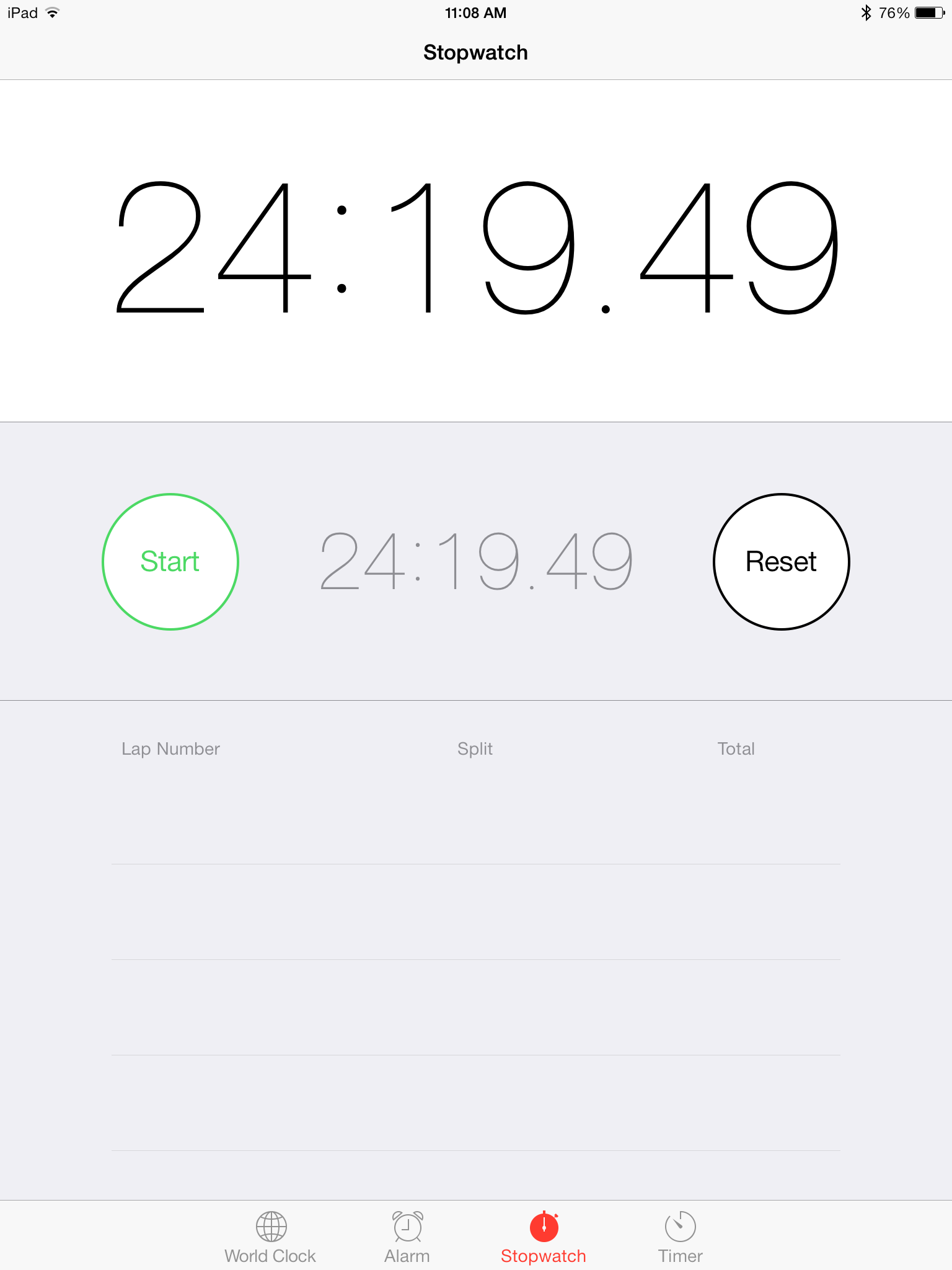
Here is how long it took me to finish the workout:

Thanksgiving Day Workout Time

A shade over 24 minutes.  Not bad in my mind.

A few observations things:

  1. Multiple breaks were needed to gather myself and ensure exercise technique was satisfactory.
  2. Vertical Pulling (chin ups) were the weak exercise, which is why I ordered them first in the sequence.
  3. 10 pistols on each leg is draining.
  4. Push Ups were the easiest of the exercises.
  5. Keeping the kettlebell swing rep scheme below 10 reps allowed for focus on aggressive hip extension (“hip snap”).
  6. Push Ups and kettlebell swings felt like filler exercises.
  7. Full burpees will jack up your heart rate as fast as any other exercise on the planet, and all you need is your body and a motivated attitude.
  8. One ascent through the rep scheme is more than enough.
  9. My muscles failed me before my cardiovascular did.
  10. This kind of training is too much to sustain over the long-term, or ever.  Special occasions only.
  11. Hardly any equipment was needed, almost completely portable.

The ascending reps was kick ass.  Early on in the workout I  enjoyed transitioning from movement to movement, turning my mind off to the exercise that I just finished and turning it on to the next exercise.  It kept the session fresh and interesting.

As the reps continued to increase beyond 5+, it began to feel more like a traditional training session where a certain amount of time is spent at a station/exercise before moving on to the next.  By the time  I arrived at 8, 9, 10 reps of pistol squats, my body was showing serious signs of fatigue.  Most of the rest breaks that were taken during pistol squats.

When you’ve accumulated massive amounts of fatigue, the execution of pistol squats (which is takes balance, strength and alignment for successful completion) becomes extremely challenging.  Each rest period last no longer than 15-20 seconds to regain composure and move forward.

All in all, it was a burn out session.  As I mentioned in the previous post, most of my workouts are nothing like yesterday’s massacre.  Typically they are short burst but well managed in the fatigue department.  However, testing will power is also important to me and the human body is capable of withstanding a lot more stress than we think.

I deemed the structure of the workout to be safe for my fitness and technical know-how, so the only thing left was mental will power to keep going despite being wiped.

Now let’s talk “soft workouts” for a second.

For me, soft workouts are sub-maximal physical efforts that are a full body experience with the intent to recover, repair and restore.

Again, they are heavy in taking joints through a full range of motion and contain movements that address all planes of possible movement.  Since stumbling on Ido Portal’s ground based tumbling drills, I tend to crawl around for the majority of these sessions.  Alignment and bodily tension at key points make the drills serve a valuable purpose, not to mention I am typically sore from the previous days effort.

Also, I have to say that low load Turkish Get Ups are amazing the day after a tough workout.  The Turkish Get Up accomplishes so much in one exercise.  It really packs a massive punch.  Joints are taken through a wide range of motion through several planes and the core is constantly under tension and challenged in these same planes of movement.  Low load Turkish Get Ups will give you a chance to focus on technique.  It gives you a chance to slow the drill down and be in the movement, every single segment on the way up to the top and on the way back down to the bottom.

Each phase of the movement can be held for a brief period of time to re-train strength and stability in various positions.  It’s important to be strong and stable throughout a wide range of motion.

Again, I consider low load Turkish Get Ups to be a perfect “soft workout” exercise.

Although you may be sore heading into a “soft workout”, you’ll find that engaging in full range of motion movement will relieve much of this soreness and deliver nutrients where it’s needed.  Nutrient delivery equals repair and recovery.

A soft workout can also include other movements like push ups, dive bombers, bodyweight squats, jump rope, inverted rows, resistance bands training, walking, etc.

If you have a suspension trainer, adjust your body position so that the angles are less vertical to your anchor point, which reduces the amount of load for each rep.  Take each exercise through a full range of motion with this lightened load.

Aerobic activity is also great for “soft workouts”.  I leverage my Schwinn Airdyne all of the time to serve this purpose.  Biking is low impact and mindless.  If you have access to an Airdyne, you get the benefit of dual action upper and lower body engagement.  Now you can flush your upper extremities also as you push and pull the arms.  During an aerobic bike session, my heart rate elevates to a manageable level (as verified by my Polar HR monitor) and I can watch hockey on my iPad while I do spin to pass the time.

What’s better than that?

The only rule is keep the volume and intensity low, which is essentially the opposite of what took place in the previous days workout, right?  Keep the volume and intensity low.  You’re recovering actively so that you can engage yourself in purposeful workouts once again in the coming days.

“Soft workouts” also include a boatload of soft tissue work using the foam roller, lacrosse ball and tiger tail hand massager.  High volume/high intensity workouts can cause significant muscular damage, so working to increase blood flow to these areas will speed up recovery and reduce soreness.

After soft tissue work, I highly suggest a quick session of yoga or static stretching to change the length of the muscle after we worked hard to change the density during massage.  I continue to value static stretching, despite the digital fist fights breaking out all over the internet about it’s effectiveness.  I feel better after long duration static stretching.  At this point post-athletic career, if it makes me feel better, I do it.

If you find value in something, do it.  If it’s important do it every single day.

Unless you’re using athletics to earn your living, static stretching is probably also a good choice for you.  Any reduction in muscular power from holding stretches for longer periods of time will probably go unnoticed in your performance.

If you’re stiff and stretching makes you feel great afterwards, why the hell not?

After a “soft workout” I hydrate like a maniac.  Cold ass water and lots of it.  Actually, let me rephrase that, I hydrate like a maniac before, during and after a “soft workout”.  I also make sure that I consume a protein based shake at some point.  The shakes that I leverage are similar to what Precision Nutrition has designed.

There is a ton of nutrition in these shakes, and quite frankly, I am thankful that I am aware of how effective they are because nutrition is the foundation of all.

If you’re thinking about getting into liquid nutrition, I suggest getting a decent blender.  I prefer mine so thick they are one level before the need to use my teeth to consume.  If they are thick, it feels like they have substance.

I use a Ninja blender, which works great (yes I know it’s an “as seen on tv” product).  A lot of liquid nutrition advocates and professional chefs recommend blending with a Vitamix.  If you have the money, go with the Vitamix.  The Vitamix is industrial strength and will blend anything with ease.  You could probably liquify a Ninja blender inside of a Vitamix if you wanted to.

Bottomline:  If you just want a kick ass blender and need to allocate money elsewhere, buy the Ninja.

“Soft workouts” are an essential piece of the fitness pie.  But they need to remain soft.  It’s important that we don’t take unnecessary steps backward because we seek the adrenaline of insane workouts all of the time.  Give your body a chance to repair itself instead.  Work low load movements and make sure that your nutrition is on point.  You’ll be fine.

Cheers to recovering from 725 reps!

KG

Take a Big Juicy Bite of Humble Pie: Progressing Your Workouts

Quick Tips
credit: blisshabits.com

credit: blisshabits.com

Ah, the humble pie.

In life it can be hard to convince yourself to take a delicious bite of humble pie, but sometimes it is absolutely necessary, especially when we begin to dissect our daily workouts.

First off, if you’re finding a way to get to the gym, you’ve put yourself ahead of the curve.  They say much of sales is just showing up, and I firmly believe fitness is very similar.  Getting to the gym is half of the battle.  Once you’re there, small shifts to progress beyond your current training habits will work magic for your body.

For example, if you’ve been killing it on the leg press, pressing a half ton load for endless reps, it’s time to remove yourself from the leg press and enter the world of free weight squatting.  You don’t even need weight.  You could knock your ego back down to earth by mixing in some pistol squats.

A few sets of pistol squats and you’ll figure out what you’ve been missing.  Single leg strength is where it is at.

If you’ve been dominating bicep curls, walk over to the squat rack and load up a set of chin-ups.  Lower yourself slow and explode on the way up.  Vertical pulling strength is a fantastic benchmark for upper body strength.  It’s important to work on handling your own bodyweight (and beyond) during upper body pulling actions.

Too cool for school on the lat pulldown?  Mix in some strict pull-ups using the same tempo as the chin ups.  Pull ups are the king of upper body exercises.  If you find yourself knocking it out of the park with pull ups, I would bet you will find yourself becoming extremely strong.

Still doing cross-words during the treadmill jog?  Take the incline up to 6-8%, turn up the speed and run some 15-20sec sprints.  Aerobic work is great, but shuffling your conditioning to venture into the higher ranges of heart rate BPM has great carryover to leaning out and resistance to fatigue during sport.

Tired of being unsure about how hard you are working?  Buy a heart rate monitor and measure your effort.  There are plenty of brands, colors and features to choose from.  It’s really a solid investment and I highly encourage that everyone leverage a heart monitor to increase the effectiveness of their training habits.

Exercise progression fitness

Improving your workouts is a lot easier than you might think, but it requires turning away from the path of least resistance and toward the path of progression.

Trust me, I know it feels really good to be awesome at certain exercises while simultaneously avoiding the exercises that plague you, but re-adjusting your training plan to include some of the exercises listed above (among others) is a sure-fire way to see quick improvement.

It really doesn’t take much put yourself on the right track for certain progress.  But you have to put yourself on the right track.  You have to progress.  If you don’t progress in some way, you’ll stay the same.

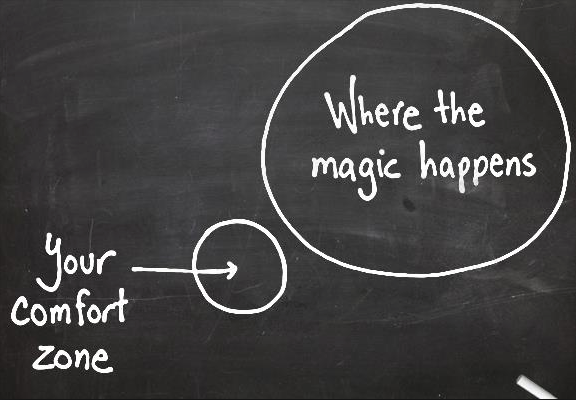
If you desire the next level of results, it will take some effort and an inner strength to consistently (and intelligently) push yourself out of your current comfort zone.  If you remember from an old post the picture below is worth a thousand words.

credit: thinkingmomsrevolution

credit: thinkingmomsrevolution

Progress applies to all aspects of life.  If you do what you always did, you’ll get what you always had.

Keep progressing and you’ll keep improving.  It’s a simple concept, but it isn’t always easy.


Cheers to progressing the workout in small increments!

KG

Progress your nutrition to see results, click the photo to find out how to make it happen.

Progress your nutrition to see results, click the photo to find out how to make it happen.

Chin Up + Kettlebell Swing + Squat + Jump Rope + Push Up… Workout

Quick Tips

I’ve never felt inclined to name any of my workouts.  Thus, I give you the:

Chin Up + Kettlebell Swing + 2KB Squat + Jump Rope + Push Up…

… workout.

There is another organization that names all of their workouts, which isn’t a bad thing,  I just don’t feel like labeling my workouts with someone else’s name.  I could name this one “Brutus” or “Cactus Jack”.  Maybe I should name my workouts after WWF wrestlers past and present.  That would be cool.  Everyone seems to know WWF wrestlers names whether they admit to watching it or not.

I could use a numbering system I suppose, like “Workout #1” or “Level 5”, but maybe I’ll just call it what it is.

I selected the movements listed above because they represent most of the major movement patterns, and also because these exercise could be easily executed with the workout equipment that I had available the other day.

What did I have available?

As I mentioned, I typically only incorporate big movement patterns into circuits.  To be honest, I don’t like wasting time with exercises that hardly stress the prime movers.  Bicep curls and such are desert.  If I have time after I have completed what I often refer to as the “main meal”, I will work in the accessory exercises for fun.


I value my time.  Time is a commodity in my life (as I am sure that it is in your’s) so I prefer to get in, get out and get back out to experience other aspects of life.  Sure, I write about working out, structuring workouts, movement and nutrition a great deal, but that doesn’t mean that I am working out 2 hours a day.  Efficiency is the name of the game.  How effective can I make my workouts without taking away from other areas of my life that I also value.

Occasionally I will add an exercise or two that is slightly out of the box, but these movements are usually treated as a filler exercise (active rest) between more demanding exercises, or reserved for before or after the main circuit of the workout.

While I will admit that doing this is my personal preference, I would suspect that most of you will find that your own workouts are immediately enhanced by working in the big movements instead of a series of fillers.  More muscles engaged equals a greater training effective at the end of the workout session.

If you do more work in a smaller time frame, now you’ve primed your body for fat loss + muscle gain.

This is a great scenario, one that we need to keep advocating instead of “weight loss”.  You can lose weight by dehydrating yourself down to a raison in a sauna.  That’s weight loss, right?

Swap the fat tissue for muscle tissue.

Chase muscle and while running away from fat.

So what are the big movements?  In this case, the big movements that I leveraged for a training effect were:

I’m continually amazed at how effective bodyweight strength movements are, especially when organized into a circuit.

I can get the training effect that I desire while minimizing risk of injury and awful soreness in the days that is so commonly associated with resistance based training.   Of course, if you have never performed a push up or a squat, you’re going to be sore in the coming days.  That’s something you can expect with a new training stimulus and re-discovered muscle contraction.

Loading up on bodyweight style training sessions.  This type of training sessions should be heavily considered by anyone that struggles with achy joints, etc.  Bodyweight resistance exercise provides a low load introduction to basic strength drills, easing your body back into the swing of things.

Plus, being able to control your body exhibiting stability, strength and power through a healthy range of motion will do wonders for your performance, whether that performance be for sport or raking the leaves out of your yard.

So what does last weekends workout look like?

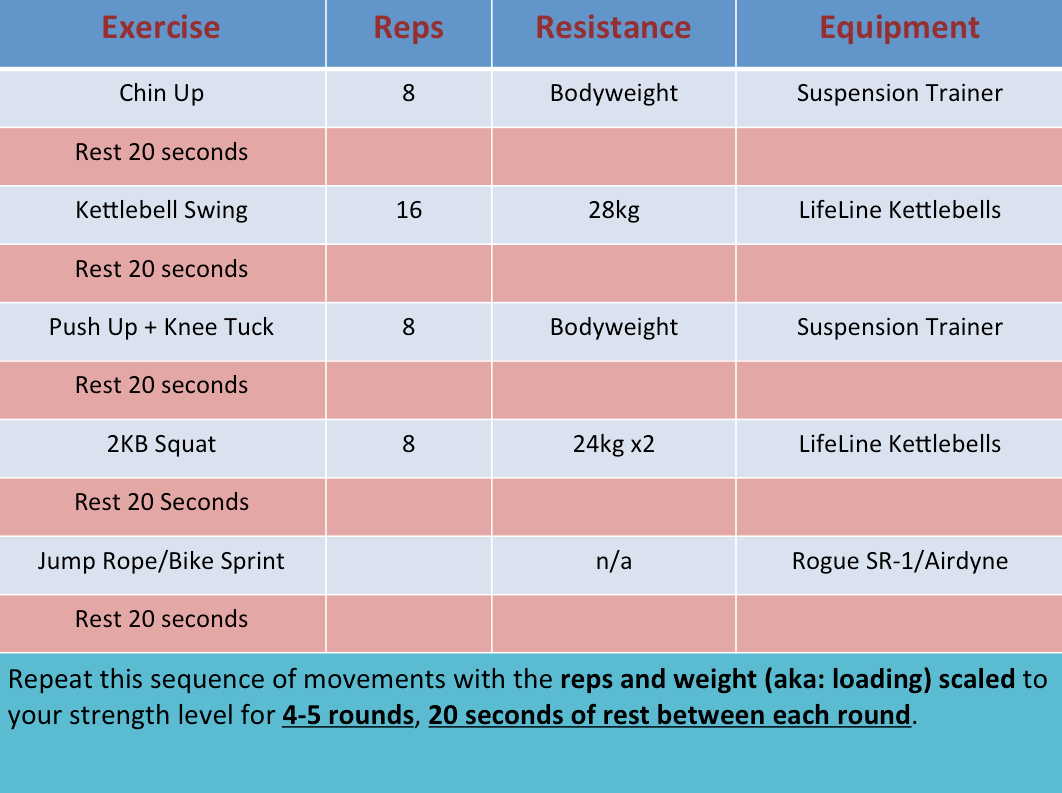
The structure looked something like this:

Metabolic Resistance Training Circuit

I loaded up most of the movements and went for 4 rounds, which took slightly over 20 minutes.  20 minutes continues to be the sweet spot for workout duration.  Anything more than that and I lose output, anything less and it seems like it wasn’t enough… as if I left some fuel in the tank.

20 minutes also seems to allow for focus on proper exercise technique (and grooving) while the fatigue continues to snowball.  Technique is important, don’t forget that.

If you take another look at the exercise selection above, I’d like to share a couple of substitutions that you could make.  If you cannot perform a bodyweight chin up, wrap a resistance band around the chin up bar you’re using, and stretch it down around your knee or foot.  This will assist you on the way up and ease you down from the top.

You could swap out standing broad jumps or squat jumps for the kettlebell swings, although there really isn’t a movement to mimic a kettlebell swing.  If you have dumbbells you could use those in a pinch, but again, there is no tool that functions quite like a kettlebell.

If you don’t have a suspension trainer, just do regular old push ups.  If you want a less expensive option that does a decent job of mimicking the push up+knee tuck combination, use furniture sliders or socks on a hard surface.  Both work decently.  I would go the furniture slide route if I had to choose.

If you don’t have kettlebells, dumbbells or a barbell for squats, you can do bodyweight squats just as well.  If bodyweight squats are easy, mix in pistols alternating each leg.  If you squats are too easy and pistols are too hard, use squat jumps.

If you don’t have a jump rope or a bike, run in place.  High knee with simultaneously arm action.  If you’re lucky enough to have a place to run a short distance, figure out how far it takes to run half of a 20 second shuttle run (10 sec out, 10 sec back).

As you can see, there is a progression, regression and alternative to just about every single movement known to man.  Once you know what a level up and a level down from an exercise is, you’re in business. Now you can OWN your workouts.

Replenish and refuel your body with some rock solid recovery nutrition, and you’ve just done your body good.


Cheers to Chin Ups, Kettlebell Swings, Squats, Jumping Rope and Push Ups!

KG

PS:  Seriously check out the nutritional link that I posted above.  If you want to see dramatic change in your body and performance, nutrition is at the bottom rung of the pyramid.  

High Repetition Kettlebell Swings

Kettlebell Training

The kettlebell swing is a amazing exercise that can build power, strength, improve conditioning and accelerate fat loss.  

Swings are packed with benefits.  

Kettlebell swings have been a staple exercise in my workouts for the past 13+ years.  

I started by swinging a 24kg kettlebell, and have since moving on to 28kg, 32kg and 44kg swings of varying intensities and volume.  

Within 4 weeks, I noticed the impact kettlebell swings had on my physique.  

And I wasn’t using fancy workouts, just a simple 15 seconds on/ 15 seconds off for 24 rounds.  That’s a 12 minute workout, with 6 of those minutes being dedicated to swings.   

Long story short, adding swings to my workout regimine helped to burn fat off of my body while building functional power, improving my posture and delivering a potent form of conditioning. 

Swinging kettlebells has also improved my running.

Kettlebell swings are a total body exercise.

In the beginning, I rarely swung my 28kg bell beyond the 15-20 reps in a work set.  

Overall, my workouts 

Then I started reading testimonials where people described how high rep kettlebell swing workouts (several days per week) was torching fat off their bodies. 

Who doesn’t want to burn a little more fat off their body?  I sure did, and still do, let’s get lean people. 

Of couse, nutrition is a crucial part of fat loss, so factor that in. 

Over the years, I’ve gone pretty far down the rabbit hole with swings.  High rep swing workouts might eclipse 300-400 reps in a session, using heavier kettlebells.  

Note:  Tread lightly using high rep swings too frequently.  Give your body chance to recover and avoid injury.  

—> Here is a short list of my observations and findings while using high rep kettlebell swing workouts <—

1)  High rep kettlebell swings builds grip endurance.  

2)  Might be a good idea to perform self administered soft tissue work on the forearms using a lacrosse ball or a percusion massager like the TheraGun. 

3)  I got lean pretty quick, which is predictable because kettlebell swings work a large number of muscles and burn a significant number of calories in these high rep workouts.  

4)  Take adequate rest between sessions.  Give your low back, glutes and hamstrings a chance to recover from the increase volume.  Foam roll, percussion massage, accupressure mat, active mobility training and long walks are a good idea.  

5)  2-3 high rep swing workouts per week is enough to create noticeable changes in body composition and conditioning.  

6)  Postural changes were interesting.  Standing position seemed like my hips were further forward and my shoulders pulled back.  

7)  15-20 minutes is more than enough time to accumulate a shit ton of swings.   

8)  Don’t be afraid to move up in weight and attack heavier kettlebells.  

I’d consider a high rep swing workout to be 100+ reps or more.  

Taking that number and scaling it for a beginner,  40-50 swings might be high rep for your experience level. 

If you’re advanced, 200+ swings might be your target for that day.  

It depends on your conditioning level and familiarity with the kettlebell swing.

Here’s a good kettlebell swing workout:

Baseline Kettlebell Swing Workout

Workoust like this are deceptively challenging.  

In the early round the rest periods feel long, but in the later rounds the rest periods don’t feel long enough.   

Fatigue is a hell of a drug.  

Using this workout, you’ll accumulate 100 swings in 10 minutes.  

That’s plenty to create a training effect.   

Choosing kettlebell weight.  20-24kg for men and a 16kg/20kg for women.

This is not the law however.  If you need to go lighter, do it.  Need to go heavier?  Do it.  Feel it out and make that decision as needed.  

This workout uses a fixed work:rest structure.  Wear a heart rate monitor if you have one.  A heart rate monitor can provide valuable information on work and rest periods, along with pinpointing how hard you’re actually working according to heart beats per minute.  

Using a heart rate monitor, I’ll perform the swings, finsih, then watch my heart rate monitor until the BPM decresases to 130bpm before starting the next round.  This method will make rest periods short in the beginning and tends to increase the length of rest later in the workout as fatigue accumulates and your body needs more time to calm down.  

Here are a few other workouts I’ve played around with. 

Other tips for high rep swing workouts

Don’t make the mistake of swinging too light of a kettlebell.  

The hips are powerful , size up the kettlebell and challenge yourself.  

If you have several different weights, you can start the workout with the heavier kettlebell and transition to the lighter bell as needed.  

It’s all based on feel.  

If you’re swinging super high rep marathon sessions with too light of a kettlebell, there’s diminishing returns.  

Instead of swinging 500 reps and feeling fresh at the end of the workout, lower the reps while increasing the weight.  

The increase in load will challenge your body plenty, and over time, the volume will increase.  

Repeat this process and you’ll be swinging the 40kg BEAST in not time.  I bet your body will reflect this progress.  

Just remember, the rules of progressive loading apply to kettlebell swings also.  

Again, this is a basic progression with loading, similar to what you’d use with traditional resistance training.

Heavier kettlebells will require greater effort to move the kettlebell through the arc of motion.    

Kettlebells are amazing for building power, improving posture and fat loss.  

Swings, while not the best for building lean muscle, are known to and can build muscle.  

Don’t count kettlebell swings out for building SOME muscle.  Just know there are better exercises.  

Deadlifts, squats, vertical pulling, rows, horizontal pressing and overhead pressing are best for building muscle because muscles will spend more time under tension through the full range of motion.  

Kettlebell swing are great for fat loss, if…   

… you’re in a caloric deficit.    

It doesn’t matter if you’re getting into a  caloric deficit via the swing workouts, or you’re a badass and entering workouts already in a caloric deficit.

You cannot out-swing a calorie surplus and expect to lose fat.  The math will work against you every time and you’ll go insane.  

People fight the calorie deficit thing all the time, like there’s some other secret sauce that can only be found by spending $97 on a fitness guru’s fat loss product.  

The caloric deficit is NOT EVERYTHING when it comes to fat loss, but it does play a HUGE role in burning fat.  

Huge.  

Sleep, hydration, protein intake, eating whole foods over processed foods (as much as possible) will deliver “best” results.

If you found this article wondering if high rep kettlebell swings are a good idea… 

… yes, they are.  

Just make sure you approach these workouts with some common sense, making sure you’re familiar with the swing itself and not overdoing the volume out of the gates. 

Increase the reps gradually, find the sweet spot with the weight, attack the workout. 

Integrating several high volume swing workouts per work alongside decent nutrition will deliver awesome athletic and aesthetic results.  

Cheers to high rep kettlebell swings!

KG