It’s Just a Kettlebell Swing and Suspension Trainer Workout

Quick Tips

A few months ago, I wrote a post titled:

—>  It’s Just a Kettlebell Swing Workout

Kettlebell Swings

That has been my most popular post on this blog, by far.

I wrote it because I wanted to convey how simple a workout can be, and probably should be for most people.

Totally stripped down.  Nothing but a timer, a towel and water bottle, and a kettlebell of a decent weight.  You could make the argument that a “totally stripped down” workout would only involve bodyweight exercises, but that’s beside the point.

A lot of people avoid physical activity because of two things:

  • Time
  • Preconceived thoughts and anxiety about how the workout will feel.

Simple workouts are time effective and aim to limit anxiety.  You look at the agenda for the workout and say to yourself, “Oh, I just have to focus on kettlebell swings today.  I can do that”.

If you have a kettlebell or have the means to acquire a kettlebell for the future, I will ALWAYS encourage you to make the purchase.  Don’t wait, don’t peruse, don’t over-analyze.

Just buy and be done with it.  You won’t be sorry.

Well, I take that back, you could be sorry… if you buy it and fizzle out and using it.  Then it’s just another heavy object holding a door open.  What a shame that would be.

Anyways, I wanted to build on that post, because I felt that the workouts displayed were rock solid, and applicable to a large population of readers.

They are simple, yet brutally effective.  I would consider them entry-level workouts, however, I have to admit that I continue to use the 15sec work/ 15sec rest (24 rounds) kettlebell swing protocol to this day.

The only difference is that I have climbed the ladder in weight.  When I started with the protocol, I used a 20kg kettlebell from LifeLine Fitness.  I then climbed to the 24kg kettlebell, then to the 28kg kettlebell and now on to the 32kg kettlebell.  All were purchased from LifeLine Fitness also (yes, I promote these guys heavily, they make equipment worth buying).

Don’t be fooled by elaborate training protocols.  Keep it simple and be detailed.

A simple workout/program executed to perfection will trump the world’s most complex/perfectly written program done poorly.

Stay in the “simple” zone, do it right.

That being said, I would like to say that kettlebells and suspension trainers are a match made in heavy.  For roughly $300, you can outfit your home with a Jungle Gym XT and a nice variety of kettlebells ranging in weight.

The combination of a suspension trainer and kettlebells is magic.

Seriously, they are match made in heaven.

Let’s look at workout that I’ve employed over the years…

Kettlebell + Suspension Trainer

A workout like this is complete.

The kettlebell swings alone are enough to initiate a tremendous training stimulus, but when paired with the other movements, the workout is magic.  Push, pull and ballistic movements for the upper and lower body are all represented here.

With high volume workouts, I typically choose simple rep schemes.  It’s annoying trying to remember how many reps to complete in the middle of round, when you’re real focus should be on controlling your breathing and fatigue.  Once you experience this frustration, you’ll wish that you would have picked simple rep schemes.

After completing each round, I would rest anywhere from 45-75 seconds depending on your conditioning level.  Don’t be a hero and rest for 45sec in the first round if you can’t handle it.  This decision may bite you in the ass in the later rounds when your fatigue levels spike.

Fatigue accumulates throughout the workout, just as it does for every workout.  It’s inevitable that it’s coming, but timing it so that you complete quality work while you can is the idea here.

The number of rounds that you complete is depends on your ability to complete quality work (exercise technique, complete reps, etc).  If your form breaks, you make the decision to rest before re-engaging, or you pull the plug on the workout altogether.

Safety first, always.  Form good habits.

Put this workout in your back pocket for now, load it in the chamber when you need a challenging high tempo training session.


Cheers to ST’s, BW’s and KB’s!

KG

(PS:  I turned on “Location Tagging” so that you’ll really believe that I reside in God’s Country… Eau Claire, WI)

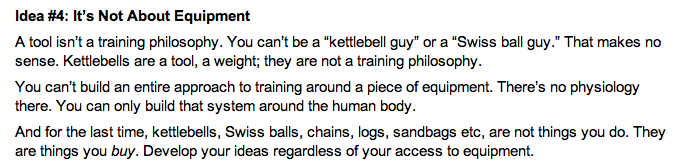
My Philosophy: Great Point Alwyn Cosgrove!

Quick Tips

Image

When I initially read  Alwyn Cosgroves post (shown above) I immediately felt that it was too good not to share. 

Once I established my training philosophy, I was set for life.  I was set to teach others and also to execute for my own benefit.  

It doesn’t matter what equipment is around, what I have access to or what I don’t have access to.  

I can accomplish something even though I don’t have everything.  

Sure, my ideas and preferences will evolve, but I think that much of what I believe makes a great program and workout is solidified.  I am not sure (at this point) how it can get much better, without sacrificing certain things that I morally cannot consciously sacrifice.  One of those being safety of myself, or the you guys.  

I write about kettlebells and suspension trainers on this blog A LOT.  

But it’s not for any other reason than I believe whole heartedly that the combination of kettlebells and suspension trainers make for insanely effective workouts, especially since they fit into my training philosophy so well.  

Kettlebells provide loaded (resistance), ground based movements that are primarily (not all) completed in a vertical standing position.  The bold print is a part of my training philosophy.  I could substitute “kettlebells” for a whole host of other fitness equipment, and things would be just fine.  

Movements like kettlebell swings and turkish get ups are world class for building a variety of qualities, at the same time.  

Suspension trainers are an entire gym in a box, weighing in at less than 2lbs tops.  Equipment-free bodyweight training is great, but suspension training makes it better.   Suspension trainers allow for the leverage of a person’s bodyweight against gravity.  My favorite benefit of the suspension trainer is the fact that you can PULL!  Inverted rows (aka: body rows) and chin ups (supinated and neutral grip) are all made possible by two straps with handles.  

Get rid of that shoddy kitchen chair set up that you’ve been using for so long…

But as stated in Alwyns commentary above, kettlebells and suspension trainers are just tools that I use to to implement my philosophy of what makes a great workout, program, etc.  I am not exclusive to any piece of equipment.  That’s not my style.

The fact is that most equipment works wonderfully.  

It’s the user (aka: you) that has the opportunity to make the magic happen.  

I know a lot of people that own a complete set of kettlebells and the best suspension trainer money can buy, but they don’t have a philosophy, or any sort of guidance on how to use it.  In turn, they are stalemate in their efforts, or on to the next fashionably trendy workout tool.

For most people who are beyond their days of athletics, the total body approach to training is probably best.  I know that there are upper body/lower body splits and a thousand other ways to organize your weekly training, but total body is effective in short windows of time.

Time is probably our most precious commodity.  We can never get time back.  Once a minute passes, that minute is gone.  Same with days, weeks, and months.  Time keeps moving forward at the same steady pace regardless if we want it to slow down or stand still.

That being said, leveraging a total body workout, using a smart philosophy to structure the workout is (in my personal opinion) the best approach for accomplishing goals of fat loss, building all around strength and many other athletic qualities using time management.

But, it must also be said that paying attention to your nutrition, specifically what you shove into your mouth and drink, is the most time effective way to stay lean.  

My advice to all of you is this:  Treat tools are tools, not philosophies.

Gravity decides what an object is going to weigh, humans decide how the object will be shaped, how the weight is distributed and to some degree how the tool should be used best.  An example of how a tool should be used best is in fact, the kettlebell.  You can swing a dumbbell, sure.  But your first time swinging a kettlebell will lead you to believe that dumbbell shouldn’t be swung.  

Kettlebells are the standout choice for swings and many other exercises.  

But I can in fact swing a dumbbell.  I can also perform a turkish get up with a dumbbell, or a sandbag, or a filled milk carton, or a loaded backpack, etc.  It might not feel the greatest, but I can do it because it has weight and a handle to grip.

The tool is not the philosophy.  It is an augment to the philosophy.  A supplement to your training philosophy.  

Again, I can perform a squat with any tool, or no tool.  If I don’t have a two, it’s bilateral air squats or for an added loaded and challenge, it’s pistol squats.  

Therefore, pay attention to more important aspects of your workout such as:

–  Consistent progression of loading.

–  Rest

–  Time under tension

–  Range of motion

–  Sets/Reps

–  Heart Rate

–  Movement patterns

–  Exercise progression

–  Your goals, needs, abilities and dysfunction

-etc…

These are things that can you can use to imprint your own philosophy of how an effective training session or long-term program should be designed, regardless of what equipment you have or don’t have.

Very simple thought pattern yet often overlooked.  Thanks Alwyn…


Cheers to philosophies and sticking to them…


Kyle

A Tough 20 Minute Kettlebell Workout: Clean+Squat+Press

20 minute Workouts, Kettlebell Training

Simple training delivers results.

And what’s more simple than taking a clean, squat and press and forming it into a great workout?

Today I’m sharing a 20 minute kettlebell workout that incorporates three tried and true exercises.

The training effect is awesome, and the time investment is minimal.

I’m a connoisseur of exercises and using basic equipment to create great workout, but I always keep focus on movement patterns. Compound exercises that train the entire body. Keep

Keeping it simple, for me, is keeping it effective. Simplicity eliminates decision fatigue and increases my focus and productivity.

Do less, but do it better.

Here are the 3 exercises we’ll be using for the workout:

Double Kettlebell Cleans

Double Kettlebell Squat

Double Overhead Kettlebell Press

Just three exercises, and good ones at that.

The clean, squat and press are time-tested exercises for building power, strength and muscle.

Kettlebell cleans are an hip hinging ballistic/explosive total body movement.

Kettlebell squats are a lower-body pushing exercise.

Kettlebell overhead press trains the vertical push pattern, which has great carryover to the daily living.

Combining all 3 exercises into a circuit makes it a total body effort. Plus, keeping the rest periods short and completing multiple rounds, the training effect is potent.

If calorie are in check, workouts like this are great for keeping muscle and accelerating fat loss.

Warm-up

Always work through a warm-up to prepare your body for more intense work ahead.

10-15 minutes is all you need to get a warm-up, work through mobility drills, lightly loaded movement patterns and raise core temperature.  

Here are some GREAT movements for warm-ups:

14 Exercise Full Body Warm Up

The pre-workout period will also give you an opportunity to assess how your body is feeling on that particular day.

Not feeling it? Run down? Poor night’s sleep, stress, etc? Don’t be afraid to work through a warm up, but bypass the workout for the day. Come back tomorrow fresh and focused.

Much of my pre-workout warm-ups are infused with ground-based movements and active joint mobility training.

On the tail end of the warm-up, I’ll jump rope, flow with a macebell or practice some lighter kettlebell drills.

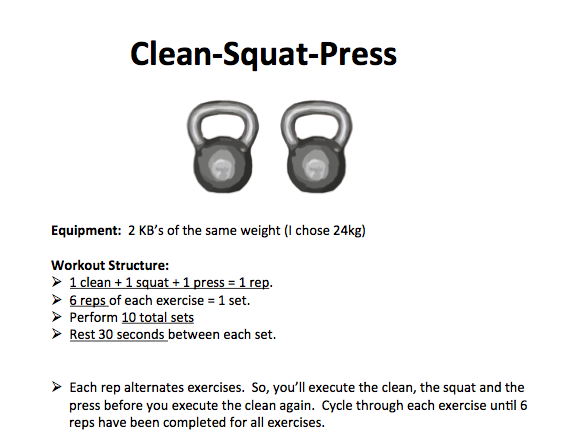
The Workout:

Image

Transitioning to a different exercise on every rep makes this circuit more challenging.

Again, you’re not doing the same exercise for X amount of reps before moving onto the next exercise, you’re performing 1 rep of clean, then 1 rep of squat and then 1 rep of overhead press before circling back to the clean.

1 time through the clean + squat + press = 1 rep.

Each set consists of 6 reps per exercise. The workout is recommended for 10 total sets. That’s a grand total of 60 reps per exercise.

The kettlebell is constantly moving throughout the workout, changing levels and positions.

Rest periods. If a 30 second rest period is completely unmanageable for 8 rounds, TAKE LONGER REST. Try 45-60 seconds. When workouts are shared, whether on this blog or any other website, you must consider your own fitness level and make adjustments as needed. NOTHING is set in stone. Tweak the session to suit your needs.

Weight. Use moderate to heavy weight for this workout. I like 24kg for males and 12-18kg for females.

Because this little circuit is using 3 different exercises, the weight you choose will correspond to both the weakest exercise of the three AND the recommended reps.

The weakest exercise with either be the clean or the overhead press for most people, and the weight of the kettlebell should be something you can squeeze 2-3 additional reps out of.

So, if the overhead press is the weakest exercise, select the weight based on that and make sure you can press it 8-10 times (even though suggested reps are 6 each)

Related Articles

Home Gym Workouts! Total Body Sandbag Circuit for Fat Loss and Muscle

Locomotion| The Weighted Lizard Crawl

One Kettlebell, 3 Fat Loss Workouts

A Kettlebell Swing Workout (Part 2): Singles and Doubles

Quick Tips

An entire workout can be centered around the kettlebell swing.

There are very few exercises other exercises I would feel comfortable saying that about.  But the kettlebell swing is definitely a movement that be an all-in-one solution.  One stop shopping if you will.

Based on the popularity of my previous post, It’s Just a Kettlebell Swing Workout, I decided to go ahead and continue posting samplings of other kettlebell swing based workouts.

But I must be clear about one thing:  I am in no way endorsing that the kettlebell swing be the only exercise that you leverage in your movement training programs.

While the kettlebell swing is certainly a world-class movement, it is important to develop strength and power through other exercises as well.  Remember, the human body pushes, pulls, jumps, twists, carries, etc.

Humans have to be able to execute a wide range physical tasks if you stop and think about it.  Especially when you consider that you never really know what the demands of the workday or weekend are going to bring.

It really pays to be physically prepared.

Workouts are scheduled bouts of physical exertion.  You know exactly what is going to happen during a workout and how it is going to happen.  So much of our daily lives are unscheduled, random and out of our control.  The workout is one aspect of our lives that we can control.  We control the amount of effort, intensity, exercise selection and duration of the workout.  We have complete control of what happens during this brief period of time.

It’s a real turn on for some people who feel like they have little control over anything else in their schedule.

Anyways, back to the point of this blog post.

Kettlebell swings, and how we can organize and rearrange kettlebell swings into highly effective training sessions.

When I sense boredom creeping up on my training habits (as many of you have also experienced) I know that it is time to shuffle a few things around.  I value the impact that 2-handed kettlebell swings- especially heavier swings for longer duration work sets- can have on maintaining my body composition, but I also know that too much of anything can be a bad thing.

Boredom is part of being human, so it’s important to inject energy into your training sessions.

In this case, single arm swings added an element to my training session that reinvigorated the entire session.

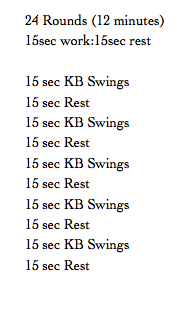
Here is what the workout looked like.

Kettlebell Swing Workouts

If you get serious about adopting kettlebell swings into your workouts, you’re quickly find that your body will enter a different realm of lean.  I have to admit that I thought kettlebells were gimmicky in the beginning, but after submerging myself into kettlebells exclusively one Summer, I prove my own opinions incorrect.

I got really lean, really quick.  From just swinging the damn thing between my legs, back and forth like a pendulum.  The concept seemed too good to be true initially.

Interestingly enough, I didn’t have the greatest technique at the time, but I had established a great foundation of all around strength, stability and resilience to fatigue which allowed me to continue advancing my workouts.

This is an important point.  I would strongly advise that anyone reading this post go and seek out a professional who has the credentials of a high level swinger.  RKC (Russian Kettlebell Challenge) or StrongFirst certified individuals would be a great place to start.  Most of these folks were trained under Pavel Psatsouline, who is the godfather of kettlebells in the Western World.  You would get fantastic tips, tricks and technique adjustment from these individuals.

But, if you have a willingness to learn and a decent bodily awareness, I also personally believe that you can teach yourself how to swing at home.  Set up a smart phone and shoot short clips of yourself swinging.  Compare it to other videos like the following:

Neghar has great technique… check out her blog

Pay attention to the difference in your technique and Neghar’s swing technique.  Critique yourself bit by bit.  Make the small adjustments.  Most people will notice that they are “lifting” the bell versus swinging it, or squatting versus hinging the hips.

We have the ability to teach ourselves things- not just mental education but physical education also- which I sometimes think that we forget.  We can be self-sustaining.

If you find that you have little time, and want a workout that is bare bones simple, try this little diddy…

10 minute kettlebell swing workoutRecently, I jumped into this exact workout prior to my evening plans.  I didn’t have much time to train but needed to get some amount of work done to feel good about myself, so this 10 minute workout fit the bill.  Using a 28kg KB, I recorded 215 swings.  Not a world record but also not too bad in my mind.

Kettlebell swings are a highly productive exercise.  Add them to your training, and with an ounce of consistency I know that you’ll see some significant return on your investment.  Just do it.

Cheers to swing workouts!

KG

Kettlebell Training Research Studies

Quick Tips

Kettlebells are probably one of the most effective workout tools on the planet.  

They are also one of the most under-researched on the planet.  

So, this post was sparked by my own interest.  

Kettlebells have proven time and time again to blow fat off of people’s bodies, most notably without losing much muscle in the process since all of the movements are loaded, both strength and ballistic exercises.

This makes kettlebell great for ditching fat without sacrificing any valuable lean muscle tissue.

And that my friends, is a win-win situation. 

So what studies exist?  

Let’s take a look at a few:

1)  Kettlebell Swings, Snatch and Bottoms Up Carry Impact on Back and Hip Muscle Activation

Excerpt:  “Some unique loading patterns discovered during the kettlebell swing included the posterior shear of the L4 vertebra on L5, which is opposite in polarity to a traditional lift. Thus, quantitative analysis provides an insight into why many individuals credit kettlebell swings with restoring and enhancing back health and function, although a few find that they irritate tissues.”

This is mostly good.  Stuart McGill is a world leader in spine research as it relates to exercise.  His work is cited and quoted in a lot of publications.  Kettlebell training, like any style of training, can be detrimental to your body if you choose to ignore technique.  Skip the learning the basics and you make yourself susceptible to injury.

Chalk one up for kettlebell swings, snatches and bottoms up holds.

Here is a video clip of the bottoms up kettlebell hold:

Your mid-section will light up like the Fourth of July while stabilizing the kettlebell in this inverted fashion.  Very challenging move.  Stay tight, tall and braced.

Protecting the spine while training is of utmost importance, and the most important role of the abdominal musculature.  Despite what mainstream projects the abs to be important for.  Protect your spine people.  

2)  Oxygen Cost of Kettlebells

This little study looked at the oxygen cost of kettlebells, more specifically the two-handed kettlebell swing.  

The metabolic challenge delivered during a kettlebell workout is large.  Part of the maximizing this challenge is selecting the proper weight bell.  It should be heavy, but not so heavy that you cannot finish the workout.  Swinging light bells encourages poor technique and decreases the impact of the overall workout.  

I’ve talked about leveraging kettlebell swings on this blog over and over again.  I cannot say enough about a properly performed swing, and what it can do for you body, performance and posture.  Preserving muscle while eliminating fat is such a desirable route when you’re seeking body transformations.  

Simple workouts can achieve big results.  Here is a recent post where I diagram some classic kettlebell workouts.  

3)  Kettlebell Swing Training Improve Maximal and Explosive Strength

Strongfirst Kettlebell Swing

The kettlebell swing is an explosive deadlift.  The extension of the hips out of the hinge is aggressive as you drive the hips forward, standing yourself up vertically.  

This hip snap is the same hip snap that athletes use for putting large amounts of force into the ground as they accelerate across the field, court or ice.  

This hip snap is not just for athletes, its beneficial for the working male or female, Mom and Dad and even physically able elderly populations.  The hips are designed to be the power source of the human body.  We spend most of our time on our feet, so having powerful hips is a great thing.  

Will you be able to dunk a basketball?  I can’t promise you that, but it will get you closer to the rim according to this study.  

Will you boost your strength and explosive strength when you call upon it?  This little study thinks so.  

*** Again, choose to swing heavy kettlebells over light kettlebells to reap the full benefits, but not so heavy that you cannot fully extend the hips or move the bell quickly.  


Cheers to the kettlebell and the emerging research behind its use…


KG

Some of the Greatest Workout Habits of Effective Fat Loss and Athletic Performance

Quick Tips

I transferred this post away from the static page tabs above and into a post.


1)  Resistance/Ground Based/Closed Chain  

  • Train with some kind of load or resistance as much as possible.  Push, pull, pick up, drag, carry, swing, squat, throw, slam… All with resistance and all with your feet on the ground whenever possible.  Lean muscle tissue from resistance training.
  • Women… (sigh)  You are not going to get “bulky” from picking up some weight.  Don’t be afraid of it.  If you knew what it takes to look like a bodybuilder you would laugh.  You’ll never get there.  If you want the “toning” effect… pick up some weight and get after it.  Nothing is sexier than a woman who is confident in the gym.  Ease into it with some effective bodyweight movements and progress from there… you’ll quickly realize what I am talking about.

2)  Aerobic/Anaerobic (Cardiovascular improvement)

  • Aerobic training isn’t the devil… it just isn’t the most effective way to drop fat and look better.  If time is a factor, and it often is, choose other methods.  Stress your cardiovascular system using as many different methods as possible.  Run, bike, paddle, swing kettlebells, use battling ropes, row, etc.  Train yourself to be effective for short distances, up inclined hills and stairs, flat surfaces, etc.  Run for distances that develop endurance-like qualities.  Do it all.  Tweak the variables:  distance, work periods, rest periods, direction, speed, heart rate recovery etc.
  • Grandma was right, “All things in moderation”.  Too much of anything can be bad.  Too little can be bad too.  Find the balance.

3)  Multi-joint (movements not muscles)

  • Unless you are rehabilitating an injury or training for a bodybuilding competition, avoid training your body in isolation.  The body is a single unit made up of many moving parts.  Train your body to push, pull, squat, hip hinge, lunge, carry, sprint, etc… and your body composition will change and performance will improve. Muscles and joints love working together (synergistically) to accomplish physical tasks.

4)  Joint-by-Joint Approach

  • The body is a vertical Jinga tower of joints.  Some joints need stability and some need mobility.  Improve your joint stability where you need it and improve your joint mobility where you need it.  Failure to obey this simple rule puts you at risk for injury and decreased performance.  Generalized approach, but simple and crazy effective.  Freedom to move effortlessly in all 3 planes will keep you functional in the game of life, and most of all, injury free.

5)  Progression

  • In simple terms, every movement/exercise has an easier or more difficult variation.  You just have to know where to start based on your abilities.  Beginners must spend time mastering the basics before they earn the right to step up to a more difficult variations.  Proper progression means leaving your ego at the door.  Do what YOU can do, not what you WANT to do or what you saw someone else do.  This is a hard lesson to learn and implement (even for myself a long time ago), but in the long run, you’ll thank me on this one.  All in good time.

6)  Rest—Recovery—Regeneration

  • Train hard… Recover harder.  If you train hard enough, you can elicit a training effect worthy of fat loss, injury prevention and performance.  If you recover hard enough, you will give yourself the opportunity to continue to train hard week in and week out.  Recovery is also where the magic happens.  Nutrition, sleep, hydration and soft tissue maintenance allows for a life-time of physical success.
  • Foam roll, roll a lacrosse ball on your feet, iron out your muscles with Tiger Tail.  Keep your tissue healthy and circulation flowing.  Stretch and elongate.  Soft tissue restrictions are uncomfortable and breed dysfunctional movement.
  • Think of it this way:  You have a full glass of water prior to a workout (water= energy levels/fatigue, etc).  After completing your workout, you have now poured out have of the glass of water (fatigue, hormones, muscular health, etc).  It is important to put more water back in your glass before the next training session (rest, recovery, regeneration). If you pour all of the water out of your glass before you replenish what you have poured out from your workout, you increase the likelihood of injury, over-training and increased fatigue, sub-optimal hormone balance, decreased performance, etc.  Keep your glass full and your body will be happy.  Keep the balance.

8)  System

  • Just like movements over muscles… choose systems over workouts.  Following a system will always get you further in the long-term than “winging” it.  A system is a road map to body re-design.  It’s a plan.  A system allows a person to experience continued improvement in a scheduled, intelligent, measurable and safe method.  A system is sustainable and built for the long-term.

*  There are a TON of variables to consider when designing a training program.  Getting yourself adjusted to healthy habits takes repetition/practice and body re-design takes time.  Be patient but don’t get complacent.  Attack the hell out of it.  You have to be all in on this.  Focus on doing the simple things really well and be patient as your body begins to experience positive aesthetic change and performance.


Cheers to the full integration of these habits…

KG

A 1000 Words of Movement

Quick Tips

It’s been said that a picture is worth a thousand words, so a video of free-flowing movement ( what it can and should be) may be worth 10,000 words.

That could be truth or extrapolated mathematics.

I won’t have much commentary on the video below from Diewey Nielson.

All that I will add is that this is what my warm-ups have evolved into.  Sure, I still recommend activating known weak areas and also mobilizing known restricted areas, but ground based movement like this may do more for re-educating our bodies on what baby-like movement feels like.

I look at ground based movements like this almost as a dynamic yoga, with far more transfer into your everyday movement.

Some years back, I was blown away by how challenging these movements really are.  5-10 minutes of this and you’re sore in weird places in the days following.  After viewing myself on video playback, I also realized that what my mind thought I was doing, was not what my body was doing.  I looked stiff, out of sequence and in some instances, un-athletic.

For any of you that thinks this type of training is “soft” or “un-extreme”, I would tell you that I used to feel the same way.  I used to think that workouts meant big weights, iron, chalk and balls to the wall effort.

I still believe that it is important to pick up heavy things, but I have a distaste in my mouth for the extreme these days.  A lot of us should be starting from ground zero with moves shown in the video shown below, not huffing and puffing over a loaded barbell or swinging like a chimp from a pull up bar.

I suggest that all of you learn a few of these moves and find a way to work them into your warm-ups and your workouts.


Cheers to the ground based flow…

Kyle

Example of 3 Simple Kettlebell Workouts

Quick Tips

Lifeline Kettlebells

Kettlebells are a great tool for the home gym.

If you’re scared of making the monetary investment in a decent pair of kettlebells, don’t sweat it.

Kettlebells will out live you.  Spread $100-$200 over a lifetime and you’re looking at pennies per month to own a nice selection of kettlebells.  Besides, nothing is more refreshing than eliminating that boring commute to and from the stuffy ass gym that you’re training in, where you have to fight for equipment or discuss politics with the guy next to you (who is resting on the equipment that you need to finish your training session).

Ugh, I don’t regret leaving the gym atmosphere, not for one second.

I’ll always pump the tires of companies that I personally support and believe in.  If you’re interested in purchasing some kettlebells, head on over to LifeLine Fitness (a Madison, WI based company) and get yourself some.

Read up on the good starting weights for males and females, but I’ll go ahead and make the suggestion that you purchase the next size bell.  You’ll grow out of your suggested starting weight rather quickly.  Adaptations happen quickly with kettlebells and most people are swinging bells that are far too light to have any significant impact.  Especially swings are designed to load the hips explosively, and the hip musculature are the most powerful in the human body.  Swings require a decent load, so load up people.

I started with a 20kg kettlebell and almost immediately moved to the Russian Special Forces standard weight of 24kg. I hovered there for a while before adding a second 24 kg kettlebell.  Double kettlebell movement opens doors to whole other world of training, one that is perfect for complexes and other work capacity based sessions.

Training sessions that incorporate high amounts of work in a condensed time frame will blow fat off your body quickly.

Here are examples of 3 simple kettlebell workouts that I commonly use in my own personal workout regimen…

1)  Kettlebell Flow

2)  Kettlebell Swings on the Minute (aka:  swing-stop-swing-stop)

Screen Shot 2013-07-25 at 6.47.23 PM

I tend to use a much heavier kettlebell for this workout than I do for workout #3 (listed below).  Grip strength is tested toward the middle/end of the workout, but having two hands on the bell during swings helps to distribute the stress to both hands, versus snatches, where the load of the bell is directed at one hand.

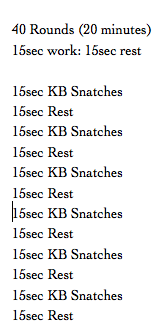
3)  15:15 Kettlebell Snatch Intervals (20 minutes total)

Screen Shot 2013-07-25 at 6.52.18 PM

I use a sub-maximal weight kettlebell for this type of workout.  Speed of movement from top to bottom, without sacrificing technique are my focus.  I could probably go for a 24kg kettlebell for this type of training session, but the 20kg has been my go to.

This is hight repetition snatch work.  Make sure you’re resting between sessions like this.  Overdoing snatches will tear up your hands, mess with your nervous system and potentially cause some overuse response in your shoulder/back musculature.  Just be aware of these things, don’t dwell on them.


Fire up one of these workouts today or tonight.  If you don’t own a kettlebell, go buy one.

You won’t regret it.

Oh one more things… if you want shorter tidbits on movement and health, head over to my Facebook Page and give it a like 🙂


Cheers to the simplicity of effective workouts,

KG

The Devil’s Ass Crack is Sitting on Wisconsin and There’s Nothing Wrong with Working Out Indoors

Quick Tips

Image

Blog post title is inspired by this viral “It’s Hot As Hell” YouTube video

(you can find the link to the video at the end of the post)

All of my Apple devices say that it’s 89 degrees in the EC (Eau Claire, WI), but there is no way in hell it is 89 degrees.  I could cook an egg on the sidewalk and I nearly lost skin to the seat of my Volkswagen Jetta (TDI I might add).  Just for clarification, TDI means diesel:)  It’s got to be closer to 94-95 degrees at least.

In a nutshell, it is stupid hot in Wisconsin at the present moment.   It’s down right suffocating outside.

***  Please grant me this moment to bitch about the weather… I am well aware that it is hotter elsewhere.

I preach about how refreshing it is to get take your workouts outside, but not in this kind of heat and humidity.  You’ll bury yourself in the first ten minutes.  Plus, if you’re a sweater like I am, any movements that require grip become annoyingly unsafe.  When I say sweater, I mean wet.  Not damp or slight lower back sweat stain, I’m talking about ring out my t-shirt wet.  Squeaky sneakers wet.

Swinging a kettlebell with sweat sliding between the palms of your hands and a heavy cast iron cannonball is nerve-racking.  It’s not fun to re-grip at the apex of your swing.  Also, if the bell slips, it’s going to slip on the backswing, where gravity is re-introduced and the hands are taxed to maintain grip.  Smashing the bones in your feet would not be fun.  I’ve been swinging for a while, and I’ll still grind through a few extra swings with wet hands despite knowing better.  It’s not good practice, but I’ll commonly pull the plug on any ballistic kettlebell movements (snatches, cleans, swings, etc) when the sweat is really pouring out of me.

So, the game plan today is an indoor workout.  No question about it.

My sacrifice for training indoors is that my ceilings are not of the ideal height for a select few kettlebell exercises.  If I was working in max effort squat jumps (which I never do) or snatches (which I love to do but can’t), I would have to find alternatives or take my workout outside.  But not today.

Today is going to be totally improvised.

Image

  • Continuous movement for 15 Minutes
  • No rest between movements, reset back to squat jumps after finishing the Schwinn Airdyne ride.
  • Monitor heart rate for effort.
  • Monitor exercise technique for muscular fatigue/breaking of form.

*  I don’t claim to have invented this, and I don’t typically mix multiple movements together that take a great deal of thinking, but this seemed like a nice combination.  I wanted a total body movement combination, and this seems to serve that purpose.

First, I put this workout together using my same general template that I use for all of my program/workout design.  All movement patterns are represented in the workout, including a cardio effort with the 60 second Schwinn Airdyne ride (in honor of the Tour de France).  Nothing is maximal effort.  That would ruin the point of the workout.  Burning out in the first round does little for you.  By monitoring my heart rate, I can verify that I am in fact working as hard as I think I am.  It’s not a perfect gauge effort, it has it’s flaws, but it works extremely well for me and a lot of other people.

Second (and to my last point), I chose sub-maximal reps and sub-maximal loading on all exercises.  This decision was influenced by the duration of time that I targeted for the session (15 minutes).  Again, the point is to move a pace that allows for:

1)   Quality technique in each rep of every exercise.

2)   The accumulation of an afterburn-like effect that will lend itself to staying lean, maintaining strength, improving work capacity through various exercise variations and while leveraging my body’s reaction to the training stimulus (calories expended post-workout). 

Third, all movements are bodyweight based the entire way through.  I have fallen back in love with bodyweight training.  Bodyweight training goes wherever you go, has simple progressions and leverages the most effective movement patterns in a brutally effective manner.  Bodyweight training is the foundation of all other modes of training, so it’s probably best be capable of executing sound technique using just bodyweight against gravity’s pull.

Also, I enjoy having and building strength as much as the next person, but at the present time, the strength that I have developed and maintained through bodyweight based exercise progressions is more than enough to meet my daily needs.  If I ever want to develop higher levels of strength, I will have to move heavier loads and adjust other training variables.  Simple as that.

Fourth, the entire workout takes 15 minutes.  Now, I won’t con you (yes con you) into thinking that the whole ordeal takes 15 minutes only, because it doesn’t.  I typically spend 10-15 minutes before the actual effort driven portion of the training session hammering home joint mobility, soft tissue restrictions and activation of weaker muscles.  I also whip through a series of staple dynamic flexibility drills that prepare my body for what’s ahead.

You can argue that warming up doesn’t prevent injuries, but in reality, why risk it?  Do you really want to find out through experience?  It’s just not worth it.

Lastly, take a look at the final two bullet points above.  Here is a snapshot so that you don’t have to scroll up (the things I do for my readers):

Image

What’s going to burn out first?  Lungs or muscles.  It will vary from person to person depending on what your past training regimen was and current fitness status is.  In other words, will your cardio or your ability to successfully and repeatedly execute each rep of each exercise (muscular contraction) give way first?

For me, it’s a combination.  Muscles seem to go first, especially when I am toying around with higher volume training sessions.  Some of you may find that you haven’t open up your lungs aggressively for quite some time, so the feeling of not getting enough air may cause you to tap out first.  In this case, focus on relaxing your neck.  Push your oxygen through your neck and chest down to the lowest part of your stomach.

Breathe deep.

So there you have it, a simple yet effective training session for all the land to enjoy.  Feel free to substitute your favorite or most accessible cardio alternative for the Schwinn Airdyne sprint.  Some days, low impact/high reward conditioning tools are the ticket.  High impact all of the time may mean high risk for some of you who have not yet adapted.  Jumping rope would fit the bill nicely, so would a treadmill sprint set to an incline.  Your choice.

Cheers to training inside when it’s Image outside!

KG

(As promised:  “It’s Hot As Hell”)

Be A Perfectly Golden Marshmallow: Toying w/ BJ Gaddour’s Fat Loss Workout

Quick Tips

Screen Shot 2013-07-18 at 8.56.17 AM

BJ Gaddour

BJ Gaddour is the new Craig Ballantyne.

Craig Ballantyne created Turbulence Training back when it was personal trainers were not publishing material on the internet the way that they are now.  Now everyone has a product.

Hey, if you can write and you have the drive to stay motivated after working 9-10 hour days, why the hell not?  Everyone is selling something, product or self.  Doesn’t matter, it’s how we succeed.

BJ Gaddour currently works with Men’s Health as a consultant.  Essentially that means that he made enough noise doing his own thing that Men’s Health contracted him to write workouts, articles and programs for them.

BJ’s claim to fame is fat loss and boot camp style workouts.

A while back he posted a free PDF titled “The Seven Deadly Workout Sins”.

Pretty solid little article.

In it, he describes a general outline on how to design effective fat loss workouts.

When I read the article, it was a wake up call that I should have WAY more confidence in my writing and methods.  It was nearly identical to my training philosophy at the present time.  It was a great moment for me to realize that what I am cooking up here in Eau Claire (the mecca of the Midwest) is well seasoned (nice play on words) and spot on for what’s current in the training world.

Total body workouts, timed efforts and rest, 3-4 days a week.  No cardio.  Cardio is obtained as byproduct from the unique blend of incomplete rest periods and resistance based exercises.  

Again, this is a STYLE of training.  It’s not the law, but this kind of training gets results quickly.  If you buttoned up your eating habits, you would shed unwanted layers in very little time.

I enjoy giving other trainer’s workouts a run through, as it can get a little monotonous writing your own programs all of the time.  Sometimes, it’s nice to have someone else do the designing for you.  I just follow along for once.

BJ’s workout looked something like this:

Image

I talk about movement patterns on this blog all of the time, and a closer look at BJ’s template shows that he thinks along similar lines.  Hip hinging, squat, pressing, pulling, total body movements are all represented in this workout.  It’s a recipe that has endless variations and keeps your workouts interesting and effective.  The systemic effect of a workout like this is fantastic.

Most people will probably find that they are unable to keep moving all of the way through some of the 30 second work bouts with certain exercises.  Chin-ups continuous for 30 seconds doesn’t sound that hard, but talk to me about that in round 3 of the workout when your eyeballs are teetering on your orbitals.  It’s a different ballgame at that point of the workout.  You’re in the eye of the storm in round 3.

What I like about this workout is that is manageable.  The movements can be scaled up or down depending on a person’s training level and age.  Manageable fatigue is the key to successful fat loss workouts.  If you cannot control and OWN every movement in every rep, every round, every workout, you’re putting yourself at risk.  Posture collapses in a matter of a rep.  I’ve seen it in both my own training and others.  That’s all it takes to slip a disc, tear a rotator cuff or and break bones.  It’s a long, painful and expensive ride to the emergency room.

Injury during training is a tragedy.

Overall, this is a great workout.  The rest periods can be frustrating if you have to adjust your equipment in between exercises.  I was using my suspension trainer for a variation of this workout.  I found that adjusting the straps was a nightmare.  15 seconds is not a lot of time to gather yourself and set up for the next movement, especially when your hands are shaking like crazy.  The nervous system is on full alert.

The 60 second rest periods at the end of each round is also well thought out.  One minute gives adequate time to gather yourself, get a drink and towel off before entering into the next round of work.  In the later round, one minute feels like a blink of the eyes.

Successful work capacity based fat loss workouts seem to have peaking point with regard to exertion, whether in the middle of the circuit itself or as gradual accumulating fatigue that reaches a high point at the end of a workout.  The goal is to manage your output, giving an effort that challenges your body steadily in the early and later rounds.  Early burnout makes for sloppy exercise technique in later rounds and a serious lack of enjoyment.  The workout should be challenging but fun and engaging.  Purposeful.

Lately, I’ve been drawing similarities between the perfect “golden marshmallow” and a fat loss driven workout:

The golden marshmallow

When you cook a marshmallow for a s’more, some people enjoy perfectly cooked golden marshmallows and some people like the torched black marshmallows.  Cooking a perfectly golden marshmallow is a campfire art.  If the marshmallow gets too close to the fire it will burn.  If you don’t get it close enough it’s just a warm white marshmallow.

Peaking after the final rep of a workout (while still being able to own your movement) is an art.  We are all at different fitness levels so this is largely a judgment call by YOU, the trainee.  You need to make the decision on when to pull the plug on a set, a workout, or when it’s necessary to add more.

This is what a smart personal trainer can monitor for a client, and why good personal trainer add value to person’s fitness endeavors.  Personal trainers can take a client close to that edge, that fine line, without pushing them over.  The entire workout remains in control, yet impactful in its training effect.

The goal of a great workout is to be a perfectly golden marshmallow at the end.

BJ’s workout accomplishes this.


Cheers to golden marshmallows and better workouts!

KG