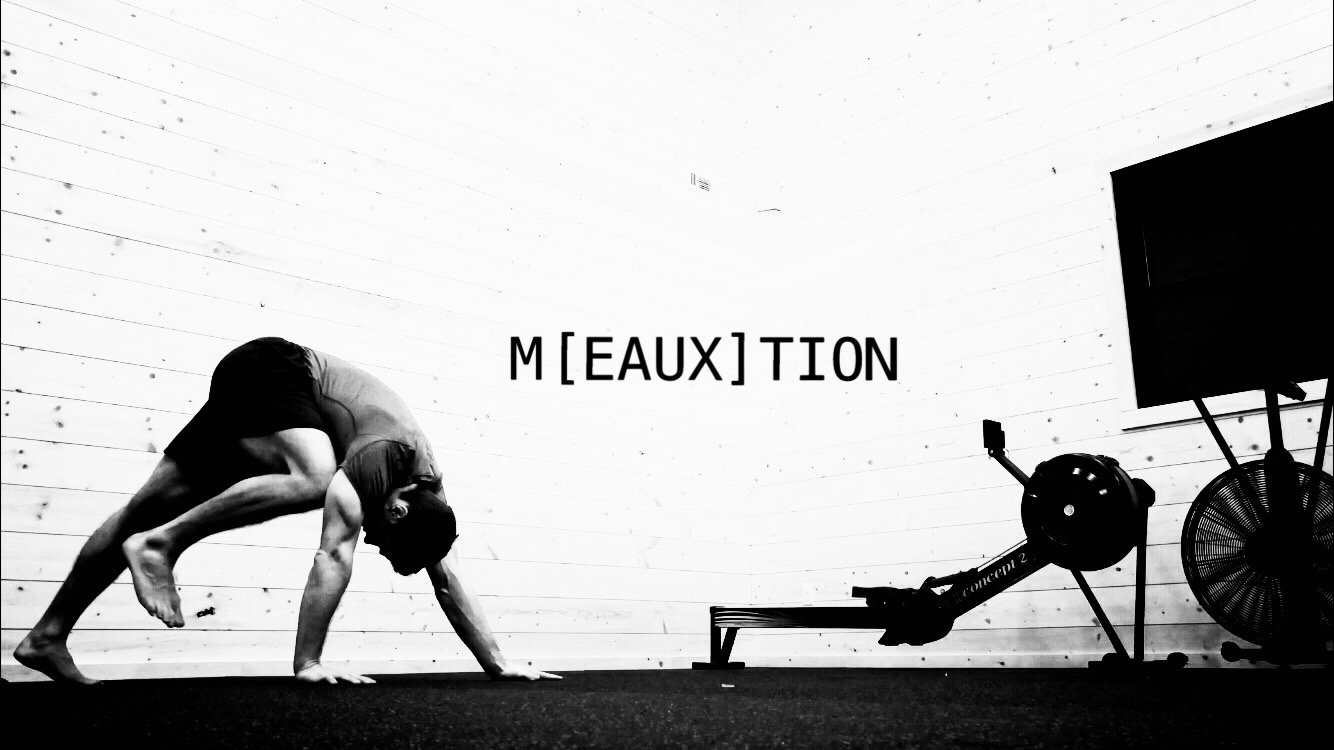
Look! Movement is the Benefit :)

Quick Tips

Screen Shot 2013-08-22 at 6.59.07 PM

Non-traditional movement has been the name of the game lately.

Pure ground based locomotion and flow.

It’s not that I don’t have time for more mainstream forms of movement, because I believe in that also,  but I am becoming increasingly intrigued with other methods of movement training.  I almost used the term “time-tested” instead of mainstream.  It might have been a better description, but admittedly, 95% of my personal workout habits and the habits which I recommend to others seeking movement regimens are in fact, mainstream.

A simple blend of squats, lunges, hip dominant hinging, upper body pushing and pulling in a vertical and horizontal fashion will set you up for success.  Add in some chops and lifts and you have got yourself a damn good routine.  It’s all in how you organize it and tweak the variables to best fit your goals.

A squat is a squat, but with a few tweaks here and there, you can make the squat conducive to building a number of different human physical qualities (strength, endurance, power, etc), all completely different from each other.

Always remember, in the beginning… establish mobility, establish stability in that new-found range of motion, then begin the process of building strength.

It’s a layering effect.

This is a recipe that works every single time for the person that is willing to be diligent in their training efforts.

Are you that person?

Because here is the reality:  Movement works every single time.  100% effective.  It’s people that fall short.

Movement works.  People don’t do the work.  Shame on us.

Over the past few weeks, I have progressively integrated more and more Ido-style movements into my pre-work training block.  Maybe I shouldn’t refer to these movements as “Ido-invented” (after watching some of his videos he probably would deny they are his but were there from the beginning of time), but he was one of the first (and still the best that I’ve seen) to make sense of less mainstream forms of movement.

He is a mover, in every sense of the word.

From one-arm hand stands and other hand balancing, single arm chin ups, planches and twice bodyweight back squats, Ido can move with flow and move load if necessary.

Planche training

Planche

I keep referring to Ido’s teachings as “movement”, and that’s because it is.  He neither specializes nor generalizes.

I guess I never really stopped and thought about it, but most of what is published and preached today is purely about fitness.  Even Yoga, with it’s cult like following, doesn’t necessarily make a person MOVE better.  It might help a person increase flexibility and improve range of motion, but it doesn’t guarantee that you will move better.

You have to practice movement to improve your ability to move.

Now, I will say that I don’t necessarily believe that the mere act of practicing movement is going to grant you access to better movement.  It may open a few doors to becoming a better mover, but I also think that each person needs to be real with themselves and their own situation.  Some folks have got some real compensations, imbalances and dysfunction going on.  Who knows where or how these issues manifested themselves (a lot are from sitting too long) but they are there, so it may be completely necessary to address these movement restrictions before you’ll ever be a great mover, or even an average mover.

The Functional Movement Screen is a great system for evaluating yourself, and your ability to move.  Why?  Because it is systematic.  You grade your movement quality, and lesser quality scores in any given movement pattern has a roadmap of corrective drills that you can use to clean up that movement pattern.  In essence, you can correct faulty movement rather quickly.

Realistically, you can perform a poor man’s movement screen at home on yourself.  It will always be better to have a knowledgeable FMS certified trainer evaluate you, but hey, we can DIY.

Use a big mirror or better yet film yourself performing the tests from the movement screen.  Don’t feel dumb filming, you can delete it immediately.  The filming of your movement capabilities is extremely valuable.  What you “think” you’re doing isn’t always what you actually doing movement-wise.

Take your video and compare it to some perfect screens (which you can easily find on YouTube) and take note of the differences.  Most people will notice that their overhead squat is a lacking, rotational stability nearly impossible to complete and the inline lunge makes you feel like you’re balancing on a tight rope.

Cleaning up these patterns will make you a better mover, and probably decrease the likelihood that your dysfunction manifests itself into an injury.

However, cleaning up the screen doesn’t mean that you’ll all of the sudden be a great mover.  You have to practice moving to be a great mover.  Are you sick of me saying move?  Mover?  Movement yet?  Sit tight I’ll drop those terms a bunch more in the coming paragraphs.

In many cases, I have substituted ground based crawling variations (supine and prone) and walks in  place of my go-to dynamic warm up.  I haven’t felt like I am sacrificing anything by doing so.  My joints still move through a full range of motion and my muscles are activated in a low-impact fashion.  I would even argue that my time is being maximized by practicing my movement flow using Ido’s training drills versus my standard cookie cutter warm up.

I’ve actually exited many of these warm-ups in a pool of sweat, even before beginning what I would consider to be the “work” portion of my session.  Interesting.

I’ve quickly found that I am ridiculously weak in certain positions, uncoordinated and all around uncomfortable as I work in some of the Ido Portal warm-up drills and ground based training.  It’s an ego check for sure, especially since he refers to many of these flow-like drills as being “beginner”.  Ha!  Soreness has also been a product of the unfamiliar movements, although it’s never a goal.  Unfamiliar movements almost always produce soreness because your body hasn’t experienced it yet.

I am reminded – as I continue to force myself to become more vulnerable by the day with Ido’s training idealogy- of how a newbie to the workout scene feels at first.  It’s an emotional uppercut showing up to a personal training session or a group class (even training by yourself behind closed doors) knowing that you’re going to struggle to complete what is being asked of you.

But the key is to keep coming back.  Keep grinding.  Keep learning.  Realize that it’s a process, just like everything else.  And as a process, you’ve got to work at it, consistently and in a focused manner.  Leave your feelings at the door and work.

We’ve become detached from our bodies and desensitized to our physical abilities.  In fact, many of us no longer have a relationship with our body, and our physical abilities.  Things that we could easily do as kids are now foreign and seemingly impossible.  But all of that can be regained.

One major takeaway from the my small bit of reading Ido’s work is this:  We’ve got to establish a lifelong relationship with our movement.  Every one of us.  We will all start at different points and need different adjustments along the way- and this makes sense because we are all individually unique- but you’ve got to make sure that you start and find a way to make it stick.

Enjoy the challenge of learning new physical skills.  Embrace the frustrations and work out the solutions on your own.  If you find yourself stuck, hop on the computer or tablet and search out a solution.  The internet is packed with incredible free information that can get you where you need to go.

I suck at many of Ido’s locomotion drills right now.  I’ll admit that.  I filmed myself and I look stiff and the opposite of gracefully.  But that will change with time and practice.  It’s frustrating to know that I am practicing something that I am not good at (yet).

I think many people may find that they actually like dedicated workouts more when you a aiming to develop a certain movement skill.  Pursuing skills transforms a person’s daily workouts into a journey instead of a dreaded 60 minutes of robotic physical activity that we feel we need to participate in to chase the idea of “fitness”.

A movement journey may not have an end point.  But that is the beauty of it.  You achieve a goal and begin planning and preparation for the next goal.  One day you look back and realize that over the course of time you hopped over barriers that you never imagined you would hurdle.  That’s an incredible feeling to evaluate significant forward progress, especially when looking at where you started.

People often ask me what the benefit of an exercise is, or which exercises will best target a specific area of the body…

For a long time I couldn’t find the exact words to answer this question in a way that felt true to myself… but try this one out because I think this might be where I stand…

Ido Portal Movement


Cheers to getting uncomfortable in your movement endeavors…


KG

What is Ido Portal’s Training Philosophy Doing To Me?

Quick Tips

Ido Portal

I’ve been following Ido Portal for nearly 2 months and I’m starting to question how we “practice” fitness, what it means to be “fit”, how we get to the point of being considered fit, what humans should be able to do movement-wise, and on and on  and on.

I have to admit, thought process-wise, I am going through a shift.

Ido makes incredibly great points about movement and body control.  It’s a raw thought process, completely stripped down to just… movement.

The point that Ido conveys time and time again is that we should be able to move freely.  He references movement patterns, but I know from reading through his blog and watching his YouTube videos that he isn’t referring to the “safe” movement patterns that we fitness professionals beat into the ground.  He’s expanding far beyond that thought process.

Here are some snapshots of Ido-style movement…

I realize now, more than ever, that the modern-day human really doesn’t know how to handle their body.

We are slaves to sitting in chairs, cubicles, in front of the television and in cars.  If you really stop and think about how much we sit on any given day, it’s nauseating.  Even if we have no choice but to sit for our careers, when the weekend comes we still choose to grab a lawn chair and sit, sit at the bar, sit at restaurant.  Sit.

I can partially throw myself into this group also because I have to sit down to write on this blog.

I consider myself to be an athletic dude, but watching some of these videos leads me to believe that I have handicapped my own movement performance.  I am not even in the same realm as some of the people that have been under the Ido Portal tutelage for as few as a few months.

I can squat (ass to grass) and rest in the squatting position for long periods of time, elevate my arms overhead without breaking at the low back, and exhibit rotational range of motion at my thoracic spine when it’s required… but integrating of all of these elements into a free-flowing long sequence without making it look painfully difficult was humbling for me.

The low lizard crawl is a basic locomotion pattern in the Ido Portal Training Method, and it’s basically used as warm-up!  I am here to tell you that it is humbling how difficult it is to crawl 10-15 yards like this (fast forward to 1:56)…

Are the followers of the Ido Portal Method been practicing different techniques than I am?

Yes, of course.  They are following strict progressions that allow for a appropriate movement education.  A repetitive approach to learning movement in a progression-friendly manner will ensure that no fundamental steps were skipped along the way, all while achieving desired results.

The human body will adapt and increasingly better how we ask to move, or how we don’t it to move.  That is why a lot of people have back pain, poor hip mobility and loss of muscle activation from sitting.  But humans naturally want to stand up straight, so in order to make this possible, we compensate to achieve.

So I think that over time my movement will begin to flow like some of his videos, but it is going to take some work, some practice, dedication and time.

Many of Ido’s students YouTube videos display what I would consider to be “test-outs” or results from following his teachings, so I think that it’s important (when watching these videos) to keep in mind that there was an incredible amount of dedication and work put in prior to shooting each person’s testimonial of the Ido Portal Method.

It didn’t happen over night, in a week or in a month.

The other night, I was trying to find the words to describe my perception of how we pursue health and wellness, and where I stand on the matter.  It’s a difficult topic to discuss because there are so many elements that combine to form, health.

I continue to find myself veering away from “safe” more and more.  Now, I don’t mean that I am moving toward “unsafe” and negligent, but I really am questioning why we do what we do in the gym or outside of the gym (wherever we train).  It’s cookie cutter and robotic in nature.  It’s lacking exploration.  Reps, sets and rest cannot be the pot of gold at the end of the movement continuum.

Who established these rules that we follow so closely?  Science?  Industry leaders?

Do we continue to teach and preach these methods because that is what the masses want?  Or are we lacking in our own understanding of more complex movement patterns, integration and improvisation?  Are we aiming for the wrong target?  What does fitness mean anyways?

We aim for reproducible results- and I don’t think that we should be aiming for anything different- but we have become robots in our pursuit of fitness.  The entire idea is skewed.  Everything that we preach for people to do is cookie cutter and safe.

There is very little room for anyone to stray from the path, and if you do (as I am exploring currently), you’re branded and thrown out to the wolves.

We preach moving within our means, avoiding compromising body positions and alignment, moving weight safely, employing safe rep and set ranges for maximizing our goals, adequate rest to perform that work safely, etc.  Safe, safe, safe.

Before you label me a hippocrate, let me say that I actually also believe in safe.

Ido Portal’s methods of movement might be right for everyone at some point, but maybe not at this moment.

The human race have never moved less or eaten worse.

We sit more, we move less. We are walking time bombs with regard to our ability to move effectively or for any duration (endurance, etc).  We eat food created in factories, food that has never seen the earth’s soil, food that contains ingredients that we cannot pronounce much less identify… and because we eat so much of this food, our body’s have become a reflection of these poor choices.

Make no mistake, we are what we eat.

But the problem is that we don’t even know we are heading down a path of self-destruction.  Eating crap has become the norm, and we don’t even know it.  But food chatter is outside of the scope of this blog post.  I’m not a nutritionist nor do I really want to be.  I’ll end the nutrition talk here.

We walk around commenting that a person is “in shape” if they don’t cast a bubbly shadow on pavement on a sunny day.  Not everyone needs to have a six-pack, but we are desensitized to what health looks like.  “Lean” is almost taboo is some areas of America, and the world.  One look back in history will show that most of civilization is getting bigger.  And by bigger, I am not referring to taller.

In many instances, our body shape is actually limiting our ability to move.  Yes, the amount of tissue that we are carrying on our bodies are preventing us from moving the way that we are supposed to move.

Studies like this support my bantering…

I started thinking like this a few years ago, and I thought I was crazy, because my background is strength and conditioning.  Strength and conditioning workouts and programs are EXTREMELY structured, and EXTREMELY safe.  There is very little room for movement exploration in the eyes of strength coach.  Strength based programs, as I mentioned, are extremely structured.  You work through phases that place focus on building different athletic qualities (hypertrophy, strength, power, work capacity, etc).  The reps and sets are calculated, training days, rest, etc.

I got trapped in that way thinking for everyone, athlete or otherwise.  More like handcuffed.  To the point that I felt like if I explored anything outside of a 4-phase workout program, a barbell squat or a systematic approach to “core training”, then I was a Looney Tune.

Then I picked up a kettlebell for the first time.  Kettlebells had been around for a little while, but they were still considered taboo by some of the leaders in the strength and conditioning industry.  After executing some kettlebell swings and some turkish get ups in a hotel room after a performance conference, I realized that movement was different from exercise.

Movement is different from exercise.

This is movement:

This is exercise:

I was strong, but my integrated movement was shit.  In fact, I wasn’t graceful at all.  My muscles were powerful and my joint were mobile and stable, but I had zero grace in pure movement.  I was powerful, strong and stable within the confines of identified movement patterns, but when I challenged myself outside of these confines, I was at beginner level.

Again, I realized that movement is different from exercise. I was certainly moving when I exercise, but I was trapping and limiting my ability to move freely with traditional exercise.

In fact, I don’t even like the word exercise.  I use it but I don’t like it.  I use the word “movement” on this blog over and over again.  I would even prefer to say “train” or “practice” or “drills” over the word exercise.  Exercise makes me cringe.  “Exercise” makes me think of automated robots on a treadmill.  I don’t want to be an automated robot.  I want to move.  I want to move because I enjoy moving, and seeking out new methods of movement is challenging.  I want to move in an unrestricted 3-dimensional manner.

I’m not going to discard structured movement training using such drills as push ups, squats, and lunges, because they have their place.  But I am damn well going to explore un-traditional forms of movement from here on out.  Climbing, hanging, swinging, etc.  Full integration of movement play and practice starts now.

We fitness professionals think that we know movement and that we are teaching people how to be “functional”, shame on us.  We stop our teachings at “flat back”, “shoulders down and back” and “pressurize your core”!

I learned a long time ago, after crumpling up and throwing away probably 2-3 books worth of writing material that I should trust my thinking.  I feel that I should trust my thinking now.  I have grown to appreciate being exposed to new ideas that initiate an evolution in my own thinking.

Why be trapped?  Go explore, go move…

Oh and here is that picture that I promised some 910 words ago…

Screen Shot 2013-08-17 at 12.01.58 PM


Cheers to stumbling onto ideas that open our minds!

KG

Are We Aiming For Weight Loss or Are We Aiming For Happiness?

Quick Tips

Image

There is a concept emerging from the behavioral/psychology scene that I predict is going to make it’s way into the health and wellness arena.

Happiness.  

The pursuit of happiness over the pursuit of weight loss, fat loss, muscle, athletic prowess.  

Because happiness is at the root of all of these things if you stop and think about it.  

We all want to lose weight for different reasons, but when you boil it down, the foundational motivation to lose weight might be so that we can experience emotions of happiness.  

Happiness is the fuel is at the root of nearly every action that we take in our lives, and when opportunities slip by, we tend to lose these feelings of happiness.  We experience regret, discontent and guilt.

We feel bad, not happy.

Everyone wants to feel happy.  Happy feels good.  

I’m not a scientist and won’t pretend to be, but what if you shifted your thought process away from “I want to lose weight” to “I want to be happy”?  

Would that change anything for you?  

Maybe, maybe not.  Not every method is effective for every person.  

I think humans have a tendency to place focus on the wrong things at times, and I can certainly be lumped into this bunch.  We develop tunnel vision toward something we want, like weight loss or money for example.  But we don’t stop and think about our deeper reasoning for wanting it.  

It seems like the moment that we uncover the real reasons for our pursuits might be the moment that we develop an unshakeable attitude and drive toward accomplishing that pursuit.


Cheers to being happy…


KG


Some of the Greatest Workout Habits of Effective Fat Loss and Athletic Performance

Quick Tips

I transferred this post away from the static page tabs above and into a post.


1)  Resistance/Ground Based/Closed Chain  

  • Train with some kind of load or resistance as much as possible.  Push, pull, pick up, drag, carry, swing, squat, throw, slam… All with resistance and all with your feet on the ground whenever possible.  Lean muscle tissue from resistance training.
  • Women… (sigh)  You are not going to get “bulky” from picking up some weight.  Don’t be afraid of it.  If you knew what it takes to look like a bodybuilder you would laugh.  You’ll never get there.  If you want the “toning” effect… pick up some weight and get after it.  Nothing is sexier than a woman who is confident in the gym.  Ease into it with some effective bodyweight movements and progress from there… you’ll quickly realize what I am talking about.

2)  Aerobic/Anaerobic (Cardiovascular improvement)

  • Aerobic training isn’t the devil… it just isn’t the most effective way to drop fat and look better.  If time is a factor, and it often is, choose other methods.  Stress your cardiovascular system using as many different methods as possible.  Run, bike, paddle, swing kettlebells, use battling ropes, row, etc.  Train yourself to be effective for short distances, up inclined hills and stairs, flat surfaces, etc.  Run for distances that develop endurance-like qualities.  Do it all.  Tweak the variables:  distance, work periods, rest periods, direction, speed, heart rate recovery etc.
  • Grandma was right, “All things in moderation”.  Too much of anything can be bad.  Too little can be bad too.  Find the balance.

3)  Multi-joint (movements not muscles)

  • Unless you are rehabilitating an injury or training for a bodybuilding competition, avoid training your body in isolation.  The body is a single unit made up of many moving parts.  Train your body to push, pull, squat, hip hinge, lunge, carry, sprint, etc… and your body composition will change and performance will improve. Muscles and joints love working together (synergistically) to accomplish physical tasks.

4)  Joint-by-Joint Approach

  • The body is a vertical Jinga tower of joints.  Some joints need stability and some need mobility.  Improve your joint stability where you need it and improve your joint mobility where you need it.  Failure to obey this simple rule puts you at risk for injury and decreased performance.  Generalized approach, but simple and crazy effective.  Freedom to move effortlessly in all 3 planes will keep you functional in the game of life, and most of all, injury free.

5)  Progression

  • In simple terms, every movement/exercise has an easier or more difficult variation.  You just have to know where to start based on your abilities.  Beginners must spend time mastering the basics before they earn the right to step up to a more difficult variations.  Proper progression means leaving your ego at the door.  Do what YOU can do, not what you WANT to do or what you saw someone else do.  This is a hard lesson to learn and implement (even for myself a long time ago), but in the long run, you’ll thank me on this one.  All in good time.

6)  Rest—Recovery—Regeneration

  • Train hard… Recover harder.  If you train hard enough, you can elicit a training effect worthy of fat loss, injury prevention and performance.  If you recover hard enough, you will give yourself the opportunity to continue to train hard week in and week out.  Recovery is also where the magic happens.  Nutrition, sleep, hydration and soft tissue maintenance allows for a life-time of physical success.
  • Foam roll, roll a lacrosse ball on your feet, iron out your muscles with Tiger Tail.  Keep your tissue healthy and circulation flowing.  Stretch and elongate.  Soft tissue restrictions are uncomfortable and breed dysfunctional movement.
  • Think of it this way:  You have a full glass of water prior to a workout (water= energy levels/fatigue, etc).  After completing your workout, you have now poured out have of the glass of water (fatigue, hormones, muscular health, etc).  It is important to put more water back in your glass before the next training session (rest, recovery, regeneration). If you pour all of the water out of your glass before you replenish what you have poured out from your workout, you increase the likelihood of injury, over-training and increased fatigue, sub-optimal hormone balance, decreased performance, etc.  Keep your glass full and your body will be happy.  Keep the balance.

8)  System

  • Just like movements over muscles… choose systems over workouts.  Following a system will always get you further in the long-term than “winging” it.  A system is a road map to body re-design.  It’s a plan.  A system allows a person to experience continued improvement in a scheduled, intelligent, measurable and safe method.  A system is sustainable and built for the long-term.

*  There are a TON of variables to consider when designing a training program.  Getting yourself adjusted to healthy habits takes repetition/practice and body re-design takes time.  Be patient but don’t get complacent.  Attack the hell out of it.  You have to be all in on this.  Focus on doing the simple things really well and be patient as your body begins to experience positive aesthetic change and performance.


Cheers to the full integration of these habits…

KG

A Brief Synopsis About Why “Fat Loss” is Preferred Over “Weight Loss”

Quick Tips

Screen Shot 2013-07-16 at 1.08.50 PM

Look familiar?

“Weight loss” is a common set of terms that has been the measurement of health and wellness for decades.  Once the mainstream grabbed ahold of the weight loss, it was all over.  As for who first used the phrase “weight loss” to describe a positive shift in a person’s health and appearance?…

I have no clue.

What I do know is that I have never really understood why we say “weight loss”.

While I know that on some level, “weight loss” does do a decent job of describing the events taking place when a person decides to improve their nutrition or physical activity, I also feel that “weight loss” is so short-sighted.

Especially when the weight that is being lost is being measured by a bathroom scale or the equivalent.  We judge our progress by comparing our previous weigh in to the current weigh in.  If the needle moves left (weight loss) we celebrate and feel good, if the needle moves right (weight gained) we become frustrated, depressed, pissed off and in some extreme reactions, give up on our health endeavors all together.

I’ve witnessed people give up on physical activity and nutritionally smart eating habits solely based on the needle bouncing to the right instead of the left.  They may not give up the first time that they see it happen, but most certainly on the second, third, or fourth time that significant loss does not occur.

The problem with letting the weight scale be the dictator of your progress is that weight scales measure weight!  Ha!  Yes, weight scales suck because all they do is measure weight.  Weight scales don’t factor in whether that weight is useful muscle or useless fat (not all fat is useless), water weight, fecal matter (grow but true), etc.  There is zero indication about where the weight displayed on the scale is coming from, which is why I feel that body composition (or the composition of your total weight) is such important information to know.

Here are a couple of pictures that help make my point.  If you are someone that finds motivation to get fit for body appearance reasons, consider this picture:

Image

The picture depicts the same female at different weights, yet different shapes.  Although the difference between the right and left pictures may be subtle, there is a noticeable difference.  When asked, most people would probably want to look like the picture on the right, especially not knowing that the picture on the right represents the same girl at a HEAVIER weight.

The girl looks more “toned” (not sure I like using this word but it works for now) and fit in the picture on the right, but she weighs more.  Why?  She built lean muscle and removed  layers of fat.

Fat on the body, visually, projects much different than muscle on the same body.

Here is a picture that helps support my last statement, anyone who has ever been in a health class or kinesiology classroom has no doubt seen images like this:

Image

While the old “muscle weighs more than fat” adage doesn’t make much sense, body composition and  visual observations at what muscle increase and fat decrease looks like certainly do.

What we could potentially say, is that “a pound of fat takes up nearly four times the space of the same amount of muscle tissue”.

In other words, your height and weight can remain exactly the same, but you can feel and even visually look, well… fatter.

If you add more lean muscle to your body while simultaneously losing fat, you’re going to see a decrease in size, despite what the scale tells you. Your body begins to “tighten up”, “tone” or whichever descriptive word you choose to use.

Increasing muscle while decreasing fat is a positive shift in body composition, and generally, overall health.

The most direct and efficient way to accomplish this is with resistance training, and decent nutritional regimen.

Here is an old article from the University of New Mexico describing all of the benefits of resistance training…

Too simplify, here is a snapshot:

Weight loss versus Fat loss

Because of this, I have to recommend that we shift our thinking and judgements away from the weight scale, and on to body composition tests like bodpods, skin calipers or hydro-static weighing to analyze what the ratio of muscle to fat really is.  The problem is, these are all laboratory tools.  They are unrealistic for the average person to use for monitoring progress.

Waist circumference is also a decent indicator of how your body is reacting to exercise and nutritional interventions.

Go find a pair of jeans that fit tight at the current moment.  Try them on.  Set them aside for now.

Get aggressive with your movement and eating, forgetting about any measurements or weighing.

A week or two down the road, try on that same pair of jeans.

Rinse and repeat for months, because months is how long it is going to take.  Dedicated and repeated effort for months, not overnight or in a week.  Bodies built naturally and properly, take months to establish.  But once they are built, basic upkeep is all that needed to maintain their integrity.

Screen Shot 2013-07-16 at 1.04.23 PM

Better yet, strip down into a swimsuit for females, and a  pair of short with no shirt if you are a male.  Make a conscious effort to show some skin.  Now, take a full body picture.  Have the courage to do this in the beginning and frequently along the way.  It’s unscientific but it is brutally effective.  As they say, a picture is worth a thousand words.

Screen Shot 2013-07-16 at 1.05.45 PM

You don’t have to show anyone the pictures but yourself.  It’s your reminder of where you started and how you a progressing.  In the future, it may serve as a fuel to continue on the right path when times get rough.  We can all use a little motivation every now and then.

It takes time and effort to make change.  Transformation is a big process.  You’re tearing down and building up.  A complete remodel of your body.  Don’t get discouraged.  If you’re doing right things to initiate lean muscle gain and fat loss, you’ll make progress.  There is no doubt.  If you falter or give up, your progress will slow or halt.

Always remember that if it were easy, everyone would do it.

In most cases, body composition change is incredibly predictable.  Keep moving often, purposefully and aggressively and leverage that effort with nutrient dense food.  The combination of the two will peel fat off of your body like an onion, and restore something that most of us could use more of… muscle.

Cheers to trading weight loss for fat loss…

KG

Bodyweight Style: Dive Bombers: Pressing On Without Equipment

Quick Tips

Males love upper body pressing because it tends to make us look muscular, and females love upper body pressing exercise because (apparently) it decreases the amount of jiggle on the back of their arms while waving or doing other upper extremity activities.

Arm Jiggle

Ladies… it’s all in your head 🙂

However, upper body pressing exercises have to be on the top of most people’s lists when it comes to a workout, so why not talk about it?

Hello dive bombers.

I love dive bombers.  Dive bombers bridge an important gap for upper body pressing, and more specifically, vertical upper body pressing.  Traditional vertical pressing can also be referred to as overhead pressing.  Military presses are probably the most recognizable exercise in this category.

Handstand push-ups look great on paper, but the reality is that handstand push-ups are often too aggressive for most people, and dumbbells and kettlebells are not always readily available for use.  If you stop and think about it, a handstand push-up (press-up) is an inverted vertical press where you’re lifting the weight of your entire body.  If you weigh 175lbs, you’re pressing 175lbs.  Add in the friction of your heels against the wall, and you’re probably pressing 180lbs or more.  A lot of people cannot vertically press their bodyweight in a strict fashion.

Dive bombers can fill this training gap when needed, and dive bombers have the progressions (more difficult) and regressions (less difficult) to fit the needs of most people.

Dive bombers are challenging enough for the toughest guy/gal, yet can be regressed for the beginner who seeks an upper body challenge.

For those of you who cannot perform handstand push-ups or want to save your walls and neck from wear and tear, dive bombers are a fantastic alternative.

I’ve seen a few variations to this movement.  If possible, I prefer working through the entire eccentric and concentric phases of this exercise.  Meaning, you’re going to lower yourself down into “the hole” and also press yourself out of “the hole”.

Some folks will lower themselves into the hole, press up, then raise their butt back to the starting position.  Essentially, you are performing half of the whole dive bomber by doing this.  I don’t see anything terribly wrong with this, but I would much rather see both eccentric (lowering portion) and concentric (upward portion) strength represented.

If you’re going to get all dressed up, you may as well dance.

Here is a snapshot overview on how to perform dive bombers…

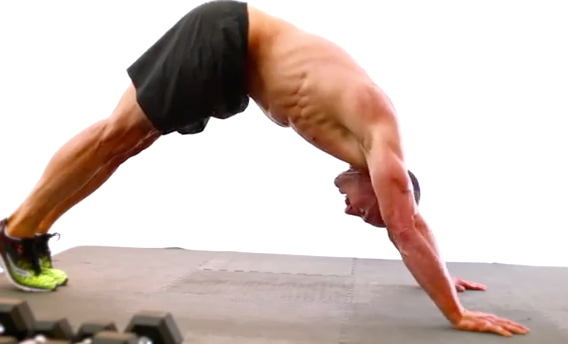
The starting/finishing position of the dive bomber is very similar to downward facing dog in yoga.  Very similar.

Image

Alignment from hands to hips could be better, but you get the general idea…

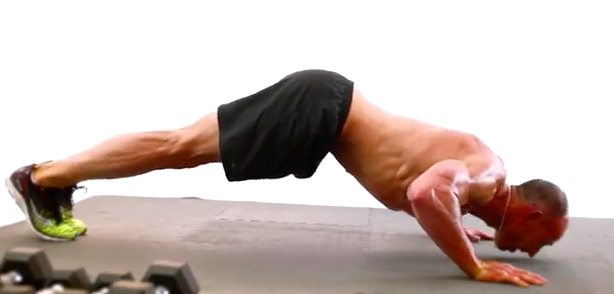
The lowering/pressing portion of the dive bomber demands upper body control, joint mobility and stability through the mid-section.

Image

The mid-point press up provides a low load training stimulus similar to a modified dip

Image


Image

1)  Imagine slithering your body underneath barbed wire on the way down and also on the way back up.  Chest can brush the ground but does not lean or rest for any amount of time, them movement flows from start to finish.

2)  Lower into the hole with control and press hard on the way back up.

3)  Maintain posture from head to hips.  Don’t break.  If you do, regress the movement and work different phases before going for the whole thing.

4)  Regress if need be (work lowering phase only, or upward phase only), progress if need be (elevate feet, lower slower, single arm, etc).

5)  Breathe.


Don’t over think dive bombers or any other exercise.  Just do it.  Play around with it.  Tweak it and then tweak it again.  Experiment with your movement and what fits best.

Use your judgment on progressing the difficulty of the movement or dialing it back.

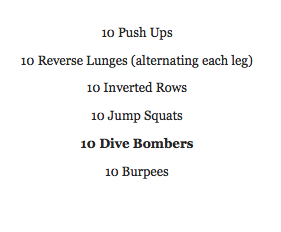
Here is sample bodyweight circuit with dive bombers included:

Bodyweight Workout

Dive bombers fit nicely in circuits because they can be adjust to be sub-maximal, which is an important consideration when fatigue begins to set in.  Again, they are a great alternative for vertical pressing, and it’s undeniable that there is a significant amount of stress put on the core to maintain posture throughout the range of motion.

It’s a home-run movement that is safe and effective.

Integrate into your training regimen right now.


Cheers to dive bombers, improved pressing habits and blasting jiggle!

KG

Shakira’s Hips Don’t Lie and Adding Burpees to My Kettlebell Complex Workout Kicked Ass

Quick Tips

Image

Burpees and I have a love/hate relationship, and I’m sure that most of you probably have similar feelings.  

On one hand, full burpees are as close as it gets to being a complete bodyweight exercise.

Burpees are ridiculously effective for elevating heart rate and recruiting a large amount of muscles.  Large muscular recruitment is a beautiful thing.  Burpees require little to no space, zero equipment and you can perform them anywhere.  Indoors or outdoors it does not matter.  Burpee workouts are a perfect alternative to traditional running or biking.

On the other hand- the hand that despises every aspect of the burpee- burpees are the red headed step child of my workouts.  When I see them on the docket for the day, I cringe.  I cringe because they test me every single time.  I cannot think of a single workout where burpees felt easy.  If there was a workout where burpees were enjoyable like a walk on a white sand beach on a hot Summer day, that would be a major red flag that I didn’t design my workout properly, or I was leaving something in the tank (aka:  Half-assing it).  Burpees are the vegetables of the workout world.  They require very little thought and are quite monotonous when performed for high reps.

But, when weighing the likes and dislikes toward burpees, I know full well that slipping burpees into a workout can crank up the overall impact of the workout.  The training effect if you will.  In other words, I’ve never felt worse (physically or mentally) after performing burpees at the end of a circuit or as a workout by themselves.  

Burpees deliver every single time.  

ImageShakira’s hips don’t lie and neither does my heart rate monitor.

So while I started thinking about different sub-maximal activities that I could integrate into my complex workouts- to keep my heart rate elevated in between rounds- burpees were one of the first exercises that came to mind.  It seemed like slipping them in between rounds could deliver what I was looking for.  Preferably, the filler exercise needed to be ground based and something that kept me in a vertical standing position.

So, here is what the workout evolved into:

Image

Again, the goal here was to add another 5 minutes of elevated heart rate and exertion to my training session.  I know from extensive experience that the kettlebell complex displayed in the snapshot typically takes 12-15 minutes to complete in full, so my goal was to extend the workout to 20 minutes or longer.  The addition of the burpees between complex rounds successfully did just that.

Overall, I enjoyed the addition.  I’ve added timed jump rope intervals to my complexes before, and they worked quite well.  But since I can’t seem to find a jump rope that can live longer than 2-3 months before breaking, I was forced to use burpees.  The key to adding filler exercises to tough workouts is to choose exercises that require low technical know-how.  When you’re sucking wind, trying to gather yourself before the next bout of exertion, this is not the time to be messing around with movements that have high technical difficulty.  

In fact I will just come out and say it… it’s stupid.  The risk doesn’t even come close to matching the reward.  Avoid it and you’ll put yourself in a better position to avoid injury while reaping all of the good that can come from a workout like this.

Closing thoughts…

The majority of my workouts are by design.  I rarely walk into a workout without knowing what’s about to happen, which is why I think I have adhered to this physical lifestyle for so long, and why I will remain committed to moving aggressively and intelligently for years to come.  It’s habit now, fully engrained into my life.

Each workout (or entire program) follows a general training template that I’ve got embedded in my mind.  Early in my strength and conditioning education, I consumed book after book and realized that everyone was using the same general approach to designing effective workouts and long-term programs, so I began adapting and experimenting with slight variations to these time tested principles.  

My personal preference is a system wide, total body approach to exercising, so I know that I like to see all of the major movement patterns represented in each training session (ex: squat, pressing, pulling, hip hinge, etc).  Body part splits are not for me.  I get bored.  Working a squat pattern four different ways on the same day is un-interesting to me.  But that doesn’t mean that it isn’t a great option for your fitness endeavors.

I also have a crystal clear distinction between what I classify as a purpose driven workout, and what I classify as a recreational activity.  Playing ice hockey on Wednesday nights is recreational.  Kettlebell complexes are a workout.  My approach doesn’t downplay the positives of recreational activities (because they do matter overall), but I feel that there is a major difference between “the workout” and pick up basketball.  

At the end of the day, movement in any shape or form adds up, and there is no denying this.  Any way that you can engage in it, it’s a bonus.  We can debate the details all day long, but the bottom line is make an effort to sit less and move more.  That’s a recipe worth following.

Here is a great video that diagrams how dramatic even the smallest shift in movement can have on health.  


Cheers to adding burpees to the workout…


KG 

The Scientific 7 Minute Workout and Shortcuts

Quick Tips

Screen Shot 2013-06-05 at 1.29.46 PM

I don’t mind shortcuts.

If there is a more efficient way of completing a task or achieving a goal, I am all for it.

But shortcuts aren’t meant for everyone.  Some of us are always looking for shortcuts, the path of least resistance.  We abuse the shortcuts, and when the shortcuts become too challenging, they look for a shortcut to the shortcut.  Some people are always looking for shortcuts, a way out from doing the work.

When building fitness, I think that shortcuts are not appropriate for everyone.  People avoid physical exertion like the plague as it is, and now science is telling us that we can comfortably fulfill our daily activity needs in a matter of… wait for it…

Image

I respect science, but I cringe at how information like this is received by the public.  Now every personal trainer in America is going to be put on trial by their clients for holding 60 minute training sessions when The New York Times says that an effective workout can be achieved in 7 minutes flat.

With fitness, you get what you put in.  If you put forth an exceptional effort, you’ll get an exceptional reward.

If you put forth a crap effort, you’ll get a crap reward.  No secrets here.

In my experience, it’s tough to get a complete warm-up in 7 minutes time, especially when you are working to fix mobility and stability issues, let alone make a 7 minute workout change your body.

Is 7 minutes better than 0 minutes?  Of course it is.  If reading that New York Times article is the spark that you need to get you off the couch and moving, then god bless it.  Run with that motivation.  I can support that.

I have to assume that the article is only referring to building fitness, which is different than body transformation or fat loss.  Fitness does go hand in hand with accelerating body transformation, but 7 minutes won’t hold up against even an average nutritional effort.  If nutrition was perfect, you could make some decent gains (or should I say losses) with body transformation.

The main takeaway from the article (and the original research) was that short burst high intensity interval training can produce comparable health benefits to prolonged endurance training, if not better.

I know I have said this on this blog before, but I will continue to say it… what’s happening in innovative gyms across the country (and the world) at this very moment won’t be researched  for 2-3 years at least.  We have been executing -with great success- strength based workouts like the one below for years, and now the research comes.

In case you were wondering what the 7 minute workout entails, here is a snapshot from the New York Times site:

Image

With the exception of the abdominal crunches, I actually like all of the exercises listed in the workout.  It represents a minimalist total body (bodyweight) workout.  Not a bad little program.     The movements are require bodyweight strength based movements organized with minimal rest between movements.  Cardio strength.  I know you’ve heard that before.

Taxing your muscles to a high degree with minimal rest is an extremely effective way to accomplish performance improvement, body fat reduction and lean muscle gain in one shot.

Now that I think about it, this fitness news reminds me a lot of the Tabata intervals over-reaction that the fitness industry went through some years ago, but most of us have poured water on that fire.  Be careful not to mis-interpret the information and transform it into something that it was never intended to be.

And for someone who lacks the workout know-how, the diagram that was provided is perfect for that person.  My beef with still frame exercise tutorials has always been that it leaves A LOT unexplained.  You see the start of the movement, a mid-point and an end, but what does the entire movement look like?  What’s going on with the body in between those still shots?

In my early days of learning functional training, I used the still shot pictures of movements out of Mark Verstegen’s book (Core Performance), yet I never felt completely confident with what I was doing.  It was hard to know if what I was doing was an exact replication of what Mark wanted us to be doing.

Watching a video is better than still frame, and working with a knowledgeable professional is better than a video.  Hands on coaching from a good personal trainer is priceless, assuming they know what they are talking about.  If you are going to spend any money on a personal training, use it to learn the movements and get your technique down if nothing else.  Knowing how to execute basics movements like:  squats, lunges, chin ups, planks, push ups, cable movements, etc is well worth the money.  Learn how to execute big movements like deadlifts, front squats, split squats, bench press, rows, etc.

That’s an investment in your body for years to come.

Wrapping it up, give the 7 minute workout a shot, but don’t be afraid of physical exertion and increasing your body’s ability to handle that exertion.  Don’t shy away from training longer than 7 minutes, because that is just a recommendation.  Take your training to another level and see how it goes, learn something about yourself.

There is great long-term reward in pursuing physical endeavors throughout life.


Cheers to doing more than 7 minutes of exercise…


KG


The Shark Tank, Results and How Both Can Impact You

Quick Tips

Image

Photo Credit:  stressfreekids.com

I love the television show “Shark Tank”.

I love everything about it.  

Here is how it works:

1)  The entrepreneur enters the “shark tank” (a room to present to five different successful millionaires) seeking to gain valuable business partners and investment capital for their business.

2)  The entrepreneur makes their product/idea pitch.

3)  Post-pitch, the sharks give feedback and ask questions about the business/idea.

  • The feedback is either sharp and harsh, or encouraging and curious.
  • The questions heavily pertain to past revenue, experience, growth potential, evaluation of the business, etc.

4)  The Sharks decide whether the idea is valuable enough to earn them profit on their investment.

I am absolute fascinated by people who find their calling and begin creating and designing gadgets, apps or services that can solve everyday problems, improve old products or pave the way for a new way of doing things.  I have such a respect for an entrepreneur that can sacrifice everything for their passion, refusing to give up through thick and thin.  It takes amazing courage to build a dream from scratch and see it through to the end.  

Many of these people have given everything to pursue the American dream.  

That’s passion.  

Another aspect of Shark Tank that I love is the negotiations.  Sure, the pitches that introduce the entrepreneur’s idea to the Sharks (who are millionaire/billionaire investors themselves) are great, but the negotiations after all of the glitz and glamour is what I get sucked into.

The questions from the Sharks are direct and typically no non-sense.  The Sharks want to know if the investment opportunity has gotten results in the past and what the plan is to grow on those results (the forecast).  The entrepreneurs that do the best on the show tend to answer the questions with sharp, crisp and clear answers.  They have a plan and they have results to show positive growth and execution of that plan. 

Those who respond with wishy washy answers get crucified on national television.

You’re probably wondering why I am talking about the Shark Tank on a active/fitness related blog…

… and to that I say: settle down and let me get there.  It might be choppy.

Here is an un-organized collection of my thoughts that I had earlier today…

As I briefly touched on above, shortly after the entrepreneur shares their product or idea, the Sharks take their gloves off and begin poking and prodding into exactly what they- the entrepreneurs- need (money and connections to influential networks), why they need it, what they will do with it when they get it, and most importantly, their past efforts and the results of those efforts.  

I have seen countless entrepreneurs lose out on investments by the Sharks just because they didn’t have results (sales/income/revenue) from their product or idea.  Maybe the product is being treated too much like a hobby, or maybe the entrepreneur has got some serious flaws and gaps in their business and how they have been going about growing it and scaling it.  

Either way, the Sharks always crack me up because they can sniff out flaws in a matter of minutes, and a few simple questions.  The numbers add up.  The numbers make the flaws glaringly obvious.

What have I learned from Shark Tank is the difference between an entrepreneur who is rejected out of the board room and an entrepreneur who makes a deal, and acquires one of the Sharks as a business partner…

Results matter.

If the entrepreneur hasn’t sold jack-squat in years, the reception of their product/idea pitch is typically lauded at.

In the fitness world, I hear and read a lot of people talking about how “results based” fitness is a scam.

Really?  How?  

How is getting the results that you seek a scam?  

How is stripping fat, running your first 5k, followed by your first 10k, followed by your first half-marathon, restoring function and posture, etc… a scam?  

We measure success in anything based on results.

I can see how getting the results that you seek at the expensive of bodily harm might be a scam, but I would call that recklessness, absent minded or possibly neglect.  

There is plenty of that going around for sure.

If you set out on a journey to build a body (and I don’t mean stage show bodybuilding) and you are getting great results… Why would you change anything that you are doing until you observe that change is necessary?  Don’t stay in your comfort bubble forever, but stick to the plan if it is working for heavens sake.

Again, you have to be getting results to maintain your same course of action.  

If you’re a person that is interpreting this as pass to continue the same ineffective workout habits that incorporate the same weight for the same amount of time for the same days per week…

… you are mis-understanding what I am trying to say, and maybe it’s an error in my ability to communicate effectively.

I wrote an article a while back where I described a 90 day kettlebell complex training program where I basically leveraged the same kettlebells (24kg Lifeline KB’s) for a full three months, making gains the entire time.  If you read back into some of my older posts, you’ll find that I love acting as the guinea pig.  

I will always try something on myself before I ever recommend anyone else to do it.  Not everyone can say that.  I am willing to put myself through the gauntlet prior to suggesting someone else try it.  I take pride in that.  That’s how I formulate my opinions on certain things, one of those being some aspects of Cross-Fit.  

That being said, I always caution everyone that what I do while training is not always a good fit for what they should be doing, and what their colleagues are doing in the gym might also not be what they should be doing.  Do what you can do, not your what your network can do or the random fit guy at the gym can do.  You’re not him, you’re you.

Sidenote:  I actually know a cosmetic surgeon in town locally who tries all of her techniques on herself first, prior to offering it out to her paying customers.  How bad ass is that?  She puts herself through the gauntlet before bragging about it to her customers just to make a buck.

I have a deep respect for that.  This surgeon’s face is constantly puffy and inflamed from all of the new treatments, but hey, at least she can say that it works or it doesn’t, which makes her far more credible to the patients who come to her for solutions.  Again, I love that.

Back to it…

During the 90 days of kettlebell complex glory, I leveraged the same general movements while I continued to tweak the reps, time under tension, sets, recovery time, etc.  

My results graph was steadily climbing in a positive direction , so why would I alter anything.

I know that staying in the vortex of the same workout for 90 days might sound crazy, and I definitely could have bumped up weights during that time, but I couldn’t resist giving it a go.  

What is the worst that would happen?  Maybe I would simply flat line and maintain my current fitness and body composition levels?  So what?  I was lean going in and the experiment wasn’t going to make me less lean or less strong.

Tweaking the variables can really take a program a great distance, and I think manipulating the variables of exercise is far less scientific than most people think.  Often, the point of improving your body, both performance and aesthetically, is to simply add or subtract.  Add weight, add time under tension, add reps… or… subtract rest period time, subtract volume, subtract paralysis by analysis.  

The last subtraction point is a huge hold up for most people’s results.  What are you waiting for?  The next big study?  We lean on studies and research like crutches.  It drives me nuts.  It’s like we can’t take action until we can justify it with a massive study.  That my friends, is an excuse in disguise.  You can call it being educated and precise, but in my world, someone who doesn’t take action and bases it on lack of research is an excuse maker.  

Trust me, you don’t need a landmark study to justify swapping an hour of TV time for a decent sweat.  And if you’re a person that wishes that you could shrink down, swap fat for muscle and become more athletic, then your results are sitting on the couch right next to you.  

Exercise + eating properly + H20 hydration = Authentic Health.

It’s that simple.  Screw complexity.  Follow the above formula for four weeks without falling off the wagon and see what happens.  You won’t be disappointed that is for sure.

Results require action, and the right kind of action.  On Shark Tank, the interesting part about some of the products/ideas (and the people that are behind them) is that they aren’t bad products/ideas and the business owners are putting in massive amounts of effort and time. The business plan/strategy is just plain wrong.

In these situations the Sharks have the jam to call these people out when they have sold less than $10,000 in 4 consecutive years of being in business.  That’s a red flag that something isn’t right.

Then you’ll get people that have sold $10,000 in their first month after launch, and they just don’t have the capital to take things to the next level.  Very interesting to see those situations.

Sidenote: In the case of building fitness, you don’t need capital.  That’s the beauty of it.  You can honestly get amazing results by buckling down and doing the work with your own bodyweight.  Heck, if you’re on a tight budget, I will even recommend going for a run.  

Running isn’t all that bad really, we sort of blow that out of proportion, just don’t expect to build much muscle by running.  Many times, running along with other long duration represents the entrepreneur who is willing to put forth the effort and time for their results, yet always ends up disappointed because they are operating off of the wrong business plan.  

Is that you?  I bet that statement connects with some of you out there… no doubt about that.

If you’re just starting to get serious about being purposefully active and building your fitness… and you’ve got decent mobility and stability where you need it while being proficient with the lifts, you are probably good to go.  In fact, you’re more than good to go.  Start with a simple strategy and build out from there.  Once you lay a solid foundation, the rest of the house can be built over time without crumbling.  

For example, building strength is simple, it really is.  It isn’t always the most comfortable process and it takes effort to continue added weight over time, but it is simple.  Building cardiovascular endurance is simple.  It isn’t always enjoyable to shave time off of your efforts, but it is simple.  

Sidenote:  Exercise professionals often overreact and preach about the details a little too much for my liking (I am guilty of this).  Sometimes I feel like it might be because they are dry on content or looking to stir up the pot somehow.  I love attention to detail as much as anyone, but it gets old after a while.

Segue…

So as the Sharks on Shark Tank seek investment opportunities that have seen results in acceptable periods of time, so should the person who seeks fitness.  Results are damn important.  If you aren’t seeing results, something is not right with your plan.  Your strategy isn’t working for you.  

People who are fit despite busy careers and family, while working in a much needed social life also, have effective plans.  

Go back to the drawing board, analyze your strategies and get back to it.  

But remember, results matter.  


Cheers to results and The Shark Tank!


KG

(Sorry for being away for so long)


Crushing Your Workout’s Comfort Zone

Quick Tips

Image

Aaaaahhh comfort.  What a great word.  It brings such a heart warmed feeling just thinking about it.  We all love comfort.  The comfort of home, the comfort of socializing with long time friends and family, the comfort of driving the same route to work everyday and the comfort of knowing that everything is going to be alright.

Image

… and here come the black clouds… 😦

Let’s do a u-turn and get real for a few minutes…

… because this post is about identifying and breaking comfort to strive for more.

Comfort is the enemy of building fitness:  getting stronger, running farther/faster, stretching longer, assessing smarter, conditioning harder or choosing to eat wiser.

When you get comfortable in your pursuit body transformation or performance enhancement, you are essentially saying that your work is done.  You slip, lose control, let important things fall to the wayside.

But your work is never done because you are always are work in progress, always.  You have to be, otherwise you have submitted.

I read a Facebook post by Scott Sonnon where he describes himself as being “always a white belt mind”.  If you aren’t familiar with Scott’s background, he is a world champion martial artist turned strength and conditioning innovator.  I don’t agree with everything that he teaches, but he does push the boundaries of what we consider to be “functional” in the training world.  He’s got a bunch of other accolades and awards under his belt (no pun intended) that you can Google if you’re interested further.  He’s extremely bright guy and I enjoy reading this work.

It’s been said that exercising and eating properly is a “lifestyle choice”, and well, as shitty as it is for me to admit this, it really is.  I really don’t like dropping that line because everywhere you walk some donkey is preaching that same old song and dance.

Image

Got lost there for a second… sorry… back to comfort…

Getting comfortable leads to all kinds of silly workout habits that can become hard to break:

  • Lifting the same dumbbells over and over.
  • Never switching your training variables… same reps, sets, etc.
  • Skipping reps and sets, or even entire workouts.
  • Resting for the same amount of time after each effort.
  • Running the same mph, for the same amount of time, for the same distance.
  • Biking for the same amount of time, at the same RPM, for the same distance.
  • Refusing to evolve and try new movements or methods.
  • *** Refusing to change or FEAR of change.

***  This is a big one.  There are a lot of people out there who are scared of the unknown.  They fear the thought of working to improve themselves.  They fear the anticipation of how difficult it will be to lift more weight, condition harder or uncover weak points in their movement.  We end up tricking ourselves into thinking that we are “doing the best that we can”, but there is always another level that we can get to.  Check out this post regarding success, it has a lot of carryover into breaking through the comfort zone in your workouts.

—>  My own story

I’ll step up here… I was scared to put myself out to the world, start a building an audience (again) and take my writing seriously.  I cared too much about what people thought, or how my message would be received, so I threw away nearly 100 pages of written material.  Now I realize that I am on the right track, my writing does serve a purpose and all of this “practice” will force me to break through my own comfort zone.  I learn something new every single day and I love it.

Fear is paralyzing… and it is also just a feeling.  I repeat, fear is just a feeling.

So the next time you step foot in the gym, bring that new strength program with you and give it a shot.  What is the worst that could happen?  You get tired and realize that you’re a little weaker, unstable, immobile than you thought you were?  Who cares.  People care a lot less than you would think.  Go for it.

Most of the bulleted points above are representative of a person who has already committed to fitness at one point in their life and are now stuck in the rut.  They get stuck in a rut and it gets tough to wake up and dig out.  Waking up only happens when you become aware that your current workout habits are no longer serving you well.  You’ve got to realize that your body is really good at adapting to the stresses that are constantly placed on it.  Especially if those stresses never change.

Screen Shot 2013-03-29 at 7.09.46 AM

Experts of developing bad habits.

We become experts are what we repeatedly do, which in some cases is a good thing (good habits), but in a lot of cases, we have become experts of carrying through with poor habits.  Less than optimal habits. (I’ll be the first to stand up here too).  Breaking habits is a billion dollar industry.  Look at guys like Tony Robbins.  He’s built his entire career around teaching people how to break bad habits and develop habits that are more conducive to achieving success.

Change it, don’t be afraid to change it.

But not all of you have begun your pursuit of fitness yet.  Some of you don’t know where to start.  You’re searching for that beginning point to build from. For you folks, you can learn from the mistakes of the folks who are currently stuck in their comfort zone.  Avoid it.  Learn how to progress your exercises, add reps, sets, weight and difficulty of movement.  Train on one leg, two legs, sprint up hills, jump over hurdles, pull your body up to a bar, push your body away from the floor, hold a core demanding static position for time, take joints through a full range of motion even when they feel “locked” up, smash your tissue with a foam roller and then take a lacrosse ball to your feet for a few minutes

Keep progressing, keep pushing forward.

You get the point.

Image

In my own training, I have plateaued.  It is time to move on.  I would’t say that I was in a “comfort zone”, but I definitely reached a point of no return where going longer and harder was foolish… I need to increase the poundage.  Making myself increasingly tired by adding volume during my sessions isn’t accomplishing anything, other than making me… more tired.  Those double 24kg Lifeline Kettlebells have officially become too light.  It sucks to say it, because we had a great run, but it is time to move on to bigger and better kettlebells/barbells/etc.  My conditioning has never been better (except in my hockey playing days) but my backside is weak as hell (article about that coming soon) and my upper body pulling strength is lacking.  It is time to upgrade the gym and increase the demands of my training.  I made it last a while, and it was a great experiment.

Getting comfortable in anything in life can have disastrous outcomes.  Whether it’s career, working at building relationships or making your time worthwhile in the gym, if it is worth pursuing, it is worth pursuing aggressively.


—>  The irony of “having no time” and the comfort zone…

If you’re a person that’s pressed for time and you’re caught in the black hole of a workout comfort zone, you’re committing the ultimate sin.  Do you see the irony in not having any time to workout and then when you do finally workout it is same generic routine that you always use?  No wonder people are depressed and confused from their progress in the gym.

You’re going through the motions… stop now.


—>  Here are 5 quick tips to crushing comfort zone syndrome:

1)  Increase the load of your lifts, now.  (add roughly 2.5-5lbs to each lift every couple of workouts)

2)  If engaging in aerobic:  decrease the time to cover the same distance (move your ass!), increase incline or resistance, monitor your heart rate (effort) or ditch aerobic training altogether and throw down with some interval training sessions.

3)  Trade machines for free weights.  (Machines are for rehab patients and the elderly)

4)  Find someone that trains harder than you do.  (You become who you hang around)

5)  Set a goal with a date and read that goal 2-3 times a day.

If you felt like I was calling you out at any point, you’re guilty.  I feel the same way when I read articles about taking actions to the next level, especially the link I shared early in the article related to success.  There is always room for improvement, room to grow, another gear…


Cheers to crushing comfort in your workouts!


KG