Movement Flow| Cossack Squats, Kick Throughs and Static Beast

Motion, Movement Flow

Flow training challenges movement capacity and ownership and are a great addition to any workout.

Organizing 2-5 different movements into a sequence gives you a chance to focus on smooth transitions, soft ground contacts and stability throughout the effort.

Flow sequences can be up-tempo, or slow and controlled.

Slow and controlled flow training can be humbling for any fitness level, beginner to advanced.

Today’s movement flow includes Cossack Squats, Kick Throughs and Static Beast. Each exercise is great in it’s own right.

The Cossack Squat is a unique squat variation. It’s a strength and hip mobility builder.

How to Perform this Flow

Lower your butt to the floor using a Cossack Squat.

What’s a Cossack Squat?

Bottoming out on the Cossack Squat (whatever depth that may be) find the floor with the same side hand.

Raise the extended leg, pulling it underneath your body as you turn into static beast.
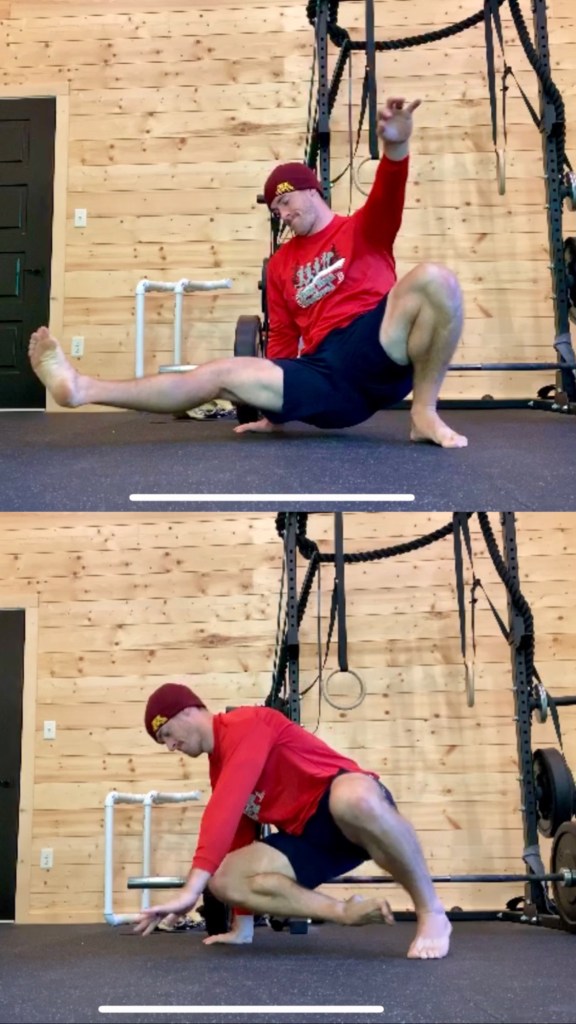
Hold Static Beast for 5 seconds. Stay tight.

Release out of Static Beast, reversing the flow.

Slide the hovering leg through and out the other side where you’ll REACH and point the toes.

Extend the foot out as far as possible re the free arm pulls back in the opposite direction.

This picture should give context to the technique.
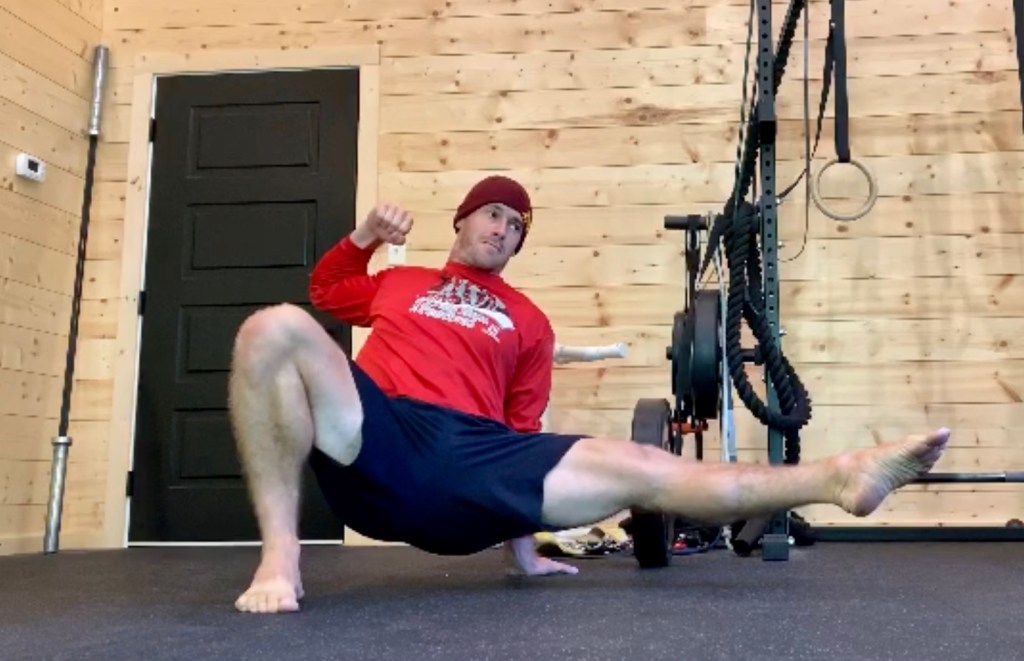
The Kick Through will be felt in the quads, hip flexors, core, up and out the opposite side shoulder.

Pulling back with the arm should resemble the draw of a bow, where the hand stops behind the ear.

Freeze the Kick Through posture and hold. This will be tough.

Re-initiate the Cossack Squat, sliding through the middle and repeating the sequence.

Quiet and Smooth Transitions

In a flow sequence, working toward quiet ground contacts and smooth transitions between exercises is the name of the game.

Quiet interactions with the floor is a good indicator of control over the movements.

With practice, ground contacts become softer as your body adapts to the demands of the movements.

Transitions are present in every day life.

We’re constantly moving from one posture, position or activity to the next.

One minute you’re lifting a heavy, awkward shaped object. The next minute you’re crawling underneath a table to play with your kids.

Static and dynamic movements show up every single day, and the in-between transitions are often overlooked.

Flow workouts are great for improving movement capacity.

conditioning the body to navigate various transitional moments, and move with greater confidence.

Where does Flow Training Fit in a Workout?

Using movement flows in pre-workout warm-ups is a great way to prime the body (and mind) before more aggressive training.

You can practice a flow for 4-5 minutes before lifting weights or performing cardio.

Flow + Resistance Training

Combining tried and true resistance training with movement flow is an effective way to maximize productivity in the gym.

1a) Chin-Up

1b) Squat

1c) Flow Sequence (give this one a try)

Perform the exercises from top to bottom for a target number of sets.

This structure leverages non-competing exercises. Using non-competing exercises, you can move from one exercise to the next relatively quickly because different muscle groups are used for each movement. Chin-ups are an upper body effort, while squats are a lower body effort. The flow might challenge the upper and lower body, but not at an intensity that would take away from the chin-up or squat.

Non-competing exercises organized into a tri-set allows for shorter rest periods, keeping the workout moving along.

People get fixated on lifting weights, adding weight to the bar, numbers, etc.

Put these people on the floor and ask them to execute the flow sequence shared today, and they look like stiff robots.

Flow work is a perfect addition to a resistance training program.

It gives you a chance to put those gains into practice with free flowing bodyweight movements.

Flow Sequences in Circuits

Mixing and matching flow sequences with resistance exercises, ballistic movements like kettlebell swings and a little core work is a great way to create a total body movement session.

1a) Kettlebell Swings x10

2a) Kettlebell Overhead Press x5 each arm

3a) Kettlebell Bent Over Row x8 each arm

4a) Hollow Body Rocks (core)

5a) Flow Sequence

Work through 1a-5a, rest for 45-60 seconds after the flow sequence. Perform 3-5 rounds.

Total body workout in less than 20 minutes.

Circuit training like this is are great for fat loss and performance.

Integration = Best Fitness and Health Results

It’s not any ONE thing that catapults health, performance and aesthetics.

You’ve got to pay a attention to all of the moving parts that contribute equally to a pain-free, athletic, lean and muscular body.

What are those moving parts?

  • Mobility Training
  • Resistance Exercise
  • Cardio
  • Ground-Based Movement (flow, etc)
  • NEAT (non-exercise activity, like walking)

Most people would be extremely happy with their results by organizing a workout regimen to include a steady mix of:

By including each element, you’re improving joint function and tissue health, performance, building strength and useful lean muscle, movement capacity in unique positions, and overall health.

Your body will have the look you want, free of ache and pains, and the movement performance.

If you’re ready to take your workouts to the next level with quality movement training, this is the program

5 Minute Kettlebell Flow Workout

Motion

Here’s a challenging 5-minute kettlebell flow workout.

I’ve used kettlebell flows off and on for years.

Workouts are generally highly organized, predictable and step by step.

Kettlebell flows are the opposite.

A truly improvised flow session is unpredictable with no real agenda for using any specific exercise, and no designated reps per exercise.

You flow with whatever comes to mind, for whatever amount of time, without stopping to rest or putting the kettlebell down.

Most flow workouts are performed in the same spot, so they are space-efficient.  

Keep the kettlebell moving.

Best Exercises for Kettlebell Flows

Familiarization of the exercises in a flow is essential.

Don’t make the mistake of dabbling with movements you don’t have an intimate familiarity with.  I can’t think of a better way to get hurt.

When I’m setting up for a flow session, I use the following exercises the most:

Swings

Snatches

Cleans

Overhead Pressing

Around the World Slingshot

Lunges

Squats 

Rows

Windmills

Swings have a ton of variations and are a mainstay in any flow session.

Fluid transitions between 2-hand swings, single-arm swings, and hand-to-hand swings keep the kettlebell moving.

All of the ballistic kettlebell exercises (swing, snatch, clean) have a rocking/pendulum-like motion that creates opportunity for quick transitions between exercises.

Ultimately, any exercise is can be used for a flow.  

I just prefer quick transitions and constant movement, versus stop and starts.  

Love the Flow or Hate the Flow

People either love or hate kettlebell flow workouts.

I sit somewhere in the middle and understand the love and the despise of both sides.

The problem most people have with kettlebell flow workouts the “did it for the gram” type portrayal, where the user is twirling paperweight size kettlebells.  

Playing hot potato with a 15lb kettlebell is mostly a waste of time.

People also tend to use kettlebell flows TOO OFTEN.

Kettlebell flows make up about 5% of my training time.

The other 95% of the time, the focus is on building strength and power, active mobility, movement capacity, and cardio.

24/7/365 kettlebell flow training often delivers mediocre results.  

Training with too light of weight for too long creates little to no long-lasting improvements in performance or aesthetics.  

Sure, you’ll break a sweat, but sweating doesn’t mean you’re making gains.  It means you’re sweating.

I have an unbroken sweat streak going while mowing the yard on my riding lawn mower or walking for 30 minutes in 90degree heat.

Sweat is a cooling mechanism for the body.

Now, I’m not here to fully bash kettlebell flows, because the fact is I do play around with flow work throughout a training week.

Benefits of Kettlebell Flow

The benefits of a kettlebell flow training are having to improvise, change shape and adjust posture, coordinate each movement, catch, power up, move beyond accumulating fatigue, stay focused, etc.

Kettlebell flow workouts are challenging, both for the mind and body.

And honestly, flow training is FUN.

The gym is a place where people are rewarded for effort, consistency, and discipline.

But it’s also a place that can become insanely boring and monotonous.  

Flow training breaks up the monotony.

A more sensible approach would be to sprinkle in a flow here and there.

After the warm-up or at the end of workout once the big stuff is completed.

Advice: Use a Heavier Kettlebell

I wrote an article about the benefits of kettlebell swings, where I touched on people making the mistake of “lifting” the kettlebell during the swing.

It’s not 100% always true, but overwhelmingly,  lifting the kettlebell happens because the kettlebell isn’t heavy enough.

You can’t lift a kettlebell that’s heavy enough to train the powerful posterior chain muscles.

Try lifting a 24kg kettlebell completely horizontal up to sternum height with straight arms.

Hip action is everything with ballistic kettlebell exercises.

What does this story have to do with kettlebell flow workouts?

Pick a weight that you cannot lift with ballistic exercises like swings and cleans.

In most flow workouts, the snatch is the weakest exercise with regard to weight.

Most people can swing and clean a lot more weight compared to the snatch.

If snatches will be part of a flow, I select my kettlebell with heaviest weight I can snatch with control.

I use the same approach with kettlebell complexes.

These exercises are valuable only because of the explosive hip action needed to move the kettlebell through space.

Exceptions to Using a Heavier Kettlebell

Kettlebell exercises that cross the midline of the body are the exception to the “use a heavier kettlebell” advice.

“Lighter” kettlebells are best for cross-body movements, especially single arm cross-body variations.  Control is the name of the game here.  

Cast iron colliding with bone doesn’t usually end well.

My advice with cross-body exercises is to practice in isolation.  

Slipping them into a flow tends to diminish the returns of the other exercises.

In general, there’s no greater waste of time than grossly underloading exercises on a regular basis.  

You’ll spin your wheels in a vortex of a maintenance phase, forever. 

Improved Circular Training Options

Clubbells and macebells are amazing for circular strength training.


Clubbells and macebells have a longer shaft with the bulk of weight located at the end, which creates a more torque.  

Home Workouts! Bodyweight Flow to Challenge Balance, Mobility and Endurance

Motion

Bodyweight training can (and probably should) be the foundation of any home workout.

No matter where you go, what equipment is or isn’t available, bodyweight based exercise is a card that can be ALWAYS be played.

There many ways to design and organize a bodyweight workout.  

Varying the tempo, joint range of motion, training on one leg, changing levels, balancing, transitions between exercises are all ways to keep bodyweight training fresh and effective.

Today’s workout is non-traditional, imagine that. 

If Yoga, locomotion, and calisthenics got together, partied and made a baby, this flow would be the result.

Flow training is like a more dynamic form of Yoga.  

I find myself sharing a lot of slow-tempo movements and flow sequences on YouTube and Instagram.  

Subconsciously, it might be a knee-jerk reaction to counterbalance all of the high-intensity training videos out there.  

Removing momentum from movements can reveal strengths and weaknesses with regard to what positions and motions you own versus what you don’t.  

Here’s the bodyweight flow:

This flow is designed to be mirrored on the right and left side and can be performed as a warm-up or as the workout itself.  Changing legs on the single-leg squat will keep you alternating sides. 

If you choose to use it as a workout, set a timer and keep working for the duration non-stop.  

Aim for 20 minutes.  If you get 20 minutes, go to 25 minutes, 30 minutes, etc.  

You’ll be exhausted (in a positive way) moving like this for long periods, and it might be an eye-opening shift away from high-intensity training.  

Muscles will fatigue and heart rate will elevate, even though you’re moving slow and steady.  

This flow is low-impact on the joints but does require a decent amount of joint mobility. 

Focus on momentum free movement.  

Especially with the modified hip CARs (controlled articular rotations).  Do your best to ONLY articulate the hip joint without changing posture to do so.  Obviously, in the video, I’m moving elsewhere but the goal is to keep the movement at the hip.

CARs are incredible for joint health, especially the hips which are supposed super mobile, but oftentimes aren’t.

Most people lack mobility at key joints like the hip, which forces other joints to try and pick up the slack, but so commonly ends up creating greater issues (aches, pains, injury).  

MyDailyMobility.com is a really good follow along resource to keep up with daily mobility work.  The guys upload new workouts all the time.  Last time I checked they had 5 months’ worth of workouts for customers.

Similar to resistance training (muscle) and cardio (endurance), mobility must be practiced consistently for maintenance and improvement.

Use it or lose it.

[You can see me lose balance returning to the single-leg stance.  I could have reshot the video and uploaded a perfect rep, but I decided to keep the original because this flow will test your balance.]

After the single-leg deadlift (Warrior 3 to the Yoga peeps) descending to the floor gracefully is the next order of business.  While this flow is controlled, learning how to fall is a skill people could really benefit from, especially older folks.  

Lowering down to the floor stress your pushing muscles and core.  You’re basically hitting the brakes on the way down, and stepping on the gas to stand back up.  

Lastly, expect the final move to make you cramp at the hips.  It’s aggressive.  Squat down, lift the hovering leg as high as possible and REACH.  

Find the floor, transition through the middle and get deep into the Cossack squat.  

Flow completed.  

Stand up and start over.  

Movement sequences like this are perfect for a home workout.  

No equipment is needed, it’s just bodyweight, balance, expressing strength and mobility while flowing into and out of various body positions.  

🤔 Want to make this flow harder?  Add a weight vest,slow down the tempo ever more or speed up the tempo and move quicker.  

👉 Make sure to check out more M(EAUX)TION fitness content on Instagram and YouTube.  

Beginner Flow Training: 5 Challenging Bodyweight Exercise Combinations

Motion

Natural movement flow is a key training element missing from most people’s fitness regimens.

Including movement combinations, ground-based exercises and sequences bridge the gap between linear resistance training and natural movement.

Practicing exercises in isolation essential for developing performance.  

What is isolation?  

Deadlifts, front squats, push-ups and pulling without the addition of any add-on exercises, using a work-then-rest format, is isolation.  

You’re isolating an exercise and performing it for a set number of sets, reps and rest.

In a separate blog post, I dove deeper into Ido Portal’s general training template, which included an overview of his methods following this approach:

Isolation 👉 Integration 👉 Improvisation

Walk into any gym, and you’re likely going to see people exercising in isolation.  

Perform a set of deadlifts, rest, check Instagram, a sip of water, then back to the next set of deadlifts.

This is the isolation phase of movement training.

Movement Flow

If you’re looking to add a fresh challenge to your workouts, combining exercises together to create movement flow sequences is a great way to do that. 

Several years ago, I started mixing and matching traditional movement patterns and non-traditional exercises together to create 2 or 3 exercise flow sequences.

Here’s an example:


Gym workouts and real-world movement can be very different experiences.  

While I value pursuing a mechanically perfect squat, do I ever stop to align my feet before squatting in a real-world scenario?

NEVER.

The modified squat I’m using in a real-world situation is often combined with 1 or 2 other movements.  

Squat down, lunge up, twist and carry.  

It’s rarely every just a perfect bodyweight squat in the real-world.

One goal of controlled environment training (aka gym workouts) is maximum transferability.

We lift and conditioning with the idea that it will enhance the physical moments (daily tasks, sports, and recreation, health, etc) help us improve the functionality of our body.

Yet, natural bodyweight movement is completely absent from most workout templates.

Crawling, climbing, rolling, navigating changing levels (laying to standing, fall training, etc), rotation or fusing exercises together in a pre-planned movement sequence or improvised movement work where you don’t know what’s coming next.

Practicing how to transition efficiently and effectively between two different body positions or patterns just makes sense to me.

Benefits of Movement Flow Training

👉  Improve movement IQ (confidence, dissipating fear of unexplored positions and tasks).

👉  Coordination and skill-building.

👉  Improving spatial awareness and how to transition between movements.

👉 Strength at more angles and positions.

👉  Injury mitigation via conditioning tissues to handle stress.

👉 Improve mind-body connection 

👉  Control over one’s bodyweight. 

👉  Fun, refreshing, never boring. 

Movement flow is very challenging for the mind, which to me, is one of the greatest benefits of flow work.

While you’re learning a flow, you really have to think it through to execute it properly and avoid getting twisted up, trips and falls.

“Ok, so my hand goes here, foot over the top, create tension, then relax, drop down, etc…”

The elevated thinking involved with a lot of ground-based movements is a major benefit.

Plus, introducing flow training is refreshing and fun. 

Hours in the gym working the same exercises, chasing the numbers (weight increases, more reps, more sets, faster finishing times) can get quite bland. 

Remaining excited every to move every single day is best for the long-term.   

5 Bodyweight Movement Combinations

#1  Parallette Bar Pass Through to L-Sit

Parallette Bars are inexpensive to buy and easy to build from PVC pipes.

Start in a push-up position, passing the legs through the middle of the parallettes right into an L-Sit.  

If an L-Sit is too aggressive, transition into a tuck position instead.

Hold the L-Sit for a 2-3 second count, then reverse the motion back to the start position. 

Perform 2-3 sets of 8-10 reps.

No parallettes?  

Chairs, stools or yoga blocks a good equipment substitutes.      

#2  High Bridge Rotation to Lizard Crawl

A reasonable looking back bridge used to be impossible for me.  My body was stiff as a board and incapable of arching through the spine. My shoulders lacked mobility, etc.  

Using dedicated joint mobility drills really accelerated the process, expanding the positions I was able to get into and out of, but bulletproofing my joints as well. 

MyDailyMobility is my recommendation for mobility conditioning. 

Today, I practice some variation of back bridging in nearly every workout, either as maintenance or to make progress.  

High Bridge Rotations require an adequate amount of spinal extension, shoulder mobility, stability and strength, which is why I recommend adopting a mobility program to accelerate the process.  

From an exercise progress perspective, practicing basic back bridges is the starting point.  

Adding in the rotation will come after.  

Transitioning out of the high bridge rotation can be a dizzying experience.  Refocus your vision, lower down and crawl lizard-style. 

The lizard crawl is an amazing strength and conditioning exercise.  

Here is a variation better suited for beginners: 

  Alligator Crawl

  Hand Slide Lizard Crawl 

  Elbow Crawl

#3 Burpee Sprawl – Push Up – Squat – L Sit

Perform a push-up, hop forward into a deep squat position, place the hands on the floor slightly behind the butt cheeks as the legs extend and LIGHTLY tap the floor with the heels. 

Reverse the flow.  

Keep the sprawl motion soft and graceful. 

#4  Lunge to Pistol Squat Flow

Lower body training is essential for health and performance. 

Our legs need to be strong and well-conditioned, but also mobile and capable of expressing strength and stability throughout a large range of motion.

Especially the hips.  Hip mobility training has been a game-changer for me.

This combination connects two movement patterns:  lunges and squats.  

During the transition from front to back, do your best to avoid making contact with the floor.

This is one combination probably best executed for reps. 

3-5 sets of 6-10 reps per side will work. 

#5  Lizard Crawl + Low Scorpion 

This lizard crawl + low scorpion combination is a unique, high-value movement combination. 

There’s no beginning or end with this sequence, which makes it a great bodyweight-based cardio alternative.

This flow is relatively compact, making it perfect for a small home gym or other imperfect training spaces.  

Practice this sequence for repetitions or time. 

I like to set a timer and go.  Not having to keep track of reps allows me to focus on what my body is doing.  

Time-wise, I’ve used this flow for 5+ minutes continuous and it’s a challenge every time.

MOVEMENT20XX 

Fusing movements together to create flows is a great addition to traditional lifting and cardio, and is sure to bring a refreshing challenge into workouts. 

If you want to learn more about movement flow training, I highly recommend checking out the MOVEMENT20XX program from Vahva Fitness.

MOVEMENT20XX is one of the best movement-based products I’ve come across.  

Eero Westerberg did a brilliant job organizing and communicating the techniques of each exercise, how to create flows and leverage this method of training to build a high functioning body.


Related Blog Posts

✅ Basics of Movement 20XX| The A-B-C’s of Crawling Exercises

✅ 14 Exercise Total Body Warm-Up Routine

✅ A Giant List of Effective Core Exercises| Part 1