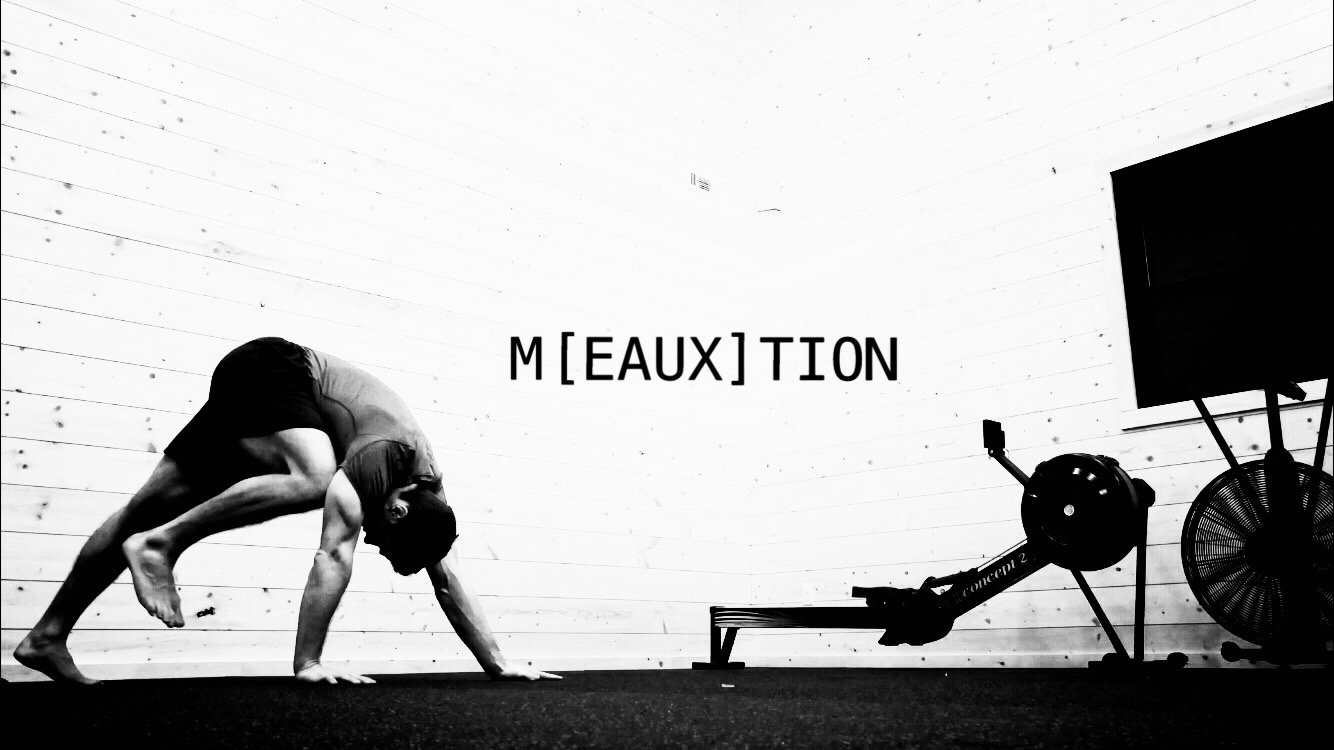
Look! Movement is the Benefit :)

Quick Tips

Screen Shot 2013-08-22 at 6.59.07 PM

Non-traditional movement has been the name of the game lately.

Pure ground based locomotion and flow.

It’s not that I don’t have time for more mainstream forms of movement, because I believe in that also,  but I am becoming increasingly intrigued with other methods of movement training.  I almost used the term “time-tested” instead of mainstream.  It might have been a better description, but admittedly, 95% of my personal workout habits and the habits which I recommend to others seeking movement regimens are in fact, mainstream.

A simple blend of squats, lunges, hip dominant hinging, upper body pushing and pulling in a vertical and horizontal fashion will set you up for success.  Add in some chops and lifts and you have got yourself a damn good routine.  It’s all in how you organize it and tweak the variables to best fit your goals.

A squat is a squat, but with a few tweaks here and there, you can make the squat conducive to building a number of different human physical qualities (strength, endurance, power, etc), all completely different from each other.

Always remember, in the beginning… establish mobility, establish stability in that new-found range of motion, then begin the process of building strength.

It’s a layering effect.

This is a recipe that works every single time for the person that is willing to be diligent in their training efforts.

Are you that person?

Because here is the reality:  Movement works every single time.  100% effective.  It’s people that fall short.

Movement works.  People don’t do the work.  Shame on us.

Over the past few weeks, I have progressively integrated more and more Ido-style movements into my pre-work training block.  Maybe I shouldn’t refer to these movements as “Ido-invented” (after watching some of his videos he probably would deny they are his but were there from the beginning of time), but he was one of the first (and still the best that I’ve seen) to make sense of less mainstream forms of movement.

He is a mover, in every sense of the word.

From one-arm hand stands and other hand balancing, single arm chin ups, planches and twice bodyweight back squats, Ido can move with flow and move load if necessary.

Planche training

Planche

I keep referring to Ido’s teachings as “movement”, and that’s because it is.  He neither specializes nor generalizes.

I guess I never really stopped and thought about it, but most of what is published and preached today is purely about fitness.  Even Yoga, with it’s cult like following, doesn’t necessarily make a person MOVE better.  It might help a person increase flexibility and improve range of motion, but it doesn’t guarantee that you will move better.

You have to practice movement to improve your ability to move.

Now, I will say that I don’t necessarily believe that the mere act of practicing movement is going to grant you access to better movement.  It may open a few doors to becoming a better mover, but I also think that each person needs to be real with themselves and their own situation.  Some folks have got some real compensations, imbalances and dysfunction going on.  Who knows where or how these issues manifested themselves (a lot are from sitting too long) but they are there, so it may be completely necessary to address these movement restrictions before you’ll ever be a great mover, or even an average mover.

The Functional Movement Screen is a great system for evaluating yourself, and your ability to move.  Why?  Because it is systematic.  You grade your movement quality, and lesser quality scores in any given movement pattern has a roadmap of corrective drills that you can use to clean up that movement pattern.  In essence, you can correct faulty movement rather quickly.

Realistically, you can perform a poor man’s movement screen at home on yourself.  It will always be better to have a knowledgeable FMS certified trainer evaluate you, but hey, we can DIY.

Use a big mirror or better yet film yourself performing the tests from the movement screen.  Don’t feel dumb filming, you can delete it immediately.  The filming of your movement capabilities is extremely valuable.  What you “think” you’re doing isn’t always what you actually doing movement-wise.

Take your video and compare it to some perfect screens (which you can easily find on YouTube) and take note of the differences.  Most people will notice that their overhead squat is a lacking, rotational stability nearly impossible to complete and the inline lunge makes you feel like you’re balancing on a tight rope.

Cleaning up these patterns will make you a better mover, and probably decrease the likelihood that your dysfunction manifests itself into an injury.

However, cleaning up the screen doesn’t mean that you’ll all of the sudden be a great mover.  You have to practice moving to be a great mover.  Are you sick of me saying move?  Mover?  Movement yet?  Sit tight I’ll drop those terms a bunch more in the coming paragraphs.

In many cases, I have substituted ground based crawling variations (supine and prone) and walks in  place of my go-to dynamic warm up.  I haven’t felt like I am sacrificing anything by doing so.  My joints still move through a full range of motion and my muscles are activated in a low-impact fashion.  I would even argue that my time is being maximized by practicing my movement flow using Ido’s training drills versus my standard cookie cutter warm up.

I’ve actually exited many of these warm-ups in a pool of sweat, even before beginning what I would consider to be the “work” portion of my session.  Interesting.

I’ve quickly found that I am ridiculously weak in certain positions, uncoordinated and all around uncomfortable as I work in some of the Ido Portal warm-up drills and ground based training.  It’s an ego check for sure, especially since he refers to many of these flow-like drills as being “beginner”.  Ha!  Soreness has also been a product of the unfamiliar movements, although it’s never a goal.  Unfamiliar movements almost always produce soreness because your body hasn’t experienced it yet.

I am reminded – as I continue to force myself to become more vulnerable by the day with Ido’s training idealogy- of how a newbie to the workout scene feels at first.  It’s an emotional uppercut showing up to a personal training session or a group class (even training by yourself behind closed doors) knowing that you’re going to struggle to complete what is being asked of you.

But the key is to keep coming back.  Keep grinding.  Keep learning.  Realize that it’s a process, just like everything else.  And as a process, you’ve got to work at it, consistently and in a focused manner.  Leave your feelings at the door and work.

We’ve become detached from our bodies and desensitized to our physical abilities.  In fact, many of us no longer have a relationship with our body, and our physical abilities.  Things that we could easily do as kids are now foreign and seemingly impossible.  But all of that can be regained.

One major takeaway from the my small bit of reading Ido’s work is this:  We’ve got to establish a lifelong relationship with our movement.  Every one of us.  We will all start at different points and need different adjustments along the way- and this makes sense because we are all individually unique- but you’ve got to make sure that you start and find a way to make it stick.

Enjoy the challenge of learning new physical skills.  Embrace the frustrations and work out the solutions on your own.  If you find yourself stuck, hop on the computer or tablet and search out a solution.  The internet is packed with incredible free information that can get you where you need to go.

I suck at many of Ido’s locomotion drills right now.  I’ll admit that.  I filmed myself and I look stiff and the opposite of gracefully.  But that will change with time and practice.  It’s frustrating to know that I am practicing something that I am not good at (yet).

I think many people may find that they actually like dedicated workouts more when you a aiming to develop a certain movement skill.  Pursuing skills transforms a person’s daily workouts into a journey instead of a dreaded 60 minutes of robotic physical activity that we feel we need to participate in to chase the idea of “fitness”.

A movement journey may not have an end point.  But that is the beauty of it.  You achieve a goal and begin planning and preparation for the next goal.  One day you look back and realize that over the course of time you hopped over barriers that you never imagined you would hurdle.  That’s an incredible feeling to evaluate significant forward progress, especially when looking at where you started.

People often ask me what the benefit of an exercise is, or which exercises will best target a specific area of the body…

For a long time I couldn’t find the exact words to answer this question in a way that felt true to myself… but try this one out because I think this might be where I stand…

Ido Portal Movement


Cheers to getting uncomfortable in your movement endeavors…


KG

Assess Yourself Often, Decide What’s Next

Quick Tips

Image

Assessment is an essential element of physical improvement.

Ideally, frequent assessments are made not only to your body aesthetics (weight, fat, muscle, etc) but also to your ability to move freely with stability and strength (mobility, stability, strength, etc).

After all, it is completely possible to look great and move like shit.

It’s also possible to move great and look like shit.

*** I should clarify what I mean when I say “look great”… it’s in the eye of the beholder.  Our perception of what a great body looks like is grossly skewed by mainstream models, magazines and media.  Obviously, carrying higher levels of body fat can raise health concerns, but “looking great” doesn’t have to mean visible muscle striations and the almighty six-pack.  If you’re body type allows you to feel confident in your own skin in any situation, good for you, you’re there.***

Besides, most magazine models, movie actors, and testimonials from famous workout programs like P90X and Insanity are manipulated and photo shopped to amplify their physiques.  Did you know that?

Check out this great article recently published in the Huffington Post describing how fake testimonials for workout programs really are…

Having looks without movement or movement without looks both carry their negatives.

The best approach might be to meet in the middle.  It’s more than possible to improve both at the same time without sacrificing one or the other.

If you look great but you cannot move without encountering restriction or pain, life’s activities become a hassle and certain movement patterns might be avoided altogether.  No one enjoys feeling pain, so we tend to avoid moving in ways that cause it.  I’m not referring to that burning sensation felt in your arms and legs when executing push-ups or squats, but rather the debilitating lower back pain experienced while you attempt to pull up a pair a socks.  Or maybe it’s the pinch in your shoulder when you reach overhead for a clean glass in the cupboard.

Looking great isn’t the only qualifying element to health.

The advances in made in assessing (and correcting) movement over the last 10 years or so have been tremendous.  The physical therapy world and fitness world are beginning to bridge gaps to one another, with ancient practices like indian clubs, yoga and martial arts adding value to the mix.

Image

We have a much clearer understanding of joint function, breathing and soft tissue health and how it all ties together to create a highly functioning body.

We understand that six-pack abs, bulging biceps and a set of trapezious muscles big enough to scratch your ear lobes may not mean a damn thing if movement dysfunction is present.

On the other hand, maybe you move really well but you pay little attention to your body composition.  I know a lot of people who are extremely athletic but don’t pay much attention to what they put in their mouths food-wise.  Ironically, poor eating can case inflammation and pain in and around your joints also.  Here are some common foods that are worth re-considering.  Eliminating most of these foods, or at the very least reducing and substituting with more nutrient dense options can work wonders.

In the operating room, it is obvious that a lack of attention to body composition will eventually restrict joint range of motion.  Many of the patients in need total joint replacements are also overweight/obese.  The increase in body fat literally prohibits the patient from achieving a healthy range of motion in the knee joint.  The additional weight combined with the lack of range of motion earns them a trip to the operating room where a surgeon hacks, cuts and pounds his way to an artificial knee.

This is an extreme end of the spectrum, but it’s worth mentioning none the less.

Image

Both scenarios described have solutions.  But it requires that you take a step back and assess what your next move is.  Just like a chess match, there is a next move, unless you’ve waited too long.  Then it’s checkmate.

If you desire the lean body, assess your training habits while simultaneously assessing your eating habits.  I’ve tried to out train my diet before, and it’s a pain in the ass.  Once my eating was in check, my body appearance improved but ironically so did my performance, skin and quality of sleep.

If you want to improve the quality of your movement, learn a few simple assessment tests give you feedback as to what’s going on.  If you cannot squat with arms extended overhead or perform a push up without breaking at the midsection, you’ve got some work to do.  Film yourself while you test out.  You don’t have to show anyone the video, it’s for your reference and education only.  Watch yourself, compare it with other folks, preferably a fitness professional that moves effortlessly and do some research on how to fix your hang ups.

I would start with the Functional Movement Screen, and someone who knows how to conduct such as test.

Consistently assessing yourself gives you important information on you where you are, your progress thus far, and allows you to decide on the next course of action.  It gives you focused direction.  It creates a clear and simple route from point A (where you are now) to point B (where you want to be in the future).

Assess and make the next move.


Cheers to assessing, correcting and building non-photo shopped bodies!

KG

Forget Fat Loss For Now! Quality of Movement Before Quantity of Exercise

Quick Tips

Out of the gates fast here.

Two things…

1)   Gray Cook is a genius.

2)   “People would do better if they knew better”.  –Jim Rohn

If you aren’t familiar with Gray Cook, it’s quite alright.  The trickling down of human performance and corrective exercise information coming from Gray isn’t targeted to the average Joe and Jane.  Gray is the guy that teaches professionals.  You can probably guess how influential he is judging by the fact that he is the person who is teaching the people who you folks think are the experts in their field.

Gray Cook FMS

Genius.

Did you catch all of that?  Make some sense?

Anyways, Gray developed a system of assessing human movement called the FMS, or Functional Movement Screen.  Some years ago, he noticed that the movement industry lacked a protocols for assessing the quality of a person’s movement.  There was no baseline from which to build from.  Sure, you could watch a person squat and determine that it didn’t look right, but what then?  What is the course of action to fix that squat?

All we really had outside of the rehabilitation setting were “quantity” protocols.  By quantity, I am referring to the stereotypical physical assessment that you can still get in many gyms around the world. These assessments commonly included:

–       # of squats to failure

–       # of push ups to failure

–       # of chin ups/pull ups to failure

–       some assessment of cardiovascular performance (treadmill, bike, etc)

–       flexibility testing

Sit and Reach Test

I enjoyed my time in my college Kinesiology program as much as the next person, but how relevant is the data that I’m gathering from Sit and Reach Test (pictured above)?  Look at that guy!  That test is largely designed to measure lower back and lower extremity (hamstrings, etc) flexibility.  Check out the amount of spinal flexion he’s got going on that will increase his numbers.  Sit up straight son!  Even if he did sit up straight, and the test was legit, what are you going to do with the data gathered from the test?  What is your course of action?  Stretch the hamstrings?

We know that the lower back demands (primarily not only) stability for health and the hamstrings have become long, weak, and dormant in most people (from sitting all day).

So, using something like the sit and reach rewards a person that has flexibility in the hamstrings and flexibility in their lower back.  Pure tunnel-vision.

It’s not enough.  Tests like this are ancient and it’s just not enough anymore.

Quantity.  Do you see what I am talking about now?  Everything was based on physical performance qualities like strength, endurance, flexibility, etc.  I have no beef with any of these qualities, as they are definitely worth improving, I simply have shifted my thought process of what we should be assessing on people from the beginning of our relationship.

Personally, I now promote establishing quality of movement, then adding quantity of movement.  Move right and then burn tons of fat.  It’s a pre-requisite of sorts.  Adding quantity of movement with high volume methods (circuits, complexes, interval based, etc) only serves to make pre-existing movement problems worse.

Dust under the rug

 It’s like sweeping dirt underneath the rug.  Dirt is still there, you just can’t see it.

That shift led me to favor the FMS and everything that it stands for. 

It took me a while to understand what the hell the Functional Movement Screen was all about.  It’s complex.  It takes a great deal of studying, reading and experimenting to grasp the concepts.  Every single time I listen to Gray speak; it’s easy to pick up that he is on a whole other level of knowledge and understanding.  He’s a pioneer for sure.

Messing around with the FMS and the associated corrective exercises is a blast.

Why?

Because in a matter of minutes you can fix a person’s faulty movement.  You can go from testing horribly in one of the seven FMS screens, to testing near perfect from leveraging a number of highly impactful corrective movements, each designed to improve a specific movement pattern test.


The FMS to me is the pre-assessment to the assessment. 

—> Personal Trainers:  Don’t Sell Yourself and Your Clients Short…

If you an exercise professional stopping by this blog, you need to get educated on the FMS.  It is a disservice to ask a client to perform bodyweight squats to failure when they can’t even squat properly in the first place.  I would also like to add that the inability of a person to squat often not a grooving problem.  In other words, having a person perform more and more ugly squats is not going to improve a person’s squat form.

Motor control definitely has something to do with movement technique, yes, but there are so many underlying issues revolving around primarily mobility and stability that need to be addressed to work out the kinks.

Personal trainers, you’ve got to establish your identity.  People come to you to lose weight and get “ripped”, but you’ve got to have standards.  Articulate the importance of moving properly and then moving to burn fat and lose weight.  We live in a world that feeds off instant gratification, but you’ve got to resist the urge to do the activities that make your clients happy at times.  You’re the professional, you’re in control.

So, my shift in thinking is from quantity to quality.  I adopted the concepts of the FMS quite a few years ago, and it’s been nothing short of fantastic.  I can’t even say that I am “drinking the Kool-Aid” anymore… I am officially doing a full-blown keg stand with the Kool-Aid.

You should to.  I’ll hold your legs while you drink.

—>  Average Joes and Janes read and watch now…

If you’re not an exercise professional, take a glance at this video from Gray.  Many of you are familiar with the Turkish Get Up, and Gray does a fantastic job describing how it fits into a training program.

Wrapping it up for now… address your movement quality and the ramp up your training regimen to burn fat, build muscles and all kinds of crazy athleticism.  Sustainable movement is more important than some rapid flash in a pan fat loss training program.  You’ve got the rest of your life to strip fat off your body.  Literally, years I tell you.  Habits are made over time and broken over time.  Stay dedicated and consistent in your workouts and fat loss with lean muscle gain will be pleasant reward.

*** If it feels like I only provided a hazy glimpse into what the FMS is and why we should apply it right now to our own situations, you’re accurate in with that feeling.  As I mentioned, the FMS is complex and articulating it’s importance and application to your own workouts is something that I want to address over time and multiple articles, not in one shot.

All in good time friends, all in good time.

—> Speaking of friends… if you like anything that you read or see on this blog, subscribe to it.  All subscribing does is notify you of a new posting when it drops.  I have stated that I want to build a community using this blog as my vehicle.  Humble beginnings, yes, but it will grow.  Let’s connect and move mountains together.<—


Cheers on this Superbowl Sunday 2013!


KG