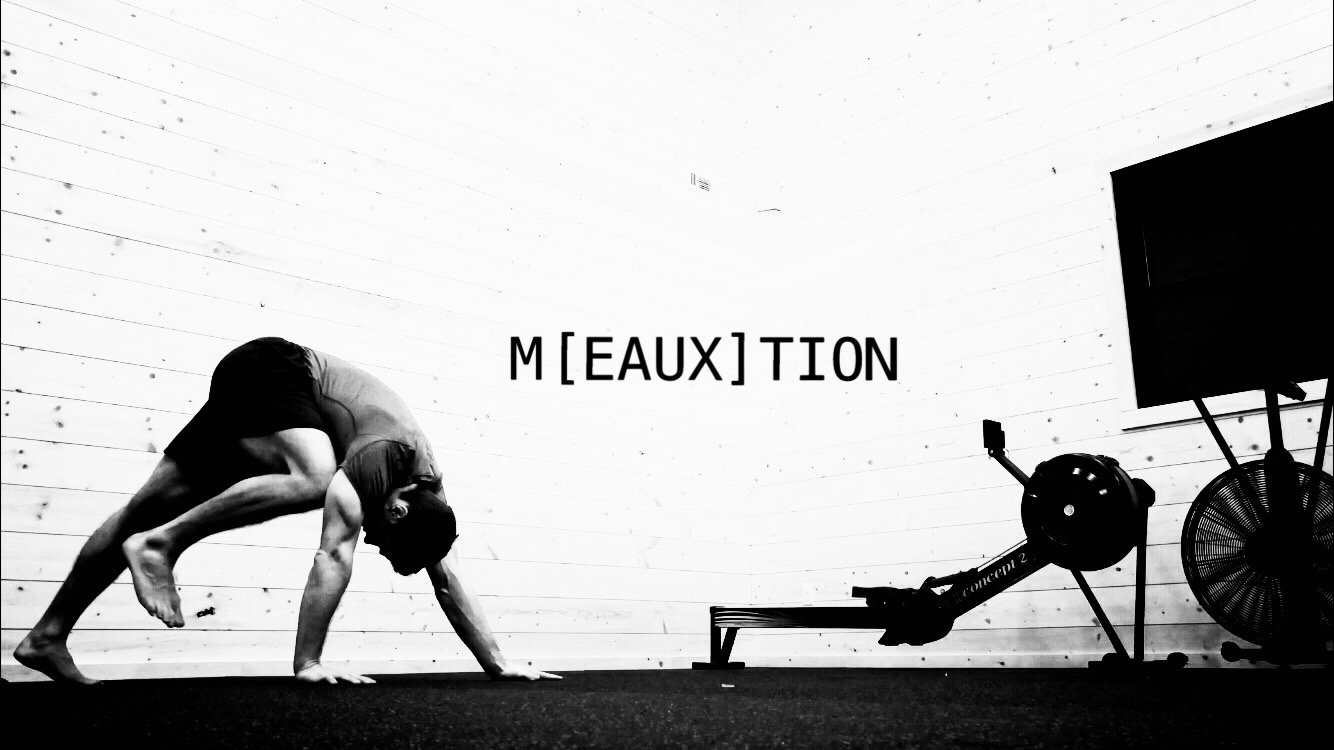

Non-traditional movement has been the name of the game lately.
Pure ground based locomotion and flow.
It’s not that I don’t have time for more mainstream forms of movement, because I believe in that also, but I am becoming increasingly intrigued with other methods of movement training. I almost used the term “time-tested” instead of mainstream. It might have been a better description, but admittedly, 95% of my personal workout habits and the habits which I recommend to others seeking movement regimens are in fact, mainstream.
A simple blend of squats, lunges, hip dominant hinging, upper body pushing and pulling in a vertical and horizontal fashion will set you up for success. Add in some chops and lifts and you have got yourself a damn good routine. It’s all in how you organize it and tweak the variables to best fit your goals.
A squat is a squat, but with a few tweaks here and there, you can make the squat conducive to building a number of different human physical qualities (strength, endurance, power, etc), all completely different from each other.
Always remember, in the beginning… establish mobility, establish stability in that new-found range of motion, then begin the process of building strength.
It’s a layering effect.
This is a recipe that works every single time for the person that is willing to be diligent in their training efforts.
Are you that person?
Because here is the reality: Movement works every single time. 100% effective. It’s people that fall short.
Movement works. People don’t do the work. Shame on us.
Over the past few weeks, I have progressively integrated more and more Ido-style movements into my pre-work training block. Maybe I shouldn’t refer to these movements as “Ido-invented” (after watching some of his videos he probably would deny they are his but were there from the beginning of time), but he was one of the first (and still the best that I’ve seen) to make sense of less mainstream forms of movement.
He is a mover, in every sense of the word.
From one-arm hand stands and other hand balancing, single arm chin ups, planches and twice bodyweight back squats, Ido can move with flow and move load if necessary.

Planche
I keep referring to Ido’s teachings as “movement”, and that’s because it is. He neither specializes nor generalizes.
I guess I never really stopped and thought about it, but most of what is published and preached today is purely about fitness. Even Yoga, with it’s cult like following, doesn’t necessarily make a person MOVE better. It might help a person increase flexibility and improve range of motion, but it doesn’t guarantee that you will move better.
You have to practice movement to improve your ability to move.
Now, I will say that I don’t necessarily believe that the mere act of practicing movement is going to grant you access to better movement. It may open a few doors to becoming a better mover, but I also think that each person needs to be real with themselves and their own situation. Some folks have got some real compensations, imbalances and dysfunction going on. Who knows where or how these issues manifested themselves (a lot are from sitting too long) but they are there, so it may be completely necessary to address these movement restrictions before you’ll ever be a great mover, or even an average mover.
The Functional Movement Screen is a great system for evaluating yourself, and your ability to move. Why? Because it is systematic. You grade your movement quality, and lesser quality scores in any given movement pattern has a roadmap of corrective drills that you can use to clean up that movement pattern. In essence, you can correct faulty movement rather quickly.
Realistically, you can perform a poor man’s movement screen at home on yourself. It will always be better to have a knowledgeable FMS certified trainer evaluate you, but hey, we can DIY.
Use a big mirror or better yet film yourself performing the tests from the movement screen. Don’t feel dumb filming, you can delete it immediately. The filming of your movement capabilities is extremely valuable. What you “think” you’re doing isn’t always what you actually doing movement-wise.
Take your video and compare it to some perfect screens (which you can easily find on YouTube) and take note of the differences. Most people will notice that their overhead squat is a lacking, rotational stability nearly impossible to complete and the inline lunge makes you feel like you’re balancing on a tight rope.
Cleaning up these patterns will make you a better mover, and probably decrease the likelihood that your dysfunction manifests itself into an injury.
However, cleaning up the screen doesn’t mean that you’ll all of the sudden be a great mover. You have to practice moving to be a great mover. Are you sick of me saying move? Mover? Movement yet? Sit tight I’ll drop those terms a bunch more in the coming paragraphs.
In many cases, I have substituted ground based crawling variations (supine and prone) and walks in place of my go-to dynamic warm up. I haven’t felt like I am sacrificing anything by doing so. My joints still move through a full range of motion and my muscles are activated in a low-impact fashion. I would even argue that my time is being maximized by practicing my movement flow using Ido’s training drills versus my standard cookie cutter warm up.
I’ve actually exited many of these warm-ups in a pool of sweat, even before beginning what I would consider to be the “work” portion of my session. Interesting.
I’ve quickly found that I am ridiculously weak in certain positions, uncoordinated and all around uncomfortable as I work in some of the Ido Portal warm-up drills and ground based training. It’s an ego check for sure, especially since he refers to many of these flow-like drills as being “beginner”. Ha! Soreness has also been a product of the unfamiliar movements, although it’s never a goal. Unfamiliar movements almost always produce soreness because your body hasn’t experienced it yet.
I am reminded – as I continue to force myself to become more vulnerable by the day with Ido’s training idealogy- of how a newbie to the workout scene feels at first. It’s an emotional uppercut showing up to a personal training session or a group class (even training by yourself behind closed doors) knowing that you’re going to struggle to complete what is being asked of you.
But the key is to keep coming back. Keep grinding. Keep learning. Realize that it’s a process, just like everything else. And as a process, you’ve got to work at it, consistently and in a focused manner. Leave your feelings at the door and work.
We’ve become detached from our bodies and desensitized to our physical abilities. In fact, many of us no longer have a relationship with our body, and our physical abilities. Things that we could easily do as kids are now foreign and seemingly impossible. But all of that can be regained.
One major takeaway from the my small bit of reading Ido’s work is this: We’ve got to establish a lifelong relationship with our movement. Every one of us. We will all start at different points and need different adjustments along the way- and this makes sense because we are all individually unique- but you’ve got to make sure that you start and find a way to make it stick.
Enjoy the challenge of learning new physical skills. Embrace the frustrations and work out the solutions on your own. If you find yourself stuck, hop on the computer or tablet and search out a solution. The internet is packed with incredible free information that can get you where you need to go.
I suck at many of Ido’s locomotion drills right now. I’ll admit that. I filmed myself and I look stiff and the opposite of gracefully. But that will change with time and practice. It’s frustrating to know that I am practicing something that I am not good at (yet).
I think many people may find that they actually like dedicated workouts more when you a aiming to develop a certain movement skill. Pursuing skills transforms a person’s daily workouts into a journey instead of a dreaded 60 minutes of robotic physical activity that we feel we need to participate in to chase the idea of “fitness”.
A movement journey may not have an end point. But that is the beauty of it. You achieve a goal and begin planning and preparation for the next goal. One day you look back and realize that over the course of time you hopped over barriers that you never imagined you would hurdle. That’s an incredible feeling to evaluate significant forward progress, especially when looking at where you started.
People often ask me what the benefit of an exercise is, or which exercises will best target a specific area of the body…
For a long time I couldn’t find the exact words to answer this question in a way that felt true to myself… but try this one out because I think this might be where I stand…

Cheers to getting uncomfortable in your movement endeavors…
KG


 M(eaux)tion Fitness