20 Minute Workout| Kettlebell Complex and Air Bike Intervals

Quick Tips

Here is a 20 minute kettlebell complex and air bike workout BURNER.  

This workout uses the same kettlebell complex I used for 90 days straight, just to see what would happen.  

Progression is key to improving performance. 

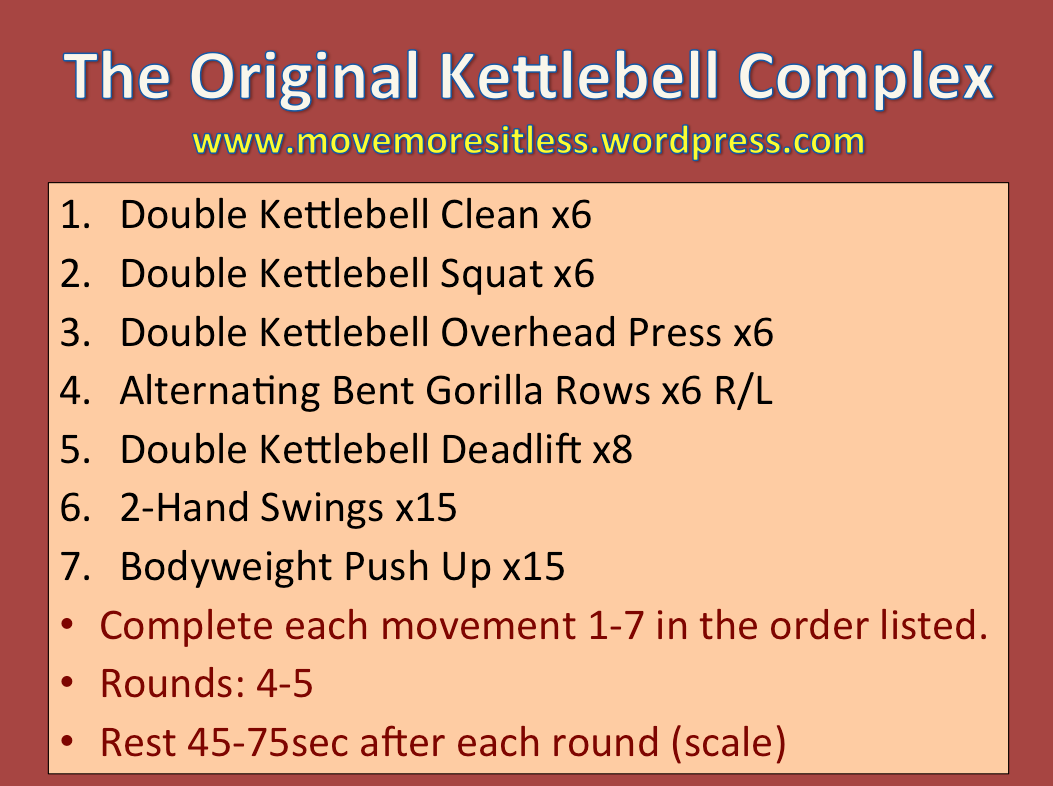
The original complex looked like this:

Original Kettlebell Complex

The goal was to keep the workout brief.  Under 20 minutes.

20 minutes is a sweet spot for me, especially with higher intensity efforts.  

I’m able to get the training effect I want, without losing technique to fatigue or subjecting myself to unnecessary injury.  

Higher quality work in shorter amount of time.

I really like these short burst sessions that address cardio and strength in one shot.  Life doesn’t always allow for 60-90 minute daily workouts.  We wish it did, but it’s turbulent.  

Being able to walk in the gym, warm up quick and get after it is awesome.  

The Workout

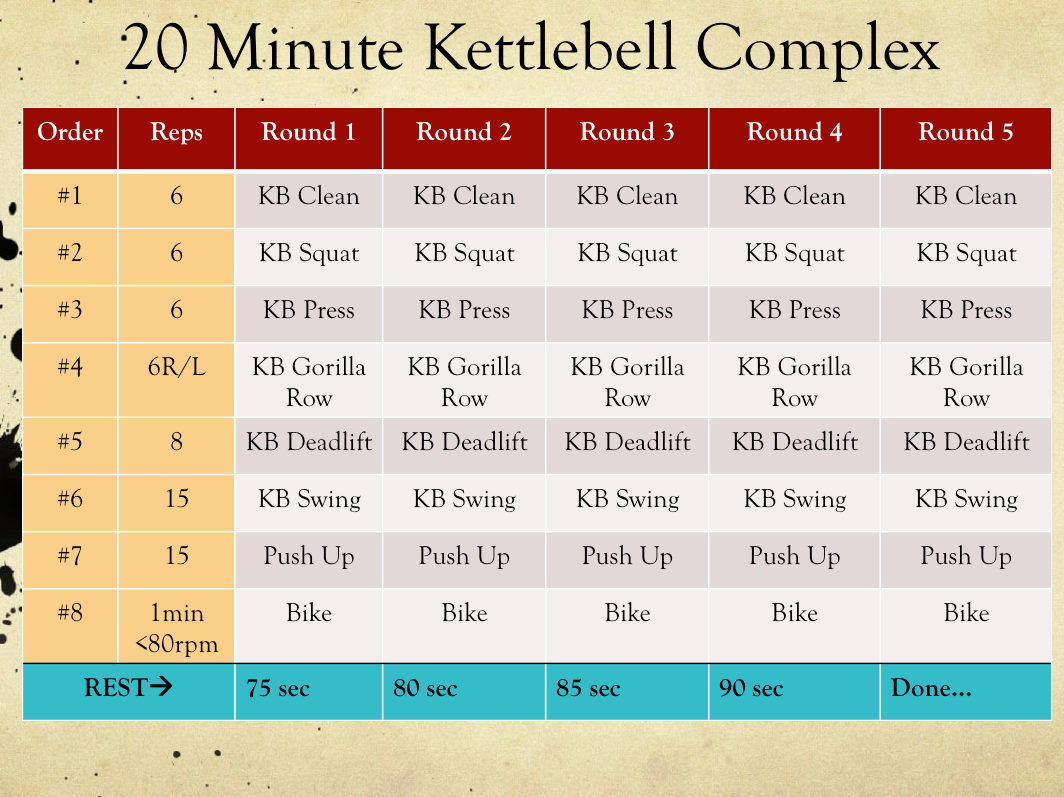
20 Minute Kettlebell Complex

Biking.  The addition of the 1-minute air bike ride at the end of the round shakes things up.  The goal is to keep the RPM above 80.  

The first few rounds were fairly easy, but rounds 4 and 5 were a bitch to keep pace.   

Why bike?

Biking is a low impact activity that requires ZERO skill.  Get on and ride.  Air bikes involve the entire body via turning the pedals over while pushing/pulling the dual action arms.

Biking is a safe way to condition while mitigating stupid workout injuries.  

Fatigue.  The ascending rest period tactic was perfect.  

Ascending Rest Periods

As fatigue accumulates, so does the amount of rest.  

The extra 5 seconds of rest added to each round helped managed my fatigue.

75 seconds of rest will seem long in the beginning.  But again, the fatigue hits you like a slap across the face.  

In rounds 3, 4 and 5… the 85-90 seconds rest passes by quickly.  

During your rest period, focus on breathing.  Deep and full breaths. 

Breathe deep into your BELLY, not your chest and neck.  

Exercise technique.  Metabolic conditioning is designed to stress the muscles and cardiovascular pretty aggressively, but it should NEVER come at the expense of technique.  

Scale the workout for yourself.  Start with longer rest in the earlier rounds.  Use less weight or bike for 30-45 seconds at a lower RPM instead of 1 min at >80 rpm.

Explore and tweak it as you go.  You can expect each “round + rest” to last 4+ minutes, with the later rounds lasting longer because of the increased rest.


Kyle


Redemption: The Matthew McConaughey Ninja Bodyweight Workout

Quick Tips

Ninja Workout

I have to start by offering an apology for misleading many of you on my previous article about Matthew McConaughey’s training philosophy.

All I did in that post was mention that “he sweats”, which I suppose made complete sense to me as the main point of the article, but left many of you readers wanting to know some specifics.  After reading it, I feel that the message was received, but it was lacking in “how-to” knowledge.  That is my error.  I hope to redeem myself by sharing a decent little bodyweight workout with you today.

In honor of Spring of course.

Hopefully I can redeem myself here.  I’m nervous.

Wisconsin Mecca

The Mecca of the Midwest

As the weather warms up here in “God’s Country”, Eau Claire, WI, the doors begin to open to all sorts of opportunity for engaging in physical activity outside.

Training outside is the greatest.  It’s freeing.  The air is fresh (depending on where you live), the sun is beaming, and quite honestly, when you train outside the workout seems less monotonous than training indoors.  Training inside year round can make you feel like a rat in a laboratory.

[Segue…]

Alright, let’s talk about Matthew McConaughey’s workout, because that is why we are gathered here today.

Screen Shot 2013-04-05 at 6.54.52 AM

Super awkward that I had to post this pic, but needed the visual.

Let’s face it, guy has the kind of body aesthetics that women drool over and men want, yet his theory on physical activity and what it takes to maintain his physique is so incredibly simple.  I love that.  Why complicate matters?

Performance-wise, I’m not entirely sure how strong the guy is, if he has aches and pains or any sort of endurance.  But aesthetically he is doing alright.

Just sweat everyday… doing something.

I received a lot of interest in the previous article, so I should probably man up and post a workout of his… ahemmmm… or at least a workout that I believe he may enjoy participating in.

Well, ok… maybe it’s just a workout that I designed with the thought that if he and I were hanging out, he would enjoy working through it with me.  Based on some of his older interviews in Men’s Health, he tends to avoid the gym whenever possible in favor of training outside in a more natural environment.

Workout structure

Equipment:  None (although a heart rate monitor is highly encouraged)

Time commitment:  30 minutes-ish

Difficulty:  3/5

Screen Shot 2013-04-02 at 7.01.47 AM

*** Warm up***

Start with a 5 minute run at 70-75% of your HRM (heart rate max)

  • Run #1)  2 minutes at 80-85% of your HRM (heart rate max)

—>  Recover to 130 bpm

a)  20 Push Ups (no rest leading into the run)

  • Run #2)  2 minutes at 80-85% of your HRM (heart rate max)

—>  Recover to 130 bpm

b)  20 Reverse Lunges (no rest leading into the run)

  • Run#3)  2 minutes at 80-85% of your HRM (heart rate max)

Recover to 130 bpm

c)  20 Bodyweight Squats (no rest leading into the run)

  • Run#4)  2 minutes at 80-85% of your HRM (heart rate max)

–> Recover to 130 bpm

d)  20 Burpees (no rest leading into the run)

Finish with a 5 minute run at 70-75% of your HRM (heart rate max)


Fitness thoughts

Buy a heart rate monitor.

If you are going to take your cardio training seriously, you need to be monitoring your work bouts and your recovery time with a heart rate monitor.  Buy the cheapest version Polar sells if you are concerned with cost.  It will work just fine and help guide your training.  The heart rate monitor will give you insight into your progress.

On the 2 minute run, which is the “work” portion of the session, you’ll notice that I suggest running at a pace that is 80-85% of your heart rate max.  The easiest way to figure out your heart rate max is to get on a treadmill, crank it up to a ridiculously high speed and incline, and sprint until your vision becomes blurry.  The test ends when the treadmill spits you off.

JUST KIDDING!

Seriously, don’t do that.  However, there are some equations that you can use.  Most heart rate related formulas have some flaws in them.  They are just formulas, estimations, so this makes sense.  The Karvonen formula is “the best of the worst” when it comes to finding max heart rate.  No matter which formula you choose, remember that your heart rate “training zones” are going to be ESTIMATED.  I’d rather you use these formulas than the really old school method of finding heart rate, which is nothing more than 220-(Your Age).  220-your age is quick, but there is a lot of room for error.

Recover to 130 bpm after each run prior to working through each bodyweight exercise.  Recovering to 130bpm will keep your training efforts aerobically challenging and also provide an beats per minute (BPM) mark to green light the next work bout.  Recovering based on time is ok in a pinch, but recovering based on when you heart is ready to go again is preferred.  Your body will let you know when it’s time to go back to work.

The bodyweight strength movements that follow the rest periods are integrated to break up the monotony of running and provide a low load resistance based training stimulus.  Don’t expect to build great amounts of strength from just 20 reps of any of those movements.  If fact, let me re-phrase that last sentence… You will not build strength from those exercises.  Not at that rep count, with bodyweight load, etc.  Unless you are relatively reconditioned (which isn’t a bad thing) or new to purposeful exercise.  You may experience some strength gains, but I would rather see you work through a dedicated strength program at that point.

Scale the workout.  Run for less time if you need to.  Decrease the reps on the bodyweight moves if you need to.

Or, if you are battle hardened, increase the running time, add a few more rounds of bodyweight moves, etc.

Take your training outside and get some fresh air.  It will change the training experience.


Cheers to breaking up the monotony of running!


KG

15 minute Workout: Why I Don’t Give a Sh*t About the Tabata Protocol

15 minute Workouts

The Tabata Protocol is a simple and sinister conditioning protocol, possibly  more classified as a raw test of will-power.

The original structure of the Tabata Protocol looked like this:

Round 1: 20sec work/10sec rest

Round 2:  20sec work/10sec rest

Round 3:  20sec work/10sec rest

Round 4:  20sec work/10sec rest

Round 5:  20sec work/10sec rest

Round 6:  20sec work/10sec rest

Round 7:  20sec work/10sec rest

Round 8:  20sec work/10 sec rest

4 minutes in hell.

What is the Tabata Protocol?

The Tabata Protocol was conducted in 1996 to observe the effects of moderate-intensity endurance and high-intensity intermittent training on anaerobic capacity and VO2max.  That’s a mouthful.  Using a braked cycle ergometer, participants worked through 7-8 sets of 20:10 (work:rest) at 170% VO2max.  This training protocol was performed 5 days per week for 6 total weeks.

[youtube=http://www.youtube.com/watch?v=PCl9Z2Q_cvs

Who is the Tabata?

Yes, Tabata, is actually a person.

Profesor Izumi Tabata is a former researcher at the National Institute for Health and Nutrition and is currently a professor and researcher  at Ritsumeikan Unversity.

I thought you should at least know what the guy looks like…

Why is it NOT relevant to YOU?

110% effort.

I know you work hard in the gym, but trust me, there is another gear that everyone can tap into.  110% exertion is beyond the governor that most of us are calibrated with.

A lot of us will never know what 110% effort is like.

The original Tabata Protocol involved training at an effort that would left nothing at the end of the 8th round.

You can work “hard” during your Tabata, but you won’t touch the intensity the subjects in the study put forth.  Sorry.  That doesn’t mean that you won’t get some kind of training effect from it!


How to make the Tabata Protocol Work for you…

You can start by calling this type of training what it really is… negative work to rest ratio or maybe a “20:10 workout”.  Meaning, the amount of time you are going to spend in your work sets is longer in duration that you rest periods during each rep/round.

Don’t take this the wrong way, but you’ll never touch the 170% VO2 max.

170% of your VO2 max looks something like this…

170% VO2 max = Eyeballs popping out of your head + lungs being vomitted


Tabata protocols is an advanced conditioning workout.

You are going to find that your fatigue levels are going to increase beyond what you are accustomed to, draining your energy reserves rather quickly, which means that your output in the later rounds is going to be shit.

The Tabata Protocol never looked at fat loss, and the actual subjects who were engaged in this type of training actually used a 5th day of aerobic exercise during the study.

This is what happens sometimes when research hits the mainstream.  Magazines need something to write about and trainers need a way to set themselves apart, so new modalities are formed, and the general population bites on the hype.

What we do know is that high exertion/intensity exercise is effective as hell for jarring our system and creating an environment that is more likely to burn fat.  There is no question about that.

But picking up heavy things and building muscle will also get you lean, so don’t get tunnel vision on interval training.

I would use the Tabata as a finisher if you are short on time at the end of a workout.

Get your strength training in, rest a few minutes while you set up on the bike, then rip out 8 rounds of hell.

I know that you will get a positive training effect assuming you put forth an effort that is way out of your comfort zone.


Personally…

I have used the 20:10 protocol a lot.  I can tell you that I have never touched the 170% VO2 max effort that the subjects put forth in the study.  Mentally, I am not even there.  Most times I am pressed for time after my resistance based work, and the 20:10 method is quick and effective solution. 8 minutes is all you need.

I always use 20:10 type work on my Schwinn Airdyne.  There is nothing like an Airdyne.  I found mine on Craigslist from an old lady, best investment ever for low impact cardiovascular work.

Do I find the Tabata structured protocol difficult?  Hell yes.  Like anything, try it for yourself.  Make your own decisions.  Negative work to rest ratios leave a person gasping for oxygen.  I don’t care how well-trained you are, oxygen depletion in that short of a time is going to leave you “well-done”.


Let your heart guide you…

As always, I encourage you to wear a heart rate monitor and see where you end up.  You’ll notice the lag time between the end of your last 20:10 round and your heart rate, as your heart rate will continue to creep up.  This is normal with anaerobic work.  See where you get and chart it.  How long does it take you to recover to 130bpm after your last rep?  Chart that.  If you used a bike (which I encourage) how far did you go during your work sets… chart that too.  Aim to increase your distance each time.


Give it a shot and let me know how it goes in the comments section…


Cheers.