One Kettlebell, 3 Fat Loss Workouts

Motion

Only one kettlebell?  NOT A PROBLEM.

There are hundreds of different movement combinations, circuits, and workouts that can be created using a single kettlebell.  

I actually prefer to workout with one kettlebell.  

Single kettlebell training allows for smooth hand-to-hand switches but also employs uni-lateral loading, which challenges the muscles on the non-working side to stabilize the body.  

Pound for pound, the king of all unilaterally loaded exercises is the Turkish Get Up.

The training effect will be profound and significant.  

Each exercise listed has suggested reps for that particular exercise.  

If your kettlebell is on the lighter side, which it might be, simple adjustments can be made to… 

… make lightweight feel heavier…

  •  Reducing or eliminating rest periods
  •  Slowing down the speed/tempo of exercises (check out this super slow push up)
  •  Adding reps to each exercise

In short, you can add reps, reduce, or fully eliminate rest periods or slow down the tempo of exercises to spend more time under tension. 

All of these options will increase the intensity of the work being performed. 

Note:  Some exercises are impossible to slow down.  

Swings, cleans, snatches are ballistic movements that need to be performed with explosiveness.  

Lunges, squats, deadlifts, core work, pressing, etc… can benefit from a slow tempo.

Perfect for the Home Workouts

Kettlebell and bodyweight exercises are PERFECT for home workouts.

Each workout below was created for people who are exercising at home.

I’ve been training exclusively out of my home for over 12 years, and I’ll never go back.  Learning about how to structure workouts at home can take some time, but once you get into a groove it’s really hard to return to the gym.  

Time and money savings are two HUGE reasons to exercise at home.

If you have a gym membership, including a home-based workout 1-2 days per week can save time and help accelerate your pursuit of fitness goals.  

Warming Up

Each workout should include mobility work for joint hygiene and function.  

Improving joint range of motion is a complete game-changer. 

Basic mobility drills are powerful for relieving nagging aches and pains and restoring function.  

A lot of mobility drills are bodyweight-based, so if you’re without much equipment you can still practice these and get all of the benefits.

Pretty cool. 

You came here for workouts, and workouts you’ll get.  

But if you’re in need of improving your useable range of motion (hint:  most people are), check out MyDailyMobility for daily workouts.

Workout #1:

8 Half Get Ups

8 Goblet Squats

8 Kettlebell Diamond Push-Ups

8 Bent Over Rotary Rows

8 Single-Leg Deadlift 

8 Burpees

Workout #2: 

Snatch

Clean-Squat-Press

Reverse Lunge

Split Stance Rows

Optional:  active rest using jumping jacks


Workout #3:

Squat to Press

Plank Rows

Hollow Body Rocks

Split Squat Jumps

Swings


Bonus Workout Finisher

Anything left in the tank?  

Give this workout finisher a shot… 

10 Push-Ups

10 Right Single Leg Hip Lifts

10 Left Single Leg Hip Lifts

The goal is to complete 100 reps of each exercise, as quickly as possible.

Perform 10 push-ups, then 10 right hip lifts, then 10 left hip lifts, then back to 10 push-ups.  Make sense?  

FULL RANGE OF MOTION REPS ONLY.

Don’t stop until 100 reps are achieved.  

A lot of people could benefit from more glute work, especially hip extension.  All that sitting has deflated our asses and has a looking like 🐢 ‘s.

Fill out those jeans 👖. 

Single leg hip lifts can be performed with back on the floor, or, back elevated on a couch, chair, coffee table or wood plyo box.  

The first few rounds will feel easy, but rounds 7-8-9-10 gets intense. 

Push-ups and hip lifts are non-competing exercises, so ramp up the intensity and do your best to complete 100 reps without stopping.

Anticipate a wildfire 🔥 starting in your ass cheeks, chest, and arms.

Want more home workout options?

✅ Check out these posts:

👉 Learn more about movement flow!

👉 Turkish Get Ups Kick Ass

👉 Home Workout Options


Build a Home Gym? Yes, You Should.

home gym, Motion

Before you read this, please know I am a HUGE advocate for moving workouts into the home setting.  

Cutting the cord on a big box gym membership is a little like cutting the cord on cable television.  I’ve done both so I’ve got some experience here.  Change is hard.  Sounds dumb but when I cut cable television for good, I had a few weeks of not knowing what the hell to do with myself at night.  

It was purely conditioning and habit driving these feelings.  

But eventually, I adapted and transitioned my time to more productive activities.  Of course economical streaming subscriptions also helped fill the void (Netflix, Hulu, Prime Video, etc). 

Anyways, there’s some initial hesitation, weighing, back and forth, and although it sounds kind of funny… anxiety involved with cancelling a gym membership (or cable television).

“What will I do without my gym membership?”

Step one is to ask yourself if you’re actually using your gym membership.  If you are, how many days a week are you going?  Are you getting results from that money and time investment?  

These are simple questions.  Are you going to the gym enough to make the cost of keeping the membership worth while?

A lot of people go to the gym with intentions of losing weight, building strength, getting healthy, yet have very little if anything to show for it.  

No offense to these folks, but there’s a lot of people that fall into this category.  Gyms love them because not achieving results (aka:  spinning tires in the mud) is great for ensuring a steady revenue stream.  The anxiety is too high to cancel the membership.  So, you pay every month.  

If you do go to the gym and you enjoy it, KEEP YOUR MEMBERSHIP.

The goal of this article isn’t to project a rigid stance on big box gyms and paint them as being a bad place.  

My goal is to shed light on the effectiveness of working out at home and let you know it’s more than doable, it’s becoming the new standard.  Lots of people aren’t aware of this.  #themoreyouknow

A lot of folks use gyms as a social hang out just as people get memberships at the local country club to hang out with their buddies.  

Well built gyms often offer amenities to families (pools, child care, classes, etc).  So for these folks, spending the money might be well worth it.  

Mom and Dad can get some exercise in while the kids play in the pool with licensed gym staff.  

But…

… cancelling your gym membership will free up funds, time and hopefully bring some excitement back to your workouts.  

The biggest benefit (in my opinion) of moving workouts to a home gym set up is the freeing up of TIME.  

When I was younger I had a much harder time understanding the value of my time on this earth.  My perception was that I had all the time in the world.  Wrong.  

Fast forward several birthdays later, I feel much differently.  I have a desire to own as much of my time as possible.  Life’s too short.

Google “Memento Mori Chart” and fill one of those out if you really want the realities on the shortness of life.  

Balancing family, career and finding time for recreation can eat up most of the time in a day.  

Working out at a membership based brick and mortar gym certainly has it’s advantages, but it also has limitations which often go overlooked.


#1  Paying for something you don’t use.

A gym membership going unused or not being used on a regular basis is a waste of money.  

#2  Time.  

How much is your time worth?  

Time is our most precious commodity, and we can never get time back.  Drive time to and from, changing clothes time, waiting for equipment time, workout time, shower time, etc.  Big box gyms are a TIME SUCK. 

#3  Safe equipment.  

Most gyms still refuse to offer fitness equipment considered to be “taboo” or “dangerous” because it’s a liability for injury.  

So, the average big box gym is littered with fixed range of motion (aka:  artificial and unnatural range of motion cardio and resistance machines)

There’s a reason most people despise exercise…  because spending hours on these machines is uneventful and completely against human nature.  We were force fed the concept of exercising on fixed machines back in the 1960’s and 1970’s and somehow the concept survived to 2018.  

Those feelings of boredom while “ellipticalling” are real… and more importantly they are NOT WRONG.  Your body craves robust movement, exploration, change of direction, challenge.  

It took 8+ years for most gyms to offer kettlebells to clients for fear of throwing them through mirrors, dropping them on toes, or blowing out backs from poor technique.  All reasonable concerns.

To be blunt, if your gym isn’t offering and promoting alternative modalities of building fitness such as kettlebells, you’re missing out.

#4  Personal training is expensive

God bless personal trainers and their ongoing commitment to educating the public on the benefits of exercise.  

But personal training is expensive.

Personal training is expensive regardless if you’re training 1-on-1, semi private or in a group setting.  At $5, $10 or in some areas $70-$80 per session you could pivot and transition those dollars into one of many online training programs (probably starting with bodyweight based training like yoga or calisthenics) and gradually purchase some home equipment.

Start with a simple pair of dumbbells or kettlebells, maybe a suspension trainer.  These are three of the most versatile pieces of gym equipment on the market.  

Yes, I know barbell training is amazing.  But even in the year 2018, barbells freak a lot of people out.  I don’t know if their is data on this, but it’s anecdotal fact for me in conversations with people.  

So, do your homework on dumbbells, kettlebells or a suspension trainer.  

For the cost of one month of gym membership, you can buy one or possibly two pieces of equipment.  A kettlebell is a one-time purchase.  That kettlebell will outlast your life. 

The gym membership model succeeds and relies on signing up customers who don’t set foot in the door.  

I didn’t make this up.  

Listen, if I owned a gym I wouldn’t want all of my members to workout daily and tear up my expensive equipment.  

It would be a hassle and lost dollars for me to constantly fix broken down cardio machines, reface beat up barbells and weight plates, patch holes in benches, etc.  

No, no… if I owned a gym, give me your money and stay at home.  

Here are some great articles regarding gym memberships:

A snippet from the last NPR article:

“Joining a gym is an interesting form of what behavioral economists call pre-commitment,” says Kevin Volpp, director of the Center for Health Incentives and Behavioral Economics at the Wharton School. Volpp says we actually like the idea of being locked into a gym contract … at first, anyway. “They’re picturing the ‘new me’ who’s actually going to go to the gym three times a week and become a physical fitness machine.” We convince ourselves that since we have committed to putting down money for a year, we will make ourselves go to the gym. And then, of course, we don’t.

Working out at home is not for everyone. 

“Wait, I thought you just told me that…”

I did.

Before you cancel your gym membership, it’s important to understand your habits and personality.  

Cancelling a gym membership with intentions of working out at home, but never actually getting the home workout habit to stick is not good.  It’s a step in the wrong direction.

If you were exercising twice a week at a gym, but now exercising ZERO times per week after making the transition, this is not a good scenario.

While taking workouts into the home setting is loaded with advantages, a lot of people may find it difficult to stick to a workout regimen at home.

I’ve found that inability to make the home workout habit stick are pretty similar to the reasons a lot of people shouldn’t have a home-based career.  

The comfortable environment of the home setting can kill off motivation for physical exertion and breed complacency.  

The temptation to do anything but be productive and get work done is too great.

Before cancelling a gym membership, test the waters by bringing 1 or 2 workouts into the home.  Keep it simple.  Work some bodyweight sessions, play around with the space you’ve got and get acclimated.   

No equipment means no workout!

Survey says:  Wrong.  

A common perception is that quality exercise cannot happen without the presence of fancy fitness machines.  

Heavenly Father… what are you supposed to do without any fitness equipment?!

I can see how a person would have this opinion, I really can. But the reality is you DON’T KNOW WHAT YOU DON’T KNOW.  

If you have these feelings, you’ve got to explore your options.   

Here are some ideas for you… 

Yoga, Animal Flow, KinStretch, gymnastics and calisthenics and resistance training are all INCREDIBLE forms of movement that can provide far more benefit for your body (looks, feel and performance) than any machine ever will.  

Listen, exercise machines have their place, but moving your body in a natural environment should be a primary goal.  Your body and the ground.  Start there.

What about walking?  

Walking, time and time again has proven to be potent form of daily activity.  Start with 10 minutes per day, every single day.  See what happens.  

The Economics of Building a Home Gym

Before buying home gym equipment there are two important points to consider:

  1. Quality gym equipment often isn’t cheap at time of purchase.  The upfront cost of purchasing the equipment will likely exceed what you were paying per month at your gym.  However, shift your attention to the long-term value instead of the short-term.  Most quality gym equipment should last you lifetime versus paying for monthly gym memberships.
  2. What’s the cost of not exercising across the long-term?  This question can be hard to wrap one’s head around, but seriously, in 10, 20, 30 years, what will be the cost you pay for not taking care of yourself physically when you had the chance.  

A badass home gym could be built by shifting spending habits for 6-8 months.  

Many people won’t buy gym equipment for the home because they don’t know how to use it.  In 1996, this was a valid concern, but not in 2017.  This little thing called the internet has created massive opportunities to learn basic technique of physical conditioning, all the way to movement mastery.  

Fitness is now digital.  The information is distributed through video, audio and the written word, there is education that appeals to all forms of learning.  A lot of it is given away for free.

Everything a person could want to know about fitness is on the internet.  

If you’re one of those anti-internet people… please stop.  Yes, the internet has some crap floating around but so does society.  

Take ownership, research, experiment, explore, refine, get curious, learn.  

I want this article to open your eyes to a different perspective on working out, where you do it, how you do it and a alternative view to transitioning your health regimen back to home base.  

Even if you don’t make the switch, it’s important to have the information.

Please let me comments or questions.

Check out some of these other topics of I’ve explored on the blog…  

All center around workout programs, workouts, exercises or equipment fully compatible with the home gym setting.


For now… cheers to you and building a home gym.


Kyle 
 

Basics of Movement20XX| The A-B-C’s of Crawling Exercises

Motion

The Basic Forward Crawling Pattern

Movement 20XX is a brilliant bodyweight fitness program designed to build a body using ground-based movement and smart exercise progressions

Beginner, novice or elite… it doesn’t matter.  

Eero Westerberg created exercise progressions for any level of fitness, from a beginner all the way up to an elite mover looking to develop movement mastery. 

Movement 20XX is a bodyweight ground-based movement training system that integrates different training methodologies into one unique workout experience.  

Looking closer, you’ll notice elements of yoga, ground-based locomotion, and various gymnastics drills fused into one flexible training system.

Crawling is a key element of Movement 20XX.

The most effective online fitness programs coach clients using clearly communicated coaching cues.  Clear and concise communication is an art form.  

Eero’s communication is what makes Movement20XX great, combined with regressions and progressions to those exercises.  

Movement20XX introduces beginner movers to the fundamentals of movement training while providing exercise progressions to challenge people who are higher up on the ladder.   

Natural (bodyweight-based) movement training is MISSING from most workout programs.

Improving your ability to control your body in any environment, with or without external load moving through space.  

Climbing, crawling, balancing, jumping, rolling, reaching, twisting, lifting, etc.

… keeps people young.

Lifting weights is great.  Mobility training is great.  But at some point, MOVE.

Ground-based exercises like crawling are rarely included in traditional fitness programs.  

Shame. It should be.  

Ground-Based Crawling

3 basic locomotion patterns I’d like to share today:  ape, forward/backward crawl and the crab walk.

Each pattern is bodyweight-based, requiring no equipment, just a small about of space either indoors or outdoors

Crawling Patterns: 

Ape is likely going to be the most challenging pattern shared today.  Ape requires the most upper body strength and coordination.  

Forward/backward crawling is a basic crawling pattern, and probably the most recognizable.  

Crab Walk is a supine (chest up) pattern that’ll challenge shoulder and hip mobility in a unique way.  


Ape

Forward/Backward Crawl


Crab Walk

Adding Crawling and Locomotion to Workouts

I started slow with crawling.  Not because I wanted to, because I had to.  

Even the basic patterns crushed me for short distances.  

#humblepie

Over the course of a few months, I increased the crawling frequency from 1-2 times per week (mainly during warm-ups) to daily practice for longer distances and durations.  

I’ve posted several videos on the Meauxtion YouTube page demonstrating 5+minutes of traveling forms/crawling.  

5+ minutes may seem like a long time to be crawling without rest… and you’re right… it is. 

Ideas For Workouts…

I train in the morning 99% of the time.

If I wake up and feel residual fatigue or muscle soreness from the previous day’s resistance training or metabolic conditioning workouts, I reach for ground-based only sessions. 

Isolating a workout to only ground-based movements like crawling (and other locomotion patterns) is great for the joints yet doesn’t involve huge muscle contractions, challenging, FUN… while delivering a significant training effect.  

The tempo (speed… fast or slow) of the movements can easily be adjusted to change the stimulus.

Crawling can be formatted for cardio training.  Increasing the speed of a basic crawl pattern (while reducing rest periods) challenges mind-body processing speed and coordination.

Or, add a weight vest to increase the loading.  Progressive loading is essential to make gains while lifting weights, and crawling is no different.   

Here I am wearing 80lbs of extra weight while practicing an advanced crawl variation, the lizard crawl:


In time, simple movement patterns like Ape, Forward/Backward Crawl and Crab Walk can be integrated into flow-like sequences. 

See below:

Video


For beginners, crawling is learned best using a slow and controlled tempo.  

Slow and controlled practice allows for a better motor pattern education.  You’ll develop a better understanding of the mechanics and physical demands of each movement.  

Why Crawl?

Ground-based crawling and other locomotion patterns are both fun and challenging.  

You may find (as I did) that these patterns bring restore life into your workout regimen.  

Isolated resistance training day in and day out can get extremely monotonous. 

One secret to maintaining a healthy long-term relationship with your fitness is to keep training fresh.  

Choose activities that require increased physical AND mental engagement.  

Most of us don’t have the will power or capacity to sustain a workout regimen it despises.  You’ll fizzle out over time.

Make sure to find a workout structure that’s results-oriented, challenging, yet ENJOYABLE. 

I love a good physical challenge, and these bodyweight ground-based movement patterns provide it every single time.

Engaging in more locomotion-based exercises reminded me it’s possible to finish a workout exhausted but REFRESHED, not beaten into a pulp.  

A 20-25 yard lizard crawl is both exhausting and humbling.  For me personally, diving deeper into crawl work was a splash of cold water to the face.  

Bodyweight training is an anytime, anywhere with zero equipment and limited space method of building fitness.  

Small, odd shaped, cluttered spaces become ideal areas to workout when bodyweight training is the focus.   

👉 For more info, check out the Movement 20XX


Related blog posts:


Kyle


A Quick (and effective) Kettlebell Swing + Bodyweight Movement Workout

Quick Tips

I’ve started to trend some of my posts toward topics that people are searching for in Google, which I am informed of on my blog.  You cannot see these stats and search terms, but I can, so advantage to me!

I won’t sell out and write what I think will drive more traffic to this blog (a lot of fitness bloggers do), but I am interested in what kind of traffic numbers will arrive if I direct some of my posts toward the needs of the people.  My goal has always been to write authentically and reach as many people as possible.  We will see how it turns out.

Ha, listen to me… “The needs of the people”.

Photo Credit:  tv.com

Photo Credit: tv.com

I sound like I should run for city office, or city treasurer on Boardwalk Empire.

Anyways, I put myself through what I would consider an intermediate workout tonight.

This workout was heavily centered around kettlebell swings, and supplemented with various other bodyweight movements.  I feel like “supplemented” is the proper terminology in this particular situation, as you’ll see from the workout below.

The bodyweight movements that separate the kettlebell swings are nothing more than filler exercises used to keep my heart rate elevated in between bouts of swings.  More muscles worked, more calories burned during and after training.

I tend to choose both upper and lower body bodyweight movements to disperse the training stress to  more of a total body approach.  Splitting the movements to upper and lower allows for a brief period of training stress directed at a specific movement pattern (horizontal push, squat, vertical pull, etc) without exhausting that pattern completely.  This allows for intelligent fatigue management during other bodyweight movements and more importantly during kettlebell swings.

When fatigue sets in, technique gets ugly, people are exposed to bad habits and injury.

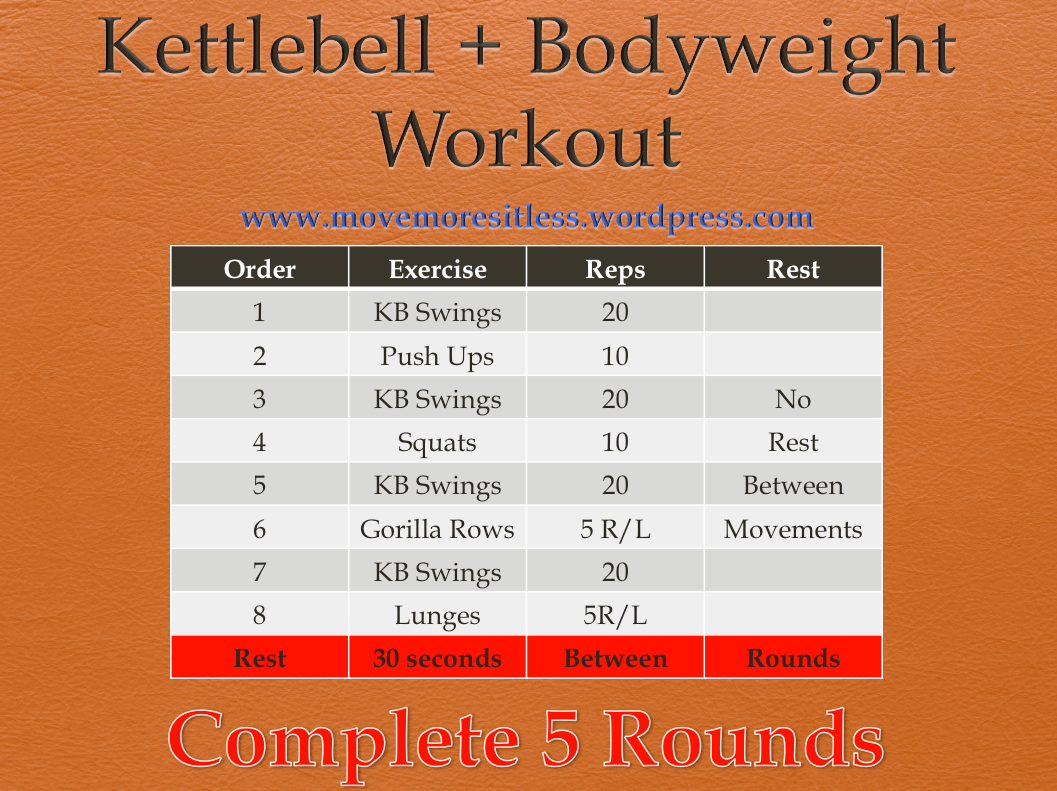
So, without blabbing any further, here is the structure of the workout, please notice that it is very similar to the multi-method cardio approach:

sample kettlebell and bodyweight workout

A couple of points…

First, there is a lot of work being done here, as you can see.  There is a lot of muscle being stressed and the rest is light.  A workout like this could be a complete training session for a beginner or an intermediate, or scaled up for an advanced lifter.  Scaling up for an advanced trainee might involve a bump up in bodyweight exercise progression or adding a weight vest to those movements.  It’s all a matter of tweaking the variables based on your unique situation and needs.

Second, I kept the reps to even numbers, 10’s and 20’s.  Why?  Because it is annoying having to check your notebook after every movement.  I want you to be focused on what you’re doing during the training session not counting reps like people count food calories.  Focus on your movement, your breathing, your recovery.  Forget about complicated rep schemes… I have plenty of those that I will post in good time.

Third, go sub-maximal but not too light on your kettlebell swings.  Grab a bell that you could swing for 30 reps and focus on hip snap during those suggested 20 reps.  Guys you might grab a 24kg or a 28kg, gals you might grab a 16kg or a 20kg.  Both guys and gals, you’re allowed to grab more or less than that, but on average, males and females will use those weights.

Remember, don’t gauge your energy expenditure on the first set of swings because you’ve got 3 more sets of swings and 4 different bodyweight movements lying ahead.  Manage your fatigue appropriately.  If you have a heart rate monitor, I would suggest using it to check you heart rate.  Of course, you’d want to already have an idea of the beats per minute that separate you from exhibiting crappy movement technique.  When you reach that heart rate, you can back off, rest for a few seconds, then get back into the workout once you can control and OWN the movement.

Why 20 reps of swings?  Because I personally feel that anything more than that really doesn’t provide much benefit other than poor technique (lack of finishing in full hip extension, slouching, etc) and a rising risk of losing the bell on the backswing or at the highest point of the arc.  One slip will kill your pet or put a hole in your wall, and the other will destroy your brand new LED TV.

20 reps (or less depending on your conditioning level) seems to allow for a sufficient elevation in heart rate without making the swings pointless from lack of load and endless volume.  There will be plenty of work performed in this training session, it doesn’t all need to be accomplished with kettlebell swings.

If you’re bored with your typical cardio routine, I would highly recommend giving a workout like this a real shot.  You will be pleasantly surprised at how hard your cardiovascular is taxed during a training session like the one described below.  20 minutes seems to be the sweet spot for me.  I have tested up to 30+ minutes of work like this, and it just doesn’t work for a couple of reasons…

1)  I feel like I am just going through the motions with regard to loading (aka weight used).

2)  I feel like I am adding  volume for an unjustified purpose.

These days, workouts like this serve as a great follow-up to my 2-day on/1-day off training schedule.

Day 1 is a heavily focused on strength work with a splash of jump rope or Airdyne cardio work, while day 2 (this workout) is dedicated to sub-maximal movements strung together to work cardio-strength (traditional strength moves with incomplete rest periods).

Ultimately, the goal is to stay physically prepared until I shift my training toward a particular goal.

Also, although the 20-25 minutes of work being completed in a workout are definitely stressful and draining, I feel as though it’s a short enough bout that allows for adequate recovery between training sessions, avoiding over-training.  The full 24+ hours of rest is also a motivating factor to work hard during this type of training session.  The rest day is just that… a rest and recovery day.

Be a perfectly golden marshmallow at the end, not a crusted black scabby marshmallow.

Give it a shot and let me know how you make out!

Cheers to short effective bouts of exercise!

Kyle