The Lizard Crawl is one of the most challenging crawling patterns.
Aggressive joint angles, timing and coordination of the limbs along with a massive muscular demand make the lizard crawl pretty brutal in the beginning.
Not all that long ago, I was a beginner with the lizard crawl.
The pattern was pretty sloppy for a long time. I was inefficient and felt out of control.
Inefficiency with movement might be great for burning calories, but it’s a bumpy road when you’re trying to build the pattern.
On the road to preparing my body for the demands of the lizard crawl, several key exercise regressions played a significant role. and this blog post directed at the beginner looking to learn more.
The goal of this article is to provide several launch points to work up into the full Lizard Crawl.
Each Lizard Crawl exercise progression is designed to provide a gentle introduction to the body position and loading.
A full-blown Lizard Crawl has a deceptive number of moving parts moving and requires plenty of mental processing and physical capability.
Exercises
The full lizard crawl requires:
👉 Mobility
👉 Upper body and core strength
👉 Coordination and timing
Improving control over shoulder range of motion is important for lizard crawling and beyond.
The shoulder is a ball-and-socket joint and should be able to move freely, but with control.
When the shoulder joint lacks mobility or control over range of motion, problems can surface.
Shoulder CARs
Controlled articular rotations are a mobility exercise that great for daily shoulder “hygiene”.
I like to perform 8-10 reps per side each workout, which means every day. Yes, every single day.
Mobility training is a critical component of fitness, yet, training mobility like you would strength or endurance is a relatively new to a lot of people.
My friends over at MyDailyMobility created daily mobility workouts to introduce people to effective mobility training that’ll expand your range of motion and help control what you’ve already got. Check it out
Upper body strength is essential for the lizard crawl. If you lack upper body strength, the full lizard crawl will be impossible.
Regular push-ups are a great place to start. You should be able to perform 15-20 bodyweight push-ups without rest.
From there, progress the bodyweight push-ups by adding weight. The weight can be in the form of a weight plate, sandbag, chains, weightvest, backpack loaded iwth gear, etc. Whatever you’ve got.
Weighted Push-Ups
You’ll have to reduce the reps per set once you add weight, and consider lengthening the rest periods to recover from each effort.
Start with 10-20lbs of additional weight and work up from there. Stay rigid from head to heel.
Sets/Reps: 3-5 sets of 5-6 reps. (the last rep should suck)
Next, it’s time for a gradual transition into single-arm push-up variations.
Single-arm push-ups are an incredible exercise for building pressing and core strength.
I really like this carpet slide push-up variation.
Carpet Slide Push-Up w/ Reach
Carpet Slide Push-Ups increase the load on the working arm, provide practice of reaching the non-working hand out to move forward (as you would in the full lizard crawl) while introducing a less stable position for the core to sort out.
Your mid-section will probably be sore after a carpet slide push-ups.
Gradually decrease hand pressure on the carpet slide, eventually removing the slide completely, just lightly sliding the hand across the floor surface.
Sets/Reps: 2-3 sets of 5-8 reps.
*** The rep range is pretty broad, but keep pressing until you feel posture begin to break down. At that point, end the set and rest.
Core Training
The lizard crawl will put your core strength, endurance and function to the test.
Here are 3 different exercises to integrate into your workouts.
Core Rolling Patterns
Rolling patterns are exercises you have to try to truly understand how draining they can be. When you take most of the momentum out of rolling, you’re rolling over with subtle movements from your mid-section.
Very humbling drills.
Sets/Reps: Roll 360 degrees, than roll back to the start. Go by feel here, this exericse can be self-limiting, as in you’ll burn out won’t be able to complete a full revolution.
Hollow Body Rocks
Turn yourself into a banana and keep that position while you rock like a rocking chair.
Sets/Reps: 3-4 sets of 12-15 reps.
Dragon Flag Variations
Dragon flags are one of the best core strengtheners I know.
Sets/Rep: 3 sets of 5-8 reps.
Lizard 🦎 Looking Exercises
For beginners, breaking the lizard crawl up into sections and training each section works well.
I like to start introducing the coordination and timing aspect of the lizard crawl by practicing non-moving variations.
First, become familiar with what the low position feels like, because it is different.
Push-Up with Alternating Foot Placement
The goal of this first drill is to practice the feel of the lizard crawl while reducing the amount of strength needed to do so.
Using two arms into the descent accomplishes this.
👉 Step the foot up to the outside of the hand and plant.
👉 Lower down into and out of a push-up.
👉 Return to high plank position.
Don’t forget to relax the jaw and breathe.
Sets/Reps: 3-4 sets of 6-10 per side
Alternating Lower-Body Step and Reach
👉 Starting in a high plank position, step one foot to the outside of the same side hand. (The side you step to will be opposite of the working arm)
👉 Slowly lower your chest to 1-2 inches above the floor.
👉 With feather light pressure, slide the unloaded hand out into full extension.
👉 Pause for a moment, breathe, feel the position.
👉 Slide the hand back in, return the foot and press up to the high plank.
Sets/Reps: 3-4 sets of 8-10 reps on each side.
Dynamic Crawling Variations
The next step in the process is to start moving around.
Building up strength is important, but it’s time to dive into crawling.
Crawling can be a humbling activity, especially for adults.
We think of it as something exclusive to babies or when your TV remote slides underneath the couch, but crawling is a great coordination and conditioning activity.
I’ve been checking the Ido Portal Method website for 7 years hoping the “store” page would populate with a few online products.
Take my money Ido Portal, take my money.
7 straight years of, “Coming Soon”.
I’m confident saying Ido Portal is not going to write a book or create a digital product.
Ido has mentioned in interviews he doesn’t want to chain his work to the “foreverness” of a book.
Plus Ido Portal Method training philosophy is constantly evolving and expanding, so he’d likely have to compose a 10,000-page book on movement training, which would receive weekly edits for all eternity.
Like others who wanted to know more about The Ido Portal Method, I started to compile notes from his old blogs, YouTube videos, and interviews. The idea was to collect enough information, sort it out and begin piecing together a program for myself.
But at some point, I’d burned out.
I started researching alternatives. Something that could bring me close to the Ido Portal Method style of training, without wrecking my bank account (more on that below).
While the Ido Portal Method has brand name recognition (with movement training), I knew there had to be other training systems comparable to, possibly even better.
Initial search results confirmed that there were some amazing alternatives.
The Bones of Ido Portal Method
Weeks of sorting through older content on Ido’s first blog, YouTube videos, and other media was time-consuming and painful.
But, it gave me valuable insight into his movement philosophy.
Deconstructing his training methods, it becomes clear Ido Portal Method is a carefully organized hybrid system.
A collection of many different disciplines and methods:
Categorizing the main elements provided clarity on what to look for during my alternative program search.
Again, looking through the magnifying glass, one will find elements of gymnastics, locomotion, Yoga, traditional resistance training, dance, Capoeira along with mobility training from Functional Range Conditioning (FRC).
Most of these methods are bodyweight-based. However, Ido does utilize barbells, dumbbells and other tools to train strength or loaded stretching.
“Expensive Machines, Cheap Bodies”, is a classic theme inside Ido’s camp.
While I disagree with going cold turkey on all gym gadgets, I do understand Ido’s point of view. People get lured into thinking they need fancy fitness machines to get into shape, build strength, etc.
You don’t.
Equipment manufacturers do not care if you buy their products only to love itwhen a customer buys a product, only to use it for drying wet laundry. They have your money, you have clutter.
The potency and power of a simple gym set up can be humbling. A pair of gymnastics rings, an overhead pull up bar, a space to crawl/roll and a willingness to train hard more than enough to make huge gains.
The Rise of Locomotion
Ido Portal did not invent locomotion, crawling and floor flow sequences.
I know this will be difficult for some people to read, but humans crawl as babies during early development and flow-oriented training has been around for generations.
He can be credited with being one of the first to post locomotion work on YouTube.
Crawling/locomotion, bridging and various “Floreio” elements is a great way to expand workouts away from linear exercises. It’s easy to see the Capoeira influence.
Locomotion exercises can be progressed similarly to traditional exercises, giving beginners an opportunity to practice regressions while offering advanced trainees some really difficult patterns.
Along the way, isolated locomotion work is fused with other movements to create sequences.
Movement 20XX (a digital program from Vahva Fitness described below) was one of the first programs I found to be teaching a similar ground-based conditioning/locomotion curriculum at a FRACTION OF THE COST.
Newsflash: Online coaching with Ido Portal Method is expensive as shit.
How do you quantify “expensive as shit”?
Expensive as shit = $1,000-$2,000 for 3 months (3-4 hrs per day, 6 days per week)
Price tag 6 years ago, best believe it’s higher now.
It’s unlikely you’ll be coached by Ido Portal himself, but rather one of his students. Plus, they reserve the right to fire you with zero refund.
People can justify and afford to spend $150 on a program. Especially one with zero compromises in content and coaching, and likely a superior delivery with stream quality and support.
Across 12 months, that’s $15 per month. Very doable.
Spotlighted below are a few training systems worth exploring:
Movement 20XX
Movement 20XXis a bodyweight based training system that uses ground-based conditioning exercises and combinations to create pre-planned flows and movement sequences.
Natural movement training.
Students start out by training movements in isolation, gaining strength, stability and fluidity prior to transitioning into movement sequences, and eventually improvised flow work.
Movement 20XX blends many different movement disciplines, cherry-picking the best elements from Parkour, Yoga, bodyweight training, etc.
I started working on beginner locomotion years ago. Doing so changed everything about my movement quality, capacity and confidence.
It also started a shift in how I viewed the “working out” and fitness.
The first few weeks of crawling was no joke. It was humbling and I sucked. But in time, my body adapted to the demands, graduating from stiff and immobile… to pliable, dynamic and strong.
My early attempts at the lizard crawl were ugly.
It’s a tough pattern. The body position and range of motion were foreign, and the timing of the hand/foot movements was a challenge to manage. Getting into the low position was challenging (trademark of the lizard crawl), much less moving anywhere.
I reluctantly swallowed my pride and started training as a true beginner. The basics of crawling became my daily practice.
With practice, progression and adaptation, the Lizard Crawl became one of my favorite locomotion patterns, and still is to this day.
I experiment with a lot of hybrid variations of the lizard crawl now, along with integrating it into conditioning circuits. Nothing like sucking wind while crawling 1 inch off the floor. Whew.
Locomotion exercises are primarily quadrupedal (4 points of contact with arms and legs) and move the body through a natural (yet uncommon) range of motion, reconnecting the upper and lower extremities, challenge the torso muscles, timing, etc.
I include a variety of crawling patterns in nearly all of my workouts.
Currently, I use crawling patterns inside of pre-workout warm-ups (daily tune-up) on strength-focused days, as part of work capacity circuits or with bodyweight based flow sessions.
The bodyweight based flow sessions are fun and equally challenging for the body and mind. The premise is simple. I move around a room without a plan for 10, 15, 20+ minutes.
Here’s an example flow…
A lot of crawling and locomotion patterns I integrated from Ido Portal Method (skimming the blogs and social media) are being taught by Eero Westerberg in Movement20XX, which is why the program made the list as a valid alternative to Ido Portal online coaching.
Movement 20XX was designed to be effective when used remotely, which makes it great for training at home or while traveling. The program design is progressive and structurally sound.
Global Bodyweight Training
Strength is a critical component of becoming a better mover.
Dare I say… strength might be the most important of them all.
Strength comes in many forms. Strength doesn’t always have to be associated with bench pressing 3x your bodyweight, deadlifting a truck or heaving a 300lb atlas stone onto a platform.
A full range of motion single arm push up is a demonstration of pure strength.
As I get older, I care less and less about quantifying my performance with numbers (weight on the barbell, etc).
What I do care about, is how my body feels the other 23 hours a day (when I’m not training) and also what I’m able to with my body in both known and unknown situations where I need to be able to perform.
There’s some truth to the old saying, “Nice body, what can you do with it?”
Bodyweight Athlete curriculum introduces and educates people on the power of leveraging bodyweight based strength training.
When I found Global Bodyweight Training, the first thing I noticed was how closely the curriculum matched what I had designed for myself. It was nearly a carbon copy.
I’d recently decided to trim the fat with regard to exercise selection and variation, choosing to pursue higher-level bodyweight patterns like single-arm push-ups, single-leg squat variations, handstand positioned pressing, L-Sits, etc.
Progressive bodyweight training requires plenty of body tension, attention to detail and refinement of technique.
Bodyweight Athlete is a structurally sound training program for anyone interested in experiencing the potency of bodyweight training.
The best part about bodyweight training is it can be taken ANYWHERE.
You’re never without an opportunity to workout.
Bodyweight-based patterns included in the curriculum:
Muscle Ups
Handstand Push-Ups
Single Arm Push-Ups
Single Arm Body Rows
Pistol Squats
Handstands
L-Sits
Human Flag
Back Levers
The exercise progressions listed can be scaled for any level fitness, from beginner or elite level movers.
Carefully selected exercises and well-timed progression of those exercises are extremely powerful.
The human body is an adaptation machine. In order to continue making progress, you’ve got to increase the challenge somewhere. Increasing the challenge can mean adding load, complexity, volume, time under tension, etc.
Quality programs are designed to condition the body progressively and safely. You want to boost performance while limiting the chance of injury during training.
Regarding injuries, always remember there is life outside of the gym. If you’re destroying your body while working out, life is going suck. Dealing with daily aches and pains, dysfunction and injury is no way to live.
Keep the needle moving… safely. Your gym work should enhance your life, not take away from it.
Bodyweight Athlete emphasizes joint mobility work, core conditioning, self-myofascial release, and breathwork. These are lesser-known elements (yet important) of a comprehensive approach to building a body.
It’s easy to become fixated on the sexy part of the program… the exercises.
Building a high performing body is a multi-faceted approach.
Mobility, establishing and expanding your useable range of motion, is CRITICAL.
I’ll go ahead and say mobility training IS strength training.
Keeping joints buttery and strong contributes to adding useable strength to your frame and also avoiding doctor’s visits for preventable joint conditions later in life.
Core training. Lots of people have gone deaf to the importance of training the core. It’s hard to pinpoint exactly why, but I think it could be because people are wasting their time with most core-focused exercises.
In fitness, the pendulum always seems to swing too far in one direction (with concepts, machines, techniques, etc) and people get hyper-focused on things for a little while before the novelty eventually fades.
I think this is sort of what happened with core training.
Just like low load/high volume bodyweight exercises (1000 bodyweight squat workouts) do very little for increasing raw strength, limited range of motion crunches and sloppy toe-to-bar work also do little to contribute to developing a functional core.
(Oh. My. God. He said “functional”. Send me a better word and I’ll edit it out)
Take a single arm push up. If your mid-section is weak, you’ll know within the first 6 inches of the descent. Low back with fold, ribs will flare, compensatory movement becomes the default operating system.
Approach your core training like you’d approach building other patterns (squat, deadlift, pulling, pushing, etc) and you’ll be pleasantly surprised.
Everyone will read and digest this article differently (seeing value or maybe not seeing as much value) and I understand that we all have different financial budgets for investing in programs.
That being said, I do believe that combining the strength work from The Bodyweight Athlete with the ground-based conditioning elements (crawling, locomotion, etc) taught in Movement20XX is an extremely powerful approach to take.
You’re getting the best of both worlds. Strength and natural movement training.
Train elements from each in the same workout, or, alternate every workout.
I’ve used both approaches and found each to be equally effective and enjoyable.
Either way, you’re going to make great progress.
Follow a system
Find a training system and follow it.
I’ve provided a few options for you to look into, please do.
Skipping around from program to program, using bits and pieces of various techniques doesn’t deliver the same results when compared to digging in and following every detail from a full training system.
Building fitness and movement capacity is a multi-faceted endeavor.
There’s plenty to consider and monitor.
Strength, mobility, movement training, traditional resistance training all play a significant role in creating a strong, well-conditioned, injury resistant, dynamic body.
It’s a lot to think about, it’s not easy, but in time you’ll begin to gain an understanding of how to building a body. The path to improvement should be simple, not complex.
Avoid the minutiae of complex training systems. Both of the programs above are structured with clear communication, free of B.S. and straight to the point.
Keep it simple. Work hard, stay consistent, bust your ass when you’re training and remember to give your body rest when necessary.
The best advice I can offer is to limit the “paralysis by analysis” and exhaustive research.
Yes, do your own homework and self-educate, observe which programs areworth trying out, but ultimately remember to settle on 1 or 2 get into the gym to do the work.
Nobody ever “thought” themselves into a better moving body with less body fat.
At some point, you must get your hands dirty and move, even if you’re god awful. If you’re new to this stuff, lord knows, you might be god awful.
Keep at it and your body will begin to adapt. You’ll move with improved grace, balance, strength, and confidence.
In the beginning, nobody knows what the hell they are doing. Not Ido Portal, not me, no one.
If you’d like to see what I’m up to, check the Meauxtion YouTube channelor Instagram to see what my daily training looks like from a home gym.
The effectiveness of the Ido Portal Method is no longer a secret.
Ido’s knowledge is quickly becoming the premier system for building body weight dominance.
Before you watch the videos below, remember that the best gains are made when following a system, which is basically a recipe.
Keep the movement recipe simple:
Find an effective training system and practice it relentlessly.
Everything works… for a little while. Literally everything. Some programs are more effective than others, but people who commit themselves to any one system are going to see results from their effort. If you’re not getting results, it’s time for a self-audit to identify what’s missing. Chances are high the audit will reveal it’s something you’re not doing, or in some instances, not doing, that’s holding you back.
Allow me to rant on the value of practice…
Practice until you are sick of practicing. Then practice some more. Had a bad training session? Come back tomorrow and do it again. Build
There is no substitute for hard work. You’ve got to tear up your hands, sweat and have a willingness to be sore and humbled by the difficulty of the movements.
Practice increases understanding, awareness and insight, motor control, strength/stability/endurance/power/mobility.
The “elite” become “elite” because they practice. A lot of athletes who are household names across the world, practice 10x more than people think. When you’re watching them on television, you’re seeing the finished product. Thousands of hours of behind the scenes blood, sweat and tears prepared that athlete to execute on the main stage.
Exercise #1: QDR: Beginner Rotational Push-Ups
Now, while doing something is generally better than doing nothing, it is possible to practice incorrectly, which is why receiving feedback from a mentor or a teacher so valuable. A teacher is an advanced practitioner. The teacher, through experience, has acquired understanding, knowledge to share with students.
The best teachers maintain the humble student mentality despite being experts at their craft.
Exercise #2: NDA Beginner Lateral Push Ups
With movement, more specifically body position, it is very easy and quite common to think that you are practicing technique correctly when you are not.
Improper body alignment or stopping short of a full range of motion are two extremely predictable situations that a teacher has the eye and understanding to verbally cue or re-position.
Exercise #3: Beginner Hybrid Push-Ups
A person could slip any (or all) of these exercises into their current workouts and get the full benefit. Remember, each of these exercises is a puzzle piece that makes up an entire program. Progress will always be faster when working inside of a system, which is a well drawn out plan.
Exercise #4: Dive Planks
Another problem the distanced onlooker has with Ido Portal’s current portfolio of work is there isn’t a clear and defined starting point for a beginner. Beginner in my world means someone who’s unfamiliar with all of this stuff. Not someone who’s banging out unsupported handstands, looking to move on to an iron cross.
Exercise #5: Push-Ups with Toe Touch
One option a beginner has is a tedious scavenger hunt through old information on Ido’s previous blog. Before I started to assemble the puzzle pieces, this is what I did. It sucked.
If sifting through hundreds of blog posts seems a bit tedious, there are other fantastic training programs similar to the Ido Portal Method approach. These books serve as a logical stepping stone into the Ido Portal Method movement philosophy.
Are they identical? No. Are they extremely similar? Hell yes. Will you get results? Hell yes.
Here are those alternative training systems, should you decide to investigate further…
Whether you’re a novice or advanced trainee, a simple equipment set up can catapult your progress and increase your enjoyment. Actually wanting to workout because you enjoy the process is just as important as training intelligently.
For the beginner, gymnastics rings and parallettes are the best starting point and will provide big bang for your buck. There are endless exercise progressions and variations using rings and parallettes.
L-Sit progressions, tuck and push-up variations, vertical and horizontal pulling exercises, hanging challenges just to name a few.
Nayoya Gymnastics Rings
The Nagoya Gymnastics Rings (Amazon, $30) currently have a 5-star rating and over 1,007 customer reviews. You’re welcome to shop around, but for the price and quality, you’ll be hard pressed to find a better deal with similar quality.
Best-selling author and movement enthusiast Tim Ferriss has raved about these gymnastics rings after testing them himself in past newsletters and blog posts.
Gymnastics rings are an unbeatable buy in my opinion.
For parallettes, I constructed mine from PVC using these exact instructions. It was inexpensive, simple and fast to assemble. They work fantastic.
6 years ago I watched Jon Hinds strap his LifeLine Power Wheel to his feet and proceed to walk on his hands 100 yards down entire length of a football field.
I have to admit I thought the entire sequence was pretty badass. The feat also seemed like something I could achieve… wrong. It’s way harder than it looks.
The LifeLine Power Wheel boasts that it’s core activation is top notch, and that is supported with a study composed by CSU-Sacramento students. The two other training tools that were compared to the Power Wheel were quite weak in my opinion (Ab Revolutionizer, ab straps).
However, it appears that based on muscle activation (through surface electromyography (EMG), the Power Wheel performed extremely well.
When you watch YouTube videos, especially how-to exercise videos, it can be hard to find value in what the performer is showing you. You watch it, roll your eyes and move on the the next suggested video.
I did exactly that with Jon’s hand walking video 6 years ago.
It’s a damn shame.
But, fast forward 6 years and I am an advocate spending more time loading the upper body via static/dynamic various of crawling, handstands and hand walking. I think we need to stress our upper extremities in a similar fashion that we do our lower extremities.
Battling ropes are an example of a tool have added tremendous value to the average trainee’s tool box. Battling rope drills are primarily executed in a standing position, involving timed (or rep based) work sets that are highly metabolic, recruit a ton of muscle for completion and train the upper body to produce repeated effort force in a way that is extremely unique.
But, battling rope drills don’t require our upper extremities to support the weight of our body.
Sure, the shoulder is not a load bearing like the hip or the knee, but we should be able to support and stabilize a percentage or even our entire body with our hands and arms. Please don’t ask me to give “functional” examples of how drills such as handstands transfer over into real world activities until you yourself perform a series of 1-minute inverted holds yourself.
Doing so might make you feel like you like a weakling whether you are an avid exerciser or not. I sure did.
—> What can you attribute to the difficulty of a hand walking/crawling/stands?
New stimulus? Yes. Very challenging regardless? Absolutely, every single time.
The average workout just doesn’t stress the upper body in the same way that it tends to stress the lower body. It makes sense since humans are bipedals. Keeping our lower extremities strong, mobile, stable, and capable of sustained and high level repeated physical effort serves us very well.
But we need to be strong, stable and mobile movers in many different positions, not just with walking and running.
Hand walking, crawling, handstands and other upper body support drills stress the upper body much differently than push ups, overhead pressing, Turkish Get-Ups. In the past, most hand walking drills were exclusive to gymnasts and other tumblers. It’s amazing that it has taken so long for this type of training to leak out to the general population.
But, it’s here now and we need to leverage it. It’s a tool (or maybe a strategy is a better description), and like all training tools, it serves a purpose in our physical development.
Handstands. I have been a huge fan of hand walking and crawling for years, but have more recently begun to see amazing value in practicing handstands. Simply kicking your feet up to a wall and holding that position with assisted support from your feet is extremely challenging and beneficial for overall physical improvement.
Try it for yourself. Go. Now. Try it.
It feels unnatural to support yourself vertically and I believe this is a good thing (unless you are experiencing pain). You’re acclimating yourself to a new movement skill. I am all about safety in training because it keeps us moving for life, but exploring uncharted territories of movement will bring you back to your childhood roots, where exploring is encouraged and crucial for overall development.
Fast forward to our adult years. People who are hesitant to participate in certain physical tasks haven’t exposed themselves to that stimulus before. They haven’t explored, so the movement seems risky, difficult or in some cases unfathomable.
Much of this handstand talk is probably coming from Ido Portal’s training philosophy, which is fine because I love the tenacity that Ido is bringing to the movement community. He doesn’t dabble with movement, he is movement. That’s pretty cool. Devoting your life’s work to becoming the best mover possible, and then teaching the progressions on how to get to that level to others, is pretty amazing when you think about it.
Kudos to Ido Portal.
In my own training, I have divided my hand walking/crawling into two different categories:
Horizontal walking/crawling
Vertical walking/crawling
Both of these have two sub-categories that can be broken down even further:
Static (not moving)
Dynamic (moving)
I haven’t felt the need to progress any further than the bulleted points to be honest. Hand walking/crawling is a supplement to my current training regimen, not the entire training regimen itself. It’s a skill that I am looking to develop starting from ground zero. The decision to keep hand walking/crawling as a supplement to the whole is based on my current goals.
My warm-ups have proven to be prime time for practicing and experimenting with various progressions of hand walking/crawling. 80% of the time I am crawling, which is what I would consider to be a horizontal-dynamic drill. Something like this…
If you slow down while performing a basic bear crawl and do it properly, you may notice that you aren’t as connected as you thought you were. Timing and an upper/lower body connectedness are two main keys to crawling properly. The core serves as the conduit between the upper and lower body. You’ll also notice that crawling isn’t as easy as it looks, as it can be extremely taxing even at shorter distances.
If you’re looking for a core workout, start crawling. Start with a basic static hold. You’ll find that supporting yourself in this position activates your torso musculature like the 4th of July. Progress to dynamic crawling slowly, working on the the timing of your opposite hand/foot. Again, feel the burn in your stomach.
Here is Dewey Nielsen working through the ladder of crawling progressions…
—> Why should you incorporate more crawling and hand walking into your training?
1) It’s fun.
I never thought that I would tout “it’s fun” as the top reason for crawling and hand-walking, but it really is. Both provide a unique challenge that we can look forward to. Pursuing specific goals in your training will keep the fire going in your belly. Otherwise, it’s easy to begin flaking out on training.
I have recently dropped a few barriers with regard to my viewpoints on training, and what it means to “workout”. For sometime, I felt unfulfilled in my workouts. It seemed there was a piece that was missing. I felt like a robot going through the motions. Start a set, do the reps at a particular tempo using a particular weight, stop, rest, rinse, repeat. It was nauseating.
Crawling and hand-walks scratched that itch. Now intentionally incorporate warm-ups packed with plenty of crawling and hand walks. It’s open new doors for me as I know it will for you.
2) Loading the upper extremities uniquely
Moving yourself around using your hands/arms is a new training stimulus for many. Even holding yourself against a wall for a brief period of time puts a valuable stress on your upper body to support the weight of your body.
3) Balance
Horizontal or vertical crawling/walking are activities that require constant body correction. Reflexive stability is a hot topic right now, and crawling/walking works reflexive stability nicely. Keeping the hands connected to Mother Earth is advantageous, creating a closed-chain training scenario. Crawling is both simple and more complicated than we think, especially when we realize how dysfunctional we have become from our lack of movement. Holding a wall supported handstand requires stability, strength and balance. A free-stranding handstand is the perfect expression of balance.
4) Connecting the core
Not six-pack abs. Chasing six pack abs should be furthest down on most people’s list. The torso musculature’s main job is to protect the spine. Our core is supposed to activate when it senses that the spine might be in jeopardy. Our torso lights up (activates) to keep our bodies stabile and in control during these movements. Lightly palpate (touch) your stomach while in the assumed basic bear crawl position, tell me what you feel.
5) Primal movement
We had to crawl before we could walk. Crawling isn’t a fitness progression, it’s a human life progression. Regressing back to crawling can help to restore lost movement patterns from which we can build a bulletproof body. The body’s wires can easily become crossed, don’t make the mistake of blowing a fuse by skipping the crawling section of the progression book.
6) Low impact
Crazy is the craze right now. Extreme, hardcore, tenacity and intensity! But not everyone wants crazy workouts, and crawling fits the bill nicely for those who seek a bodyweight challenge without the risk of injury. Although it’s possible to hurt yourself doing just about anything, crawling/handwalks are extremely low on the injury potential ladder. Your joints will applaud your choice.
7) Movement
To take an unofficial idea from Ido Portal’s training philosophy… Just start f’ing move people. Stop over thinking it and engage in full fledged movement. Explore what your body can do in space. If you’re embarrassed to do it in the public gym, do it behind closed doors in your basement or garage. As I have said before, movement is the benefit of moving. So keep moving every which way. Caution… be prepared to be humbled at first… you might need to lubricate your joints and blow off the cobwebs for a few sessions before it starts flowing and feeling natural.
So there you go, the most un-organized 1600+ word article ever written on crawling/handwalking.
Stay tuned for how to get started with crawling/walking and where to slip it into workouts…
Cheers to exploring the upper body’s ability to move!
Non-traditional movement has been the name of the game lately.
Pure ground based locomotion and flow.
It’s not that I don’t have time for more mainstream forms of movement, because I believe in that also, but I am becoming increasingly intrigued with other methods of movement training. I almost used the term “time-tested” instead of mainstream. It might have been a better description, but admittedly, 95% of my personal workout habits and the habits which I recommend to others seeking movement regimens are in fact, mainstream.
A simple blend of squats, lunges, hip dominant hinging, upper body pushing and pulling in a vertical and horizontal fashion will set you up for success. Add in some chops and lifts and you have got yourself a damn good routine. It’s all in how you organize it and tweak the variables to best fit your goals.
A squat is a squat, but with a few tweaks here and there, you can make the squat conducive to building a number of different human physical qualities (strength, endurance, power, etc), all completely different from each other.
Always remember, in the beginning… establish mobility, establish stability in that new-found range of motion, then begin the process of building strength.
It’s a layering effect.
This is a recipe that works every single time for the person that is willing to be diligent in their training efforts.
Are you that person?
Because here is the reality: Movement works every single time. 100% effective. It’s people that fall short.
Movement works. People don’t do the work. Shame on us.
Over the past few weeks, I have progressively integrated more and more Ido-style movements into my pre-work training block. Maybe I shouldn’t refer to these movements as “Ido-invented” (after watching some of his videos he probably would deny they are his but were there from the beginning of time), but he was one of the first (and still the best that I’ve seen) to make sense of less mainstream forms of movement.
He is a mover, in every sense of the word.
From one-arm hand stands and other hand balancing, single arm chin ups, planches and twice bodyweight back squats, Ido can move with flow and move load if necessary.
Planche
I keep referring to Ido’s teachings as “movement”, and that’s because it is. He neither specializes nor generalizes.
I guess I never really stopped and thought about it, but most of what is published and preached today is purely about fitness. Even Yoga, with it’s cult like following, doesn’t necessarily make a person MOVE better. It might help a person increase flexibility and improve range of motion, but it doesn’t guarantee that you will move better.
You have to practice movement to improve your ability to move.
Now, I will say that I don’t necessarily believe that the mere act of practicing movement is going to grant you access to better movement. It may open a few doors to becoming a better mover, but I also think that each person needs to be real with themselves and their own situation. Some folks have got some real compensations, imbalances and dysfunction going on. Who knows where or how these issues manifested themselves (a lot are from sitting too long) but they are there, so it may be completely necessary to address these movement restrictions before you’ll ever be a great mover, or even an average mover.
The Functional Movement Screen is a great system for evaluating yourself, and your ability to move. Why? Because it is systematic. You grade your movement quality, and lesser quality scores in any given movement pattern has a roadmap of corrective drills that you can use to clean up that movement pattern. In essence, you can correct faulty movement rather quickly.
Realistically, you can perform a poor man’s movement screen at home on yourself. It will always be better to have a knowledgeable FMS certified trainer evaluate you, but hey, we can DIY.
Use a big mirror or better yet film yourself performing the tests from the movement screen. Don’t feel dumb filming, you can delete it immediately. The filming of your movement capabilities is extremely valuable. What you “think” you’re doing isn’t always what you actually doing movement-wise.
Take your video and compare it to some perfect screens (which you can easily find on YouTube) and take note of the differences. Most people will notice that their overhead squat is a lacking, rotational stability nearly impossible to complete and the inline lunge makes you feel like you’re balancing on a tight rope.
Cleaning up these patterns will make you a better mover, and probably decrease the likelihood that your dysfunction manifests itself into an injury.
However, cleaning up the screen doesn’t mean that you’ll all of the sudden be a great mover. You have to practice moving to be a great mover. Are you sick of me saying move? Mover? Movement yet? Sit tight I’ll drop those terms a bunch more in the coming paragraphs.
In many cases, I have substituted ground based crawling variations (supine and prone) and walks in place of my go-to dynamic warm up. I haven’t felt like I am sacrificing anything by doing so. My joints still move through a full range of motion and my muscles are activated in a low-impact fashion. I would even argue that my time is being maximized by practicing my movement flow using Ido’s training drills versus my standard cookie cutter warm up.
I’ve actually exited many of these warm-ups in a pool of sweat, even before beginning what I would consider to be the “work” portion of my session. Interesting.
I’ve quickly found that I am ridiculously weak in certain positions, uncoordinated and all around uncomfortable as I work in some of the Ido Portal warm-up drills and ground based training. It’s an ego check for sure, especially since he refers to many of these flow-like drills as being “beginner”. Ha! Soreness has also been a product of the unfamiliar movements, although it’s never a goal. Unfamiliar movements almost always produce soreness because your body hasn’t experienced it yet.
I am reminded – as I continue to force myself to become more vulnerable by the day with Ido’s training idealogy- of how a newbie to the workout scene feels at first. It’s an emotional uppercut showing up to a personal training session or a group class (even training by yourself behind closed doors) knowing that you’re going to struggle to complete what is being asked of you.
But the key is to keep coming back. Keep grinding. Keep learning. Realize that it’s a process, just like everything else. And as a process, you’ve got to work at it, consistently and in a focused manner. Leave your feelings at the door and work.
We’ve become detached from our bodies and desensitized to our physical abilities. In fact, many of us no longer have a relationship with our body, and our physical abilities. Things that we could easily do as kids are now foreign and seemingly impossible. But all of that can be regained.
One major takeaway from the my small bit of reading Ido’s work is this: We’ve got to establish a lifelong relationship with our movement. Every one of us. We will all start at different points and need different adjustments along the way- and this makes sense because we are all individually unique- but you’ve got to make sure that you start and find a way to make it stick.
Enjoy the challenge of learning new physical skills. Embrace the frustrations and work out the solutions on your own. If you find yourself stuck, hop on the computer or tablet and search out a solution. The internet is packed with incredible free information that can get you where you need to go.
I suck at many of Ido’s locomotion drills right now. I’ll admit that. I filmed myself and I look stiff and the opposite of gracefully. But that will change with time and practice. It’s frustrating to know that I am practicing something that I am not good at (yet).
I think many people may find that they actually like dedicated workouts more when you a aiming to develop a certain movement skill. Pursuing skills transforms a person’s daily workouts into a journey instead of a dreaded 60 minutes of robotic physical activity that we feel we need to participate in to chase the idea of “fitness”.
A movement journey may not have an end point. But that is the beauty of it. You achieve a goal and begin planning and preparation for the next goal. One day you look back and realize that over the course of time you hopped over barriers that you never imagined you would hurdle. That’s an incredible feeling to evaluate significant forward progress, especially when looking at where you started.
People often ask me what the benefit of an exercise is, or which exercises will best target a specific area of the body…
For a long time I couldn’t find the exact words to answer this question in a way that felt true to myself… but try this one out because I think this might be where I stand…
Cheers to getting uncomfortable in your movement endeavors…
I’ve been following Ido Portal for nearly 2 months and I’m starting to question how we “practice” fitness, what it means to be “fit”, how we get to the point of being considered fit, what humans should be able to do movement-wise, and on and on and on.
I have to admit, thought process-wise, I am going through a shift.
Ido makes incredibly great points about movement and body control. It’s a raw thought process, completely stripped down to just… movement.
The point that Ido conveys time and time again is that we should be able to move freely. He references movement patterns, but I know from reading through his blog and watching his YouTube videos that he isn’t referring to the “safe” movement patterns that we fitness professionals beat into the ground. He’s expanding far beyond that thought process.
Here are some snapshots of Ido-style movement…
I realize now, more than ever, that the modern-day human really doesn’t know how to handle their body.
We are slaves to sitting in chairs, cubicles, in front of the television and in cars. If you really stop and think about how much we sit on any given day, it’s nauseating. Even if we have no choice but to sit for our careers, when the weekend comes we still choose to grab a lawn chair and sit, sit at the bar, sit at restaurant. Sit.
I can partially throw myself into this group also because I have to sit down to write on this blog.
I consider myself to be an athletic dude, but watching some of these videos leads me to believe that I have handicapped my own movement performance. I am not even in the same realm as some of the people that have been under the Ido Portal tutelage for as few as a few months.
I can squat (ass to grass) and rest in the squatting position for long periods of time, elevate my arms overhead without breaking at the low back, and exhibit rotational range of motion at my thoracic spine when it’s required… but integrating of all of these elements into a free-flowing long sequence without making it look painfully difficult was humbling for me.
The low lizard crawl is a basic locomotion pattern in the Ido Portal Training Method, and it’s basically used as warm-up! I am here to tell you that it is humbling how difficult it is to crawl 10-15 yards like this (fast forward to 1:56)…
Are the followers of the Ido Portal Method been practicing different techniques than I am?
Yes, of course. They are following strict progressions that allow for a appropriate movement education. A repetitive approach to learning movement in a progression-friendly manner will ensure that no fundamental steps were skipped along the way, all while achieving desired results.
The human body will adapt and increasingly better how we ask to move, or how we don’t it to move. That is why a lot of people have back pain, poor hip mobility and loss of muscle activation from sitting. But humans naturally want to stand up straight, so in order to make this possible, we compensate to achieve.
So I think that over time my movement will begin to flow like some of his videos, but it is going to take some work, some practice, dedication and time.
Many of Ido’s students YouTube videos display what I would consider to be “test-outs” or results from following his teachings, so I think that it’s important (when watching these videos) to keep in mind that there was an incredible amount of dedication and work put in prior to shooting each person’s testimonial of the Ido Portal Method.
It didn’t happen over night, in a week or in a month.
The other night, I was trying to find the words to describe my perception of how we pursue health and wellness, and where I stand on the matter. It’s a difficult topic to discuss because there are so many elements that combine to form, health.
I continue to find myself veering away from “safe” more and more. Now, I don’t mean that I am moving toward “unsafe” and negligent, but I really am questioning why we do what we do in the gym or outside of the gym (wherever we train). It’s cookie cutter and robotic in nature. It’s lacking exploration. Reps, sets and rest cannot be the pot of gold at the end of the movement continuum.
Who established these rules that we follow so closely? Science? Industry leaders?
Do we continue to teach and preach these methods because that is what the masses want? Or are we lacking in our own understanding of more complex movement patterns, integration and improvisation? Are we aiming for the wrong target? What does fitness mean anyways?
We aim for reproducible results- and I don’t think that we should be aiming for anything different- but we have become robots in our pursuit of fitness. The entire idea is skewed. Everything that we preach for people to do is cookie cutter and safe.
There is very little room for anyone to stray from the path, and if you do (as I am exploring currently), you’re branded and thrown out to the wolves.
We preach moving within our means, avoiding compromising body positions and alignment, moving weight safely, employing safe rep and set ranges for maximizing our goals, adequate rest to perform that work safely, etc. Safe, safe, safe.
Before you label me a hippocrate, let me say that I actually also believe in safe.
Ido Portal’s methods of movement might be right for everyone at some point, but maybe not at this moment.
The human race have never moved less or eaten worse.
We sit more, we move less. We are walking time bombs with regard to our ability to move effectively or for any duration (endurance, etc). We eat food created in factories, food that has never seen the earth’s soil, food that contains ingredients that we cannot pronounce much less identify… and because we eat so much of this food, our body’s have become a reflection of these poor choices.
Make no mistake, we are what we eat.
But the problem is that we don’t even know we are heading down a path of self-destruction. Eating crap has become the norm, and we don’t even know it. But food chatter is outside of the scope of this blog post. I’m not a nutritionist nor do I really want to be. I’ll end the nutrition talk here.
We walk around commenting that a person is “in shape” if they don’t cast a bubbly shadow on pavement on a sunny day. Not everyone needs to have a six-pack, but we are desensitized to what health looks like. “Lean” is almost taboo is some areas of America, and the world. One look back in history will show that most of civilization is getting bigger. And by bigger, I am not referring to taller.
In many instances, our body shape is actually limiting our ability to move. Yes, the amount of tissue that we are carrying on our bodies are preventing us from moving the way that we are supposed to move.
I started thinking like this a few years ago, and I thought I was crazy, because my background is strength and conditioning. Strength and conditioning workouts and programs are EXTREMELY structured, and EXTREMELY safe. There is very little room for movement exploration in the eyes of strength coach. Strength based programs, as I mentioned, are extremely structured. You work through phases that place focus on building different athletic qualities (hypertrophy, strength, power, work capacity, etc). The reps and sets are calculated, training days, rest, etc.
I got trapped in that way thinking for everyone, athlete or otherwise. More like handcuffed. To the point that I felt like if I explored anything outside of a 4-phase workout program, a barbell squat or a systematic approach to “core training”, then I was a Looney Tune.
Then I picked up a kettlebell for the first time. Kettlebells had been around for a little while, but they were still considered taboo by some of the leaders in the strength and conditioning industry. After executing some kettlebell swings and some turkish get ups in a hotel room after a performance conference, I realized that movement was different from exercise.
Movement is different from exercise.
This is movement:
This is exercise:
I was strong, but my integrated movement was shit. In fact, I wasn’t graceful at all. My muscles were powerful and my joint were mobile and stable, but I had zero grace in pure movement. I was powerful, strong and stable within the confines of identified movement patterns, but when I challenged myself outside of these confines, I was at beginner level.
Again, I realized that movement is different from exercise. I was certainly moving when I exercise, but I was trapping and limiting my ability to move freely with traditional exercise.
In fact, I don’t even like the word exercise. I use it but I don’t like it. I use the word “movement” on this blog over and over again. I would even prefer to say “train” or “practice” or “drills” over the word exercise. Exercise makes me cringe. “Exercise” makes me think of automated robots on a treadmill. I don’t want to be an automated robot. I want to move. I want to move because I enjoy moving, and seeking out new methods of movement is challenging. I want to move in an unrestricted 3-dimensional manner.
I’m not going to discard structured movement training using such drills as push ups, squats, and lunges, because they have their place. But I am damn well going to explore un-traditional forms of movement from here on out. Climbing, hanging, swinging, etc. Full integration of movement play and practice starts now.
We fitness professionals think that we know movement and that we are teaching people how to be “functional”, shame on us. We stop our teachings at “flat back”, “shoulders down and back” and “pressurize your core”!
I learned a long time ago, after crumpling up and throwing away probably 2-3 books worth of writing material that I should trust my thinking. I feel that I should trust my thinking now. I have grown to appreciate being exposed to new ideas that initiate an evolution in my own thinking.
Why be trapped? Go explore, go move…
Oh and here is that picture that I promised some 910 words ago…
Cheers to stumbling onto ideas that open our minds!
With all of the rage about WOD’s, WMD’s and DTF’s, whoops…
I thought that I would post a quote from one of Ido Portal’s YouTube videos. I love this guys philosophy on exploring movement. Referring to Ido as a jack of all trades wouldn’t be fair, because in modern society we often think of someone like this as being “sort of” good at everything, but a master of none.
Maybe I’ll start posting SWOD’s, “swing workout of the day”. Or BOD’s, “breakfast of the day”. Maybe TOD’s, “television of the day”.
But through watching his few YouTube videos and reading some written word from Ido, it seems that he has it all figured out. I like his approach.
P.S. I’m still unsure about the everted ankle jumping, but hey, I don’t need to agree with everything that everyone says.
My personal feeling on this statement is quite simple…
Why subject yourself to proving this statement incorrect? When your ability to move is taken from you, what if you cannot get it back? Or worse?
And what’s more simple than taking a clean, squat and press and forming it into a great workout?
Today I’m sharing a 20 minute kettlebell workout that incorporates three tried and true exercises.
The training effect is awesome, and the time investment is minimal.
I’m a connoisseur of exercises and using basic equipment to create great workout, but I always keep focus on movement patterns. Compound exercises that train the entire body. Keep
Keeping it simple, for me, is keeping it effective. Simplicity eliminates decision fatigue and increases my focus and productivity.
Do less, but do it better.
Here are the 3 exercises we’ll be using for the workout:
Double Kettlebell Cleans
Double Kettlebell Squat
Double Overhead Kettlebell Press
Just three exercises, and good ones at that.
The clean, squat and press are time-tested exercises for building power, strength and muscle.
Kettlebell cleans are an hip hinging ballistic/explosive total body movement.
Kettlebell squats are a lower-body pushing exercise.
Kettlebell overhead press trains the vertical push pattern, which has great carryover to the daily living.
Combining all 3 exercises into a circuit makes it a total body effort. Plus, keeping the rest periods short and completing multiple rounds, the training effect is potent.
If calorie are in check, workouts like this are great for keeping muscle and accelerating fat loss.
Warm-up
Always work through a warm-up to prepare your body for more intense work ahead.
10-15 minutes is all you need to get a warm-up, work through mobility drills, lightly loaded movement patterns and raise core temperature.
Here are some GREAT movements for warm-ups:
14 Exercise Full Body Warm Up
The pre-workout period will also give you an opportunity to assess how your body is feeling on that particular day.
Not feeling it? Run down? Poor night’s sleep, stress, etc? Don’t be afraid to work through a warm up, but bypass the workout for the day. Come back tomorrow fresh and focused.
Much of my pre-workout warm-ups are infused with ground-based movements and active joint mobility training.
On the tail end of the warm-up, I’ll jump rope, flow with a macebell or practice some lighter kettlebell drills.
The Workout:
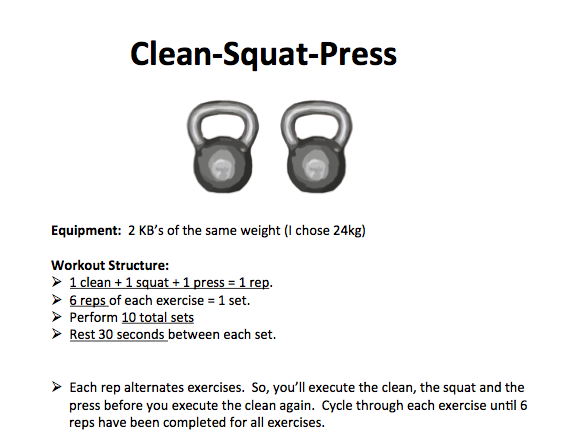
Transitioning to a different exercise on every rep makes this circuit more challenging.
Again, you’re not doing the same exercise for X amount of reps before moving onto the next exercise, you’re performing 1 rep of clean, then 1 rep of squat and then 1 rep of overhead press before circling back to the clean.
1 time through the clean + squat + press = 1 rep.
Each set consists of 6 reps per exercise. The workout is recommended for 10 total sets. That’s a grand total of 60 reps per exercise.
The kettlebell is constantly moving throughout the workout, changing levels and positions.
Rest periods. If a 30 second rest period is completely unmanageable for 8 rounds, TAKE LONGER REST. Try 45-60 seconds. When workouts are shared, whether on this blog or any other website, you must consider your own fitness level and make adjustments as needed. NOTHING is set in stone. Tweak the session to suit your needs.
Weight. Use moderate to heavy weight for this workout. I like 24kg for males and 12-18kg for females.
Because this little circuit is using 3 different exercises, the weight you choose will correspond to both the weakest exercise of the three AND the recommended reps.
The weakest exercise with either be the clean or the overhead press for most people, and the weight of the kettlebell should be something you can squeeze 2-3 additional reps out of.
So, if the overhead press is the weakest exercise, select the weight based on that and make sure you can press it 8-10 times (even though suggested reps are 6 each)









 M(eaux)tion Fitness