Airbike Workouts Part 1| Time, Distance, Recovery and Hybrid Variations

Airbike Workouts, Motion

Cardio Training

The airbike is a near total-body, beast of a conditioning tool.

I’ve been an avid user and advocate of airbikes for over 10 years so for what’s it worth, I will speak on their effectiveness as a conditioning tool.

I love to hate on my Assault Bike, always have.

But don’t let the rumors about airbikes scare you off.  Any workout on an airbike can be scaled to suit your current fitness level or goals for the workout.  Not every training session needs to be “torturous” or end of days.  

My experience with airbikes…

During the first 8 years, I owned the only airbike on the market, a large fan Schwinn Airdyne.  It was a vintage model: gold metal frame, plenty loud and weighed as much as a refrigerator.  For $150 on Craigslist, I couldn’t pass it up.   

The problem with the Airdyne bike is they break down.  Mine blew apart on me, literally.  Others who have owned these older model Airdyne bikes have probably had similar experiences.  The Airdyne was a great piece of equipment but had poor durability when used consistently with higher intensity workouts.  

The damage proved too much to repair (finding replacement parts is a nightmare),  so I chose to invest in the next generation airbike, the LifeCore Assault Airbike.  

The main reason for the purchase was my belief in the versatility and overall training effect an airbike can inject into a workout program.  Plus, once I purchased my Concept2 rower, the mechanics of each offset each other quite well.  

For the past 2 years, 33% of my machine-based cardio workouts have been satisfied using the Assault bike (33% on the rower, 33% running).  

I purchased my Assault Bike from Amazon.com with Free Prime Shipping, trust in Amazon as an online retailer and a killer price of $799 (usually $999).  The same deal is still live on the site to this day.  

Screen Shot 2017-06-27 at 6.05.02 AM

Though I felt it was important to share how I came into ownership of my current Assault bike, it’s not the point of this article.  

Enough with the back story, let’s talk about how you can bring airbikes into your training sessions using several different methods… 

Hybrid Work-Capacity Training

As mentioned earlier, airbikes are more versatile than most people know.  Sure, they provide a tremendous training effect on their own, but the challenge gets cranked up a notch when positioned inside of a bigger workout. 

Here’s an example of a hybrid workout (airbike mixed with other exercises):

Complete 5 Rounds (as fast as possible)

20 Squats

10 Pull-Ups

20 Push-Ups

15 Lunges

15 Hollow Body Rocks

20 calorie Airbike

*** Caution:  Your soul (and your oxygen) will be consumed by round 3 and fully digested by round 4 or 5.  

Workouts like this a built on simplicity.  No fancy exercises needed .  The focus of this workout is to perform as much work in as little time as possible.  

A 20 calorie ride may take roughly 25-40 seconds depending on how hard you’re pushing.  Choosing calories as the target can provide increased motivation to pedal harder since the calories will accumulate quicker with higher output, or slower with lower output.

Adding an airbike sprint to the end of each round adds an injury-free exertional challenge. 

Expect major fatigue here.

Airbikes kick ass alone…

Let’s not forget how great of a training stimulus airbikes provide by themselves.  

I’m talking about doing nothing else along with it, just hopping on the bike and working hard for a set period of time, distance or calories.

The 5-Mile Ride for Time is an excellent choice.

Keeping a workout simple can mean keeping your objectives simple, and is often the best choice for the day.

Sore or lacking time?…

For the individual who finds themselves frequently pressed for time but wants to workout, airbikes can provide a potent workout solutions in less than 20 minutes, including a warm-up.

That’s hard to beat.

Here’s a classic distance based interval training workout…

.3 Mile Sprints 


  • Complete 6-12 rounds of a target distance of .3 mile
  • Each sprint is 100% effort for best time.
  • Work:Rest Ratios (Example: 1:3 = 30 second sprint, 90 second rest)
    • Beginner – 1:4 
    • Intermediate – 1:2 or 1:3
    • Advanced – 1:1 or 1:2

An distance-based workout like this will take anywhere from 15-30 minutes, depending on how many rounds

If you’re capable of a 1:1 work-to-rest ratio without any significant drop-off in watt output in the later rounds, you’re an animal and probably need to increase the distance per work bout.  

Most people won’t touch a 1:1 work-to-rest scenario, and that’s perfectly ok. 

Progressive fitness is smart fitness, right?

A Recovery Option…  

For the person who’s suffering from delayed onset muscle soreness or simply looking for a low-impact workout, a long and slow ride on the airbike can serve as a great total body recovery tool.  

To measure effort best, I suggest using a heart rate monitor with chest strap to track beats per minute.  Try to keep heart rate below a target beats per minutes, say 130-150bpm.  Typically I aim for 150bpm with my recovery rides. 

If you don’t have a heart rate monitor, you can keep your RPM’s below a certain pace, anywhere from 55-70 RPM.  This pace translates well with the 130-150bpm suggestion.    

Both beats per minute and RPM’s will depend on your current fitness level of course.  Some folks with ride at 60RPM and see a heart rate of 150bpm.  Others could ride at the same pace and see a heart rate of 130bpm or less.  

This is fitness, unique to each person.

Once you identify a manageable pace, aim to ride for an extended distance or time.  

Personally, I prefer riding a distance of 10-15 miles or 30-40 minutes for recovery.  Grab some water and a towel, set the bike up in front of the TV, put the headphones in and start riding.  

Post-recovery ride, you should feel good, not drained, just good.

During interval training, pay attention to recovery…

My goals during an interval training workout are not solely centered around my output.  

Ability to recover quickly, fully and repeatedly is an important adaptation of training.  

It’s worth measuring from workout to workout, month to month.  Recovery tells a story.  For some it can indicate over-training.  For others, it can indicate improvements in cardiovascular conditioning.  

Example:  If your output is 1000 watts during interval #1 but drops off to 800 watts during interval #2, this is an indication you were not recovered enough between work bouts to maintain initial intensity.  You could expect interval #3 to be even worse.  

This is an example of a mis-managed workout.  The workout looked great on paper but didn’t translate well when it came time for application.  

Interval training, much like resistance training, should be programmed progressively.  If you’re a beginner, you’ll need more rest between work bouts.  If you’re well conditioned, you may need to decrease your rest periods or increase the work interval while maintaining a steady watt output.  

One major benefit of interval training with an airbike is the ability to start and stop quickly.  When the interval begins, it’s easy to get the bike up to speed.  The interval ends and it’s easy to back off and recover in a comfortable position and pace.  

Part of the art of interval training is managing the work bouts and the rest periods according to your fitness level and goals for the workout.  

We want to develop our ability to exert at higher and higher intensities (adding duration) during the interval, yet we also want to train our body to recover faster between efforts.  

If you’re tanking from fatigue on the first couple of intervals, it’s defeating the purpose altogether.

Monitoring improvements in recovery time can provide valuable insight on the body’s adaptation to physical exertion.  

With discipline, consistency and appropriate progression in interval length and rest periods, your body will improve its ability to exert but also recover from that exertion.

*** Beginners will take longer to recover after performing work than a more conditioned individual.  

Connect your mind to your body for recovery…

One important, yet overlooked strategy to recovery is to become AWARE.

Get in touch with how your body is feeling during the workout.  Check your breath.  Are you breathing deep, with control and purpose?  

Or are you neck breathing in full panic mode?

Control your breathing, calm your thoughts, do your best to relax during the rest periods.  

Allowing your thoughts run wild is the wrong way to recover, but it’s what we often default to when physical stress becomes overwhelming.  Developing capacity to control your mental self-talk in times of physical stress is a character builder.  

The mental-self frequently acts as a governor to the physical-self.  In other words, your mental will give out before your physical will.  

Physical stress alters our state, perceptions and rational thinking.

Learning to anticipate, manage and expand our ability to handle physical stress is important.  

It’s worth asking the question:  “Is this really that bad?”

Time-based Interval Training

Time-based interval training is a classic strategy to training on any piece of cardio equipment.  Comparing effort with time is highly applicable to sport, and provides great benefits to general population looking for tough workouts.    

Here are several of my favorites, varying in length:

Short: 20 seconds work/ 40 seconds rest

  • 1:2 Work-to-Rest Ratio
  • 5 to 10 rounds
  • All out sprint for 20 sec work interval.

Don’t hold back on this sprint.  20 seconds is short enough to max out your watts.

Intermediate: 30 seconds work/60 seconds rest

  • 1:2 Work-to-Rest Ratio
  • 6-8 rounds.
  • All out sprint for the 30 sec work interval.

Long: 60 Second work/120 second rest

  • 1:2 Work-to-Rest Ratio
  • 5-8 Rounds
  • Find pace for the 60 seconds.

Any working interval extending beyond 30-40 seconds will have to be paced.  

Maximum effort cannot be sustained across the timeframe.  With newer generation airbikes, managing effort can be gauged several ways: watts and RPM’s.  Use both to monitor output during the work interval.  

It will take some painful trial and error (and honesty) to pinpoint the highest output you’re capable of sustaining across during of 60 seconds.  

Choose an output based on the last 10-15 seconds of the work interval when fatigue is highest, not the first 30 seconds of the work interval.  

It’s easy to come out of the gates hard during interval training, only to see output drop off drastically.

The goal of this workout is to sustain end range output across the entire 60 seconds.  It’s important to note that end rage output for 60 seconds will not be the same as it is for 20-30 seconds.  

Closing it out… 

If you’ve read other posts on Meauxtion, my promotion of airbike training might seem to conflict with the current “movement culture” approach.  Maybe it does, maybe it doesn’t.

The cool part about fitness is there are MANY ways to “do” fitness, and I see value in participating in ALL of them.

Too much of any one “thing” can end up being a bad thing because you’re excluding other “things” that can provide value and balance.

Make sense?

Cardio machines such as airbikes, rowers, SkiErgs, and Versaclimbers serve a valuable purpose inside of a long-term term training regimen.  

Keep your mind open, train hard, and let me know how you did with these workouts.


Cheers,

Kyle


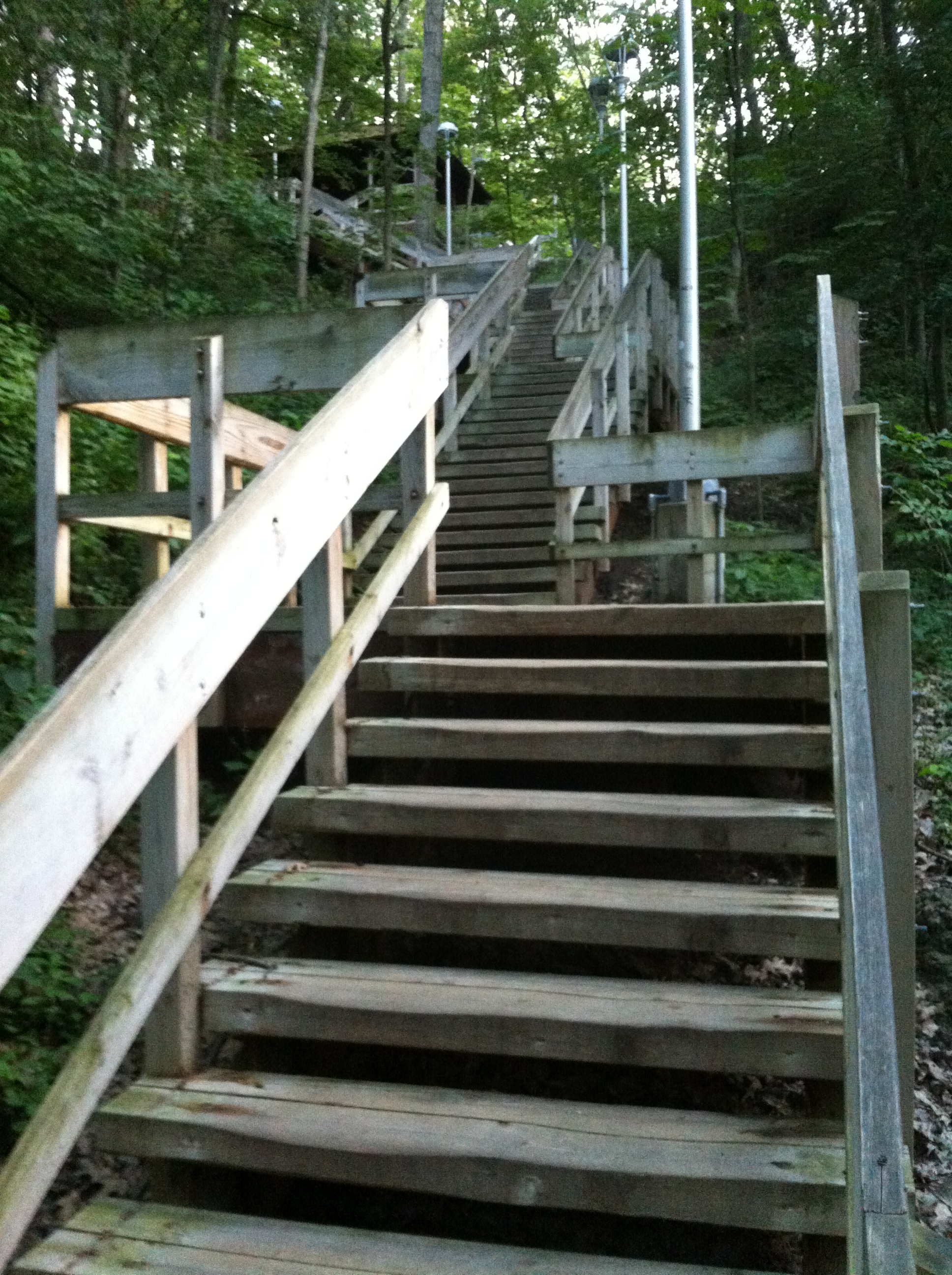
A Glimpse of a Sample Staircase Interval Workout

Quick Tips

There is really nothing like sprinting up and down a long staircase.

If you’re fortunate enough to have a staircase near you that is of decent length, congrats, you’re in luck.

By decent length, I am referring to a staircase that takes about 30 seconds or longer to run up at a brisk pace.

If you’ve never treated yourself to a staircase training session, you’re going to find that running vertically is nothing like running horizontally.  Every step/stride requires brute force and attention to detail.

Why attention to detail?

Because the split second that you get lazy or lose focus on what you’re doing, you’re going to miss a step and leave shin skin on the staircase.

Staircase running requires hip extension.  You can fake to make it for a little while, but you’ll find that opening up the hips and driving “down and back” with every stride is going to get you to the top faster and with a higher efficiency.  The hips are the powerhouse of the body, so you might as well use them if you have them, right?

Besides, your quads are overworked.  Let’s build a backside.

If you are finding that you cannot comfortable achieve hip extension, I would suggest regressing and addressing these issues quickly…

Here are some videos that might help…

Thanks KStarr.

Now on to the workout…

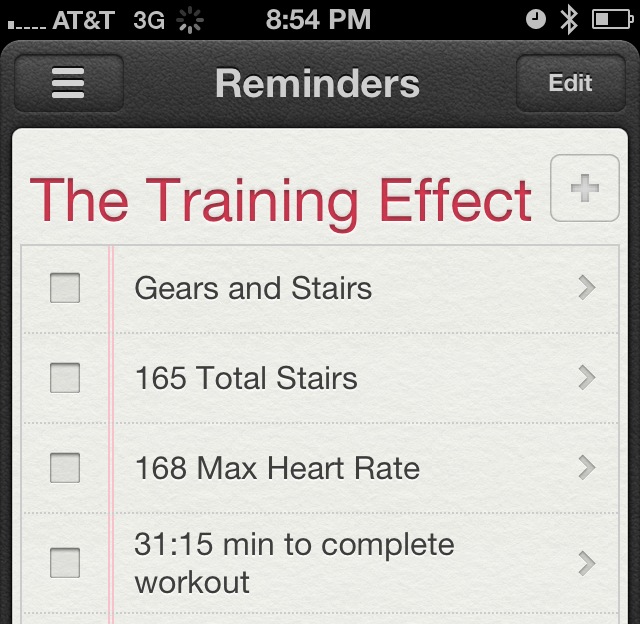
Staircase Interval Training165 glorious stairs

Staircase interval training

Total time from start to finish for this workout.

Staircase Interval Training

This is the break down of the workout.  30 minutes of work was my initial target.  I hit that.

My heart rate peaked at 168bpm, which I thought was surprising.  I thought that it would have been much higher.  I’ve seen it 175bpm while running trails.  Interesting.  I suspect that had the staircase taken me longer to run, I may have seen higher heart rates.

I have to disclose that I probably whipped through 12-13 rounds.  2 of these round were loaded up with kettlebells.  I brought my trusty 24kg LifeLine kettlebells with me for some fun carrying variations.  After looking at the length of the staircase and evaluating what I wanted from the workout, I decided that I would only use one kettlebell for these carrying drill.

I worked overhead, racked position and farmer carries, switching hands using a single arm swing hand transition + KB clean + Press.  I can explain this later, but I prefer using this method for switching hands during single kettlebell workouts.  Always loaded this way.

The general structure of the workout look like this:

  • Running the stairs took around 60 seconds (I think)
  • Rest periods were 1.5x-2x the length that it took to climb the stairs (or recovery to 130bpm)
  • Upper body focus was placed on arm action (elbow drive and hands to face) and keeping posture vertical versus slouching once fatigue set in.
  • Lower body was all about putting force into each stair and extending the hips aggressively, picture your feet as springs… explode!

Men’s Health ran an article almost a year and a half ago that I thought I would share because they included a research study out of the British Journal of Sports Medicine which concluded that stair climbing was pretty bad ass, even at relatively low output (just walking up).

Here is that article

One interesting thing to think about here.  Keep in mind that the speed with which you run the stairs is not the only quality we are aiming to build here.

We are also aiming to reduce the time it takes for you to recover, and repeat that effort.  Faster recovery is a sign of improving conditioning.

If you’re a weekend athlete or a movement enthusiast, increasing your ability to recover quickly from multiple bouts of vigorous activity is beneficial for performance and your body composition.

Runners, I would consider this an amazing supplement to improving your running endeavors.  You’re essentially lifting yourself with every stride while running a staircase, and focusing on explosive hip extension is what most of you could benefit from.  Get the hips involved people.


Cheers to training where other people aren’t…


KG

The Scientific 7 Minute Workout and Shortcuts

Quick Tips

Screen Shot 2013-06-05 at 1.29.46 PM

I don’t mind shortcuts.

If there is a more efficient way of completing a task or achieving a goal, I am all for it.

But shortcuts aren’t meant for everyone.  Some of us are always looking for shortcuts, the path of least resistance.  We abuse the shortcuts, and when the shortcuts become too challenging, they look for a shortcut to the shortcut.  Some people are always looking for shortcuts, a way out from doing the work.

When building fitness, I think that shortcuts are not appropriate for everyone.  People avoid physical exertion like the plague as it is, and now science is telling us that we can comfortably fulfill our daily activity needs in a matter of… wait for it…

Image

I respect science, but I cringe at how information like this is received by the public.  Now every personal trainer in America is going to be put on trial by their clients for holding 60 minute training sessions when The New York Times says that an effective workout can be achieved in 7 minutes flat.

With fitness, you get what you put in.  If you put forth an exceptional effort, you’ll get an exceptional reward.

If you put forth a crap effort, you’ll get a crap reward.  No secrets here.

In my experience, it’s tough to get a complete warm-up in 7 minutes time, especially when you are working to fix mobility and stability issues, let alone make a 7 minute workout change your body.

Is 7 minutes better than 0 minutes?  Of course it is.  If reading that New York Times article is the spark that you need to get you off the couch and moving, then god bless it.  Run with that motivation.  I can support that.

I have to assume that the article is only referring to building fitness, which is different than body transformation or fat loss.  Fitness does go hand in hand with accelerating body transformation, but 7 minutes won’t hold up against even an average nutritional effort.  If nutrition was perfect, you could make some decent gains (or should I say losses) with body transformation.

The main takeaway from the article (and the original research) was that short burst high intensity interval training can produce comparable health benefits to prolonged endurance training, if not better.

I know I have said this on this blog before, but I will continue to say it… what’s happening in innovative gyms across the country (and the world) at this very moment won’t be researched  for 2-3 years at least.  We have been executing -with great success- strength based workouts like the one below for years, and now the research comes.

In case you were wondering what the 7 minute workout entails, here is a snapshot from the New York Times site:

Image

With the exception of the abdominal crunches, I actually like all of the exercises listed in the workout.  It represents a minimalist total body (bodyweight) workout.  Not a bad little program.     The movements are require bodyweight strength based movements organized with minimal rest between movements.  Cardio strength.  I know you’ve heard that before.

Taxing your muscles to a high degree with minimal rest is an extremely effective way to accomplish performance improvement, body fat reduction and lean muscle gain in one shot.

Now that I think about it, this fitness news reminds me a lot of the Tabata intervals over-reaction that the fitness industry went through some years ago, but most of us have poured water on that fire.  Be careful not to mis-interpret the information and transform it into something that it was never intended to be.

And for someone who lacks the workout know-how, the diagram that was provided is perfect for that person.  My beef with still frame exercise tutorials has always been that it leaves A LOT unexplained.  You see the start of the movement, a mid-point and an end, but what does the entire movement look like?  What’s going on with the body in between those still shots?

In my early days of learning functional training, I used the still shot pictures of movements out of Mark Verstegen’s book (Core Performance), yet I never felt completely confident with what I was doing.  It was hard to know if what I was doing was an exact replication of what Mark wanted us to be doing.

Watching a video is better than still frame, and working with a knowledgeable professional is better than a video.  Hands on coaching from a good personal trainer is priceless, assuming they know what they are talking about.  If you are going to spend any money on a personal training, use it to learn the movements and get your technique down if nothing else.  Knowing how to execute basics movements like:  squats, lunges, chin ups, planks, push ups, cable movements, etc is well worth the money.  Learn how to execute big movements like deadlifts, front squats, split squats, bench press, rows, etc.

That’s an investment in your body for years to come.

Wrapping it up, give the 7 minute workout a shot, but don’t be afraid of physical exertion and increasing your body’s ability to handle that exertion.  Don’t shy away from training longer than 7 minutes, because that is just a recommendation.  Take your training to another level and see how it goes, learn something about yourself.

There is great long-term reward in pursuing physical endeavors throughout life.


Cheers to doing more than 7 minutes of exercise…


KG


3 Methods I Don’t Recommend for Interval Training

Pressed for Time, Pure Fat Loss

Interval training is definitely worth the time and energy.

I will just get that out in the open right away.

But, also remember that there is a lot more to building a lean body capable of quality movement, then well, interval training.

It’s not the end all be all, but when it is organized in an intelligent manner, it is effective as hell.

I often think about all of the possibilities available for organizing a solid interval training session.  I have tested them all, or nearly all of them.  I really am my own testing lab.  I take pride in that.  I would NEVER ask anyone to do something physically that I haven’t done myself.  That would make me uncomfortable and would be unprofessional in my opinion.

In my own experience, the magic of interval training comes when there is little technique skill involved in the exercises be used for that session.

I have talked about the golden rule of “first do no harm” to oneself (injury) in during a workout in the past.  Well, that same rule will hold true throughout the remainder of this article.

Let’s get to it.

Here are 3 Methods that I don’t recommend for interval training:


1)  Olympic Lifting

If you want my number one beef with a fitness brand that rhymes with “boss-knit”, here it is.  Using HIGHLY TECHNICAL lifts such as cleans and snatches to elicit a work capacity based effect, or “metabolic” as they refer to it now (it’s a catchy marketing term), it dumb.  It’s mindless.  Olympic lifts were never intended to be used to “burn fat” and “create athleticism” by being placed 3 movements into a 6 movement circuit.  I don’t care what your justification is or what Kool-Aid watering hole you are drinking from, olympic lifting will never be ok to perform for anything other than strict power development and rapid force production.  True sets of olympic lifts are organized early in a training session and surrounded by plenty of rest between sets, heavy loading and strict attention to technique and body position.

In my opinion, high rep sets of cleans used for developing work capacity and a training effect is making a complete mockery of a movement that is even in the Olympics as its own sport!  Guys and gals train daily for years to execute a lift with a load that can win them a gold medal, so what makes YOU (the 34 year old mother of two) think you can just walk into a gym and grind out a long set of 20 hang cleans?

If you want injury, this is your best route to it.  Risk vs. Reward.  Run your own evaluation.  End rant.


2)  Sprinting

I know this is going to piss some people off, but most of you physically cannot sprint and interval train at the same time.  Sprinting is a fast twitch, short duration, short distance sport that the average person just cannot execute in most cases.  If you are in fact sprinting, it is probably only for the first couple of work sets, followed by an up-tempo gallop (or limp in some cases).

Call it high tempo running instead, and we can meet in the middle.  What you are actually doing is running, and as your energy reserves deplete, you are now probably jogging.

What scares me about people announcing that they are sprinting for their interval training is the fact that a true sprint for any individual requires massive contraction from the musculature on the back of the legs (hamstrings, glutes).  For people who sit all day, your glutes are effectively “turned off”.  I guarantee it.  Your pelvis is probably tilted forward and your back is consistently stiff, right?  Are you hips tight too?  Your hamstrings are long and weak and now you are calling about both of those muscles to exert a large amount of force over a distance that is far to long.

Dessert:  Hamstring pull anyone?


3)  “Tabata” anything (other than on a stationary bike)

I touched on this in an older post, but cranking out a true Tabata is impossible.  Most will never know what it is like to hover around 170% effort and have your lungs and heart feel like it is going to explode.  But this is just human nature.  We will shut it down before we ever reach that point for some fear of high exertion? (just a guess)

Anyways, please please please do not fall into the Tabata pit.  Don’t believe the bullshit that your trainer is feeding you about this protocol being the greatest fat loss and conditioning method on the planet.

It’s not.  It’s fatiguing and grueling, but at the end of the day, it is just negative work to rest ratios with a high effort.

Most of all, if you are going to give this protocol a solid effort, don’t use anything other than a stationary bike.  Squatting, kettlebell swings, deadlifts, cleans, snatches, bench press, etc are all loaded movements that should be avoided at all costs using this method.

I know Dan John talked about ripping out a Tabata Protocol with front squats on T-Nation but I am here to tell you, don’t.  Loaded movement + high level fatigue is not for average folk.  If you have a high training age (years of training) I would still caution you.

Please take my advice here.  Injury may await you.


So there you have it.  3 methods that I am not very high on for interval training.  Remember, interval training can be effective and safe at the same time.  It doesn’t have to involve circus like movement coupled with heavy resistance.  It’s important to know your limits.  Just because a fitness author writes something crazy in a book as their “fat burning”, “performance enhancing” program, that doesn’t mean that you should do it.

David Blaine (the magician) held his breath for 17 minutes underwater in a giant glass egg in front of the world.  If he wrote about doing that, would you do it?

Probably not.


Cheers…


KG