The Benefits of Jump Rope Training

cardio, Motion

Jump rope training is packed with benefits.  Jumping over that tiny little rope can improve muscle strength and skeletal integrity (through medium ground impact force).  

The calories burned while jumping rope are high compared to other activities and including jump rope training in a workout regimen is a great way to get a potent cardio training effect with the body in a standing position, versus seated cardio machines.  

Lastly, jump ropes are inexpensive, versatile and simple to integrate with other training methods to increase the challenge and scope of your workouts.

Several years ago I wrote an article called:  Jumping Rope:  The Undeniable Negatives.

The article came off a bit, safe and cautionary.  To be honest, I was a lot younger then and my writing style wasn’t as clear and to the point as it is now.  Regardless, I feel some of the points made in that article are valid.

Jumping rope can be tough on the muscles and joints early on.  I don’t recommend a sedentary individual reach for a jump rope to initiate their exercise regimen.  If your body hasn’t been exposed to impact in a while (maybe never), jumping rope will annihilate your lower extremity muscles in the days afterward.  

But cautionary tales won’t be part of this article, so let’s get into the good stuff… 

… the benefits of jump rope training.

Inexpensive

If you’re looking for an inexpensive piece of fitness equipment, jump ropes are the ticket.

The last jump rope I purchased set me back $7 on Amazon over 3 years ago.  
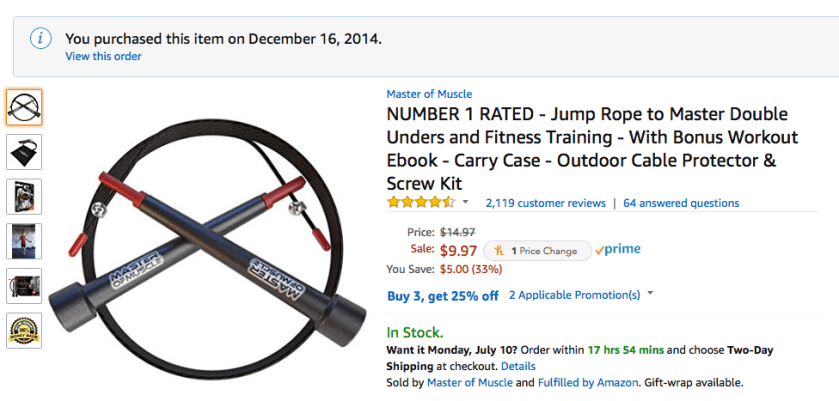
Screen Shot 2017-07-08 at 8.04.25 AM

Inflation.

The same rope is still kicking ass and serves as a valuable part of my pre-workout warm-ups, occasionally making appearances inside of metabolic conditioning workouts.  

36 months of use divided by $7 cost-to-own equals roughly $.19/month.  

Previous to my $7 jump rope, I purchased a $30+ jump rope from LifeLine Fitness which turned out to be a piece of shit for the cost.  

In the early 2000’s, LifeLine was considered to be the “functional fitness” company, so I was surprised at the quality and design of their jump ropes.  Durability was terrible and there was no way to adjust the length of the rope.  

So, when it was time to find another rope, I went with the thinnest cable based rope I could find and I have had no issues yet.  

Side-thought: One downside to jump ropes is they are a one-trick pony.  In other words, you can only really jump rope with a jump rope.  But hey, for $7-$15, who cares, it serves it’s purpose without breaking the bank.

Cost comparison to other popular forms of equipment-based cardio:

Jump Rope:  $7-$40

Concept2 Rower:  $950

Assault Airbike:  $799+

Versaclimber:  $2000+

Treadmill:  $900+

Jacobs Ladder:  $2500+

Non-Treadmill Running:  $50+ for shoes (dependent on weather)

* To be clear, I’m not advising you to stay away from any of these machines.  For machine-based cardio, each ranks high on the effectiveness list.  I personally own both a Concept2 rower and the Assault Airbike and wouldn’t have it any other way.

Environment/location/equipment friendly

I’m going to tackle this benefit in bullet point fashion.

  • Jump training doesn’t require a lot of room to train.
  • You can do it on the spot.
  • You can pack it up and travel with it, taking it anywhere.
  • You can train inside (not weather dependent)

If you’ve got a 6×6 space with a 7ft2inch high ceiling, you’re clear for jumping rope.  I know this because 70% of my workouts take place in my home basement, where space is limited but adequate for twirling a rope.  

Scalable for everyone

Any great piece of cardio training equipment is scalable to a wide range of skill and fitness levels.  Most are, but some are not.  

Beginners who are new to jump rope training can start with the basics:  two-foot jumps, alternating jumps etc.  


Turning up the intensity is simple:  turn the rope over faster.  

Don’t confuse “basics” with ineffective.  Exercises are best scaled to match fitness level, the challenge is therefore proportionate no matter how fit you are. 

Advanced jump rope training can include various single leg jumps, mixed medley jumping and double-unders (turning the rope under the feet twice per jump).  

High knees (running in place) while jumping rope is extremely taxing when performed for intervals of 30-60 seconds per work set.  A workout designed with 10-15 intervals will make you a believer in the cardio training effect of jumping rope.  

Just like a beginner, if an advanced trainee wants to increase the difficulty of their training sessions all you need to do is 

Duration of jumping rope can be adjusted for both beginners and advanced alike.  Adding a minute to a jump rope workout every week or two can have you jumping for 15-20 minutes in no time.  

However, once you hit 20 minutes of continuous jumping, I suggest adjusting the movement complexity of the jump or cranking up the tempo of the rope versus adding more time.  

Jump Rope Posture

As stated earlier, I love cardio equipment like rowers and airbikes, but these machines put people in a seated position to operate.

If sitting is the new smoking, and a lot of people are sitting too much throughout most days as it is, I don’t want you to come home and sit down to exercise.  This would be contributing to the epidemic.

Jumping rope puts a person in a standing position with shoulders pulled back and hips forward.  

It is difficult to jump rope with poor posture.  Doing so will likely limit the speed you’re able to turn the rope and also the jump technique.  Plus, it will be uncomfortable to hunch over and jump.  

Any physical activity getting a person uncoiled from the seated posture is a great option.  

Great for Pre-Workout Warm-Ups

After some basic stretching and mobility work, grab a jump rope and work through roughly 5-10 minutes of medium-intensity rhythmic jumping.  Work a medley of jumps:  two-foot jumps, high knees, single leg, back and forth, side to side and lower body boxer twists.  

I promise you will find little else as simple and effective to get your body and mind prepared for a workout.  

Again, getting the blood flowing pre-workout in a standing position is ideal.

Impressive calorie burn

Jumping rope can burn up to 700 calories per hour.

But here’s the deal, I don’t think anyone should be jumping rope for 60 minutes, it’s too much volume.  If you have the attention span and endurance to turn a rope for 60 unbroken minutes, you’re a badass.  

In terms of training volume and ground contacts, 60 minutes of jump rope training is sort of like running a marathon every week.  There are obvious dangers associated with both (overuse, overtraining, lack of variety, etc).

I don’t recommend choosing exercises based on calorie burn, it can develop favoritism toward certain activities while and excluding others.  Balance is the key.    

However, jump rope training does use up an impressive amount of energy which means a larger amount of calories being burned in the same amount of time when compared to other popular activities like running, cycling and swimming.  

Weight Loss/Fat Loss

Jumping rope consistently can help you look better naked.  See reasons above for why.

Jumping rope burns calories.  Increasing calories out compared to calories taken in is a scientifically backed strategy for both weight loss and fat loss.  Calories in versus calories out.  Of course, the quality of calories taken in will influence the rate of weight loss and fat burning a great deal also.

Combine a decent nutritional regimen with some quality jump rope training and you’ll see a major shift in body composition.  Intermittent Fasting is hot diet pattern right now.

Cardio Integration

This is the real reason why I love jumping rope.  Supplementing jump rope training in with rowing, biking, running and bodyweight metabolic conditioning workouts keeps workouts challenging and fresh.

Fact #1:  If you look forward to your workouts, you’ll keep training.  

Fact #2:  If you despise your workouts, you’ll fade to doing nothing quickly. 

Jumping rope after pre-fatiguing your body with other exercises provides a great challenge.  When muscles are tired, posture degrades, so turning the rope while huffing and puffing demands an increased level of focus.  

Here’s quick and dirty bodyweight and jump rope workout for you to try:

10 Squats

10 Push Ups 

1 Minute Jump Rope

10 Lunges

10 Body Rows or Pull Ups

1 Minute jump rope

8 Hollow Body Rocks

Complete 5 rounds as fast as possible.  Record your time and re-test in a month or so.

If you completed 5 rounds, the numbers break down like this:

  •  10 minutes of jumping rope
  •  50 squats
  •  50 push ups
  •  50 lunges (per leg)
  •  50 body rows/pull ups
  •  40 hollow body rocks

If you’re in the market for developing work capacity and burning fat in the process, simple and effective workouts like this are essential.  

Splitting up the jump rope into 1-minute bursts will make you feel like you’re hardly jumping.  But as the numbers show, you actually accumulated 10 minutes worth.  Not bad.   

Over the course of the next few months, you’ll see an increased number of full workouts posted to this blog, and my YouTube page.  If you’re interested in following along, I suggest you subscribe for updates.  

I’ll be keeping things fresh for a long, long time.  

If you got some value from this post, I’d like to expose you to several other popular posts my readers have enjoyed:

Now, stop reading and thinking, grab a rope and go crush a workout. 


Cheers to the benefits of jump rope training, 

Kyle 

Jumping Rope: The Undeniable Negatives (Part 1)

Quick Tips

Summary:

  • Jumping rope can be hard on the joints if done excessively.  
  • The learning curve can be a turn off.  
  • Don’t let me talk you out of jumping rope.

Jumping rope is a low cost, medium to high-skill activity people have been leveraging to build impressive cardio fitness for a long, long time.  Particularly athletes in the combat sports, boxing and mixed martial arts.

As a cardio enhancer, jumping rope is making a resurgence.

Here I am working the Ali Shuffle, and other patterns of jumping rope.  

Modern day metabolic conditioning is giving the jump rope a reason to play a large part of many high-intensity workouts.  

Screen Shot 2013-06-25 at 6.37.53 AM

When you’re a kid, you jump rope… 

As a kid, I can vividly remember jumping rope in elementary school.  We had a yearly fundraiser called “Jump Rope for Heart”.  All the kids brought their jump ropes down to the gym, they pumped some 90’s dance music, and we jumped for hours.

I was never the best rope skipper in the gym, but I could hold my own by showcasing classy moves like crossovers, single and alternate leg hops, and even surviving in the infamous Double Dutch vortex.

As a kid, you don’t over-analyze the value of jumping rope.  You jump because it’s fun, not because you want to know how to burn more calories or lose weight.  Jumping rope provides an outlet for kids to burn off extra energy while

Jumping rope provides an outlet for kids to burn off extra energy while

But then adulthood stumbles in.  Jumping rope is no longer cool, it’s taboo.  

When you’re a kid, you move for the fun of it, when you’re an adult, any movement beyond what’s necessary becomes a chore.

As we age, many ask less and less from our bodies.

The “fun” part of hopping over the turning jumping rope seems like the furthest thing in adulthood.  

“You want me to what?  Uh, no thanks”.  

Exerting on purpose as an adult becomes a depressive thought.

Screen Shot 2013-06-25 at 7.05.36 AM

But when mainstream media picks up on the trends, it often reignites our interest in old training methods.  

Screen Shot 2013-06-25 at 7.05.46 AM

Naturally, we head to the sporting good store and buy a badass jump rope. 

But before you start jumping, let’s work through a couple of hang-ups I have with jump rope training.  Particularly if you haven’t exercised in a while.  

1)  Repetitive ground impact and overuse injuries.

Screen Shot 2013-06-25 at 7.04.32 AM

Any activity overdone is going to put you at risk for overuse injuries.  

Too much of a good thing is generally a bad thing.  Drink too much water, bad thing.  Eat too much broccoli, bad thing.  Exercise too much, bad thing.

Overuse injuries certainly aren’t a jumping rope problem per say.  Overuse injuries often occur because of excess volume or intensity (or both combined) relative to what the tissue tolerance is capable of managing.  

If you’ve ever run barefoot or with minimalist shoes without some kind of pre-workout up, the extreme soreness you felt in the days after is a perfect example of impact forces overwhelming the tissues without any shock absorption.  

In other words, physical stress beyond what the body is acclimated to can create some painful issues.

As for jumping rope, it’s the ground impact forces doing the damage.  Every single jump places strain on the legs, particularly the calves and ankles.

How much strain?  Roughly 300lbs of impact is directed toward the foot and ankle while jumping rope, as measured by lab tests.

But this isn’t 300lbs just one time… it’s 300lbs multiplied by thousands of jumps per workout. Thi can be a recipe for injury if your body is not acclimated progressively.

If a person is spinning a jump rope at an average of 100-120 revolutions per minute, a 10-minute workout can add up to about 1,000-1,200 jumps.

Jumping rope for 10 minutes is nothing like running for 10 minutes.  These are two completely different stresses.  Time seems to stand still when you jump rope.  10 minutes can feel like 30 minutes.

Many websites recommend “20-minute jump rope workouts for toning”, but I am extremely hesitant to encourage anyone to jump for 20 minutes as a starting point.

Start with 1 minute unbroken, then 2 minutes… 5 minutes… 10 minute, etc.

10 full minutes of jumping rope without stopping for breaks is a commendable feat.  Once you hit 10 minutes, it’s time to go harder or increase the difficulty of the jumps (1-foot, side-to-side, running).

Now, the impact forces of jumping rope are far less than running. 

If you haven’t jumped 1,000+ times in a while, or you’re a de-conditioned individual who hasn’t engaged in moderate to high physical activity in some time, you stand a high likelihood of sidelining yourself after a short duration of jumping rope.  

Jumping rope is a sub-maximal variation of plyometrics (jump training), which can be very high-impact. Plyometric training is best kept to reasonable volumes during a workout.  Most high-level athletes are jumping anywhere from 25-40 foot contacts per workout in the off-season.  

Lesson:  Work into your jump rope training, progressively adding minutes to each session.  If you’re a beginner, consider jumping from less than 5 minutes cumulatively per workout.  You can always build up.  

2)  Learning curve versus training stimulus.

Screen Shot 2013-06-25 at 7.03.02 AM

Here’s a realistic scenario…

You go out and buy a jump rope to whip yourself into shape.  You get that baby home, rip it out of the packaging and head to the garage.  After you put on your workout playlist, get ready to turn the rope over like Muhammad Ali.  

Wham!  You catch your feet and stomp the rope on the very first turn.  Hey, no problem, it’s the first time in a long time you tell yourself.  Here we go again…

Wham!  Shins this time.  Wham!  Ceiling got in the way.  Wham!  Back of your head, not enough tension on the twirl.  Wham!  Toes again, but somehow this time the rope tied a knot that you have to unravel.  Damn, a tight knot too.  

Next thing you know, the rope is 10 inches shorter and you’ve wasted 45 minutes jumping 25 times.  Ouch.

Don’t laugh now.  This is a real scenario, I’ve seen it happen to coordinated athletes, so I know it is happening to the average Joe and Jane all over the world.  

The real benefits of jumping rope comes from continuous jumping.  In other words, getting hung up on your toes every fifth turn isn’t going to allow for any real training effect.  You won’t be exerting long enough to accomplish much.  

I applaud your spirit and motivation, but we have to consider one thing…

Jumping rope is a skill.  And like any skill, we all have a unique starting point and learning curves of various lengths to become better at that skill.  Some will acclimate to the rhythm faster than others.  Here’s another important thing to consider:  some of us have a higher resilience for knowing that we suck at activities, yet continue to practice until the day we move passed the “suck” stage.   

If you’re terrible at jumping rope AND you have a tendency to shut down at first encounter of resistance, consider saving jump rope practice for after normal gym work, when you have peace of mind that some quality work was put in.  

But don’t let me turn you off from jumping.  Get after it.  But beware, you may not have the workout of your life on the first go around.  

If your goal is to get into shape ASAP, and for many people it is.  Riding the struggle bus for 15-20 minutes a day just to turn a rope 10 consecutive times without stepping on it won’t sound like fun to most people.

Therefore, it may be worth considering that the jump rope can take a backseat to bread and butter activities like running, cycling, rowing or lifting weights.  Even a potent bodyweight workout should be considered before re-engaging with the rope of death.  Talk about defeating.  

Again, jumping rope is a skill.  Expect it to involve failure, slow progress, and patience.  

If you’re lucky, you’ll hop right into it.  If you’re not, I warned you.  

Lesson:  Treat jumping rope like a skill.  Dedicate a small amount of time before or after your main workout to improving your jump proficiency.  Don’t make the mistake of putting all of your eggs in the jump rope basket, only to find out you can only manage 10 seconds of continuous movement before you smash your toes.

This tip will save you a lot of frustration.

3)  Cardio benefits over-hyped.

Screen Shot 2013-06-25 at 7.01.19 AM

Yes, jumping rope burns calories, but so does doing the laundry or making the bed.

Yes, jumping rope can improve cardiovascular function, but so does push mowing the yard.   help reinforce posture during exertion.  

Yes, jumping rope can be a decent reinforcer of upright posture, but so is waiting in line for public transit.

Compared to running, rowing, cycling, kettlebell swings/snatches, burpees, or smart bodyweight circuits, jumping rope delivers less bang for you cardio conditioning buck.   

Some of this circles back to the learning curve and the barrier it has to a reasonable training effect.  

I’ve seen videos of Ross Enaimat spinning a jump rope so fast I wasn’t even sure it was still in his hands, but not everyone is Ross Enaimat.  

He’s got over a million views on some of his YouTube videos from people eating popcorn watching him sweat, aspiring to have his conditioning without putting any effort in.

Returning to my previous point about training effect, head out to your local hill for some incline sprints or pick up your heaviest kettlebell and swing away.  

You’ll probably find time is better spent elsewhere to get that conditioning stimulus.

Adaptation sadness…

At some point, you’re going to experience diminishing returns on your efforts.  This is called adaptation.  It’s a good thing and a bad thing.  It’s good because you’ve established an efficiency at a certain skill, intensity, and duration.  It’s a bad thing because now, you have to push yourself harder to keep progressing.  

Adaptation is bound to happen with any activity you commit to doing on a regular basis.  It’s only a matter of time.  

When you reach this adaptation point, it is important to remember that jumping rope is no different from any other form of exercise.  You have to re-adjust the variables in order to continue progressing and break out of your adaptation, moving forward to the next level of adaptation.

The problem, once again, circles back to the issue of learning curve.  Once you’re a pro with single hops and the duration of jumping is hovering around 15-20 minutes, personally, I feel it’s time to figure out how to leverage the next progression in order to save your precious time.  Unless you love jumping rope that much.  

So how do we progress?  Well, you could…

  •  Buy a weighted jump rope
  •  Increase the tempo of the jumps (turn the rope faster)
  •  Decrease base of support (single leg hopping)
  •  Mix and match various jumps (front to back, side to side, boxer jump, high knees, etc)
  •  Move on to Double-Unders

Adjusting any one of these variables will progress the training stimulus and keep you away from stagnation.

Wrap Up…

You’ll notice that this post is more of a cautionary tale than anything.  

Personally, I jump rope before almost every single workout.  I love it.  It get’s me in a standing position and it serves as a great warm-up prior the tough part of my training sessions.  

Jumping rope is not a bad activity.  But, it’s important to know how it could be bad, and where the disadvantages are.  Probably the most important part of this article is the warning about overdoing it.  The impact can leave you limping for days afterward.  

Some of you will be able to pick up a jump rope and get after it aggressively from the start.  Others won’t make it 3 consecutive turns without tying a noose around your ankles or blooding up your toes.

Get to know yourself, your current physical conditioning level, and make a decision if jumping rope is right for you.  If it is, schedule some practice time before or after a workout to hone your jumping skills and acclimate your body to the stress.  

This article would be a real let down if I didn’t recommend at least one great resource to related to jump rope training:

If you found this article while searching for alternatives to high-impact activity, I highly recommend you to check out these posts:

Cheers, 

Kyle