Hang In There… The Kettlebell Clean is a Great Exercise and an Acquired Taste

Quick Tips

The kettlebell clean is an acquired taste, for sure.

It reminds me of a craft beer drinkers first sips of an I.P.A. or a Double I.P.A.  Do you remember the bitter beer face commercials?

One quick search on the old Dragon Door article library or the new StrongFirst forum, and people will praise the hell out of this move, but I am here to warn you up front, you might not enjoy this exercise at first.

It’s an acquired taste.

Both from a technique standpoint and a “Why the hell would I choose this exercise over kettlebell swing variations, kettlebell snatches, weighted jump squats or even barbell cleans”?… standpoint.

For quite some time, I wasn’t exactly sure what significant purpose kettlebell cleans served.

At that time, the kettlebell clean seemed more like a sweet little method to move the kettlebell from the floor up to the rack position, and not much more than that.

Photo credit:  FitBomb

Photo credit: FitBomb

In case you’re not familiar, the rack position describes a static posture where the bell rests for a given amount of time (split second or for multiple seconds) against the chest with elbow tucked tightly to the side.

Also, at that time, my timing was way off with the kettlebell clean.  I was mostly pulling the bell up from between my legs using my upper extremities, and flipping it over the top of my knuckles.  Obviously, the upper body does have some involvement in most kettlebell training, but one of the main principles of any ballistic kettlebell movement is hip snap.  I have always viewed “hip snap” as the slang terminology for aggressive/powerful extension of the hips.

Kettlebell drills like swings, snatches and cleans all thrive off of aggressive hip extension, or hip snap to catapult the bell through its trajectory/range of motion.

[Improving your ability to aggressively extend your hips is incredible for sport performance and fat loss.  The research on the influence that kettlebell swings has on body fat elimination has been growing rather consistently in recent months.  Anyone that has spent any time working out with kettlebells in a dedicated manner will no doubt give the nod to kettlebell training (specifically swings, cleans, snatches) and its dramatic effect on fat loss.  Almost to the point of zero dietary intervention.  That’s not to say that you shouldn’t pursue higher standards of eating… because you should.]  

Ok, back to kettlebell cleans.  Originally, I didn’t like them.  I just didn’t see the value.  Swings (moving the bell to about sternum height) provided a noticeably large training stimulus that mimicked an explosive deadlift and kettlebell snatches (moving the kettlebell overhead) worked very similar to dumbbell snatches, which are amazing for building uni-lateral explosive power.

But kettlebell cleans seemed like the red-headed step child (forgive my joke if this offends anyone).  I kept asking myself,  “What are they good for?”

I never felt like I was achieving anything while practicing the kettlebell clean.  The hip snap didn’t feel like it was present, and quite frankly, it didn’t seem like it really needed to be present in order to execute the clean.  So then what?

Again, as I stated early in this post, the clean (to me) felt like an efficient method to transport the kettlebell vertically to the rack position so that I could set up for other exercises like:  squats, overhead pressing or carries.

Eventually, I made the decision to work on my clean technique in a diligent manner.  I also spent some time combing over the forums and articles from trusted resources for to increase my understanding of what the kettlebell clean is and why it was important.

Here’s a messy synopsis of what I found…

From a basic observation, I thought of the kettlebell clean as a variation of the swing, and still do.  Obviously the motion is different, but hiking the kettlebell through the legs, moving forward into an arcing pattern is very similar to that of the kettlebell swing.  However this arching pattern is interrupted as the hand/arm pulls the bell much tighter to the anterior (front) aspect of the body than the arc of the kettlebell swing.  Some people will refer to this as “taming the arc”.

You can read more about “taming the arc” from this excerpt:

Kettlebell Taming the Arc

Once the bell begins its ascent vertically to the chest, this is where most people will get lost, as I did.

Why?  Because in the time that it takes to blink your eyes, the bell needs to transition from a prone (hand over the top) grip to a neutral grip (palm toward the midline of the body) with the kettlebell nestled partially against the forearm and chest, at armpit height.  The entire sequence happens really quickly.

The most common mistake here is “flipping” the bell.  Technically, it’s incorrect yes, but the bigger mistake is that flipping the bell over the hand is essentially beating yourself with the greatest mass of the kettlebell.  Kettlebells are constructed of dense cast iron so… it hurts.  Once the bell flips over the hand, the only object to stop its motion is your body, and this can be painful.  If you’ve played contact sports, the sensation of the bell impacting your body will be eerily similar to the impact of another human hitting you.

So what is supposed to happen?

Around waist height, the bell begins to turn over and rotate.  It’s a combination of both.  The only way to successfully accomplish this, is to relax your grip and allow the kettlebell to turn over/rotate around your forearm.  I said RELAX, NOT LET GO.  Your hand position changes on the bell, without your hand ever leaving the bell.  I use the terminology turn over/rotate because I feel this is the best description of what happens to the kettlebell as it transitions into the rack position hand position changes on the bell, without your hand ever leaving the bell.

This “relaxed” grip was uncomfortable for me at first.  It didn’t feel natural to loosen a grip and relax while dynamically swinging a 53lb piece of cast iron.  I am sure that you might feel the same way when you give this movement a go.  It can be unsettling for the first few reps.  Make sure that your hands are dry and free of any grease.

Chalking your hands is a great technique for improving hand/grip integrity kettlebell training, although chalking can be messy for you house over time.  Check out this Metolius Eco Ball chalk bag that really helps to save yourself the hassle of cleaning up chalk mess.

But, like anything other new stimulus or skill, consistent practice will move your  technique of the clean from completely foreign to second nature.

Filming my kettlebell clean (which I encourage you to do always) revealed that I wasn’t initiating my turn over/rotation of the bell soon enough.  I was attempting to mimic the barbell clean, where the hands and elbows (and body) move under the vertical moving barbell above waist level.

Again, if you attempt to “flip” the kettelbell above waist level you’re going to get some tough love from the bell in the form of a shot to the chest/shoulder.  As long as you don’t hurt yourself, this type of feedback is probably a good thing, as there will be no question that your timing is off.

The kettlebell should park itself into the rack position rather peacefully.

The kettllebell clean is a “steering strength” movement that requires adequate attention for successful completion.

You might start out despising it like I did and end up loving it as I do now.

A series of simple tips that can help you out:

  • In the beginning feel free to learn using a lighter bell.  This is important.
  • Quickly move into a heavier kettlebell that demands some  hip snap to make the bell move.  Otherwise, you may find yourself “muscling” the bell as I was.
  • Work the single arm kettlebell clean until you feel you are proficient with technique at heavier weights.  Forget about “work capacity” training while you are learning, learn it first, don’t get ahead of yourself.
  • Once you’re moving a heavier kettlebell (32kg men/24kg women), consider transitioning into the double kettlebell clean, which will require attention to be paid to both arms and an increase in hip snap to move the bells to the rack position.
  • Practice, practice, practice.

On a positive note, if decide to dedicate some time and practice into learning the kettlebell clean, you’re going to find great carryover to all of your other lifts also (kettlebell swings, presses, etc).  The move requires timing and coordination, but improving both will boost your performance and your results in the race to lose fat.

The clean is nothing that I thought it was and everything that I thought that it wasn’t.  I have been pleasantly surprised and challenged by its technique and it’s purpose inside of a balanced strength and conditioning program.  I highly suggest that you work it for yourself and see how it benefits you.


Cheers to kettlebell cleans babies!

KG

The RKC Deep Six Kettlebell Workout

Kettlebell Training


The RKC Deep Six Kettlebell Workout is movement challenge that creates a potent cardio and strength training effect using six of the best kettlebell exercises. 

  • Snatch
  • Swing
  • Clean and Press
  • Squat
  • Turkish Get-Up

There are hundreds, if not thousands of kettlebell exercise variations stemming from these six exercises.  

The “original 6” kettlebell exercises create the foundation on which pretty much all other results-based kettlebell training is built.  

For the home gym, this type of training is perfect.    

The RKC Deep Six Kettlebell Workout ONLY requires 1 kettlebell and leverages HIGH VALUE exercises.  

The RKC Deep Six Workout

The RKC Deep Six Workout leverages the effectiveness of the six premiere kettlebell exercises.  

Snatch, swing, clean and press, squat and Turkish Get Ups.  

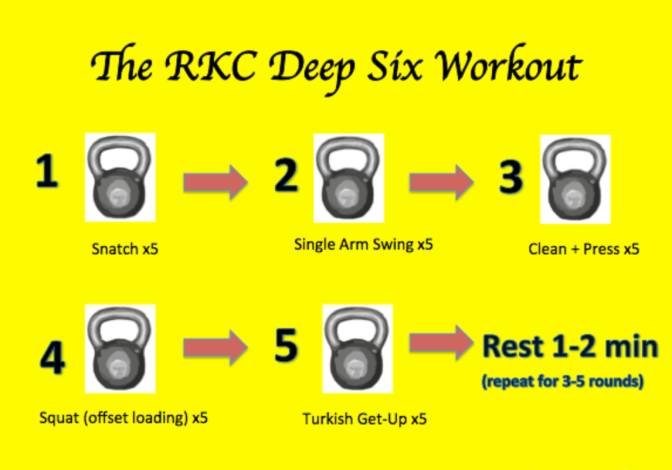
Here’s what the workout looks like.

Screen Shot 2020-07-29 at 8.20.49 AM

Workout Structure

Each movement is performed in the order above, 1 through 5, starting with snatches.

Complete 5 snacthes, move to 5 reps of single-arm swings, then 5 reps of clean to press, and so on.

Each exercise must be performed on BOTH SIDES OF THE BODY before advancing to the next exercise.

Again, the exercise order and repetition structure of The RKC Deep Six Kettlebell Workout looks the following:

5 Snatches

5 Single Arm Swings

5 Clean to Press

5 Squats

1 Turkish Get-Up

  • 5 reps per exercise (except turkish get-ups) per arm.
  • 3-5 total rounds
  • 1-2 minutes rest after each round.

Turkish get-ups are the only exercise following a different rep structure, 1 rep per side.  

Change hands/sides after the Turkish Get-Up.  

Changing Sides with the Kettlebell 

If possible, transition the kettlebell from side-to-side without letting the kettlebell touch the floor.  

This requires a hand-to-hand swing transition, which looks this:


If you’re unfamiliar with hand-to-hand transitioning, don’t worry.   

Slow the kettlebell and set it down.  Pick it up with the other hand and continue the workout.

Rest Periods

Rest periods are an important consideration for training hard and smart.   

Exert, then rest.  Gear up for the next round.

The decision to increase or decrease rest periods will depend on your fitness level and past experience.  

It’s better to start with longer rest periods and shave the rest period duration down as you see fit.  Chase movement quality, not extreme fatigue.    

In general, plan on resting 1-2 minutes between each round.

Hands Dry and Know the Exercises

Keep a towel nearby to dry your hands.

Snatches, swings and clean are all exercises that require a good grip on the kettlebell.

If sweat gets between your hands and the kettlebell, it’s extremely slippery and can result in slippage.  Losing hold of a even a light kettlebell will destroy bones. 

Exclude any exercises you’re unfamiliar with.  I say again, learn all of these exercses in isolation, free of accumulating fatigue and sloppy body position.  

You should be proficient in each of these exercise before trying this workout.

How often should you do this workout? 

You could use this workout 2-3 times a week.  

Monitor your fatigue level and don’t force a workout if it’s not right.  

People get excited about exercise and tend to overdo it.

I’d suggest positioning this workout in with other activities like active mobility training, resistance training, steady-state cardio and plenty of walking.

Yes, walking.  Walking will change your body and life.

Weight

You’ll have to play around with the best weight.  Sounnds like shit advice, but different fitness levels will find different weights challenging.  

Males might want to start with 16kg-24kg.

Females might start with 12kg-20kg.

These are general weight recommendations.  Go heavier or lighter depending on your fitness level.  

Investing in 3 different weight kettlebells is a nice approach.  

A light, medium and heavy option.  This allows for regressing or progressing the load used for an exercise if needed.

Scale this Workout to YOUR Fitness Level

Adaptation to physical stress can occur quickly with discipline and consistency.

If you do the same workout over and over, without your gains will come to a halt.  

Simple ways to INCREASE the difficulty:

  • Increase kettlebell weight
  • Add more reps per exercise
  • Add more rounds per workout
  • Decrease the length of rest periods in between rounds

Did you cruise through all 5 rounds no problem?  Bump up to the next size kettlebell.  Increasing weight is a simple way to challenge your training. 

Conversely, to DECREASE the difficulty, do the exact opposite of the bulleted points above.

  • Decrease kettlebell weight
  • Lower the reps per exercise
  • Lower reps per exercise
  • Remove rounds per workout
  • Increase the length of rest periods in between rounds.

Kettlebell training is brutally effective, and few other gym tools are as versatile. 

The RKC Deep Six Workout is a good example of how effective simple exercises can be.  

You’re getting cardio and strength in one shot, while keeping the workout time efficient.   

Forget spending hours in the gym.  

Turkish Get Up Favoritism

Turkish Get Ups are a game-changing exercise.  

TGUs are my go-to movement for building total body strength.

They’re incredible.  Maybe a little more of a learning curve, but well worth familiarizing.

👉 Read more about one of my favorite TGU and swing workouts here.


Learn more about kettlebell training

👉 Kettlebell Swings|Benefits and Workout Ideas

👉 3 Fresh Turkish Get Up Variations

👉 Kettlebell Clean – Press – Squat Combination


A Tough 20 Minute Kettlebell Workout: Clean+Squat+Press

20 minute Workouts, Kettlebell Training

Simple training delivers results.

And what’s more simple than taking a clean, squat and press and forming it into a great workout?

Today I’m sharing a 20 minute kettlebell workout that incorporates three tried and true exercises.

The training effect is awesome, and the time investment is minimal.

I’m a connoisseur of exercises and using basic equipment to create great workout, but I always keep focus on movement patterns. Compound exercises that train the entire body. Keep

Keeping it simple, for me, is keeping it effective. Simplicity eliminates decision fatigue and increases my focus and productivity.

Do less, but do it better.

Here are the 3 exercises we’ll be using for the workout:

Double Kettlebell Cleans

Double Kettlebell Squat

Double Overhead Kettlebell Press

Just three exercises, and good ones at that.

The clean, squat and press are time-tested exercises for building power, strength and muscle.

Kettlebell cleans are an hip hinging ballistic/explosive total body movement.

Kettlebell squats are a lower-body pushing exercise.

Kettlebell overhead press trains the vertical push pattern, which has great carryover to the daily living.

Combining all 3 exercises into a circuit makes it a total body effort. Plus, keeping the rest periods short and completing multiple rounds, the training effect is potent.

If calorie are in check, workouts like this are great for keeping muscle and accelerating fat loss.

Warm-up

Always work through a warm-up to prepare your body for more intense work ahead.

10-15 minutes is all you need to get a warm-up, work through mobility drills, lightly loaded movement patterns and raise core temperature.  

Here are some GREAT movements for warm-ups:

14 Exercise Full Body Warm Up

The pre-workout period will also give you an opportunity to assess how your body is feeling on that particular day.

Not feeling it? Run down? Poor night’s sleep, stress, etc? Don’t be afraid to work through a warm up, but bypass the workout for the day. Come back tomorrow fresh and focused.

Much of my pre-workout warm-ups are infused with ground-based movements and active joint mobility training.

On the tail end of the warm-up, I’ll jump rope, flow with a macebell or practice some lighter kettlebell drills.

The Workout:

Image

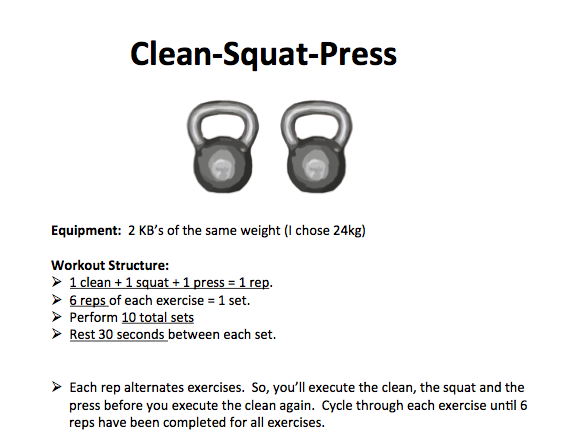
Transitioning to a different exercise on every rep makes this circuit more challenging.

Again, you’re not doing the same exercise for X amount of reps before moving onto the next exercise, you’re performing 1 rep of clean, then 1 rep of squat and then 1 rep of overhead press before circling back to the clean.

1 time through the clean + squat + press = 1 rep.

Each set consists of 6 reps per exercise. The workout is recommended for 10 total sets. That’s a grand total of 60 reps per exercise.

The kettlebell is constantly moving throughout the workout, changing levels and positions.

Rest periods. If a 30 second rest period is completely unmanageable for 8 rounds, TAKE LONGER REST. Try 45-60 seconds. When workouts are shared, whether on this blog or any other website, you must consider your own fitness level and make adjustments as needed. NOTHING is set in stone. Tweak the session to suit your needs.

Weight. Use moderate to heavy weight for this workout. I like 24kg for males and 12-18kg for females.

Because this little circuit is using 3 different exercises, the weight you choose will correspond to both the weakest exercise of the three AND the recommended reps.

The weakest exercise with either be the clean or the overhead press for most people, and the weight of the kettlebell should be something you can squeeze 2-3 additional reps out of.

So, if the overhead press is the weakest exercise, select the weight based on that and make sure you can press it 8-10 times (even though suggested reps are 6 each)

Related Articles

Home Gym Workouts! Total Body Sandbag Circuit for Fat Loss and Muscle

Locomotion| The Weighted Lizard Crawl

One Kettlebell, 3 Fat Loss Workouts