The goal was to keep the workout brief. Under 20 minutes.
20 minutes is a sweet spot for me, especially with higher intensity efforts.
I’m able to get the training effect I want, without losing technique to fatigue or subjecting myself to unnecessary injury.
Higher quality work in shorter amount of time.
I really like these short burst sessions that address cardio and strength in one shot. Life doesn’t always allow for 60-90 minute daily workouts. We wish it did, but it’s turbulent.
Being able to walk in the gym, warm up quick and get after it is awesome.
The Workout
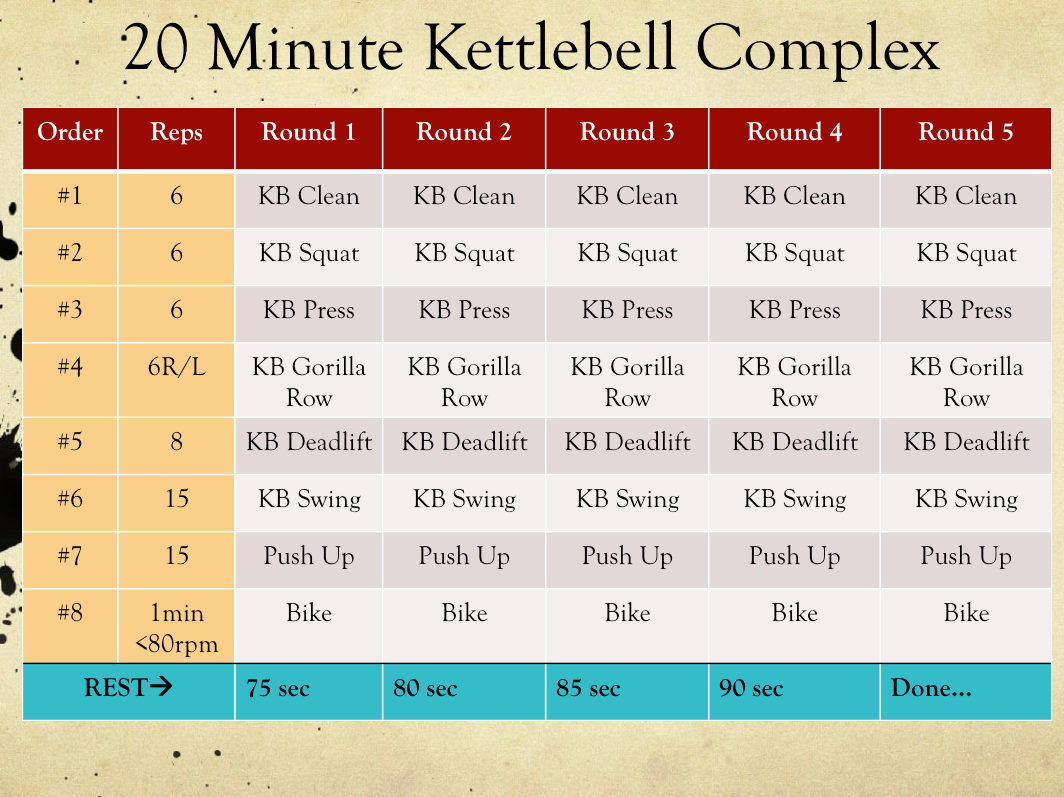
Biking. The addition of the 1-minute air bike ride at the end of the round shakes things up. The goal is to keep the RPM above 80.
The first few rounds were fairly easy, but rounds 4 and 5 were a bitch to keep pace.
Why bike?
Biking is a low impact activity that requires ZERO skill. Get on and ride. Air bikes involve the entire body via turning the pedals over while pushing/pulling the dual action arms.
Biking is a safe way to condition while mitigating stupid workout injuries.
Fatigue. The ascending rest period tactic was perfect.
As fatigue accumulates, so does the amount of rest.
The extra 5 seconds of rest added to each round helped managed my fatigue.
75 seconds of rest will seem long in the beginning. But again, the fatigue hits you like a slap across the face.
In rounds 3, 4 and 5… the 85-90 seconds rest passes by quickly.
During your rest period, focus on breathing. Deep and full breaths.
Breathe deep into your BELLY, not your chest and neck.
Exercise technique. Metabolic conditioning is designed to stress the muscles and cardiovascular pretty aggressively, but it should NEVER come at the expense of technique.
Scale the workout for yourself. Start with longer rest in the earlier rounds. Use less weight or bike for 30-45 seconds at a lower RPM instead of 1 min at >80 rpm.
Explore and tweak it as you go. You can expect each “round + rest” to last 4+ minutes, with the later rounds lasting longer because of the increased rest.
I added a few new elements to what I like to call a staple kettlebell complex that seemed to fit the bill just right.
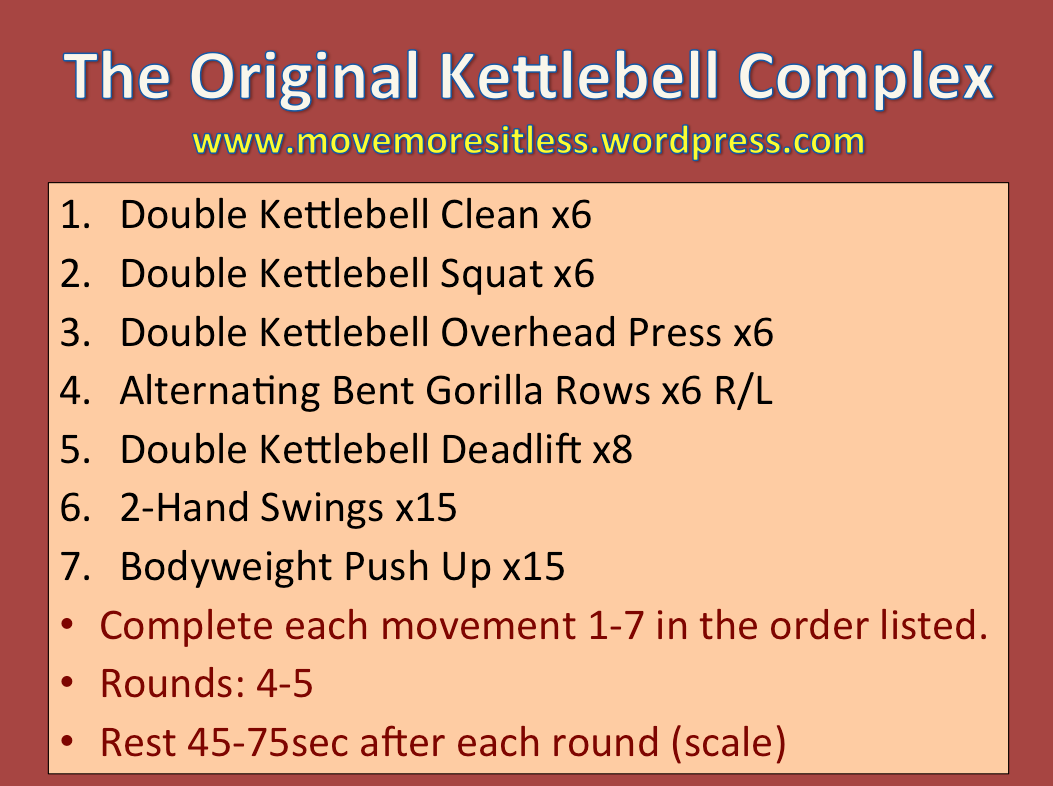
The original kettlebell complex was structured like this:
First let me say that if you have the physical know-how and ability to train like this, you won’t regret it. If you’re short on time, its pure gold. If you’re looking to lose fat, its pure gold. There is so much happening in a condensed total body work capacity-style training session like this, it’s definitely going to create a large training effect.
And that is what you should be after… A large training effect while keeping safety in the front of your mind.
So, as much as I love the above training session, it was time to re-organize some things.
Boredom in training sucks. I aim to avoid this without straying too far toward the radical.
Using the above kettlebell complex, my rest periods had decreased to nearly 40 seconds in between complex rounds, and my total number of complex rounds had increased to 6. I felt as though I was spinning my tires. Would adding another round or decreasing the rest periods the 40 second mark really provide any benefit? I really had to ask myself what there was to gain from adding more, or resting less.
My options seemed to be: increase the loading or change the stimulus.
I chose to change the stimulus and see what happens.
My first experience with the modifications was promising. Here is how it looked:
Alternating the double kettlebell swing and the double kettlebell cleans added significant work time to the beginning of the complex. I should clarify that “significant time” is really only 15-20 extra seconds, but when the entire complex round clocks out at 2min11sec total, 15-20 seconds of extra work begins to look a lot more challenging.
Other areas of the complex that seemed to increase the working time were the overhead presses.
Exploding out of the last rep of squats, I immediately transitioned into a double overhead press. Upon bringing the kettlebells back to the rack position, I then pressed the right hand bell up and back down, followed by the left hand bell up and back down. Pressing a single kettlebell while holding the other in the rack position is draining, but this is what I was aiming for.
Lastly, the implementation of the alternating reverse lunges added working time to the entire work set. In the original kettlebell complex, sumo-style deadlifts were used. The cadence of a sumo-style deadlift is commonly much quicker than alternating between reverse lunges. The training stimulus is also altered by changing the movement pattern. I quickly found out how much I had deprived myself of lunge work.
As far as rest periods go, I suspect that 45-60sec of incomplete rest will remain adequate to receive the training effect that I am after (lean, conditioning, maintenance of strength qualities).
I refer to the rest periods as incomplete anytime my heart rate doesn’t recover to 130 beats per minute.
In the later rounds of the workout, my work periods begin higher and higher heart rates.
If you’re proficient with kettlebell training, give this workout a shot. You may have to adjust some things to suit your abilities, scale up or scale down, but you’ll be pleasantly surprised at the results you’ll get from training like this.
At the very least, it’s a different angle on working out.
Cheers to shifting the complex to create a new training effect!
Burpees and I have a love/hate relationship, and I’m sure that most of you probably have similar feelings.
On one hand, full burpees are as close as it gets to being a complete bodyweight exercise.
Burpees are ridiculously effective for elevating heart rate and recruiting a large amount of muscles. Large muscular recruitment is a beautiful thing. Burpees require little to no space, zero equipment and you can perform them anywhere. Indoors or outdoors it does not matter. Burpee workouts are a perfect alternative to traditional running or biking.
On the other hand- the hand that despises every aspect of the burpee- burpees are the red headed step child of my workouts. When I see them on the docket for the day, I cringe. I cringe because they test me every single time. I cannot think of a single workout where burpees felt easy. If there was a workout where burpees were enjoyable like a walk on a white sand beach on a hot Summer day, that would be a major red flag that I didn’t design my workout properly, or I was leaving something in the tank (aka: Half-assing it). Burpees are the vegetables of the workout world. They require very little thought and are quite monotonous when performed for high reps.
But, when weighing the likes and dislikes toward burpees, I know full well that slipping burpees into a workout can crank up the overall impact of the workout. The training effect if you will. In other words, I’ve never felt worse (physically or mentally) after performing burpees at the end of a circuit or as a workout by themselves.
Burpees deliver every single time.
Shakira’s hips don’t lie and neither does my heart rate monitor.
So while I started thinking about different sub-maximal activities that I could integrate into my complex workouts- to keep my heart rate elevated in between rounds- burpees were one of the first exercises that came to mind. It seemed like slipping them in between rounds could deliver what I was looking for. Preferably, the filler exercise needed to be ground based and something that kept me in a vertical standing position.
So, here is what the workout evolved into:
Again, the goal here was to add another 5 minutes of elevated heart rate and exertion to my training session. I know from extensive experience that the kettlebell complex displayed in the snapshot typically takes 12-15 minutes to complete in full, so my goal was to extend the workout to 20 minutes or longer. The addition of the burpees between complex rounds successfully did just that.
Overall, I enjoyed the addition. I’ve added timed jump rope intervals to my complexes before, and they worked quite well. But since I can’t seem to find a jump rope that can live longer than 2-3 months before breaking, I was forced to use burpees. The key to adding filler exercises to tough workouts is to choose exercises that require low technical know-how. When you’re sucking wind, trying to gather yourself before the next bout of exertion, this is not the time to be messing around with movements that have high technical difficulty.
In fact I will just come out and say it… it’s stupid. The risk doesn’t even come close to matching the reward. Avoid it and you’ll put yourself in a better position to avoid injury while reaping all of the good that can come from a workout like this.
Closing thoughts…
The majority of my workouts are by design. I rarely walk into a workout without knowing what’s about to happen, which is why I think I have adhered to this physical lifestyle for so long, and why I will remain committed to moving aggressively and intelligently for years to come. It’s habit now, fully engrained into my life.
Each workout (or entire program) follows a general training template that I’ve got embedded in my mind. Early in my strength and conditioning education, I consumed book after book and realized that everyone was using the same general approach to designing effective workouts and long-term programs, so I began adapting and experimenting with slight variations to these time tested principles.
My personal preference is a system wide, total body approach to exercising, so I know that I like to see all of the major movement patterns represented in each training session (ex: squat, pressing, pulling, hip hinge, etc). Body part splits are not for me. I get bored. Working a squat pattern four different ways on the same day is un-interesting to me. But that doesn’t mean that it isn’t a great option for your fitness endeavors.
I also have a crystal clear distinction between what I classify as a purpose driven workout, and what I classify as a recreational activity. Playing ice hockey on Wednesday nights is recreational. Kettlebell complexes are a workout. My approach doesn’t downplay the positives of recreational activities (because they do matter overall), but I feel that there is a major difference between “the workout” and pick up basketball.
At the end of the day, movement in any shape or form adds up, and there is no denying this. Any way that you can engage in it, it’s a bonus. We can debate the details all day long, but the bottom line is make an effort to sit less and move more. That’s a recipe worth following.
Last night “dinner and a movie night” at our place. After a long weekend, yes, a long weekend… I couldn’t wait to lay on the couch and mindless watch Sherlock Holmes: Game of Shadows. It was a good flick. I enjoy the modern-day film that is shot in the old day setting. Know what I mean?
Prior to the dinner and movie, my girlfriend Amanda gave me the challenge of ripping out a movement training session in 30 minutes or less. She knows that when I go downstairs to train, I typically procrastinate the workout by writing while I am down there. There is something about being in our training area that puts me in a frame of mind to write. I can’t say it’s a bad thing, but when I am on a time crunch, it usually delays whatever we have planned.
Amanda was nearly finished with dinner (fajitas, so good!) when I told her that I was heading down for a workout. To her credit, that is a bullshit move on my part heading down with dinner so close to being done, but I am always confident that I can get a quality workout done in short time. Especially if it’s going to be work capacity based.
“I bet you can’t finish a workout before 7:01pm”, she says.
I looked at the clock, it was 6:31pm.
“I will take that challenge”, I said.
“But there is one more thing I would like to add to this. If you don’t finish the workout by 7:01pm, we are going to watch my movie, What to Expect When You’re Expecting”, she adds with a grin on her face.
I took the challenge and without thinking twice (still in my scrubs from the work day), I grabbed my computer and sprinted downstairs. The computer is very necessary for an enjoyable workout I will have you know. It’s provide me the advantage of being able to listen to whatever music I want, and with my premium subscription to Spotify, my playlists are rock solid. No music, or worse yet slow music or bland tunes during a training session are brutally painful.
Here is an example of one of my Spotify playlists…
Fueled by a deep burning desire to not watch her awful chick flick, I quickly traded by scrubs for a workout shirt and short, filled the water bottle and got my Macklemore playlist going. Macklemore is a stud.
Here he is in Breckenridge, CO at the Dew Tour… stud:
Once I made it to the basement, I made of list of quick priorities for the workout:
1) Grease my t-spine and hips
2) Jump Rope to increase my core temp and basically sweat (some skill practice here).
3) Unloaded and sub-maximal loaded movements that would act as a primer to the demands of the workout itself.
5) Any time leftover would be devoted to “anti-core training” of my choosing.
I got it done.
Crisis avoided.
It was a great reminder of what a person can accomplish in a ridiculously short amount of time. I enjoyed competing against the clock. I weeded out any unnecessary exercises and created priorities for the training session by asking myself, “With the time that I have, what are the most impactful activities that I should incorporate into this workout”. It created a focus to what was most important.
Strategy with training is important, but people tend to over think their training sessions I find.
Keep it simple…
—> Choose movements you can manage, ideally:
Squats, hip hinging lifts, presses, pulls, drags, carrying, “anti”core work, etc.
Go total body to elicit a larger training effect.
—> Choose reps/sets or rounds to perform:
3-5 sets/rounds of 8-10 repetitions per movement.
—> Choose rest periods that make sense to both your goals and your conditioning level:
Beginner: 60-90 sec
Novice: 45-60 sec
Advanced: 45 sec or less
Basic strength based movements using sub-maximal loads at a rep/set or round type format, organized with challenging rest periods between movements can do wonders for people.
Forget complicated workouts. Keep it simple and safe. There will be plenty of reward from a well designed simple and safe workout.
Are there some pretty awesome exercises that aren’t basic? Yes, absolutely. But my point is that you can get one hell of a training effect, create some serious change and work your way to earning the right to integrate those higher level movements into your program.
—> Warning: Here comes an awful attempt at an analogy…
If you sign up for a marathon you start your race at the starting line, the 0 mile mark, and you run 26.2 miles to the finish line. They don’t drop you off at the 24 mile mark and still call it a Marathon. That’s my awful analogy for skipping over essential progressions in movement.
Now, not every training session is like this for me. I spend a great deal of time working on the quality of my movement, making sure that I avoid nagging injuries like low back pain or shoulder issues. I value my mobility, stability and bodily symmetry. When things get jacked up and become restricted, unstable or asymmetric, the body starts compensating for those issues and injuries begin to surface. A small amount of proactive interventions goes a long ways in preserving the integrity of one’s body.
—> Eating isn’t the only thing but it is everything…
Plain and simple: my eating is on track. I don’t feel the need to “kill” myself during each and every training session. In fact, there is zero need for me to bury myself in each and every training session. Eating the right foods makes training more enjoyable and vice versa because I do not feel the need deprive myself of “vice-like” foods or “fun training”.
If you looked at my diet, you’d notice a couple of things without digging too deep:
1) I eat a lot of vegetables.
2) I drink a lot of water.
Veggies keep me full while delivering vital nutrients and water keeps me hydrated. Pure and simple. The benefits of staying hydrated go well beyond what I care to touch on in this post… so I will refer out for that:
You’ll notice that the link says “dehydration”. Dr. Berardi and his team at Precision Nutrition are the best (in my opinion), so I jumped on that article. At the very least you’ll get an idea of why you should avoid entering a dehydration-like state. There’s a fair bit of science in the article for those of you that enjoy that sort of thing.
So, what did we learn from my movie threat experience?…
—> Anyone can get a workout done in about 30 minutes or less and feel damn good about what they accomplished<—
… and What to Expect When You’re Expecting is worth avoiding. 🙂
Kettlebell complex workouts accomplish a lot (strength, muscle endurance, work capacity, afterburn training effect, etc) considering the time investment (15 minutes or less).
I’ve got an extensive background using complexes on training days where time is tight and when I want to lean out quickly.
Complex training is not a miracle, but for me and many others, they do pack a MASSIVE punch.
Essentially for 90 days, I used the same catalog of exercise, weight, reps, sets and rest periods to observe the adapations and see what would happe.
Calorie intake (and the quality of those calories, protein intake, etc) remained as consistent as possible.
To be fair, there was probably some slight variance with calorie intake over the 90 days, but it was controlled and kept as consisent day-to-day as possible.
Complex workouts, particularly using kettlebells, are my go-to modality for quick and powerful combination of resistance training and conditioning. Some refer to this as metabolic conditioning, fine.
No matter what you choose to call it, complexes deliver an awesome training effect in a really short amount of time.
Here’s the 20,000 foot view of my personal experiment using a kettlebell complex:
Duration: 90 days
Complex workouts per week: 3 (sprinkling in airbike session on the weekends)
Rounds per workout: 5
Reps per movement: 6 (except for kettlebell swings and pushups… 15 reps for those)
Equipment: 53lb (24kg) kettlebells x2
Rest: No rest between movements, 60 seconds of rest after each round
After the last rep of push-ups, rest for 60 seconds before starting the next round.
Again, one full pass through each of these exercises from beginning to end = 1 round.
Complete 5 total rounds.
Make sense?
The combination of 7 different exercises to stress the entire body, movement tempo, no rest between exercises and incomplete rest after each round makes complex training extremely challenging.
In 15 minutes or less, you trained the entire body, addressing strength and conditioning in one workout.
Complexes are generally made up of 4-8 exercises, mixing ballistic, upper and lower body resistance training, bodyweight and even ground based conditioning exercises like crawling, etc.
Results
Lean and efficient.
If I wasn’t such a dipshit, I would’ve documented exactly what happened with, before and after pictures, saving the chit chat. 🙄 Now you all think I’m liar.
My bodyfat percentage dropped below previous lows (my college hockey playing days). I can’t say this didn’t come at the expense of losing some muscle and raw strength, but I leaned out pretty aggressively.
Nutrition. The 90 day experiment was a reminder of the power nutritional consistency (calorie management, protein intake, hydration, etc) and how much impact it has on fat loss.
But I also have to tip my cap to impact of exercise. Exercise matters. It adds muscle, strength, burns calories and has a plethora of health benefits. I hate it when people ONLY preach nutrition or exercise for aesthetic gains.
Execute both and maximize your results.
Complex workouts can add lean muscle (resistance training) while accelerating fat loss.
Work capacity improved dramatically. How do I know? After roughly 6 weeks, I could’ve dropped the rest periods to 45 seconds and added another round. Specific adaptations to imposed demands. My body acclimated to the stress and I became efficient at crushing the workouts.
In the last few weeks of the experiment, I added a 6th round, then a 7th and closed it out with 8 rounds.
The negatives of adding more rounds was the increase in time it took to complete the workout, and a general feeling of diminishing return.
More volume isn’t always the answer, and in this case, I felt it was probably overboard.
Progressive loading. The purists will tar and feather me for not increasing the loading, but AGAIN, I deliberately avoided progressive loading. I wanted to see what zero change looked like after 90 days.
Strength gains plateaued quickly, but this was also expected bI never increased the weight of the kettlebells. Again, SAID Principle at work.
Without progressive increases in weight using the exact same exercises, strength stalls.
The goal was engage in a little experiment. 3 months of the exact same complex workout. No change, no deviation, just consistency.
Cautions
Know the exercises beforehand.
Don’t “learn” how to control the kettlebells while under fatigue.
Practice and develop familiarity with each of the exercises in ISOLATION FIRST.
Complex workouts are great for helping the fat loss process along. But this type of exercise is much different than aerobic steady state cardio. The fatigue hits hard.
This type of training is also very different than a traditional approach to lifting weights, where you’re performing reps and then taking full rest before the next work set.
Complexes are purposefully designed with incomplete rest periods. In the later rounds, you’re going to cringe at picking up the kettlebells to start again.
The key is find the right balance of weight used and rest periods. You want the session to be difficult but not impossible, yet not so easy that you walk away feeling like you could have done another 4 rounds.
5 rounds should be a bear 🐻
Lastly, whenever weights are being used to create a conditioning type training effect (metabolic conditioning) the user runs the risk of mishandling the equipment, losing body position and tension, etc… resulting in tweaks, strains and injury.
USE COMMON SENSE.
If you don’t have access to a pair of same weight kettlebells, this workout could be adjusted to use dumbbells aor a barbell instead.
Note: It’ll be difficult to include swings if you use a subsitute.
Progress slowly and adjust the training variables incrementally… Start with light weight, decrease the reps, add rest periods between each exercise, increase the rest after each round.
Over time, do the exact opposite of the previous suggestions to keep the workouts challenging. Increase weight, increase reps, reduce or remove rest periods between each exercise or shave off time after each round.
Let exercise technique be your guide. If you feel technique deteriorating, rest. Simle as that.
The goal is to control every movement, rep, set and stay the hell away from injury.
Closing
Complex training is perfect for people who are looking to get a TON of work done in a short amount of time.
In this busy world (career, kids, social life, hobbies, daily duties, etc) not every workout can last 90 minutes.
When you’re short on time and have the drive to get a sweat in, complexes are extremely valuable, without giving up much.
Plus, complex workout generally require very little space and equipment, so they are great for at-home workouts.
For people who are regularly lifting weights and doing cardio, I highly recommend adding in a complex day (two) throughout the training week. Mixing it up here and there can provide a refreshing break from your normal exercise regimen.








 M(eaux)tion Fitness