Kettlebell swings are a dynamic exercise that’s been proven to be a powerful tool for weight loss, especially when shedding unwanted fat. Kettlebell swings are a highly effective exercise for fat loss due to their high calorie burn, total body workout, cardiovascular benefits, functional movement, and low-impact nature.
This blog post will examine why kettlebell swings are one of the best exercises for fat loss and explore the science behind their effectiveness.
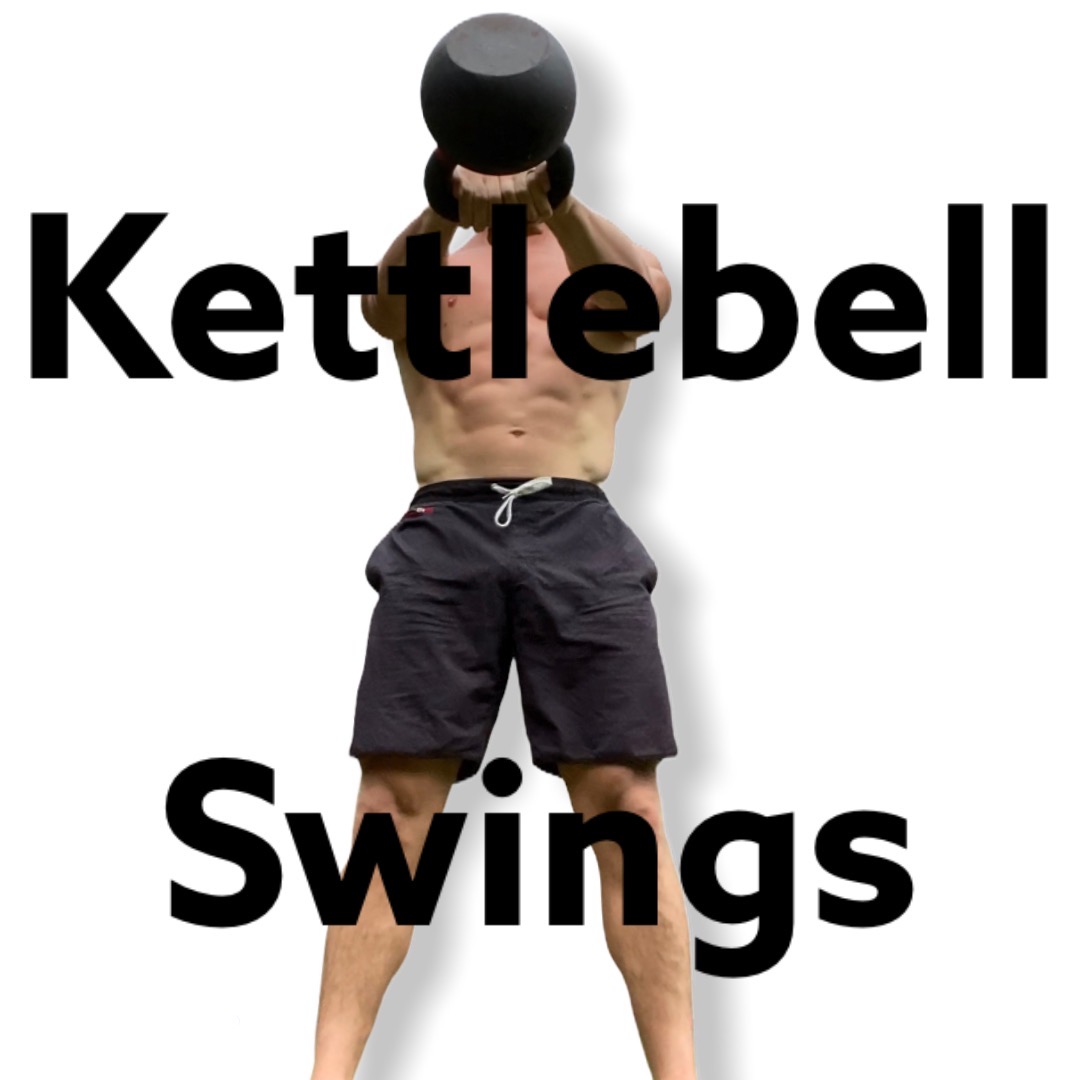
First, let’s define what kettlebell swings are. I won’t assume everyone reading this has been swinging kettlebells for years. Here’s what swings look like. My YouTube and Instagram have tons of clips of me swinging.
Kettlebell swings are a ballistic exercise that involves swinging a weighted ball-shaped object, known as a kettlebell, between your legs and up to shoulder height. This movement engages your glutes, hamstrings, quads, core, and back muscles.
So why are kettlebell swings the best exercise for fat loss?
High Calorie Burn
Kettlebell swings require significant energy output and have been shown to burn a lot of calories quickly. Studies have shown that kettlebell swings can burn up to 20 calories per minute, making them one of the most effective exercises for fat loss.
Total Body Workout
Kettlebell swings exercise an extraordinary number of muscle groups simultaneously, including the legs, glutes, core, and back. This full-body workout is ideal for increasing strength and conditioning and promoting fat loss.
Improved Cardiovascular Health
Kettlebell swings are a high-intensity exercise that gets your heart rate up quickly. This type of cardiovascular training has been shown in studies to improve heart health, boost metabolism, and increase fat burning.
Functional Movement
Kettlebell swings mimic (and enhance) many daily movements, such as lifting and carrying heavy objects. This functional movement pattern helps improve overall fitness and enhances our ability to perform daily activities efficiently.
Improve Maximal and Explosive Strength
Kettlebell swings are a powerful exercise for building muscle and improving overall fitness. The explosive nature of the movement requires a significant amount of force to be generated by the lower body muscles, making it an effective way to improve strength and power.
The study “Kettlebell swing training improves maximal and explosive strength” was published in the Journal of Strength and Conditioning Research in 2014. The study investigated the effects of kettlebell swing training on maximal and explosive strength in the lower body. The participants were 16 recreationally active men and women randomly assigned to either a kettlebell swing training or a control group.
The kettlebell swing group trained with kettlebell swings twice a week for six weeks, while the control group did not perform any resistance training during the study period. The kettlebell swing training program consisted of three sets of 20 kettlebell swings with moderate weight.
After six weeks of training, the kettlebell swing group showed significant improvements in maximal and explosive strength in the lower body compared to the control group. The researchers concluded that kettlebell swing training effectively improves lower body strength and power output.
Low Impact Exercise
Kettlebell swings are a low-impact exercise, which means they put less stress on your joints and muscles compared to high-impact activities like running. This makes swings an excellent option for individuals looking to lose weight but may have joint or mobility issues.
How Many Kettlebell Swings Should I do?
Most people will see fantastic results (after about 4 weeks) from performing 75-150 repetitions of kettlebell swings in a single workout, 2-3 days per week. The sensible approach for beginners is to start with lower repetitions an
Over time, the swing volume can increase by adding repetitions to each work set, or by adding an additional work set.
Kettlebell swings are a powerful dynamic exercise that can benefit those who consistently incorporate them into their workout routine. Swinging a kettlebell engages multiple muscle groups, including the glutes, hamstrings, quads, core, and back muscles, making it an effective full-body exercise. Kettlebell swings can improve cardiovascular health, as they require significant energy and can elevate your heart rate quickly. Regularly performing kettlebell swings can also improve your posture, enhance your balance and coordination, and even help to alleviate lower back pain.
According to a study published in the Journal of Strength and Conditioning Research, kettlebell swings increase muscle power and cardiovascular health, effectively improving overall fitness (Jay et al., 2013). Furthermore, a study published in the Journal of Human Kinetics found that kettlebell training can also increase both maximum and explosive strength in the lower body (Pavel et al., 2011).
Incorporating kettlebell swings into your workout routine can help to boost your energy, increase your strength and endurance, and provide a range of other physical and mental benefits.
How to make kettlebell swings more challenging?
You can make kettlebell swings, progressively more difficult by following the same guidelines as any other resistance, training, exercise. Sensibly increasing the weight of the bell, adding reps or incorporating different swing variations are all simple and effective ways to increase the difficulty.
20lb ankle weight riding on top of the 48kg kettlebell
Increase the weight: One of the simplest ways to make kettlebell swing workouts harder is to increase the weight of the kettlebell. As you get stronger, you can gradually increase the weight to challenge yourself. If 15-20+ reps of swings are no longer feeling challenging, it’s time to increase the weight of the bell. Make weight jumps incrementally. If you’re swinging a 24kg kettlebell comfortably for 15 repetitions, try swinging a 28kg kettlebell for 10-12 repetitions. Monitor your swing technique and post-set fatigue.
Increase the reps: Another way to make kettlebell swing workouts harder is to increase the number of reps you perform. As your endurance improves, add more reps to your sets, or perform additional sets. Adding repetitions has fallen out of favor recently, but it’s still an effective way to increase the difficulty of swings. Try adding 2-5 repetitions to each set and see how it feels. The key here is knowing when enough is enough volume-wise. At some point, adding more reps has diminishing returns. Also, beware of rep fatigue degrading swing technique. If you start moving sloppy, injury does become a concern, especially while swinging a heavy object.
Increase the intensity: You can make kettlebell swing workouts more challenging by increasing the intensity of your swings. This can be done by swinging the kettlebell more explosively or decreasing the rest time between sets. This is a hidden gem for getting better results from the same weight kettlebell. Swings should be explosive. Are you swinging aggressively? Or simply “guiding” the kettlebell through the arc? Check out this video where I’m performing “fake kettlebell swings”.
Change the swing style: There are several swing variations that you can try to make your workout more challenging. For example, you can perform one-handed swings, double-arm swings, or alternating swings to challenge your coordination and balance. If swing training is feeling stale with 2-handed swings, remove a hand, decrease the weight and attack one-handed swings. It’ll provide a different training stimulus.
Incorporate other exercises: You can also make your kettlebell swing workout more challenging by incorporating other exercises. For example, you can perform squats, lunges, or other bodyweight exercises in between sets of kettlebell swings to increase the overall intensity of your workout. Adding a set of 10 push-ups to the tail end of a swing set adds a new dimension to the workout. This is a simple tactic that can amplify the challenge exponentially. Bodyweight-based exercises are the most resourceful, but incorporating cardio or resistance training equipment are fantastic options as well. My personal favorite is alternating between kettlebell swings and SkiErg sprints. SkiErg motion is the opposite of swings, so they pair well together.
Kettlebell swings are a phenomenal exercise, one that the vast majority of people should consider incorporating into their workouts regularly. Take the suggestions in this article and apply them right away!
The simplicity of a two exercise workout finisher might lead you to believe it’ll be easy.
Wrong.
Bouncing between these two exercises non-stop for 5 minutes is exhausting. By the 3rd round, you’ll understand. The training effect is massive.
Push-Ups
Push-ups on an upper body horizontal pushing exercise. Push-ups build strength and condition the chest, arms and core. Bodyweight push-ups can be performed virtually anywhere. Long before I started this blog, people were leveraging push-ups to build strong bodies. Long after I’m gone people will still be using push-ups to build muscle and improve performance. Do not underestimate push-ups.
Push-ups (and the progressions) are one of the most under-progressed movement patterns. People stop at 2-arm push-ups and opt for high reps using a sub-maximal exercise variation. Explore the progressions that exist beyond 2-arm bodyweight push-ups. Carpet slide push-ups, archer, typewriter and single arm push-ups are worth your time.
Kettlebell Swings
Kettlebell swings are an explosive hip hinging exercise. On every repetition, the kettlebell travels through a arc of motion, hiking between the leg, pulling through out and up to the sternum height. Kettlebell swings have a pendulum-like look to them. Kettlebells are incredibly resourceful tools for building fitness. Swings are a great exercise to train the “go” muscles of the body, the posterior chain. For people that want to train power but don’t want to mess around with Olympic lifts (snatches, cleans, etc), swings are the exercise.
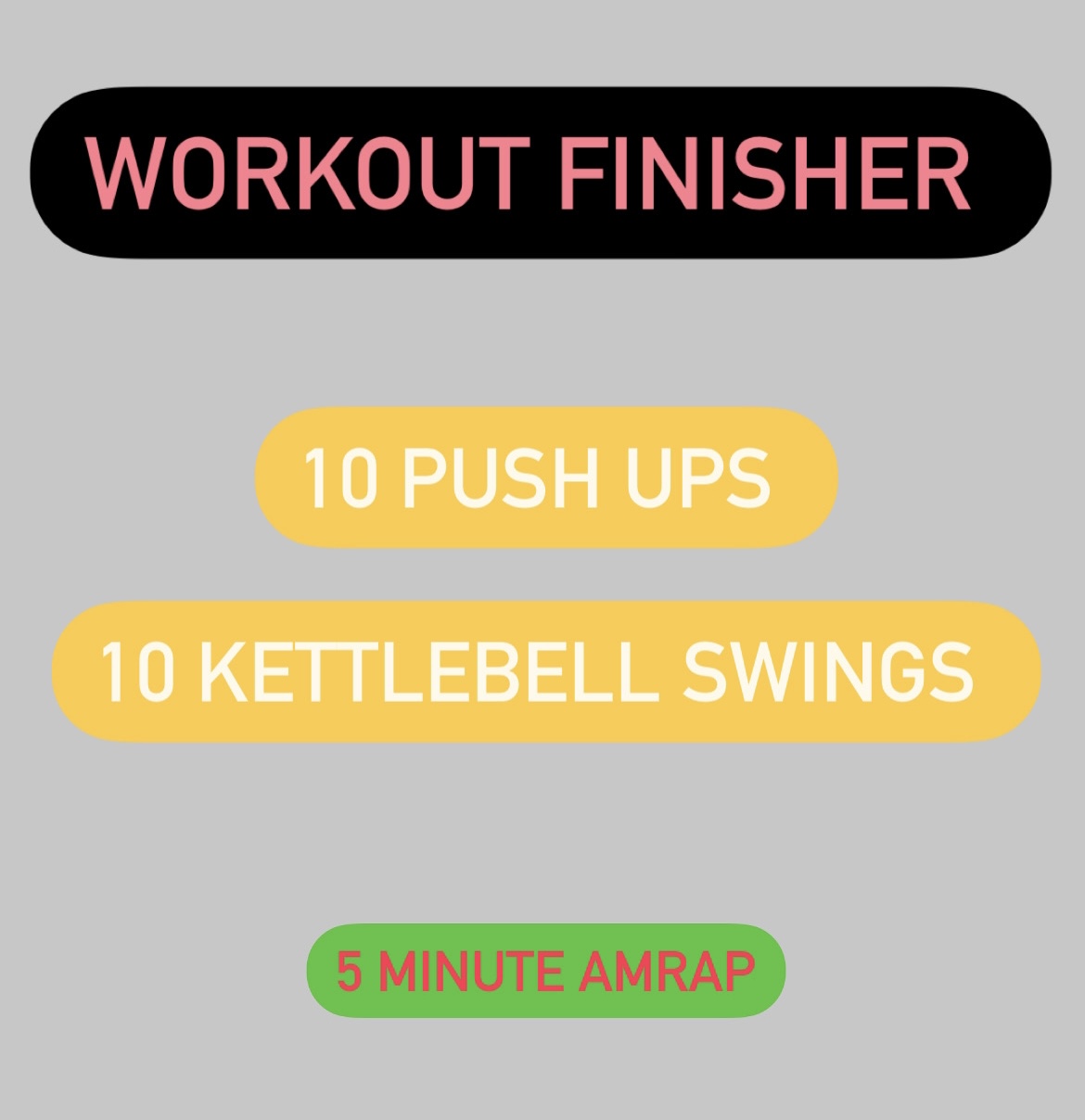
Workout Finisher: Push-Ups and Kettlebell Swings
Perform as many rounds as possible (AMRAP) in 5 minutes.
Take rest if you need it. There’s zero reason to injure yourself because you were chasing a personal record with horse-sh*t technique brought on by fatigue. Stay disciplined with technique.
Conditioning yourself to move well when tired takes time. Lots of personal trainers act like fatigue does not exist out in the real world, or high intensity (machine free) conditioning is “dangerous”. I’ve developed an opinion that it’s dangerous not to do it.
If you’re living a physical life, conditioning your body to move with integrity when you’re exhausted will serve you well.
Fatigue is a technique killer, yes, but the gym is a controlled environment where we can practice demonstrating technique when fatigue creeps in.
Like I mentioned above, take rest if you need it. There’s no shame.
A workout finisher is a short burst bout of high(er) intensity positioned at the end of a workout. It usually consists of 2-4 exercises, using minimal equipment (or no equipment).
There are thousands ways to design a workout finisher, and I intend to share them all!
Kettlebell swings, push-ups and rowing are timeless exercises. They also happen to make a perfect workout finisher.
Push Ups
Push-ups are an upper body horizontal pushing exercise. They work the chest, arms and core. Push-ups are easy to modify for any level of fitness. Beginner? Elevate the hands, reduce the weight and limit the challenge to the core. Advanced? Add weight to move on to single arm variations. A set of push-ups is seamless to start and end, making them a great option for a workout finisher.
Kettlebell Swings
Kettlebell swings are an explosive hip hinging exercise. I’ve been swinging kettlebells for 13 years and it’s still one of my favorite movements. Swings are a great choice for workout finishers because they are easy to set up, start/stop and train the entire body. Walk up to the kettlebell, grab the handle, swing. Plus when you’re using weights for cardio, I prefer swings because they are more forgiving with technique (compared to barbell cleans, etc).
Rowing
Rowing is one of the best cardio activities a person can do. Rowing is taxing for the entire body. Rowing isn’t as quick to get set up (compared to push-ups and swings). Put your butt on the seat, strap the feet, grab the handle and row.
Push-ups and kettlebell swings make a fantastic pairing. Upper body push with a hip hinge. Grip is preserved for the swings, pushing muscular is preserved for the push-ups, lots of muscle being taxed with two basic exercises.
Aim for completing 5 rounds using an 8 minute time limit.
In other words, you get 8 minutes to complete 5 rounds, and if you fall short, the workout finisher ends.
Is this workout finisher too aggressive?
Cut the push-up and kettlebell swing reps down to 5. Lower the rowing distance to 150-200m.
Do not be afraid to tweak workouts to suit your fitness level.
You don’t need permission to do this.
Flow and Non-Competing Exercises
The best workout finishers have a good flow/transition between exercises.
Remove as much set up fiddle factor as possible.
The goal of a workout finisher is constant movement. Transition from one exercise to the next until it’s over.
Don’t waste time with exercises that have a long set up time.
Choosing non-competing exercises allows you to give more energy to each exercise and take a total body approach to the finisher.
3-4 exercises is perfect for a workout finisher. Remember, workout finishers are supposed to be the icing on the cake, not the meal.
Non-competing exercises can help with safety. You’ll be tired, but not overly tired in any one movement pattern or muscle group.
Here are a two simple non-competing exercise strategies:
Upper and lower body exercises
Push and pull exercises
Non-competing exercises:
Squats + pull-up
Lunges + overhead press
Push-Up + kettlebell swings 😉
Crawling + loaded carries
⚠️ CAUTION ⚠️
A workout finisher should be brief. By definition, a workout finisher is the ending to a workout, meaning you completed other activities leading up to it.
If a workout finisher drags on for 15-20 minutes… it tells me it’s over-engineered, didn’t do enough quality during the middle of the workout, and set yourself up for unrecoverable fatigue in the coming days.
People make the mistake of biting off more than they can chew. They step up to workouts that don’t account for the days ahead or their current fitness level.
Fitness is a long-term play.
Hundreds of workouts (and diet) will create the body and performance you desire. This is the #truth, depressing for some, but realistic and honest.
Like this workout finisher??? It’s just the tip of the iceberg for options.
The difference between a kettlebell swing and a macebell swing is profound, and damn it, I intend to show you the difference!
Kettlebell swings and macebell swings look nothing alike, although they are both called “swings”.
Both are amazing exercises to include in a workout regimen.
The information below will shed light on the differences between these two great movements.
Kettlebell Swings
Characteristics: Mobile hips, stabile shoulders, front-to-back pendulum/arcing motion, hip hinge (flexion/extension)
Grip for a kettlebell swing involves hands hooked around the handle, side by side. The handle of a kettlebell with be parallel with the floor.
Kettlebell grip
Kettlebell floats nearing the apex of the arc. “Float” meaning the hip snap/drive/extension powers the kettlebell out from between the legs and up the arc, where it has a split second of float (perceived weightlessness) before traveling back down the arc. During the float, you could literally let go of the kettlebell briefly, or at the very least, relax the grip.
Swings have been a staple exercise since they were first introduced to the Western culture back in the early 2000’s.
I use kettlebell swings A LOT. For going on nearly 14 years, kettlebell swings have shown up in my workouts 2-3 days per week, sometimes more or less. I swing using different variations (1-hand and 2-hand), weights, reps and sets.
There are an infinite number of ways to design a workout with kettlebell swings contributing to the session.
Macebell Swings
Characteristics: Stable hips, mobile shoulders, side-to-side circular motion, very little deviation from the standing position (subtle rotation and lateral lean)
Grip for a macebell swing involves stacking the hands near the bottom with fingers wrapped shaft of the macebell.
Macebell Grip
The macebell swing does experience a similar “floating”, but in a different way, and it’s a little harder to describe.
Macebell 360 swings complete a full circle with every repetition. As the head of the mace descends down, your job is to ready the body for what comes next. The head of the mace gets a taste of gravity’s pull as it travels down and across the midline (posterior). The hands grip tight and resist letting go. The mace “floats” after passing through the middle, traveling up the opposite side of the body. It’s brief, but there is a moment where you can ever so relax the body during the float.
Macebell training is still relatively undiscovered by Western culture, and many who do know about it consider it taboo training.
Using my crystal ball, I predict macebell training will experience a very similar rise to popularity. The circular exercises make for an amazing addition to workouts.
The shape and design is what makes the difference with both exercises and the grip.
The risk of losing your grip during kettlebell swings and macebell swings is about the same. Maintaining grip on the shaft of the macebell to be more difficult. As the head of the macebell whips around, the shaft wants to slide out your hands.
I relate it to hanging from a horizontal bar versus hanging from a rope. The vertical position of the rope can wear out the grip and make the hands feel really weak.
Use Both Kettlebell and Macebell Swings for Fitness
Combining both kettlebell swings and macebell swings into the same workout regimen will expand the ballistic movement experience, and build athleticism using different tools and completely different motions.
Here’s a sample workout:
This is one workout example (of thousands) that mix kettlebell and macebell swings with a few other key exercises (squats, push-ups, etc). It’s a density circuit, so you’re setting the timer and getting a ton of work done within a short time frame.
Fitness is about making gradual gains, exploring and expanding outward.
There are a lot of really useful tools to help make gains. Adding equipment like kettlebells and macebells adds variety to your workouts, options, while building new skills and overall health.
By including kettlebell swings and macebell swings in your daily workouts, you’d getting different benefits from both tools.
Be a skilled generalist, you’ll be happier overall.
And for heaven’s sake, explore and stay curious about different modes of exercise!
Low repetition kettlebell swings prevent form decay while mitigating the chance of unnecessary injury do to that decay.
It doesn’t matter if you’re talking swings, squats, crawling, handstands, chopping wood, raking the yard or target shooting with a bow.
Fatigue kills technique and when taken too far (how far? not sure) can make us more susceptible to intra-workout tweaks, strains and injuries.
Reps
Depends who you’re talking to, but in my humble opinion, 5-7 repetitions of quality swings with plenty of rest in between efforts is a good target.
When the mind body connection begins to slip, muscles get tired, movement gets sloppy, you’re playing with fire.
Explosive low repetition kettlebell swing training using a heavier weight kettlebell are great for training fast twitch muscle fibers, developing explosiveness and power.
For the aging population, or anyone really, preserving (or improving) the ability to express power is essential. Kettlebell swings can be used as a tool to preserve power and limit the loss of muscle mass with age (in combination with resistance training).
Swings are a very rhythmic form of training, even when using heavier kettlebells, so completing 6 repetitions of kettlebell swings takes inside of a 5-6 second window.
It’s starts quick and ends quick.
Low rep swings will keep the exertion time to a minimum and the focus on technique maximized.
Rest Periods
Rest periods in between each set can vary, but I often opt for 45-60 seconds of rest.
45-60 seconds of rest might seem excessive, but it’s important to be fresh for every set.
Set a timer and stay strict to the rest periods. The stopwatch on your iPhone works great, or find a free website or app.
You shouldn’t feel exhausted after each effort.
Rest periods should be complete, not incomplete.
Utilizing incomplete or non-existent rest periods is a whole other style of training with a different structure and intentions.
The goal with low rep kettlebell swing training is to bang out quality/powerful swings, rest fully, and stay hyper focused on technique.
Sets
After the last rep of the set, place the kettlebell down, breathe deep, pace around little bit if you want to, get ready for the next effort.
8-12 work sets in a workout where reps are kept low should just fine.
For the well conditioned folks, work sets can go higher than 12.
Personally, I get what I’m looking for from 8-12 good sets using a 32kg-40kg kettlebell.
In summary:
5-7 reps/per set
45-60 seconds of rest
8-12 sets
You could get after explosive/power focused swing sessions 2-3 days per week. 2 days might be enough to see significant changes over time.
For a lot of people, the hardest part about using low rep/high rest kettlebell swings is going to be the “feeling” that little work is being done.
Resist the temptation to skip rest and chase fatigue.
🤔 Keep in mind, a blog gives generalized advice, so, use your big boy and big girl brain to make you-focused choices on kettlebell weight, reps and sets for YOU.
Not your neighbor, someone boasting on a Reddit thread, or me.
Get after it, have fun, leave me a comment and let’s chat.
20 minutes is all you need to get a hell of a workout.
This 20 minute workout combines the SkiErg, kettlebell swings and landmine grapplers to create one hell of a training stimulus using just 3 exercises.
The SkiErg and kettlebell swing combination is one of my favorite gym combinations of all time.
Yes, they are both somewhat linear, but the opposite actions is what I love.
Kettlebell swings are mostly hip extension focused. (Yes, I know the eccentric loading is great with kettlebell swings).
SkiErg is a flexion heavy exercise. The pull downward requires a lot of lat and core contribution. The hips hinge as you finish the stroke, followed by moving back up into extension to reload for the next pull. One of the great features of the SkiErg machine is being able to walk up to it and walk away from it quickly. It’s awesome.
Landmine grapplers, well, read below about why I think landmine grapplers are badass.
Both are completed in the standing position, feet firmly fixed to the floor. In a world where machines are taking over, standing up like human during a beat down is refreshing.
Complete the following exercises in cyclical fashion:
Kettlebell Swings x8
Landmine Grapplers x8
SkiErg x150meters
Choose your kettlebell weight and throw a plate on the barbell for the landmine grapplers, and you’re ready to move.
I used a 32kg kettlebell and a 25lb plate on the landmine apparatus.
The beauty of this circuit is how little space you need. I’m clearly training in a larger home gym space, but I could be getting after it inside a bedroom closet and still get the same training effect.
Maybe I’ll shoot another video doing the same workout inside of super tight space to make my point.
The rest periods are designed to be INCOMPLETE. You won’t want to start into the next exercise, but do it anyways.
The idea is to start the next exercise BEFORE you’re completely ready to do so, yet be mindful of when it’s inappropriate to start the next bout of work to avoid injury (technical failure, etc).
You have to be an adult in the gym, make adult decisions, and know thyself.
If the next round is going to involve crappy reps, stop. Rest. When you’re ready, get back to it.
It’s a fine line… and only you know when you’re toeing that line.
Landmine Training is Sexy
There’s no other way to say it.
Landmine training is sexy and I love my landmine set up. It was a small investment for the vast amount of training options I gained.
For anyone who owns a barbell and plates, but doesn’t own a landmine, SHAME ON YOU.
Kidding.
Adding landmine trainer to your home gym can change a lot about how you workout, including more pressing, pulling, squatting options. As it relates to this workout, more rotational training.
My favorite landmine exercises involve rotation.
Grapplers are a classic rotational exercise that can be tweaked for rotational power work, grinding strength or cardio conditioning.
Every swipe through the middle feels like this movement has application beyond the gym setting. And no, not all exercises give me that same warm and fuzzy feeling.
Landmine Grapplers bring joy to my soul.
They aren’t a cheesy isolated core twist. Grapplers are full body exercise that begin on the floor, traveling up the body, through the hips/torso and out the hands.
Biggest Problem with this Workout
Access to the SkiErg will be the biggest issue for people to give this exact workout a go.
If you have a few dollar laying around, theSkiErgis an incredible piece of equipment to own.
I have to admit I purchased my rowing machine first, but the SkiErg was a much more anticipated addition. It hasn’t disappointed one bit. Mine is well fixed to a wall.
[Buyer beware: Swings aren’t a miracle, don’t expect immediate results from 1-2 workouts. It doesn’t work like that.]
Total Body
The kettlebell swing works a lot of muscles on each and every rep.
Swings are a ballistic (explosive) pendulum-like exercise that hammers the hamstrings, glutes, core, forearm, and back muscles all in one shot.
To maximize power training, turn your focus on pulling the kettlebell through the legs explosively and “pop” the hips forward into an extension on every rep.
Make sure the kettlebell appropriately weighted. Swinging a kettlebell that is too light will not provide enough of a challenge for the powerful muscles of the posterior chain. Explore different weights and be sure to increase the weight when it’s necessary.
Calorie Burn and Fat Loss
I really want to avoid going overboard with the potential fat loss benefits associated with kettlebell swings.
For me, it’s not fair to label any exercise as being SUPREME to others for burning fat.
And the fact is, nutrition you talk to the nutritionists, exercise and there are too many other factors influencing the amount and speed of losing body fat.
That being said, kettlebell swings burn a significant number of calories and can make a nice contribution to fat loss.
The big takeaway, as it pertains to fat loss, is that kettlebell swings recruit a lot of muscles, and the work really adds up (calorie burn) if performed for multiple sets.
A kettlebell swing focused workout could burn up to 150 calories in 12 minutes.
Kettlebell swings burn a lot of calories because they work a large number of muscles.
In general, the more muscles working during an exercise, the larger the calorie burn of that particular exercise across time.
Thousands of people have experienced amazing aesthetic transformations (in addition to performance gains) by adding kettlebell swings to their workout.
Core Training
Kettlebell swings condition the core in a really unique way.
During each rep, the hips catapult the kettlebell up the arc of motion, while the lats pull the kettlebell back down.
A fully active kettlebell swing hammers the core muscles, particularly while pulling the kettlebell back down through the arc of motion. Actively reversing the motion at the apex of the swing hits the core muscles good.
While the kettlebell swing might not deliver the same muscle burn (mostly due to lack of time under tension) through the mid-section (like Turkish Get Ups, L-Sits, or Dragon Flags), the core muscles are getting a solid dose of stress.
Scroll up and reference the first photo in this blog post.
The core gets a workout during swings, no question.
Improve Athleticism
Kettlebell swings are amazing for training power and explosiveness.
The velocity component to kettlebell swings is a key ingredient to its effectiveness for improving power.
Kettlebell swings can improve strength, but they are probably best thought of as an enhancer of strength.
Swings serve as a supplement to strength exercises like deadlifts and squat.
Muscular endurance is the ability to produce sub-maximal muscle contractions for extended periods of time. Moderate to high rep kettlebell swings SHINE for building muscular endurance.
Other notable athletic benefits include balance and coordination.
Perfect for the Home Gym
Swings require very little space, making them PERFECT for a home gym workout.
Nobody’s home gym is a perfect space. You work with what you’ve got. And that’s fine because kettlebell swings shine in imperfect spaces.
Kettlebell swings are a front to back pendulum exercise, so the clearance needed to swing is minimal.
Reach your arms out in front, then reach your arms behind your body. If you didn’t touch anything, you’re good to perform swings in that space, no matter where it is.
Swings reign supreme for home workouts because overhead clearance is not a factor. The swing range of motion rarely rises above sternum height.
I’ve swung a kettlebell in bedrooms, living rooms, kitchens, etc.
Being able to perform swings almost anywhere decreases the likelihood of missing a workout due to environmental constraints.
Off-setting the long hours spent driving with active mobility trainingand a quality swing workout can unwind time spent sitting.
Normally, people rely on bodyweight exercise or running while traveling.
The kettlebell can add a new dimension to the usual travel workout.
Kettlebell swings integrate really well with bodyweight or suspension trainer exercise and can boost the training effect.
Or, make a workout by combining swings with other time-tested exercises like presses, rows, squats, snatches, cleans, lunges, or Turkish Get Ups.
Note: Kettlebells aren’t ideal for air travel because of weight and having to lug it around the airport.
Listen to Joe Da Sena talk about this travel habits with his 20kg kettlebell on the Joe Rogan Experience Podcast.
Low-Impact
Kettlebell swings are a low-impact exercise that can deliver a potent cardiovascular training effect similar to running, according to this study.
The subjects in the study swung extremely light kettlebells (in my opinion) and were still able to generate an aerobic training effect comparable to running.
Low impact activities that have a high energy cost/metabolic demand can be great for a lot of people.
Simple to Learn
For benefits, kettlebell swings are easy to learn.
Hike and Hinge
Hike the kettlebell between the legs, hinge and load the hips, shoulders stay higher than the hips.
2. Root
Pull the kettlebell through legs from the back to the front of the body, “root” the feet firmly to the ground as the bell arcs upward.
3. Float
Float the kettlebell as it reaches the apex of the swing.
Common Mistakes:
Avoid “lifting” the kettlebell or squatting the kettlebell.
The best way to avoid lifting the kettlebell is to choose a weight you cannot lift. People can muscle up lighter weight. When the kettlebell is too heavy for muscling, you’re forced to power it up with hip action.
Avoid squatting by practicing the kettlebell deadlift, which has very similar mechanics to the swing.
The swing is a hip hinge, not a squat.
Kettlebell Swing Variations
Kettlebell swings have a number of awesome variations to keep workouts fresh and challenging.
The three most common swing variations are:
2-hand swing
The exercises above are ranked in order of learning importance. Always start and train the 2-hand swing hard.
Once you’re acclimated to the basic three, explore other swing variations.
Hybrid swing variations:
Dynamic Forward and Lateral Single Arm Swings
Single Arm Swing and Catch
Staggered Stance Single Arm Swings
Band Resisted Swings Traveling Swings
Outside-the-Knee Swings
Side-to-Side Swings
The staggered stance single-arm swings are a personal favorite.
Shift body weight to the opposite leg for a more aggressive loading stimulus on each rep and the rotational component of this swing variation is evident.
With a few different weight kettlebells, switching up the swing variations throughout the workout becomes a refreshing approach and a great way to train.
Creating Workouts with Kettlebell Swings
Creating a workout that includes kettlebell swings is simple.
Kettlebell swings can be performed in an isolated fashion without any other exercises or can be paired with other movements to create a 2-3 exercise circuit, building up to a complex style workoutwhere 6-8 exercises are performed.
Kettlebell ONLY Workout
Grab a kettlebell and swing it for 10 reps.
After the 10th rep, stand over the kettlebell, don’t move.
This can serve as a workout finisher or as the workout. Don’t let the simplicity fool you.
Kettlebell Circuits
Kettlebell swings don’t have to be THE ONLY exercise in the workout.
You can increase a workout’s impact by adding other exercises to make a circuit.
Example:
1a) Clean to Overhead Press
2a) Goblet Squat
3a) Bent Over Rows
4a) Push-Ups
5a) Kettlebell Swings
Amplify the Training Effect Using Cardio Machines
Mixing kettlebell swings with other equipment, cardio machines, bodyweight or accessory lifts is a great way to amplify the training effect of the workout.
Most of these workouts are metabolic resistance training workouts.
Low-impact workout:
1a) Row, SkiErg or Airbike x 1-minute effort
2a) 15 Kettlebell Swings
3a) 15 Bodyweight Push-Ups
Rest for 60-75 seconds, repeat for 6-8 rounds.
Kettlebells (not just kettlebell swings) pair well with cardio machines.
Several days per week, I put in 60+ minutes of steady-state cardio on the air bike.
During the workout, I like to break up the monotony of riding with kettlebell swings and/or hip thrusts.
Performing kettlebell swings saves your ass from falling asleep on the bike, puts you back in the standing position while delivering a potent training stimulus to the posterior chain.
Finish the swings and start riding again.
SkiErg
SkiErg is anterior dominant and kettlebell swings are posterior dominant. Combining the two creates a non-competing, total-body training session.
I love alternating between 8-10 heavy kettlebell swings and 100m-150m SkiErg sprints, for 10 total sets
This power-endurance type training delivers a punch with explosive efforts, cardio and calorie burn using a simple and effective workout.
If rowing, I do my best to accumulate at least 2000 meters in the session.
8 x 250m = 2000 meters.
My Results Using Kettlebell Swings
The key is consistency (swinging several days per week), respecting progressive loading (can’t swing the same weight forever and expect different results) mixing in other swing variations to challenge rotation, stability, and balance.
The style of the swing matters.
Adjustments can be made to kettlebell swings to elicit varying different training responses.
The weight and reps per set can dramatically change the style of the swing.
High(er) rep kettlebell swing work set is going to look and feel a little different because, at 20+ reps, we’re now dealing with muscular endurance and conditioning.
Low rep efforts are best for power training. Each rep is maximum effort. The goal with low rep kettlebell swings is NOT cardio, it’s explosiveness and power.
High rep swings have diminishing returns for improving power, but can be great for improving conditioning.
Each swing style has its own advantages and benefits. It’s all about what you’re hoping to achieve from your training.
Swings remain my go-to exercise for getting sh*t done.
Crawling patterns and kettlebell swings are two great exercises that work really well together inside of circuits.
Quick and saucy training stimulus.
Combining two exercises might sound limiting, but if you select the right exercises it can be a really effective way to train.
Workouts don’t need to be complicated to be effective. There doesn’t need to be a long list of exercises to work through.
Alternating between two non-competing movements allows for max energy to be plugged into each movement, improves time efficiency while keeping the work focused.
Let’s talk about crawling and kettlebell swings, shall we?
Crawling
Crawling exercises can be performed in almost any training space. Tiny hotel rooms, outside, or at home in the make-shift home gym.
6-8 feet of straightaway space can accommodate any crawling variation.
There are a hundred different ways to modify the crawl to fit your environment and training space.
However, as you gain strength and coordination with the patterns, consider increasing the challenge by introducing obstacles, crawling over, under and around different terrain creates a whole new challenge.
Crawling looks easy. Baby’s crawl without a problem, so adults shouldn’t have an issue, right?
The shoulders, chest, core, and hips tire quickly, which is not necessarily an indicator of an effective workout, but more so a point to make for folks who think crawling looks “too easy”.
Here are some notable benefits of crawling:
Spatial awareness
Total body strength and conditioning
Coordination
Confidence (movement skill education)
Minimalist (can be performed anywhere, anytime)
Scalable for beginners to elite movers
Easily adjusted to elicit different training effects
Pair well with other exercises (lower body, pulling, swings)
Natural movement other than lifting weights and linear cardio
Kettlebell Swings
Kettlebells are one of the most versatile pieces of gym equipment on the planet.
A single kettlebell is all that’s required to crush a workout featuring kettlebell swings.
Similar to crawling, kettlebell swings can be performed in extremely small spaces, outside, hotel rooms, etc.
Higher rep kettlebell swing workouts are fantastic for burning calories and accelerating fat loss. It’s essentially loaded conditioning, similar to metabolic conditioning.
Kettlebell swings will burn fat while doing a surprisingly great job at maintaining muscle mass.
Some bloggers would feel guilt writing something like that, but there are too many testimonials to argue otherwise.
Thousands people who’ve leveraged kettlebell swings for body transformation. With good nutrition and a caloric deficit, using higher volume kettlebell swings will blast fat.
You can see how the lizard crawl and bear walk differ with regard to hip position.
Hips stay high, arms straight with the Bear Walk.
The lizard crawl is a whole other situation. Lizard crawling drops the hips close to the floor, making this crawling variation a serious challenge.
Kettlebell Swing Variations
The video above demonstrates 3 basic kettlebell swing variations:
2-hand kettlebell swing
1-hand kettlebell swing
Hand-to-hand swing
There are a lot more variations to explore, but I would consider these to be the fundamentals.
We will pair these variations up with a crawling pattern for each of the nano-circuits shared below.
Nano-Circuit Training
Nano-Circuits incorporate 3 exercises or less.
They are simple, saucy, and focused.
Reducing the number of exercises in the circuit removes unnecessary thinking.
There’s no stopping to check what exercises come next, how many reps, etc.
You just go.
Here are a few ideas for you to try:
Forward/Backward Crawl + 2-Arm Kettlebell Swings
Accumulate 20 yards of forward and backward crawling.
After finishing the crawl, step up to the kettlebell and perform 10 swings.
Side-to-Side Crawl + Single Arm Kettlebell Swings
Accumulate 20 yards of side to side crawl.
Upon finishing the crawl, step up to the kettlebell and perform 10 reps of 1-hand swings.
FW/BW/Side-to-Side + Bear Walk + 2 -Arm Swings
Perform forward, backward, side-to-side crawl, bear walk for 10 yards each…
… step up to the kettlebell and bang out 10 reps of 2-arm swings.
Lizard Crawl + Hand to Hand Kettlebell Swings
Obliques are going to take a beating with this combo. The lizard crawl is one of the toughest crawling patterns. Lizard crawling might require shortening the crawl distance because of how aggressive it is. Play around with it. Perform 5 reps per arm with the hand to hand swings. Use a lighter kettlebell if needed.
Move with focus.
Not every exercise needs to be picture-perfect from the get-go, but DO NOT RUSH THE MOVEMENTS.
Slow down, focus, move with stability
Beginners will feel and look wobbly, which is why selecting an exercise variation of the appropriate difficulty level is so important.
Even with simple exercises, movement mechanics are rarely sexy in the early days.
No matter which exercise variations you choose, establish the discipline DO IT RIGHT, versus opting to do it fast, intensely or while versus blasting through it chasing burn.
Generally, moving slow to learn exercises and develop strength, mechanics, and coordination.
I think people chase fatigue by rushing through exercises far too early in the process.
Learn slow, create a solid foundation, then add in the sexy stuff.





 M(eaux)tion Fitness