The Perfect Combination: Kettlebell Training and Rowing Machines for a Total-Body Workout

Motion

Are you looking for a powerful full-body workout?

Combining kettlebell training and rowing offer incredible benefits, including increased cardiovascular fitness, improved muscular endurance, and enhanced core strength.

Kettlebells are the ideal fitness equipment for a home gym because they have a small footprint (space efficient) and offer hundreds of different exercises ranging from squats, pressing, pulling, carrying and ballistic movements. Rowing machines are a incredible tool for building cardio conditioning while sparing the joints from impact.

Kettlebell exercises like snatches, swings, and cleans can help you build explosive power and functional strength, while rowing machines provide low-impact, high-intensity cardio that targets your entire body.

MetCon Kettlebell & Rowing Workout

Kettlebell Snatches Combined with the Rowing Machine
  • Perform 8 kettlebell snatches on each side.
  • Row 250-300 meters.
  • Rest for 45-60 seconds.
  • Complete 8-10 rounds.

Whether you’re a fitness enthusiast looking to take your training to the next level or a beginner looking for an effective and efficient workout, kettlebell training and rowing machines can help you achieve your goals.

Keep your metabolic conditioning workouts simple and effective. There is ZERO need for the intense exercise portion of a high-intensity metabolic conditoning portion to be longer than 20 mintes.

In less than 40 minutes you should be able to warm up, train mobility, strength and cardio, cool-down.

How to Make Turkish Get Ups More Challenging

Kettlebell Training

The Turkish Get Up is not only one of the premier kettlebell exercises, but one of the best exercises on the planet.

In the past, I’ve done my best to avoid playing favorites with exercises, but if I could only choose one exercise, it would be Turkish Get Ups. 

Blending total body strength, joint range of motion, movement transitions, functionality and options to modify for a cardio training effect, the Turkish Get Up exercise checks a lot of boxes all in one shot.  

In this article, I’m going to share how to add exercises to an already complex exercise, to make it, well, more complex.  

Many Exercises Rolled Into One

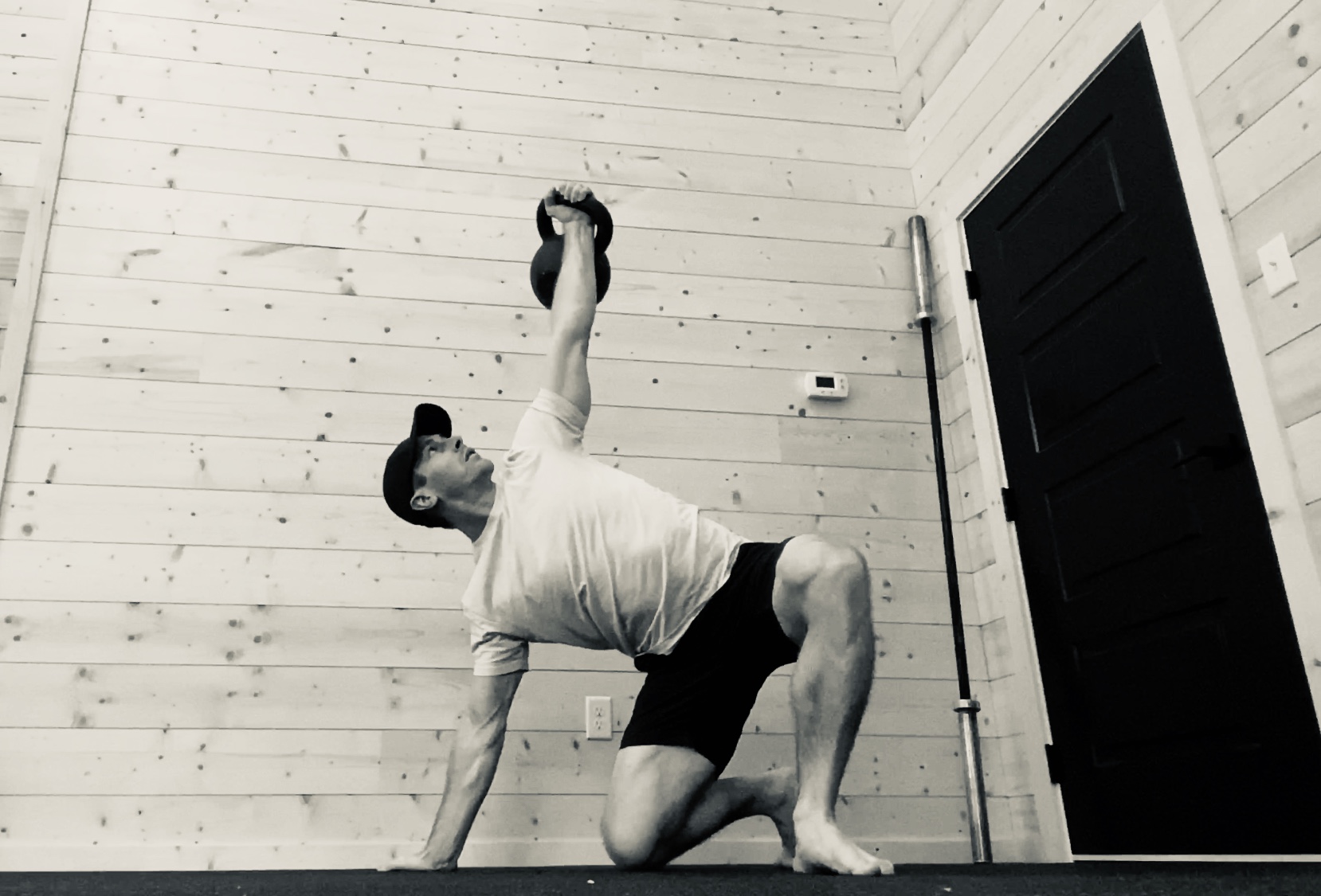
Boiled down, a single repetition of Turkish Get Up is made up of a diagonal crunch, modified lateral plank, hip lift, kneeling windmill, lunge, and static overhead carry.

Every pattern listed is performed concentrically and eccentrically.   

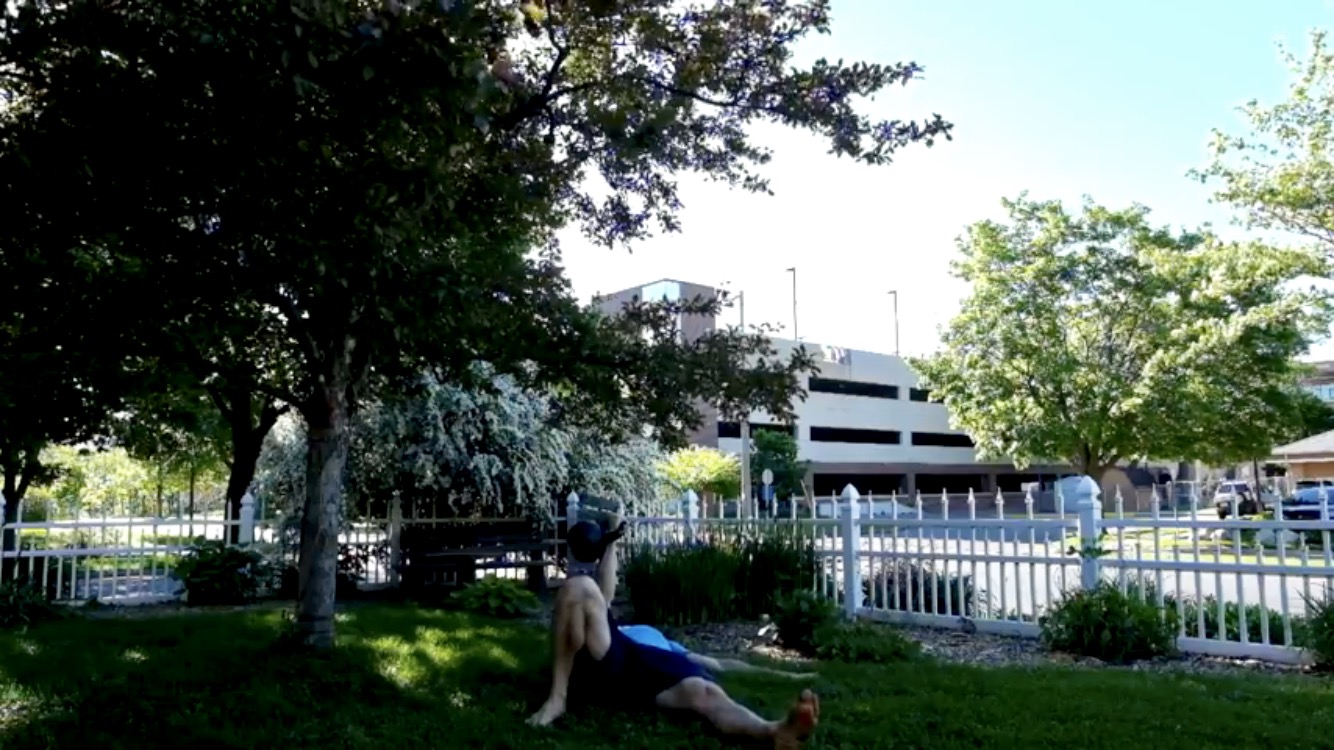
Start in a lying position.  Roll up to the elbow, then the hand.  Lift the hips, bring the leg underneath, windmill up to kneeling.  Lunge to stand up.  Reverse the flow.  

The only major movement pattern Turkish Get Ups don’t really address is upper body pulling.  

Non-issue.  

I’ll show you how to include bent-over rows to get your pulling work in.  

There is an infinite number of ways to reorganize traditional Turkish Get Ups without losing the incredible benefits of the exercise.  

Since the main positions of Turkish Get Ups include lying, kneeling and standing, we can slip exercises into each of these positions to create a brand new movement challenge.  

Here are some examples of exercises that can be added to the traditional Turkish Get Up pattern to increase the movement complexity.

Turkish Get Ups w/ Cleans, Pressing, Squats and Z-Press

Once in a standing position, the exercise options are limitless.  

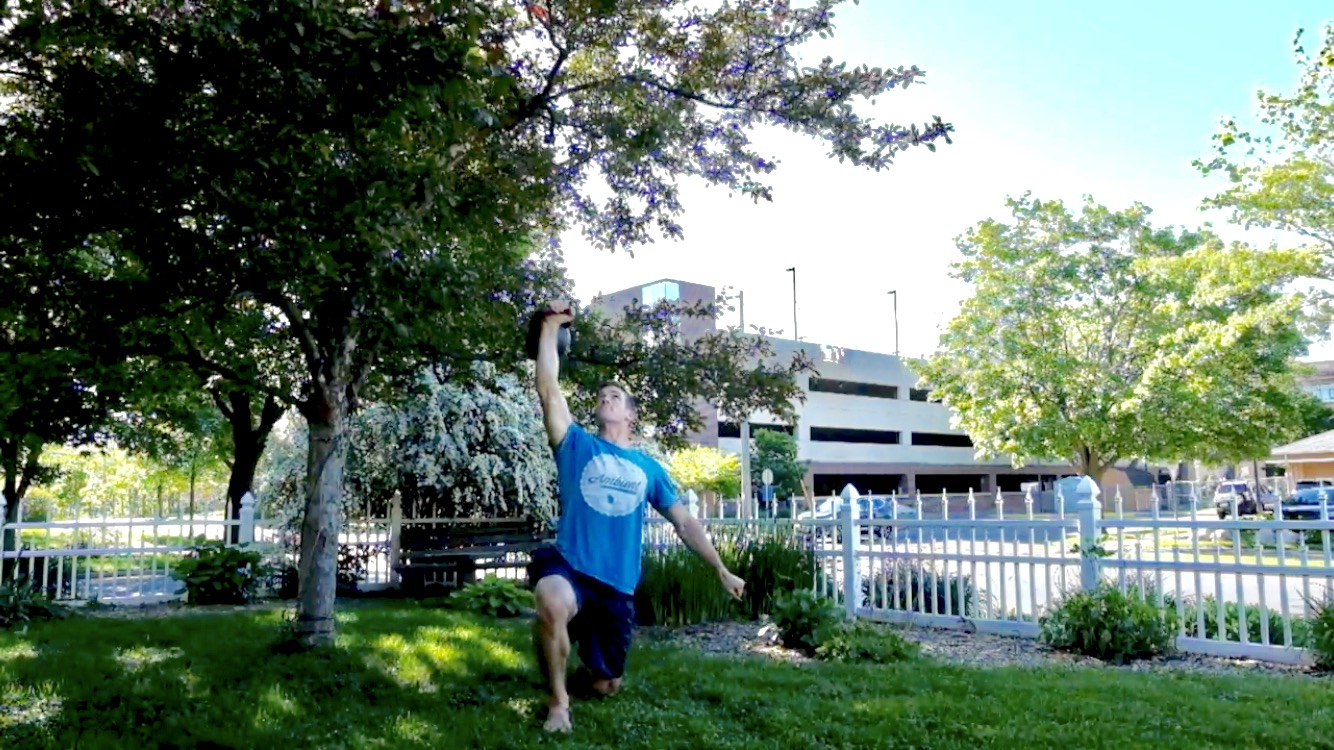
The kettlebell clean and press is a staple combination.  Descending down to the floor with an offset loaded kettlebell front squat gives the body a dose of asymmetric loading.  

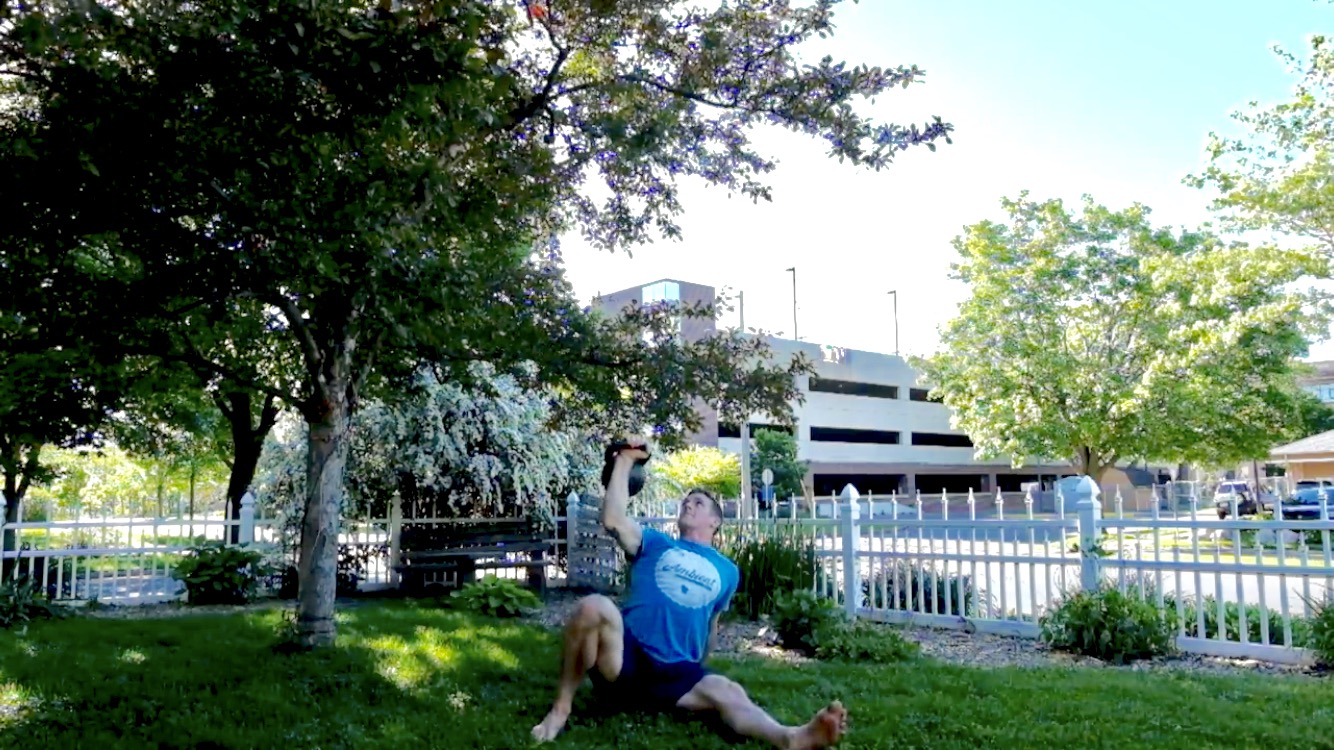
Once seated, get tight and press the kettlebell overhead.  

Expect the Z-Press to be the limiting exercise with regard to weight selection.  

Pressing from this position is far more strict compared to other overhead press variations.   


Turkish Get Ups w/ Cossack Squats and 1-Arm Swings

I place a high value on being able to squat in different ways.  

People have beaten the mechanics of the basic bilateral squat to death.  

Cossack Squats require pretty aggressive hip mobility and strength in an uncommon pattern that a lot of people just don’t train.  The adductors will be singing.  

Once standing, the hand-to-hand 1 Arm Swings deliver a short burst dose of loaded conditioning and indirect core training.

Turkish Get Ups w/ Squats

Normally, Turkish Get Ups are performed with a lunge to stand and return to the lying position.  This variation removes the lunge completely, using squats instead.

Caution:  Must have sufficient shoulder/t-spine mobility and stability for this.  


Turkish Get Ups w/ Bent Rows

One knock against calling Turkish Get Ups a “total body exercise” is the lack of upper body pulling.  This variation provides a solution by including bent over rows.


Turkish Get Ups w/ Pistol Squats and Z-Press

Pistol squats, the slang description for unsupported single leg balance squats, are one of the best squat variations I know.

Improving single leg performance is great for sport and daily living.

At the halfway point, it’s time to return to the floor.  This variation leverages an overloaded eccentric pistol squat for the descent mechanism, which is pretty challenging and effective way to return the ass to the ground.

Once settled, press the kettlebell overhead with a strict Z-Press.

In my own training…

… I engage in exclusive Turkish Get Up workouts several days per week.  

To be clear, the “work” part of these workouts ONLY includes Turkish Get Ups, nothing else.  

Mobility exercises come first to prime my body.  

I pull out the kettlebells, set the timer, turn on the music and start moving.  

These sessions start with a lighter weight kettlebell, gradually bumping up in weight every 4-5 minutes.  

I like to finish the session with a heavy kettlebell, testing my will, focus and ability to stay organized physically while the fuel tank runs low.

Controlled movement while under fatigue is an underlying goal of most of my training.  Explore new movements while fresh, morph the basics for conditioning and mental tests. 

Yes, these sessions can be monotonous, but they are free of bullshit and any unnecessary exhaustive decision making in the gym.  

The work is non-stop.  I’ll take rest for a sip of water and to towel off the sweat, but always getting right back into the work.

Fatigue is going to set in as time passes.  This is understood and accepted.  

When the body becomes fatigued, movement quality degrades.  

Maintain awareness about how fatigue impacts movement, blurs the mind-body connection and also how to continue moving with quality.

If rest is needed, it is taken.   

Expanding movement capacity is best done while fresh.  But don’t forget how to program your body to move well when tired.  

The key is to know thyself, which means knowing your current fitness level and when you’re about to overstep your capacity to exercise safely.  


General Tips/Insight/Common Sense

The question of “how many reps should I do” varies greatly from person to person.

I prefer to set a timer (anywhere from 10-20 minutes) and begin working.  You might only be able to go for 5 minutes.  Who cares.  Celebrate the effort and build on it.  

Focus on QUALITY repetitions.  Take breaks as needed to execute quality reps.

Despite the soul-sucking marathon workouts found in at-home DVD’s, magazines and on social media, it’s unnecessary to beat yourself into a pulp every single workout.  

Deliver a potent dosage of movement, get on with your day.  Rest, recover, regenerate, grow stronger. 

Learn each add-on movement in an isolated fashion.  Do not Z-Press in the middle of a Turkish Get Up having never performed a Z-Press before.  Do not attempt swings, cleans, rows, etc… having not practiced each of these exercises in isolation.

Make sense? 

Always dabble with light weight first.  Playing with new movement combinations while flinging a heavy kettlebell increases the risk of disaster.  We can mitigate the risk of injury by using lighter, more manageable weight.   

Again… move with quality.  There’s a time and place for high intensity, balls to the wall, aggressive exercise with a little less emphasis on precise movement.  

Turkish Get Ups are not an exercise to rush through. Embrace the slow, meticulous grind.  Move with purpose, grace, soft hand/foot touches and strength in transitions.  

Breathe. 

Don’t forget to breathe. 

Kettlebell Clean – Press- Squat

Motion

Years ago when I was low on cash and training in my studio apartment, my lone pair of 24kg kettlebells provided workout after challenging workout.  Making the most of a tiny home gym also gave me PHD in resourcefulness. 

Kettlebell training is unique, unlike any other mode of training.

Bursting onto the fitness scene in the early 2000s, kettlebells gradually became a mainstay piece of equipment in gyms all over the world.

Kettlebells disrupted fitness.  The spotlight was shifted really functional loaded exercises.  Drills like swings, cleans, snatches, Turkish Get Ups and other combinations became the new standard.  Most of which performed in standing position.

Though the effectiveness of kettlebell training has never changed, the novelty of the tool has since dissipated, which is common in the fitness industry.  

Exercises, equipment, and methods lose their popularity in the mainstream… here today, gone tomorrow.  

“Bring in the next shiny toy of the year, please!”.  

Despite the sex appeal fading a bit, basic kettlebell exercises remain brutally effective for building strength, conditioning, and fat loss.  

I’m one of those people who don’t forget.   

Outside of nutrition, sleep, hydration and adequate non-exercise activity on a daily basis… short burst kettlebell training (high intensity, low rest, etc) is amazing for burning body fat.

And yes, if you want to maximize workouts, you’d better be auditing habits outside of the gym.  Don’t sabotage your efforts. 


Kettlebell Clean, Press and Squat Combo

The clean, press and squat combination is a prime example of how a simple 3 exercise circuit can be leveraged to produce a significant training effect.  

And it doesn’t require much time at all.  15-20 minutes at most. 

For your eyes only… 


This kettlebell combination features 3 staple exercises:  clean, press and squat.  

Each exercise is performed with very little or no rest in between each exercise.  

Smooth transitions between each exercise is the goal.

Changing levels with the kettlebell… cleaning the bell from under the legs up to the front rack position, pressing overhead, back down to the front rack for the squat for repetitions…

… is pure work.  

This work creates a total body training stimulus.  

It’s the “magic sauce” of this combination.  

Before moving on, here are some key thoughts:

  •  You must have a working familiarity with each exercise before engaging in this circuit.
  •  Respect fatigue and what it does to the body while under load (increase rest if needed)
  •  Work reps, rounds and rest periods appropriate to your 
  •  Choose a sub-maximal kettlebell weight that allows for 10-12 reps per exercise (even though you’re going to do 6 reps).
  •  Not sure what weight to start with? Go light, work up as needed.
  •  Keep the workout short (15-20 minutes at most)


Alternatives/Substitutions

Not everyone is going to have access to a pair of kettlebells that are the same weight, or maybe they are the same weight, but too light or too heavy for your current fitness level.  

One of the most important ideas in staying fit is becoming resourceful.  When space is limited, equipment is scarce or time is tight, DO NOT FOLD.

How many times do we read a workout blog or fitness article and realize we don’t have the same set up the author did?  I’ve had this experience hundreds of times.  

What do you do?  Make adjustments, move forward, get the work done.

No kettlebells?  It’s ok!  Here are some equipment alternatives:

  • Barbell (same exercises and reps)
  • Dumbbells (same exercises and reps)
  • *Bodyweight (change exercises and reps)

Barbells and dumbbells are the most common pieces of weight training equipment in the world.  Most hotel gyms, YMCAs, 24Hour Fitness or Big Box Gym is going to have one or the other.  

Both allow for the clean+press+squat exercise combination to be performed.  The main difference between barbells/dumbbells and kettlebells is the design and how you can maneuver them.  

Barbell training fixes both hands to the shaft of the barbell.  For some people, this is great because you’re not having to control each hand independently.  

Dumbbells allow for independent arm work, but the shape of dumbells means you’ll have to tweak hand position/technique for each exercise.  These are subtle adjustments are mainly to avoid bumping the dumbells into your body on each movement.  

Bodyweight.  Now, if you’ve got no equipment available whatsoever, you’re still in the game, don’t worry!  You’ve got plenty of options.  Tons.  

When resources are scarce, you make adjustments, adapt and push forward.  Don’t get hung up on imperfections. 


Try this bodyweight combination…

Wouldn’t it be great if life was perfect all day, everyday?  Yes, it would be. 

(👋 slap across the face)

Life’s not perfect and never will be, so the best practice is to be ready to embrace the situation presented and make do with what you’ve got.

If bodyweight is the only option for the workout, consider digging into this circuit:

  •  Alternating Split Squat Jumps
  •  Dive Bomber Push-Ups
  •  Air squat (or variations: pistols, rear foot elevated, etc)
  •  Burpees

– 6-8 reps per exercise

– 6-10 rounds

– Limited/no rest between exercises

– 45-90 seconds rest after each round.

Perform in descending order (top to bottom) without rest between exercises.  Alternating split squat jumps first, then dive bomber push ups, etc…  

Factoring in no weight is being used to load these exercises, consider increasing reps per exercise, increasing the number of rounds performed or reducing the rest periods.  

Be mindful not to adjust all of these variables in one shot, it may create more fatigue than what your body can handle.  It’s like fine-tuning the dial on a boombox to get the signal of a radio station.  

Tweak here, tweak there.

Burpees?!?! What?!?! I h*te you!?

I don’t believe burpees are the greatest exercise on the planet. 

Some people do, I do not.

Burpees are often blindly prescribed to the wrong people and abused by many, but burpees are an incredible exercise to increase heart rate quickly and condition the entire body… in a pinch.

Personally, I rarely perform burpees.  But if I have few other options, hell yeah, I’m going to rip out some burpees.  

Don’t tar and feather me.

👉👉👉 Up for a challenge?  Try this burpee variation.

So, you have access to kettlebells, but… 

  • Kettlebells are too light
    • Increase the reps 
    • Increase the rounds
    • Decrease the rest periods
    • Add other kettlebell moves or filler bodyweight exercises
  • Kettlebells are too heavy (for desired rep range)
    • Decrease the reps
    • Decrease rest periods
    • Insert bodyweight filler exercises to achieve desired training stimulus)
  • Only 1 kettlebell (see video below)
    • Perform exact same exercises one side at a time 
    • Finish both sides, take rest period
    • Single kettlebell training is fantastic.

Ok, I’ve laid it out for you.  Time to dig in.  

Get after this exercise combination.  The kettlebell clean-press-squat combination is awesome for improving strength, conditioning and fat loss. 

Go.  Now. 


Cheers, 

Kyle 


(Work)out| Lizard Crawl + Kettlebell Carries + Walking Lunges + Crab Walk

Motion, Workouts


Screen Shot 2017-07-18 at 5.57.50 AM.png

Lizard Crawl to Kettlebells


Fusing body weight locomotion movements with traditional strength and conditioning exercises can create a hybrid workout experience. can breathe new life into a stale training regimen.  

When training gets stale, mix it up to breathe new life into your regimen.  

Basic linear lifting can get extremely monotonous.  Instead of skipping the workout, toss in different exercises to give you new motivation.  

What exercises are you avoiding or leaving out of your program?  Everyone has some.  It is impossible to do it all, all of the time.  My YouTube channel has hundreds of exercise demos, only 4-10 exercises can make the cut for a workout on any given day.  That leaves hundreds more sitting on the sidelines.  

Many people forget about the value of carrying heavy objects.  Carry those objects in as many different positions as possible (overhead, at your side, chest height, bear hug, etc).  Do it all.  

Locomotion drills are also a relatively new platform for building fitness most people haven’t explored.   If you haven’t, you must.  

This training session includes both.  

Today’s workout includes the following exercises:

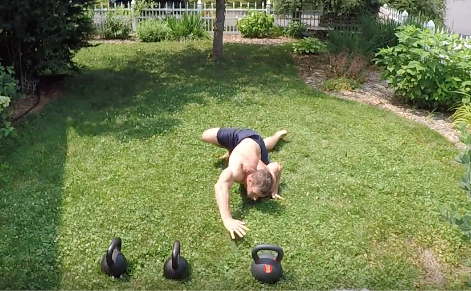
  • Lizard Crawling (“traveling forms” in Animal Flow)
  • Suitcase-style Kettlebell Carries 
  • Overhead Kettlebell Carries
  • Kettlebell Walking Lunges
  • Reverse Crab Walks (“traveling forms” in Animal Flow)

*** For all of the kettlebell exercises, feel free to use dumbbells instead.  Any object with a handle and some challenging weight will do.

What you’ll need:

  •  1 heavy kettlebell
  •  2 kettlebells of matching weight
  •  15 yards of walking space

The Structure of the Workout

  1.  Start by lizard crawling 15 yards the location of the kettlebells.
  2.  Clean the heavy kettlebell up to chest height and position overhead.  Walk down and back with the overhead carry.
  3.  Clean the same kettlebell overhead with the opposite arm.  Walk down and back with the overhead carry.
  4.  Suitcase carry the same heavy kettlebell down and back with both arms.
  5.  Pick up the matching kettlebells and lunge walk the same 15-yard distance, down and back.
  6. Reverse crab walk to the initial start position.
  7. Repeat the process, beginning with lizard crawling once again.

Workout Video Demo

Workout Notes

This workout can be executed for rounds or time, whichever you prefer.

If you were going to work this for rounds, I suggest starting with 3-4 rounds and crushing those rounds.  The idea is to work hard and work smart.  Working smart is awareness of fatigue and body position.  When your movement turns sloppy, you’re done.  

Of course, more rounds can be added if you can handle it.  

If you’re hammering this workout for 8-10 rounds, you need to increase the difficulty of all of the exercises.  Lizard crawl for 20-25 yards, increase the weight of all of the kettlebell carries and the walking lunges.  More is not always better.

If working for a target amount of time, I suggest capping this at 20 minutes.  The video demo above shows roughly 8 minutes worth of execution.  

Use the lizard crawl and overhead kettlebell carry as indicators of when you need intra-workout rest periods or when you need to pull the plug on the session altogether.  Don’t be afraid to rest.  There is zero shame in it.  Your body can only fight fatigue for so long before the movements get sloppy.  Take the rest, towel off, get back to work.  

The overhead carry is an amazing shoulder stability/vertical core exercise, but it is also an exercise that deserves respect.  DO NOT FORCE THE OVERHEAD CARRY FATIGUE IS EATING YOU UP AND TECHNIQUE IS DROWNING.  

This particular day, I worked this exact medley for 15 minutes, wiped down the sweat avalanche and transitioned into another medley of completely different exercises.  

Combining both medleys, I accumulated 30 minutes worth of continuous quality work.  

If you don’t have access to kettlebells, don’t worry about it.  Weight is weight.  Use dumbbells, a sandbag or any other tool that has a handle.  


Give this workout a shot and let me know how it went…

Kyle 


Turkish Get-Ups: “Press at Every Step” Variation

Kettlebell Training

Turkish Get-Ups (TGU’s) are one of the great kettlebell exercises.   Nevermind kettlebell exercises, they are one of the great movement training drills we’ve got.

When I am asked, “What are the best exercises I should be doing?”

Turkish Get-Ups are always a part of my answer.

This is a heavy question to ask and even heavier to answer.  Responses will differ depending who you’re asking but generally speaking, there is too much movement value, low risk and high reward with Turkish Get-Ups to leave it out.

Few other exercises provide the total body training effect of Turkish Get-Ups.  

Like any exercise, TGU’s have an infinite amount of variations, add-ons, and programming option (sets, reps, time, weight, etc).  Practicing variations is a nice way to introduce a movement challenge and avoid the onset of boredom.

Make no mistake, keeping training fresh is important across the long-term.

One of those variations is the “press at every step”.

This TGU variation involves performing five presses in the following positions:

  1.  Lying position.
  2.  Elbow support.
  3.  Hand support.
  4.  Half-keeling.
  5.  Standing.

Press #1:  Lying Position

FullSizeRender 3

This is the only true horizontal press of the five listed.  “Horizontal”, meaning you’re pressing from the back of the body to the front of the body (anterior to posterior then back to anterior again), similar to the mechanics of a traditional bench press.  Lower the weight down until the elbow makes light contact with the ground, pause, press back up.

Press #2: Elbow Support

FullSizeRenderPressing from the elbow support position will be a new experience for a lot of people.  Expect this to feel unnatural and use cautionary judgment with weight here.  The trajectory of the kettlebell is slightly different than any traditional pressing exercise. 

Press #3:  Hand Support

FullSizeRender

This body position will likely be the most awkward press of them all.  Remain rigid from waist to shoulder.  Naturally, your body is going to want to crease or your ribs are going to flail.  Avoid letting either happen.  Stay rigid and press! 

Press #4:  Half-kneeling

FullSizeRender 2

Training in the half-kneeling narrow stance position is a natural core blaster and can reveal side-to-side differences in symmetry.  You might be steady with the left knee up, but hardly maintain the position with the right knee up.

Turkish Get-Ups aside, half-kneeling pressing is a natural overhead pressing progression into the standing press.

Press #5:  Standing

FullSizeRender 5

Finally, standing at last.  In the world of “functional training”, this is as functional as it gets.  Pressing objects overhead is a common task in life.  Unfortunately, most of the objects pressed overhead in life aren’t evenly weighted with nice handles.

Here is a video of a full “Press at Every Step” Turkish Get-Up…


Whether you’re craving a movement challenge or simply a new variation of a timeless exercise, give this one a shot.  Be prepared for sore shoulders and core in the days that follow.  Five presses inside of each TGU repetition accumulates a lot of work for the upper extremities.  

For more great kettlebell exercise variations, I recommend two resources.  The first is a landmark book from the modern day Godfather of kettlebell training, Pavel Psatsouline.  There isn’t a kettlebell professional who hasn’t read Pavel’s ongoing work with kettlebell training.  

The second resource is a full training system from Chris Lopez designed to improve body composition using kettlebells, more specifically fat loss.  Kettlebells are unique in their ability to burn fat when used systematically.  Chris has published a number of kettlebell training programs focused on how to  “lean out” using kettlebells for quite some time.   

Screen Shot 2017-06-04 at 10.17.51 AM


Most importantly, let me know how you made out with this TGU variation…


Cheers, 

Kyle

High Repetition Kettlebell Swings

Kettlebell Training

The kettlebell swing is a amazing exercise that can build power, strength, improve conditioning and accelerate fat loss.  

Swings are packed with benefits.  

Kettlebell swings have been a staple exercise in my workouts for the past 13+ years.  

I started by swinging a 24kg kettlebell, and have since moving on to 28kg, 32kg and 44kg swings of varying intensities and volume.  

Within 4 weeks, I noticed the impact kettlebell swings had on my physique.  

And I wasn’t using fancy workouts, just a simple 15 seconds on/ 15 seconds off for 24 rounds.  That’s a 12 minute workout, with 6 of those minutes being dedicated to swings.   

Long story short, adding swings to my workout regimine helped to burn fat off of my body while building functional power, improving my posture and delivering a potent form of conditioning. 

Swinging kettlebells has also improved my running.

Kettlebell swings are a total body exercise.

In the beginning, I rarely swung my 28kg bell beyond the 15-20 reps in a work set.  

Overall, my workouts 

Then I started reading testimonials where people described how high rep kettlebell swing workouts (several days per week) was torching fat off their bodies. 

Who doesn’t want to burn a little more fat off their body?  I sure did, and still do, let’s get lean people. 

Of couse, nutrition is a crucial part of fat loss, so factor that in. 

Over the years, I’ve gone pretty far down the rabbit hole with swings.  High rep swing workouts might eclipse 300-400 reps in a session, using heavier kettlebells.  

Note:  Tread lightly using high rep swings too frequently.  Give your body chance to recover and avoid injury.  

—> Here is a short list of my observations and findings while using high rep kettlebell swing workouts <—

1)  High rep kettlebell swings builds grip endurance.  

2)  Might be a good idea to perform self administered soft tissue work on the forearms using a lacrosse ball or a percusion massager like the TheraGun. 

3)  I got lean pretty quick, which is predictable because kettlebell swings work a large number of muscles and burn a significant number of calories in these high rep workouts.  

4)  Take adequate rest between sessions.  Give your low back, glutes and hamstrings a chance to recover from the increase volume.  Foam roll, percussion massage, accupressure mat, active mobility training and long walks are a good idea.  

5)  2-3 high rep swing workouts per week is enough to create noticeable changes in body composition and conditioning.  

6)  Postural changes were interesting.  Standing position seemed like my hips were further forward and my shoulders pulled back.  

7)  15-20 minutes is more than enough time to accumulate a shit ton of swings.   

8)  Don’t be afraid to move up in weight and attack heavier kettlebells.  

I’d consider a high rep swing workout to be 100+ reps or more.  

Taking that number and scaling it for a beginner,  40-50 swings might be high rep for your experience level. 

If you’re advanced, 200+ swings might be your target for that day.  

It depends on your conditioning level and familiarity with the kettlebell swing.

Here’s a good kettlebell swing workout:

Baseline Kettlebell Swing Workout

Workoust like this are deceptively challenging.  

In the early round the rest periods feel long, but in the later rounds the rest periods don’t feel long enough.   

Fatigue is a hell of a drug.  

Using this workout, you’ll accumulate 100 swings in 10 minutes.  

That’s plenty to create a training effect.   

Choosing kettlebell weight.  20-24kg for men and a 16kg/20kg for women.

This is not the law however.  If you need to go lighter, do it.  Need to go heavier?  Do it.  Feel it out and make that decision as needed.  

This workout uses a fixed work:rest structure.  Wear a heart rate monitor if you have one.  A heart rate monitor can provide valuable information on work and rest periods, along with pinpointing how hard you’re actually working according to heart beats per minute.  

Using a heart rate monitor, I’ll perform the swings, finsih, then watch my heart rate monitor until the BPM decresases to 130bpm before starting the next round.  This method will make rest periods short in the beginning and tends to increase the length of rest later in the workout as fatigue accumulates and your body needs more time to calm down.  

Here are a few other workouts I’ve played around with. 

Other tips for high rep swing workouts

Don’t make the mistake of swinging too light of a kettlebell.  

The hips are powerful , size up the kettlebell and challenge yourself.  

If you have several different weights, you can start the workout with the heavier kettlebell and transition to the lighter bell as needed.  

It’s all based on feel.  

If you’re swinging super high rep marathon sessions with too light of a kettlebell, there’s diminishing returns.  

Instead of swinging 500 reps and feeling fresh at the end of the workout, lower the reps while increasing the weight.  

The increase in load will challenge your body plenty, and over time, the volume will increase.  

Repeat this process and you’ll be swinging the 40kg BEAST in not time.  I bet your body will reflect this progress.  

Just remember, the rules of progressive loading apply to kettlebell swings also.  

Again, this is a basic progression with loading, similar to what you’d use with traditional resistance training.

Heavier kettlebells will require greater effort to move the kettlebell through the arc of motion.    

Kettlebells are amazing for building power, improving posture and fat loss.  

Swings, while not the best for building lean muscle, are known to and can build muscle.  

Don’t count kettlebell swings out for building SOME muscle.  Just know there are better exercises.  

Deadlifts, squats, vertical pulling, rows, horizontal pressing and overhead pressing are best for building muscle because muscles will spend more time under tension through the full range of motion.  

Kettlebell swing are great for fat loss, if…   

… you’re in a caloric deficit.    

It doesn’t matter if you’re getting into a  caloric deficit via the swing workouts, or you’re a badass and entering workouts already in a caloric deficit.

You cannot out-swing a calorie surplus and expect to lose fat.  The math will work against you every time and you’ll go insane.  

People fight the calorie deficit thing all the time, like there’s some other secret sauce that can only be found by spending $97 on a fitness guru’s fat loss product.  

The caloric deficit is NOT EVERYTHING when it comes to fat loss, but it does play a HUGE role in burning fat.  

Huge.  

Sleep, hydration, protein intake, eating whole foods over processed foods (as much as possible) will deliver “best” results.

If you found this article wondering if high rep kettlebell swings are a good idea… 

… yes, they are.  

Just make sure you approach these workouts with some common sense, making sure you’re familiar with the swing itself and not overdoing the volume out of the gates. 

Increase the reps gradually, find the sweet spot with the weight, attack the workout. 

Integrating several high volume swing workouts per work alongside decent nutrition will deliver awesome athletic and aesthetic results.  

Cheers to high rep kettlebell swings!

KG
20 Minute Workout| Kettlebell Complex and Air Bike Intervals

Quick Tips

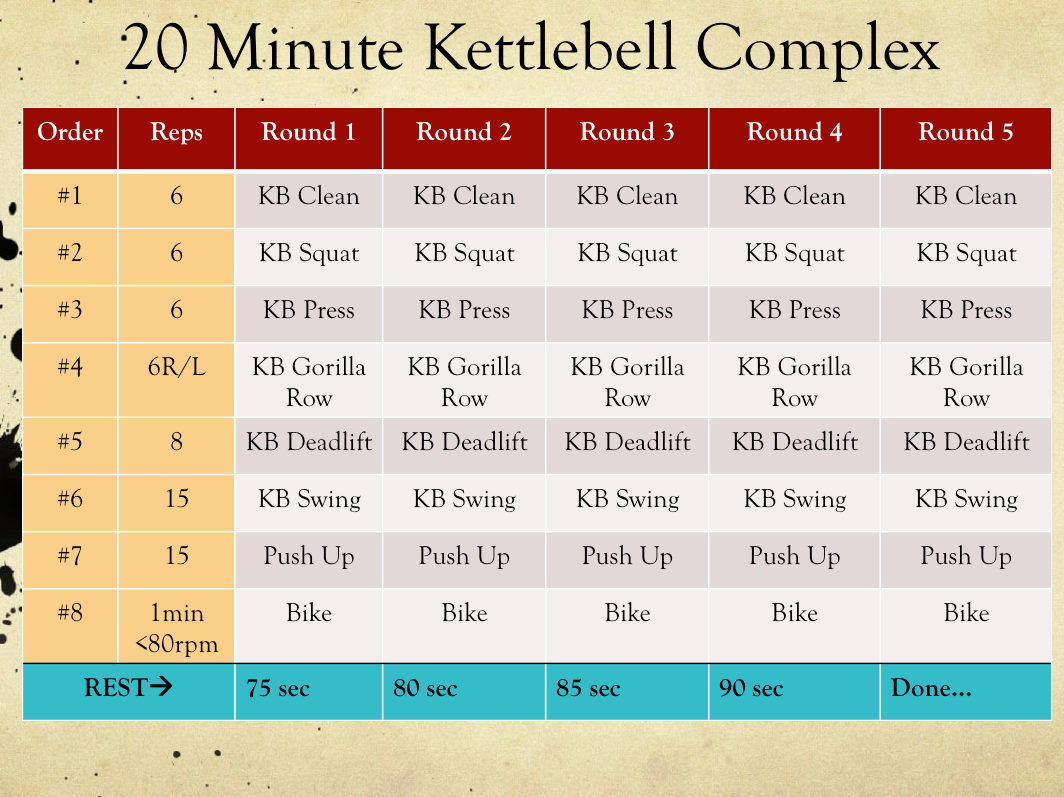
Here is a 20 minute kettlebell complex and air bike workout BURNER.  

This workout uses the same kettlebell complex I used for 90 days straight, just to see what would happen.  

Progression is key to improving performance. 

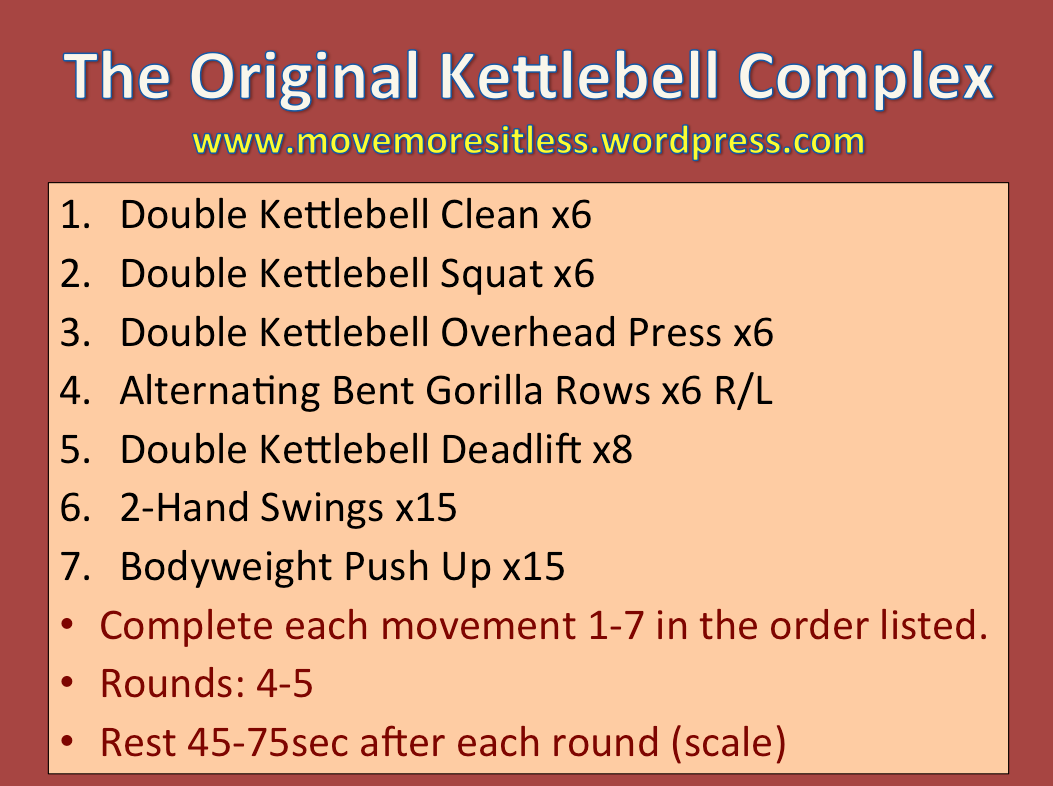
The original complex looked like this:

Original Kettlebell Complex

The goal was to keep the workout brief.  Under 20 minutes.

20 minutes is a sweet spot for me, especially with higher intensity efforts.  

I’m able to get the training effect I want, without losing technique to fatigue or subjecting myself to unnecessary injury.  

Higher quality work in shorter amount of time.

I really like these short burst sessions that address cardio and strength in one shot.  Life doesn’t always allow for 60-90 minute daily workouts.  We wish it did, but it’s turbulent.  

Being able to walk in the gym, warm up quick and get after it is awesome.  

The Workout

20 Minute Kettlebell Complex

Biking.  The addition of the 1-minute air bike ride at the end of the round shakes things up.  The goal is to keep the RPM above 80.  

The first few rounds were fairly easy, but rounds 4 and 5 were a bitch to keep pace.   

Why bike?

Biking is a low impact activity that requires ZERO skill.  Get on and ride.  Air bikes involve the entire body via turning the pedals over while pushing/pulling the dual action arms.

Biking is a safe way to condition while mitigating stupid workout injuries.  

Fatigue.  The ascending rest period tactic was perfect.  

Ascending Rest Periods

As fatigue accumulates, so does the amount of rest.  

The extra 5 seconds of rest added to each round helped managed my fatigue.

75 seconds of rest will seem long in the beginning.  But again, the fatigue hits you like a slap across the face.  

In rounds 3, 4 and 5… the 85-90 seconds rest passes by quickly.  

During your rest period, focus on breathing.  Deep and full breaths. 

Breathe deep into your BELLY, not your chest and neck.  

Exercise technique.  Metabolic conditioning is designed to stress the muscles and cardiovascular pretty aggressively, but it should NEVER come at the expense of technique.  

Scale the workout for yourself.  Start with longer rest in the earlier rounds.  Use less weight or bike for 30-45 seconds at a lower RPM instead of 1 min at >80 rpm.

Explore and tweak it as you go.  You can expect each “round + rest” to last 4+ minutes, with the later rounds lasting longer because of the increased rest.


Kyle


Hang In There… The Kettlebell Clean is a Great Exercise and an Acquired Taste

Quick Tips

The kettlebell clean is an acquired taste, for sure.

It reminds me of a craft beer drinkers first sips of an I.P.A. or a Double I.P.A.  Do you remember the bitter beer face commercials?

One quick search on the old Dragon Door article library or the new StrongFirst forum, and people will praise the hell out of this move, but I am here to warn you up front, you might not enjoy this exercise at first.

It’s an acquired taste.

Both from a technique standpoint and a “Why the hell would I choose this exercise over kettlebell swing variations, kettlebell snatches, weighted jump squats or even barbell cleans”?… standpoint.

For quite some time, I wasn’t exactly sure what significant purpose kettlebell cleans served.

At that time, the kettlebell clean seemed more like a sweet little method to move the kettlebell from the floor up to the rack position, and not much more than that.

Photo credit:  FitBomb

Photo credit: FitBomb

In case you’re not familiar, the rack position describes a static posture where the bell rests for a given amount of time (split second or for multiple seconds) against the chest with elbow tucked tightly to the side.

Also, at that time, my timing was way off with the kettlebell clean.  I was mostly pulling the bell up from between my legs using my upper extremities, and flipping it over the top of my knuckles.  Obviously, the upper body does have some involvement in most kettlebell training, but one of the main principles of any ballistic kettlebell movement is hip snap.  I have always viewed “hip snap” as the slang terminology for aggressive/powerful extension of the hips.

Kettlebell drills like swings, snatches and cleans all thrive off of aggressive hip extension, or hip snap to catapult the bell through its trajectory/range of motion.

[Improving your ability to aggressively extend your hips is incredible for sport performance and fat loss.  The research on the influence that kettlebell swings has on body fat elimination has been growing rather consistently in recent months.  Anyone that has spent any time working out with kettlebells in a dedicated manner will no doubt give the nod to kettlebell training (specifically swings, cleans, snatches) and its dramatic effect on fat loss.  Almost to the point of zero dietary intervention.  That’s not to say that you shouldn’t pursue higher standards of eating… because you should.]  

Ok, back to kettlebell cleans.  Originally, I didn’t like them.  I just didn’t see the value.  Swings (moving the bell to about sternum height) provided a noticeably large training stimulus that mimicked an explosive deadlift and kettlebell snatches (moving the kettlebell overhead) worked very similar to dumbbell snatches, which are amazing for building uni-lateral explosive power.

But kettlebell cleans seemed like the red-headed step child (forgive my joke if this offends anyone).  I kept asking myself,  “What are they good for?”

I never felt like I was achieving anything while practicing the kettlebell clean.  The hip snap didn’t feel like it was present, and quite frankly, it didn’t seem like it really needed to be present in order to execute the clean.  So then what?

Again, as I stated early in this post, the clean (to me) felt like an efficient method to transport the kettlebell vertically to the rack position so that I could set up for other exercises like:  squats, overhead pressing or carries.

Eventually, I made the decision to work on my clean technique in a diligent manner.  I also spent some time combing over the forums and articles from trusted resources for to increase my understanding of what the kettlebell clean is and why it was important.

Here’s a messy synopsis of what I found…

From a basic observation, I thought of the kettlebell clean as a variation of the swing, and still do.  Obviously the motion is different, but hiking the kettlebell through the legs, moving forward into an arcing pattern is very similar to that of the kettlebell swing.  However this arching pattern is interrupted as the hand/arm pulls the bell much tighter to the anterior (front) aspect of the body than the arc of the kettlebell swing.  Some people will refer to this as “taming the arc”.

You can read more about “taming the arc” from this excerpt:

Kettlebell Taming the Arc

Once the bell begins its ascent vertically to the chest, this is where most people will get lost, as I did.

Why?  Because in the time that it takes to blink your eyes, the bell needs to transition from a prone (hand over the top) grip to a neutral grip (palm toward the midline of the body) with the kettlebell nestled partially against the forearm and chest, at armpit height.  The entire sequence happens really quickly.

The most common mistake here is “flipping” the bell.  Technically, it’s incorrect yes, but the bigger mistake is that flipping the bell over the hand is essentially beating yourself with the greatest mass of the kettlebell.  Kettlebells are constructed of dense cast iron so… it hurts.  Once the bell flips over the hand, the only object to stop its motion is your body, and this can be painful.  If you’ve played contact sports, the sensation of the bell impacting your body will be eerily similar to the impact of another human hitting you.

So what is supposed to happen?

Around waist height, the bell begins to turn over and rotate.  It’s a combination of both.  The only way to successfully accomplish this, is to relax your grip and allow the kettlebell to turn over/rotate around your forearm.  I said RELAX, NOT LET GO.  Your hand position changes on the bell, without your hand ever leaving the bell.  I use the terminology turn over/rotate because I feel this is the best description of what happens to the kettlebell as it transitions into the rack position hand position changes on the bell, without your hand ever leaving the bell.

This “relaxed” grip was uncomfortable for me at first.  It didn’t feel natural to loosen a grip and relax while dynamically swinging a 53lb piece of cast iron.  I am sure that you might feel the same way when you give this movement a go.  It can be unsettling for the first few reps.  Make sure that your hands are dry and free of any grease.

Chalking your hands is a great technique for improving hand/grip integrity kettlebell training, although chalking can be messy for you house over time.  Check out this Metolius Eco Ball chalk bag that really helps to save yourself the hassle of cleaning up chalk mess.

But, like anything other new stimulus or skill, consistent practice will move your  technique of the clean from completely foreign to second nature.

Filming my kettlebell clean (which I encourage you to do always) revealed that I wasn’t initiating my turn over/rotation of the bell soon enough.  I was attempting to mimic the barbell clean, where the hands and elbows (and body) move under the vertical moving barbell above waist level.

Again, if you attempt to “flip” the kettelbell above waist level you’re going to get some tough love from the bell in the form of a shot to the chest/shoulder.  As long as you don’t hurt yourself, this type of feedback is probably a good thing, as there will be no question that your timing is off.

The kettlebell should park itself into the rack position rather peacefully.

The kettllebell clean is a “steering strength” movement that requires adequate attention for successful completion.

You might start out despising it like I did and end up loving it as I do now.

A series of simple tips that can help you out:

  • In the beginning feel free to learn using a lighter bell.  This is important.
  • Quickly move into a heavier kettlebell that demands some  hip snap to make the bell move.  Otherwise, you may find yourself “muscling” the bell as I was.
  • Work the single arm kettlebell clean until you feel you are proficient with technique at heavier weights.  Forget about “work capacity” training while you are learning, learn it first, don’t get ahead of yourself.
  • Once you’re moving a heavier kettlebell (32kg men/24kg women), consider transitioning into the double kettlebell clean, which will require attention to be paid to both arms and an increase in hip snap to move the bells to the rack position.
  • Practice, practice, practice.

On a positive note, if decide to dedicate some time and practice into learning the kettlebell clean, you’re going to find great carryover to all of your other lifts also (kettlebell swings, presses, etc).  The move requires timing and coordination, but improving both will boost your performance and your results in the race to lose fat.

The clean is nothing that I thought it was and everything that I thought that it wasn’t.  I have been pleasantly surprised and challenged by its technique and it’s purpose inside of a balanced strength and conditioning program.  I highly suggest that you work it for yourself and see how it benefits you.


Cheers to kettlebell cleans babies!

KG

It’s Just a Kettlebell Workout: Adjusting a Brutally Effective Kettlebell Complex

Quick Tips

I added a few new elements to what I like to call a staple kettlebell complex that seemed to fit the bill just right.

The original kettlebell complex was structured like this:

Kettlebell Complex Training

First let me say that if you have the physical know-how and ability to train like this, you won’t regret it.  If you’re short on time, its pure gold.  If you’re looking to lose fat, its pure gold.  There is so much happening in a condensed total body work capacity-style training session like this, it’s definitely going to create a large training effect.

And that is what you should be after… A large training effect while keeping safety in the front of your mind.

So, as much as I love the above training session, it was time to re-organize some things.

Boredom in training sucks.  I aim to avoid this without straying too far toward the radical.

Using the above kettlebell complex, my rest periods had decreased to nearly 40 seconds in between complex rounds, and my total number of complex rounds had increased to 6.  I felt as though I was spinning my tires.  Would adding another round or decreasing the rest periods  the 40 second mark really provide any benefit?  I really had to ask myself what there was to gain from adding more, or resting less.

My options seemed to be: increase the loading or change the stimulus.

I chose to change the stimulus and see what happens.

My first experience with the modifications was promising.  Here is how it looked:

kettlebell complex training

Alternating the double kettlebell swing and the double kettlebell cleans added significant work time to the beginning of the complex.  I should clarify that “significant time” is really only 15-20 extra seconds, but when the entire complex round clocks out at 2min11sec total, 15-20 seconds of extra work begins to look a lot more challenging.

Other areas of the complex that seemed to increase the working time were the overhead presses.

Exploding out of the last rep of  squats, I immediately transitioned into a double overhead press.  Upon bringing the kettlebells back to the rack position, I then pressed the right hand bell up and back down, followed by the left hand bell up and back down.  Pressing a single kettlebell while holding the other in the rack position is draining, but this is what I was aiming for.

Lastly, the implementation of the alternating reverse lunges added working time to the entire work set.  In the original kettlebell complex, sumo-style deadlifts were used.  The cadence of a sumo-style deadlift is commonly much quicker than alternating between reverse lunges.  The training stimulus is also altered by changing the movement pattern.  I quickly found out how much I had deprived myself of lunge work.

As far as rest periods go, I suspect that 45-60sec of incomplete rest will remain adequate to receive the training effect that I am after (lean, conditioning, maintenance of strength qualities).

I refer to the rest periods as incomplete anytime my heart rate doesn’t recover to 130 beats per minute.

In the later rounds of the workout, my work periods begin higher and higher heart rates.

My goal is to be a perfectly golden marshmallow.

If you’re proficient with kettlebell training, give this workout a shot.  You may have to adjust some things to suit your abilities, scale up or scale down, but you’ll be pleasantly surprised at the results you’ll get from training like this.

At the very least, it’s a different angle on working out.


Cheers to shifting the complex to create a new training effect!


Kyle