The RKC Deep Six Kettlebell Workout

Kettlebell Training


The RKC Deep Six Kettlebell Workout is movement challenge that creates a potent cardio and strength training effect using six of the best kettlebell exercises. 

  • Snatch
  • Swing
  • Clean and Press
  • Squat
  • Turkish Get-Up

There are hundreds, if not thousands of kettlebell exercise variations stemming from these six exercises.  

The “original 6” kettlebell exercises create the foundation on which pretty much all other results-based kettlebell training is built.  

For the home gym, this type of training is perfect.    

The RKC Deep Six Kettlebell Workout ONLY requires 1 kettlebell and leverages HIGH VALUE exercises.  

The RKC Deep Six Workout

The RKC Deep Six Workout leverages the effectiveness of the six premiere kettlebell exercises.  

Snatch, swing, clean and press, squat and Turkish Get Ups.  

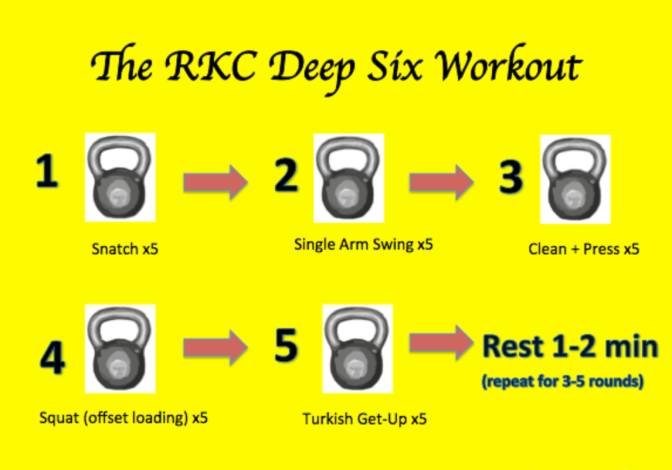
Here’s what the workout looks like.
Screen Shot 2020-07-29 at 8.20.49 AM

Workout Structure

Each movement is performed in the order above, 1 through 5, starting with snatches.

Complete 5 snacthes, move to 5 reps of single-arm swings, then 5 reps of clean to press, and so on.

Each exercise must be performed on BOTH SIDES OF THE BODY before advancing to the next exercise.

Again, the exercise order and repetition structure of The RKC Deep Six Kettlebell Workout looks the following:

5 Snatches

5 Single Arm Swings

5 Clean to Press

5 Squats

1 Turkish Get-Up

  • 5 reps per exercise (except turkish get-ups) per arm.
  • 3-5 total rounds
  • 1-2 minutes rest after each round.

Turkish get-ups are the only exercise following a different rep structure, 1 rep per side.  

Change hands/sides after the Turkish Get-Up.  

Changing Sides with the Kettlebell 

If possible, transition the kettlebell from side-to-side without letting the kettlebell touch the floor.  

This requires a hand-to-hand swing transition, which looks this:


If you’re unfamiliar with hand-to-hand transitioning, don’t worry.   

Slow the kettlebell and set it down.  Pick it up with the other hand and continue the workout.

Rest Periods

Rest periods are an important consideration for training hard and smart.   

Exert, then rest.  Gear up for the next round.

The decision to increase or decrease rest periods will depend on your fitness level and past experience.  

It’s better to start with longer rest periods and shave the rest period duration down as you see fit.  Chase movement quality, not extreme fatigue.    

In general, plan on resting 1-2 minutes between each round.

Hands Dry and Know the Exercises

Keep a towel nearby to dry your hands.

Snatches, swings and clean are all exercises that require a good grip on the kettlebell.

If sweat gets between your hands and the kettlebell, it’s extremely slippery and can result in slippage.  Losing hold of a even a light kettlebell will destroy bones. 

Exclude any exercises you’re unfamiliar with.  I say again, learn all of these exercses in isolation, free of accumulating fatigue and sloppy body position.  

You should be proficient in each of these exercise before trying this workout.

How often should you do this workout? 

You could use this workout 2-3 times a week.  

Monitor your fatigue level and don’t force a workout if it’s not right.  

People get excited about exercise and tend to overdo it.

I’d suggest positioning this workout in with other activities like active mobility training, resistance training, steady-state cardio and plenty of walking.

Yes, walking.  Walking will change your body and life.

Weight

You’ll have to play around with the best weight.  Sounnds like shit advice, but different fitness levels will find different weights challenging.  

Males might want to start with 16kg-24kg.

Females might start with 12kg-20kg.

These are general weight recommendations.  Go heavier or lighter depending on your fitness level.  

Investing in 3 different weight kettlebells is a nice approach.  

A light, medium and heavy option.  This allows for regressing or progressing the load used for an exercise if needed.

Scale this Workout to YOUR Fitness Level

Adaptation to physical stress can occur quickly with discipline and consistency.

If you do the same workout over and over, without your gains will come to a halt.  

Simple ways to INCREASE the difficulty:

  • Increase kettlebell weight
  • Add more reps per exercise
  • Add more rounds per workout
  • Decrease the length of rest periods in between rounds

Did you cruise through all 5 rounds no problem?  Bump up to the next size kettlebell.  Increasing weight is a simple way to challenge your training. 

Conversely, to DECREASE the difficulty, do the exact opposite of the bulleted points above.

  • Decrease kettlebell weight
  • Lower the reps per exercise
  • Lower reps per exercise
  • Remove rounds per workout
  • Increase the length of rest periods in between rounds.

Kettlebell training is brutally effective, and few other gym tools are as versatile. 

The RKC Deep Six Workout is a good example of how effective simple exercises can be.  

You’re getting cardio and strength in one shot, while keeping the workout time efficient.   

Forget spending hours in the gym.  

Turkish Get Up Favoritism

Turkish Get Ups are a game-changing exercise.  

TGUs are my go-to movement for building total body strength.

They’re incredible.  Maybe a little more of a learning curve, but well worth familiarizing.

👉 Read more about one of my favorite TGU and swing workouts here.


Learn more about kettlebell training

👉 Kettlebell Swings|Benefits and Workout Ideas

👉 3 Fresh Turkish Get Up Variations

👉 Kettlebell Clean – Press – Squat Combination


Turkish Get-Up and Kettlebell Swing ONLY Workout

20 minute Workouts, Kettlebell Training

This workout includes two foundational kettlebell exercises (Turkish Get-Ups and Kettlebell Swings) and is perfect for a home gym workout.

Who doesn’t love a home gym workout these days?  Time-efficient and minimalistic workouts are PERFECT proving the superiority of the home gym workout experience.

Clearly, I’m an outspoken advocate for creating a home gym space.

In the kettlebell training world, turkish get-ups and swings are two of the best exercises a person could learn, practice, and improve on.

I stand firm on this statement.  Call it “my truth” or whatever.  I’ve spent years working these two movements and the benefits of my efforts include sustained power, strength, and a consistently lean and muscular physique.

Aesthetics might seem superficial, but no one trains hard to stay fat.

There are HUNDREDS of other great exercises, I support them all, but going full-on minimalistic mode, I know that attacking turkish get-ups and swings would make a lot of people happy with the time investment.

It’s a powerful combo.

Kettlebell swings are a ballistic hip hinging exercise that’ll improve power, train fast-twitch muscle fibers and if organized accordingly, build conditioning in a really unique way.

Turkish Get-Ups are a pure loaded movement-rich exercise.  Few other exercises are as humbling, addicting, total body, and rewarding as practicing turkish get-ups on a regular basis.

You feel less like a Lego exercising while doing turkish get-ups, and more human.  

Equipment needed:  Timer and kettlebell

15 minutes Alternating Turkish Get-Ups

+

2-Hand Kettlebell Swings (24 rounds of 15sec on/15 sec off)

The TGU’s

15 minutes of continuous turkish get-ups is a lot of work, so if the duration needs to be decreased a bit, please do it.

Start with 5 minutes, see how you feel.

If 5 minutes is a breeze, add 2 more minutes and see how that feels.

There are very few secrets to fitness.  Actually, there are none.  Only what you know, and what do you don’t know… and how consistently and effectively you are at practicing what you know.

The key to building fitness safely, is auditing and be honest with your fitness level, and adjusting any pre-formatted workouts (like this one) to match your abilities.

Turkish get-ups, like any other exercise, are not supposed to be sloppy.

A full turkish get-up is a marathon of an exercise, multi-segmented, with many steps/moves/transitions on the way up and down.

The technique, timing, hand and foot placements, breathing and coordination are just a few key things to pay attention to while performing Turkish get-ups.

Poor technique… can result in tweaks, strains and injuries, which is not the point of exercising in the first place.

We exercise to improve our lives, not make it worse.

Regressions may be necessary, and the person who acknowledges they need to scale back a workout is a person I RESPECT!

The Swings

24 rounds of 15 seconds on (swinging) and 15 seconds off (rest) equates to 12 total minutes.

6 out of 12 minutes are spent performing kettlebell swings.

Pausing to think about how potent kettlebell swings are for fat loss (among other benefits), it’s pretty amazing a measly six minutes can have such a dramatic impact on body composition over time.

When I first started shaping this workout years ago, I used a 24kg kettlebell.

Today, I like to use a 32kg or my 40kg for the swings.

Exercise Variations for the Workout

Establish familiarity with both turkish get-ups and kettlebell swings BEFORE diving into a workout like this one.

Here are the recommended variations of each exercise:

Turkish Get-Ups

Kettlebell Swings

Give this workout a shot and leave a comment.

90 Days of Kettlebell Complex Workouts

15 minute Workouts

Kettlebell complex workouts accomplish a lot (strength, muscle endurance, work capacity, afterburn training effect, etc) considering the time investment (15 minutes or less).

I’ve got an extensive background using complexes on training days where time is tight and when I want to lean out quickly.  

Complex training is not a miracle, but for me and many others, they do pack a MASSIVE punch.  

Essentially for 90 days, I used the same catalog of exercise, weight, reps, sets and rest periods to observe the adapations and see what would happe.  

Calorie intake (and the quality of those calories, protein intake, etc) remained as consistent as possible.  

To be fair, there was probably some slight variance with calorie intake over the 90 days, but it was controlled and kept as consisent day-to-day as possible.

Complex workouts, particularly using kettlebells, are my go-to modality for quick and powerful combination of resistance training and conditioning.  Some refer to this as metabolic conditioning, fine.  

No matter what you choose to call it, complexes deliver an awesome training effect in a really short amount of time.  

Here’s the 20,000 foot view of my personal experiment using a kettlebell complex:

  • Duration: 90 days
  • Complex workouts per week: 3 (sprinkling in airbike session on the weekends)
  • Rounds per workout: 5
  • Reps per movement: 6 (except for kettlebell swings and pushups… 15 reps for those)
  • Equipment: 53lb (24kg) kettlebells x2
  • Rest: No rest between movements, 60 seconds of rest after each round
 

The Kettlebell Complex Workout

Double Kettlebell Clean x6

Double Kettlebell Front Squat x6

Double Kettlebell Overhead Press x6

Alternating Gorilla Rows x6 r/l

Double Kettlebell Deadlift x6

2-Hand Kettlebell Swing x15

Bodyweight Push Ups x15


After the last rep of push-ups, rest for 60 seconds before starting the next round.

Again, one full pass through each of these exercises from beginning to end  = 1 round.  

Complete 5 total rounds.

Make sense?

The combination of 7 different exercises to stress the entire body, movement tempo, no rest between exercises and incomplete rest after each round makes complex training extremely challenging.  

In 15 minutes or less, you trained the entire body, addressing strength and conditioning in one workout.  

Complexes are generally made up of 4-8 exercises, mixing ballistic, upper and lower body resistance training, bodyweight and even ground based conditioning exercises like crawling, etc.

Results

Lean and efficient.

If I wasn’t such a dipshit, I would’ve documented exactly what happened with, before and after pictures, saving the chit chat. 🙄 Now you all think I’m liar.

My bodyfat percentage dropped below previous lows (my college hockey playing days).  I can’t say this didn’t come at the expense of losing some muscle and raw strength, but I leaned out pretty aggressively.  

Nutrition.  The 90 day experiment was a reminder of the power nutritional consistency (calorie management, protein intake, hydration, etc) and how much impact it has on fat loss.  

But I also have to tip my cap to impact of exercise.  Exercise matters.  It adds muscle, strength, burns calories and has a plethora of health benefits.  I hate it when people ONLY preach nutrition or exercise for aesthetic gains.    

Execute both and maximize your results.  

Complex workouts can add lean muscle (resistance training) while accelerating fat loss.  

Work capacity improved dramatically.  How do I know?  After roughly 6 weeks, I could’ve dropped the rest periods to 45 seconds and added another round.  Specific adaptations to imposed demands.  My body acclimated to the stress and I became efficient at crushing the workouts.

In the last few weeks of the experiment, I added a 6th round, then a 7th and closed it out with 8 rounds.  

The negatives of adding more rounds was the increase in time it took to complete the workout, and a general feeling of diminishing return.  

More volume isn’t always the answer, and in this case, I felt it was probably overboard.  

Progressive loading.  The purists will tar and feather me for not increasing the loading, but AGAIN, I deliberately avoided progressive loading. I wanted to see what zero change looked like after 90 days. 

Strength gains plateaued quickly, but this was also expected bI never increased the weight of the kettlebells.  Again, SAID Principle at work.

Without progressive increases in weight using the exact same exercises, strength stalls.

The goal was engage in a little experiment.   3 months of the exact same complex workout.  No change, no deviation, just consistency.

Cautions

Know the exercises beforehand.  

Don’t “learn” how to control the kettlebells while under fatigue.  

Practice and develop familiarity with each of the exercises in ISOLATION FIRST.  

 Complex workouts are great for helping the fat loss process along.  But this type of exercise is much different than aerobic steady state cardio.  The fatigue hits hard.  

This type of training is also very different than a traditional approach to lifting weights, where you’re performing reps and then taking full rest before the next work set.  

Complexes are purposefully designed with incomplete rest periods.  In the later rounds, you’re going to cringe at picking up the kettlebells to start again.  

The key is find the right balance of weight used and rest periods.  You want the session to be difficult but not impossible, yet not so easy that you walk away feeling like you could have done another 4 rounds.  

5 rounds should be a bear 🐻 

Lastly, whenever weights are being used to create a conditioning type training effect (metabolic conditioning) the user runs the risk of mishandling the equipment, losing body position and tension, etc… resulting in tweaks, strains and injury.  

USE COMMON SENSE.

If you don’t have access to a pair of same weight kettlebells, this workout could be adjusted to use dumbbells aor a barbell instead.  

Note:  It’ll be difficult to include swings if you use a subsitute.  

Progress slowly and adjust the training variables incrementally…  Start with light weight, decrease the reps, add rest periods between each exercise, increase the rest after each round.  

Over time, do the exact opposite of the previous suggestions to keep the workouts challenging.  Increase weight, increase reps, reduce or remove rest periods between each exercise or shave off time after each round.   

Let exercise technique be your guide.  If you feel technique deteriorating, rest.  Simle as that.  

The goal is to control every movement, rep, set and stay the hell away from injury.  

Closing

Complex training is perfect for people who are looking to get a TON of work done in a short amount of time.  

In this busy world (career, kids, social life, hobbies, daily duties, etc) not every workout can last 90 minutes.  

When you’re short on time and have the drive to get a sweat in, complexes are extremely valuable, without giving up much. 

Plus, complex workout generally require very little space and equipment, so they are great for at-home workouts.  

For people who are regularly lifting weights and doing cardio, I highly recommend adding in a complex day (two) throughout the training week.  Mixing it up here and there can provide a refreshing break from your normal exercise regimen.  


e