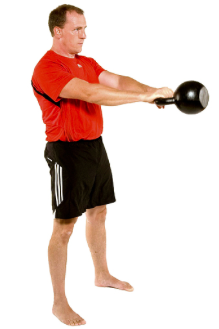
It’s Just a Kettlebell Swing and Suspension Trainer Workout

Quick Tips

A few months ago, I wrote a post titled:

—>  It’s Just a Kettlebell Swing Workout

Kettlebell Swings

That has been my most popular post on this blog, by far.

I wrote it because I wanted to convey how simple a workout can be, and probably should be for most people.

Totally stripped down.  Nothing but a timer, a towel and water bottle, and a kettlebell of a decent weight.  You could make the argument that a “totally stripped down” workout would only involve bodyweight exercises, but that’s beside the point.

A lot of people avoid physical activity because of two things:

  • Time
  • Preconceived thoughts and anxiety about how the workout will feel.

Simple workouts are time effective and aim to limit anxiety.  You look at the agenda for the workout and say to yourself, “Oh, I just have to focus on kettlebell swings today.  I can do that”.

If you have a kettlebell or have the means to acquire a kettlebell for the future, I will ALWAYS encourage you to make the purchase.  Don’t wait, don’t peruse, don’t over-analyze.

Just buy and be done with it.  You won’t be sorry.

Well, I take that back, you could be sorry… if you buy it and fizzle out and using it.  Then it’s just another heavy object holding a door open.  What a shame that would be.

Anyways, I wanted to build on that post, because I felt that the workouts displayed were rock solid, and applicable to a large population of readers.

They are simple, yet brutally effective.  I would consider them entry-level workouts, however, I have to admit that I continue to use the 15sec work/ 15sec rest (24 rounds) kettlebell swing protocol to this day.

The only difference is that I have climbed the ladder in weight.  When I started with the protocol, I used a 20kg kettlebell from LifeLine Fitness.  I then climbed to the 24kg kettlebell, then to the 28kg kettlebell and now on to the 32kg kettlebell.  All were purchased from LifeLine Fitness also (yes, I promote these guys heavily, they make equipment worth buying).

Don’t be fooled by elaborate training protocols.  Keep it simple and be detailed.

A simple workout/program executed to perfection will trump the world’s most complex/perfectly written program done poorly.

Stay in the “simple” zone, do it right.

That being said, I would like to say that kettlebells and suspension trainers are a match made in heavy.  For roughly $300, you can outfit your home with a Jungle Gym XT and a nice variety of kettlebells ranging in weight.

The combination of a suspension trainer and kettlebells is magic.

Seriously, they are match made in heaven.

Let’s look at workout that I’ve employed over the years…

Kettlebell + Suspension Trainer

A workout like this is complete.

The kettlebell swings alone are enough to initiate a tremendous training stimulus, but when paired with the other movements, the workout is magic.  Push, pull and ballistic movements for the upper and lower body are all represented here.

With high volume workouts, I typically choose simple rep schemes.  It’s annoying trying to remember how many reps to complete in the middle of round, when you’re real focus should be on controlling your breathing and fatigue.  Once you experience this frustration, you’ll wish that you would have picked simple rep schemes.

After completing each round, I would rest anywhere from 45-75 seconds depending on your conditioning level.  Don’t be a hero and rest for 45sec in the first round if you can’t handle it.  This decision may bite you in the ass in the later rounds when your fatigue levels spike.

Fatigue accumulates throughout the workout, just as it does for every workout.  It’s inevitable that it’s coming, but timing it so that you complete quality work while you can is the idea here.

The number of rounds that you complete is depends on your ability to complete quality work (exercise technique, complete reps, etc).  If your form breaks, you make the decision to rest before re-engaging, or you pull the plug on the workout altogether.

Safety first, always.  Form good habits.

Put this workout in your back pocket for now, load it in the chamber when you need a challenging high tempo training session.


Cheers to ST’s, BW’s and KB’s!

KG

(PS:  I turned on “Location Tagging” so that you’ll really believe that I reside in God’s Country… Eau Claire, WI)

My Philosophy: Great Point Alwyn Cosgrove!

Quick Tips

Image

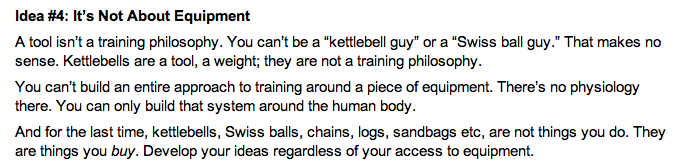
When I initially read  Alwyn Cosgroves post (shown above) I immediately felt that it was too good not to share. 

Once I established my training philosophy, I was set for life.  I was set to teach others and also to execute for my own benefit.  

It doesn’t matter what equipment is around, what I have access to or what I don’t have access to.  

I can accomplish something even though I don’t have everything.  

Sure, my ideas and preferences will evolve, but I think that much of what I believe makes a great program and workout is solidified.  I am not sure (at this point) how it can get much better, without sacrificing certain things that I morally cannot consciously sacrifice.  One of those being safety of myself, or the you guys.  

I write about kettlebells and suspension trainers on this blog A LOT.  

But it’s not for any other reason than I believe whole heartedly that the combination of kettlebells and suspension trainers make for insanely effective workouts, especially since they fit into my training philosophy so well.  

Kettlebells provide loaded (resistance), ground based movements that are primarily (not all) completed in a vertical standing position.  The bold print is a part of my training philosophy.  I could substitute “kettlebells” for a whole host of other fitness equipment, and things would be just fine.  

Movements like kettlebell swings and turkish get ups are world class for building a variety of qualities, at the same time.  

Suspension trainers are an entire gym in a box, weighing in at less than 2lbs tops.  Equipment-free bodyweight training is great, but suspension training makes it better.   Suspension trainers allow for the leverage of a person’s bodyweight against gravity.  My favorite benefit of the suspension trainer is the fact that you can PULL!  Inverted rows (aka: body rows) and chin ups (supinated and neutral grip) are all made possible by two straps with handles.  

Get rid of that shoddy kitchen chair set up that you’ve been using for so long…

But as stated in Alwyns commentary above, kettlebells and suspension trainers are just tools that I use to to implement my philosophy of what makes a great workout, program, etc.  I am not exclusive to any piece of equipment.  That’s not my style.

The fact is that most equipment works wonderfully.  

It’s the user (aka: you) that has the opportunity to make the magic happen.  

I know a lot of people that own a complete set of kettlebells and the best suspension trainer money can buy, but they don’t have a philosophy, or any sort of guidance on how to use it.  In turn, they are stalemate in their efforts, or on to the next fashionably trendy workout tool.

For most people who are beyond their days of athletics, the total body approach to training is probably best.  I know that there are upper body/lower body splits and a thousand other ways to organize your weekly training, but total body is effective in short windows of time.

Time is probably our most precious commodity.  We can never get time back.  Once a minute passes, that minute is gone.  Same with days, weeks, and months.  Time keeps moving forward at the same steady pace regardless if we want it to slow down or stand still.

That being said, leveraging a total body workout, using a smart philosophy to structure the workout is (in my personal opinion) the best approach for accomplishing goals of fat loss, building all around strength and many other athletic qualities using time management.

But, it must also be said that paying attention to your nutrition, specifically what you shove into your mouth and drink, is the most time effective way to stay lean.  

My advice to all of you is this:  Treat tools are tools, not philosophies.

Gravity decides what an object is going to weigh, humans decide how the object will be shaped, how the weight is distributed and to some degree how the tool should be used best.  An example of how a tool should be used best is in fact, the kettlebell.  You can swing a dumbbell, sure.  But your first time swinging a kettlebell will lead you to believe that dumbbell shouldn’t be swung.  

Kettlebells are the standout choice for swings and many other exercises.  

But I can in fact swing a dumbbell.  I can also perform a turkish get up with a dumbbell, or a sandbag, or a filled milk carton, or a loaded backpack, etc.  It might not feel the greatest, but I can do it because it has weight and a handle to grip.

The tool is not the philosophy.  It is an augment to the philosophy.  A supplement to your training philosophy.  

Again, I can perform a squat with any tool, or no tool.  If I don’t have a two, it’s bilateral air squats or for an added loaded and challenge, it’s pistol squats.  

Therefore, pay attention to more important aspects of your workout such as:

–  Consistent progression of loading.

–  Rest

–  Time under tension

–  Range of motion

–  Sets/Reps

–  Heart Rate

–  Movement patterns

–  Exercise progression

–  Your goals, needs, abilities and dysfunction

-etc…

These are things that can you can use to imprint your own philosophy of how an effective training session or long-term program should be designed, regardless of what equipment you have or don’t have.

Very simple thought pattern yet often overlooked.  Thanks Alwyn…


Cheers to philosophies and sticking to them…


Kyle

A Tough 20 Minute Kettlebell Workout: Clean+Squat+Press

20 minute Workouts, Kettlebell Training

Simple training delivers results.

And what’s more simple than taking a clean, squat and press and forming it into a great workout?

Today I’m sharing a 20 minute kettlebell workout that incorporates three tried and true exercises.

The training effect is awesome, and the time investment is minimal.

I’m a connoisseur of exercises and using basic equipment to create great workout, but I always keep focus on movement patterns. Compound exercises that train the entire body. Keep

Keeping it simple, for me, is keeping it effective. Simplicity eliminates decision fatigue and increases my focus and productivity.

Do less, but do it better.

Here are the 3 exercises we’ll be using for the workout:

Double Kettlebell Cleans

Double Kettlebell Squat

Double Overhead Kettlebell Press

Just three exercises, and good ones at that.

The clean, squat and press are time-tested exercises for building power, strength and muscle.

Kettlebell cleans are an hip hinging ballistic/explosive total body movement.

Kettlebell squats are a lower-body pushing exercise.

Kettlebell overhead press trains the vertical push pattern, which has great carryover to the daily living.

Combining all 3 exercises into a circuit makes it a total body effort. Plus, keeping the rest periods short and completing multiple rounds, the training effect is potent.

If calorie are in check, workouts like this are great for keeping muscle and accelerating fat loss.

Warm-up

Always work through a warm-up to prepare your body for more intense work ahead.

10-15 minutes is all you need to get a warm-up, work through mobility drills, lightly loaded movement patterns and raise core temperature.  

Here are some GREAT movements for warm-ups:

14 Exercise Full Body Warm Up

The pre-workout period will also give you an opportunity to assess how your body is feeling on that particular day.

Not feeling it? Run down? Poor night’s sleep, stress, etc? Don’t be afraid to work through a warm up, but bypass the workout for the day. Come back tomorrow fresh and focused.

Much of my pre-workout warm-ups are infused with ground-based movements and active joint mobility training.

On the tail end of the warm-up, I’ll jump rope, flow with a macebell or practice some lighter kettlebell drills.

The Workout:

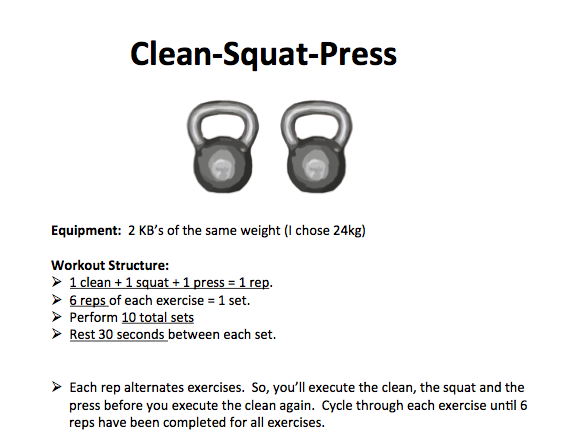
Image

Transitioning to a different exercise on every rep makes this circuit more challenging.

Again, you’re not doing the same exercise for X amount of reps before moving onto the next exercise, you’re performing 1 rep of clean, then 1 rep of squat and then 1 rep of overhead press before circling back to the clean.

1 time through the clean + squat + press = 1 rep.

Each set consists of 6 reps per exercise. The workout is recommended for 10 total sets. That’s a grand total of 60 reps per exercise.

The kettlebell is constantly moving throughout the workout, changing levels and positions.

Rest periods. If a 30 second rest period is completely unmanageable for 8 rounds, TAKE LONGER REST. Try 45-60 seconds. When workouts are shared, whether on this blog or any other website, you must consider your own fitness level and make adjustments as needed. NOTHING is set in stone. Tweak the session to suit your needs.

Weight. Use moderate to heavy weight for this workout. I like 24kg for males and 12-18kg for females.

Because this little circuit is using 3 different exercises, the weight you choose will correspond to both the weakest exercise of the three AND the recommended reps.

The weakest exercise with either be the clean or the overhead press for most people, and the weight of the kettlebell should be something you can squeeze 2-3 additional reps out of.

So, if the overhead press is the weakest exercise, select the weight based on that and make sure you can press it 8-10 times (even though suggested reps are 6 each)

Related Articles

Home Gym Workouts! Total Body Sandbag Circuit for Fat Loss and Muscle

Locomotion| The Weighted Lizard Crawl

One Kettlebell, 3 Fat Loss Workouts

Kettlebell Training Research Studies

Quick Tips

Kettlebells are probably one of the most effective workout tools on the planet.  

They are also one of the most under-researched on the planet.  

So, this post was sparked by my own interest.  

Kettlebells have proven time and time again to blow fat off of people’s bodies, most notably without losing much muscle in the process since all of the movements are loaded, both strength and ballistic exercises.

This makes kettlebell great for ditching fat without sacrificing any valuable lean muscle tissue.

And that my friends, is a win-win situation. 

So what studies exist?  

Let’s take a look at a few:

1)  Kettlebell Swings, Snatch and Bottoms Up Carry Impact on Back and Hip Muscle Activation

Excerpt:  “Some unique loading patterns discovered during the kettlebell swing included the posterior shear of the L4 vertebra on L5, which is opposite in polarity to a traditional lift. Thus, quantitative analysis provides an insight into why many individuals credit kettlebell swings with restoring and enhancing back health and function, although a few find that they irritate tissues.”

This is mostly good.  Stuart McGill is a world leader in spine research as it relates to exercise.  His work is cited and quoted in a lot of publications.  Kettlebell training, like any style of training, can be detrimental to your body if you choose to ignore technique.  Skip the learning the basics and you make yourself susceptible to injury.

Chalk one up for kettlebell swings, snatches and bottoms up holds.

Here is a video clip of the bottoms up kettlebell hold:

Your mid-section will light up like the Fourth of July while stabilizing the kettlebell in this inverted fashion.  Very challenging move.  Stay tight, tall and braced.

Protecting the spine while training is of utmost importance, and the most important role of the abdominal musculature.  Despite what mainstream projects the abs to be important for.  Protect your spine people.  

2)  Oxygen Cost of Kettlebells

This little study looked at the oxygen cost of kettlebells, more specifically the two-handed kettlebell swing.  

The metabolic challenge delivered during a kettlebell workout is large.  Part of the maximizing this challenge is selecting the proper weight bell.  It should be heavy, but not so heavy that you cannot finish the workout.  Swinging light bells encourages poor technique and decreases the impact of the overall workout.  

I’ve talked about leveraging kettlebell swings on this blog over and over again.  I cannot say enough about a properly performed swing, and what it can do for you body, performance and posture.  Preserving muscle while eliminating fat is such a desirable route when you’re seeking body transformations.  

Simple workouts can achieve big results.  Here is a recent post where I diagram some classic kettlebell workouts.  

3)  Kettlebell Swing Training Improve Maximal and Explosive Strength

Strongfirst Kettlebell Swing

The kettlebell swing is an explosive deadlift.  The extension of the hips out of the hinge is aggressive as you drive the hips forward, standing yourself up vertically.  

This hip snap is the same hip snap that athletes use for putting large amounts of force into the ground as they accelerate across the field, court or ice.  

This hip snap is not just for athletes, its beneficial for the working male or female, Mom and Dad and even physically able elderly populations.  The hips are designed to be the power source of the human body.  We spend most of our time on our feet, so having powerful hips is a great thing.  

Will you be able to dunk a basketball?  I can’t promise you that, but it will get you closer to the rim according to this study.  

Will you boost your strength and explosive strength when you call upon it?  This little study thinks so.  

*** Again, choose to swing heavy kettlebells over light kettlebells to reap the full benefits, but not so heavy that you cannot fully extend the hips or move the bell quickly.  


Cheers to the kettlebell and the emerging research behind its use…


KG

No Equipment Workouts: Rocky Pull-Ups and Hill Running

Quick Tips

This past weekend proved to be a test of my ability to adapt to my surroundings, get my workouts and also do a decent job eating right.

My fiancé and I travelled down to my parent’s new retirement residence in central Wisconsin, where I quickly realized that any chance of a nice Saturday morning jog was out the window.  

It was all hills.  Nothing but hills encapsulated my parent’s little community.

No matter which direction I went out of the driveway, it was a hill both ways.  I know that sounds impossible, but trust me, I would have paid money to have flat ground.

Regardless, it was a scheduled training day and I am fully accountable to myself to get my workouts in when I schedule them, so I went through with it anyways.

The tough part about running terrain that has such great elevation change is that it leaves little time for the body to warm up.  I felt like I was still half-striding by the time I reached the base of the first incline.  In these situations, I typically dial back my pace and turn it into more a of a long slow climb.  Short, choppy steps work well for warming up on inclines, similar to what you would use when climbing a mountain or something similar.  Enough to keep you moving but nothing to set personal records with.

Saturday’s Workout looked like this…

Goal:  Increase heart rate and maintain for time, open up the lungs, enjoy the new sights and sounds.  Here’s what I did:

  • 20 minute run (slower pace accounting for hills)

I have no idea how far I went.  I would presume that I was running somewhere in the neighborhood of 8:30-9:00min/mile pace, but I cannot confirm this.  I didn’t have a heart rate monitor on either, so it was a fairly primitive run for me.  In situations like this, I try and gauge my effort based on respiration and stride technique.  If I feel like I am suffocating or my technique is compensating in some fashion, I dial back the intensity.  I am a chronic over strider during runs, so having the inclines on the hills really forced me to shorten up my stride and increase the frequency.  For me, this is good reinforcement.  

  • 100+ yard incline sprints x3

There was no shortage of hills.  One particular naturally identified itself as a nice location for some incline sprints (aka: a burnout session).  There was limited motor vehicle traffic, which made me feel comfortable about being out there, especially in the countryside.  You might look at the rep count for the hill sprints and feel that it is low.  That’s fair.  But three reps of all out sprints up a 7% incline for 100+ yards will surprise you.  I suggest that you give it a shot sometime.  Focus was placed purely on running posture, arm swing, knee drive and hip extension.  I’ll never be considered for the Olympics, but it’s fun to continue to work on skills.

Sunday’s workout something like this…

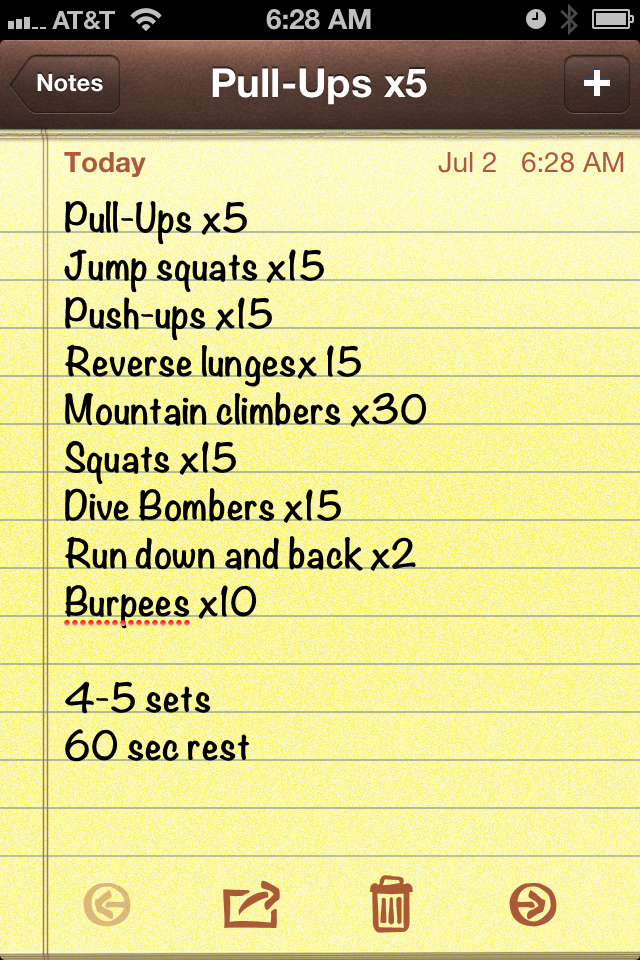
Pure bodyweight circuit:

Image

A couple of thoughts:

  • You can do pull-ups pretty much anywhere, but it doesn’t make them more enjoyable.
  • Pull-ups with a poor grip surface places a greater demand on grip strength/endurance, which can effect your performance.  
  • Grip strength is important.
  • Shuttle runs late in a circuit can be the icing on the cake.
  • There is still no great way to pull horizontally without some kind of equipment (suspension trainer, etc).
  • Burpees are one of the greatest total body, space saving movements of all time, and they also suck each and every time.
  • Understanding basic exercise and how to organize it using what you have, where you are, and your current fitness level will keep you on track for life.  

Conclusion…

Were my workouts this past weekend ideal?  Absolutely… not.  

I would have rather have been working with my kettlebells and something more structured.  But, I did not have access to that kind of equipment.  I had access to my body-weight, some hills and a phone timer.  The situation was not ideal, but it worked.

Depending on your body composition and fitness level, you could make some serious gains from workouts like this.  I have been training for quite some time, so the point of these workouts for me was basic maintenance.  Something to get me moving and get a daily sweat in.  

But for a beginner or a novice looking to make some bodyfat change or improve performance-like qualities, these two workouts are fantastic.  


Cheers to adapting unideal situations and leveraging your body!


KG

The Shark Tank, Results and How Both Can Impact You

Quick Tips

Image

Photo Credit:  stressfreekids.com

I love the television show “Shark Tank”.

I love everything about it.  

Here is how it works:

1)  The entrepreneur enters the “shark tank” (a room to present to five different successful millionaires) seeking to gain valuable business partners and investment capital for their business.

2)  The entrepreneur makes their product/idea pitch.

3)  Post-pitch, the sharks give feedback and ask questions about the business/idea.

  • The feedback is either sharp and harsh, or encouraging and curious.
  • The questions heavily pertain to past revenue, experience, growth potential, evaluation of the business, etc.

4)  The Sharks decide whether the idea is valuable enough to earn them profit on their investment.

I am absolute fascinated by people who find their calling and begin creating and designing gadgets, apps or services that can solve everyday problems, improve old products or pave the way for a new way of doing things.  I have such a respect for an entrepreneur that can sacrifice everything for their passion, refusing to give up through thick and thin.  It takes amazing courage to build a dream from scratch and see it through to the end.  

Many of these people have given everything to pursue the American dream.  

That’s passion.  

Another aspect of Shark Tank that I love is the negotiations.  Sure, the pitches that introduce the entrepreneur’s idea to the Sharks (who are millionaire/billionaire investors themselves) are great, but the negotiations after all of the glitz and glamour is what I get sucked into.

The questions from the Sharks are direct and typically no non-sense.  The Sharks want to know if the investment opportunity has gotten results in the past and what the plan is to grow on those results (the forecast).  The entrepreneurs that do the best on the show tend to answer the questions with sharp, crisp and clear answers.  They have a plan and they have results to show positive growth and execution of that plan. 

Those who respond with wishy washy answers get crucified on national television.

You’re probably wondering why I am talking about the Shark Tank on a active/fitness related blog…

… and to that I say: settle down and let me get there.  It might be choppy.

Here is an un-organized collection of my thoughts that I had earlier today…

As I briefly touched on above, shortly after the entrepreneur shares their product or idea, the Sharks take their gloves off and begin poking and prodding into exactly what they- the entrepreneurs- need (money and connections to influential networks), why they need it, what they will do with it when they get it, and most importantly, their past efforts and the results of those efforts.  

I have seen countless entrepreneurs lose out on investments by the Sharks just because they didn’t have results (sales/income/revenue) from their product or idea.  Maybe the product is being treated too much like a hobby, or maybe the entrepreneur has got some serious flaws and gaps in their business and how they have been going about growing it and scaling it.  

Either way, the Sharks always crack me up because they can sniff out flaws in a matter of minutes, and a few simple questions.  The numbers add up.  The numbers make the flaws glaringly obvious.

What have I learned from Shark Tank is the difference between an entrepreneur who is rejected out of the board room and an entrepreneur who makes a deal, and acquires one of the Sharks as a business partner…

Results matter.

If the entrepreneur hasn’t sold jack-squat in years, the reception of their product/idea pitch is typically lauded at.

In the fitness world, I hear and read a lot of people talking about how “results based” fitness is a scam.

Really?  How?  

How is getting the results that you seek a scam?  

How is stripping fat, running your first 5k, followed by your first 10k, followed by your first half-marathon, restoring function and posture, etc… a scam?  

We measure success in anything based on results.

I can see how getting the results that you seek at the expensive of bodily harm might be a scam, but I would call that recklessness, absent minded or possibly neglect.  

There is plenty of that going around for sure.

If you set out on a journey to build a body (and I don’t mean stage show bodybuilding) and you are getting great results… Why would you change anything that you are doing until you observe that change is necessary?  Don’t stay in your comfort bubble forever, but stick to the plan if it is working for heavens sake.

Again, you have to be getting results to maintain your same course of action.  

If you’re a person that is interpreting this as pass to continue the same ineffective workout habits that incorporate the same weight for the same amount of time for the same days per week…

… you are mis-understanding what I am trying to say, and maybe it’s an error in my ability to communicate effectively.

I wrote an article a while back where I described a 90 day kettlebell complex training program where I basically leveraged the same kettlebells (24kg Lifeline KB’s) for a full three months, making gains the entire time.  If you read back into some of my older posts, you’ll find that I love acting as the guinea pig.  

I will always try something on myself before I ever recommend anyone else to do it.  Not everyone can say that.  I am willing to put myself through the gauntlet prior to suggesting someone else try it.  I take pride in that.  That’s how I formulate my opinions on certain things, one of those being some aspects of Cross-Fit.  

That being said, I always caution everyone that what I do while training is not always a good fit for what they should be doing, and what their colleagues are doing in the gym might also not be what they should be doing.  Do what you can do, not your what your network can do or the random fit guy at the gym can do.  You’re not him, you’re you.

Sidenote:  I actually know a cosmetic surgeon in town locally who tries all of her techniques on herself first, prior to offering it out to her paying customers.  How bad ass is that?  She puts herself through the gauntlet before bragging about it to her customers just to make a buck.

I have a deep respect for that.  This surgeon’s face is constantly puffy and inflamed from all of the new treatments, but hey, at least she can say that it works or it doesn’t, which makes her far more credible to the patients who come to her for solutions.  Again, I love that.

Back to it…

During the 90 days of kettlebell complex glory, I leveraged the same general movements while I continued to tweak the reps, time under tension, sets, recovery time, etc.  

My results graph was steadily climbing in a positive direction , so why would I alter anything.

I know that staying in the vortex of the same workout for 90 days might sound crazy, and I definitely could have bumped up weights during that time, but I couldn’t resist giving it a go.  

What is the worst that would happen?  Maybe I would simply flat line and maintain my current fitness and body composition levels?  So what?  I was lean going in and the experiment wasn’t going to make me less lean or less strong.

Tweaking the variables can really take a program a great distance, and I think manipulating the variables of exercise is far less scientific than most people think.  Often, the point of improving your body, both performance and aesthetically, is to simply add or subtract.  Add weight, add time under tension, add reps… or… subtract rest period time, subtract volume, subtract paralysis by analysis.  

The last subtraction point is a huge hold up for most people’s results.  What are you waiting for?  The next big study?  We lean on studies and research like crutches.  It drives me nuts.  It’s like we can’t take action until we can justify it with a massive study.  That my friends, is an excuse in disguise.  You can call it being educated and precise, but in my world, someone who doesn’t take action and bases it on lack of research is an excuse maker.  

Trust me, you don’t need a landmark study to justify swapping an hour of TV time for a decent sweat.  And if you’re a person that wishes that you could shrink down, swap fat for muscle and become more athletic, then your results are sitting on the couch right next to you.  

Exercise + eating properly + H20 hydration = Authentic Health.

It’s that simple.  Screw complexity.  Follow the above formula for four weeks without falling off the wagon and see what happens.  You won’t be disappointed that is for sure.

Results require action, and the right kind of action.  On Shark Tank, the interesting part about some of the products/ideas (and the people that are behind them) is that they aren’t bad products/ideas and the business owners are putting in massive amounts of effort and time. The business plan/strategy is just plain wrong.

In these situations the Sharks have the jam to call these people out when they have sold less than $10,000 in 4 consecutive years of being in business.  That’s a red flag that something isn’t right.

Then you’ll get people that have sold $10,000 in their first month after launch, and they just don’t have the capital to take things to the next level.  Very interesting to see those situations.

Sidenote: In the case of building fitness, you don’t need capital.  That’s the beauty of it.  You can honestly get amazing results by buckling down and doing the work with your own bodyweight.  Heck, if you’re on a tight budget, I will even recommend going for a run.  

Running isn’t all that bad really, we sort of blow that out of proportion, just don’t expect to build much muscle by running.  Many times, running along with other long duration represents the entrepreneur who is willing to put forth the effort and time for their results, yet always ends up disappointed because they are operating off of the wrong business plan.  

Is that you?  I bet that statement connects with some of you out there… no doubt about that.

If you’re just starting to get serious about being purposefully active and building your fitness… and you’ve got decent mobility and stability where you need it while being proficient with the lifts, you are probably good to go.  In fact, you’re more than good to go.  Start with a simple strategy and build out from there.  Once you lay a solid foundation, the rest of the house can be built over time without crumbling.  

For example, building strength is simple, it really is.  It isn’t always the most comfortable process and it takes effort to continue added weight over time, but it is simple.  Building cardiovascular endurance is simple.  It isn’t always enjoyable to shave time off of your efforts, but it is simple.  

Sidenote:  Exercise professionals often overreact and preach about the details a little too much for my liking (I am guilty of this).  Sometimes I feel like it might be because they are dry on content or looking to stir up the pot somehow.  I love attention to detail as much as anyone, but it gets old after a while.

Segue…

So as the Sharks on Shark Tank seek investment opportunities that have seen results in acceptable periods of time, so should the person who seeks fitness.  Results are damn important.  If you aren’t seeing results, something is not right with your plan.  Your strategy isn’t working for you.  

People who are fit despite busy careers and family, while working in a much needed social life also, have effective plans.  

Go back to the drawing board, analyze your strategies and get back to it.  

But remember, results matter.  


Cheers to results and The Shark Tank!


KG

(Sorry for being away for so long)


3 Conditioning Workouts to Check Your… Conditioning.

Quick Tips


One of my favorite things to do when I am training in a commercial gym is to use machines for everything but what they are intended to be used for.

Take the infamous Smith Machine for example.  I have never performed a Smith Machine specific exercise on this piece of equipment, and I never will.

The Smith Machine

The $2,000 “coat rack”

Why?  Because…

1)  I am an able bodied individual and should therefore be working with free weights.

2)  I value moving the through a natural range of motion with and without external resistance. (Smith machine is guided on tracks)

Squats, lunges, curling (I don’t even know how this would work) rowing are not for the Smith Machine, assuming you are an able bodied individual.  A Smith Machine to me is a glorified Nautilus machine.  They make great coat racks and leaning stations for recovering trainees in most gyms.

However, I have used the Smith Machine to execute movements such as:

  • Inverted rows (2 arm and 1 arm)
  • Plyo-like Bench Throws
  • Lateral torso holds
  • 1-Arm Push-Up progressions
  • Mountain climber progressions
  • Hip mobility warm ups

I may have to whip up a post about how to leverage a Smith Machine for executing different movements, we’ll see.

But whatever, this post wasn’t intended to bash Smith Machines.

The goal here was to provide you with some non-traditional ways to use some common pieces of equipment.

Enjoy…

 Screen Shot 2013-03-26 at 1.36.00 PM

Better use of treadmills… Incline + MPH

—> Treadmill Hill Sprints:

  • Set the speed of the treadmill to 8-10mph.
  • Set the incline to 8-10 degree of inclination.
  • Sprint for 15 seconds, step off and rest for 15 seconds (this equals 1 round)
  • Perform 10-12 rounds.

Screen Shot 2013-03-26 at 1.36.23 PM

The greatest low impact conditioning tool of all time.

—>  Stationary Bike 20:10 Protocol (I will not refer to it as the Tabata Protocol!)

  • Set the bike to medium resistance (you should be able to pedal around 90-100 rpm)
  • Spin as hard as possible for 20 seconds, follow that will 10 seconds of rest (this is one round)
  • Complete 8 total rounds and check fatigue levels.
  • If you have more in the tank, complete another 8 rounds or modify as needed.
  • *** I have commonly modified this type of workout to 6 rounds x 2-3 sets with 2 minutes rest in between.
  • Stay seated the entire time.


—>  5 Mile Ride for Time

I have talked about this conditioning test before on this site, somewhere, but it deserves to be talked about again.  Here are the specs on this challenge:

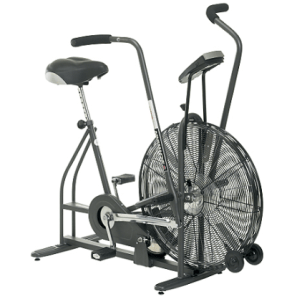
  • Ideally you’ll use a Schwinn Airdyne, but you can use any other stationary bike in a pinch.  Make sure that the bike has a mileage gauge on it, otherwise you won’t know when you’ve completed the 5 miles.
  • Set to light-medium resistance… and GO.
  • Again.. pedal pedal pedal and keep pedaling.  There isn’t much else to say here.
  • Chart the time that it takes to ride the full 5 miles, record it, attempt to beat it the next time around.
  • *** On the big fan Airdyne, my best is 11min30sec.  It was a bear.  I think my friend and fellow strength coach Joe Gorshe (Bemidji State Hockey) finished around 12:15-12:30min if I am not mistaken.


—>  Kettlebell Swing Breath Ladder

  • Grab a kettlebell that you know you can swing for at least 20 reps.  
  • Match the number of swings with the number of breaths for each round.
  • Set the kettlebell down after each round of swings and take an equal number of breaths.
  • Begin the next round of swings once you finish your breathing reps.
  • ***  This is high volume swinging, but shifting focus to calming your breathing really slows things down nicely
  • Focus on your swing technique.  Move from hips, stay tall and rigid at the top of the swing.

Kettlebell Swing Breath Ladder


—>  Closing thoughts…

A couple of these methods incorporate interval style training.  Go hard during the work sets of an interval training session.  Rest is coming don’t you worry, but go hard when it is time to work.

Always wear a heart rate monitor if you can.  It’s a great way to gauge your efforts and your ability to recover from those intense efforts.  It also keeps you honest during your training sessions.  Monitor your progress, how long it takes to recover, how high your heart rate reaches during each work set, etc.  You can learn a lot about your conditioning levels/progress by checking keeping an eye on this information.

On the treadmill conditioning workout, remember that the incline of the treadmill is going to require that you drive your knees all the way through with each stride.  If you get lazy, even just for one stride, you could catch your toe on the belt of the treadmill and get spit off and look ridiculous.  Avoid this.  Drive your knees, drive your arms, extends you hips with each powerful stride.

Use your head during these training sessions.  Don’t be afraid to scale the intensity down to suit your needs.  There is no shame in that.  It’s a process, you’ll get there.  If you have questions on how to go about doing this, just ask… I will field any and all questions…


Cheers to building up your conditioning!


KG

*** Coming up next:  The next Saga in the Coach Hacker series…***

The Coach Hacker Files: It’s Time to Go “Ballistic” on Kettlebell Cleans + Presses

Quick Tips

I’ve got to lighten up on this blog.  The tone has been stuffy lately.  I want to distribute applicable information that is bullshit-free, but I also want to keep things light.

After all, it’s just a workout.

However, I would like to start an intermittent series on a gentleman that I was recently introduced to via my friends at Edge Fitness in Sun Prairie, WI.

I use Facebook extensively to keep up with my friends and family, and I typically make one or two scrolls down the news feed every day just to make sure that I know what all of my friends are up to.  So what? I like to creep!  So does everyone else who has Facebook!  Don’t you dare judge me.  It takes a man to admit something like that.  I feel better now.

Anyways, I came across a Facebook posting by Edge Fitness that had a video attached to it.  I watched and nearly wet myself.  The guy in the video is superstar.  I plan on blowing this guy up for the world to see.  He’s that good.  The best part is that he doesn’t even know that he is that good.

Ladies and gentleman… I present to you… the one… the only…

Coach Hacker

Coach Hacker

I believe the right thing to do here is waste no time and transition straight to the video (one of the many videos) that sparked my interest in this guy.  You’ll see in the video that he’s a real modern-day warrior.

Take a quick look at this guy in action…

Blowing up the kettlebell clean + press

As you know by now, I am a fan of kettlebell training.  Kettlebells and suspension trainers are by far the best pieces of equipment to outfit a home gym with.  However, apparently Coach Hacker is a die-hard kettlebell fan also, so we share that in common.  I am also a big fan of multi-segmented moves.  Exercises like Turkish Get-Ups, Clean+Press, Squat to Press, etc.  Again, apparently so is Coach Hacker.

I think that our technique is may be slightly different, but that could just be who we trained under, what books we read and the conferences that we attend.  Different strokes for different folks.

I also see that he is from the Northeast (Oregon).  This could be another reason for the difference in our training styles.  I am from the Midwest, (aka: Paradise) (aka:  “God’s Country”) Eau Claire, WI.  I see this as a point that could be influential in each of our training styles and philosophies.

I have to admit, once I played the video, I felt like I had met the guy before.  He looks like that “someone” from “somewhere”, you know?  “What’s his face” from the next town over.

Then it all came together.  The light bulb went off.

He’s a hybrid…

Coach Hacker Hybrid Picture

 Micheal Douglas—>  Coach Hacker —>  David Hasselhoff

Coach Hacker’s resemblance to these other two superstars is uncanny.  Micheal Douglas mated with David Hasselhoff which gave birth to Coach Hacker.  Based on Hasselhoff’s physique in that photo, I suspect that Coach Hacker was the on-set personal trainer for BayWatch also.  Good for him.  Job well done.

Now, before you think that I am ripping too hard on this guy, please know this.  He’s got about 100x the views on his kettlebell YouTube video than I do on my own kettlebell clean + press video clip (seen below)…

It’s just not enough apparently…

So, I am thinking that maybe I should reach out and make contact with Coach Hacker and figure out how to market myself better.  His display of raw strength and intensity throughout the video clip is something to be marveled at and also something that my video clip lacks big time.

The Intensity of Coach Hacker

Intensity.

I also noticed that he has great commentary.  My video is more like a mime performing kettlebell drills.  I could definitely work on this.

Technique-wise, “The Hack” is also really going for it.  I mean, he ramps it up from rep #1 into rep #3-#5.  No doubt about that.  Me?  I am way too calm and collected.  Not enough ramp up.

Proper kettlebell clean technique

Technique is everything.  Neutral spine, arm reach, drive through the hips.

Along with technique, I also couldn’t help but notice the size of Coach Hacker’s kettlebell.  He’s the founder of Kettlebell Madness, which seems to be aimed at kettlebell enthusiasts.  Every strength and conditioning book or research study that I have ever come across says that the weight of the object being lifted needs to be heavy enough to initiate gains in strength, build muscle, etc.  Basically, the weight has to be challenging to move.

Light Kettlebells

Kettlebell, or paperweight?

Coach Hacker is a pioneer, he’s going against the grain, he’s going light.  Light weight.  I would suspect that he’s using a 8-12lb kettlebell, where as I am using a 44lb in my video clip.  Maybe he’s on to something.  Body’s a sculpted from dialing back the load.  If this is the case, we have got to re-write and re-think hundreds of physiology books.  Nobel prize for The Hack?  Wouldn’t surprise me.

So ladies and gentleman, I hope that you are buckled in for a wild ride because as long as Coach Hacker is updating his YouTube videos, I am going to be writing about them.  Be sure to check in from time to time so that you don’t miss ANYTHING related to this guy’s activities.  He’s got exactly 17 videos on his channel, and I fully plan on doing a full break down and recap of each and every one of them.  I want to miss NOTHING on this guy.

He’s a real gem… a diamond in the rough… he’s Coach Hacker.

Coach Hacker Crunch Pose

Please, help me make this guy a world sensation!

Cheers to Coach Hacker!

KG

The 5 minute Kettlebell Swing + Burpee Challenge

Quick Tips

I love metabolic challenges, especially ones that incorporate kettlebells and burpees.

If you didn’t get a chance to check out the burpee challenge from a few days ago, I suggest that you do.  It’s a tough workout that will definitely get your heart rate up.

—>  Metabolic Challenges/Finishers Over Boring Cardio

I favor metabolic challenge workouts, sometimes referred to as “finishers”, because they test your mind and body in a controlled setting.  The movements and reps/sets (aka: volume) should always be structured to YOUR own physical abilities, not someone else’s.  Nothing during a metabolic workout should be forced.

It is crucial that a high tempo work capacity style training session have progressions and regressions.  One size does not fit all.  The workout should be scaled to fit each of us on an individual level.  This will decrease the likelihood of injury while promoting physical transformation and improvements in performance.

Once you have proven that you can move efficiently without pain and have acquired adequate strength, stability and mobility to execute basic exercise like squats, push-ups, chin-ups, lunges and planks, it may be time to consider mixing in some metabolic work.

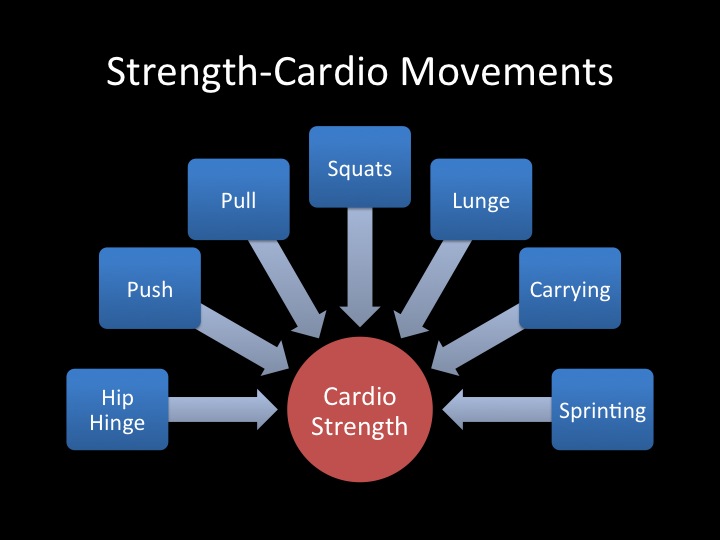
Remember this picture from a recent post?…

Strength Cardio Movements

I use “cardio-strength” and “metabolic” interchangeably…

At the very least, you can mix in some short burst finishers toward the end of your strength training session.  Adding finishers to the end of a workout will shift the way that you think about conditioning.  I know that it did for me.  It was a game changer.

There is nothing wrong with traditional activities like bike and hill sprinting, but to be honest, I find it painfully boring.  I know for a fact that I do not sit alone with these feelings.  Boring cardiovascular training can actually do more harm than good.  If you dread boring cardio to the point that you choose not to workout at all, that’s bad.  It shouldn’t have to be this way.

Boring Cardio Hamster Wheel

Do you ever feel like this while working out?

You don’t have to be a fanatic about your training habits, but long-term adherence to a life full of movement requires that at the very least you find some amount of enjoyment from your workouts.

The main point is that you have great alternatives to the long, slow, boring treadmill trot.  Finishers will keep your training fresh and challenging.  The return on investing in finishers is large.

I will always encourage beginners, novice and even advanced trainees to continue to make conscious efforts to improve strength and power.  This will never change.  So much good comes from building basic strength.

In a normal training session, after working through a complete warm up, strength and power work should be next on the day’s agenda.  Most workouts will require anywhere from 15-20 minutes to work through 2-3 tri-sets of strength/power enhancing movements.

—>  Kettlebells and burpees collide

Lifeline Kettlebells

Lifeline Kettlebells…

I am a huge kettlebell fan.

Kettlebells changed my perception of working out.  Kettlebells brought  the importance of strong, stable, free-flowing movement back into the fitness equation.  You have to be 3-dimensionally strong to lift, swing and carry a kettlebell.  My gym sessions transformed from a of time devoted to the typical big lifts- squats, pressing and pulling- to ground based movement sessions that built strength and stability using in greater ranges of motion.

I now have a level of stability, mobility, and functional strength that I didn’t know was possible for me to have.  Kettlebells aren’t a miracle, but the shift that they caused in my views on what an effective workout could be certainly make them one of the most influential pieces of training equipment I have ever used.

Kettlebell training is represents true movement.

The Turkish Get Up

Segue…

Next, the reason that we’re gathered here in the first place.

—>  The kettlebell swing + burpee metabolic challenge

I cannot remember where I first saw a version of this challenge posted, so please forgive me.

Credit belongs to someone out there, so take it if you’re deserving of it.

I’ve adapted it to fit my needs over the years, as I do with most everything related to training.


Tools needed:  To complete this challenge, you’ll need a kettlebell that you can swing for about 15-18 reps continuously for multiple sets.  I use a 24kg or a 28kg kettlebell for a finisher like the one described below.  Have some kind of timing device on hand.  I always go with my trusty GymBoss.

You’ll also need an open space of about 8ft x 8ft.  This should work just fine.  You can get by with less- and I have- but the more the merrier.  The ceiling of the space you are training in should be high enough to avoid hitting the top of your head when jumping.  If you’ve got clearance, you’re in business.

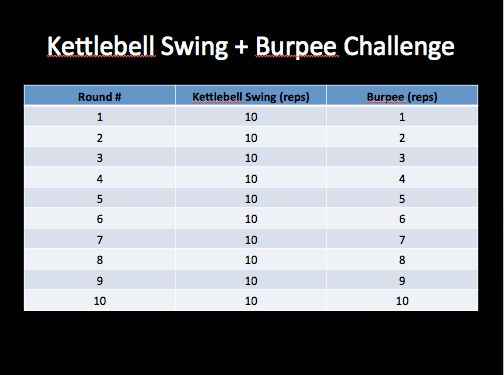
Here is how the challenge is formatted…

kettlebell + burpee workout

Make sense?

Take note of how each round accumulates burpee reps while the kettlebell swings remain the same.  It’s a very simple format to remember.  Two exercise finishers work great because they take very little thought.

The weight of kettlebell used will vary from person to person, but in general I would go with the following:

Females:  12-16kg

Males:  24-28kg

Of course there are going to be those of you who can use heavier kettlebells than what I suggested, but these are common weights for each gender.

The ultimate goal is to finish in 5 minutes.

I won’t p that I “think” a beginner, novice or advanced trainee should be able to finish a challenge like this in.  That’s not the point.  The goal is to finish in 5 minutes, end of story.  Anything longer than that indicates that you have a goal to work toward.  Sound good?

Stop Sign Warning

—->  Mandatory warnings to this workout

If you have never swung a kettlebell before or you aren’t proficient in swinging kettlebells for higher volumes or while under fatigue, this is not the time to test yourself.  Work up then work in.

Lastly, technique breakdown automatically initiates rest until technique can be maintained.  Fatigue kills exercise technique.  Leave your ego at the door when you train, it will save your body from injury.

Work smart and hard, not smart and reckless.

Give it a shot, have some fun and post how you finish up…

Cheers to the conditioning without boredom!

KG

What, Where, When, Why, How: The Prone Plank

Quick Tips

I love planking, but probably not for the reason that most people do.

I see tremendous value in a person’s ability to maintain a rigid plank, especially the prone plank.  Screw lateral planks for now, they will get their time in the spotlight in another post.

The prone plank is a drill that gets very little respect in this world, probably because it falls into the “core exercise” category, yet planking alone will do very little for uncovering those hidden abdominals.

I have opened my mind in recent years to new ideas.  I no longer make harsh judgements when I am introduced to a new style of movement, methods, etc.  I take the time to learn about the method or exercise, run it through my checklist of importance/advantages and disadvantages/safety and ultimately where it would fit in an average Joe or Jane’s workout program.

I can’t lie, sometimes I see movements that make very little sense to me, so I discard them to the junk pile immediately.  Use what is useful, right?

With other movements, I see high value and high reward to the trainee should they perform them regularly.

Enter:  The Prone Plank.

—>  What is the Prone Plank?

Well, first off “prone” is an anatomical term that simply means the front side of the body (belly, thighs, chest) facing the ground surface.  Planking is a drill that asks a trainee to hold a rigid and typically long body position where the only contact points are the elbow and the balls of the feet.  Keeping rigid body posture and a straight line from heels to head (no caving, etc) the position is held for a duration of time.  Inhalation and exhalation (aka: breathing) is controlled smoothly against a braced torso.

cartoon plank

—>  Why should I perform the plank?

The plank serves many different purposes depending on a person’s physical abilities.  It’s no different then any other exercise, it deserves proper progression for optimal benefit.  For most people however, the plank is a stabilization drill for the torso musculature (“the core”).  Firing important tummy muscles in proper sequence is vital for body health.  (Yes, tummy).  The ability to exhibit adequate stability for a duration of time can give a person many clues as to what they need to be working on.  If an individual struggles to hold a plank position for 5-10 seconds, we can use that information to tweak not only the plank exercise, but also the movements in the rest of the program.  The plank also serves as a reinforcement drill for other movements.  The top of a kettlebell swing where the hips are engaged and extended and the lockout of a deadlift are two positions that closely mirror the principles that we seek to reinforce in the simple prone plank.  Body rigidity with proper breathing.  Tense yet relaxed.

Screen Shot 2013-02-07 at 8.31.38 AM

—>  How should I perform the plank?

I briefly touched on this in the “what” section above, however I suppose it deserves some elaboration.  Here are some coaching cues for the prone plank:

  • Straight line from head to heels.
  • I should be able to set a glass of water on your back and not have it spill.
  • Brace the core 360 degrees around your body as if you were going to take a punch.
  • Squeeze your butt.
  • No peaks (butt high) and valleys (low back caving in)
  • Breathe

Also, think about it this way:  I want you to resemble a rigid standing position (vertically) while you are in your ground position planking (horizontally).  I should be able to stand you up and lay you down and you would hold the same rigid body position

—>  When should I plank?

There are many schools of thought on where core work should fit into a daily program.  Should it go in the beginning of the workout?  The middle?  The end?  On off days?  Who knows what is correct here.  Honestly, the best advice might be to make sure that you get it done.  Execute the plank with attention to detail and respectable technique, and get it done.

For me personally, I tend to enjoy putting any direct core work into a tri-set.  It would look something like this:

1a)  Squat

2a)  Chin Up

3a)  Plank

If my workout is work capacity based, and the plank has no place in the meat of the session, I will simply save it for the end of the training day.

Simple as that.

The number of days per week that you are planking may also vary.  In general, I would say around 3 days per week would be just fine assuming you are training 3 days per week.  The plank won’t drain you like a squat or a kettlebell swing will.  You’d be hard pressed to overtrain yourself by simply planking alone.

Duration? This is heavily dependent on your physical abilities.  30-40sec is a good length of time for someone that can successfully hold that rigid body position.  Base your time of hold on your technique.  When technique breaks, you stop.  Reset yourself, assume the plank position and hold until you feel the slightest break in technique.  Stopping a set for poor technique will help avoid injury and also create good training habits.

—>  Where should I feel it?

I used to roll my eyes to this question, but then I realize that it provided a great opportunity for me leverage the question to my advantage.  The plank, for most people, isn’t going to burn out the stomach muscles.  Some folks have weak shoulders and some have a weak lower extremity.  You very well could feel it both of those places first.  Remember this gives you clues that something might not be firing properly if this is the case.

Screen Shot 2013-02-06 at 2.17.27 PM

I cannot say that you shouldn’t feel this in your lower back.  What I will say, is that if you feel pain in your lower back, body position is not correct or muscles are firing improperly.  Either way, you’ve got some regressing to do.  It’s not a bad thing people, it happens.  Better that you found it now as opposed to when you go to lift that 60lb box in your house and you slip a disc.  Right?

If you’re squeezing your butt and bracing your core in a 360 degree fashion, you should feel most of the stress between your butt and your sternum.  Shaking during a plank is common and breathing may become labored.  Labored breathing is always interesting to me.  Challenging positions create a stress response that usually shows up in a person’s breathing.

—>  Progressing the plank.

This article is a brief introduction, not a comprehensive novel on planking.  There are a tremendous amount of progressions and regression for planking that will have to wait for another article.  But know that it gets fun as this drill progresses.

Here’s a glimpse of where planking leads…

What is important for you to remember is that we can simplify the movement for beginners, or add challenging elements for those who demonstrate mastery of the exercise.

It goes both ways.

Cheers to dominating the plank…

KG