Air Bike Workouts| 5-Mile Ride for Time

Airbike Workouts

Assault Air Bike

The air bike is a low-impact, low learning curve, low-risk of injury, high reward cardio machine that’s perfectly designed for high-intensity workouts.  

Air bike training is super effective for improving cardio, without all of the ground impact forces.  

On an air bike, the harder you pedal, the more difficult it becomes.  

Air bikes work the upper and lower body.  The upper body works the dual-action arms, while the lower body pedals.   

This article is all about a middle-distance air bike workout, the 5-mile ride for time. 

The 5-mile ride for time is a SOUL-CRUSHING aerobic threshold challenge.

Most people will finish the ride in 15 minutes or less, making this ride extremely time-efficient.

Air Bikes

One of the best features of air bike training is the learning curve.  

There isn’t a learning curve.  

There’s very little skill required to peddle a stationary bike.  

Get on and go.

I wrote a more comprehensive article on air bikes here.

There’s a significant amount of mental conditioning involved with air bike training at higher intensities.  You’re willing your body to push on through the discomfort.  

It’s a character builder.  

The addition of the dual-action arms works the upper body using a push and pull motion.  

This adds to the overall training effect.  

With air bikes, the resistance felt is proportionate to the intensity of the effort.

As effort increases, so does the air resistance.  😯

Pedal at higher intensity efforts and holding that intensity for time is a first-class way to trash yourself.

1-minute ride for max calories is a perfect example.


5-Mile Ride Instructions…

The instructions for the 5-mile ride are simple:  ride 5 miles as quickly as possible.

Record your time so you can monitor progress and identify the time to beat for the next ride.  

Tracking your numbers will give you massive fuel for future attempts.

Make sure you remember to record your time.  Each personal best time serves as the target for the next attempt.  

Constantly attacking your personal best is a great way to gauge improvements with conditioning. 

Here’s a cinema-quality video of the closing seconds of a 5-mile effort…


Finding the data…

Over the years, I’ve been unable to find a log of best 5-mile air bike times on the internet.  I’ve seen private gyms and colleges post times, but not the general public.

I’ve come across plenty of recorded times using the large fan Schwinn Airdyne, but fewer using modern air bikes like the Assault Bike.  

The Schwinn Airdyne has been on the market for 20+ years so naturally there will be more data for the bike. 

I was able to locate several clips of 5 -mile rides on YouTube, but watching someone ride a bike for 12 minutes is boring, not to mention no quality control to verify methods.  

I’m looking for is visual proof of finishing time.  


Strategies to crush the 5-Mile Ride…

Your best 5-mile time will depend on the following:

  •  Increase in fitness levels (strength, power, endurance, etc)
  •  Willingness to be uncomfortable for an extended period of time (grit).
  •  Pacing

Unlike a lot of popular air bike workouts, the 5-mile ride requires a bit of strategy.

Don’t sprint too early.  Come out of the gates too hard, you’ll hit the wall and have nothing left to give as you near the end.  I’ve done this plenty of times.  

Don’t save it all for the end.  Conserve energy for too long and valuable seconds are lost which might not be able to recover at later stages of the ride.

Pace yourself with RPM’s and heart rate.  Monitor your heart rate (beats per minute) and pay attention to RPM’s.  Both are tracked on the computer monitor.  

Avoid obsessing over how far you’ve ridden.  You’ll always think you’re farther than you actually are and wish you were farther.  Settle into a challenging RPM range, focus on breathing and stay there.  No need to keep glancing at the monitor when only 15 seconds have passed since you last checked. 

Use your arms.  The arms play an important part in finishing faster.  You must get your arms involved to take on the stress.  

Push and pull, push, and pull.

Lift your legs.  The deadweight of the non-working leg makes it harder for the working leg and arm.  Actively lift the non-working leg on each revolution, otherwise, you’re moving deadweight with the working leg.

Posture.  Keep the chest tall and the butt planted firmly on the seat.  Do not stand up, that is cheating.  Keeping the chest tall will keep the airways open, versus hunching like a turtle and trying to breathe all coiled up.

What’s a good finishing time?

12 minutes or less is a great time.

Here are the closing seconds of my most recent attempt:


Finishing closer to 11 minutes is aggressive.  

A sub-11 minute ride can be done, no doubt about it.  However, as you become more fit, it becomes more difficult to shave seconds off the finishing time.

My best time is 11:07, verified with picture proof Instagram.

screen-shot-2017-01-03-at-9-04-00-pm

I need your help compiling the data…

After completing the 5-mile ride, stop back and leave your time in the comments section.

Snap a picture of the computer monitor like you see above.  

We need proof.  No cheaters.

Read more about fitness and workouts:

Relieve Stress from Sore and Aching Feet In 60 Seconds Using a Lacrosse Ball

Quick Tips

relieving foot stress


Do your feet ache?  Yeah?  Mine too.  

I’m going to share a simple home remedy I’ve used for years to relieve pressure and stress from sore/aching feet.

It might seem too good to be true, but I can assure you it isn’t.  This is a fluff-free zone, so I encourage you to take 5 minutes and read the rest of this post.  Your feet will appreciate it.

Sore and achy feet is a very predictable, fairly tolerable issue I deal with everyday.  My day time profession often requires standing for 8-14 hour stretches.  

While my feet have acclimated to these standing for these durations, they still throb at the end of the day.  I often describe it as a “pressure build up”.

I know I’m not alone here.  For as many professions sit for long periods of time, there’s another sector of the work force that spends most of the work day walking or standing.  

No offense to the sitters, but the tips in this article are for the standers.  

Standing for hours on end can reek serious havoc on your feet, especially if they are trapped inside of shoes.  It seems the style of footwear can make the situation worse.  

Dress footwear for men and women are horrible for feet for a variety of reasons.  

Mens dress shoes often have narrow toe boxes, smashing the toes together.  Many dress shoes also have an elevated heel, though it is more subtle compared to women’s high heels.    

Women’s dress shoes have single-handedly messed up women feet and ankles.  In high heels, the ankle is locked into an unnatural plantar flexed position since the heel is elevated.  Women’s dress shoes also tend to have very narrow toe boxes.  

Standing for hours on end creates a nagging pressure that doesn’t go away quickly.

standing foot stress

After a full day of standing, my feet feel like an over inflated bike tire.  

Initially, my fix to this was to get off my feet, sitting down or laying down until the pressure dissipates.  While both definitely help, the amount of time it took to get my feet to relax seemed quite long.  

One problem is that sitting is not always an option, much less laying down.  Most employers frown about laying down at work.  

The second problem is both sitting and laying down only provided temporary relief to an ongoing problem.

The first few days of standing all day were a nightmare.  I was hobbling by the end of the day.  It literally effected my ability to think on-the-go, which might seem like an over-exaggeration but it’s not.  

To date, I have been on my feet daily for nearly 10 years.  I can’t even imagine what some people’s feet feel like after 15-20+ years without doing something to get relief.  

However, there is a solution.  The best part is it’s inexpensive and effective.

Ready?

Buy a lacrosse ball.  They cost $3-$5 and you can take everywhere you go.  

Don’t have any money to spare?  Walk out into your garage and find a tennis ball or even a golf ball.  A tennis ball can be a bit soft for most people, though some may find works well.  A golf ball’s surface area is quite small which makes the method I will describe somewhat uncomfortable for people.

I prefer the lacrosse ball because of density and surface area, but these other options will work also. 

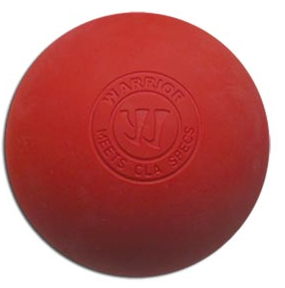
A lacrosse ball looks like this:

Warrior lacrosse ball

Simple instructions for foot relief…

Give yourself a foot massage.

Once you buy the lacrosse ball, do this…

Roll the lacrosse ball deep into the muscles of your feet for 60 seconds on each foot.  Move the ball from the heel, to mid-foot, to your forefoot.  Move it forward, backward, side-to-side, and circular.  Any way you choose to roll is the right way.

Look for sore or tender areas.  Give those spots some extra love.  Consider holding the lacrosse on those spots, wiggling your toes and wrapping your foot further around the ball.  

You cannot mess up this up. 

After you finish with both feet, stand up straight and see how you feel.  

If you’re like me, there should be a big release of pressure.  The release may run up the back of your legs to your back, stopping just short of the back of your head.  

My experience

The first time I rolled my feet out on a lacrosse ball I couldn’t believe it.  It was instant relief.  Remember that over-inflated bike tire analogy?  

Rolling my feet is like letting air out of the tire.

These days, I don’t leave the house for a work day or a weekend trip without a lacrosse ball in my bag.  Sometimes I use it, and other times I don’t.  But I always have it I need it.  That’s the point.  

When my feet start throbbing, I roll.  Rolling buys me more time on my feet, which makes me less irritable at work and more productive.  

Beyond that, the feet need attention just like the rest of our bodies.  Foot health is vital.  Some basic soft tissue maintenance daily can provide a lot of relief.  

Bonus tip:  Spend more time barefoot.  Get out of those shoes, spread the toes out and go skin on surface as much as possible.  

Shoes are soft and comfy, but your feet are designed to be extremely resilient.  Footwear is hurting your foot health more than it’s helping it.  It desensitizes and alters your gait (natural walking motion).  

Your podiatrist loves it, but your bank account and body won’t.

Obviously, most people won’t be able to go barefoot on the job, but any other time, free those babies. 

What is fascia and why does it matter?

Fascia is a giant webbing (laymen’s description) wrapping around our muscles, skeleton and internal organs.  It basically holds us together, gives us some structure internally.

Fascia health can impact our ability to move and overall daily comfort.

Here is a nice article from the Telegraph on fascia.

To fascial researcher Tom Myers, “The ‘illusion’ of separate muscles is created by the anatomist’s scalpel, dividing tissues along the planes of fascia.  Fascia is the missing element in the movement/stability equation.”

Fascia is important.  Taking care of it is important.  Not that you know, you cannot un-know.  🙂

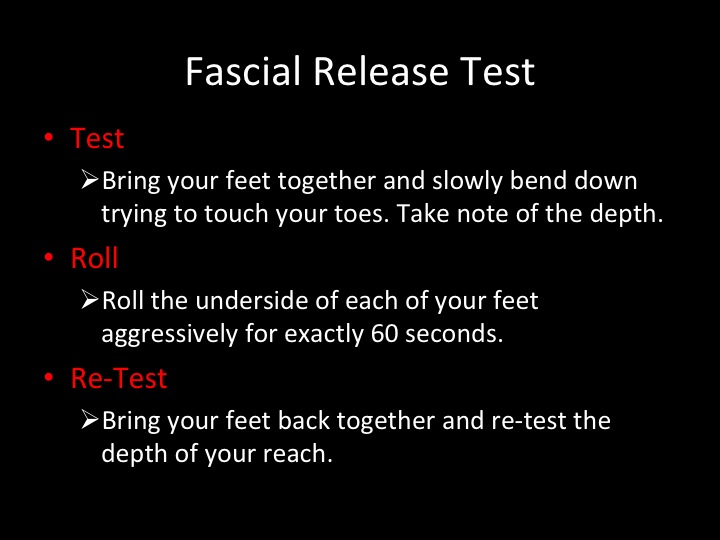
Here’s a simple test/re-test to try…

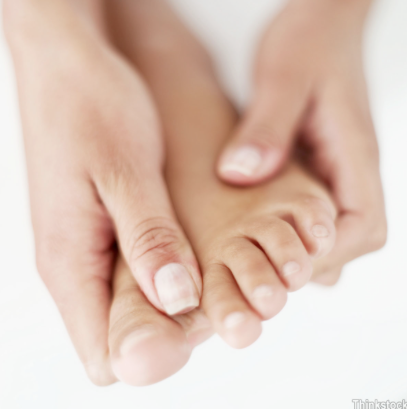
Foot relief fascia test

Notice a difference?

Chances are you gained few inches.  

I’ve personally seen people who couldn’t reach within 6 inches of their feet on the first test, roll out for 45-60 seconds, re-test and be able to scratch the top of their feet.  

“What the…?”

The expressions crack me up every single time.  

This very basic fascia release allows for an increase in range of motion, though it may be temporary. 

It’s important to understand that basic self-maintenance strategies like this exist and you have the power to work on yourself daily.  

Nothing will replace the experienced hands of a manual therapist, but for ongoing relief of aches and pains, tools lying around the house can gives us relief.  

Advice:  Perform simple maintenance on a daily basis, and over time you’ll start to feel some changes take place.  Don’t be surprised if you feel like your movement improves from this great home remedy, that’s quite common also.


Cheers to giving your feet some love…

Kyle

Turkish Get-Up and Kettlebell Swing ONLY Workout

20 minute Workouts, Kettlebell Training

This workout includes two foundational kettlebell exercises (Turkish Get-Ups and Kettlebell Swings) and is perfect for a home gym workout.

Who doesn’t love a home gym workout these days?  Time-efficient and minimalistic workouts are PERFECT proving the superiority of the home gym workout experience.

Clearly, I’m an outspoken advocate for creating a home gym space.

In the kettlebell training world, turkish get-ups and swings are two of the best exercises a person could learn, practice, and improve on.

I stand firm on this statement.  Call it “my truth” or whatever.  I’ve spent years working these two movements and the benefits of my efforts include sustained power, strength, and a consistently lean and muscular physique.

Aesthetics might seem superficial, but no one trains hard to stay fat.

There are HUNDREDS of other great exercises, I support them all, but going full-on minimalistic mode, I know that attacking turkish get-ups and swings would make a lot of people happy with the time investment.

It’s a powerful combo.

Kettlebell swings are a ballistic hip hinging exercise that’ll improve power, train fast-twitch muscle fibers and if organized accordingly, build conditioning in a really unique way.

Turkish Get-Ups are a pure loaded movement-rich exercise.  Few other exercises are as humbling, addicting, total body, and rewarding as practicing turkish get-ups on a regular basis.

You feel less like a Lego exercising while doing turkish get-ups, and more human.  

Equipment needed:  Timer and kettlebell

15 minutes Alternating Turkish Get-Ups

+

2-Hand Kettlebell Swings (24 rounds of 15sec on/15 sec off)

The TGU’s

15 minutes of continuous turkish get-ups is a lot of work, so if the duration needs to be decreased a bit, please do it.

Start with 5 minutes, see how you feel.

If 5 minutes is a breeze, add 2 more minutes and see how that feels.

There are very few secrets to fitness.  Actually, there are none.  Only what you know, and what do you don’t know… and how consistently and effectively you are at practicing what you know.

The key to building fitness safely, is auditing and be honest with your fitness level, and adjusting any pre-formatted workouts (like this one) to match your abilities.

Turkish get-ups, like any other exercise, are not supposed to be sloppy.

A full turkish get-up is a marathon of an exercise, multi-segmented, with many steps/moves/transitions on the way up and down.

The technique, timing, hand and foot placements, breathing and coordination are just a few key things to pay attention to while performing Turkish get-ups.

Poor technique… can result in tweaks, strains and injuries, which is not the point of exercising in the first place.

We exercise to improve our lives, not make it worse.

Regressions may be necessary, and the person who acknowledges they need to scale back a workout is a person I RESPECT!

The Swings

24 rounds of 15 seconds on (swinging) and 15 seconds off (rest) equates to 12 total minutes.

6 out of 12 minutes are spent performing kettlebell swings.

Pausing to think about how potent kettlebell swings are for fat loss (among other benefits), it’s pretty amazing a measly six minutes can have such a dramatic impact on body composition over time.

When I first started shaping this workout years ago, I used a 24kg kettlebell.

Today, I like to use a 32kg or my 40kg for the swings.

Exercise Variations for the Workout

Establish familiarity with both turkish get-ups and kettlebell swings BEFORE diving into a workout like this one.

Here are the recommended variations of each exercise:

Turkish Get-Ups

Kettlebell Swings

Give this workout a shot and leave a comment.