The Benefits of Jump Rope Training

cardio, Motion

Jump rope training is packed with benefits.  Jumping over that tiny little rope can improve muscle strength and skeletal integrity (through medium ground impact force).  

The calories burned while jumping rope are high compared to other activities and including jump rope training in a workout regimen is a great way to get a potent cardio training effect with the body in a standing position, versus seated cardio machines.  

Lastly, jump ropes are inexpensive, versatile and simple to integrate with other training methods to increase the challenge and scope of your workouts.

Several years ago I wrote an article called:  Jumping Rope:  The Undeniable Negatives.

The article came off a bit, safe and cautionary.  To be honest, I was a lot younger then and my writing style wasn’t as clear and to the point as it is now.  Regardless, I feel some of the points made in that article are valid.

Jumping rope can be tough on the muscles and joints early on.  I don’t recommend a sedentary individual reach for a jump rope to initiate their exercise regimen.  If your body hasn’t been exposed to impact in a while (maybe never), jumping rope will annihilate your lower extremity muscles in the days afterward.  

But cautionary tales won’t be part of this article, so let’s get into the good stuff… 

… the benefits of jump rope training.

Inexpensive

If you’re looking for an inexpensive piece of fitness equipment, jump ropes are the ticket.

The last jump rope I purchased set me back $7 on Amazon over 3 years ago.  
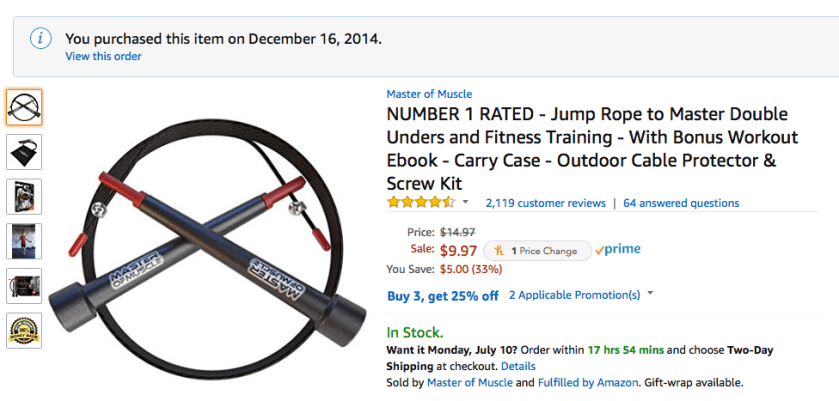
Screen Shot 2017-07-08 at 8.04.25 AM

Inflation.

The same rope is still kicking ass and serves as a valuable part of my pre-workout warm-ups, occasionally making appearances inside of metabolic conditioning workouts.  

36 months of use divided by $7 cost-to-own equals roughly $.19/month.  

Previous to my $7 jump rope, I purchased a $30+ jump rope from LifeLine Fitness which turned out to be a piece of shit for the cost.  

In the early 2000’s, LifeLine was considered to be the “functional fitness” company, so I was surprised at the quality and design of their jump ropes.  Durability was terrible and there was no way to adjust the length of the rope.  

So, when it was time to find another rope, I went with the thinnest cable based rope I could find and I have had no issues yet.  

Side-thought: One downside to jump ropes is they are a one-trick pony.  In other words, you can only really jump rope with a jump rope.  But hey, for $7-$15, who cares, it serves it’s purpose without breaking the bank.

Cost comparison to other popular forms of equipment-based cardio:

Jump Rope:  $7-$40

Concept2 Rower:  $950

Assault Airbike:  $799+

Versaclimber:  $2000+

Treadmill:  $900+

Jacobs Ladder:  $2500+

Non-Treadmill Running:  $50+ for shoes (dependent on weather)

* To be clear, I’m not advising you to stay away from any of these machines.  For machine-based cardio, each ranks high on the effectiveness list.  I personally own both a Concept2 rower and the Assault Airbike and wouldn’t have it any other way.

Environment/location/equipment friendly

I’m going to tackle this benefit in bullet point fashion.

  • Jump training doesn’t require a lot of room to train.
  • You can do it on the spot.
  • You can pack it up and travel with it, taking it anywhere.
  • You can train inside (not weather dependent)

If you’ve got a 6×6 space with a 7ft2inch high ceiling, you’re clear for jumping rope.  I know this because 70% of my workouts take place in my home basement, where space is limited but adequate for twirling a rope.  

Scalable for everyone

Any great piece of cardio training equipment is scalable to a wide range of skill and fitness levels.  Most are, but some are not.  

Beginners who are new to jump rope training can start with the basics:  two-foot jumps, alternating jumps etc.  


Turning up the intensity is simple:  turn the rope over faster.  

Don’t confuse “basics” with ineffective.  Exercises are best scaled to match fitness level, the challenge is therefore proportionate no matter how fit you are. 

Advanced jump rope training can include various single leg jumps, mixed medley jumping and double-unders (turning the rope under the feet twice per jump).  

High knees (running in place) while jumping rope is extremely taxing when performed for intervals of 30-60 seconds per work set.  A workout designed with 10-15 intervals will make you a believer in the cardio training effect of jumping rope.  

Just like a beginner, if an advanced trainee wants to increase the difficulty of their training sessions all you need to do is 

Duration of jumping rope can be adjusted for both beginners and advanced alike.  Adding a minute to a jump rope workout every week or two can have you jumping for 15-20 minutes in no time.  

However, once you hit 20 minutes of continuous jumping, I suggest adjusting the movement complexity of the jump or cranking up the tempo of the rope versus adding more time.  

Jump Rope Posture

As stated earlier, I love cardio equipment like rowers and airbikes, but these machines put people in a seated position to operate.

If sitting is the new smoking, and a lot of people are sitting too much throughout most days as it is, I don’t want you to come home and sit down to exercise.  This would be contributing to the epidemic.

Jumping rope puts a person in a standing position with shoulders pulled back and hips forward.  

It is difficult to jump rope with poor posture.  Doing so will likely limit the speed you’re able to turn the rope and also the jump technique.  Plus, it will be uncomfortable to hunch over and jump.  

Any physical activity getting a person uncoiled from the seated posture is a great option.  

Great for Pre-Workout Warm-Ups

After some basic stretching and mobility work, grab a jump rope and work through roughly 5-10 minutes of medium-intensity rhythmic jumping.  Work a medley of jumps:  two-foot jumps, high knees, single leg, back and forth, side to side and lower body boxer twists.  

I promise you will find little else as simple and effective to get your body and mind prepared for a workout.  

Again, getting the blood flowing pre-workout in a standing position is ideal.

Impressive calorie burn

Jumping rope can burn up to 700 calories per hour.

But here’s the deal, I don’t think anyone should be jumping rope for 60 minutes, it’s too much volume.  If you have the attention span and endurance to turn a rope for 60 unbroken minutes, you’re a badass.  

In terms of training volume and ground contacts, 60 minutes of jump rope training is sort of like running a marathon every week.  There are obvious dangers associated with both (overuse, overtraining, lack of variety, etc).

I don’t recommend choosing exercises based on calorie burn, it can develop favoritism toward certain activities while and excluding others.  Balance is the key.    

However, jump rope training does use up an impressive amount of energy which means a larger amount of calories being burned in the same amount of time when compared to other popular activities like running, cycling and swimming.  

Weight Loss/Fat Loss

Jumping rope consistently can help you look better naked.  See reasons above for why.

Jumping rope burns calories.  Increasing calories out compared to calories taken in is a scientifically backed strategy for both weight loss and fat loss.  Calories in versus calories out.  Of course, the quality of calories taken in will influence the rate of weight loss and fat burning a great deal also.

Combine a decent nutritional regimen with some quality jump rope training and you’ll see a major shift in body composition.  Intermittent Fasting is hot diet pattern right now.

Cardio Integration

This is the real reason why I love jumping rope.  Supplementing jump rope training in with rowing, biking, running and bodyweight metabolic conditioning workouts keeps workouts challenging and fresh.

Fact #1:  If you look forward to your workouts, you’ll keep training.  

Fact #2:  If you despise your workouts, you’ll fade to doing nothing quickly. 

Jumping rope after pre-fatiguing your body with other exercises provides a great challenge.  When muscles are tired, posture degrades, so turning the rope while huffing and puffing demands an increased level of focus.  

Here’s quick and dirty bodyweight and jump rope workout for you to try:

10 Squats

10 Push Ups 

1 Minute Jump Rope

10 Lunges

10 Body Rows or Pull Ups

1 Minute jump rope

8 Hollow Body Rocks

Complete 5 rounds as fast as possible.  Record your time and re-test in a month or so.

If you completed 5 rounds, the numbers break down like this:

  •  10 minutes of jumping rope
  •  50 squats
  •  50 push ups
  •  50 lunges (per leg)
  •  50 body rows/pull ups
  •  40 hollow body rocks

If you’re in the market for developing work capacity and burning fat in the process, simple and effective workouts like this are essential.  

Splitting up the jump rope into 1-minute bursts will make you feel like you’re hardly jumping.  But as the numbers show, you actually accumulated 10 minutes worth.  Not bad.   

Over the course of the next few months, you’ll see an increased number of full workouts posted to this blog, and my YouTube page.  If you’re interested in following along, I suggest you subscribe for updates.  

I’ll be keeping things fresh for a long, long time.  

If you got some value from this post, I’d like to expose you to several other popular posts my readers have enjoyed:

Now, stop reading and thinking, grab a rope and go crush a workout. 


Cheers to the benefits of jump rope training, 

Kyle 

Metabolic Conditioning: The Bear Barbell Complex Workout

20 minute Workouts, Quick Tips

“The Bear” Barbell Complex is as close to flowing barbell training with a barbell that you’ll ever get, or at least I have ever gotten.

I’ll assume that “The Bear” is referred to as “The Bear” because of how difficult the workout is.

This complex workout leverages barbells.  Barbells are mostly thought to develop pure strength and power.

The barbell was manufactured to work well for moving heavy weight.  Moving heavy weight creates the ideal training stimulus for building strength.  If a person moves the barbell fast enough across a set distance (Point A to Point B), the barbell becomes a tool that enhances an individuals power.  Think cleans, snatches, jerks, etc.

  • Slower moving + heavy weight = Strength Development
  • Fast moving + medium/heavy weight = Force Production = Power Development

Although barbell training might not be an appetizing fitness solution for a lot of people, taking some time to learn and practice the basics of barbell training can pay a person back ten-fold over time.

My guess is a lot of people avoid barbell training because of the intimidation and unfamiliarity factor, or for some, the uncomfortable sensation of iron grinding against the skin.  Barbell work will develop tough hands over time.

The callouses I cannot help you with… but if you want to know more about barbell training, buy Starting Strength by Mark Rippletoe.  Read a few pages, practice, read a few more pages and practice some more.  There is a wealth of knowledge in Starting Strength that can help you establish the emotional confidence and the technique to play around with the barbell a bit more.

It’s important not to be afraid or intimidated by the barbell.  When people think of barbell training they usually picture a 300lb tank-of-a-man squatting 500lbs, yelling like a maniac during every rep while his friends stand around yelling like maniacs during every rep.

You’re partially right if this is your initial mental picture.  But barbells, and how we use them to develop physical qualities has evolved a lot over the years.

Like any other fitness tool, barbells can be leveraged for other purposes also.

In particular, I enjoy using the barbell during work capacity directed training sessions (aka: metabolic conditioning) or at the end of a workout for a short burst finisher.  Think high reps with lower loads, or a highly concentrated amount of work done in a short time frame, or unique mixture of both.

When I re-stumbled onto the The Bear Barbell Complex a few weeks ago, I reintroduced myself to a style of barbell training that I used to use quite a bit, especially when available workout time was limited.

“What is The Bear Complex?, you ask.

Come a bit closer and let’s take a look…

Barrier to Entry

Tools: Barbell and plates (bumper or standard metal work fine), clock timer such as the GymBoss.
Skill:  Working knowledge of the barbell based exercises listed below.

The Exercises

#1: Power Clean

#2: Front Squat

#3:  Push Press

#4: Back Squat

#5:  Behind-the-neck Push Press

Workout Structure

–  Each movement is performed for 1 repetition before immediately moving into the next exercise.

–  1 Cycle =  1 repetition from #1-#5 in alternating/descending order.  After exercise #5’s rep, return back to exercise #1.

–  1 Round = 7 Cycles

–  Perform 5 Rounds

–  Rest 90 seconds after finishing each round.

–  Barbell weight is dependent on:

  • Weakest lift (the weakest lift determines the appropriate load, which should be sub-maximal)
  • Exercise technique and know-how.
  • Reaction to fatigue (which correlates closely with the deterioration of exercise technique)
  • Advanced Women – 95lbs
  • Advanced Men – 135lbs

The Extended Break-Down…

There are 35 reps of every movement being performed throughout all 5 rounds.  Just 35 reps.  If you consider the volume of a more traditional work-rest training session, where a squat is performed for 8 reps x 3-4sets, the volume is not much higher.

The weight used is also much lighter than a more traditional work-rest set and should be determined by your weakest lift in the complex.  For a lot of people that is going to be the push press, possibly the power clean (grip). I’m asking you to perform 5 reps for each round.  The barbell load should be a sub-maximal, which means that you should be able to push press that barbell for 8-10 reps comfortably.

My suggestions on weight for men and women are not the law.  Adjust the weight to what is appropriate for your current fitness level and know-how.

Every exercise is performed for a single rep before moving into the next exercise.  From rep to rep, you’re alternating between different movement pattern throughout each cycle.  It’s important to understand this aspect of The Bear Complex, because it’s one of it’s features that makes it so physically taxing.

Elevation Change

The barbell begins on the floor and travels to chest height after the clean and during the front squat.  After the front squat the barbell moves overhead after the push press.  The barbell then transitions from the front of the body to the back of the body on the descent down from the push press.

At this point, the barbell rests on the shoulders while you perform a back squat.  At the top of the back squat, the barbell is forcefully pressed overhead once more, and caught back into the front rack position at chest height.  The barbell is guided back to waist height and eventually back down to the floor to prepare for the next cycle, starting with a power clean.

The training stimulus elicited by moving the barbell up and down, front to back, movement to movement creates a large metabolic training effect.

Performing single rep of a movement pattern, followed by single rep of a completely different movement pattern, while bundling a bunch of different movement patterns together in a row (creating a “cycle”) is extremely fatiguing.  It’s provides a unique training stimulus for the body to cope with and also laser-like focus for the mind to keep up with since every rep involves a different movement pattern.

‘Single-rep-alternating-movement-pattern-workouts’ have proven to be an effective variation of traditional complex training, where exercises are performed for multiple repetitions before moving on to the next movement pattern.

If you’re accustomed to sectioning off your complexes, doing 6 reps of one exercise here and 6 reps of another there before moving on, alternating movement patterns with every rep will be a shock to your system.

It’s reiterating once again that alternating the movement pattern on every rep requires great skill.  The barbell is constantly changes levels, stopping and starting in different positions.  The transitions can be brutal.  There’s a high level of focus needed here.

The Fatigue is Coming…

During The Bear Complex, the first few reps/cycles usually don’t feel too rough, but the wave of fatigue that bites you in the ass somewhere around cycle 5, 6 or 7 can be overwhelming.  Possibly so much so that executing all 7 cycles for any 1 round is just plain unreasonable if you’re new it.  Don’t be afraid to remove your hands from the barbell to take a break and to gather yourself.

Loaded conditioning is a fantastic method to burn fat and develop high level work capacity which has great transfer into sport and becoming more resilient toward real life labor, but fatigue can break down your exercise technique.  Don’t be a hero here, be smart.  If 5 rounds is too much, do 4 rounds.  Be reasonable.

Movement technique first and foremost, forever and always.

Pay Attention to your grip integrity

Alternating movement patterns and transitioning the bar to different resting positions can fry your grip.  Consider that the bar is moving from the floor, to chest to over head, to shoulders, back to overhead and finally back down to the floor position.  That’s a lot of bar movement.  Don’t be afraid to walk away from the barbell if your grip starts to slip.  A quality grip is needed for the cleans.  Attempting to pull a barbell with a poor grip can be dangerous, and the fatigue that’s been created with slow your reaction/recovery time.  Again, rest for a few seconds, gather yourself, then complete the work with a solid grip.

If you’re a tenacious sweater like I am, also be aware of any sweat rolling down your forearm and into the hand/barbell interface.  Don’t push through this situation either.  Dry all surfaces with a towel and continue on.  Maybe consider using a no mess chalk solution such as HumanX Chalk Balls to help maintain grip.  Chalking your hands has come a long way.
.

This workout is advanced 

Complex training in general is an advanced form of training.

Any exercise scheduled in a complex must be an exercise that you have a familiarity with BEFORE you enter the workout.  You must have experience and proficiency in executing each of the included exercises on an individual level before you attempt a workout like The Bear Complex.  If you don’t know how to perform any one of the exercises, The Bear Complex is not the place to learn.

Explore…

If you’re looking to add in some variety to your training, give The Bear Complex a legitimate shot.  Be honest with your rest periods, your exercise technique and the structure of the reps, cycles, rounds.  Also be honest with weight that you choose to use.  There’s no shame in lessening the load if you need to.

Cheers to The Bear…

Kyle

(Video Coming Soon)

The 5 minute Kettlebell Swing + Burpee Challenge

Quick Tips

I love metabolic challenges, especially ones that incorporate kettlebells and burpees.

If you didn’t get a chance to check out the burpee challenge from a few days ago, I suggest that you do.  It’s a tough workout that will definitely get your heart rate up.

—>  Metabolic Challenges/Finishers Over Boring Cardio

I favor metabolic challenge workouts, sometimes referred to as “finishers”, because they test your mind and body in a controlled setting.  The movements and reps/sets (aka: volume) should always be structured to YOUR own physical abilities, not someone else’s.  Nothing during a metabolic workout should be forced.

It is crucial that a high tempo work capacity style training session have progressions and regressions.  One size does not fit all.  The workout should be scaled to fit each of us on an individual level.  This will decrease the likelihood of injury while promoting physical transformation and improvements in performance.

Once you have proven that you can move efficiently without pain and have acquired adequate strength, stability and mobility to execute basic exercise like squats, push-ups, chin-ups, lunges and planks, it may be time to consider mixing in some metabolic work.

Remember this picture from a recent post?…

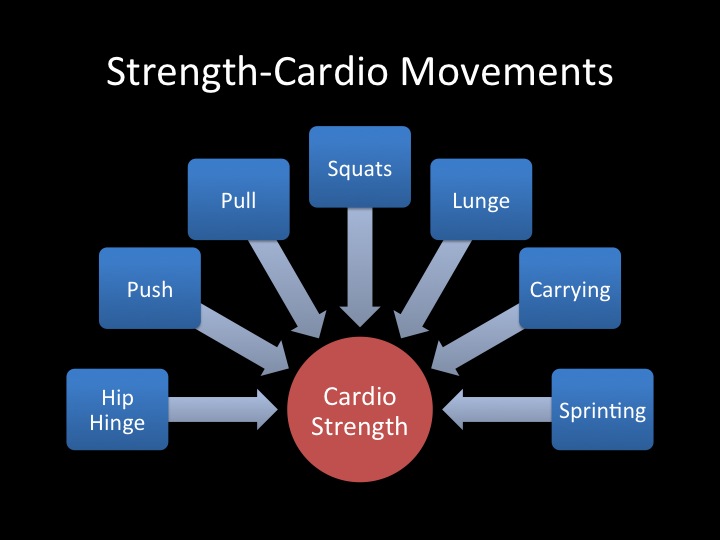
Strength Cardio Movements

I use “cardio-strength” and “metabolic” interchangeably…

At the very least, you can mix in some short burst finishers toward the end of your strength training session.  Adding finishers to the end of a workout will shift the way that you think about conditioning.  I know that it did for me.  It was a game changer.

There is nothing wrong with traditional activities like bike and hill sprinting, but to be honest, I find it painfully boring.  I know for a fact that I do not sit alone with these feelings.  Boring cardiovascular training can actually do more harm than good.  If you dread boring cardio to the point that you choose not to workout at all, that’s bad.  It shouldn’t have to be this way.

Boring Cardio Hamster Wheel

Do you ever feel like this while working out?

You don’t have to be a fanatic about your training habits, but long-term adherence to a life full of movement requires that at the very least you find some amount of enjoyment from your workouts.

The main point is that you have great alternatives to the long, slow, boring treadmill trot.  Finishers will keep your training fresh and challenging.  The return on investing in finishers is large.

I will always encourage beginners, novice and even advanced trainees to continue to make conscious efforts to improve strength and power.  This will never change.  So much good comes from building basic strength.

In a normal training session, after working through a complete warm up, strength and power work should be next on the day’s agenda.  Most workouts will require anywhere from 15-20 minutes to work through 2-3 tri-sets of strength/power enhancing movements.

—>  Kettlebells and burpees collide

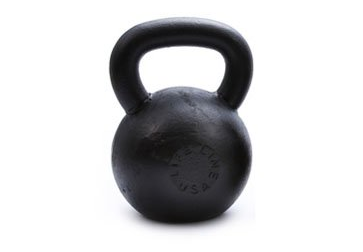
Lifeline Kettlebells

Lifeline Kettlebells…

I am a huge kettlebell fan.

Kettlebells changed my perception of working out.  Kettlebells brought  the importance of strong, stable, free-flowing movement back into the fitness equation.  You have to be 3-dimensionally strong to lift, swing and carry a kettlebell.  My gym sessions transformed from a of time devoted to the typical big lifts- squats, pressing and pulling- to ground based movement sessions that built strength and stability using in greater ranges of motion.

I now have a level of stability, mobility, and functional strength that I didn’t know was possible for me to have.  Kettlebells aren’t a miracle, but the shift that they caused in my views on what an effective workout could be certainly make them one of the most influential pieces of training equipment I have ever used.

Kettlebell training is represents true movement.

The Turkish Get Up

Segue…

Next, the reason that we’re gathered here in the first place.

—>  The kettlebell swing + burpee metabolic challenge

I cannot remember where I first saw a version of this challenge posted, so please forgive me.

Credit belongs to someone out there, so take it if you’re deserving of it.

I’ve adapted it to fit my needs over the years, as I do with most everything related to training.


Tools needed:  To complete this challenge, you’ll need a kettlebell that you can swing for about 15-18 reps continuously for multiple sets.  I use a 24kg or a 28kg kettlebell for a finisher like the one described below.  Have some kind of timing device on hand.  I always go with my trusty GymBoss.

You’ll also need an open space of about 8ft x 8ft.  This should work just fine.  You can get by with less- and I have- but the more the merrier.  The ceiling of the space you are training in should be high enough to avoid hitting the top of your head when jumping.  If you’ve got clearance, you’re in business.

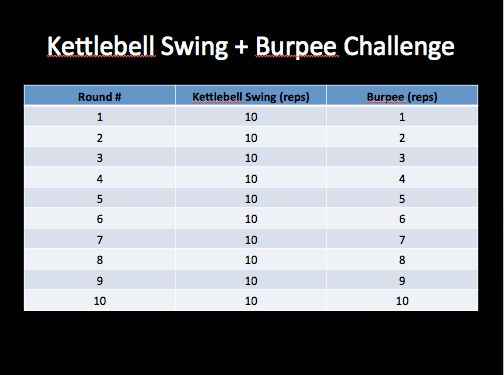
Here is how the challenge is formatted…

kettlebell + burpee workout

Make sense?

Take note of how each round accumulates burpee reps while the kettlebell swings remain the same.  It’s a very simple format to remember.  Two exercise finishers work great because they take very little thought.

The weight of kettlebell used will vary from person to person, but in general I would go with the following:

Females:  12-16kg

Males:  24-28kg

Of course there are going to be those of you who can use heavier kettlebells than what I suggested, but these are common weights for each gender.

The ultimate goal is to finish in 5 minutes.

I won’t p that I “think” a beginner, novice or advanced trainee should be able to finish a challenge like this in.  That’s not the point.  The goal is to finish in 5 minutes, end of story.  Anything longer than that indicates that you have a goal to work toward.  Sound good?

Stop Sign Warning

—->  Mandatory warnings to this workout

If you have never swung a kettlebell before or you aren’t proficient in swinging kettlebells for higher volumes or while under fatigue, this is not the time to test yourself.  Work up then work in.

Lastly, technique breakdown automatically initiates rest until technique can be maintained.  Fatigue kills exercise technique.  Leave your ego at the door when you train, it will save your body from injury.

Work smart and hard, not smart and reckless.

Give it a shot, have some fun and post how you finish up…

Cheers to the conditioning without boredom!

KG

How to Warm Up Before a Home Workout (Video)

Quick Tips

Below is a sample of what a warm up looks like for me prior to a training session.

The only awkward moment comes when I attempt to stay on the rubber matting while performing forward, backward and side to side gorilla hops.  Hey, I’m human, shit happens.  This isn’t Hollywood produced, it’s real world home training.  Film it like it happens, right?

The important thing to remember is that you should always maximize the equipment, time and space that you have available to you.  You can always get way more accomplished with what you have than you originally thought.

I have really come to enjoy integrating animal style movements in the warm up, as it demands rhythm, stability and mobility to accomplish the moves.  Plus it isn’t boring, which is important for keeping your movement endeavors interesting and sustainable.


After you watched some of the video, it’s important to understand a couple of things:

1)  I only foam roll problem areas (trigger points, stiff muscles, overactive muscles)

2)  I only address mobility in areas that I lack it.

3)  The dynamic movement prep is mostly total body.

4)  Jumping rope serves to increase blood flow, core temperature and gets me sweating.

The point is that there is no time wasted and everything has a purpose.  My body is prepped for the transition into the physical demands of the workout.

My workout for this day was highly metabolic, which is how I have been training for quite some time now.  All workouts are designed mindfully and not intended to destroy my body, but rather build and condition it intelligently.  I completed all of the exercises below without rest between movements in a 15 minute timeframe (I was tight on time):

Metabolic Strength Training


I have used workouts like this successfully for over 5 years now.  The loads and exercises are appropriate for my skill and fitness level.  To be completely honest, the less complicated you make a session like this, the more fun you will have.  I rarely stray from the basic movement patterns: push ups, vertical pulling, squats, kb swings, etc.

I am after the training effect, not a circus-like performance.  The risk doesn’t always match the reward with complex movements.  It usually looks great on paper and sucks in practice.

For the time invested, I haven’t found any other style of training that keeps me lean and functional for the time invested.  The trade-off for time reduction is an increase in intensity.  This isn’t for beginner or the weak of heart.  You’ll be tired at the end.

It’s a great blend of work capacity and strength movements that demand full range of motion and attention to technique.  Of course, you can increase the difficulty of a workout like this or make it slightly easier if need be.  Progression is always the answer.


Cheers to making less excuses and  taking more action…


KG


5 Hot Trends in the Fitness World

Quick Tips

I always enjoy reading “list” style article from other writers, so I am making a conscious effort to put out more list style articles.  I have to be careful on how I word the titles however.  My major beef with article that are constructed in the list format are when they appear like the following:

“3 Best Foods to Eat for Fat Loss”

“10 Best Resistance Band Exercises”

“5 Best Butt Shaping Moves”

What is the common trend that you see there?

The word “best”.

I have trouble with the word “best” these days.  I used to be the kind of guy that would give out information about what I thought was the best, but I have since realized that just about everything works.  That being said, there are definitely exercises that I would select over others for most people.  But I still don’t feel comfortable saying that there is any one “best” of anything.  It’s a human malfunction, not an exercise malfunction.

I am guilty of it myself.

So I am careful on how I am going to word these “list” articles.

Moving on…

Physical culture has evolved tremendously over the last few years.  Products and methods have continuously improved our industry.  Naturally, the information being dispensed to the public has also become much more applicable.

Below are what I feel are 5 red hot trends in the fitness world

1)  Metabolic training.

I can’t really use any more description than that.  We have officially entered the age of Cardio-Strength, Met-Con (metabolic conditioning) and work capacity based training for getting lean and regaining control of our bodies.  It’s a trendy method, and rightfully so.  I myself have trained using incomplete rest periods and high volumes of work in short amounts of time for years.  The results are undeniable.  I don’t like to generalize statements, but the kind of aesthetic look that metabolic style training produces seems to be highly desirable by the public.  People want the lean and athletic look.  As with any trendy method, metabolic conditioning is also heading toward the dangerous realms.  There are always individuals who will take ideas to the extreme, and we are seeing this currently with metabolic conditioning.  Over-training and injuries have never been so prevalent, yet people seem to think it is part of the gig.  It doesn’t have to be.

2)  Suspension Training.

Screen Shot 2013-02-07 at 7.09.40 PM

Yes, TRX first hit the mainstream a long time ago.  Close to 6-7 years actually before finally hitting it big time.  Jon Hinds at LifeLine Fitness has been promoting his Jungle Gym suspension trainer for years prior to that.  What is amazing is the evolution of how we are using the suspension trainer.  It’s become a go to tool for rehab, developing and regaining mobility and stability and also yoga like movements.  It’s arguably the most versatile piece of training equipment in fitness right now.  Every home should have one.

3)  Paleo.

Screen Shot 2013-02-08 at 6.24.55 AM

Paleo is the hottest trend in eating, and I have to say that I have been eating ridiculously close to Paleo for quite some time.  Paleo is clean eating.  Whole food, lean meats and plenty of plants.  Although I feel that some professionals have really enjoyed the marketing appeal of a term like “Paleo”, I cannot argue with the eating recommendations.  If you want to strip fat and get yourself out of the “sick, overweight and heading for preventable disease category”, Paleo is a fantastic option.

Here is a link to Robb Wolf, a trusted name in the Paleo world: Robb Wolf

4)  Animal Movements.

This is something that I am HIGHLY interested in at that the present time.  I will be reporting back on this in future posts.  I would like to call it ground based mobility training, but that doesn’t even do it justice.  After watching a few video clips from the folks over at Primal Move, I was hooked.  I see so much value in it.  Strength and Conditioning coaches have been gravitating to Gray Cook and his Functional Movement Screen for assessing athletes and general population clients alike.  I can see this building on the findings of Gray’s FMS.  Moving joints in a range of motion like the video below would be a tremendous addition for so many people…

5)  Self-massage.

It’s never been more simple to perform self-maintenance on your body.  Tools like foam rollers and lacrosse balls have around for ages, but the information on how to use them was really lacking.  Sure, guys like Mike Boyle and others were promoting foam rolling sessions as a pre-workout method for eliminating trigger points and changing the density of muscle before changing length.  Some will argue against the effectiveness of stretching statically, and I am not even sure where I stand on static stretching at the present time, but no one should argue against the effectiveness of relieving oneself of restrictions (aka: knots and sticky tissue).  Trigger Point Performance, a company out of Texas, has really taken the concept of self-massage to the next level.  There educational seminars and products are fantastic.

Where is physical culture heading next?  Who knows, and that is the beauty of it.  We read, learn and apply daily.  The landscape of the fitness industry is constantly changing, and I really like that.


Cheers to being trendy (in a good way)…

KG

Is a 15 Minute Workout Realistic???

15 minute Workouts

60 minute workouts for fat loss are old news (so it seems).

Heck, in some circles, 45 minute workouts for fat loss are considered yesterday’s methods.

I have thought long and hard about my position on the judging a workout’s effectiveness or quality based on the time it takes to complete it.

While I was in Detroit, Michigan working with high-end athletes, our training sessions would take AT LEAST 90 minutes.

Why 90 minutes?

That is the amount of time it took us to from start to finish, working through this simple template:

1)  Foam Roll

2)  Static Stretch/Mobility

3)  Activation

4)  Dynamic Warm-Up

5)  Explosive (Plyometrics/Jump Training)

6)  Olympic Lifts/Power

7)  Strength/Core (Tri-sets)

8)  Conditioning/ESD (Energy System Development)

Total Time: 90min

This athletic based template was fast paced and continuous.  The breaks between each section were for water or timed rest periods.  Building an athlete requires focused development of a number of different qualities, and this template proved to be rock solid when it came to getting things done in a timely fashion, and most of all… getting results.

Now,  I know that most of my readers are not current athletes.  You may have been an athlete at one time (as I was), but reality is creeping up on you with regard to time available to workout.  It’s ok.  Life happens and we have to make adjustments to accommodate our daily activities.

Some fitness fanatics think that life should be built around your workouts, however, I tend to believe based my own testimonials and my own personal experiences… that your workouts should be designed to fit your lifestyle.

I know that some people are going to take advantage of my last statement, trying to bend the rules to the point where they begin to develop habits of never working out and letting themselves go, but I would hope that most of you choose to maintain a strict training regimen.

In my effort to adapt my workouts around my career and other business ventures, I began to look hard a Javorek’s complex training for fat loss and all around strength and conditioning.

I liked the idea of performing a large volume of work in a small window of time.  Javorek’s complex training is perfect for this as it is ridiculously effective for stripping fat in record setting time (15min or less).

Here are some of the training tools that I have used in the past for a complex:

–  Kettlebells

–  Barbells

–  Dumbbells

–  Suspension Trainers and Weight Vests

KB’s, BB’s and DB’s are what I have found to be the most effective.  You can adjust the loading easily with these training tools to fit your strength and conditioning and experience level and quite honestly… the movements just feel more natural using KB’s, BB’s, and DB’s.  Sometimes you have to go with your gut when you are designing workouts/programs.

Nothing against suspension trainers or weight vests, but trying to adjust the length on a suspension trainer or remove a weight vest while your eyeballs are popping out of your head from oxygen debt isn’t ideal.

For 3 months straight, I tested the idea that I might be able maintain my body composition and performance levels using just one simple complex template.  In the back of my mind, I wondered if I could actually improve my body composition and performance, but I didn’t want to set my hopes too high.

Here is the basic total body workout template overview that I used…

3 months is a long time to use the same general training format, workout after workout.  I have to admit that I worried about developing faulty movement patterns or flat out overtraining from the repetitive nature of the self-experiment.