I’ve never felt inclined to name any of my workouts. Thus, I give you the:
Chin Up + Kettlebell Swing + 2KB Squat + Jump Rope + Push Up…
… workout.
There is another organization that names all of their workouts, which isn’t a bad thing, I just don’t feel like labeling my workouts with someone else’s name. I could name this one “Brutus” or “Cactus Jack”. Maybe I should name my workouts after WWF wrestlers past and present. That would be cool. Everyone seems to know WWF wrestlers names whether they admit to watching it or not.
I could use a numbering system I suppose, like “Workout #1” or “Level 5”, but maybe I’ll just call it what it is.
I selected the movements listed above because they represent most of the major movement patterns, and also because these exercise could be easily executed with the workout equipment that I had available the other day.
What did I have available?
- My bodyweight
- Jungle Gym Suspension Trainer
- LifeLine Kettlebells (24kg x2, 28kg x1)
As I mentioned, I typically only incorporate big movement patterns into circuits. To be honest, I don’t like wasting time with exercises that hardly stress the prime movers. Bicep curls and such are desert. If I have time after I have completed what I often refer to as the “main meal”, I will work in the accessory exercises for fun.
I value my time. Time is a commodity in my life (as I am sure that it is in your’s) so I prefer to get in, get out and get back out to experience other aspects of life. Sure, I write about working out, structuring workouts, movement and nutrition a great deal, but that doesn’t mean that I am working out 2 hours a day. Efficiency is the name of the game. How effective can I make my workouts without taking away from other areas of my life that I also value.
Occasionally I will add an exercise or two that is slightly out of the box, but these movements are usually treated as a filler exercise (active rest) between more demanding exercises, or reserved for before or after the main circuit of the workout.
While I will admit that doing this is my personal preference, I would suspect that most of you will find that your own workouts are immediately enhanced by working in the big movements instead of a series of fillers. More muscles engaged equals a greater training effective at the end of the workout session.
If you do more work in a smaller time frame, now you’ve primed your body for fat loss + muscle gain.
This is a great scenario, one that we need to keep advocating instead of “weight loss”. You can lose weight by dehydrating yourself down to a raison in a sauna. That’s weight loss, right?
Swap the fat tissue for muscle tissue.
Chase muscle and while running away from fat.
So what are the big movements? In this case, the big movements that I leveraged for a training effect were:

I’m continually amazed at how effective bodyweight strength movements are, especially when organized into a circuit.
I can get the training effect that I desire while minimizing risk of injury and awful soreness in the days that is so commonly associated with resistance based training. Of course, if you have never performed a push up or a squat, you’re going to be sore in the coming days. That’s something you can expect with a new training stimulus and re-discovered muscle contraction.
Loading up on bodyweight style training sessions. This type of training sessions should be heavily considered by anyone that struggles with achy joints, etc. Bodyweight resistance exercise provides a low load introduction to basic strength drills, easing your body back into the swing of things.
Plus, being able to control your body exhibiting stability, strength and power through a healthy range of motion will do wonders for your performance, whether that performance be for sport or raking the leaves out of your yard.
So what does last weekends workout look like?
The structure looked something like this:
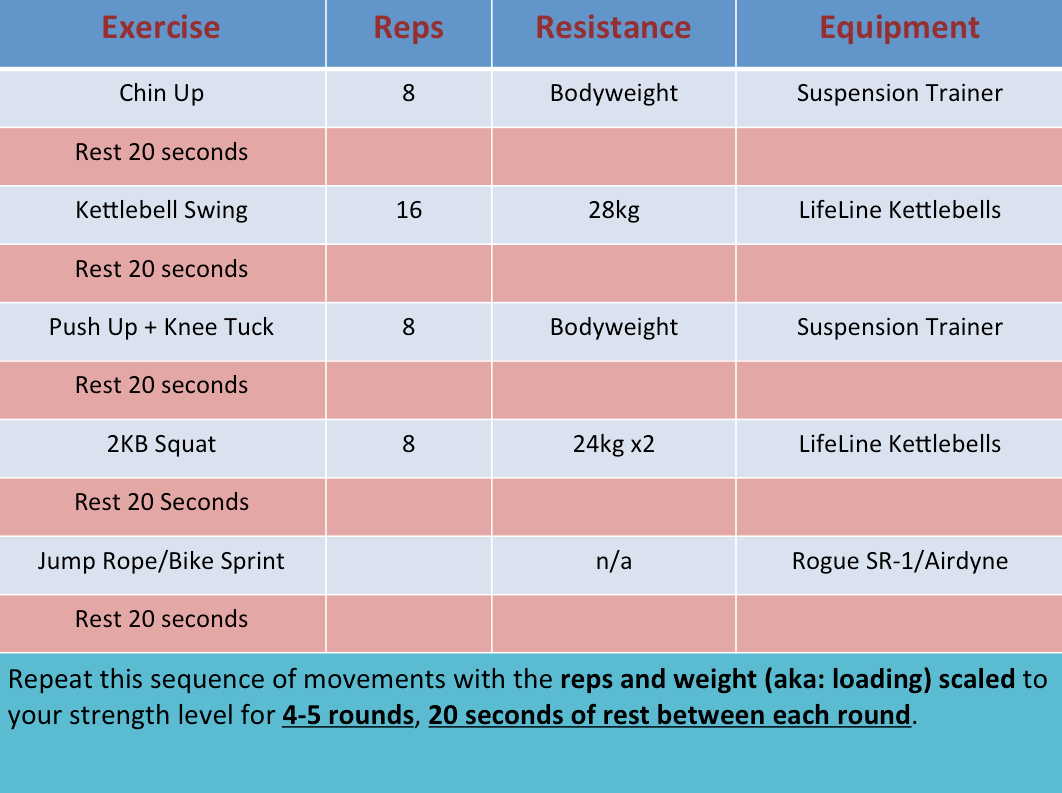
I loaded up most of the movements and went for 4 rounds, which took slightly over 20 minutes. 20 minutes continues to be the sweet spot for workout duration. Anything more than that and I lose output, anything less and it seems like it wasn’t enough… as if I left some fuel in the tank.
20 minutes also seems to allow for focus on proper exercise technique (and grooving) while the fatigue continues to snowball. Technique is important, don’t forget that.
If you take another look at the exercise selection above, I’d like to share a couple of substitutions that you could make. If you cannot perform a bodyweight chin up, wrap a resistance band around the chin up bar you’re using, and stretch it down around your knee or foot. This will assist you on the way up and ease you down from the top.
You could swap out standing broad jumps or squat jumps for the kettlebell swings, although there really isn’t a movement to mimic a kettlebell swing. If you have dumbbells you could use those in a pinch, but again, there is no tool that functions quite like a kettlebell.
If you don’t have a suspension trainer, just do regular old push ups. If you want a less expensive option that does a decent job of mimicking the push up+knee tuck combination, use furniture sliders or socks on a hard surface. Both work decently. I would go the furniture slide route if I had to choose.
If you don’t have kettlebells, dumbbells or a barbell for squats, you can do bodyweight squats just as well. If bodyweight squats are easy, mix in pistols alternating each leg. If you squats are too easy and pistols are too hard, use squat jumps.
If you don’t have a jump rope or a bike, run in place. High knee with simultaneously arm action. If you’re lucky enough to have a place to run a short distance, figure out how far it takes to run half of a 20 second shuttle run (10 sec out, 10 sec back).
As you can see, there is a progression, regression and alternative to just about every single movement known to man. Once you know what a level up and a level down from an exercise is, you’re in business. Now you can OWN your workouts.
Replenish and refuel your body with some rock solid recovery nutrition, and you’ve just done your body good.
Cheers to Chin Ups, Kettlebell Swings, Squats, Jumping Rope and Push Ups!
KG
PS: Seriously check out the nutritional link that I posted above. If you want to see dramatic change in your body and performance, nutrition is at the bottom rung of the pyramid.


 M(eaux)tion Fitness