High Repetition Kettlebell Swings

Kettlebell Training

The kettlebell swing is a amazing exercise that can build power, strength, improve conditioning and accelerate fat loss.  

Swings are packed with benefits.  

Kettlebell swings have been a staple exercise in my workouts for the past 13+ years.  

I started by swinging a 24kg kettlebell, and have since moving on to 28kg, 32kg and 44kg swings of varying intensities and volume.  

Within 4 weeks, I noticed the impact kettlebell swings had on my physique.  

And I wasn’t using fancy workouts, just a simple 15 seconds on/ 15 seconds off for 24 rounds.  That’s a 12 minute workout, with 6 of those minutes being dedicated to swings.   

Long story short, adding swings to my workout regimine helped to burn fat off of my body while building functional power, improving my posture and delivering a potent form of conditioning. 

Swinging kettlebells has also improved my running.

Kettlebell swings are a total body exercise.

In the beginning, I rarely swung my 28kg bell beyond the 15-20 reps in a work set.  

Overall, my workouts 

Then I started reading testimonials where people described how high rep kettlebell swing workouts (several days per week) was torching fat off their bodies. 

Who doesn’t want to burn a little more fat off their body?  I sure did, and still do, let’s get lean people. 

Of couse, nutrition is a crucial part of fat loss, so factor that in. 

Over the years, I’ve gone pretty far down the rabbit hole with swings.  High rep swing workouts might eclipse 300-400 reps in a session, using heavier kettlebells.  

Note:  Tread lightly using high rep swings too frequently.  Give your body chance to recover and avoid injury.  

—> Here is a short list of my observations and findings while using high rep kettlebell swing workouts <—

1)  High rep kettlebell swings builds grip endurance.  

2)  Might be a good idea to perform self administered soft tissue work on the forearms using a lacrosse ball or a percusion massager like the TheraGun. 

3)  I got lean pretty quick, which is predictable because kettlebell swings work a large number of muscles and burn a significant number of calories in these high rep workouts.  

4)  Take adequate rest between sessions.  Give your low back, glutes and hamstrings a chance to recover from the increase volume.  Foam roll, percussion massage, accupressure mat, active mobility training and long walks are a good idea.  

5)  2-3 high rep swing workouts per week is enough to create noticeable changes in body composition and conditioning.  

6)  Postural changes were interesting.  Standing position seemed like my hips were further forward and my shoulders pulled back.  

7)  15-20 minutes is more than enough time to accumulate a shit ton of swings.   

8)  Don’t be afraid to move up in weight and attack heavier kettlebells.  

I’d consider a high rep swing workout to be 100+ reps or more.  

Taking that number and scaling it for a beginner,  40-50 swings might be high rep for your experience level. 

If you’re advanced, 200+ swings might be your target for that day.  

It depends on your conditioning level and familiarity with the kettlebell swing.

Here’s a good kettlebell swing workout:

Baseline Kettlebell Swing Workout

Workoust like this are deceptively challenging.  

In the early round the rest periods feel long, but in the later rounds the rest periods don’t feel long enough.   

Fatigue is a hell of a drug.  

Using this workout, you’ll accumulate 100 swings in 10 minutes.  

That’s plenty to create a training effect.   

Choosing kettlebell weight.  20-24kg for men and a 16kg/20kg for women.

This is not the law however.  If you need to go lighter, do it.  Need to go heavier?  Do it.  Feel it out and make that decision as needed.  

This workout uses a fixed work:rest structure.  Wear a heart rate monitor if you have one.  A heart rate monitor can provide valuable information on work and rest periods, along with pinpointing how hard you’re actually working according to heart beats per minute.  

Using a heart rate monitor, I’ll perform the swings, finsih, then watch my heart rate monitor until the BPM decresases to 130bpm before starting the next round.  This method will make rest periods short in the beginning and tends to increase the length of rest later in the workout as fatigue accumulates and your body needs more time to calm down.  

Here are a few other workouts I’ve played around with. 

Other tips for high rep swing workouts

Don’t make the mistake of swinging too light of a kettlebell.  

The hips are powerful , size up the kettlebell and challenge yourself.  

If you have several different weights, you can start the workout with the heavier kettlebell and transition to the lighter bell as needed.  

It’s all based on feel.  

If you’re swinging super high rep marathon sessions with too light of a kettlebell, there’s diminishing returns.  

Instead of swinging 500 reps and feeling fresh at the end of the workout, lower the reps while increasing the weight.  

The increase in load will challenge your body plenty, and over time, the volume will increase.  

Repeat this process and you’ll be swinging the 40kg BEAST in not time.  I bet your body will reflect this progress.  

Just remember, the rules of progressive loading apply to kettlebell swings also.  

Again, this is a basic progression with loading, similar to what you’d use with traditional resistance training.

Heavier kettlebells will require greater effort to move the kettlebell through the arc of motion.    

Kettlebells are amazing for building power, improving posture and fat loss.  

Swings, while not the best for building lean muscle, are known to and can build muscle.  

Don’t count kettlebell swings out for building SOME muscle.  Just know there are better exercises.  

Deadlifts, squats, vertical pulling, rows, horizontal pressing and overhead pressing are best for building muscle because muscles will spend more time under tension through the full range of motion.  

Kettlebell swing are great for fat loss, if…   

… you’re in a caloric deficit.    

It doesn’t matter if you’re getting into a  caloric deficit via the swing workouts, or you’re a badass and entering workouts already in a caloric deficit.

You cannot out-swing a calorie surplus and expect to lose fat.  The math will work against you every time and you’ll go insane.  

People fight the calorie deficit thing all the time, like there’s some other secret sauce that can only be found by spending $97 on a fitness guru’s fat loss product.  

The caloric deficit is NOT EVERYTHING when it comes to fat loss, but it does play a HUGE role in burning fat.  

Huge.  

Sleep, hydration, protein intake, eating whole foods over processed foods (as much as possible) will deliver “best” results.

If you found this article wondering if high rep kettlebell swings are a good idea… 

… yes, they are.  

Just make sure you approach these workouts with some common sense, making sure you’re familiar with the swing itself and not overdoing the volume out of the gates. 

Increase the reps gradually, find the sweet spot with the weight, attack the workout. 

Integrating several high volume swing workouts per work alongside decent nutrition will deliver awesome athletic and aesthetic results.  

Cheers to high rep kettlebell swings!

KG

20 Minute Workout| Kettlebell Complex and Air Bike Intervals

Quick Tips

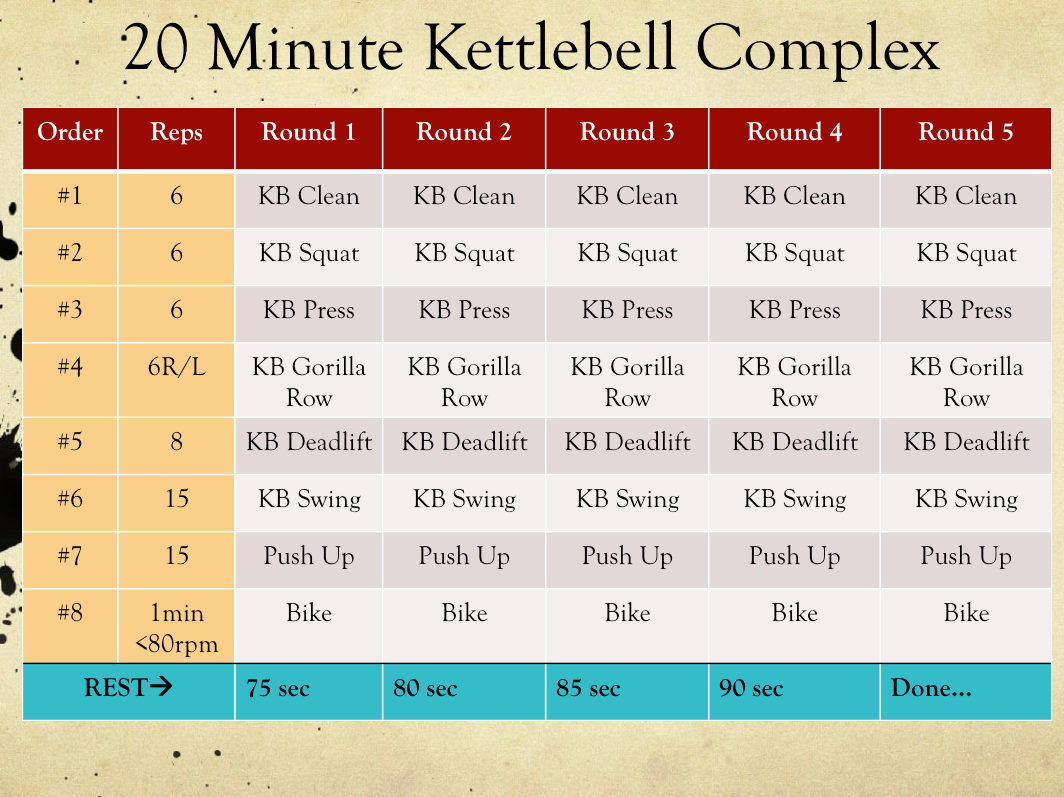
Here is a 20 minute kettlebell complex and air bike workout BURNER.  

This workout uses the same kettlebell complex I used for 90 days straight, just to see what would happen.  

Progression is key to improving performance. 

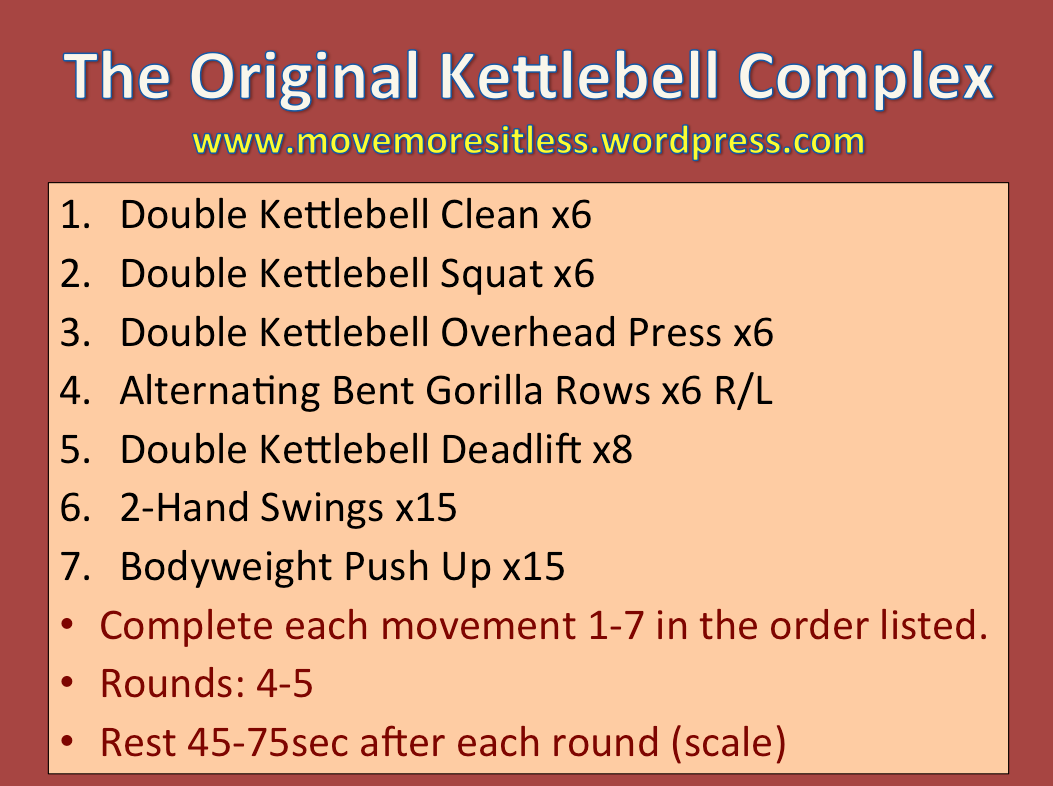
The original complex looked like this:

Original Kettlebell Complex

The goal was to keep the workout brief.  Under 20 minutes.

20 minutes is a sweet spot for me, especially with higher intensity efforts.  

I’m able to get the training effect I want, without losing technique to fatigue or subjecting myself to unnecessary injury.  

Higher quality work in shorter amount of time.

I really like these short burst sessions that address cardio and strength in one shot.  Life doesn’t always allow for 60-90 minute daily workouts.  We wish it did, but it’s turbulent.  

Being able to walk in the gym, warm up quick and get after it is awesome.  

The Workout

20 Minute Kettlebell Complex

Biking.  The addition of the 1-minute air bike ride at the end of the round shakes things up.  The goal is to keep the RPM above 80.  

The first few rounds were fairly easy, but rounds 4 and 5 were a bitch to keep pace.   

Why bike?

Biking is a low impact activity that requires ZERO skill.  Get on and ride.  Air bikes involve the entire body via turning the pedals over while pushing/pulling the dual action arms.

Biking is a safe way to condition while mitigating stupid workout injuries.  

Fatigue.  The ascending rest period tactic was perfect.  

Ascending Rest Periods

As fatigue accumulates, so does the amount of rest.  

The extra 5 seconds of rest added to each round helped managed my fatigue.

75 seconds of rest will seem long in the beginning.  But again, the fatigue hits you like a slap across the face.  

In rounds 3, 4 and 5… the 85-90 seconds rest passes by quickly.  

During your rest period, focus on breathing.  Deep and full breaths. 

Breathe deep into your BELLY, not your chest and neck.  

Exercise technique.  Metabolic conditioning is designed to stress the muscles and cardiovascular pretty aggressively, but it should NEVER come at the expense of technique.  

Scale the workout for yourself.  Start with longer rest in the earlier rounds.  Use less weight or bike for 30-45 seconds at a lower RPM instead of 1 min at >80 rpm.

Explore and tweak it as you go.  You can expect each “round + rest” to last 4+ minutes, with the later rounds lasting longer because of the increased rest.


Kyle


A Kettlebell Swing Workout (Part 2): Singles and Doubles

Quick Tips

An entire workout can be centered around the kettlebell swing.

There are very few exercises other exercises I would feel comfortable saying that about.  But the kettlebell swing is definitely a movement that be an all-in-one solution.  One stop shopping if you will.

Based on the popularity of my previous post, It’s Just a Kettlebell Swing Workout, I decided to go ahead and continue posting samplings of other kettlebell swing based workouts.

But I must be clear about one thing:  I am in no way endorsing that the kettlebell swing be the only exercise that you leverage in your movement training programs.

While the kettlebell swing is certainly a world-class movement, it is important to develop strength and power through other exercises as well.  Remember, the human body pushes, pulls, jumps, twists, carries, etc.

Humans have to be able to execute a wide range physical tasks if you stop and think about it.  Especially when you consider that you never really know what the demands of the workday or weekend are going to bring.

It really pays to be physically prepared.

Workouts are scheduled bouts of physical exertion.  You know exactly what is going to happen during a workout and how it is going to happen.  So much of our daily lives are unscheduled, random and out of our control.  The workout is one aspect of our lives that we can control.  We control the amount of effort, intensity, exercise selection and duration of the workout.  We have complete control of what happens during this brief period of time.

It’s a real turn on for some people who feel like they have little control over anything else in their schedule.

Anyways, back to the point of this blog post.

Kettlebell swings, and how we can organize and rearrange kettlebell swings into highly effective training sessions.

When I sense boredom creeping up on my training habits (as many of you have also experienced) I know that it is time to shuffle a few things around.  I value the impact that 2-handed kettlebell swings- especially heavier swings for longer duration work sets- can have on maintaining my body composition, but I also know that too much of anything can be a bad thing.

Boredom is part of being human, so it’s important to inject energy into your training sessions.

In this case, single arm swings added an element to my training session that reinvigorated the entire session.

Here is what the workout looked like.

Kettlebell Swing Workouts

If you get serious about adopting kettlebell swings into your workouts, you’re quickly find that your body will enter a different realm of lean.  I have to admit that I thought kettlebells were gimmicky in the beginning, but after submerging myself into kettlebells exclusively one Summer, I prove my own opinions incorrect.

I got really lean, really quick.  From just swinging the damn thing between my legs, back and forth like a pendulum.  The concept seemed too good to be true initially.

Interestingly enough, I didn’t have the greatest technique at the time, but I had established a great foundation of all around strength, stability and resilience to fatigue which allowed me to continue advancing my workouts.

This is an important point.  I would strongly advise that anyone reading this post go and seek out a professional who has the credentials of a high level swinger.  RKC (Russian Kettlebell Challenge) or StrongFirst certified individuals would be a great place to start.  Most of these folks were trained under Pavel Psatsouline, who is the godfather of kettlebells in the Western World.  You would get fantastic tips, tricks and technique adjustment from these individuals.

But, if you have a willingness to learn and a decent bodily awareness, I also personally believe that you can teach yourself how to swing at home.  Set up a smart phone and shoot short clips of yourself swinging.  Compare it to other videos like the following:

Neghar has great technique… check out her blog

Pay attention to the difference in your technique and Neghar’s swing technique.  Critique yourself bit by bit.  Make the small adjustments.  Most people will notice that they are “lifting” the bell versus swinging it, or squatting versus hinging the hips.

We have the ability to teach ourselves things- not just mental education but physical education also- which I sometimes think that we forget.  We can be self-sustaining.

If you find that you have little time, and want a workout that is bare bones simple, try this little diddy…

10 minute kettlebell swing workoutRecently, I jumped into this exact workout prior to my evening plans.  I didn’t have much time to train but needed to get some amount of work done to feel good about myself, so this 10 minute workout fit the bill.  Using a 28kg KB, I recorded 215 swings.  Not a world record but also not too bad in my mind.

Kettlebell swings are a highly productive exercise.  Add them to your training, and with an ounce of consistency I know that you’ll see some significant return on your investment.  Just do it.

Cheers to swing workouts!

KG

Some of the Greatest Workout Habits of Effective Fat Loss and Athletic Performance

Quick Tips

I transferred this post away from the static page tabs above and into a post.


1)  Resistance/Ground Based/Closed Chain  

  • Train with some kind of load or resistance as much as possible.  Push, pull, pick up, drag, carry, swing, squat, throw, slam… All with resistance and all with your feet on the ground whenever possible.  Lean muscle tissue from resistance training.
  • Women… (sigh)  You are not going to get “bulky” from picking up some weight.  Don’t be afraid of it.  If you knew what it takes to look like a bodybuilder you would laugh.  You’ll never get there.  If you want the “toning” effect… pick up some weight and get after it.  Nothing is sexier than a woman who is confident in the gym.  Ease into it with some effective bodyweight movements and progress from there… you’ll quickly realize what I am talking about.

2)  Aerobic/Anaerobic (Cardiovascular improvement)

  • Aerobic training isn’t the devil… it just isn’t the most effective way to drop fat and look better.  If time is a factor, and it often is, choose other methods.  Stress your cardiovascular system using as many different methods as possible.  Run, bike, paddle, swing kettlebells, use battling ropes, row, etc.  Train yourself to be effective for short distances, up inclined hills and stairs, flat surfaces, etc.  Run for distances that develop endurance-like qualities.  Do it all.  Tweak the variables:  distance, work periods, rest periods, direction, speed, heart rate recovery etc.
  • Grandma was right, “All things in moderation”.  Too much of anything can be bad.  Too little can be bad too.  Find the balance.

3)  Multi-joint (movements not muscles)

  • Unless you are rehabilitating an injury or training for a bodybuilding competition, avoid training your body in isolation.  The body is a single unit made up of many moving parts.  Train your body to push, pull, squat, hip hinge, lunge, carry, sprint, etc… and your body composition will change and performance will improve. Muscles and joints love working together (synergistically) to accomplish physical tasks.

4)  Joint-by-Joint Approach

  • The body is a vertical Jinga tower of joints.  Some joints need stability and some need mobility.  Improve your joint stability where you need it and improve your joint mobility where you need it.  Failure to obey this simple rule puts you at risk for injury and decreased performance.  Generalized approach, but simple and crazy effective.  Freedom to move effortlessly in all 3 planes will keep you functional in the game of life, and most of all, injury free.

5)  Progression

  • In simple terms, every movement/exercise has an easier or more difficult variation.  You just have to know where to start based on your abilities.  Beginners must spend time mastering the basics before they earn the right to step up to a more difficult variations.  Proper progression means leaving your ego at the door.  Do what YOU can do, not what you WANT to do or what you saw someone else do.  This is a hard lesson to learn and implement (even for myself a long time ago), but in the long run, you’ll thank me on this one.  All in good time.

6)  Rest—Recovery—Regeneration

  • Train hard… Recover harder.  If you train hard enough, you can elicit a training effect worthy of fat loss, injury prevention and performance.  If you recover hard enough, you will give yourself the opportunity to continue to train hard week in and week out.  Recovery is also where the magic happens.  Nutrition, sleep, hydration and soft tissue maintenance allows for a life-time of physical success.
  • Foam roll, roll a lacrosse ball on your feet, iron out your muscles with Tiger Tail.  Keep your tissue healthy and circulation flowing.  Stretch and elongate.  Soft tissue restrictions are uncomfortable and breed dysfunctional movement.
  • Think of it this way:  You have a full glass of water prior to a workout (water= energy levels/fatigue, etc).  After completing your workout, you have now poured out have of the glass of water (fatigue, hormones, muscular health, etc).  It is important to put more water back in your glass before the next training session (rest, recovery, regeneration). If you pour all of the water out of your glass before you replenish what you have poured out from your workout, you increase the likelihood of injury, over-training and increased fatigue, sub-optimal hormone balance, decreased performance, etc.  Keep your glass full and your body will be happy.  Keep the balance.

8)  System

  • Just like movements over muscles… choose systems over workouts.  Following a system will always get you further in the long-term than “winging” it.  A system is a road map to body re-design.  It’s a plan.  A system allows a person to experience continued improvement in a scheduled, intelligent, measurable and safe method.  A system is sustainable and built for the long-term.

*  There are a TON of variables to consider when designing a training program.  Getting yourself adjusted to healthy habits takes repetition/practice and body re-design takes time.  Be patient but don’t get complacent.  Attack the hell out of it.  You have to be all in on this.  Focus on doing the simple things really well and be patient as your body begins to experience positive aesthetic change and performance.


Cheers to the full integration of these habits…

KG

Exercise Is Cognitive Medicine and Performance is Prevention

Quick Tips

I think exercise makes us smarter, but so do the scientists.   

I’ve felt for some time that peri-exercise and post-exercise “high’s” can shed light on solutions to problems that previously seemed unsolvable or overwhelming.  I’ve been stumped time and time again before heading into a workout, engaged in a workout, then come out of the workout with the solution.  

It’s magic. 

Whenever I hit writer’s block or cannot seem to find the words to describe what I am thinking about, a solid workout seems to help me climb over the hump. 

Most recently, during a couple of long slow runs (if I all else fails, lace ’em up and pound the pavement) while up north for July 4th weekend, I began thinking about how the benefits of purposeful movement extend so much further than just building beach bodies.  

Image

It goes back to the overall training effect of a workout.

I started thinking about how improving physical performance can have such a dramatic effect on your ability to ward off injury or chronic pain.  

Exercise can keep you pain-free.  You can bulletproof your body to unnecessary injury using simple tactics.

It’s so powerful.

Sure, exercise is just a small piece of the pie of life, but making an effort to move more adds years to your life with very little time invested.  It really doesn’t take much effort to initiate a noticeable shift in appearance and health markers.  In fact, I think most people are taken back by the simplicity of the overall process of establishing new levels of health and performance. 

At the very least, improving physical performance gives you the best opportunity to add years to your life, and make those years quality.  Moving through life in pain and negative effects of preventable disease is no way to live.  Adding quality years to your life is the goal.  

My simple advice is to learn which training methods and movements to invest your time in.  Doing so will pay dividends for the rest of your life.  It’s an investment that will pay you back whether you want it to or not.  “Do this, get that” kind of thing.  

Increasing performance-like qualities is prevention from injury and poor health.

I view training as an investment, and always have.  I’ve talked about leveraging quality workouts over and over again in the past.  It’s an investment in your physical and mental health.  The research on the effects that exercise has on long-term cognitive function alone are plentiful.  Besides the positive internal effects of that exercise has on or brains, persevering through challenging workouts and sticking to a long-term training regimen builds character.  

Here are some cool articles that I found regarding the effect that exercise has on your brain health:

1)  Regular Exercise Has Powerful Effect on Brain Health

2)  Exercise as a Behavioral Intervention

3)  How Exercise May Help Memory

The internet is jam packed with great articles like the one’s above.  If you get bored on a rainy day, type “exercise and brain health” into Google.  You’ll see get an insane amount of hits for that search phrase:

Image

There are so many positives byproducts that result from dedicating yourself to working out a regular basis, it is hard to imagine why we all aren’t flooding gyms, parks and trails to get our daily fix of movement.  


Cheers to keeping all of your fingers intact as we move through this 4th of July!


KG


The Squat Exercise Progression: 3 Movements to Build Lower Body Performance

Quick Tips

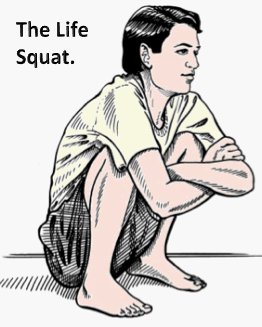
LIfe Squat

The squat is arguably the most important movement pattern known to man.

I typically try to avoid making bold statements like that, but squatting is vital to a physical life.

Squatting will build a bulletproof body, from head to toe.  A successful squat demands lower body strength, but it also requires a mobile, stable upper body.  Building strength in the squat is a total body affair.

Working to build lower body performance should be at the top of everybody’s priorities.  If you are going to the gym and avoiding working on your squat, shame on you.  You’re leaving a lot on the table.  Even if you’re not an aspiring athlete outside of the workplace, life happens on your feet.

In an effort to keep my posts slightly more direct and to the point, lets waste no time and get into a few squat progressions that I know that you will find to be extremely valuable…


1)  Goblet Squat

The goblet squat is favorite exercise for introducing beginners to bilateral (two legs) squatting.  I have found that the goblet squat can work out the kinks in a person’s squat form.  If you have trouble performing a bodyweight squat to a decent depth while keeping upright posture, the goblet squat can help to correct this.  It’s easiest to select the dumbbell or kettlebell that you’ll be using, set it on a bench and then position yourself underneath the weight in order to hold the weight correctly.  Don’t try to “pop” it up to chest height from the rack or waist level… I have seen bad things happen to good feet in these scenarios.  Keep the weight close to your chest with elbows tucked in tight during the ascent and descent of the movement.


2)  Front Squat

The front squat is similar to the goblet squat position-wise, except that the front squat places a greater amount of flexibility and mobility from the shoulders, elbows and wrists, while reducing loading to the lower back.  The starting posture of the lift is referred to as the “rack” position.  It is often uncomfortable for a newbie to get into a proper starting position if you’ve never been there before.  As you descend down into the squat, thoracic mobility (mid-spine) becomes increasingly important.  If you lack of mobility at the mid-spine, you’ll often begin to round your back or have a “locked up sensation”.  Rounding of the back will be more noticeable during an exercise like the overhead squat.  Compensating to complete the movement is undesirable.  The front squat differs from the goblet squat mainly in the holding position of the weight and the ability to apply a greater loading stimulus which will accelerate your strength gains and body transformation.


3)  Split Squat

The split squat is the first squat-like progression that challenges our base of support.  It moves the squat pattern away from the two-foot stance and into a modified lunge/squat type stance.  Now we are moving toward single leg training.  This is a good thing… very good.  The split squat is commonly performed with arms at your side and weight in hand, although the position of the weight can be moved to other positions (goblet style, rack positions, overhead).  Notice that the front and back leg/feet remain fixed.  The back leg serves as a support rudder, not as a load bearing leaning pole.  Keep as much of the effort coming from the front leg as possible.  The split squat will place a higher demand on the adductor group (think groin area), which can leave some soreness in the days following.  Nothing that you can’t handle if you’re expecting it.

Closing Thoughts

Progressing the squat, or any movement for that matter, is important for challenging the lower body.  Increasing the demands of the exercise will accelerate performance, along with body composition.  Bottom line, you’ll feel stronger and keep yourself moving toward a leaner body in the process.

The squat is also a fantastic tool for identifying mobility and stability issues.  As you move through range of motion, you may find that you are restricted in some way.  It’s not a the end of the world, so don’t beat yourself up over it if you are.  Pay attention to where on your body you feel restricted and at what point in the movement.  Our bodies give us clues about their inefficiencies all day long, you just have to take time to notice.

These restrictions will become a problem if you do not address them with a foam roller, flexibility, stability or mobility drills.

Add in these interventions and then test and re-test.  Look for improvement.  It’s that simple.


Cheers to smart squat progressions to improve performance in life!

KG

How to Choose Exercises for a Time Efficient Total Body Circuit Training Workout For Strength and Fat Loss

Quick Tips

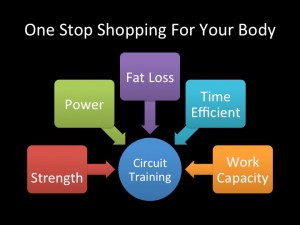
If you’re in the market to lose a little fat, circuit training is for you.  The bonus is that you’re going to build some strength and work capacity in the process.  Or maybe it is the other way around, maybe the bonus is that you’re going to burn some fat while you make an effort to build strength and work capacity?

Benefits of Circuit Training

Either way you look at it, you’re circuit training is going to kill multiple birds with one stone.  This is time leverage for a workout.  If you’re going to make the time to workout, you should really be utilizing a training method that is going to continue to work for you even after you finish the last rep.  That’s smart training.

When I say “circuit training, I’m not referring the kind of training where you move from one machine to the next.  There will be no use of machines- at least not how they were designed to be used- on this blog.  I can confidently say that.  An able-bodied human needs to move about their joints freely, not sit on a machine.

I guess I don’t mind fitness machines… for hanging my jacket on them when I arrive to the gym.

Total body circuit training should fatigue just about every single muscle in your body by the end of the training session.  That’s why we call it “total body”.  In fact, I will make the argument that just about every circuit training workout should be total body.  I guess am just not a fan of training the upper body on one day and the lower body on the next, or splitting sessions up by body parts.

The total body approach builds athleticism.  Circuit training using the total body approach will allow you to perform more work using heavier loads for each movement pattern while remaining as fresh as possible.

That’s a mouthful.

The most effective circuit training in the world involves strength based (or resistance based) multi-joint movements.

If you aren’t familiar with the terms “multi-joint movements”, I am referring to exercises like:

  • Squats
  • Lunges
  • Push-Ups
  • Chin-Ups
  • etc…

All of these movements require freedom of movement about multiple joints and recruitment from multiple muscles.

Total body muscular fatigue.

Just because I keep saying total body, doesn’t mean that you’ll be performing 20 different exercises in a training session.  Don’t confuse that.  The goal with exercise selection is to keep it simple and focused.

When selecting exercises to incorporate prior to the workout, there is a simple format that you can follow to help you along.

You can literally plug any exercise into the following categories and whammo!… You’ve got yourself a quality training session.

Here are the movement patterns that I would like you to address during the session:

1)  Total Body Explosive  (Kettlebell swings, thrusters, etc)

2)  Upper Body Vertical Pulling (Chin ups, pull ups, etc)

3)  Lower Body Pushing (squats)

4)  Core/Pillar (ab wheel rollouts, body rocks, suspension trainer pendulums)

5)  Upper Body Horizontal Push (Push-Ups, bench press, etc)

6)  Lower Body Hip Dominant (Lunge, deadlift, hamstring curls, etc)

7)  Cardio Filler (Schwinn Airdyne, mountain climbers, jump rope, etc)

Exercises for Circuit Training

Seven categories of movements that will build you a lean athletic body: burn fat, develop strength and power, improve performance and save you time in the gym or at home.

Here is how the exercise would be ordered for the training session:

Effective Circuit Training

A workout like this is what I call a leveraged training session.  Time is leveraged and the training effect of the workout is leveraged.  Just about any workout is to elicit a metabolic response, but an aggressive workout like this done 3-4 times per week will really shake up your system.

A workout like this combined with some sensible food choices will send a body transformation into overdrive.

Where people fail, is they fail to take action.  Or, if they take action, the motivation to stick with the program begins to fizzle out.

Stay with it for at least 4-6 weeks and you’re going to see some amazing changes take place.  Trust me here.

But you have to stay with it.


Cheers to DIY circuit training!

KG

How Fast Can You Complete the 100 Burpee Challenge?

Quick Tips

ImageThe Burpee.

I’ve been obsessed with work capacity style workouts for quite sometime now, and I have a love/hate relationship with burpees.  Burpees have been a main ingredient in many of these workouts, and for damn good reason.

Burpees are one of the greatest work total body conditioning exercises known to man.  

Transitioning from a standing position down into a pushup then immediately back into a full squat jump is fatiguing as all heck.  Incredibly fatiguing.

If someone gave me the choice between burpees, kettlebell swings, Schwinn Airdyne sprints or hill sprints as a work capacity conditioning session, I am going to choose all three of the latter before I choose burpees.  Sorry burpees.  Sometimes the best exercises are the ones that we dread the most.  This is one of those cases for me and many others out there.  

However, since this is a love/hate relationship, I have to admit that the burpee can drastically improve a person’s cardiovascular conditioning while accelerating body composition changes.  

In other words, if you keep working at burpees and get really good at them, you’re going to put yourself into a state of great physical shape and see some serious changes in the mirror.

I wouldn’t never build an entire program around burpees alone- or any exercise- but I would build an entire workout or a solid “finisher” around the burpees.  “Finishers” are sequences of exercises grouped together at the end of a workout to elicit a large metabolic training effect.  They are designed to test your mind and your body, and well, finish you.

If you enjoy leaving the gym feeling highly fatigued- and lets face it most of us do- the 100 burpee for time finisher is a fantastic challenge.  

Here is how it works:

—> The Rules for the 100 Burpee AFAP (as fast as possible) <—

  • Full burpees only (push up and squat jump included).
  • Take breaks as needed but remember you’re racing the clock.
  • Stop if you experience nausea or dizziness.

That’s it.  Set the clock and get to work.  

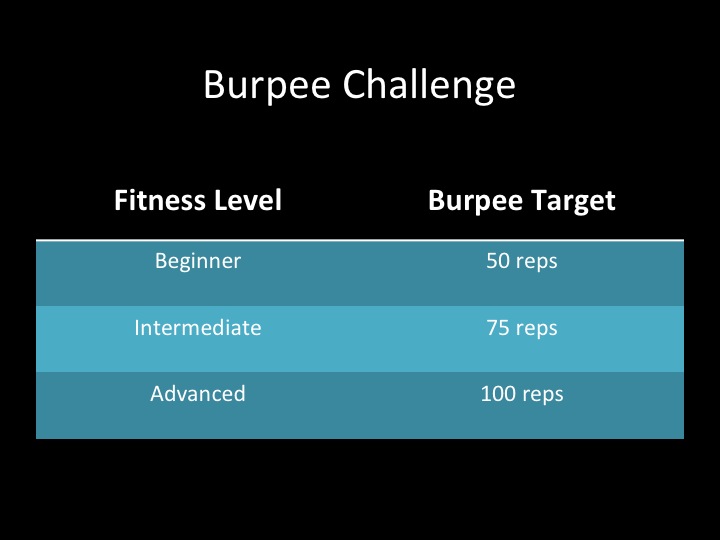
Now, I know that not everyone is at a fitness level to perform burpees for the full 100 reps.  You may not be able to finish 20 reps.  If this is the case, adjust the challenge to fit you.

Here are some general guidelines for different fitness levels:

 Image

If you’ve never performed a single rep of burpees, you’re a beginner in my book.  Sorry, but you are.  You might be physically fit but you’ve never experienced a single burpee.  Nothing wrong with that.  Never a better time to start implementing the burpee.

What I really like about this challenge is that it requires zero equipment, can be performed anywhere and can serve as a conditioning test that you can continue to re-test to see improvements in fitness.  It’s no different than testing how fast you can run 2-miles.  

One of the keys to work capacity style workouts and finishers is to avoid letting your mind cash checks that your body can’t cash.  

The best work capacity workouts keep the trainee in complete control of their body and the weight being used.  Of course, it’s every person’s responsibility to pull the plug at his or her own discretion.  You’ve got a brain, don’t be afraid to use it, even if it means swallowing your pride and falling short of your goals for the training session.  

If reps get sloppy, stop the set and regroup.  Grab a drink, take a breather, gather yourself.  If you still cannot finish the set after a break in the action, stop.  Done.  Finished.  

Image

Don’t be afraid to pull the plug.

Grinding out one more rep with horrific form isn’t worth the torn rotator cuff, slipped disc in the lower back or tweaked ankle.  There’s no glory in it.  None.

I’d like to think that much of what I advocate on this blog is high tempo, yet safe.  There will be no circus tricks done for high reps just to burn you out and get you fatigued.  Safety is a real concern here.  

Push it hard and to the limit, but in a safe manner.  If you keep that balance, you’ll be able to sustain a life full of physical activity, not just a few years of glory until ligaments and tendons start giving out.  

Building your fitness and preserve your body.  It’s a balance.

Give this challenge a real shot, either as workout in and of itself or as a finisher after a strength training session.  

Submit your time in the comments section!


Cheers to 100 beautiful burpees in a row…


KG

Crawling to Improve Core Stability and Performance

Quick Tips

Animal movement is getting a lot of attention from forward thinking fitness professionals these days.

I predict that Men’s Health will jump on this bandwagon soon enough.  You’ll probably see a headline that screams:

“Burn Fat and Build An Athletic Body Like True Animal!”

Men’s Health has mastered the art of the headline and how to attract to attention.  That’s cool.  I am slightly jealous, but then again, I would rather have the freedom to write with my own authentic voice and tone, not what they think people want to read.  That would get old real quick.  You lose your identity as a person, what makes you uniquely you, when you start working for the man.

My blog articles wouldn’t be authentic if I didn’t get a bit lost here and there, so let’s get back to the business of discussing animal-like exercises, and where they might fit in a workout program.

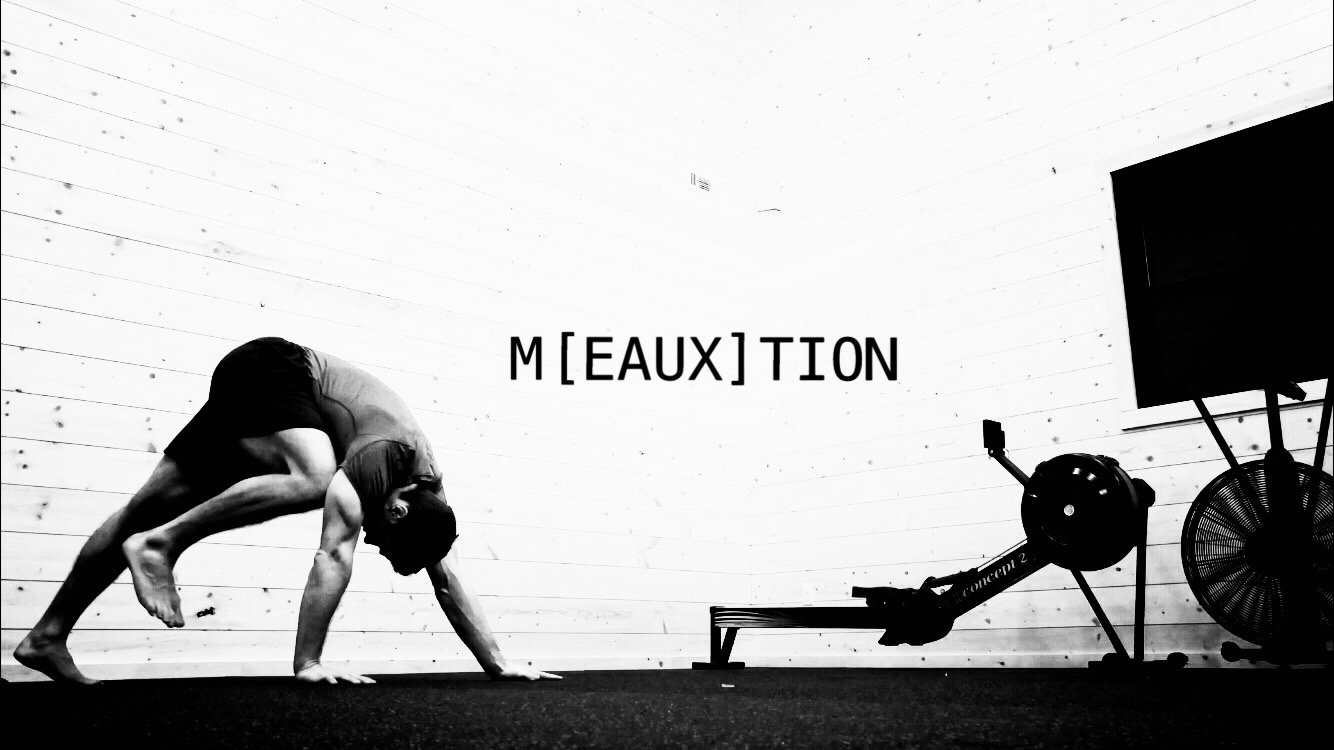
—>Bear crawling is an awesome therapeutic movement…

First, let me say that I understand movement, however, I am not an “animal movement”, I simply see it as a methodology that can provide some great benefit while keeping your training session fresh.

Crawling for a better body…

I have used crawling off and on for quite some time now, both in my own training and in the training of my general and athlete clients.

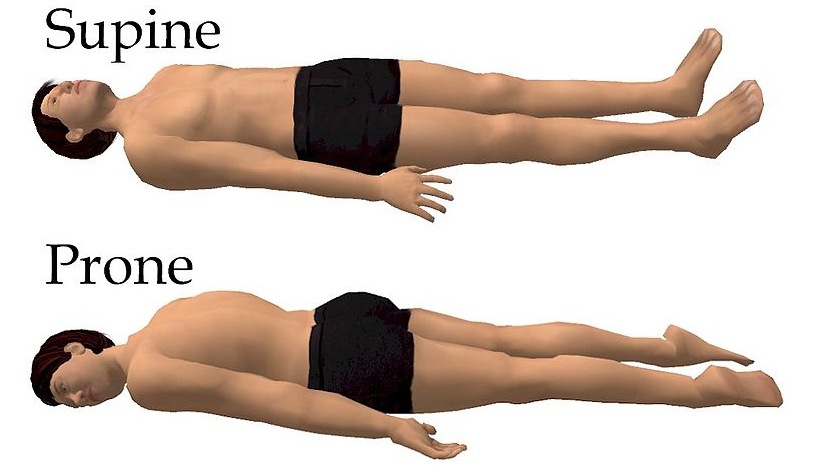
Actually, I have used the supine and prone versions of crawling for about 7 years.  Here is what I mean when I use the anatomical terms supine and prone:

supine and prone

Crawling was valuable part of our warm up when I worked with my younger athletes.  I have to admit however that I really only used crawling movements with the younger population, mostly between the ages 9-12 yrs.  Reflecting back, I wish I would have programmed more crawling with my elite athletes and corporate personal training clients.

Babies crab and bear crawl all of the time.  It is essential for their movement and development into the early walking stages of life… Check out these videos for proof….

The Crab Crawl and Variations

The crab crawl is the supine version of crawling.  The front of the body faces the ceiling and back faces the floor.

Here is a simple variation of a supine crab crawl called the Table Top Pull Through.  You’ll understand why it’s named this way once you click on the video.  Great warm up movement…

With the younger athletes, I mostly used the crab crawl (supine).  I saw (and still do see) tremendous value in the upper body and lower body connection that a supine (crab crawl) provides.  When working with younger athletes, it’s important to keep the balance of entertaining them (keeping them engaged in what you’re coaching) and teaching them how to use their bodies.  It’s quite an interesting process working with younger kids, I deeply respect any coach or trainer that is successful at it.

Here is what a full crab crawl looks like:

I would ask my athletes and clients to crawl forward like you see in the video above until I verbally cued “hips up!”, at which time they would stop, raise their hips and form that human table top that you viewed in the first video.  The backside muscles of the body light up during this static hold, as does the torso.  While the backside activates you’re simultaneously lengthening the anterior (front side) aspect of the shoulders/pecs.

This is such a fantastic movement for people who sit all day long.  It really helps to unwind some of the structural changes that as a result of sitting for extended periods of time.  Unwinding and reversing these changes is really important to avoid unnecessary injury and malfunction.

It was great, but most of all, it was fun for the kids and adults alike.  It’s one of those movements that doesn’t feel like a “workout”, yet has tremendous bang for your buck.

Shortly after incorporating the crab crawl, I started playing around with the bear crawl.  This is essentially the flipped over version of the crab crawl, with the participants face and belly facing the floor.

You’ll notice  that it is quite easy to “butcher” crawling movements and cheat.  However, if you take your time, align your body and move as if you were trying to stay as soft and quiet as possible, there is an incredible amount of motor control, timing and recruitment that takes place to make it all happen.

Sidenote:  I have found the “soft and quiet” idea to be quite effective for working to perfect movements related to crawling and Turkish Get Ups.  Staying soft and quiet asks the person to stabilize and activate muscular in a timely manner in order to be graceful.  In a fitness world that seems to drool over “harder, faster, aggressive, yeah!!!!”… moving with grace is a nice breath of fresh air.  Think yoga-like grace.

Now, the bear crawl, just like any other movement, can be performed at different speeds.  My recommendation is to prove that you can perform the slow motion bear crawl before you start racing around with horrible technique.  I’ve seen some videos of bear crawl racing on YouTube.

Not where you should be starting…

If you can’t go slow with expert like technique, why should you go fast?

It’s almost hard to say “technique” when talking about bear crawls, because I don’t know if anyone has actually established what ideal technique should look like.  It’s open for interpretation and varies depending on who you are talking to.

Keeping the mid-section still and some sort of rhythm is key however. Picture a glass of water balancing on your back as you crawl, avoid spilling any of the water during the movement.

—> Keep the bear crawls training effect in perspective…

1)  The bear crawl is a demanding exercise that has progressions, just like any other exercise.  If you can’t hold a satisfactory plank or properly activate your abdominal musculature, bear crawling might be a little further down on the needs list for you.  You may have to fix some other things first, than work into the full bear crawl.

2)  Start slow and perfect the movement. Move with control over speed.  It’s not a race.

3)  Don’t expect anything extreme to come from the bear crawl.  You’re not going to develop a six pack (abs are made in the kitchen), burn crazy fat, or become super human by incorporating the bear crawl into your workouts.  It’s a tool, treat it as a small but important piece of the whole picture.

4)  Integrate the bear crawl into your warm-up.  It’s a fantastic upper/lower body activating exercise that will prepare your joints for the demands of the workout.

I have to admit, I am fascinated with animal movements and how they can and should fit into a training program.  It’s an old idea that is creeping back into workout programming for forward thinking coaches.  I value animal movements, but I wouldn’t be the first to base an entire program off of them.  As I mentioned earlier, they are tools and puzzle pieces that help create a complete program.

Definitely worth messing around with in your own training however.  I can say that for sure.

—>  People will think you are a weird for sure…

You’ll get some weird looks if you’re doing bear crawls in a public place or at your local gym, but remember, who cares?  People don’t think much about anything, so just do it.  You’ll have a blast and create some positive training effects from it.  If you’re at the gym and people roll their eyes, let them.  You’re ahead of the game by incorporating crawling movements into your training regimen. Keep yourself away from stale training programs.

Cheers to humans crawling around like bears and crabs…

KG

3 Methods I Don’t Recommend for Interval Training

Pressed for Time, Pure Fat Loss

Interval training is definitely worth the time and energy.

I will just get that out in the open right away.

But, also remember that there is a lot more to building a lean body capable of quality movement, then well, interval training.

It’s not the end all be all, but when it is organized in an intelligent manner, it is effective as hell.

I often think about all of the possibilities available for organizing a solid interval training session.  I have tested them all, or nearly all of them.  I really am my own testing lab.  I take pride in that.  I would NEVER ask anyone to do something physically that I haven’t done myself.  That would make me uncomfortable and would be unprofessional in my opinion.

In my own experience, the magic of interval training comes when there is little technique skill involved in the exercises be used for that session.

I have talked about the golden rule of “first do no harm” to oneself (injury) in during a workout in the past.  Well, that same rule will hold true throughout the remainder of this article.

Let’s get to it.

Here are 3 Methods that I don’t recommend for interval training:


1)  Olympic Lifting

If you want my number one beef with a fitness brand that rhymes with “boss-knit”, here it is.  Using HIGHLY TECHNICAL lifts such as cleans and snatches to elicit a work capacity based effect, or “metabolic” as they refer to it now (it’s a catchy marketing term), it dumb.  It’s mindless.  Olympic lifts were never intended to be used to “burn fat” and “create athleticism” by being placed 3 movements into a 6 movement circuit.  I don’t care what your justification is or what Kool-Aid watering hole you are drinking from, olympic lifting will never be ok to perform for anything other than strict power development and rapid force production.  True sets of olympic lifts are organized early in a training session and surrounded by plenty of rest between sets, heavy loading and strict attention to technique and body position.

In my opinion, high rep sets of cleans used for developing work capacity and a training effect is making a complete mockery of a movement that is even in the Olympics as its own sport!  Guys and gals train daily for years to execute a lift with a load that can win them a gold medal, so what makes YOU (the 34 year old mother of two) think you can just walk into a gym and grind out a long set of 20 hang cleans?

If you want injury, this is your best route to it.  Risk vs. Reward.  Run your own evaluation.  End rant.


2)  Sprinting

I know this is going to piss some people off, but most of you physically cannot sprint and interval train at the same time.  Sprinting is a fast twitch, short duration, short distance sport that the average person just cannot execute in most cases.  If you are in fact sprinting, it is probably only for the first couple of work sets, followed by an up-tempo gallop (or limp in some cases).

Call it high tempo running instead, and we can meet in the middle.  What you are actually doing is running, and as your energy reserves deplete, you are now probably jogging.

What scares me about people announcing that they are sprinting for their interval training is the fact that a true sprint for any individual requires massive contraction from the musculature on the back of the legs (hamstrings, glutes).  For people who sit all day, your glutes are effectively “turned off”.  I guarantee it.  Your pelvis is probably tilted forward and your back is consistently stiff, right?  Are you hips tight too?  Your hamstrings are long and weak and now you are calling about both of those muscles to exert a large amount of force over a distance that is far to long.

Dessert:  Hamstring pull anyone?


3)  “Tabata” anything (other than on a stationary bike)

I touched on this in an older post, but cranking out a true Tabata is impossible.  Most will never know what it is like to hover around 170% effort and have your lungs and heart feel like it is going to explode.  But this is just human nature.  We will shut it down before we ever reach that point for some fear of high exertion? (just a guess)

Anyways, please please please do not fall into the Tabata pit.  Don’t believe the bullshit that your trainer is feeding you about this protocol being the greatest fat loss and conditioning method on the planet.

It’s not.  It’s fatiguing and grueling, but at the end of the day, it is just negative work to rest ratios with a high effort.

Most of all, if you are going to give this protocol a solid effort, don’t use anything other than a stationary bike.  Squatting, kettlebell swings, deadlifts, cleans, snatches, bench press, etc are all loaded movements that should be avoided at all costs using this method.

I know Dan John talked about ripping out a Tabata Protocol with front squats on T-Nation but I am here to tell you, don’t.  Loaded movement + high level fatigue is not for average folk.  If you have a high training age (years of training) I would still caution you.

Please take my advice here.  Injury may await you.


So there you have it.  3 methods that I am not very high on for interval training.  Remember, interval training can be effective and safe at the same time.  It doesn’t have to involve circus like movement coupled with heavy resistance.  It’s important to know your limits.  Just because a fitness author writes something crazy in a book as their “fat burning”, “performance enhancing” program, that doesn’t mean that you should do it.

David Blaine (the magician) held his breath for 17 minutes underwater in a giant glass egg in front of the world.  If he wrote about doing that, would you do it?

Probably not.


Cheers…


KG