If you’re in the market to lose a little fat, circuit training is for you. The bonus is that you’re going to build some strength and work capacity in the process. Or maybe it is the other way around, maybe the bonus is that you’re going to burn some fat while you make an effort to build strength and work capacity?
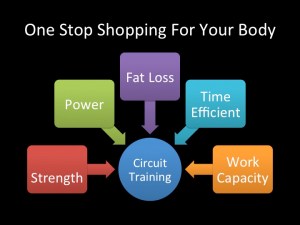
Either way you look at it, you’re circuit training is going to kill multiple birds with one stone. This is time leverage for a workout. If you’re going to make the time to workout, you should really be utilizing a training method that is going to continue to work for you even after you finish the last rep. That’s smart training.
When I say “circuit training, I’m not referring the kind of training where you move from one machine to the next. There will be no use of machines- at least not how they were designed to be used- on this blog. I can confidently say that. An able-bodied human needs to move about their joints freely, not sit on a machine.
I guess I don’t mind fitness machines… for hanging my jacket on them when I arrive to the gym.
Total body circuit training should fatigue just about every single muscle in your body by the end of the training session. That’s why we call it “total body”. In fact, I will make the argument that just about every circuit training workout should be total body. I guess am just not a fan of training the upper body on one day and the lower body on the next, or splitting sessions up by body parts.
The total body approach builds athleticism. Circuit training using the total body approach will allow you to perform more work using heavier loads for each movement pattern while remaining as fresh as possible.
That’s a mouthful.
The most effective circuit training in the world involves strength based (or resistance based) multi-joint movements.
If you aren’t familiar with the terms “multi-joint movements”, I am referring to exercises like:
- Squats
- Lunges
- Push-Ups
- Chin-Ups
- etc…
All of these movements require freedom of movement about multiple joints and recruitment from multiple muscles.
Total body muscular fatigue.
Just because I keep saying total body, doesn’t mean that you’ll be performing 20 different exercises in a training session. Don’t confuse that. The goal with exercise selection is to keep it simple and focused.
When selecting exercises to incorporate prior to the workout, there is a simple format that you can follow to help you along.
You can literally plug any exercise into the following categories and whammo!… You’ve got yourself a quality training session.
Here are the movement patterns that I would like you to address during the session:
1) Total Body Explosive (Kettlebell swings, thrusters, etc)
2) Upper Body Vertical Pulling (Chin ups, pull ups, etc)
3) Lower Body Pushing (squats)
4) Core/Pillar (ab wheel rollouts, body rocks, suspension trainer pendulums)
5) Upper Body Horizontal Push (Push-Ups, bench press, etc)
6) Lower Body Hip Dominant (Lunge, deadlift, hamstring curls, etc)
7) Cardio Filler (Schwinn Airdyne, mountain climbers, jump rope, etc)

Seven categories of movements that will build you a lean athletic body: burn fat, develop strength and power, improve performance and save you time in the gym or at home.
Here is how the exercise would be ordered for the training session:

A workout like this is what I call a leveraged training session. Time is leveraged and the training effect of the workout is leveraged. Just about any workout is to elicit a metabolic response, but an aggressive workout like this done 3-4 times per week will really shake up your system.
A workout like this combined with some sensible food choices will send a body transformation into overdrive.
Where people fail, is they fail to take action. Or, if they take action, the motivation to stick with the program begins to fizzle out.
Stay with it for at least 4-6 weeks and you’re going to see some amazing changes take place. Trust me here.
But you have to stay with it.
Cheers to DIY circuit training!
KG


 M(eaux)tion Fitness