Here’s simple guide on how to making bodyweight push-ups harder, and less boring.
Boredom in the gym is a tragedy because there’s SO MUCH you can do. Boredom often leads to an unraveling of discipline and in extreme cases, an eventual abandoning of physical exercise altogether.
A few of the push-up variations listed below require the use of a resistance band, a towel, and something to elevate the feet.
Other than few simple gym props, you shouldn’t need much to attack these exercises.
Push-ups are a time-tested upper body pushing pattern. They’ve played a role in building strong bodies for centuries and will continue to be one of the main components of building fit bodies for centuries to come.
Push-ups are about as resourceful they come (bodyweight-based) and ALWAYS there for you.
Some of the best workouts I’ve participated in involve little to no equipment, which is funny because I’ve invested quite a few dollars assembling a nice home gym.
Attacking progressively difficult bodyweight progressions can be a humbling experience and a lesson in how simple training can be.
At the very least, exploring new exercise variations can breathe new life into a workout regimen. It’s really easy to fall into the trap of doing the same thing over and over, and over and over.
Push up, squat, lunge, pull and core. Like a square meal, the structure of this workout is as simple as it get, yet delivers results. The only other thing I’d add is a quick jolt of cardio to finish off the workout.
But, we humans gravitate toward the fancy stuff, don’t we? 😉
Anyways, push-ups if practiced on a regular basis and with a progressive mindset, can be deadly effective for improving upper body strength and building lean muscle.
There are hundreds of bodyweight-based push-up variations. A subtle tweak here and there, a little shift of body position, and you’ve got yourself a new push-up variation.
The curated list of push-up variations below was created to give you ideas on how to upgrade your current push-up to the next level of difficulty, or, simply inject some creativity if you’ve worn out traditional variations.
All exercises demonstrated by yours truly.
If I can’t do it, I shouldn’t be sharing it.
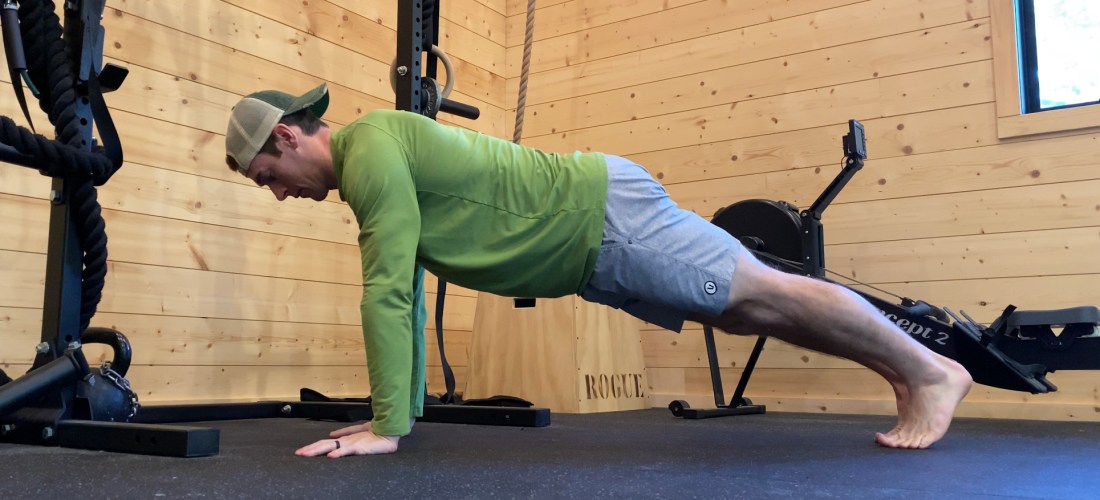
Basic Bodyweight Push-Up
The basic bodyweight push-up is ground zero for this time-tested exercise. Get tunnel vision with push ups (off-setting with plenty of pulling exercises) and chase improvement here.
If you’re struggling to maintain form with a basic bodyweight push-up, elevate the hands onto a chair, couch or stairs. Raising the reduces the weight being pushed on each rep and makes holding body position (from hips to shoulders) easier.
Don’t be afraid to take a step back, do the exercise right, then move forward.
Feet Elevated Push-Up
It’s amazing how different an exercise feels when you change height of the hand or foot position.
Raising the feet above the hands not only changes the angle of the push, but also increases the load on each repetition.
It’s a really simple way to vary body position and increase loading, which is key to continuous progress.
Trunk Twisted Push-Up
Put yourself in a trunk twisted position with feet staggered…. and push up.
*** Be careful with the lower back here. You’ll know exactly what I’m talking about once you getting the starting position.
Band Assisted Plyo Push-Ups
Power training.
The band decreases the amount of weight you’re pushing, which means you have an opportunity to get off the floor faster.
I love this exercise for upper body power development.
Owning the “landing” phase of this exercise is key. Pay attention to landing quietly and with control.
Hands hit the floor and you’re right into the next repetition. This happens quickly.
The band assisted plyo push-up is basically plyometrics for the horizontal push pattern.
A great alternative to traditional medicine ball power training.
Slow Eccentric Push-Up
Embrace the suck.
Lowering your body super slow to the floor places emphasis on the eccentric phase of the exercise.
Try lowering down for 60 seconds. 3 sets of 5 reps will be humbling.
Do you have full ownership over the two arm eccentric variation? Great!
Time for assisted single-arm push-up or full single-arm push-up.
Slow Concentric Push-Up
Slow down the upward phase of the movement.
Do the opposite of the eccentric push up described previously.
This is a sick twist to a simple exercise.
Most people get hyper-focused on slowing down the eccentric phase of exercises, but the concentric can be slowed to create a new challenge.
Carpet Slide 1-Arm Push Ups
Grab a towel, carpet slide or dolly to perform this push-up variation.
In this clip, I’m on a sticky rubber gym floor. Because of this, nothing slides across the surface. So, adapt the exercise and lightly slide the non-working hand over the floor. TOUGH.
This is the most under-utilized push-up variation and one of my all-time favorites. I love carpet slide push-ups as a stepping stone into the world of single arm push-ups. The working arm is faced with pushing more weight, the core is introduced to a limited base of support, and it’s a right/left side exercise.
Nothing wrong with bilateral exercises (where you’re using both limbs to complete the movement equally), but moving your training toward unilateral (or right and left side only) exercises is beneficial.
This variation also serves as a great strengthener and and lead-in to low-to-ground dynamic crawling patterns.
When the arm reaches full extension and you’re at the bottom of the rep, it’s resembles the infamous Lizard Crawl (king of crawling exercises).
Band Assisted 1-Arm Push-Ups
Anchor a resistance band overhead, wrap it around your chest and perform these assisted single arm push-ups.
The resistance band will assist your effort out of the toughest part of the exercise, the bottom of the push-up.
This is a fantastic way to introduce your body to the demands of a full single arm push up, yet decrease the load to make each repetition manageable.
Progress this exercise by using a smaller band over time. Eventually, eliminate the band and and opt for eccentric-only one arm push ups, or the full monty.
Lateral Push-Ups
Get into a deep squat, rotate and lean to one side, allowing yourself to tip into a push up. While this isn’t going to building world class strength, it’s a great variation to train pushing from a unique position.
I generally include lateral push ups into flow sequences, but they can be practiced in isolation.
High reps on these. Anywhere from 8-15 reps alternating side to side.
Push-Up Combinations
Training should include several movement woven into a sequence, or a combination. Combining exercise and working to create seamless transitions between each.
Push Up to Cross Body Knee-to-Elbow
Fitness experts love to blab about “making sure workouts having functional carry-over into the real world”, yet often forget to include combination movements that mimic real life.
Push Up + Step Through + Pistol Squat + Skater Squat
Few real life situations involve just one isolated movement pattern.
Push Up and Rolling Flow
Think about it. You’re laying on the floor. To stand up, you might perform a push-up, but then what? What’s the next move to stand up?
Push up + step through + hybrid lunge + stand and walk.
Combinations I tell you.
We can combine 2 exercises, or we can get wild and crazy and string together 3, 4 or 5+ exercises into a sequence.
Build strength using isolated exercises… but don’t be afraid to branch out and create combinations.

 M(eaux)tion Fitness