Workout Finisher: Push-Ups and Kettlebell Swings

Motion

Today’s workout finisher combines two non-competing exercises:  kettlebell swings and push-ups.

The simplicity of a two exercise workout finisher might lead you to believe it’ll be easy.

Wrong.

Bouncing between these two exercises non-stop for 5 minutes is exhausting. By the 3rd round, you’ll understand. The training effect is massive.  

Push-Ups

Push-ups on an upper body horizontal pushing exercise.  Push-ups build strength and condition the chest, arms and core.  Bodyweight push-ups can be performed virtually anywhere.  Long before I started this blog, people were leveraging push-ups to build strong bodies. Long after I’m gone people will still be using push-ups to build muscle and improve performance. Do not underestimate push-ups.

Push-ups (and the progressions) are one of the most under-progressed movement patterns. People stop at 2-arm push-ups and opt for high reps using a sub-maximal exercise variation. Explore the progressions that exist beyond 2-arm bodyweight push-ups. Carpet slide push-ups, archer, typewriter and single arm push-ups are worth your time.

Kettlebell Swings

Kettlebell swings are an explosive hip hinging exercise. On every repetition, the kettlebell travels through a arc of motion, hiking between the leg, pulling through out and up to the sternum height.  Kettlebell swings have a pendulum-like look to them.  Kettlebells are incredibly resourceful tools for building fitness.  Swings are a great exercise to train the “go” muscles of the body, the posterior chain.  For people that want to train power but don’t want to mess around with Olympic lifts (snatches, cleans, etc), swings are the exercise.  

Workout Finisher:  Push-Ups and Kettlebell Swings
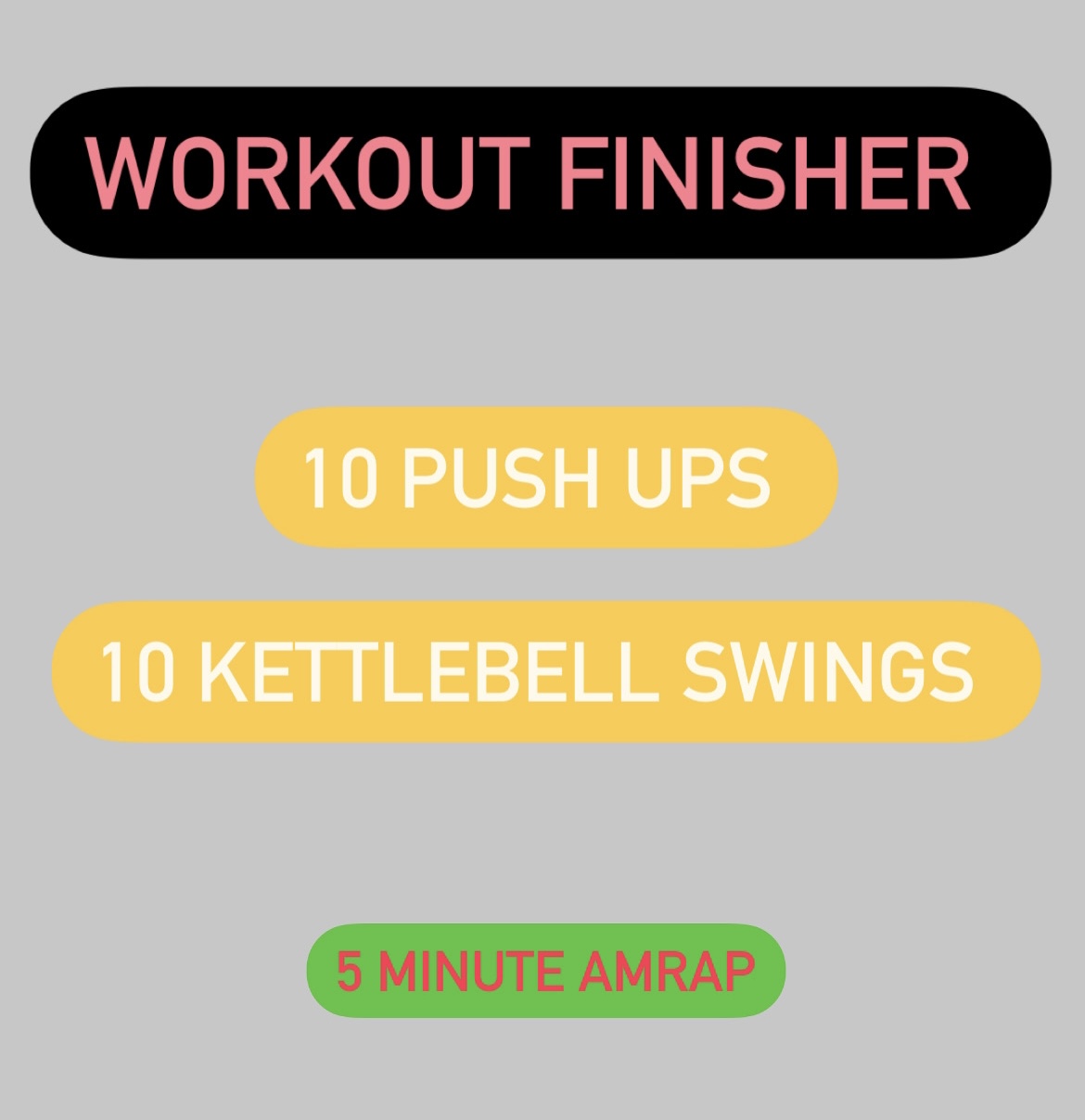
Perform as many rounds as possible (AMRAP) in 5 minutes.  

Take rest if you need it. There’s zero reason to injure yourself because you were chasing a personal record with horse-sh*t technique brought on by fatigue.  Stay disciplined with technique.  

Conditioning yourself to move well when tired takes time. Lots of personal trainers act like fatigue does not exist out in the real world, or high intensity (machine free) conditioning is “dangerous”. I’ve developed an opinion that it’s dangerous not to do it.

If you’re living a physical life, conditioning your body to move with integrity when you’re exhausted will serve you well.

Fatigue is a technique killer, yes, but the gym is a controlled environment where we can practice demonstrating technique when fatigue creeps in.

Like I mentioned above, take rest if you need it. There’s no shame.  

5 Quick Benefits and Ideas About Push-Ups

Motion

Push-ups are one of the best all around upper body exercises.

You can do push-ups anywhere, anytime, using hundreds of different variations branching out from the standard push-up that you see me performing above.

Push-ups are an effective muscle, strength and endurance builder for the anterior (front side) muscles of the upper body.

In absolutely no order whatsoever, here are a 5 quick benefits and ideas about push-ups…

Moving Planks

Push-ups are essentially dynamic (moving) planks that require whole body tension. Maintaining body tension provides benefits far beyond defining the chest and arms. From the armpits down to the heels, nothing is changing position while the arms/chest push up and lower down. The muscles of the core have to participate or technique will slip.

The practice of creating whole body tension will spill over into other movements that also benefit from body tension.

In fitness, everything seems to help everything else. Some thing more than others, but still.

Regarding the reference to push-ups being “moving planks”, try holding the bottom/middle/upper position of a push-up during each for 5 or 10 or 15 seconds, each position. See what you think. 🔥

Free the Scapulas

Push-ups are a great exercise choice for shoulder health, because the scapula are free to move. For this reason, push-ups can and should be mixed in with traditional bench press type exercises. It’ll help balance out the pressing exercise variations and add more flavor to your workout.

I’m not a push-up junkie, nor am I a bench press hater. I value all exercises. That being said, it’s important to be informed about the benefits of push-ups and how effective they are. Push-ups take a backseat to bench pressing, and they should’t. Don’t get fixated on it.

Add Weight for Strength and Muscle

If you’re able to perform 40 to 50+ continuous reps of push-ups without feeling much fatigue, it’s time to consider increasing the load progression somehow, someway. To increase the challenge, add weight to your back using a weight plate, weight vest, sandbag and or rubber variable resistance band is effective to attack load progression. Don’t get fancy here… just add weight and start pushing.

I prefer to use a sandbag because it’s easier to balance and less likely to slide off.

People forget push-ups can be progressed (just like any other exercise by adding weight), and how far the load progression can go. You can execute 3-5 reps of grinding push ups or even 1-rep max type efforts. Doing so will build strength and muscle using a different type of pressing exercise.

No weight?

Slow down bodyweight push-up tempo going down and up. Perform one repetition that last 60 seconds. 30 seconds down, 30 seconds back up. Even if a push-up only requires around 70% of bodyweight, 60 seconds for a single rep is brutal.

I also put together a blog post that helps shed light on the topic, “How to Make Bodyweight Push-Ups Harder”

Push-Ups. Everyday.

Push-ups don’t seem to create an insane amount of body fatigue. Beginners tread lightly here. A lot of people perform a fairly high number of push-ups almost daily without issues. I’ve gone in spurts where I’ll perform quick 20 rep sets throughout the day, around 5-6 times per day. 5 sets of 20 rep = 100 push-ups. Done daily for a year, that’s 36,500 reps of push-ups in a year. If you’re into aesthetic make-overs, doing 36,500 reps of push-ups per year would impact looks dramatically.

The simplicity of push-ups make them a brilliant exercise. A hidden gem. The 100 push-ups per day idea reminds me of the 10,000 steps per day target.

How would you feel (and look) if you stayed disciplined to walking 10,000 steps and performing 100 push-ups every day?

Don’t underestimate the power of doing the little things regularly.

People might think you’re wasting your time until they see what consistency looks like across 365 days. 💪

Push… AND PULL

Like anything, too much of a good thing could become a bad thing. A balanced workout regimen will include a fair amount of pulling exercises to balance out the pushing. Including an adequate amount of pulling exercises will help avoid creating cranky shoulders and imbalances. I’d suggest at least a 1:1 pull-to-push ratio in a workout regimen, if not a 2:1 pull-to-push ratio.

  • Inverted Rows (aka body rows)
  • Bent Over Rows
  • Cable Machine Rows
  • Macebell Swings (wait, really? Yup!)

The basic message here is do not become infatuated with pushing, engage in pulling also. Backside muscles of the body, both upper and lower body, are extremely important.

For more push-up variations, head over to my YouTube channel and search “push-ups”. I do a pretty good job organizing and cataloging exercise videos for convenience.

Just as push-ups are similar to moving planks, the lizard crawl is a leveling up dynamic variation of push-ups.

Learn more about the lizard crawl exercise, technique and info.