Saturday always provides adequate time to explore different combinations of work capacity style circuits.

I like to take the governor off and push myself on Saturday mornings.

This past Saturday didn’t disappoint.

The goal was to accumulate 25-30 minutes of a work:rest style circuit.  I didn’t feel like being monotonous with the exercise selection so included 10 different exercises, stringing them together strategically so that I could give an honest effort to each exercise without sacrificing anything (mostly due to fatigue) to the next exercise in the circuit.

It really worked out well and challenged a number of movement patterns.

The equipment that I used:  24kg kettlebells x2, jump rope, Jungle Gym Suspension Trainer

Here is how the workout was structured…

—> 20 seconds of work: 20 seconds of rest of the following:

24kg kettlebell snatch right hand

rest

24kg kettlebell snatch left hand

rest

Bodyweight Chin Up

rest

Double 24kg kettlebell squat-to-press (aka: Thrusters)

rest

Mountain Climbers

rest

Kettlebell Figure-8 (advanced and technical, but great drill)

rest

Bodyweight Push Ups

rest

Double 24kg Lunge (alternating sides)

rest

Hand-to-Hand 24kg Swings (alternating every rep)

rest

Burpees (jump and push up)

rest

Jump Rope (combination of two foot bounce and running)

—-> Repeat 4 complete cycles of the above…

The best part about this workout is that you don’t have to worry about keeping track of reps.  When I am doing work capacity style training, counting reps can be a major pain.  It’s really the last thing I want to be doing while I am huffing and puffing.  Instead, the work starts on the buzzer and ends on the buzzer.  It’s really convenient.

Know thyself… If you’re a beginner, this workout might not be scaled to suit you.  If you’ve been working out for a while, this might work great for you.  If you’re a tough guy or gal, bump up the weight for kettlebell exercises, add a weight vest to chin ups and push ups, use a weighted jump rope, etc.  I can provide exercise progressions to bury anyone if that is what you are seeking, hopefully that isn’t the case though.  Smart training reigns supreme.

You might see a lot of volume in a workout like this, and you’re absolutely right, so nice observation.  However, I preach workouts that can be managed.  I managed this one nicely.  Notice how explosive work is ordered first in the workout.  That is on purpose.  People tend to get hurt when they attempt to move weight quickly under fatigue and will poor form.  I am not foolish enough to place a highly technical lift at a place in the workout when I am most fatigued.

Also notice that all of the exercises are non-competing, and ordered in such a way to respect that.  In fact, look at the kettlebell figure-8 + bodyweight push ups + double 24kg lunge… sequence.  Very different muscles are being taxed there.  Figure-8’s are combination of squats with rotational power where the kettlebell moves from a high front to low back to side and finally diagonally across body to high position (hybrid movement).  Push ups are an upper body push dominant exercise, and lunges are mainly a lower body hip dominant exercise.  This allows for an increase in heart rate and work, without gassing out the body for the next exercise.  You tax one movement pattern, than move on to the next.

Different movement patterns, different muscles, quality technique, short rest, big training effect.

Now I don’t own a calorimeter or a metabolic analyzer, but I would guess that the calorie burn from a workout like this was quite high.  Maybe 650-800kcals total, and that doesn’t include the residual calories that are burned post-workout.  Shortened rest periods combined with resistance based lifts that leverage a sub-maximal muscle contraction are notorious for creating an after-burn effect, it’s been studied quite extensively in the last few years as the concept of fat loss slowly gains momentum versus weight loss.

Metabolism can stay elevated for several days leveraging workouts like this.

If you leverage some quality eating habits during that period of elevated metabolism, you’ll burn some fat no doubt.  Rinse and repeat the process and you’re going to end up burning a bunch of fat.

I should also note that I designed this workout knowing that the coming days were going to be either complete rest (no workouts) or at the very most, a short yoga/static stretch session.  It’s important to rest, recover and let your body heal in between workouts.  Your body can only handle so much stress before adverse events begin to occur.  You really don’t want to play chicken with overtraining or chronic fatigue in general.  The point of recovering in between workouts is to give your body the best possible chance to leverage the work done in the previous workout, while allowing enough time to enter the next training session and make gains.

I think that a lot of people could lose greater amounts of body-fat (faster) while boosting performance if they decreased the amount of cumulative stress from workouts.  You want your body to recover in full.  Always entering a workout in a state of recovery is bad for business.  If you haven’t acquired a full taste for physical activity, this is good news for you, as each dedicated workout can be used to accelerate

Instead, choose fewer weekly workouts that create a larger (but quality) training effect.  Make them count.

Focus on accelerating other areas of life while you recover in between sessions.  Focus on establishing quality eating habits.  Re-think your water intake.  Read more books on success and self-growth.  Calm the mind with yoga, foam rolling and a long static stretch session.  Get more sleep.

Learning how to workout is great, and building fitness is empowering.  But keep your training efforts sustainable.  Win the war, not just the battle.

Give this workout (or a variation of it) a go.

Cheers to kettlebell and bodyweight workouts!

KG

30 Minute Workouts, Bodyweight Workouts, Kettlebell Training, Quick Tips

Chin Up + Kettlebell Swing + Squat + Jump Rope + Push Up… Workout

Quick Tips

I’ve never felt inclined to name any of my workouts.  Thus, I give you the:

Chin Up + Kettlebell Swing + 2KB Squat + Jump Rope + Push Up…

… workout.

There is another organization that names all of their workouts, which isn’t a bad thing,  I just don’t feel like labeling my workouts with someone else’s name.  I could name this one “Brutus” or “Cactus Jack”.  Maybe I should name my workouts after WWF wrestlers past and present.  That would be cool.  Everyone seems to know WWF wrestlers names whether they admit to watching it or not.

I could use a numbering system I suppose, like “Workout #1” or “Level 5”, but maybe I’ll just call it what it is.

I selected the movements listed above because they represent most of the major movement patterns, and also because these exercise could be easily executed with the workout equipment that I had available the other day.

What did I have available?

As I mentioned, I typically only incorporate big movement patterns into circuits.  To be honest, I don’t like wasting time with exercises that hardly stress the prime movers.  Bicep curls and such are desert.  If I have time after I have completed what I often refer to as the “main meal”, I will work in the accessory exercises for fun.


I value my time.  Time is a commodity in my life (as I am sure that it is in your’s) so I prefer to get in, get out and get back out to experience other aspects of life.  Sure, I write about working out, structuring workouts, movement and nutrition a great deal, but that doesn’t mean that I am working out 2 hours a day.  Efficiency is the name of the game.  How effective can I make my workouts without taking away from other areas of my life that I also value.

Occasionally I will add an exercise or two that is slightly out of the box, but these movements are usually treated as a filler exercise (active rest) between more demanding exercises, or reserved for before or after the main circuit of the workout.

While I will admit that doing this is my personal preference, I would suspect that most of you will find that your own workouts are immediately enhanced by working in the big movements instead of a series of fillers.  More muscles engaged equals a greater training effective at the end of the workout session.

If you do more work in a smaller time frame, now you’ve primed your body for fat loss + muscle gain.

This is a great scenario, one that we need to keep advocating instead of “weight loss”.  You can lose weight by dehydrating yourself down to a raison in a sauna.  That’s weight loss, right?

Swap the fat tissue for muscle tissue.

Chase muscle and while running away from fat.

So what are the big movements?  In this case, the big movements that I leveraged for a training effect were:

I’m continually amazed at how effective bodyweight strength movements are, especially when organized into a circuit.

I can get the training effect that I desire while minimizing risk of injury and awful soreness in the days that is so commonly associated with resistance based training.   Of course, if you have never performed a push up or a squat, you’re going to be sore in the coming days.  That’s something you can expect with a new training stimulus and re-discovered muscle contraction.

Loading up on bodyweight style training sessions.  This type of training sessions should be heavily considered by anyone that struggles with achy joints, etc.  Bodyweight resistance exercise provides a low load introduction to basic strength drills, easing your body back into the swing of things.

Plus, being able to control your body exhibiting stability, strength and power through a healthy range of motion will do wonders for your performance, whether that performance be for sport or raking the leaves out of your yard.

So what does last weekends workout look like?

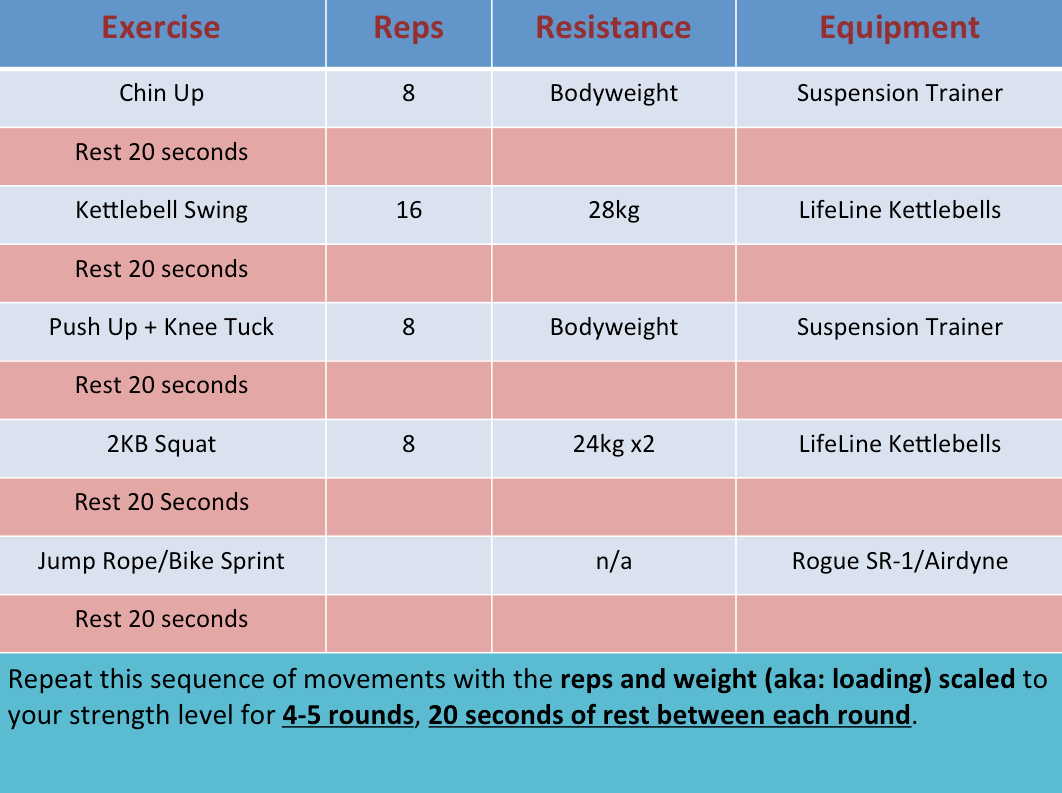
The structure looked something like this:

Metabolic Resistance Training Circuit

I loaded up most of the movements and went for 4 rounds, which took slightly over 20 minutes.  20 minutes continues to be the sweet spot for workout duration.  Anything more than that and I lose output, anything less and it seems like it wasn’t enough… as if I left some fuel in the tank.

20 minutes also seems to allow for focus on proper exercise technique (and grooving) while the fatigue continues to snowball.  Technique is important, don’t forget that.

If you take another look at the exercise selection above, I’d like to share a couple of substitutions that you could make.  If you cannot perform a bodyweight chin up, wrap a resistance band around the chin up bar you’re using, and stretch it down around your knee or foot.  This will assist you on the way up and ease you down from the top.

You could swap out standing broad jumps or squat jumps for the kettlebell swings, although there really isn’t a movement to mimic a kettlebell swing.  If you have dumbbells you could use those in a pinch, but again, there is no tool that functions quite like a kettlebell.

If you don’t have a suspension trainer, just do regular old push ups.  If you want a less expensive option that does a decent job of mimicking the push up+knee tuck combination, use furniture sliders or socks on a hard surface.  Both work decently.  I would go the furniture slide route if I had to choose.

If you don’t have kettlebells, dumbbells or a barbell for squats, you can do bodyweight squats just as well.  If bodyweight squats are easy, mix in pistols alternating each leg.  If you squats are too easy and pistols are too hard, use squat jumps.

If you don’t have a jump rope or a bike, run in place.  High knee with simultaneously arm action.  If you’re lucky enough to have a place to run a short distance, figure out how far it takes to run half of a 20 second shuttle run (10 sec out, 10 sec back).

As you can see, there is a progression, regression and alternative to just about every single movement known to man.  Once you know what a level up and a level down from an exercise is, you’re in business. Now you can OWN your workouts.

Replenish and refuel your body with some rock solid recovery nutrition, and you’ve just done your body good.


Cheers to Chin Ups, Kettlebell Swings, Squats, Jumping Rope and Push Ups!

KG

PS:  Seriously check out the nutritional link that I posted above.  If you want to see dramatic change in your body and performance, nutrition is at the bottom rung of the pyramid.  

A Glimpse of a Sample Staircase Interval Workout

Quick Tips

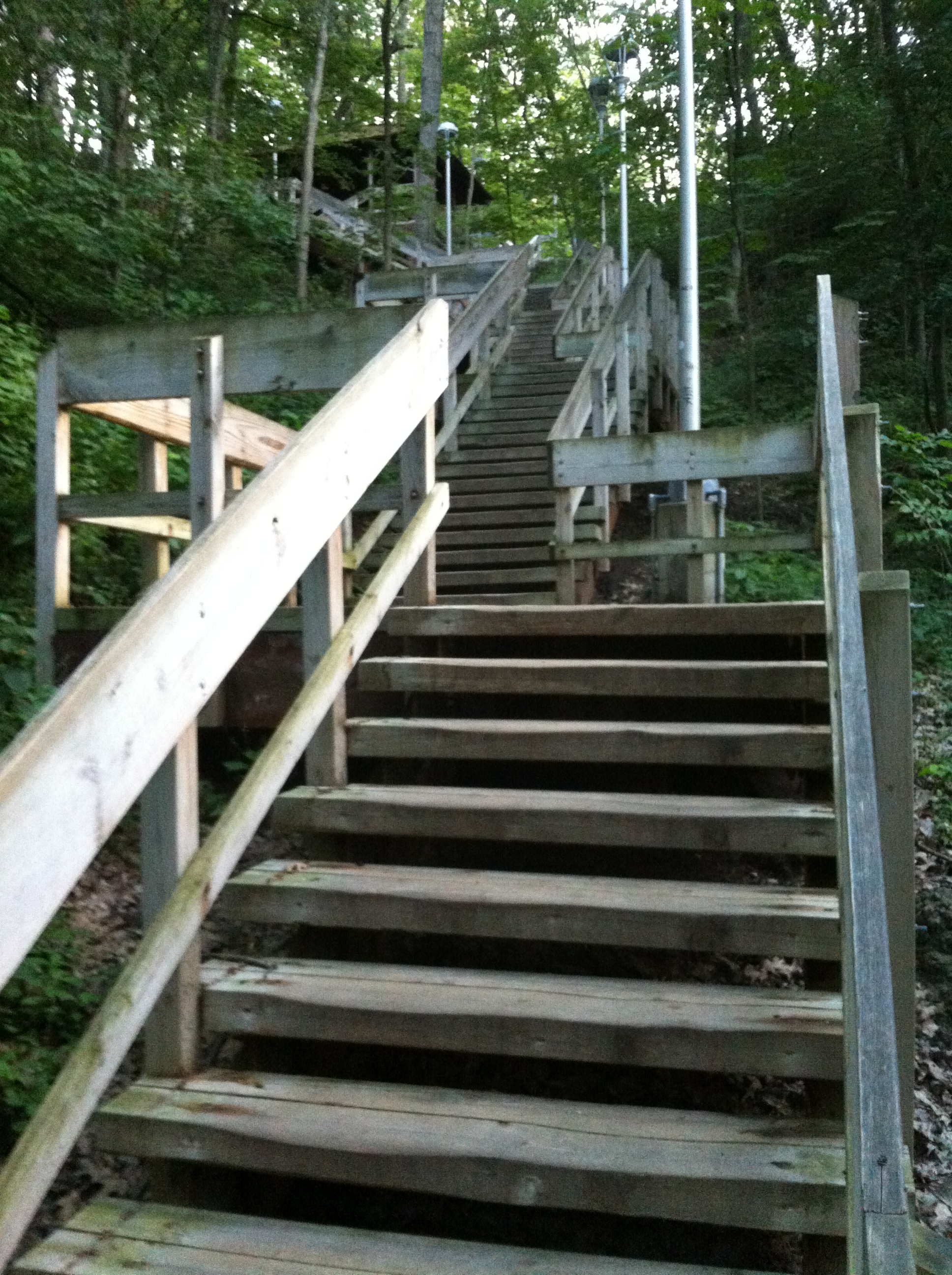
There is really nothing like sprinting up and down a long staircase.

If you’re fortunate enough to have a staircase near you that is of decent length, congrats, you’re in luck.

By decent length, I am referring to a staircase that takes about 30 seconds or longer to run up at a brisk pace.

If you’ve never treated yourself to a staircase training session, you’re going to find that running vertically is nothing like running horizontally.  Every step/stride requires brute force and attention to detail.

Why attention to detail?

Because the split second that you get lazy or lose focus on what you’re doing, you’re going to miss a step and leave shin skin on the staircase.

Staircase running requires hip extension.  You can fake to make it for a little while, but you’ll find that opening up the hips and driving “down and back” with every stride is going to get you to the top faster and with a higher efficiency.  The hips are the powerhouse of the body, so you might as well use them if you have them, right?

Besides, your quads are overworked.  Let’s build a backside.

If you are finding that you cannot comfortable achieve hip extension, I would suggest regressing and addressing these issues quickly…

Here are some videos that might help…

Thanks KStarr.

Now on to the workout…

Staircase Interval Training165 glorious stairs

Staircase interval training

Total time from start to finish for this workout.

Staircase Interval Training

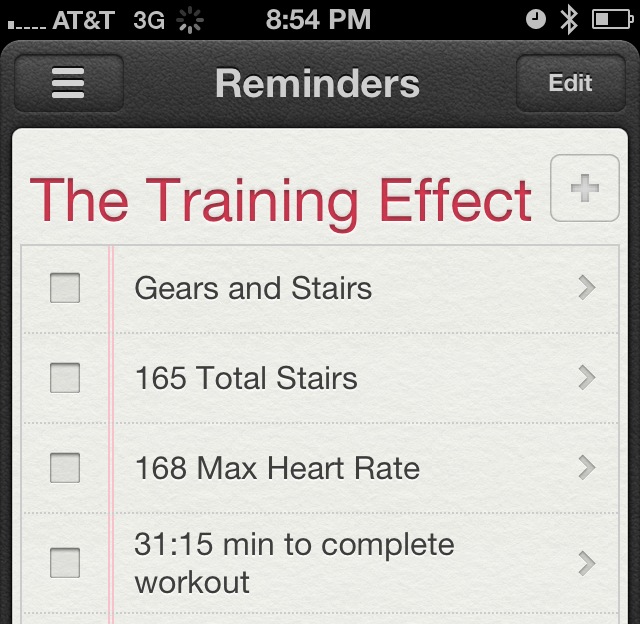
This is the break down of the workout.  30 minutes of work was my initial target.  I hit that.

My heart rate peaked at 168bpm, which I thought was surprising.  I thought that it would have been much higher.  I’ve seen it 175bpm while running trails.  Interesting.  I suspect that had the staircase taken me longer to run, I may have seen higher heart rates.

I have to disclose that I probably whipped through 12-13 rounds.  2 of these round were loaded up with kettlebells.  I brought my trusty 24kg LifeLine kettlebells with me for some fun carrying variations.  After looking at the length of the staircase and evaluating what I wanted from the workout, I decided that I would only use one kettlebell for these carrying drill.

I worked overhead, racked position and farmer carries, switching hands using a single arm swing hand transition + KB clean + Press.  I can explain this later, but I prefer using this method for switching hands during single kettlebell workouts.  Always loaded this way.

The general structure of the workout look like this:

  • Running the stairs took around 60 seconds (I think)
  • Rest periods were 1.5x-2x the length that it took to climb the stairs (or recovery to 130bpm)
  • Upper body focus was placed on arm action (elbow drive and hands to face) and keeping posture vertical versus slouching once fatigue set in.
  • Lower body was all about putting force into each stair and extending the hips aggressively, picture your feet as springs… explode!

Men’s Health ran an article almost a year and a half ago that I thought I would share because they included a research study out of the British Journal of Sports Medicine which concluded that stair climbing was pretty bad ass, even at relatively low output (just walking up).

Here is that article

One interesting thing to think about here.  Keep in mind that the speed with which you run the stairs is not the only quality we are aiming to build here.

We are also aiming to reduce the time it takes for you to recover, and repeat that effort.  Faster recovery is a sign of improving conditioning.

If you’re a weekend athlete or a movement enthusiast, increasing your ability to recover quickly from multiple bouts of vigorous activity is beneficial for performance and your body composition.

Runners, I would consider this an amazing supplement to improving your running endeavors.  You’re essentially lifting yourself with every stride while running a staircase, and focusing on explosive hip extension is what most of you could benefit from.  Get the hips involved people.


Cheers to training where other people aren’t…


KG

Completely Un-Organized Kettlebell Training For Fat Loss and Athlete-Like Conditioning: Part 1

Quick Tips

I am a huge believer in following a system.  Sticking to the game plan if you will.

There is nothing like a well executed game plan.  If you have ever played sports you know what I am referring to.  If you are fortunate enough to have a career with an employer (or as an entrepreneur) that preaches game plan for success and then the entire company comes together and follows through on executing it, well, it feels damn good.  

Sticking to your systems is the best way to measure your progress.  A system can tell you where you have been and also points you in a focused direction of where you are going.  For a beginner or even a novice aspiring to reach new levels of health and wellness, there is nothing more effective at creating change than executing a system to perfection.  

I love systems.  Did I say that already? 

But let me ask you something that I often think about in my own life…

  • What’s wrong with being sporadic about your exercise selection, sets, reps, interval length, rest periods, etc?
  • Does everything have to follow a set system?
  • Can I still maintain strength and conditioning levels and leanness improvising workouts?

I know those seem like a silly questions, some that most people will never think about, but after you make so many visits to the gym, work through workout after workout following a set progression to an end goal, systems get boring.  

Once I took a step back to get a deeper understanding of how and why we humans move, what our movement options were once we choose to train movement and what seemed to be the most effective at creating total body change… I realized that building high functioning lean bodies can be achieved in a completely un-organized way.  System-less if you will.  Cross-Fit does it in every single workout.  Besides following their two days on, 1 day off (rinse and repeat) training schedule, they seem to be building some pretty resilient humans.  I can’t say that I agree with everything that they are teaching and coaching, but the system-less approach seems to work pretty well for them.

If I can ever focus long and hard enough to put the final touches my books (they are coming I promise), you’ll find that I love simple advice.  Once you become more than a recreational exerciser and decide to invest time in learning about more serious forms of fitness and nutrition, topics can get really complicated, confusing and blurry.  The fitness and health pool is really deep.  There is a lot of conflicting advice, methods and even research.  

But it doesn’t have to be complicated, confusing and blurry.  At least I don’t think it does personally.

I spent years (and still do) reading heavy literature for no other reason than I enjoy reading it. I have a major chip on my shoulder from years and years of personal athletic endeavors that had no real guidance in strength and conditioning.  I didn’t know what a power clean was until Senior year of high school.  That sucks, because I no know what a dramatic difference a simple program can make a young athlete.  It’s incredible.

Sorry, sidetracked for a second there… Where was I?

Oh, I know…  I was just about to finish discussing the title of this post.

I love systems and I love simple training and eating advice.  Give me the meat and potatoes of what I need to know and I can figure the rest out as we move forward.  “Learn by doing” kind of thing.

I have also found that I love the concept of physical preparedness and completely un-organized kettlebell training.  I love heading to the basement, drawing up the workout based on my goals, and getting after it.  Sometimes there is good flow to the training session and sometimes it is full of sticking points, causing a much choppier workout.  Either way, I really never know what I am going to be doing until I get down there.  

However, that being said… I do stick to some key guidelines that help me get away with this un-systematized approach.  Here they are:

1)  Train big movements with challenging resistance

2)  Multi-planar core training

3)  Mobility Mobility Mobility

4)  Conditioning using many different methods

5)  Rest and recover harder than I workout


1)  When I say big movements, I am talking things like squats, kettlebell swings, snatches, presses, pulls, etc.  Stop messing around with tricep extensions and bicep curls, you have to eat your main course before you can have dessert.  

2)  I train my torso region in all directions and planes of movement.  I train my core for force production and force absorption.  I train my core to reinforce stability I can transfer as much force with any energy leaks from my lower extremity to my upper extremity.  

3)  Mobility.  I train mobility so that I can experience life as it should be experienced physically.  Loss of mobility is a prerequisite to pain through faulty movement  Loss of mobility is loss of life to me.  

4)  I condition myself with as many methods as I have resources.  When I was an athlete, I conditioned myself using set methods.  Running early in the off-season, slide boarding and then biking as the season drew closer.  It was scheduled and systematic because that was what my sport (hockey) demanded.  It made sense.  But, now I don’t have a sport.  I simply want to be physically prepared for anything.  It feels damn good to go for a 50 mile bike ride, run a 10k or play hockey 3-4 nights a week without feeling like a slug.  I use many methods to achieve both aerobic and anaerobic-like qualities.  I want to be able to endure long duration activities as much as short burst activities that get my heart rate sky high.

5)  I rest and recover much harder than I train.  Sleep, tissue work, hydration and nutrition are all important to me.  I am what I eat, drink and how I recover from my training sessions.  The green light isn’t always on.  You have to learn how to sit at the red light patiently until it is time to accelerate once again.  Rest, recovery and regeneration.  

Do you see what I am getting at?

I can train myself using a simple set of rules to keep myself lean and athletic, without experiencing the boredom of a system.  Training smart and slightly sporadic will keep me athletic for the rest of my life.  Sure, age will catch up with me as it does everybody at some point, but each training session will be fresh and purposeful.  Movement longevity is something that I am fully invested in, and I encourage you do invest in the same. 

I will say this however, I HIGHLY recommend systems to everyone.  You’ll never get better results as you will when following a system step by step.  My books leverage systems.  Systems get results.  They keep the main thing… the main thing.  Following a system takes discipline, and discipline is something worth developing throughout life.

I treat myself like test rat for variations of time tested methods.  I enjoy seeing if my 5-mile Airdyne ride for time improves or suffers after I train high repetition kettlebell snatches for 3-weeks versus metabolic body-weight circuits.  That kind of comparison scenario is interesting to me, but it isn’t for everyone.

(Any strength coach that reads this is going to grind their teeth)


Cheers to moving more and with purpose,


KG