Infusing Kettlebell Presses into Turkish Get Ups = Amazing Added Challenge

Kettlebell Training, Quick Tips

The Turkish Get Up is a little known weapon to those who are insanely strong, balanced and mobile.

Since implementing into my own training schedules, I have noticed incredible increases in shoulder stability and strength, core stability and strength through multiple planes of movement, along with a nice boost in joint mobility at the hip, shoulder and thoracic spine regions.

To be honest, it’s extremely hard for an exercise to crack my workout line-up. In other words, I am very selective about adding new training methods since I have seen such tremendous results with my mainstay movements.

However, in the same breath, I have to say that the turkish get up has been one of the greatest additions to my training habits to date. The amount of insight that I gained about my own movement quality was unprecedented, and humbling at times.

I ‘bulletproofed’ my body the day that I dedicated myself to learning the turkish get up, and by learning, I am talking about reading articles and watching YouTube videos until I was blue in the face.

You can learn any exercise correctly if you know where to look on the internet. If you’re a visual learner, check out the videos on YouTube, some are extremely high quality and in depth.

I cannot say enough about the drastic impact turkish get ups had on my performance and quite frankly, my physique. Spending that amount of time under tension does wonders for firming up a person’s body. I can’t deny that I haven’t enjoyed seeing the tweaks in transformation.

The traditional turkish get up is a phenomenal exercise, and probably needs no further adjustments or additions, but for the curious mind (which I have) and those who enjoy exploring (which I do), adding in slight tweaks to the turkish get up can make what some feel is a “bland” exercise extremely interesting, not to mention fun.

Of course, everyone should hone in on the basics of executing a regular turkish get up before moving any further in the progression, it just makes senses to progress with common sense.

The idea of pressing during the turkish get up was simple…

I perform a press at certain check points that allow for it.

Press #1: Horizontal chest press in the starting prone position.

Press #2: Overhead vertical press at the tall kneeling position.

Press #3: Overhead vertical press at the standing position.

Press #4: Explosive push press at the standing position.

Done.

If you stop and think about it, you’re pressing the kettlebell (or dumbbell) four different times for each individual rep of the turkish get up.

That’s a lot of work.

*** Keep in mind that the chest press performed in the lying position might will not feel like a normal bench press because: 1) You’re pressing an odd object (kettlebell), 2) Your range of motion is limited (elbow contacts ground surface) 3) Your body position is altered from a more traditional bench press.

All of these things are ok, so relax about it. “Real world training” says that you won’t always be pressing a shiny dumbbell on a padded bench. Though he was referring to sandbags, I believe I heard Alwyn Cosgrove call repetitions like these “alive reps”. Nice terminology, I can roll with that.

If you perform 5 reps of get ups on each side of the body, you’re looking at 20 reps per side (40 total) right and left. If you go higher reps, which I typically like doing since my turkish get up practice usually involves nothing more than get ups and some kettlebell swings afterward for conditioning purposes, you might be looking at a pressing volume of 40+ reps on each side of the body.

Consider that the pressing is uni-lateral (pressing with one arm while the other remains unloaded) and you can bet that your mid-section is getting as much of a workout as your upper and lower extremities are.

Poke your tummy the next time you press a decently heavier weight on one side only, it will be activated.

“Six-pack training” anyone?

I considered pressing at the same check points on the way back down to the start position, but felt like this would be slight overkill. Who knows, maybe down the road. That would have increased my pressing volume to 40 reps per side for every 5 reps of turkish get ups, and 80 per side had I completely 10 turkish get ups.

This is where I use my logic. For my goals, that amount of pressing will take away from my main goal, which is to work the turkish get up, not improve my pressing strength and abilities. So, I avoided this volume to keep the workout more TGU-centered.

Make sense?

Post-workout, the first observation I had was the fatigue component experienced from all of the added pressing.

The shoulder burn wasn’t nearly as bad as it was from the “5 minute no rest turkish get ups” that I adopted from Jon Hinds (owner of Monkey Bar Gym), but it was right up there. I am humbled what a simple activity like holding a weight (and a relatively light one at that) overhead can do to fry your shoulder musculature.

For me personally, it was a completely manageable fatigue (which is perfect) that provided an added challenge to the main movement.

A rarely discussed topic with turkish get ups is the amount of cognitive support needed to execute such a segmented exercise. There is a lot happening on the way up to the standing position, and then on the reversal moving back down to the starting position.

Holding the weight overhead is one thing. Holding the weight overhead while twisting and turning underneath that weight in an effort to rise up to the standing position from a dead stop laying position is another. Don’t

The first few times I gave a good effort to turkish get ups- treating them like practice versus a workout- my brain was fried. My eyes felt tired.

The brain has to be engaged in order to make turkish get ups work, and this is another HUGE benefit of the drill. Turkish get ups are a technique driven drill sequence. I respect those who preach this, because I feel that focusing on technique and the subtle details is how you extract the most physical and mental benefit from the movement.

The mind-body connection during get ups is of tremendous benefit for the exercisee.

I feel smarter after get ups, no lie. More detailed, more creative, stronger 3-dimensionally.

If you’re looking for a challenge, try adding some presses into your turkish get up practice. But keep it exactly that, practice. Be mindful of your abilities, yet don’t be afraid to walk to the fringe to challenge your mind and body.

And as I mentioned earlier in the post, if you have never practiced turkish get ups, your main job is to learn the steps first before adding pressing. You have to crawl before you walk.

Cheers to adding pressing to your turkish get ups,

KG

(pictures to come…)

How Many Box Jumps in a Workout?

exercise

Screen Shot 2013-03-23 at 7.02.06 PM

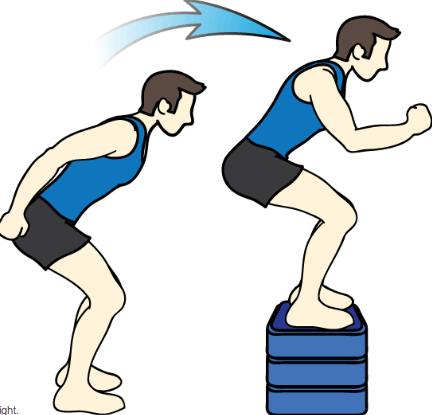
The Box Jump

Box jumps are a lower body (primarily) exercise used to build explosiveness, landing mechanics and force absorption.  Box jumps are a valuable addition to any workout regimen, but they must be progressed according to fitness level, goals and experience.

In short, the average number of box jumps per workout should be 20-40 repetitions.

A person can do more or less, as this is by no means the law of the land.  

This is my opinion deeply rooted in personal experience with athletes, my own training and my observation of modern evolution of box jumps.  

The Details…

  • Primary Muscles: Glutes, Quadriceps, Hamstrings, Calves
  • Secondary Muscles: Hip Flexors
  • Body Area: Legs
  • Modality Types: Body Weight
  • Equipment: Plyometric Boxes

Training intent:  Reinforce jumping and landing mechanics OR leverage as exercise to increase work-capacity in a different movement pattern.

I personally do not use (or recommend) box jumps as primary method (or as a part of) of enchancing cardio or as a vehicle to lose fat.  There are more effective, not to mention safer alternatives available.

Box jumps (like any exercise) have advantages and disadvantages, risks and rewards.  

The risks…

There’s risk in stepping out the front door every morning, I get it.  But let’s take an honest look at things that can happen during box jumps…

The biggest risks are slippage, landing incorrectly or missing the box completely.  All carry have a unique consequence, or potential of injury.  Nobody works out with suffering injury as the goal, but shit happens.  It does.

Murphy’s Law:  Anything that can go wrong, will go wrong.

Every repetition of box jumps has a risk of acute injury or if overdone, chronic pain.  

Speaking from experience, not every box jump is textbook perfect.  As stated before, shit happens.  Whether it’s leaving shin skin on the box, mis-judging foot placement and stumbling or hitting the deck after landing on an unstable box, something is likely to happen at some point.   

Acute pain would be… leaving shin skin on the box, mis-judging foot placement and stumbling or hitting the deck after landing on an unstable box, something is likely to happen at some point.   

Chronic pain is most commonly anterior knee pain, or irritation in the front of the knee.  High rep box jumps are incredibly predictable for causing anterior knee pain.  Sometimes it’s the landing force contributing to this pain, but I’d say most frequently it’s caused by not stepping down from the top of the box but the impact from jumping down and poor absorption.  

The impact force exceeds the tissues capacity to handle the force, pain appears.  

This likeliness increases exponentially as physical fatigue accumulates.  I’ll argue this point with anyone, anytime.  If you’re jumping onto a box with heart rate at 80-90% max,  short on breath, in an altered state… the risk of a failed box jump attempts increases.

Especially factoring in that box jumps are landing onto a surface, a target.  Each attempt must successfully clear the height of the box along with the horizontal distance, finishing with foot placement reasonable enough to stabilize the landing mechanics.  

Doesn’t always happen and it gets progressively more sloppy with fatigue.  The attention to detail drops.  Reps and time (finishing the workout) become the most objectives, not technique and safety.  

Again, when tired, distances and heights can look different, body positions are perceived differently and in general, poor decisions are common (versus being fresh).  

Perception of body position in a fatigued state is an interesting topic.  The gist is, are you in the position that your mind’s eye thinks your in?  

Often times, you’re not.  Your brain thinks you are, but you’re not.  

Scare tactics, right? So, the moral of the story is to boost awareness that there are risks in jumping onto a box. the risks we’re talking about pertain to perception of the purpose of box jumps. My belief is box jumps are a tool for developing explosiveness and landing mechanics in a low-volume (less reps) controlled environment.

The reward…

Finally, the good stuff.  

Box jumps are great training method for building lower body explosiveness.  

Improving, or at least maintaining the ability to produce muscular power is vital to  sport performance, but probably more important to the aging general population.  

As we age, our ability to produce power declines.  Sad, but true.  In fact, one study found power to decline nearly twice as fast as muscle strength…

Screen Shot 2017-06-09 at 6.42.58 AM

Therefore, the velocity component of box jumps crucial for everyone.  Another study drew several other conclusions about power training… 

Screen Shot 2017-06-09 at 7.12.28 AM

As a part of a training regimen, improve power generation has great transfer into strength training, overall athleticism and movement capacity.

Box jumps are a plyometric (aka: “jump training”) involving rapid stretching and contracting of muscles.  The goal is to produce a large amount of power in the shortest amount of time possible.  

Based on this description, it’s reasonable to position box jumps early in a workout, when the body is fresh and able to exert at the highest level.  

Jumping when fresh, ensures we can maximize effect of each box jump, the simultaneous extension of the ankles, knees and hips (triple extension).  It also gives us the best chances to practice landing mechanics and force absorption.  

Aim to land on the box in the same position you took off from.  A box height that is too low won’t challenge the velocity of the jump, but a box that is too high will alter the landing position.  Landing hunched over with the knees in the armpits is not a desireable position.  

It’s one thing to test out the maximum box jump height where you’re attempting to get onto the box by any means necessary, and another to repetitively practice deep squat landing positions.  It’s difficult to make an athletic move when the knees are buried in the armpits.  

Landing in a position that gives the advantage to the next move (whatever that move might be) is desirable.  

Of course, life is not perfect, so it’s not far fetched occasionally familiarize the body with unideal landing positions, to better accomodate the unknown.  

Simple cues for box jumps:

  • Counter-swing the arms/hands behind the body as the hips/knee flex the body lowers.
  • Drive the arms/hands aggressively upward as the hips/knees recoil and begin to extend.
  • Actively force FULL extension of the hips, knees and ankles during take off, EXPLODE.
  • Land soft and quiet with feet flat on the box in a similar position as the lowest point of the take-off.  

That’s it.  Not rocket science, just gentle reminders of exercise technique.  

https://www.youtube.com/watch?v=KX-8e06pGuI&list=PL5A09BB0D766BE510


The premise of this article is to get people thinking on a deeper level about why we do what we do inside of a workout.  There should be purpose and intent behind everything. If you cannot justify or it’s causing harm to one’s body, it might be time for an audit of training methods.  

All of my opinions are subject to change.  However, what I will say is my opinion on the purpose of box jumps is one that hasn’t seen a shift.  I do still believe in the value of training a body to first understand and recognize the technique of jumping and landing.  

Once a person can demonstrate physical compreshensive of a basic box jump, sure, progress out as needed.  But not before.  


Screen Shot 2013-03-23 at 7.17.19 PM


https://www.youtube.com/watch?v=3586susSSfY


Cheers to box jumps, not too much, not tool little, just the right amount.  

KG

SaveSaveSaveSave